From Surf Wiki (app.surf) — the open knowledge base
Doraemon
Japanese manga series by Fujiko F. Fujio

Japanese manga series by Fujiko F. Fujio
| Field | Value |
|---|---|
| image | Doraemon volume 1 cover.jpg |
| caption | First ja volume cover, featuring Doraemon |
| ja_kanji | ドラえもん |
| genre |
the media franchise
- 1973 anime series
- 1979 anime series
- 2005 anime series
- Doraemon's Long Tales
- The Doraemons
- List of Doraemon films
- List of Doraemon video games
- List of Doraemon soundtrack albums
Doraemon is a Japanese manga series written and illustrated by . First serialized in 1969, the manga's chapters were collected in 45 ja volumes published by Shogakukan from 1974 to 1996. The story revolves around an earless robotic cat named Doraemon, who travels back in time from the 22nd century to assist a boy named Nobita Nobi in his day-to-day life.
The manga spawned a media franchise. It was adapted into three different anime TV series in 1973, 1979, and 2005. Additionally, Shin-Ei Animation has produced over forty animated films, including two 3D computer-animated films, all of which are distributed by Toho. Various types of merchandise and media have been developed, including soundtrack albums, video games, and musicals. The manga series was licensed for an English language release in North America, via Amazon Kindle, through a collaboration of Fujiko F. Fujio Pro with Voyager Japan and AltJapan Co., Ltd. The anime series was licensed by Disney for an English-language release in North America in 2014, and LUK International in Europe, the Middle East and Africa.
Doraemon was well-received by critics and became a commercial success in many Asian countries. It won numerous awards, including the Japan Cartoonists Association Award in 1973 and 1994, the Shogakukan Manga Award for children's manga in 1982, and the Tezuka Osamu Cultural Prize in 1997. As of 2024, it has sold over 300 million copies worldwide, making it one of the best-selling manga series of all time. The character of Doraemon is considered a Japanese cultural icon, and was appointed as the first "anime ambassador" in 2008 by the country's Foreign Ministry.
Synopsis
Nobita Nobi is a ten-year-old Japanese school boy who is kind-hearted and honest, but also lazy, clumsy, and hapless, performing poorly in both school and sports. One day, a blue robot cat from the 22nd century named Doraemon is sent back to the past by Nobita's future great-great-grandson, Sewashi Nobi, to take care of Nobita so that his descendants can have a better life. Doraemon has a four-dimensional pocket in which he stores tools, inventions, and gadgets from the future to aid Nobita whenever he is faced with a problem. Although Doraemon is a cat robot, he has a fear of mice because of an incident where robotic mice chewed off his ears. This is why Doraemon lost his original yellow color and turned blue, from sadness.
Nobita has three main friends: Takeshi Goda (nicknamed Gian), Suneo Honekawa (Gian's sidekick), and Shizuka Minamoto, Nobita's best friend and love-interest. Gian is a strong, leading and domineering boy, but also loyal to his friends. Suneo is a wealthy and spoiled boy who uses his friendship with Gian to win the respect of other schoolmates. Shizuka is a gentle and kind girl who frequently plays with Nobita. Nobita has a crush on Shizuka; she is his prospective future wife (Nobita's future wife is initially Gian's younger sister). Although Gian and Suneo are Nobita's friends, they also typically bully and abuse him. Nobita normally responds by using Doraemon's gadgets to fight back against them, but Nobita has a tendency to get carried away with using the gadgets (or Gian and Suneo, if they steal it away), which typically results in unintended consequences for him and others.
In addition to Gian, Suneo, and Shizuka, Dorami and Hidetoshi Dekisugi are also recurring characters. Dorami is Doraemon's younger sister, and Dekisugi is a gifted student boy who as Shizuka's close friend, frequently attracts the jealousy of Nobita.
Production
Development and themes
Doraemon was written and illustrated by Fujiko F. Fujio, the pen name of Japanese manga artist Hiroshi Fujimoto. According to Fujio, the series was originally conceived following a series of three events: when searching for ideas for a new manga, he wished a machine existed that would come up with ideas for him; during this, he tripped over his daughter's toy, and heard cats fighting in his neighborhood. To set up the plot and characters, he used some elements from his earlier manga series, Obake no Q-Tarō, which involve an ja living with humans, with a similar formula. Fujio said that the idea for Doraemon came after "an accumulation of trial and error", during which he finally found the most suitable style of manga to him. Initially, the series achieved little success as ja was well-known at the time, and it only became a hit after its adaptation into an anime TV series and multiple feature films.
Doraemon is mainly aimed at children, so Fujio chose to create the character with a simple graphic style, based on shapes such as circles and ellipses. He used the same sequences of cartoons with regularity and continuity to enhance the reader's ease of understanding. In addition, blue, a characteristic color of Doraemon, was chosen as the main color in magazine publications, which used to have a yellow cover and red title. Set in Tokyo, the manga reflected parts of Japan's society, such as the class system and the "ideal" of Japanese childhood. Problems, if they occurred, were resolved in a way so as not to rely on violence and eroticism, and the stories were integrated with the concept of environmentalism. The manga also insisted on the ethical values of integrity, perseverance, courage, family and respect.
In order to underline the crucial role of the younger generation in society, the manga's creator chose to have the act carried out in a "children's domain" where young people can live with happiness, freedom and power without adult interference. As Saya S. Shiraishi noted, the existence of the "domain" helped Doraemon to have a strong appeal in various Asian countries. During Doraemon's development, Fujio did not express a change in characters; he said, "When a manga hero become a success, the manga suddenly stops being interesting. So the hero has to be like the stripes on a barber pole; he seems to keep moving upward, but actually he stays in the same place."
According to Zensho Ito, Fujio's former student, the "length" of time in the universe is one of the ideas that inspired Fujio to make Doraemon. Frequently displayed in its stories is Nobita's desire to control time, and there exist time-control gadgets that he uses to satisfy that desire, particularly the "Time Machine", which lies in his desk drawer. Unlike Western works of science fiction, the manga does not explain the theory nor the applied technology behind these tools, but instead focusing on how the characters exploit them to their advantage, making it more child-friendly.
Origin of the name
The name "Doraemon" can be roughly translated to "stray". Unusually, the name is written in a mixture of two Japanese scripts: katakana () and hiragana (). "Dora" derives from , and is a corruption of nora (stray), while "-emon" (in kanji ) is an old-fashioned suffix for male names (for example, as in Ishikawa Goemon). Nobita's home address in Tsukimidai ("moon-view-heights"), Nerima refers to Fujimidai ("Fuji-view-heights"), where Osamu Tezuka's residence and animation studio is based. The name "Nobita Nobi" refers to "nobi nobi", meaning "the way a young child grows up free, healthy, and happy, unrestrained in any sense".
Gadgets
.jpg)
Gadgets, or , are Doraemon's tools from the future, used to assist the characters. Fujio said that Doraemon has a total of 1,293 gadgets; according to a 2004 analysis by Yasuyuki Yokoyama of Toyama University, there are 1,963 gadgets found in 1,344 sketches. The most recurring gadgets include "Take-Copter", a small piece of headgear made out of bamboo that can allow its users to fly; "Time Machine", a machine used for time travel; "Anywhere Door", a pink-colored door that allows people to travel according to the thoughts of the person who turns the knob; "Time Kerchief", a handkerchief which can turn an object new or old or a person young or old; "Translator Tool", a cuboid jelly that allows one to converse in any language; and "Designer", a camera used to instantly dress-up the user.
Saya S. Shiraishi wrote that most of the gadgets were "an impressive testimony to the standards of quality control and innovation that exist in the twenty-second century". The gadgets are an essential part of the series so as to reflect a positive point of view concerning the association of technology in children, and to express the wishes of modern society.
Conclusion
The series ceased its original run in 1994 and was not given an ending before Fujimoto's death in 1996; this has since aroused numerous urban legends throughout the years. One of the most well-known "endings" of the manga was by an amateur manga cartoonist under the pen name "Yasue T. Tajima", first appearing on the Internet in 1998 and made into a manga in 2005. The story takes place when Doraemon's battery dies, and Nobita later grows up becoming a robot engineer, potentially reviving Doraemon and live a happy life. Tajima issued an apology making his own ending in 2007, and the profits were shared with Shogakukan and the copyright owner, Fujiko F. Fujio Pro.
Ryūichi Yagi and Takashi Yamazaki, the directors of Stand by Me Doraemon, confirmed that it had only one opening, while the ending has been rewritten several times. Because of this, Shogakukan had to clarify that only if the marriage of Nobita and Shizuka is finalized will the mission be accomplished, and then Doraemon will return to the future.
Media
Manga
| Title | Note | Label | Volumes | Chapter count | Publication date | Publisher |
|---|---|---|---|---|---|---|
| Doraemon | The Complete Works of Fujiko F. Fujio | 20 | 1326 | 2009–2012 | Shogakukan | |
| Doraemon | Kindle Edition | 200 | 1311 | 2013–2016 | Shogakukan | |
| Doraemon | Chūkō comics: Fujiko Fujio Land | 45 | 833 | 1984–1990 | Chūōkōronsha | |
| Doraemon | Normal volume | Tentōmushi Comics | 45 | 822 | 1974–1996 | Shogakukan |
| Doraemon Plus | Tentōmushi Comics | 7 | 145 | 2005–2006, 2014, 2023 | Shogakukan | |
| Doraemon Color Works | Tentōmushi Comics Special | 6 | 119 | 1999–2006 | Shogakukan | |
| Doraemon | Volume 0 | Tentōmushi Comics | 1 | 9 | 2019 | Shogakukan |

In December 1969, the Doraemon manga appeared in six different children's monthly magazines published by Shogakukan: Yoiko, Yōchien, Shogaku Ichi-nensei, Shogaku Ni-nensei, Shogaku San-nensei, and Shogaku Yo-nensei. The magazines were aimed at children from nursery school to fourth grade. In 1973, two other magazines, Shogaku Go-nensei and Shogaku Roku-nensei (aimed at fifth-grade and sixth-grade students respectively), started publishing the manga. In 1977, CoroCoro Comic was launched as the flagship magazine of Doraemon.
Since the debut of Doraemon in 1969, the stories have been selectively collected into forty-five ja volumes that were published under Shogakukan's Tentōmushi Comics imprint from July 31, 1974, to April 26, 1996. These volumes are collected in the Takaoka Central Library in Toyama, Japan, where Fujio was born. Between April 25, 2005, and February 28, 2006, Shōgakukan published a series of five manga volumes under the title Doraemon Plus (Doraemon+), featuring short stories which did not appear in the forty-five original volumes; a sixth volume, the first volume in eight years, was published on December 1, 2014. Additionally, 119 unpublished stories were compiled into six colored-manga volumes under the title Doraemon Kara Sakuhin-shu , published from July 17, 1999, to September 2, 2006. Between July 24, 2009, and September 25, 2012, Shogakukan published a master works collection, consisting of twenty volumes with all 1,345 stories written by Fujio. In December 2019, on the 50th anniversary of Doraemon, a "Volume 0" was published by Shogakukan featuring six different versions of Doraemon's first appearance.
There have been two series of bilingual, Japanese and English, volumes of the manga by Shogakukan English Comics under the title Doraemon: Gadget Cat from the Future, and two audio versions. The first series has ten volumes and the second one has six. 21st Century Publishing House released bilingual English-Chinese versions in mainland China, and Chingwin Publishing Group released bilingual English-Chinese versions in Taiwan.
In July 2013, Fujiko F. Fujio Pro announced that they would be collaborating with ebook publisher Voyager Japan and localization company AltJapan Co., Ltd. to release an English-language version of the manga in full color digitally via the Amazon Kindle platform in North America. Shogakukan released the first volume in November 2013; by 2016, a total of 200 volumes have been published. The English version incorporates a variety of changes to character names; Nobita is "Noby", Shizuka is "Sue", Suneo is "Sneech", and Gian is "Big G", while the food dorayaki is "Yummy Bun/Fudgy Pudgy Pie". Also, by 2016, four volumes of the manga had been published in English in print by Shogakukan Asia.
Shogakukan started digital distribution of all forty-five original volumes throughout Japan from July 16, 2015.
Long Stories
Doraemon's Long Tales, also known as Doraemon's Long Stories, is a manga and movie series ongoing since 1979, featuring longer and continuous narratives about the characters' adventures into various lands of science fiction and fantasy. The series consists of twenty-four tankōbon volumes published from 1983 to 2004.
Spin-offs
Several spin-off manga series of Doraemon have been made. The Doraemons, a manga illustrated by Michiaki Tanaka based on Doraemon, was published by Shogakukan in six tankōbon volumes from 1996 to 2001. Between 1997 and 2003, Shogakukan also published fifteen volumes of The Doraemons Special, created by Yukihiro Mitani and Masaru Miyazaki as a complement part of The Doraemons, including twelve from the main series and three from the Robot Training School Edition. Dorabase, a baseball-themed manga written and illustrated by Mugiwara Shintarō, is another spin-off of Doraemon; twenty-three volumes of the manga were published by Shogakukan from April 26, 2001, to October 28, 2011.
Anime
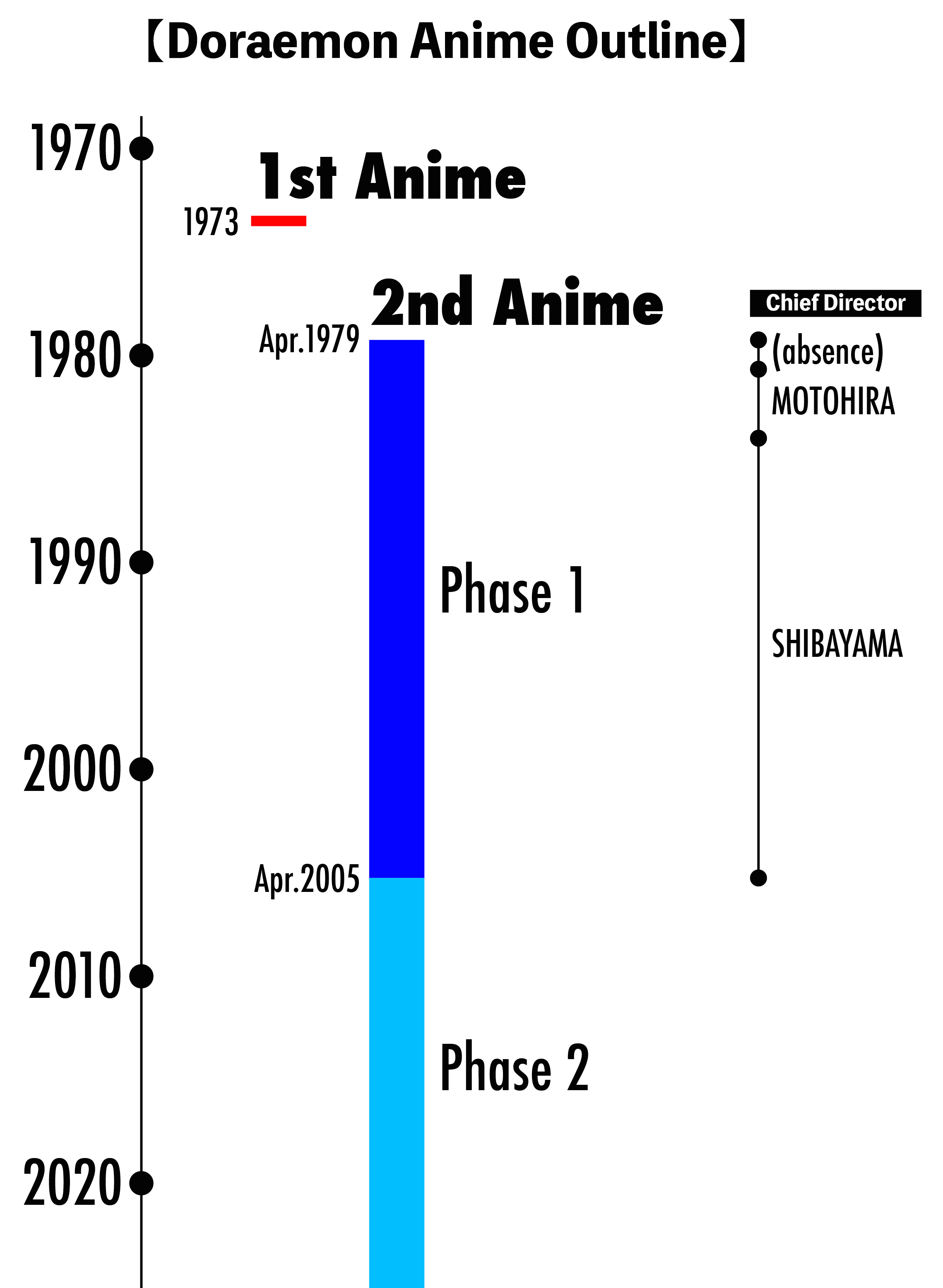
The first attempt of a Doraemon animated series was in 1973, by Nippon Television. After a January 1973 pilot named Doraemon Mirai Kara Yattekuru , twenty-six episodes, each with two segments, were broadcast on Nippon TV from April 1 to September 30 of the same year. The series was directed by Mitsuo Kaminashi with a voice cast from Aoni Production; Doraemon was voiced by Kōsei Tomita, then later by Masako Nozawa. Later in the series, the animation studio, Nippon TeleMovie Productions, went bankrupt, and the masters were sold off or destroyed. The series re-aired on Nippon TV and several local stations until 1979, when Shogakukan requested Toyama Television to cease broadcasting. Some of the segments were found in the archives of Imagica in 1995, and some others were recovered by Jun Masami in 2003. As of 2013, 21 of 52 segments are known to survive, two of which have no audio.
Doraemon remained fairly exclusive in manga form until 1979 when an animation studio, Shin-Ei Animation (now owned by TV Asahi) produced an animated second attempt of Doraemon. The series debuted on TV Asahi on April 2, 1979. Ryo Motohira served as chief director from 1981, and Tsutomu Shibayama from 1984. Eiichi Nakamura served as director of character design, while Shunsuke Kikuchi served as composer. Nobuyo Ōyama voiced Doraemon in the series; because of this, in Asia, this version is sometimes referred to as the Ōyama Edition. In total, 1,787 episodes were produced and released in VHS and DVD by Toho. On April 15, 2005, a major renewal premiered; it includes the replacement of voice actors and staff, and updated character designs. The third series is sometimes referred to in Asia as the Mizuta Edition, as a tribute for the voice actress for Doraemon, Wasabi Mizuta. It was released in DVD on February 10, 2006, under the title New TV-ban Doraemon with a Shogakukan Video banner.
In May 2014, TV Asahi Corporation announced an agreement with The Walt Disney Company to bring the 2005 series to the Disney XD television channel and Disney Channel in the United States beginning in the summer of that year. Besides using the name changes that were used in AltJapan's English adaptation of the original manga, other changes and edits had also been made to make the show more accessible to an American audience, such as Japanese text being replaced with English text on certain objects like signs and graded papers, items such as yen notes being replaced by US dollar bills, and the setting being changed from Japan to the United States. Initial response to the edited dub was positive. The Disney adaptation began broadcast in Japan on Disney Channel on February 1, 2016. The broadcast offered the choice of the English dub or a newly recorded Japanese track by the Japanese cast of the 2005 series.
The anime has been aired in over sixty countries worldwide. It premiered in Thailand in 1982, the Philippines in 1999, India in 2005, and Vietnam in 2010. Other Asian countries and regions that broadcast the series include China, Hong Kong, Singapore, Taiwan, Malaysia, Indonesia, and South Korea. The series is licensed in EMEA regions by LUK International; it premiered in Spain in 1993 and France in 2003. It has also been distributed in South American countries, including Brazil, Colombia, and Chile. In 2017, POPS Worldwide, a Vietnamese multimedia company, collaborated with TV Asahi to release the anime series on YouTube and other digital platforms.
Films
As of 2025, there have been 44 annual feature-length animated films produced by Shin-Ei Animation and released by Toho. The first twenty-five films are based on the 1979 anime, while the rest are based on the 2005 anime. Unlike the anime and manga series, the films are more action-adventure oriented, taking the familiar characters of Doraemon and placing them in a variety of exotic and perilous settings.
A 3D computer-animated film, Stand by Me Doraemon, released in Japan on August 8, 2014. Directed by Takashi Yamazaki and Ryūichi Yagi, it combines elements from the short stories of the manga series: "All the Way from the Country of the Future", "Imprinting Egg", "Goodbye, Shizuka-chan", "Romance in Snowy Mountain", "Nobita's the Night Before a Wedding", and "Goodbye, Doraemon ..." into a new complete story, from the first time Doraemon came to Nobita's house to Doraemon bidding farewell to Nobita. The film was a box office success, grossing $183.4 million worldwide. A sequel, Stand by Me Doraemon 2, also directed by Yamazaki and Yagi, was released on November 20, 2020.
Short films, OVA and crossover
Several Doraemon short films were produced and released between 1989 and 2004. These include 2112: The Birth of Doraemon, a film about the life of Doraemon from birth before coming to Nobita; Doraemon: Nobita's the Night Before a Wedding, a film about the events related to the marriage of Nobita and Shizuka; The Day When I Was Born and Doraemon: A Grandmother's Recollections, the films about the relationship between Nobita and his parents along with his grandmother. Other short films focus on Dorami and The Doraemons. In 1981, Toho released What Am I for Momotaro, a film about Momotarō, the hero of Japanese folklore.
In 1994, an educational OVA was made, titled Doraemon: Nobita to Mirai Note , where the main characters express the hope for a better Earth. The OVA was released in DVD along with the 13th issue of Fujiko F. Fujio Wonderland magazine in September 2004. A crossover episode of Doraemon with AIBOU: Tokyo Detective Duo aired on TV Asahi on November 9, 2018.
Music
The soundtrack of the 1973 anime series was composed by Nobuyoshi Koshibe, who also arranged the opening theme song "Doraemon" and the ending theme song "Doraemon Rumba", both performed by Harumi Naitō. For the 1979 anime, Shunsuke Kikuchi was the composer, who arranged "Doraemon no Uta"; it had been performed by numerous singers, including Kumiko Ōsugi and Satoko Yamano. When the anime got a reboot in 2005, Kan Sawada was the composer of the series. There are four other opening themes, including an instrumental version of "Doraemon no Uta" performed by Twelve Girls Band; "Hagushichao" performed by Rimi Natsukawa; "Yume wo Kanaete Doraemon" , the opening theme broadcast from 2007 to 2018; and "Doraemon" performed by Gen Hoshino, broadcast since October 2019.
Numerous collections of theme songs of the anime series and feature films were initially available in cassettes. Since the 1990s, Doraemon songs have been released in CD, under the type of singles and compilation albums. Soundtracks of Doraemon feature films have been released by Nippon Columbia since 2001 in the album series "Doraemon Soundtrack History".
Musical shows
Doraemon has been adapted into a musical, titled Doraemon the Musical: Nobita and the Animal Planet. Based on the 1990 anime film of the same name, it debuted at Tokyo Metropolitan Art Space on September 4, 2008, running through September 14. Shoji Kokami was the director and writer, Makoto Sakamoto played Nobita and Reiko Suho as Shizuka; Jaian and Suneo were portrayed by Tomohiro Waki and Kensaku Kobayashi, respectively; Wasabi Mizuta voiced Doraemon. The musical was later revived and ran at Sunshine Theater, Tokyo from March 26 to April 2, 2017, then later in other prefectures including Fukuoka, Osaka, Miyagi and Aichi. The 2017 revival is also directed and written by Kokami, with Mizuta reprising her role; Nobita, Shizuka, Jaian and Suneo were played by Yuuchi Ogoe, Hina Higuchi, Koki Azuma and Shō Jinnai, respectively.
Video games
Many Japanese-only video games based on Doraemon have been developed. For instance, in 1983, Bandai developed , an arcade game inspired by Pac-Man. Doraemon, a NES video game made by Hudson Soft, was released on December 12, 1986, and became one of the best-selling games of that year in Japan with over 1.15 million copies sold. On December 6, 2007, Sega published Doraemon Wii, the first Doraemon video game released on Wii. Doraemon can also be seen in Namco's Taiko no Tatsujin rhythm game series, such as in Taiko no Tatsujin: Sesson de Dodon ga Don! (2017). The first Doraemon game to receive a Western release was Doraemon Story of Seasons (2019). Card games with Doraemon themes have also been made in several special occasions, sometimes to exploit the popularity of feature films. In 2016, a special edition of Uno about the series' characters was released exclusively in Japan, as a result of a cooperation between Asatsu-DK and Mattel. In April 2025, CTW announced Doramonn Comic Traveler, the first online browser game based on the series, on its gaming platform G123.
Merchandise
In Japan, the Doraemon merchandising rights belong to Shogakukan-Shueisha Productions, which has produced and distributed a wide range of products under its brand, such as toys, food, stationery, action figures, ja, shoes, clothing, and others. Several companies have collaborated on the creation and distribution of products on the series and its characters, including Sanrio, Converse, Moleskine, and ESP Guitars, which has made guitars decorated with Doraemon characters; a further partnership of Doraemon with Uniqlo led to a line of clothing designed by Takashi Murakami. The Doraemon franchise has also collaborated with various Japanese brands, including Tsi Groove & Sports's Jack Bunny!! golf apparel brand, Unicharm's MamiPoko diaper brand, and the video games LINE Pop 2, Monster Strike, and Granblue Fantasy. Viz Media owns the Doraemon merchandising rights in North and Latin America, which has developed Doraemon-themed clothing and collectibles in collaboration with retail chain Hot Topic, and themed Happy Meals in a 2015 collaboration with McDonald's. Viz Media Europe (now Crunchyroll EMEA) manages the merchandising in Europe except Spain and Portugal; LUK International has obtained licenses in these two countries.
Characters from Doraemon have been used in advertising through specific agreements with Shogakukan. For instance, following the Cool Japan initiative promoted by the Japanese government, Sharp Corporation produced a series of commercials featuring the characters of Doraemon and Nobita, which were broadcast in several ASEAN countries. In late 2011, Shogakukan and Toyota Motor Corporation joined forces to create a series of live-action commercials as part of Toyota's ReBorn ad campaign, which depicted the manga's characters two decades after being grown up, where Hollywood actor Jean Reno played Doraemon.
Reception
General
Doraemon is considered one of the best-known manga of all time, a true Japanese cultural icon, and an essential part of family life of the Japanese post-war generation. Akihiro Motoyama observed that "mothers who watched the movies when they were children are now taking their own children to see them". It was also commercially successful: over 108 million volumes were sold in Japan by 1996. The 1979 and 2005 anime series also achieved high ratings on television. With the film Doraemon: Nobita's Secret Gadget Museum, the Doraemon anime film series reached 100 million tickets sold at the Japanese box office, surpassing Godzilla as the highest-grossing film franchise in Japan. By 2015, it had sold over 103 million tickets, and was the largest franchise by numbers of admissions in the country.
Doraemon was also a hit in other parts of Asia, and is considered an archetypical example of Japanese soft power, although it has been published without a license in some countries. The anime television series is available in over 60 countries, and reportedly getting high ratings in at least 30 countries. However, Doraemon has been less successful in Western countries, due to being viewed by many as a children-only series, and there were tight restrictions about publishing manga and broadcasting anime series the region. The manga had sold over 170 million copies worldwide by 2012; over 250 million by 2019; and over 300 million by 2024. Estimates show that Doraemon has generated at least more than in merchandise sales by 2019,{{Efn|Doraemon licensed merchandise sales:
- Royalties (1979–1994) – ()
- Japan (1999–2000, 2003, 2005, 2007, 2010) – ()
- 1999 –
- 2000 –
- 2003 –
- 2005 –
- 2007 –
- 2010 –
- Worldwide (2015–2016) –
- 2015 –
- 2016 –
- Japan (2018–2019) – ()|group=lower-alpha}} and over $1.7 billion from feature films by 2020, making it one of the highest-grossing media franchises of all time.
Outside Japan, Doraemon achieved particular success in Vietnam, with a record-breaking 40 million copies sold by 2006. The manga was first launched there in 1992 by Kim Đồng Publishing House, but the copyright from Shogakukan was not fully acquired until 1996. In 1993, the Vietnamese Ministry of Culture considered the manga's publication to be "an impactful event for the improvement of children, youth and adult's likings ... [Doraemon] is a comprehensively educational book series which has the effect of developing children's personality". Doraemon is now a cultural icon in Vietnam, having been featured at many cultural events.
Critical reception and analysis
Doraemon has received favorable reviews. Critic Mark Schilling wrote, "For kids whose lives are often so regulated, Doraemon represents a welcome breath of freedom and a glimpse of a funnier, friendlier world where all dreams, even foolish ones, can come true." Italian writer Massimo Nicora wrote that the manga "can be interpreted as a type of book that criticizes, with irony, the omnipotence of science that pretends to solve every problem with its tools", alluding to the fact that Doraemon's gadgets often end up making the problems even worse than they initially were, more than anything else. He added that it represents "the metaphor of the childish imagination, which always manages to find the most bizarre and original solutions, in a continuous game of transformation of reality".
Some critics considered that Nobita's flawed personality and modest background is different from the special or extraordinary characteristics usually seen in other typical anime and manga protagonists; this portrayal has been seen as reasons of its appeal as well as the contrary, especially in the United States. According to the Italian Parents Movement (Moige), in the manga, "the lazy Nobita does not know any kind of appreciable evolution", though there are still good points including "the criticism of bullying, the goodness that transpires from the little Nobita and the positive figure of Shizuka".
In his 2000 article, Leo Ching explained that the success of Doraemon in Asia was due to reflecting Asian values such as imagination and responsibility, the same reason that Oshin, another Japanese cultural export, became well known there. On the other hand, according to an analysis by Anne Allison, professor of cultural anthropology at Duke University, the strong point of it was not the variety of the gadgets, but the relationship between Doraemon and Nobita, which was particularly appreciated. Jason Thompson praised the "silly situations" and "old fashioned, simple artwork", with Doraemon's expression and comments adding to the "surrounding elementary-school mischief". On the manga's 50th anniversary, an op-ed published on Asahi Shimbun stated that the manga "has already become a contemporary classic".
Awards, accolades and public recognition
Doraemon has received numerous accolades. It won the Japan Cartoonists Association Award twice in 1973 and 1994, the former for the Excellence Award while the latter for the Minister of Education, Science and Technology Award. In 1982, it received the first Shogakukan Manga Award for children's manga. In 1997, the manga won the Grand Prize at the first Tezuka Osamu Cultural Prize. The 1979 series won the award from the Japanese Agency for Cultural Affairs four times for best television series in 1984, 1985, 1988 and 1989.
A 2006 poll among 80,000 Japanese fans for the 10th anniversary of the Japan Media Arts Festival placed Doraemon at fifth among the top ten best manga of all time. The 2005 and 2006 surveys conducted by TV Asahi found the Doraemon anime ranked fifth and third, respectively, among the 100 favorite anime series of all time. In 2010, a survey conducted by researchers of Tokyo Polytechnic University found that most responders considered Doraemon, along with Dragon Ball franchise, to be the anime series that best represents Cool Japan. In a 2013 survey, Doraemon was found to be the best anime recommended for foreign people.
Criticism
Doraemon has been blamed for having a negative impact on children, due to the controversial traits of the characters in the anime. The character has received criticism in China, where some media outlets considered Doraemon to be a politically subversive character and that it was a tool of Japan's "cultural invasion". Some education groups in Taiwan demanded the anime to be banned, as the plot involves bullying, which was feared would encourage campus bullying. In 2016, a resolution to ban the Hindi-dubbed Doraemon anime series was submitted in Pakistan. Around the same time, legal notices were served against several companies in India, targeting Doraemon and Crayon Shin-chan for bans (which did not materialize), as having an adverse effect on children. Disney Channel India, the regional broadcaster of the anime, was banned in Bangladesh and Pakistan due to the non-availability of localized dubs for content including Doraemon.
Cultural impact and legacy
The Doraemon manga has inspired many other mangakas; these include Eiichiro Oda, the creator of One Piece with the idea of "Devil Fruits", and Masashi Kishimoto, the creator of Naruto, who drew characters from anime shows during his childhood, including Doraemon. The manga has also been referenced in Gin Tama and Great Teacher Onizuka. The character Doraemon is considered one of the most recognizable cultural icons in Japan, and one of the most well-known characters in manga history; some critics compared his popularity with that of Mickey Mouse and Snoopy. Mark Schilling noted that Doraemon's "Take-Copter" is familiar among Japanese people "just as Snoopy's biplane is familiar to most Americans".
On April 22, 2002, in the special issue of Asian Hero in Time magazine, Doraemon was the only anime character to be named one of the twenty-two Asian Heroes, and was described as "The Cuddliest Hero in Asia". A 2007 poll by Oricon shown that Doraemon was the second-strongest manga character ever, behind only Son Goku of Dragon Ball. Doraemon is also referred as something with the ability to satisfy all wishes.
In 2005, the Taiwan Society of New York selected Doraemon as a culturally significant work of Japanese otaku pop-culture in its exhibit Little Boy: The Arts of Japan's Exploding Subculture, curated by renowned artist Takashi Murakami. In 2008, the Japanese Ministry of Foreign Affairs appointed Doraemon as the first anime cultural ambassador; a Ministry spokesperson explained the decision as an attempt to help people in other countries better understand anime and to deepen their interest in Japanese culture. On September 3, 2012, Doraemon was granted official residence in the city of Kawasaki, Kanagawa, one hundred years before he was born. In the same year, Hong Kong celebrated the birthday of Doraemon 100 years early with a series of displays of the character. In April 2013, Doraemon was chosen as Japan's ambassador in Tokyo's bid to host the 2020 Summer Olympics and 2020 Summer Paralympics. He appeared in the 2016 Summer Olympics closing ceremony to promote the 2020 Summer Olympics in Tokyo.
A Fujiko F. Fujio museum opened in Kawasaki on September 3, 2011, featuring Doraemon as the star of the museum. The National Museum of Singapore held a time-travelling exhibition in October 2020 as a tribute to the manga. After the 2011 Tōhoku earthquake and tsunami, Shogakukan released an earthquake survival guidebook, which included the main cast of the Doraemon manga series. TV Asahi launched the Doraemon Fund charity fund to raise money for natural disasters in 2004 and 2011. In 2020, the Mumbai's Sion Friends Circle group distributed food and books to children using mascots, one being Doraemon, to those in need during the COVID-19 pandemic. In Vietnam, a Doraemon scholarship fund was established in 1996, and the Doraemon character has been used for education of traffic safety. Doraemon's creator, Fujiko F. Fujio, received the Culture Fighter Medal from the Vietnamese Ministry of Culture in 1996 for his contributions to youth education through the manga.
Many prominent figures have been nicknamed after the cast of Doraemon: politician Osamu Fujimura is known as the "Doraemon of Nagatacho" due to his figure and warm personality, and sumo wrestler Takamisugi was nicknamed "Doraemon" because of his resemblance to the character. In 2015, a group of people in a drought-affected village in northern Thailand used a Doraemon toy to complete a rain-ritual, in order to avoid controversies that would occur by using real animals.
A parody of Doraemon created by Hikari Fujisaki, titled Nozoemon , was first serialized in Nihon Bungeisha's Comic Heaven magazine in September 2014, with the compiled book volume released on June 9, 2015; however, it was discontinued in August 2015 due to content issues.
Notes
References
Citations
Bibliography
References
- "Shogakukan-Shueisha Productions grants merchandise rights for beloved Doraemon franchise to Viz Media for Americas region". [[Viz Media]].
- Ong, Bang. (August 28, 2015). "10 Asian heroes we worshipped while growing up". [[Stuff (magazine).
- . (2010). ["Fの森の歩き方"](https://www.shogakukan.co.jp/pr/fzenshu/lineup/fnomori/). *[[Shogakukan]]*.
- . (2000). ["ドラえもん完全作品リスト 改訂二版"](https://mediaarts-db.bunka.go.jp/id/M188902). *NeoUtopia*.
- IGN Staff. (1996-10-01). "Doraemon Creator Dies".
- "藤子・F・不二雄(ふじこエフふじお)".
- Min Chew, Hui. (December 23, 2014). "Why Doraemon is blue and 4 other things you might not have known about the cat robot".
- {{Harvnb. Schodt. 1999
- {{Harvnb. Schodt. 1999
- {{Harvnb. Pelliteri. 2008
- {{Harvnb. Schilling. 2004
- {{Harvnb. Schodt. 1999
- Izawa, Eri. (2000). "Environmentalism in Manga and Anime".
- Arico, Giacomo. (2014-11-05). "Ambientalista e di sani valori: arriva al cinema Doraemon, il gatto robot creato da Fujio nel 1969".
- {{Harvnb. Shiraishi. 2000
- {{Harvnb. Schilling. 2004
- An Nhiên. (2007-08-29). ""Độ dài thời gian của vũ trụ" là yếu tố cơ bản để nhà văn Fujiko F Fujio sáng tác nên bộ truyện Đôrêmon?". [[Kim Đồng Publishing House]].
- {{Harvnb. Peters. 2002
- {{Harvnb. Peters. 2002
- {{Harvnb. Shiraishi. 1997
- (September 1974). "ドラえもん 2". [[Shogakukan]].
- (2004-04-20). "ぼく、ドラえもん 第4号".
- (2004-04-03). "'Doraemon' fanatic boasts Ding Dong's 1,963 gadgets". [[The Japan Times]].
- {{Harvnb. Shiraishi. 2000
- {{Harvnb. Shiraishi. 2000
- Rogolino, Letizia. (2017-01-27). "Doraemon, 10 cose che (forse) sapete sul gatto robot che viaggia nel tempo".
- Miller, Evan. (2007-05-30). "Author of False Doraemon Ending Issues Apology".
- Guglielmino, Andrea. (2014-11-04). "L'afflato tragico di Doraemon".
- . (2019). "藤子・F・不二雄WORKS ドラえもんリスト". *NeoUtopia*.
- "『てれびくん』掲載作品".
- S. Yada, Jason. (October 2009). "The Rough Guide to Manga". [[Rough Guides]].
- Loveridge, Lynzee. (2017-02-18). "Doraemon Figure Recreates His 1st Corocoro Comic Cover".
- Fujio, Fujiko F.. "ドラえもん 1". [[Shogakukan]].
- Fujio, Fujiko F.. (May 1996). "ドラえもん 45". [[Shogakukan]].
- (2004-04-07). "ぼくドラえもん!「ドラえもん文庫」開設". Toyama Brand.
- Fujio, Fujiko F.. (April 2005). "ドラえもん プラス 1". [[Shogakukan]].
- Fujio, Fujiko F.. (March 2006). "ドラえもん プラス 5". [[Shogakukan]].
- Ressler, Karen. (November 15, 2014). "1st Doraemon Manga Volume in 8 Years Ships in December".
- Fujio, Fujiko F.. (September 1999). "ドラえもんカラー作品集 1". [[Shogakukan]].
- Fujio, Fujiko F.. (October 2006). "ドラえもんカラー作品集 6". [[Shogakukan]].
- Fujio, Fujiko F.. "藤子・F・不二雄大全集 ドラえもん 1". [[Shogakukan]].
- Fujio, Fujiko F.. (September 2012). "藤子・F・不二雄大全集 ドラえもん 20". [[Shogakukan]].
- Sherman, Jennifer. (2019-11-09). "1st Doraemon Manga Volume in 23 Years Features 6 Versions of 1st Chapter".
- "小学館 イングリッシュコミックス". [[Shogakukan]].
- Thompson, Jason. (2007). "Manga: The Complete Guide". Del Rey Books.
- "哆啦A梦英汉双语精华本1". 21st Century Publishing House.
- "哆啦A夢英文版(中英對照)(01)". [[Chingwin Publishing Group]].
- Loveridge, Lynzee. (July 28, 2013). "Classic Kids' Manga Doraemon Coming to N. America Digitally".
- (November 22, 2013). "DORAEMON Vol.1 [Kindle Edition]". [[Shogakukan]].
- (2016-03-03). "DORAEMON vol.200 [Kindle Edition]". [[Shogakukan]].
- (November 23, 2013). "English version of 'Doraemon' to enter North American market". [[Asahi Shimbun]].
- Fujio, Fujiko F.. (2014-08-27). "Doraemon 1". [[Shogakukan Asia]].
- Fujio, Fujiko F.. (November 26, 2014). "Doraemon 4". [[Shogakukan Asia]].
- Chapman, Paul. (July 16, 2015). ""Doraemon" Begins Digital Distribution in Japan".
- Fujio, Fujiko F.. (1983-11-28). "大長編ドラえもん1 のび太の恐竜". Shogakukan.
- Fujiko F. Fujio Pro. (2004-08-27). "大長編ドラえもん24 のび太のワンニャン時空伝". Shogakukan.
- Tanaka, Michiaki. (1996). "ザ☆ドラえもんズ 1". [[Shogakukan]].
- Tanaka, Michiaki. (2001). "ザ・ドラえもんズ 第6巻". [[Shogakukan]].
- (1997). "ザ☆ドラえもんズスペシャル 1". [[Shogakukan]].
- (2002). "ザ☆ドラえもんズスペシャル 12". [[Shogakukan]].
- Mitani, Yukihiro. (1999). "ザ☆ドラえもんズスペシャル ロボット養成学校編". [[Shogakukan]].
- (2003). "ザ☆ドラえもんズスペシャル ロボット養成学校編 3". [[Shogakukan]].
- Shintarō, Mugiwara. (May 2001). "ドラベース ドラえもん超野球(スーパーベースボール)外伝 1". [[Shogakukan]].
- Shintarō, Mugiwara. (November 2011). "ドラベース ドラえもん超野球(スーパーベースボール)外伝 23". [[Shogakukan]].
- . (2010). "NeoUtopia No.50". *NeoUtopia*.
- (January 2007). "特集 日本テレビ版ドラえもん". Fujiko Fujio FC Neo Utopia.
- "Information on Works (Series) - ドラえもん". [[Agency for Cultural Affairs.
- Masami, Jun. "真佐美ジュンのドラえもん時代". NipponTeleAnima Labor Union.
- {{Harvnb. Kenji. 2008
- Oohata, T.. "真佐美ジュンさんに聞く".
- {{Harvnb. Kenji. 2008
- {{Harvnb. Kenji. 2008
- {{Harvnb. Kenji. 2008
- Brubaker, Charles. (2013-05-28). "The Strange Case of the 1973 "Doraemon" Series".
- {{Harvnb. Schilling. 2004
- "Information on Works (Series) - ドラえもん[新]". Japanese Agency for Cultural Affairs.
- . (2010). "NeoUtopia No.50". *NeoUtopia*.
- "ドラえもん タイムマシンBOX 1979". Surugaya.
- "東奥・第59回東奥賞".
- (February 25, 2009). "舊酒新瓶?濃厚也". Hong Kong Independent Media Network.
- "TV アニメ ドラえもん". Allcinema.
- "TV版ドラえもんVol. 1 - Blu-ray/DVD". [[Toho]].
- (April 10, 2005). "The all-new "Doraemon" premieres on TV Asahi with an hour-long special and more".
- "NEW TV版ドラえもんシリーズ". [[Toho]].
- "NEW TV版 ドラえもんvol. 1 「タイムマシンがなくなった!!」 ほか全5話+ミニシアター". [[Toho]].
- Hongo, Jun. (May 9, 2014). "Japanese Anime Star Doraemon Finally Makes U.S. Debut".
- Kagawa, Marcie. (June 25, 2014). "Doraemon hitting U.S. airwaves this summer".
- (May 9, 2014). "Doraemon plans to make US debut this summer".
- Loo, Egan. (May 11, 2014). "Doraemon Anime's Visual & Script Changes for U.S. TV Detailed".
- Kagawa, Marcie. (July 9, 2014). "Doraemon charms U.S. viewers in first remake for a foreign market".
- Loo, Egan. (January 30, 2016). "Disney XD's Doraemon Adaptation to Run in Japan With Bilingual Tracks".
- "Doraemon ドラえもん". [[TV Asahi]].
- Yasuyuki. (2012-12-10). "Celebrating Exactly 100 Years Before Doraemon's Birthday". Nippon Communications Foundation.
- Cabuag, VG. (2015-08-01). "Makers of Doraemon to push the Japanese character in Philippines".
- (May 5, 2005). "Hungama TV to launch Indian superhero show 'Hero'".
- Hạ Chinh. (2009-11-12). "Kinh doanh phim hoạt hình Nhật và hình ảnh nhân vật - Từ nay phải có bản quyền".
- (December 28, 2009). "Doraemon đã chính thức đến với các bạn trẻ Việt Nam". VietNamNet.
- {{Harvnb. Shiraishi. 2000
- "Catalogue / DORAEMON". LUK International.
- "Doraemon, El Gato Cósmico (1979)".
- Clement, Stéphane. "Doraemon".
- (January 6, 2019). "Popular anime Doraemon retorna à TV aberta no Brasil".
- (December 2, 2003). "Doraemon alcanza excelentes resultados en Caracol".
- de Prensa, Comunicado. (July 2, 2015). "Llegan a Chile capítulos exclusivos de Doraemon".
- Ngát Ngọc. (2017-08-12). "Việt Nam có bản quyền phim hoạt hình 'Doraemon' trên YouTube đầu tiên".
- (2006). "The Anime Encyclopedia, Revised & Expanded Edition: A Guide to Japanese Animation Since 1917". Stone Bridge Press.
- {{Harvnb. Schilling. 2004
- Boon Chan. (2016-06-08). "Movie review: The comforting charms of Doraemon".
- Komatsu, Mikikazu. (2014-08-19). "3DCG Film "Stand By Me Doraemon" to be Released in 21 Regions/Countries".
- (2013-11-14). "「ドラえもん」が初の3DCG映画化 来夏公開へ".
- (2014-08-16). "3DCG『ドラえもん』、藤子・F・不二雄先生も知らなかった物語".
- "Stand by Me Doraemon". [[IMDb]].
- Mateo, Alex. (2020-10-07). "Stand By Me Doraemon 2 CG Film's Trailer Reveals Masaki Suda's Song, November 20 Debut".
- "2112年 ドラえもん誕生".
- "映画 のび太の結婚前夜: 作品情報".
- "ぼくの生まれた日: 作品情報".
- "おばあちゃんの思い出: 作品情報".
- "ドラえもん ぼく桃太郎のなんなのさ: 作品情報".
- "WEBアニメスタイル 更新情報とミニニュース".
- (2004-09-03). "雑誌 ぼくドラえもん13".
- Dennison, Kara. (2018-10-30). "Doraemon Prepares to Buddy up with Cop Drama AIBOU".
- "テレビアニメ放送40周年記念 ドラえもん うたのコレクション". [[Nippon Columbia]].
- "Information on Works (Series) ドラえもん[新・第2期]". Japanese Agency for Cultural Affairs.
- Sawada, Kan. "ドラえもん".
- "ドラえもん|テレビ朝日". TV Asahi.
- "ドラえもんOPテーマついに新曲に交代、歌は夏川りみ".
- "スタッフ&声の出演者". [[TV Asahi]].
- (2019-09-06). "星野源「ドラえもん」新オープニング曲に!". [[TV Asahi]].
- "パチソン ドラえもんのうた のぶ代ドラ カセットテープ". [[Rakuten]].
- "ドラえもん映画主題歌集~雲がゆくのは".
- "ドラえもん". RecoChoku Co., Ltd..
- "ドラえもん Sound Track History~菊池俊輔 音楽集~".
- "ドラえもん サウンドトラックヒストリー2". [[Billboard Japan]].
- "映画ドラえもん のび太の宇宙英雄記 オリジナル・サウンドトラック&モア 映画ドラえもんサウンドトラックヒストリー3". [[Billboard Japan]].
- (2008-09-30). "Play of the month: Shoji Kokami".
- "舞台版ドラえもん のび太とアニマル惑星".
- Loo, Egan. (February 4, 2017). "1st Doraemon Stage Play in 9 Years Unveils Visual".
- "舞台版ドラえもん のび太とアニマル惑星".
- Dennison, Kara. (2016-12-28). ""Doraemon" Takes to the Stage in "Nobita and the Animal Planet"".
- Loo, Egan. (2016-12-27). "Doraemon Stage Play Returns After 9 Years".
- Morgan, Rik. "Bandai Dokodemo Dorayaki Doraemon".
- "ドラえもん". Japanese Agency for Cultural Affairs.
- "Japan Platinum Game Chart".
- (2007-09-14). "「セガコンシューマ新作発表会2007Autumn」で発表された最新タイトルSSを大公開".
- Romano, Sal. (2017-06-22). "Taiko Drum Master: Session de Dodon ga Don! first details, screenshots".
- (2019-04-02). "Doraemon Story of Seasons launches June 13 in Japan, first trailer and details".
- (2020-04-23). "Doraemon Story of Seasons for PS4 coming west on September 4".
- "Dorainfo". Epoch Co., Ltd..
- (2016-09-30). "UNOに新ルール コラボカードが一挙に3つ登場 「ドラえもん」「ドラゴンボール」「ワンピース」の世界観を反映".
- link. (April 21, 2025)
- "Doraemon Business Department". [[ShoPro]].
- Benson, Anya. (2015-03-09). "The utopia of suburbia: the unchanging past and limitless future in Doraemon". Japan Forum.
- (2015-07-22). "ドラえもんとハローキティが夢のコラボ 「どこでもドア」から一緒に登場".
- "Baby All Star N Doraemon Z". [[Converse (shoe company).
- "Doraemon Limited Edition Collection". [[Moleskine]].
- "ESP X Doraemon". [[ESP Guitars]].
- (2018-05-09). "UNIQLO Presents Doraemon UT Featuring Works by Master Contemporary Artist Takashi Murakami". [[Uniqlo]].
- (August 5, 2019). "「Jack Bunny!!」と人気キャラクター「ドラえもん」とのコラボがパワーアップして登場! サングラスをしたドラえもんアイテムなど限定品が発売 8月9日(金)からは「ドラえもん祭り」を開催!". PR Times.
- (July 31, 2020). "ゴルフアパレルブランド「Jack Bunny!!」から、いつものゴルフを「ドラえもん」と楽しく過ごせるコラボアイテムが今年も登場!発売を記念して8月7日(金)からは「ドラえもん祭り」を開催!". PR Times.
- (August 4, 2021). "「DORAEMON JackBunny!! FESTIVAL'21」8/6(金)~の8/22(日)開催!". PR Times.
- (May 14, 2021). "ドラえもん50周年『マミーポコパンツ』ハッピーデザイン". Fujiko Pro.
- (March 20, 2018). "「LINE POP2」に「ドラえもん」たちが登場!『映画ドラえもん のび太の宝島』とコラボレーション開始!". PR Times.
- (February 28, 2020). "【追記:3/6】「映画ドラえもん のび太の新恐竜」と「モンスト」のコラボイベントを3/6(金)より期間限定で開催!ドラえもん、のび太、しずか、ジャイアン、スネ夫がモンストに登場!". XFLAG.
- Stenbuck. (November 1, 2021). "Granblue Fantasy Doraemon Crossover Will Appear in December 2021". [[Siliconera]].
- (October 31, 2021). "Granblue Fantasy announces Doraemon collab for December". GamerBraves.
- "Viz Media announces new officially licensed collectables and apparel based on the celebrated anime property Doraemon". [[Viz Media]].
- (2015-03-14). "McDonald's hopes to make kids happy — by teaming up with Japan's favorite blue friend Doraemon!".
- "Doraemon - the gadget cat from the future!". [[Viz Media Europe]].
- "Licensing & Promotions / DORAEMON". LUK International.
- (July 2015). "Cool Japan Initiative". [[Ministry of Economy, Trade and Industry.
- Denny, Mac. (2011-11-20). "Toyota Introduces Increasingly Impressive Cast for Live-Action Doraemon Commercials".
- Loo, Egan. (July 15, 2012). "Jean Reno Goes to Olympics as Doraemon in New Live-Action Ad – News".
- {{Harvnb. Shiraishi. 1997
- Schilling, Mark. (1993). "Doraemon: Making Dreams Come True". Japan Quarterly.
- {{Harvnb. Schodt. 1999
- Ressler, Karen. (2018-02-15). "Japan's Animation TV Ranking, February 5–11".
- Sekiguchi, Toko. (March 26, 2013). "Godzilla Loses Top Spot to Kittybot Doraemon". The Wall Street Journal.
- Blair. (April 6, 2015). "Japan Box Office: 'Doraemon' Anime Still All-Conquering". [[The Hollywood Reporter]].
- {{Harvnb. Shiraishi. 1997
- {{Harvnb. Shiraishi. 1997
- McCurry, Justin. (June 3, 2015). "Japanese robot cat Doraemon helps ease diplomatic tensions with China". [[The Guardian]].
- {{Harvnb. Shiraishi. 1997
- Cooper-Chen, Anne. (2010). "Cartoon Cultures: The Globalization of Japanese Popular Media". Peter Lang.
- Iwamoto, Tetsuo. (2012-09-03). "Happy birthday! Doraemon will be born 100 years from today".
- Easton. (2016-08-31). "Tokyo 2020 and Japan's Soft Power". [[The Diplomat (magazine).
- (2019-11-27). link. Sankei Digital, Inc.
- link. [[Shogakukan]]. (August 2024)
- (2010). "Official exchange rate (LCU per US$, period average) - Japan".
- Tsukada, Yuko. (September 7, 2001). "クリエイターのための自営学". Creative Work Station / [[:ja:明日香出版社.
- (2005). "Market Share in Japan". Yano Research Institute.
- (March 6, 2007). "日本のアニメ・マンガを取り巻く状況". [[Ministry of Land, Infrastructure, Transport and Tourism]].
- (January 26, 2009). "キャラクターが日本を救う". [[NTT Communications]].
- (2011). "コンテンツ2次利用市場(ライセンス市場)に係る 競争環境及び海外市場動向実態調査". [[Ministry of Economy, Trade and Industry]] (METI).
- (July 17, 2017). "Top 20 Preschool Properties in the $12.8 Billion Industry". The Licensing Letter.
- (December 30, 2020). "Content Tokyo 2020 》Vtuber、疫情中重塑品牌、以AI創作,日本內容產業熱議的3件事". [[Central News Agency (Taiwan).
- (May 2019). "CharaBiz DATA 2019(18)". Character Databank.
- (May 2020). "CharaBiz DATA 2020(19)". Character Databank.
- Thomas, Russell. (2020-02-01). "Back to the future: The world celebrates the 50th anniversary of Doraemon".
- {{Harvnb. Shiraishi. 2000
- (March 21, 2006). "6 kỉ lục trong lĩnh vực xuất bản - in - phát hành của Việt Nam". [[Thanh Niên]].
- Nguyễn Phú Cương. (October 16, 2010). "Nguyễn Thắng Vu: Ông "bố nuôi" của Đôrêmon đã ra đi".
- Nữ Lâm. (2020-05-14). "Thế giới đã sẵn sàng chia tay Doraemon chưa?".
- (March 12, 2010). ""Ngày hội Đôrêmon"".
- Phùng Hà. (2012-12-15). "'Doraemon' - cơn sốt 20 năm chưa hạ nhiệt".
- {{Harvnb. Schilling. 2004
- Nicora, Massimo. (2016). "C'era una volta ... prima di Mazinga e Goldrake. Storia dei robot giapponesi dalle origini agli anni Settanta". Youcanprint.
- Scala, Elisabetta. (2016). "Un anno di zapping - Guida critica family friendly ai programmi televisivi". Moige.
- Ching, Leo. (2000). "Globalizing the Regional, Regionalizing the Global: Mass Culture and Asianism in the Age of Late Capital". Duke University Press.
- Allison, Anne. (2002). "Playing with Power: Morphing Toys and Transforming Heroes in Kids' Mass Culture". [[Cambridge University Press]].
- (2020-03-04). "Vox Populi: 'Doraemon' manga series at age 50 still proves prescient".
- (2009-06-17). "第2回(1973年度)". Japan Cartoonists Association.
- (2009-06-17). "第23回(1994年度)". Japan Cartoonists Association.
- link. [[Shogakukan]]
- Hahn, Joel. (2006). "Shogakukan Manga Award".
- "第1回 マンガ大賞 藤子・F・不二雄 『ドラえもん』(小学館)". [[Asahi Shimbun]].
- "作品受賞歴". Shin-Ei Animation.
- Macdonald, Christopher. (2006-10-04). "Top 10 Anime and Manga at Japan Media Arts Festival".
- Macdonald, Christopher. (2005-09-24). "TV Asahi Top 100 Anime".
- Macdonald, Christopher. (2006-10-13). "Japan's Favorite TV Anime".
- Loo, Egan. (2010-05-20). "Japan Surveyed on Anime, Manga, Other Cultural Exports".
- Komatsu, Mikikazu. (2013-02-26). "Survey: 17 Recommended Anime Titles for Foreign People".
- Cain, Rob. (2015-05-31). "Japan's Unlikely Ambassador: a Cartoon Robot Cat From the Future Wins China's Hearts and Minds".
- McCurry, Justin. (2014-10-12). "Doraemon a character of subversion, claim Chinese media".
- Piao, Vanessa. (September 29, 2014). "A Warning in China: Beware the 'Blue Fatty' Cat". [[The New York Times]].
- (2014-07-15). "「哆啦A夢」劇情涉霸凌 教團要求下架". [[Liberty Times]].
- Ressler, Karen. (2016-08-04). "Resolution to Ban Doraemon Anime Series Submitted in Pakistan".
- McCurry, Justin. (October 7, 2016). "Japanese robot cat Doraemon raises hackles in India and Pakistan".
- AFP. (2013-02-15). "Bangladesh bans Japanese cartoon Doraemon to halt Hindi invasion".
- Ahmad, Imtiaz. (December 30, 2017). "Pakistan lawmaker calls for Doraemon ban to be fully implemented".
- Wuyuan, Guan. (2014-07-03). "尾田栄一郎:航海王冒險再10年".
- (2014-07-04). "Eiichiro Oda Interview With China Times (Updated)".
- Kishimoto, Masashi. (2005). "Naruto, Volume 7". [[Viz Media]].
- McNulty, Amy. (2015-05-21). "Gintama - Episode 272".
- Santos, Carlo. (2012-09-24). "Review - GTO: 14 Days in Shonan".
- Allen, Jordan. (2020-05-23). "Fifty years of Doraemon, and still there are lessons to be learned".
- {{Harvnb. Pelliteri. 2008
- Hoover, William D.. (2011). "Historical Dictionary of Postwar Japan". Scarecrow Press.
- {{Harvnb. Schilling. 2004
- Iyer, Pico. (April 29, 2002). "The Cuddliest Hero in Asia".
- (2007-06-22). "1000人が選んだ!漫画史上"最強"キャラクターランキング!".
- "Little Boy: The Arts of Japan's Exploding Subculture".
- McCurry, Justin. (March 20, 2008). "Japan enlists cartoon cat as ambassador".
- AFP. (March 15, 2008). "Doraemon named 'anime ambassador'".
- AFP. (September 4, 2012). "Doraemon becomes official resident of Kawasaki a century before his birth". The Japan Times.
- West, David. (August 13, 2012). "Hong Kong Celebrates Doraemon's 100th Birthday (Early!)". [[Neo (magazine).
- Chavez, Amy. (2013-04-20). "Doraemon trumps Hello Kitty for Olympic Games ambassador".
- Palazzo, Chiara. (August 22, 2016). "Shinzo Abe emerges from a green pipe disguised as Super Mario during Rio Closing Ceremony". The Daily Telegraph.
- Samuelson, Kate. (August 22, 2016). "Shinzo Abe Dresses as Super Mario for Rio Closing Ceremony".
- (August 29, 2011). "Anime star Doraemon to have own museum". [[The Independent]].
- (September 4, 2011). "Doraemon museum opens its doors".
- Sor Fern, Ong. (2020-10-27). "Doraemon invades National Museum of Singapore for an Instagram fest".
- Hodgkins, Crystalyn. (June 22, 2011). "Shogakukan Publishes Doraemon Earthquake Survival Guide".
- "Doraemon Fund". [[TV Asahi]].
- "Doraemon Charity Fund for the Japan Tohoku-Kanto Earthquake". TV Asahi.
- Jamal, Alfea. (2020-06-29). "Mickey Mouse, Doraemon distribute books, food to children of Mumbai's slum areas".
- Hoàng Nguyên. (2010-05-20). "Mèo máy Doremon tái xuất và ... đổi tên".
- Hoàng Sơn. (2020-01-09). "Phát động cuộc thi Doraemon với An toàn giao thông năm 2019-2020".
- Gia Hạ. (2016-10-21). "Fujiko F. Fujio: Người họa sĩ đến từ tương lai".
- (September 2, 2011). "Noda chooses 'Doraemon' as chief Cabinet secretary".
- Sharnoff, Lora. (1993). "Grand Sumo". Weatherhill.
- (2015-06-29). "Thailand: Japan's Doraemon cartoon cat in rain ritual". BBC News.
- Pineda, Rafael Antonio. (2015-08-12). "Risqué Doraemon Parody Manga Nozoemon Abruptly Halted".
This article was imported from Wikipedia and is available under the Creative Commons Attribution-ShareAlike 4.0 License. Content has been adapted to SurfDoc format. Original contributors can be found on the article history page.
Ask Mako anything about Doraemon — get instant answers, deeper analysis, and related topics.
Research with MakoFree with your Surf account
Create a free account to save articles, ask Mako questions, and organize your research.
Sign up freeThis content may have been generated or modified by AI. CloudSurf Software LLC is not responsible for the accuracy, completeness, or reliability of AI-generated content. Always verify important information from primary sources.
Report