From Surf Wiki (app.surf) — the open knowledge base
Dopamine receptor D4
Protein-coding gene in the species Homo sapiens
Protein-coding gene in the species Homo sapiens
The dopamine receptor D4 is a dopamine D2-like G protein-coupled receptor encoded by the gene on chromosome 11 at 11p15.5.
The structure of DRD4 has been reported in complex with the antipsychotic drug nemonapride.
As with other dopamine receptor subtypes, the D4 receptor is activated by the neurotransmitter dopamine. It is linked to many neurological and psychiatric conditions including schizophrenia and bipolar disorder, ADHD, addictive behaviors, Parkinson's disease, and eating disorders such as anorexia nervosa. A weak association has been drawn between DRD4 and borderline personality disorder.
It is also a target for drugs which treat schizophrenia and Parkinson's disease. The D4 receptor is considered to be D2-like in which the activated receptor inhibits the enzyme adenylate cyclase, thereby reducing the intracellular concentration of the second messenger cyclic AMP.
Genetics
The human protein is coded by the DRD4 on chromosome 11 located in 11p15.5.
There are slight variations (mutations/polymorphisms) in the human gene:
- A 48-base pair VNTR in exon 3
- C-521T in the promoter
- 13-base pair deletion of bases 235 to 247 in exon 1
- 12 base pair repeat in exon 1
- Val194Gly
- A polymorphic tandem duplication of 48 bp
Mutations in this gene have been associated with various behavioral phenotypes, including autonomic nervous system dysfunction, attention deficit/hyperactivity disorder, schizophrenia and the personality trait of novelty seeking.
48-base pair VNTR {{anchor|DRD4-7R|DRD4–7R}}
The 48-base pair variable number tandem repeat (VNTR) in exon 3 range from 2 to 11 repeats. Dopamine is more potent at the D4 receptor with 2 allelic repeat or 7 allelic repeats than the variant with 4 allelic repeats.
DRD4-7R, the 7-repeat (7R) variant of DRD4 (DRD4 7-repeat polymorphism), has been linked to a susceptibility for developing ADHD in several meta-analyses and other psychological traits and disorders. Adults and children with the DRD4 7-repeat polymorphism show variations in auditory-evoked gamma oscillations, which may be related to attention processing.
The frequency of the alleles varies greatly between populations, e.g., the 7-repeat version has high incidence in America and low in Asia. "Long" versions of polymorphisms are the alleles with 6 to 10 repeats. 7R appears to react less strongly to dopamine molecules.
The 48-base pair VNTR has been the subject of much speculation about its evolution and role in human behaviors cross-culturally. The 7R allele appears to have been selected for about 40,000 years ago. In 1999 Chen and colleagues observed that populations who migrated farther in the past 30,000 to 1,000 years ago had a higher frequency of 7R/long alleles. They also showed that nomadic populations had higher frequencies of 7R alleles than sedentary ones. More recently it was observed that the health status of nomadic Ariaal men was higher if they had 7R alleles. However, in recently sedentary (non-nomadic) Ariaal those with 7R alleles seemed to have slightly deteriorated health.
Novelty seeking
Despite early findings of an association between the DRD4 48bp VNTR and novelty seeking (a normal characteristic of exploratory and excitable people), a 2008 meta-analysis compared 36 published studies of novelty seeking and the polymorphism and found no effect. Results are consistent with novelty-seeking behavior being a complex trait associated with many genes, and the variance attributable to DRD4 by itself being very small. The meta-analysis of 11 studies did find that another polymorphism in the gene, the -521C/T, showed an association with novelty seeking. While human results are not strong, research in animals has suggested stronger associations and new evidence suggests that human encroachment may exert selection pressure in favor of DRD4 variants associated with novelty seeking.
Cognition
Several studies have shown that agonists that activate the D4 receptor increase working memory performance and fear acquisition in monkeys and rodents according to a U-shaped dose response curve. However, antagonists of the D4 receptor reverse stress-induced or drug-induced working memory deficits. Gamma oscillations, which may be correlated with cognitive processing, can be increased by D4R agonists, but are not significantly reduced by D4R antagonists.
Cognitive development
Several studies have suggested that parenting may affect the cognitive development of children with the 7-repeat allele of DRD4. Parenting that has maternal sensitivity, mindfulness, and autonomy–support at 15 months was found to alter children's executive functions at 18 to 20 months. Children with poorer quality parenting were more impulsive and sensation seeking than those with higher quality parenting. Higher quality parenting was associated with better executive control in 4-year-olds.
Ligands
--
Agonists
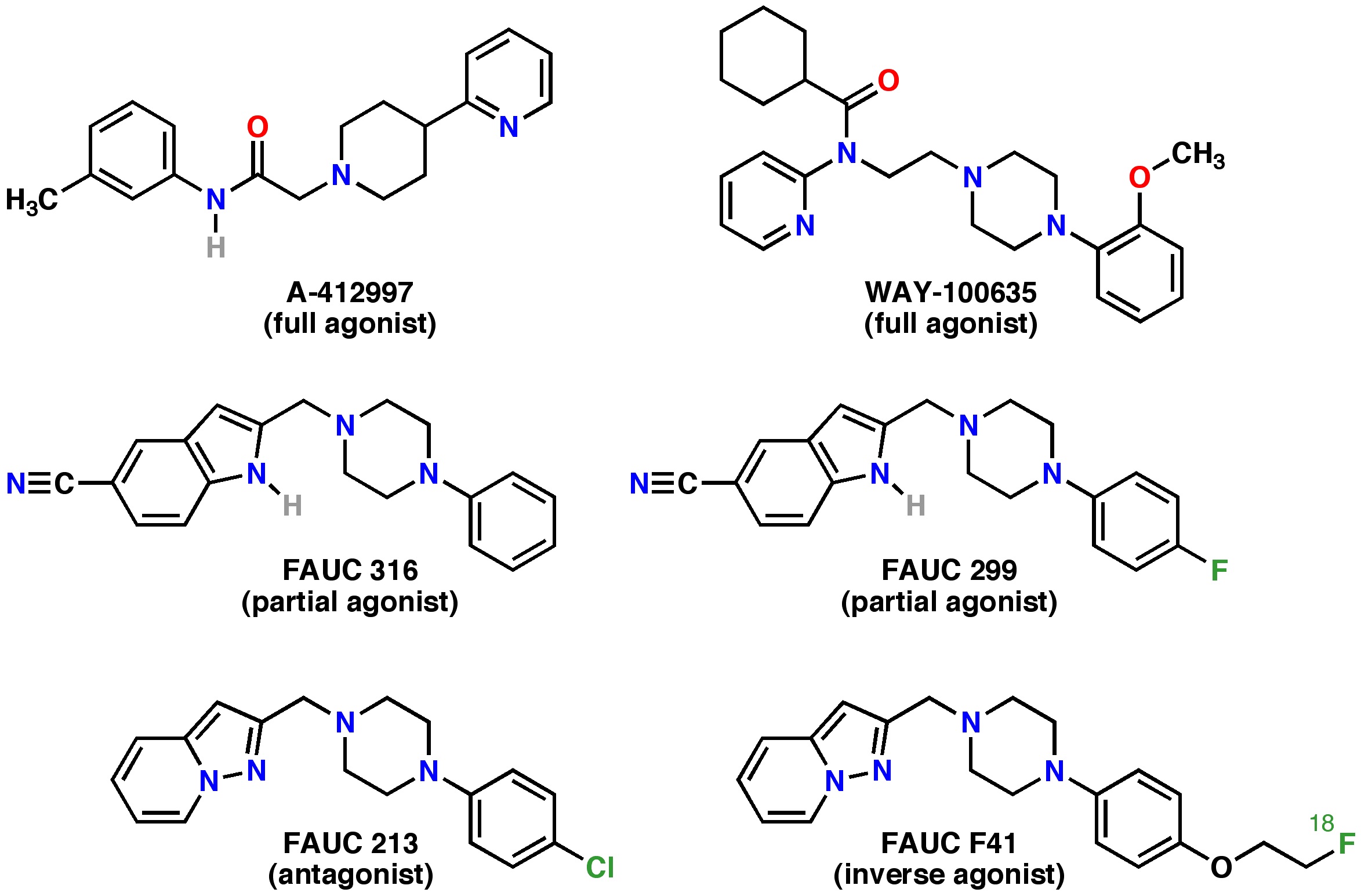
- WAY-100635: potent full agonist, with 5-HT1A antagonistic component
- A-412,997: full agonist, 100-fold selective over a panel of seventy different receptors and ion channels
- ABT-724 - developed for treatment of erectile dysfunction
- ABT-670 - better oral bioavailability than ABT-724
- FAUC 316: partial agonist, 8600-fold selective over other dopamine receptor subtypes
- FAUC 299: partial agonist
- F-15063: antipsychotic with partial D4 agonism
- (E)-1-aryl-3-(4-pyridinepiperazin-1-yl)propanone oximes
- PIP3EA: partial agonist
- Flibanserin - partial agonist
- PD-168,077 - D4 selective but also binds to α1A, α2C and 5HT1A
- CP-226,269 - D4 selective but also binds to D2, D3, α2A, α2C and 5HT1A
- Ro10-5824 – partial agonist
- Roxindole – D4 selective but also D2 and D3 autoreceptor agonist, 5HT1A receptor agonist, serotonin reuptake inhibitor)
- Apomorphine – D4 selective but also D2 and D3 agonist, α-adrenergic and serotonergic weak antagonist
- Nuciferine - D4 full selective but also partial D2 and D5 agonist
Antagonists
- A-381393: potent, subtype selective antagonist (2700-fold)
- FAUC 213
- L-745,870
- L-750,667
- ML-398
- S 18126 - also σ1 affinity
- Fananserin – mixed 5-HT2A / D4 antagonist
- Buspirone, an anxiolytic
- Clozapine - atypical antipsychotic with relative D4 and 5HT2A selectivity over D2
- Olanzapine - an atypical antipsychotic
- Pipamperone - sedative antipsychotic with relative D4 and 5HT2A selectivity over D2
Inverse agonists
- FAUC F41: inverse agonist, subtype selectivity of more than 3 orders of magnitude over D2 and D3
In popular culture
Michael Connelly's 2020 crime novel Fair Warning (ISBN 978-0-316-53942-5) revolves around a serial killer who uses DNA profiles obtained on the Dark Web to target female victims, specifically those whose DRD4 profiles allegedly make them more susceptible to risk taking and sexual promiscuity.
References
References
- (April 1991). "Cloning of the gene for a human dopamine D4 receptor with high affinity for the antipsychotic clozapine". Nature.
- (October 2017). "D4 dopamine receptor high-resolution structures enable the discovery of selective agonists". Science.
- (September 2011). "Dopamine D4 receptor gene DRD4 and its association with psychiatric disorders". Medical Science Monitor.
- (July 2013). "Clinical and molecular genetics of psychotic depression". Schizophrenia Bulletin.
- (May 1996). "Dopamine D4 receptor gene polymorphism is associated with attention deficit hyperactivity disorder". Molecular Psychiatry.
- (September 1998). "Evidence that the dopamine D4 receptor is a susceptibility gene in attention deficit hyperactivity disorder". Molecular Psychiatry.
- (September 2009). "The DRD4 exon 3 VNTR polymorphism and addiction-related phenotypes: a review". Pharmacology Biochemistry and Behavior.
- (April 2013). "Genetics of impulse control disorders in Parkinson's disease". Journal of Neural Transmission.
- (March 2010). "Molecular mechanisms underlying anorexia nervosa: focus on human gene association studies and systems controlling food intake". Brain Research Reviews.
- (April 2013). "Targeted D4 dopamine receptors: implications for drug discovery and therapeutic development". Current Drug Targets.
- (August 2004). "Dopamine receptor signaling". Journal of Receptor and Signal Transduction Research.
- (July 1992). "Multiple dopamine D4 receptor variants in the human population". Nature.
- (October 1993). "Distribution of a novel mutation in the first exon of the human dopamine D4 receptor gene in psychotic patients". Biological Psychiatry.
- (June 2010). "The dopamine D4 receptor: biochemical and signalling properties". Cellular and Molecular Life Sciences.
- (December 2007). "Advances in genetic findings on attention deficit hyperactivity disorder". Psychological Medicine.
- link. (21 February 2009 – [[SzGene]] database at [[Schizophrenia Research Forum]].)
- (January 2008). "Association of the dopamine D4 receptor (DRD4) gene and approach-related personality traits: meta-analysis and new data". Biological Psychiatry.
- (May 2007). "Functional activation by central monoamines of human dopamine D(4) receptor polymorphic variants coupled to GIRK channels in Xenopus oocytes". European Journal of Pharmacology.
- (June 2012). "Role of dopamine receptors in ADHD: a systematic meta-analysis". Molecular Neurobiology.
- (July 2001). "Meta-analysis of the association between the 7-repeat allele of the dopamine D(4) receptor gene and attention deficit hyperactivity disorder". The American Journal of Psychiatry.
- (June 2001). "Abnormal early stages of task stimulus processing in children with attention-deficit hyperactivity disorder--evidence from event-related gamma oscillations". Clinical Neurophysiology.
- (May 2007). "DRD4 and DAT1 polymorphisms modulate human gamma band responses". Cerebral Cortex.
- (May 2004). "The genetic architecture of selection at the human dopamine receptor D4 (DRD4) gene locus". American Journal of Human Genetics.
- (September 1995). "Modulation of intracellular cyclic AMP levels by different human dopamine D4 receptor variants". Journal of Neurochemistry.
- (1999). "Population Migration and the Variation of Dopamine D4 Receptor (DRD4) Allele Frequencies Around the Globe". Evolution and Human Behavior.
- (June 2008). "Dopamine receptor genetic polymorphisms and body composition in undernourished pastoralists: an exploration of nutrition indices among nomadic and recently settled Ariaal men of northern Kenya". BMC Evolutionary Biology.
- (January 1996). "Dopamine D4 receptor (D4DR) exon III polymorphism associated with the human personality trait of Novelty Seeking". Nature Genetics.
- (January 1996). "Population and familial association between the D4 dopamine receptor gene and measures of Novelty Seeking". Nature Genetics.
- (July 2007). "Drd4 gene polymorphisms are associated with personality variation in a passerine bird". Proceedings: Biological Sciences.
- (June 2014). "Behaviour-related DRD4 polymorphisms in invasive bird populations". Molecular Ecology.
- (July 2013). "Polymorphisms of the Dopamine D4 Receptor Gene in Stabled Horses are Related to Differences in Behavioral Response to Frustration". Animals.
- (2013). "Breed Differences in Dopamine Receptor D4 Gene (DRD4) in Horses". Journal of Equine Science.
- (December 2007). "Association of polymorphisms in the dopamine D4 receptor gene and the activity-impulsivity endophenotype in dogs". Animal Genetics.
- (2019). "The behavioural response of Great Tits to novel environment and handling is affected by the DRD4 gene". Ibis.
- (May 2012). "Control networks and neuromodulators of early development". Developmental Psychology.
- (June 2003). "Facilitatory effect of the dopamine D4 receptor agonist PD168,077 on memory consolidation of an inhibitory avoidance learned response in C57BL/6J mice". Behavioural Brain Research.
- (September 2005). "A-412997, a selective dopamine D4 agonist, improves cognitive performance in rats". Pharmacology Biochemistry and Behavior.
- (December 2008). "Selective dopamine D4 receptor agonist (A-412997) improves cognitive performance and stimulates motor activity without influencing reward-related behaviour in rat". Behavioural Pharmacology.
- (February 1999). "Dopamine D4 receptor antagonist reversal of subchronic phencyclidine-induced object retrieval/detour deficits in monkeys". Psychopharmacology.
- (October 2000). "The selective dopamine D4 receptor antagonist, PNU-101387G, prevents stress-induced cognitive deficits in monkeys". Neuropsychopharmacology.
- (2017). "Neuronal correlates of ketamine and walking induced gamma oscillations in the medial prefrontal cortex and mediodorsal thalamus". PLOS ONE.
- (November 2014). "Enhancement of gamma activity after selective activation of dopamine D4 receptors in freely moving rats and in a neurodevelopmental model of schizophrenia". Brain Structure & Function.
- (September 2015). "Behavioral and neurophysiological effects of Ro 10-5824, a dopamine D4 receptor partial agonist, in common marmosets". Psychopharmacology.
- (October 2006). "WAY-100635 is a potent dopamine D4 receptor agonist". Psychopharmacology.
- (September 2005). "A-412997 is a selective dopamine D4 receptor agonist in rats". Pharmacology Biochemistry and Behavior.
- (July 2004). "Discovery of 2-(4-pyridin-2-ylpiperazin-1-ylmethyl)-1H-benzimidazole (ABT-724), a dopaminergic agent with a novel mode of action for the potential treatment of erectile dysfunction". Journal of Medicinal Chemistry.
- (December 2006). "Discovery of 3-methyl-N-(1-oxy-3',4',5',6'-tetrahydro-2'H-[2,4'-bipyridine]-1'-ylmethyl)benzamide (ABT-670), an orally bioavailable dopamine D4 agonist for the treatment of erectile dysfunction". Journal of Medicinal Chemistry.
- (November 2000). "Cyanoindole derivatives as highly selective dopamine D(4) receptor partial agonists: solid-phase synthesis, binding assays, and functional experiments". Journal of Medicinal Chemistry.
- (August 2006). "1-aryl-3-(4-pyridine-2-ylpiperazin-1-yl)propan-1-one oximes as potent dopamine D4 receptor agonists for the treatment of erectile dysfunction". Journal of Medicinal Chemistry.
- (June 2006). "2-[(4-phenylpiperazin-1-yl)methyl]imidazo(di)azines as selective D4-ligands. Induction of penile erection by 2-[4-(2-methoxyphenyl)piperazin-1-ylmethyl]imidazo[1,2-a]pyridine (PIP3EA), a potent and selective D4 partial agonist". Journal of Medicinal Chemistry.
- (July 2005). "2-[4-(3,4-Dimethylphenyl)piperazin-1-ylmethyl]-1H benzoimidazole (A-381393), a selective dopamine D4 receptor antagonist". Neuropharmacology.
- (May 1996). "3-((4-(4-Chlorophenyl)piperazin-1-yl)-methyl)-1H-pyrrolo-2,3-b-pyridine: an antagonist with high affinity and selectivity for the human dopamine D4 receptor". Journal of Medicinal Chemistry.
- (November 1997). "Biological profile of L-745,870, a selective antagonist with high affinity for the dopamine D4 receptor". The Journal of Pharmacology and Experimental Therapeutics.
- (December 1996). "Identification and pharmacological characterization of [125I]L-750,667, a novel radioligand for the dopamine D4 receptor". Molecular Pharmacology.
- (September 2014). "Discovery and Characterization of ML398, a Potent and Selective Antagonist of the D4 Receptor with in Vivo Activity". ACS Medicinal Chemistry Letters.
- (October 1998). "S 18126 ([2-[4-(2,3-dihydrobenzo[1,4]dioxin-6-yl)piperazin-1-yl methyl]indan-2-yl]), a potent, selective and competitive antagonist at dopamine D4 receptors: an in vitro and in vivo comparison with L 745,870 (3-(4-[4-chlorophenyl]piperazin-1-yl)methyl-1H-pyrrolo[2, 3b]pyridine) and raclopride". The Journal of Pharmacology and Experimental Therapeutics.
- (March 2008). "Synthesis, radiofluorination, and in vitro evaluation of pyrazolo[1,5-a]pyridine-based dopamine D4 receptor ligands: discovery of an inverse agonist radioligand for PET". Journal of Medicinal Chemistry.
- (April 2001). "Comparative molecular field analysis of dopamine D4 receptor antagonists including 3-[4-(4-chlorophenyl)piperazin-1-ylmethyl]pyrazolo[1,5-a]pyridine (FAUC 113), 3-[4-(4-chlorophenyl)piperazin-1-ylmethyl]-1H-pyrrolo-[2,3-b]pyridine (L-745,870), and clozapine". Journal of Medicinal Chemistry.
This article was imported from Wikipedia and is available under the Creative Commons Attribution-ShareAlike 4.0 License. Content has been adapted to SurfDoc format. Original contributors can be found on the article history page.
Ask Mako anything about Dopamine receptor D4 — get instant answers, deeper analysis, and related topics.
Research with MakoFree with your Surf account
Create a free account to save articles, ask Mako questions, and organize your research.
Sign up freeThis content may have been generated or modified by AI. CloudSurf Software LLC is not responsible for the accuracy, completeness, or reliability of AI-generated content. Always verify important information from primary sources.
Report