From Surf Wiki (app.surf) — the open knowledge base
Dopamine beta-hydroxylase
Mammalian protein found in Homo sapiens

Mammalian protein found in Homo sapiens
The three substrates of the enzyme are dopamine, vitamin C (ascorbate), and O2. The products are norepinephrine, dehydroascorbate, and H2O.
DBH is a 290-kDa copper-containing oxygenase consisting of four identical subunits, and its activity requires ascorbate as a cofactor.
It is the only enzyme involved in the synthesis of small-molecule neurotransmitters that is membrane-bound, making norepinephrine the only known transmitter synthesized inside vesicles. It is expressed in noradrenergic neurons of the central nervous system (i.e., locus coeruleus) and peripheral nervous systems (i.e., sympathetic ganglia), as well as in chromaffin cells of the adrenal medulla.
Mechanism of catalysis
Based on the observations of what happens when there is no substrate, or oxygen, the following steps seem to constitute the hydroxylation reaction.
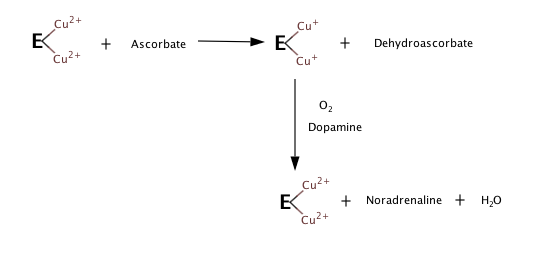
Although details of DBH mechanism are yet to be confirmed, DBH is homologous to another enzyme, peptidylglycine α-hydroxylating monooxygenase (PHM). Because DBH and PHM share similar structures, it is possible to model DBH mechanism based on what is known about PHM mechanism.
Substrate specificity
Dopamine β-hydroxylase catalyzes the hydroxylation of not only dopamine but also other phenylethylamine derivatives when available. The minimum requirement seems to be the phenylethylamine skeleton: a benzene ring with a two-carbon side chain that terminates in an amino group.
Assays for DBH activity in human serum and cerebrospinal fluid
DBH activity in human serum could be estimated by a spectrophotometric method or with the aid of ultra-high-performance liquid chromatography with photo diode array detector (UHPLC-PDA). A sensitive assay for the detection of DBH activity in cerebrospinal fluid using high-performance liquid chromatography with electrochemical detector (HPLC-ECD) was also described earlier.
Expression quantitative trait loci (eQTLs) at DBH loci
Genetic variants such as single-nucleotide polymorphisms (SNPs) at DBH loci were found to be associated with DBH activity and are well known expression quantitative trait loci. Allele variants at two regulatory SNPs namely rs1611115 and rs1989787 were shown to affect transcription of this gene. Mutations identified in dopamine β-hydroxylase deficiency and non-synonymous SNPs such as rs6271 in this gene were found to cause defective secretion of the protein from the endoplasmic reticulum.
Clinical significance
DBH primarily contributes to catecholamine and trace amine biosynthesis. It also participates in the metabolism of xenobiotics related to these substances; for example, the human DBH enzyme catalyzes the beta-hydroxylation of amphetamine and para-hydroxyamphetamine, producing norephedrine and para-hydroxynorephedrine respectively.
DBH has been implicated as correlating factor in conditions associated with decision making and addictive drugs, e.g., alcoholism and smoking, attention deficit hyperactivity disorder, schizophrenia, and Alzheimer's disease. Inadequate DBH is called dopamine β-hydroxylase deficiency.
Structure

It was difficult to obtain a stable crystal of dopamine β-hydroxylase. Hence an homology model based on the primary sequence and comparison to PHM is available.
However, a crystal structure was also put forward in 2016.
Regulation and inhibition
This protein may use the morpheein model of allosteric regulation.
Inhibitors
| HYD | HP | QCA | IQCA | BI | IAAhttps://pubchem.ncbi.nlm.nih.gov/compound/Imidazoleacetic-acid | Competitive | Uncompetitive | Mixed |
|---|---|---|---|---|---|---|---|---|
| Ascorbate | Ascorbate | Ascorbate | Ascorbate | Ascorbate | Ascorbate | |||
| Tyramine | Tyramine | |||||||
| Tyramine | Tyramine | Tyramine | Tyramine | |||||
| Ascorbate is cofactor; tyramine is substitute for dopamine, DBH's namesake substrate |
DBH is inhibited by disulfiram, tropolone, and, most selectively, by nepicastat. It is also inhibited by etamicastat and zamicastat.
DBH is reversibly inhibited by l-2H-Phthalazine hydrazone (hydralazine; HYD), 2-1H-pyridinone hydrazone (2-hydrazinopyridine; HP), 2-quinoline-carboxylic acid (QCA), l-isoquinolinecarboxylic acid (IQCA), 2,2'-bi-lH-imidazole (2,2'-biimidazole; BI), and IH-imidazole-4-acetic acid (imidazole-4-acetic acid;https://pubchem.ncbi.nlm.nih.gov/compound/Imidazoleacetic-acid IAA). HYD, QCA, and IAA are allosteric competitive.
Nomenclature
The systematic name of this enzyme class is 3,4-dihydroxyphenethylamine, ascorbate:oxygen oxidoreductase (β-hydroxylating).
Other names in common use include:
- dopamine β-monooxygenase
- dopamine β-hydroxylase
- membrane-associated dopamine β-monooxygenase (MDBH)
- soluble dopamine β-monooxygenase (SDBH)
- dopamine-B-hydroxylase
- 3,4-dihydroxyphenethylamine β-oxidase
- 4-(2-aminoethyl) pyrocatechol β-oxidase
- dopa β-hydroxylase
- dopamine β-oxidase
- dopamine hydroxylase
- phenylamine β-hydroxylase
- (3,4-dihydroxyphenethylamine) β-mono-oxygenase
References
References
- (1980). "Dopamine beta-hydroxylase in health and disease". Critical Reviews in Clinical Laboratory Sciences.
- (1968). "Oxidation of Organic Compounds".
- (May 1966). "An electron paramagnetic resonance study of 3,4-dihydroxyphenylethylamine beta-hydroxylase". The Journal of Biological Chemistry.
- (August 2000). "New insights into copper monooxygenases and peptide amidation: structure, mechanism and function". Cellular and Molecular Life Sciences.
- (1972). "Photometric Assay of Dopamine-β-Hydroxylase Activity in Human Blood". Clinical Chemistry.
- (2018). "Determination of Dopamine-β-hydroxylase Activity in Human Serum Using UHPLC-PDA Detection". Neurochemical Research.
- (1981). "Highly sensitive assay for dopamine-beta-hydroxylase activity in human cerebrospinal fluid by high performance liquid chromatography-electrochemical detection: properties of the enzyme". Journal of Neurochemistry.
- (2001). "A quantitative-trait analysis of human plasma-dopamine beta-hydroxylase activity: evidence for a major functional polymorphism at the DBH locus". American Journal of Human Genetics.
- (2016). "Deep sequencing identifies novel regulatory variants in the distal promoter region of the dopamine-beta-hydroxylase gene". Pharmacogenetics and Genomics.
- (2010). "Human dopamine beta-hydroxylase (DBH) regulatory polymorphism that influences enzymatic activity, autonomic function, and blood pressure". Journal of Hypertension.
- (2011). "Human dopamine beta-hydroxylase promoter variant alters transcription in chromaffin cells, enzyme secretion, and blood pressure". American Journal of Hypertension.
- (2011). "Norepinephrine deficiency is caused by combined abnormal mRNA processing and defective protein trafficking of dopamine beta-hydroxylase". Journal of Biological Chemistry.
- (2017). "Characterization of SNPs in the dopamine-beta-hydroxylase gene providing new insights into its structure-function relationship". Neurogenetics.
- Glennon RA. (2013). "Foye's principles of medicinal chemistry". Wolters Kluwer Health/Lippincott Williams & Wilkins.
- Taylor KB. (January 1974). "Dopamine-beta-hydroxylase. Stereochemical course of the reaction". J. Biol. Chem..
- (May 1973). "Human serum dopamine-β-hydroxylase. Relationship to hypertension and sympathetic activity". Circ. Res..
- (August 2012). "Functional polymorphism of the dopamine β-hydroxylase gene is associated with increased risk of disulfiram-induced adverse effects in alcohol-dependent patients". Journal of Clinical Psychopharmacology.
- (June 2012). "Association between dopamine beta hydroxylase rs5320 polymorphism and smoking behaviour in elderly Japanese". Journal of Human Genetics.
- (February 2005). "Analysis of polymorphisms in the dopamine beta hydroxylase gene: association with attention deficit hyperactivity disorder in Indian children". Indian Pediatrics.
- (November 2011). "Linkage analysis of plasma dopamine β-hydroxylase activity in families of patients with schizophrenia". Human Genetics.
- (2010). "The dopamine β-hydroxylase -1021C/T polymorphism is associated with the risk of Alzheimer's disease in the Epistasis Project". BMC Medical Genetics.
- (2011). "Structural insight of dopamine β-hydroxylase, a drug target for complex traits, and functional significance of exonic single nucleotide polymorphisms". PLOS ONE.
- (2016). "The crystal structure of human dopamine β-hydroxylase at 2.9 Å resolution". Science Advances.
- (March 2012). "Dynamic dissociating homo-oligomers and the control of protein function". Archives of Biochemistry and Biophysics.
- (July 1964). "Inhibition of dopamine- β -hydroxylase by disulfiram". Life Sciences.
- (July 1964). "The inhibitionof dopamine-β-hydroxylase by tropolone and other chelating agents". Biochemical Pharmacology.
- (August 1997). "Catecholamine modulatory effects of nepicastat (RS-25560-197), a novel, potent and selective inhibitor of dopamine-beta-hydroxylase". British Journal of Pharmacology.
- (September 2020). "Dopamine β hydroxylase as a potential drug target to combat hypertension". Expert Opin Investig Drugs.
- (February 1990). "Inhibition of dopamine beta-hydroxylase by bidentate chelating agents". Biochimica et Biophysica Acta (BBA) - Protein Structure and Molecular Enzymology.
This article was imported from Wikipedia and is available under the Creative Commons Attribution-ShareAlike 4.0 License. Content has been adapted to SurfDoc format. Original contributors can be found on the article history page.
Ask Mako anything about Dopamine beta-hydroxylase — get instant answers, deeper analysis, and related topics.
Research with MakoFree with your Surf account
Create a free account to save articles, ask Mako questions, and organize your research.
Sign up freeThis content may have been generated or modified by AI. CloudSurf Software LLC is not responsible for the accuracy, completeness, or reliability of AI-generated content. Always verify important information from primary sources.
Report