From Surf Wiki (app.surf) — the open knowledge base
Donets
River in Ukraine and Russia
River in Ukraine and Russia
| Field | Value |
|---|---|
| name | Donets |
| image | Северский Донец и Святогорская Лавра. 2006.jpg |
| image_size | 250 |
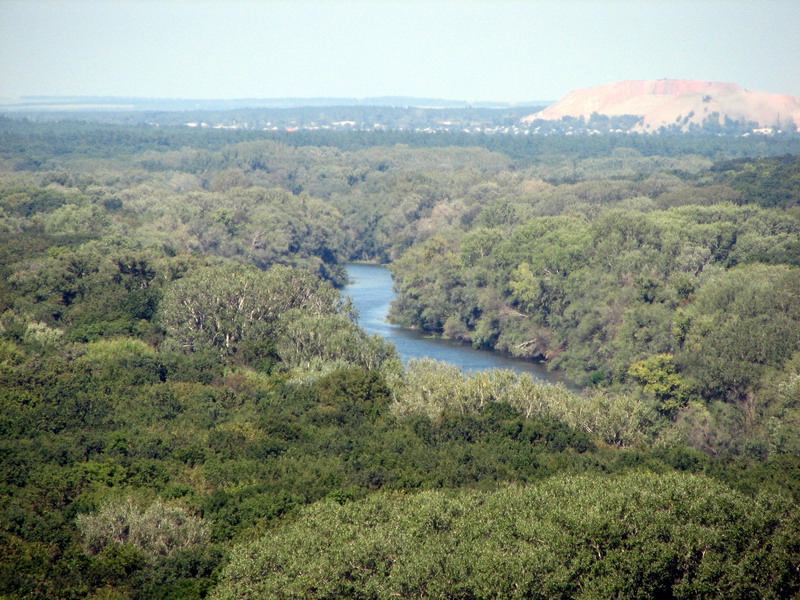
| image_caption | View of the Donets and Sviatohirsk Lavra, the Holy Mountains. |
| map | Seversky Donets.png |
| map_size | 250 |
| map_caption | Map of the Donets basin |
| mapframe | yes |
| mapframe-zoom | 5 |
| pushpin_map_size | 250 |
| subdivision_type1 | Country |
| subdivision_name1 | Russia, Ukraine |
| subdivision_type5 | Cities |
| subdivision_name5 | Belgorod, Lysychansk, Sievierodonetsk |
| length | 1053 km |
| discharge1_avg | 159 m3/s |
| source1_location | Prokhorovsky District, Belgorod Oblast, Russia |
| source1_coordinates | |
| source1_elevation | 200 m |
| mouth | Don |
| mouth_location | Rostov Oblast, Russia |
| mouth_coordinates | |
| mouth_elevation | 5.5 m |
| progression | |
| basin_size | 98900 km2 |
| mapframe-zoom = 5
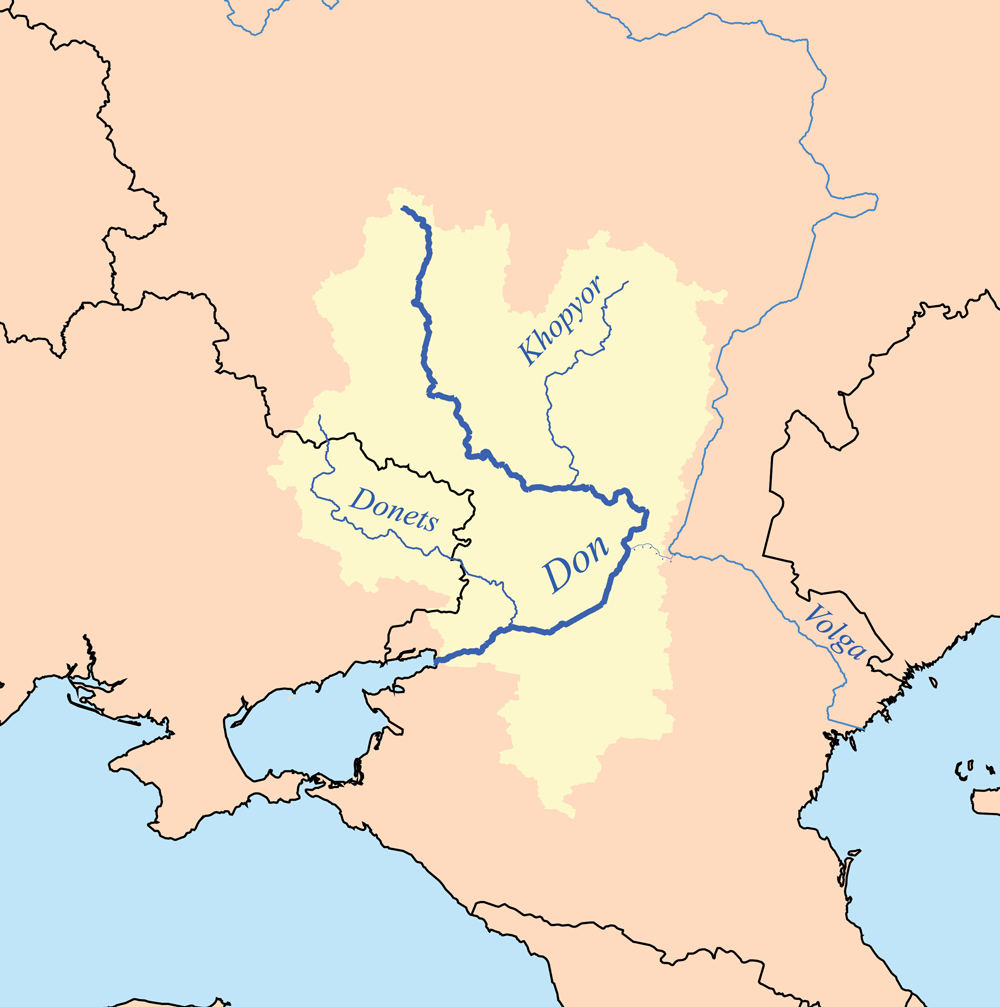
The Seversky Donets () or Siverskyi Donets (), usually simply called the Donets (), is a river on the south of the East European Plain. It originates in the Central Russian Upland, north of Belgorod, flows south-east through Ukraine (Kharkiv, Donetsk and Luhansk Oblasts) and then again through Russia (Rostov Oblast) to join the river Don, about 100 km from the Sea of Azov. The Donets is the fourth-longest river in Ukraine, and the largest in eastern Ukraine, where it is an important source of fresh water. It gives its name to the Donets Basin, known commonly as the Donbas, an important coal-mining and industrial region in Ukraine.
Etymology
The names Don and its diminutive Donets are derived from Iranic, Sarmatian Dānu "the river". Scytho-Sarmatians inhabited the areas to the north of the Black Sea from 1100 BC into the early medieval times.
In the 2nd century CE Ptolemy knew the river Don, into which the Donets flows, as Tanais, and Western Europeans recognized that the Don had a significant tributary which they called either the small Tanais or Donetz. The Slavic name of Seversky Donets derived from the fact that the river originates from the land of Severians. As the Italian-Polish chronicler Alexander Guagnini (1538–1614) wrote: "There is also another, small Tanais, which originates in the Seversky Principality (for this reason it is called Donets Seversky) and flows into the large Tanais above Azov".Guagnini, Alexander Description of Muscovy. 1997 reprint (in Russian): Есть также другой, малый Танаис, который берёт своё начало в Северском княжестве (поэтому он называется Донец Северский) и выше Азова впадает в большой Танаис.
Geography and hydrology
The Donets is the largest river in eastern Ukraine and the largest tributary of the Don. Its total length is 1053 km and the basin area is 98900 km2. Most of the river's length 950 km stretches across Ukraine. The average annual flow is 25 m3/s near the source and 200 m3/s at the confluence to the Don.
The Donets originates on the Central Russian Upland, near Podolkhi village, Prokhorovka area, north of Belgorod, at an elevation of 200 m above sea level. Its basin contains over 3000 rivers, of which 425 are longer than 10 km and 11 are longer than 100 km; 1011 of those rivers directly flow into the Donets. These rivers are mostly fed by melting snow, and thus the water supply is uneven during the year. The spring flood lasts about two months, from February to April

The width of the river mostly ranges between 30 and, sometimes reaching 100 - and even 4 km in the reservoir area. The river bottom is sandy and uneven, with the depth varying between 0.3 and and the average value of 2.5 m. The river freezes from around mid-December until late March and is covered by 20 - thick ice. It flows into the Don 218 km from the latter's mouth, at an elevation of 5.5 m above sea level; thus the fall of the river is 195 m with the average gradient of 0.18 m/km.
;Tributaries and reservoirs
- Right bank: Babka, Udy, Mozh, Bereka, Kazennyi Torets, Bakhmutka, Luhan, Luhanchyk, Great Kamianka, Kundryuchya
- Left bank: Nezhegol, Vovcha, Khotimlia, Velykyi Burluk, Hnylytsia, Balakliika, Iziumets, Oskil, Netryus, Zherebets', Krasna, Borova, Aidar, Derkul, Glubokaya, Kalitva, Bystraya
- Water reservoirs: Belgorod water reservoir, Pechenizke water reservoir
Current

The flow is slow, between 0.15 m/s at Chuhuiv and 1.41 m/s near Lysychansk. The river valley is wide: from 8 - in the upper part and up to 20 - downstream, and is asymmetrical. The right bank is usually high, sometimes with chalk cliffs, and is dissected by gullies. The left bank is more flat, contains numerous swamps, lakes and oxbow lakes, the largest of which is lake Lyman. The river is meandering, especially above the Oskil tributary.
Upstream, above Belgorod, the river contains several dams and small reservoirs. Downstream, below the confluence with the Wolf River (Volchiya River), there is the Pechenizke Reservoir (volume 86 km3), which supplies water to the city of Kharkiv. Below the Pechenizke Reservoir, the Donets is fed by the Udy and by its largest tributary, the Oskil. There the valley widens and its floodplain creates numerous oxbow lakes. Within Ukraine, the river flows between the Cisdesna plateau and the Donets lowland. In its middle, the river is partly fed by the Dnieper waters, which are brought though the Dnieper–Donbas–Seversky Donets channels which provide water to the coal industry of the Donets Basin (usually called the Donbas). Near the Russian city of Donetsk (Rostov oblast), the river crosses the Donets Ridge and flows in a narrow valley with steep and rocky slopes. In the lower part of the Donets lowland, the flow is interrupted by sluices and is slow. At the delta, it splits into three distributaries.
History

Pre-industrial era
The river played a crucial role for its ancient settlers as a source of water and food, means of transportation and trade route. The first archaeological evidence of settlers relates to Cheulean and Acheulean periods of Lower Paleolithic through stone tools (axes) found on the river banks near Izium city of Kharkiv Oblast and in Luhansk Oblast. Over the ages, the river banks were populated by tribals of various cultures, including Mousterian, Yamna, Catacomb, Scythian, Alan, Khazar and later Slavic cultures. Many of the related tribals had nomadic lifestyle characteristic of Kipchak people, Golden Horde and later of Cossacks. The river flows through the historic lands of Sloboda Ukraine as well as the lands of Don River Host. The many Cossacks became later assimilated into the strengthening Russian Empire, which had rebuilt and reinforced the fortress of Belgorod and cities of Kyiv, Izium, Luhansk, Chuhuiv and others in order keep defensive lines against the raids of nomads from the south-east. Later, the protective role of the river basin gave way to economic needs. In the 18th–19th centuries, the river was extensively used for watermills, which numbered by hundreds by the end of the 18th century, and the mill dams interrupted navigation on the river.
Industrial era
Industrialization in the 20th century shifted interests to mineral exploitation in Donbas, with water-hungry plants concentrated mostly in Kyiv, Luhansk and Donetsk. Already by the 1930s, Kharkiv, Donetsk and Luhansk were lacking water forcing the authorities to gradually create a network of canals and reservoirs. In 1936, the Kochetok Reservoir was created and coupled to the water system of Kharkiv. By the 1950s, this measure proved insufficient, and in the 1960s, Pechenizke Reservoir was constructed in place of the Kochetok Reservoir. It has with the capacity of 400 million m3 and provides about 75% of water consumed by Kharkiv. To supply water to southern Donbas and Donetsk, the 130-km long Donets-Donbas channel was built around 1958 starting near Raigorodok city, As a result of the industrial activity, the wild nature of Donets Basin transformed into an industrial settlement. After the breakup of the USSR, most of the basin territory became part of Ukraine.
Russo-Ukrainian War
During the War in Donbas, Luhansk Oblast was roughly split along the river between the Luhansk People's Republic, which controlled most of the portion of the oblast south of the Donets, and the Ukrainian government, which controlled most of the territory north of the Donets.
In May 2022, Russian attempts to cross the Donets above Lysychansk were stopped in the operationally decisive Battle of the Siverskyi Donets.
Environment
Being one of the largest rivers in Ukraine, the Donets is very intensively used in farming and industry. Ukraine alone uses more than 2 km3 of river waters per year, half of which is returned as polluted discharges; this consumption effectively reduces river runoff by 32 m3/s.
Donets suffered greatly even back in the 18th century, when old oaks were cut down along its banks. The industrial development of the 19th century reduced the groundwater levels of the basin. This resulted in shallowing of the river and slowed navigation. Until the mid-19th century, the river was rich in fish which population rapidly declined since then. The water quality is graded as level IV (polluted) to V (dirty). The main pollutants are fertilizers, petroleum, phenols, zinc, chromium and copper. In Kharkiv Oblast, water is contaminated by industrial and communal wastes of Belgorod, Izium and Shebekino cities, but the water is partially purified through the Pechenizke Reservoir. The density of plants and thus the contamination increase downstream in Donetsk and Luhansk areas, especially around Lysychansk and Sievierodonetsk, about 400 km from the mouth. Some tributaries of the Donets, such as Kozenyi Butt, Bakhmut and Lugan are so polluted that consuming fish caught there is dangerous. The purest segment of Donets is between the source and Belgorod, and between the Pechenizke Reservoir and Chuhuiv. Average water salinity is 650–750 mg/L, and it increases in winter to 1000 mg/L mostly due to industrial wastewater.

Flora and fauna
Fish
The Donets hosts 44 species of fish, predominantly small fishes such as European perch, rutilus and common rudd. Medium and large species include bream, perch, catfish and pike and are becoming increasingly rare. Near Pechenizke Reservoir a large hatchery of carp has successfully operated since 1967.
Amphibians and reptiles
.jpg)
On the banks of the river, in the floodplain wetlands, there are abundant water frogs, toads (especially green toad), smooth and great crested newts and less common grass snake, dice snake and European pond terrapin.
Mammals
Human activities, mainly cultivation of the steppes, resulted in the disappearance of animals formerly common in the basin, such as tarpan, steppe antelope, saiga antelope, marmots and others. Back in the 1960s–1970s, especially near Oskil River, it was not unusual to meet bobak marmot, Eurasian deer, wild boar and Russian desman. Current mammals of the basin include European beaver, Dipodidae, suslik, mice, European otter, European mink, weasel and bats.
| Russian desman | Marmot | European otter | Least weasel |
|---|
Birds
The number of bird species of the river basin reduced sharply over the past 100–150 years. The disappeared species include steppe eagle, tirkusha, sociable lapwing, bustard, black and winged lark. Less common are geese, swans, golden eagle, white-tailed eagle, peregrine falcon, honey buzzard and osprey. The reduction is mainly caused by the destruction of forests, especially old groves along the river banks. The creation of artificial forest belts (windbreaks) in the basin in the 1960s brought insectivorous birds new to this area, such as Streptopelia, European magpie and shrikes. From the traditional bird types, still common are several species of ducks, crows, Charadriiformes, Podiceps, great reed warbler and much less common are herons and storks. Only 12 individuals of demoiselle cranes remain in the area, near Sviatohirsk city. During the migratory season, the region is visited by greylag and black geese.
| Demoiselle crane | Great reed warbler | Skylark | White-tailed eagle |
|---|

Flora
Banks of the river used to contain groves of trees, which were cut during the 18th–19th centuries. Some of the trees were used for shipbuilding during the Russian-Turkish wars in the time of Peter I. By the 20th century, most meadows along the river banks were converted into farmers' fields. Only a small part of the old groves remains, mainly in the Kharkiv Oblast. North of Izium, there are still broadleaf forests, and pine forests are found near Chuhuiv. Many species of wild plants survive near floodplain wetlands. These include willow, downy birch, alder and krushinnik. Along the river banks, there are cane, swamp horsetail, carex, kizlyak, swamp sabelnik and other types of grass.
Tourism

The Donets is regarded as one of the most scenic rivers of East European Plain and contains many hiking and biking routes along its banks. Canoe rafting is rather popular, especially between Zmiiv and Sviatohirsk. Rafting is of the first (lowest) degree of difficulty. The busiest tourism months are from May to September. The most picturesque part is probably near the town of Izium, which hosts a National Park of Holy Mountains. Down to Lysychansk, the water is clean for swimming, and there are many sandy beaches on the shores. Near Pechenizke Reservoir, there are several health resorts.
Gallery
SeverskyDonets7.jpg|Spring flood Severskiy donetc wmp3210010.jpg|Spring SeverskyDonets4.jpg|Summer SeverskyDonets6.jpg|Winter Cеверский Донец.JPG|Seversky Donets River near the village of Yaremovka
References
Bibliography
References
- Mallory, J.P. and Victor H. Mair. ''The Tarim Mummies: Ancient China and the Mystery of the Earliest Peoples from the West''. London: Thames and Hudson, 2000. p. 106
- [http://i.ironau.ru/pdf/osjazfolk1949.pdf Абаев В. И. Осетинский язык и фольклор (Ossetian language and folklore). Moscow: Publishing house of Soviet Academy of Sciences, 1949. P. 236]
- Brown, Lloyd Arnold. (1979). "The story of maps". Courier Dover Publications.
- Rennell, James. (1830). "The geography system of Herodotus examined and explained, by a comparison with those of other ancient authors, and with modern geography". C.J.G. & F. Rivington.
- [http://textual.ru/gvr/index.php?card=171543 «Река Северский Донец (Северный Донец)»], Russian State Water Registry
- "Donets River".
- Bliznyakov E., Ovchinnikov KM, Bykov, VD ''Hydrography of the rivers of USSR'', Gidrometeoizdat, Leningrad, 1945.
- Kimstach, p. 376
- Gleditsch, Nils Petter. (1997). "Conflict and the environment". Springer.
- Antimonov NA ''Nature of the Belgorod Oblast'', Belgorod Publishing House, 1959
- (2008). "Редкие виды рыб бассейна Северского Донца Северо-восточной Украины". Kharkiv University; hosted at gov.ua.
- Рідний edge Харківський dominant педагогічний університет, Харків, 1999 {{ISBN. 966-7542-20-3
- Demchenko MA ''Hydrography of Kharkiv Oblast'' Proceedings of the Geographical Society of Kharkiv. Volume VIII. Kharkiv Oblast. Nature and economy, Kharkiv State University, Kharkiv, 1971
- – during this period the water level rises by {{convert. 3. to. 8. m
- Wisniewski В.І. ''Гідрологічні characteristics річок Ukraine'', Ніка-Center, Kyiv, 2003 (in Ukrainian)
- {{GSEn. 100668. Северский Донец (Seversky Donets)
- "Horyzont". narod.ru.
- Mendeleev D.I. ''Future force resting on the banks of the Donets''. "Northern Herald", No. 8 – 12, 1888
- Puzyrevskyi N.P. ''Prospecting on Sev. Donets River in 1903 and 1904 and the project of the waterway from Kharkiv and Belgorod to the confluence of river Donets'', St. Petersburg, 1910
- State Water Cadastre. Annual data on mode and surface water resources. Parts 1 and 2, Volume II, Issue 3. RIHMI-WDC, Obninsk, 1989
- Shramko BA ''History of Seversky Donets'' Kharkiv University, 1962
- Boriskovsky PI ''Paleolithic Ukraine'', Materials and Research on the Archaeology of the USSR (MIA), v. 40, Moscow, Leningrad, 1953
- "Описания Харьковского наместничества конца XVIII века". Original publication year 1788. Kiev, Наукова думка, 1991, [[:ru:Файл:Судоходство по Донцу 1785.JPG. p. 39]] (in Russian)
- Zhuk G. P. ''Seversky Donets'' – Donbas, Acad. "Donbas", Donetsk, 1982
- Gorelova, LN, Dogadina T., Krivitsky IA ''Enchanted Valley. Travel Seversky Donets'', "Prapor", Kharkiv, 1990
- Dotsenko AP ''Why does Seversky Donets become shallow and loses fish'', "Priroda" No. 4, 1958
- (14 May 2022). "Ukraine repels Russia's attempt to cross Donbas river, and drives invaders away from Kharkiv".
- Santora, Marc. (13 May 2022). "Ukraine decimated Russian forces trying to cross a river in the east, Britain's defense ministry says". The New York Times.
- (13 May 2022). "Ukrainian forces prevented attempted Russian river crossing in the Donbas, Britain says". Reuters.
- (12 May 2022). "Russian army 'lose entire battalion' trying to cross Ukraine bridge".
- "Ukraine inflicts huge losses on Russians during failed river crossing, officials say".
- Axe, David. "The Russians Lost An Entire Battalion Trying To Cross A River In Eastern Ukraine".
- (13 May 2022). "Ukraine river ambush shows again Russian military is 'not up to scratch'".
- (13 May 2022). "Bloody river battle was third in three days - Ukraine official". BBC News.
- (15 May 2022). "Russian troops suffer epic fail while attempting to cross river at Bilohorivka". euromaidanpress.com.
- (13 May 2022). "Russian War Report: Drone footage confirms failed Russian military pontoon crossing".
- Morozov YI ''Гидрографичекій очеркъ Сѣвернаго Донца'', University of Harkov, 1874
- Kimstach, pp. 192, 214, 258, 388–394
- Daniel P. Loucks. (1998). "Restoration of degraded rivers: challenges, issues, and experiences". Springer.
- Agroclimaticale directory of Kharkiv area, Gidrometeoizdat, Leningrad, 1957
- (2009). "Rivers of Europe". Academic Press.
- Lisiecki A. ''Fauna of the Kharkiv Oblast'' Proceedings of the Geographical Society of Kharkiv in Ukraine. Volume VIII. Kharkiv Oblast. Nature and economy, Kharkiv State University, Kharkiv, 1971
- (1995). "Amphibian populations in the Commonwealth of Independent States: current status and declines". Pensoft Publishers.
- Gorbunova NN ''Boat Tours in Ukraine'', Physical Education and Sports, Moscow, 1969
This article was imported from Wikipedia and is available under the Creative Commons Attribution-ShareAlike 4.0 License. Content has been adapted to SurfDoc format. Original contributors can be found on the article history page.
Ask Mako anything about Donets — get instant answers, deeper analysis, and related topics.
Research with MakoFree with your Surf account
Create a free account to save articles, ask Mako questions, and organize your research.
Sign up freeThis content may have been generated or modified by AI. CloudSurf Software LLC is not responsible for the accuracy, completeness, or reliability of AI-generated content. Always verify important information from primary sources.
Report