From Surf Wiki (app.surf) — the open knowledge base
Doncaster Rovers F.C.
Association football club in Doncaster, England
Association football club in Doncaster, England
| Field | Value |
|---|---|
| clubname | Doncaster Rovers |
| image | Doncaster Rovers F.C. logo.svg |
| upright | 1.0 |
| fullname | Doncaster Rovers Football Club |
| nickname | Rovers |
| short name | DRFC, Donny, The Red and White Army |
| founded | |
| ground | Eco-Power Stadium |
| capacity | 15,231 |
| owner | Doncaster Rovers Limited |
| chairman | Terry Bramall |
| manager | Grant McCann |
| league | |
| season | |
| position | |
| website | |
| current | 2025–26 Doncaster Rovers F.C. season |
| pattern_la1 | _doncaster2425h |
| pattern_b1 | _doncaster2425h |
| pattern_ra1 | _doncaster2425h |
| pattern_so1 | _doncaster2425hl |
| leftarm1 | FF0000 |
| body1 | FF0000 |
| rightarm1 | FF0000 |
| shorts1 | 000000 |
| socks1 | FF0000 |
| pattern_la2 | _doncaster2425a |
| pattern_b2 | _doncaster2425a |
| pattern_ra2 | _doncaster2425a |
| pattern_sh2 | _doncaster2425a |
| pattern_so2 | _doncaster2425al |
| leftarm2 | 000000 |
| body2 | 000000 |
| rightarm2 | 000000 |
| shorts2 | FF0000 |
| socks2 | 000000 |
| pattern_la3 | _doncaster2425t |
| pattern_b3 | _doncaster2425t |
| pattern_ra3 | _doncaster2425t |
| leftarm3 | FFFFFF |
| body3 | FFFFFF |
| rightarm3 | FFFFFF |
| shorts3 | FFFFFF |
| socks3 | FFFFFF |
the men's football club
Doncaster Rovers Football Club is a professional association football club based in Doncaster, South Yorkshire, England. The team currently competes in EFL League One, the third level of the English football league system after winning the 2024–25 EFL League Two title. The club play their home games at the Eco-Power Stadium, having moved from Belle Vue in 2007. Their home strip consists of red and white hoops, which has been the main design of the club's home shirt since 2001 through different variations.
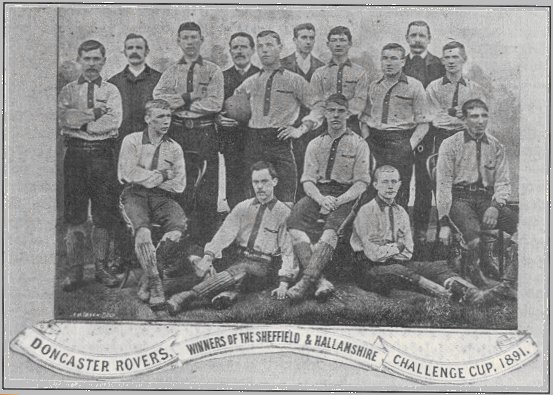
The club was founded in 1879 and turned professional six years later, moving to the Intake Ground. They entered the Midland League in 1891 and were elected into the Football League in 1901. The club lost re-election votes in 1903 and 1905 and so returned to the Midland League. They were admitted into the Football League for a third and final time in 1923 and went on to win the Third Division North in 1934–35. The club won two further Third Division North titles in 1946–47 and 1949–50, having been relegated from the Second Division in 1937 and 1948. Doncaster found themselves in the Fourth Division after suffering consecutive relegations in 1958 and 1959, though would go on to win the Fourth Division title in 1965–66 and 1968–69. The club continued to move between the third and fourth tiers, winning promotions in 1980–81 and 1983–84 and relegations in 1983 and 1988, before suffering relegation into non-League football in 1998.
Doncaster regained their Football League status after winning the 2003 Conference play-offs and then went on to win the Third Division title in 2003–04. They won the Football League Trophy in 2007 and the next year won the League One play-offs to secure a place in the second tier for the first time since 1958. They spent four of the next five seasons in the Championship, winning the League One title in 2012–13, though were relegated out of the Championship in 2012 and 2014. Relegated into League Two in 2016, they won an immediate promotion in 2016–17 and remained in League One until relegation in 2022.
History
Early years
The club was formed in 1879 by Albert Jenkins, a fitter at Doncaster's Great Northern Railway works. He gathered together some friends to play a match against the Yorkshire Institute for the Deaf in September 1879. The institute side took a 4–0 lead but the game ended as a 4–4 draw. On walking back from the game, the team took a rest at the Hall Cross, and had a discussion in which they decided to play more and called themselves Doncaster Rovers.
The first match under the name was on 3 October 1879, a draw away against Rawmarsh. Gradually, they became the main team in the town, and appear to have had their first professional players in 1887–88.
Rovers first entered the FA Cup in 1888–89, losing 9–1 to Rotherham Town at home. That same season, they also moved up to the Midland League, becoming Champions in 1896–97 and 1898–99.
They were first elected to the Football League in 1901, as a replacement for New Brighton Tower. Their first season in the League was in fact the one when Doncaster achieved their highest position ever (7th in the Football League Second Division). They only lasted two seasons in the league before being voted out in favour of local rivals Bradford City, having finished the 1902 season in the bottom three.

They spent the following season in the Midland League, only managing 11th place out of 18 but were elected back to Division 2. This time, in 1904–05, Doncaster finished bottom with W3 D2 L29, adrift by 12 points, gaining only 8 points – an unfortunate still standing record. They were voted out once again. The following several seasons saw them finish lower midtable of the Midland League, till between 1910 and 1913 they had greater success. The last few years before the war mediocrity returned, and in August 1914 debts run up over the years led to voluntary liquidation. However, a new club was formed in time for the 1914–15 season and was accepted into the Midland League to continue where the old club had left off. The outbreak of the First World War meant the club closed down, and the army took over its ground using it as a depot.
Inter war period
The club re-formed as a limited company after the war in 1919, rejoining the Midland League a year later playing at their new temporary Bennetthorpe Ground. The first two seasons Rovers finished lower-mid table. The third season they moved to Belle Vue, finished runners up and were accepted into the Football League Division 3 North for 1923–24 to replace Stalybridge Celtic.
The first match back in the Football League was a 0–0 draw against Wigan Borough at Belle Vue on 25 August 1923, with Rovers playing in red tops with white shorts. One of the players in that first match was Rovers legend Tom Keetley The next few seasons saw them rise towards the top of the table, then decline towards the bottom, before in the early 1930s finishing consistently near the top and finally becoming Champions in 1934–35.
Rovers spent two seasons in Division 2, relegated in 1936–37. However, they did well in the following two seasons before the outbreak of war, being runners up in Division 3 North, with only the champions being promoted at that time.
Second World War – late 1990s
Doncaster Rovers were involved in the longest ever competitive football match, against Stockport County at Edgeley Park on 30 March 1946, in a Division Three North cup tie. The match was deadlocked at 2–2 at 90 minutes, and after two 10-minute periods of extra time there was no further score. The rule at that time was that the game would carry on until one team scored. However, after 203 minutes, and with darkness closing in, the game was finally stopped. Fans were said to have left the game, gone home for their tea, and come back to watch the end of the game. The replay, at Doncaster, was won by Rovers 4–0.
In 1946–47 Doncaster set a record for the most games won in a league season (33), when they won the Third Division North title. The following season saw them relegated from the Second Division, but two years later with Peter Doherty as player-manager, they won the Third Division North again. This time they stayed in the Second Division for eight seasons, their most successful period to date.
During this time, several high class players were with Doncaster including Harry Gregg who kept goal, and was sold to Manchester United in December 1957 for £23,500. At the time, he was the most expensive goalkeeper in the world. He went on to help save lives in the Munich air disaster and was a regular goalkeeper for Northern Ireland. Another player, lesser known outside Doncaster, was Alick Jeffrey. Matt Busby, manager of Manchester United, had lined him up to be bought, however in October 1956 Jeffrey badly broke his leg playing for England under-23s. This ended his move and any chance of what was seen to be an almost certain glittering international career to come. Doncaster suffered two consecutive relegations in 1958 and 1959 to drop to the Fourth Division.
Billy Bremner, who achieved fame for his playing career with Leeds United and Scotland, managed Doncaster twice, his final spell ending in November 1991 – six years before his death.
Richardson era
During the early 1990s, Ken Richardson took over as the majority shareholder of the club. He invested a significant amount of money into Doncaster Rovers with the aim of obtaining a new stadium. When he was refused a new stadium by the council he soon lost interest. Richardson hired three men to torch Belle Vue and planned to sell the ground to developers. The attempt put Richardson in jail for four years, ruined Belle Vue and Rovers were edging closer to relegation. In 1998 Rovers dropped out of the league with a −83 goal difference. He withdrew his financial backing and as a result the club was subject to an administration order. The better players were sold to ease some of the financial burden. The fans blamed Richardson for effectively destroying Rovers and even a funeral was held at Belle Vue on the last game of the 1997–98 season complete with coffin along Carr House Road. Just weeks after Rovers were relegated, Richardson was found guilty of trying to set fire to the Rovers ground, apparently hoping to pay off the club's debts with the insurance money.
The rise
The Westferry Consortium took over the club just before the beginning of the 1998–99 season with a commitment to invest heavily in the club. The new ownership stated aspirations of returning it to the second tier and building a new stadium within ten years, both of which they went on to achieve within the ten years. Doncaster found their best form in 50 years in the 2000s.
After five seasons in the Conference, under the helm of manager Dave Penney the club returned to the fourth tier (known at the time as Division Three) after winning the 2003 Conference play-off final, in the only sudden death goal in the history of English football promotion play-offs. In 2003–04, the first season they were back in the Football League, Rovers achieved promotion to the third tier as champions. Doncaster were the first team to win the fourth level Championship three times, 1966, 1969, and 2004.
In 2005–06, Doncaster defeated two Premier League teams in the League Cup – Manchester City and Aston Villa. They reached the quarter-finals of the competition where they met Arsenal. They went ahead in normal time and Arsenal equalised, and in extra time Rovers went up for a second time but Gilberto Silva equalised in injury time and the North London side went on to win on penalties. Penney left in August 2006 feeling he had taken the club as far as he could and was swiftly replaced with former AFC Bournemouth manager Sean O'Driscoll.
A new stadium was completed in December 2006. Doncaster's first game at the new Keepmoat Stadium was against Huddersfield Town on New Year's Day, 2007 and the first goal scored at the Stadium was by Mark McCammon.
2007–2023
In the 2006–07 season, Doncaster reached the final of the Football League Trophy at the Millennium Stadium. After a 2–2 draw with Bristol Rovers in normal time, a header from captain Graeme Lee in extra time saw Doncaster claim their first major trophy.

In the 2007–08 season, Doncaster narrowly missed out on automatic promotion on the final day of the season to Nottingham Forest. They defeated Southend United 5–1 in the semi-final to advance to the League One play-off final at Wembley Stadium. They beat Leeds United 1–0 in the final on 25 May 2008 to return to the second tier after a half century absence. A James Hayter headed goal in the 47th minute was enough to secure victory in front of over 75,000 fans at Wembley. The first half of the 2008–09 season saw Doncaster struggling to adapt to the Championship. However, Doncaster ended their first season in the Championship comfortably in 14th position. Doncaster finished the 2009–10 season marginally better than their first season back in the Championship, in 12th and earning two more points than the previous season with 60 points. This was despite a promising period towards the end of the season which saw Doncaster close to the play-off places, thanks in part to Sheffield United loanee Billy Sharp who scored 15 goals during his stay.
The 2010–11 season saw Doncaster struggle. Despite a club record signing of £1.15 million for Billy Sharp, the season was plagued by injuries to key players, as well as poor form. They finished in 21st place, 6 points clear of relegated local rivals Sheffield United and Scunthorpe United.
Rovers struggled in the 2011–12 season; seven games into the season, Rovers had failed to win a game. This led to the sacking of manager Sean O'Driscoll, who was later replaced by Dean Saunders from Wrexham.{{cite news |access-date=23 September 2011 |archive-date=13 January 2016 |archive-url=https://web.archive.org/web/20160113023513/http://news.bbc.co.uk/sport1/hi/football/teams/d/doncaster/9596378.stm |url-status=live
The squad was rebuilt for the 2012–13 season with 19 players leaving. Expectations were low, and on 17 January caretaker manager Brian Flynn was given the role permanently until the end of the season. In an incredible finale to the season at Griffin Park, they beat Brentford 1–0 when James Coppinger scored in the last seconds of 5 minutes of added time, only seconds after Brentford's Marcello Trotta had hit a penalty against the crossbar. If Brentford had won, they would have been promoted and Doncaster would have to compete in the play-offs. As it was, the goal put Doncaster one point above Bournemouth as champions.
Following promotion to the Championship for the 2013–14 season, Brian Flynn was moved to become Director of Football and overseeing the newly formed development squad which would be playing competitive games. Paul Dickov was brought in as manager. To boost support for their chosen charity, Bluebell Wood Children's Hospice, the club signed One Direction singer Louis Tomlinson on a non-contract basis.
On 9 November, John Ryan gave an emotional farewell and stepped down as chairman of the club after 15 years, minutes before the kick-off against a Championship encounter against Barnsley at Oakwell, amid reports of boardroom disagreements following a proposed takeover bid by a hedge-fund consortium led by Sequentia Capital. On 3 May 2014, Doncaster were relegated back to League One after just one season following a 1–0 defeat to Leicester City on the final day of the season.
Rovers finished the 2014–15 season in 13th place, before being relegated to League Two after finishing 21st in 2015–16 with new manager Darren Ferguson. The 2016–17 season saw them being promoted back to League One at the first attempt in 3rd position, missing out on the title on the final day of the season.
Darren Ferguson left his post in June 2018 and was replaced by another former Peterborough boss in Grant McCann ahead of the 2018–19 season. Under McCann, Rovers finished sixth in League One, qualifying for the end of season play-offs where they faced Charlton Athletic over two legs. A 2–1 defeat in the first leg and an early Krystian Bielik goal in the second left Rovers with a mountain to climb at The Valley, but goals from captain Tommy Rowe and Andy Butler forced extra time. John Marquis put Rovers ahead for the first time in extra time, only for Darren Pratley to equalise a minute later. Rovers lost the penalty shoot-out 4–3 with misses coming from Rowe and Marquis as they fell just short of making the Wembley Stadium showdown.
McCann left in the summer for Championship side Hull City and was replaced by former defender Darren Moore ahead of the 2019–20 campaign. With the club sitting around the play-offs in December, the club's season looked to be going well. However, Moore moved to struggling Sheffield Wednesday on 1 March 2021, and Andy Butler was appointed as interim manager for the remainder of the season. Doncaster finished the season in 14th place in League One.
For the 2021–22 season, former trophy winning Doncaster Rovers player Richie Wellens was installed as first team manager. Wellens was relieved of his duties as Doncaster Rovers manager on 2 December 2021. Doncaster appointed then under-18s manager Gary McSheffrey as the interim manager, later deciding that McSheffrey was a good fit, and gave him the position full-time on 29 December 2021. Doncaster Rovers finished the season in 22nd place, relegating them to League Two. Rovers then finished 18th in League Two in the 2022–23 season, sacking McSheffrey in October 2022 then his successor Danny Schofield after the season's end.
2023–present
On 12 May 2023 Rovers re-appointed Grant McCann as manager. McCann helped Rovers to a club record-equalling run of 10 successive wins to climb into the top seven in the final week of the 2023–24 season, though the club lost on penalties to Crewe Alexandra at the play-off semi-final stage. McCann led Doncaster to the League Two title in the following season, beating Notts County in the final match of the season.
Players
Main article: :Category:Doncaster Rovers F.C. players
Current squad
Out on loan
Will Flint|other=at Gateshead until 31 May 2026}} .
Academy
Main article: Doncaster Rovers F.C. Academy
The youth system currently has Category 3 status with the U18 academy team playing in the EFL Youth Alliance North East Conference league.
Non-playing staff
| Board | Role | Person |
|---|---|---|
| Chairman | Terry Bramall | |
| Directors | Terry Bramall | |
| Gavin Baldwin | ||
| Chief Executive | Gavin Baldwin |
| First-team staff | Role | Person |
|---|---|---|
| Manager | NIR Grant McCann | |
| Assistant Manager | IRL Cliff Byrne | |
| First Team Coach | ENG Barry Richardson | |
| ENG James Coppinger | ||
| Goalkeeping Coach | WAL Kyle Letheren | |
| Head of Recruitment | SCO Lee Glover | |
| Head of Medical | ENG Dave Rennie | |
| Club Doctor | ENG Dr Tim Douglas |
Stadium

1885–1915: Intake Ground
Main article: Intake Ground
For the first six years the club began playing their games wherever they could, on playing fields at Town Moor and the Racecourse. They gained a permanent ground in 1885 when they started playing their games near the Institute for the Deaf and Dumb and so was known as the Deaf and Dumb Ground. A year later the stadium was officially named as the Intake Ground. A few months after completion, the roof blew off the stand, and the same happened in 1894 on the press and team officials stand after a gale. They played their football there until August 1914 when the club went into liquidation. A new company did take over the club soon after but all English league competition was suspended in 1915 due to the First World War and the club was closed down and the ground turned into an Army depot.
1920–1922: Bennetthorpe Ground
When the club was re-formed after the war in the summer of 1919, the Army were still occupying the old Intake Ground as a depot. They had wanted to move to Low Pastures but restrictions set by the local council meant this was not a viable option. The Club did not join the Midland League until 1920–21, by which time and as a temporary solution, a field was found on the south side of Bennetthorpe for which they were given a two-year lease. On the first day of the second season (1921–22) there, in the Midland League, the Bennetthorpe Ground saw 7,219 people watch Rovers against Gainsborough Trinity. The ground consisted of a small stand on one side and small organised terraces around the pitch. Some of the fencing/gates on Town Moor Avenue remain.
1922–2006: Low Pasture, Belle Vue
Main article: Belle Vue (Doncaster)
With council restrictions on the six acre Low Pastures site having been satisfactorily negotiated, the club moved there for the beginning of the 1922–23 season. Large amounts of ash from nearby coal tips was laid as a base for the pitch, serving it well throughout its years of use with superb drainage. Initially, there was a stand for 4,000 seated fans with terracing in front for another 3,000. The ground had a unique feature in that home and away teams had separate entrances. The stadium was opened in 1922 by Charles Sutcliffe, a representative of the Football League when it was named Belle Vue.{{cite web |access-date=11 September 2009 |archive-date=11 September 2009 |archive-url=https://web.archive.org/web/20090911155015/http://www.talkfootball.co.uk/guides/doncaster_rovers_fc.html |url-status=live
Following the Bradford City stadium fire disaster, in 1985 the wooden "Cow Shed", as the old Bennetthorpe stand was known, had to be removed for safety reasons. Mining subsidence in 1987 meant much of the "Pop Side" was removed, drastically reducing the grounds capacity to around 10,000. Further safety conditions imposed after the Hillsborough disaster led the capacity to fall to 7,294.
When the Westferry Consortium took over the club in 1998 one of the first guarantees was to help establish a new stadium for the club. Belle Vue had never been upgraded heavily since 1938 and despite minor cosmetic changes and the addition of some seating was really showing its age by the time Westferry took over. Despite this, some improvements were made in the last few years of its use as the club rose out of the conference, through Division 3 and into League 1. The Town End terracing was made safe and usable with portacabins added as executive stands behind it. The Rossington End was also extended and updated, with the capacity in its final years rising to around 11,500.
In 2003 it was renamed the Earth Stadium after Earth Finance started sponsoring the ground. Belle Vue was Doncaster's home for 84 years.
2007–present: Keepmoat/Eco-Power Stadium
Main article: Eco-Power Stadium
A new 15,231 all-seated stadium owned by Doncaster Metropolitan Borough Council and rented by the club, was completed in December 2006. The first game at the new Keepmoat Stadium was against Huddersfield Town on New Year's Day, 2007. The game also saw the first three red cards in the new stadium. Doncaster Rovers' centre forward Mark McCammon was the first player ever to score on the new pitch in a football match. The official opening of the Keepmoat Stadium was on 3 August 2007, with Doncaster Rovers playing a Manchester United XI in front of a crowd of 13,080. United won the game 2–0 with Anderson making his debut for them.{{cite news |access-date=28 August 2007 |archive-date=14 February 2008 |archive-url=https://web.archive.org/web/20080214020657/http://www.doncasterfreepress.co.uk/rovers?articleid=3101104 |url-status=live
On 19 June 2012 it was confirmed that Doncaster Rovers had secured a 99-year operating lease from the council to lead the management of the Keepmoat stadium with a view to improving operating results. The change placed the club back in charge of its home stadium after the period of renting since its move from Belle Vue (also leased from the council) in 2007.{{cite web |access-date=16 July 2012 |archive-date=8 August 2014 |archive-url=https://web.archive.org/web/20140808064329/http://www.yorkshirepost.co.uk/sport/football/doncaster/rovers-welcome-keepmoat-lease-1-4659467 |url-status=live
On 27 December 2021, the stadium underwent a name change in line with the sponsorship rights being handed over from Keepmoat Homes to the Eco-Power Group.
Training facilities
Doncaster train at Cantley Park which has been their main training facility since June 2000. The site was originally leased from Case IH.
Crests


Like most of the early English football clubs, the original crest adopted by Doncaster Rovers was that of the local coat of arms. The coat of arms of Doncaster at the time was of two lions holding Yorkshire roses in their mouths as well as a red shield depicting the old medieval Doncaster Castle. The coat of arms is primarily red and white which explains the team's decision to adopt red and white as their colours. The club stopped using Doncaster's coat of arms in 1972 when the Viking crest was introduced.
In the sixties Doncaster council denied Rovers permission to use the coat of arms and therefore a competition was held, from which the best design would be selected as the club's new badge. The winner and current crest was designed by a group of local students and named "the Viking".
When the new crest was introduced it included a monochrome Viking image overlaying a red and white circle, which denoted the club's colours, along with the year of the club's formation 1879. The Viking image would become known as "The Turk's Head". Also included on the crest was a shield with the club's initials – D.R.F.C. as well as the Yorkshire white rose in reference to the club's location. The inset shield was also coloured red and white to denote the team colours. In the early 1990s the crest was altered, omitting the red and white circle background and the Viking image was coloured gold.
A further modification to the Doncaster Rovers crest was introduced in 2006 and used until 2012. This version included a new Yorkshire rose design on the shield as well as a slightly different Viking image in dark yellow.
The club reverted to the previously used design in 2012 with a two-tone gold background. This is the version still in use by the club today.
Kits and sponsorship
From 1879 to 1885 Doncaster played in blue and white, and since then red and white. The club's first strip was a navy blue and white strip with a yellow diagonal cross. The kit uniquely included a blue Tam o' Shanter with a red toorie at the centre. A solid red shirt with a black collar was the first design adopted when the club first entered the English Football league in 1901. Since 2001 the club have played in a red and white hooped home shirt.
The home shirts have been red and white hooped (44 seasons), solid red (37), solid white (18), and red and white striped (10).
In recent years, Rovers have had a third kit each season promoting mental health charity Campaign Against Living Miserably (CALM), with proceeds of certain home games being donated to the charity.
| Season(s) | Shirt manufacturer | Main sponsor | Second shirt sponsor* |
|---|---|---|---|
| 1879–1977 | None | None | None |
| 1978–1979 | Umbro | ||
| 1979–1981 | Sereena | ||
| 1981–1982 | Lynx | ||
| 1982–1984 | Gertroot | ||
| 1982–1984 | Hobbott | CIL | |
| 1984–1987 | Pilkington Glass | ||
| 1987–1988 | Spall | St. George's Car Centre | |
| 1988–1990 | Doncaster Free Press | ||
| 1990–1992 | Ribero | ||
| 1992–1993 | Matchwinner | ||
| 1993–1994 | European Car Rental | ||
| 1994–1995 | Doncaster Star | ||
| 1995–1996 | Hayselden Motors | ||
| 1996–1997 | Patrick | East Riding Sacks | |
| 1997–1998 | Olympic Sports | ||
| 1998–1999 | Asics | Beazer Homes | |
| 1999–2001 | Viking Leisurewear | ||
| 2001–2002 | Vandanel | One Call Insurance | |
| 2002–2003 | Ledger Mobility | ||
| 2003–2006 | Carlotti | Streetwise Sports | Toyota |
| 2006–2007 | Streetwise Sports | Carlotti | |
| 2007–2008 | Carlotti | Wright Investments | Stoneacre Motor Group |
| 2008–2010 | Vandanel | ||
| 2010–2013 | Nike | One Call Insurance | |
| 2013–2016 | Avec | ||
| 2016–2017 | FBT | ||
| 2017–2018 | Virgin Trains East Coast | ||
| 2018–2019 | LNER | ||
| 2019–present | Elite Pro Sports |
LNER pledged their sponsorship for 2 further years after the 2018–2019 season. Stoneacre also agreed a new contract with the club to last until the end of the 2021–2022 season extending the partnership to 13 years.
*This sponsor appears on the back of the home kit
Mascot
The team's mascot, previously portrayed by Andrew Liney, is a brown dog known as Donny Dog that wears a red and white Rovers jersey. Before a scheduled appearance during the game against Huddersfield Town at the Galpharm Stadium on 4 March 2006, police prevented Liney from entering the stadium in costume, citing unspecified "police intelligence", and refused him permission to wear any part of the costume within 50 metres of the stadium. Mr Liney later received a full written apology for these unfounded allegations from the head of West Yorkshire Police. The mascot was next portrayed by Tracy Chandler and in June 2011, she was relieved from the position after she posed in her underwear for a Sunday newspaper. Later in the same week she was reinstated back as the club's mascot.
A second mascot, a yellow haired and bearded Viking with a helmet and wearing the away shirt named Eric the Viking, made its first appearance at the home game against Yeovil on 25 February 2013.
Fanzine
Doncaster Rovers' fanzine is called "Popular Stand" which was first launched on 17 January 1998. Previously there have been several other fanzines "Raise The Roof", "Warboys is still God" and "Keegan Was Crap Really" which are no longer being published. The fanzine sells at £1 which is the same price as when it was first published in 1998. All of its profits of the fanzine are donated to Doncaster Rovers or related causes. Popular Stand is currently edited by Glen Wilson.
In 2016 Popular Stand won the Football Supporters' Federation Fanzine of the Year.
Rivalries
Doncaster Rovers' main rivals are Rotherham United, Barnsley, and Scunthorpe United, with Sheffield Wednesday, Sheffield United, Chesterfield, Leeds United, Mansfield Town, Grimsby Town, Bradford City and Nottingham Forest all being rivalries to a lesser extent.
In popular culture
TV
In 1998 Rovers featured in a documentary on Yorkshire Television. This episode titled "Trading Places" documents and contrasts the 1997–98 season for two of the region's football clubs; Rovers heading out of the Football League and Halifax Town heading the opposite the way as Champions of the Conference. Also in 1998 the club was featured in the 1998 Channel 5 'fly-on-the-wall' documentary "They Think It's All Rovers" in which it showed the fall of Rovers. In the early 1980s there was a documentary about Billy Bremner as the manager of Rovers. The documentary is notable not only for the inside look at the pre-match preparations, warm-up conducted in the dressing rooms, starting line-up read out as if it is coming to Bremner there and then, but for such rare footage of early 1980s Belle Vue, with a full-size Popular Stand and the Cow Shed still standing at the Town End.
League history
Main article: List of Doncaster Rovers F.C. seasons
Doncaster Rovers have played their football in the following leagues:
Midland Alliance League
Midland Football League:
1891–92 to 1900–01, 1903–04, 1905–06 to 1922–23
Football League:
1901–02 to 1902–03, 1904–05, 1923–24 to 1997–98, 2003–04 to Present
2nd Tier – Division 2, Championship:
1901–02 to 1902–03, 1904–05, 1935–36 to 1936–37, 1947–48, 1950–51 to 1957–58, 2008–09 to 2011–12, 2013–14
3rd Tier – Division 3 North, Division 3, League 1:
1923–24 to 1934–35, 1937–38 to 1946–47, 1948–49 to 1949–50, 1958–59, 1966–67, 1969–70 to 1970–71, 1981–82 to 1982–83, 1984–85 to 1987–88, 2004–05 to 2007–08, 2012–13, 2014–15 to 2015–16, 2017–18 to 2020–21, 2025–26 to Present
4th Tier – Division 4, Division 3:
1959–60 to 1965–66, 1967–68 to 1968–69, 1971–72 to 1980–81, 1983–84, 1988–89 to 1997–98, 2003–04, 2016–17, 2022–23 to 2024–25
5th Tier – Football Conference
Last ten seasons
| Season | League | Pos | P | W | D | L | F | A | GD | Pts |
|---|---|---|---|---|---|---|---|---|---|---|
| 2024–25 | League 2 | 1st | 46 | 24 | 12 | 10 | 73 | 50 | +23 | 84 |
| 2023–24 | League 2 | 5th | 46 | 21 | 8 | 17 | 73 | 68 | +5 | 71 |
| 2022–23 | League 2 | 18th | 46 | 16 | 7 | 23 | 46 | 65 | −19 | 55 |
| 2021–22 | League 1 | 22nd | 46 | 10 | 8 | 28 | 37 | 82 | −45 | 38 |
| 2020–21 | League 1 | 14th | 46 | 19 | 7 | 20 | 63 | 67 | −4 | 64 |
| 2019–20 | League 1 | 9th | 34 | 16 | 11 | 9 | 51 | 33 | 18 | 54 |
| 2018–19 | League 1 | 6th | 46 | 20 | 13 | 13 | 76 | 58 | 18 | 73 |
| 2017–18 | League 1 | 15th | 46 | 13 | 17 | 16 | 52 | 52 | 0 | 56 |
| 2016–17 | League 2 | 3rd | 46 | 25 | 10 | 11 | 85 | 55 | 30 | 85 |
| 2015–16 | League 1 | 21st | 46 | 11 | 13 | 22 | 48 | 64 | −16 | 46 |
Pos = Position; P = Played; W = Won; D = Drawn; L = Lost; F = Goals for; A = Goals against; GD = Goal difference; Pts = Points
Managerial history
Main article: List of Doncaster Rovers F.C. managers
Player of the Year
The following players have won Doncaster Rovers Player of the year award.
| Season | Winner | Notes |
|---|---|---|
| 1991–92 | IRE Eddie Gormley | |
| 1992–93 | IRE Eddie Gormley | |
| 1996–97 | SCO Colin Cramb | |
| 1997–98 | ENG Lee Warren | |
| 1998–99 | ENG Ian Duerden | |
| 1999–2000 | ENG Simon Marples | |
| 2000–01 | SCO Jamie Paterson | |
| 2001–02 | SCO Jamie Paterson | |
| 2002–03 | ENG Paul Barnes | |
| 2003–04 | ENG Gregg Blundell | |
| 2004–05 | SCO Michael McIndoe | |
| 2005–06 | SCO Michael McIndoe | |
| 2006–07 | ENG Adam Lockwood / Graeme Lee | |
| 2007–08 | ENG Richie Wellens | |
| 2008–09 | ENG Matthew Mills | |
| 2009–10 | ENG James O'Connor | |
| 2010–11 | ENG Billy Sharp | |
| 2011–12 | ENG George Friend | |
| 2012–13 | ENG Rob Jones | |
| 2013–14 | ENG Chris Brown | |
| 2014–15 | ENG Nathan Tyson | |
| 2015–16 | ENG Craig Alcock | Voted by Sheffield Star |
| 2016–17 | ENG John Marquis / James Coppinger | |
| 2017–18 | ENG James Coppinger | |
| 2018–19 | ENG Ben Whiteman | |
| 2019–20 | n/a | Season void |
| 2020–21 | ENG James Coppinger | |
| 2021–22 | ENG Tommy Rowe | |
| 2024-25 | ENG Luke Molyneux |
Records
Main article: List of Doncaster Rovers F.C. records and statistics
Honours
League
- Third Division North / League One (level 3)
- Fourth Division / Third Division / League Two (level 4)
- Football Conference (level 5)
- Play-off winners: 2003
- Midland Football League
- Midland Alliance League
- Runners-up: 1890–91
- Yorkshire League
- Runners-up: 1898–99
Cup
Other teams
Doncaster Rovers Belles were formed by Rover's lottery ticket saleswomen in 1969 as Belle Vue Belles. They merged with the Official DRFC Women's side in 2003 becoming Doncaster Rovers Belles, though they were still run independently. In 2019 they became part of Club Doncaster. They currently play in the FA Women's National League Division One Midlands. Their home games are played at Oxford Street, Rossington.
Whilst not affiliated in any way to the English club, Doncaster Rovers of Melbourne, Australia, who play in the Victoria Leagues, were formed in 1967 and named after them.
References
References
- When Saturday Comes. (2006). "When Saturday Comes: The Half Decent Football Book (When Saturday Comes Magazine)". Penguin.
- Bluff, Tony. (2011). "Donny:Doncaster Rovers F.C. The Complete History (1879–2010)". Yore Publications.
- (4 July 2012). "Doncaster Rovers Facts and Figures". Doncaster Rovers FC.
- "Doncaster Rovers Football Club". Talk Football.
- "Doncaster Rovers". Football Club History Database.
- "Rovers History". DoncasterRovers.co.uk.
- "Doncaster Rovers's results from season 1923/1924". Football Mad.
- "English Third Division (North) 1923/1924 Historical league standings at 3 May 1924". Football Mad.
- BBC, [https://books.google.com/books?id=syHqHSsft_8C&pg=PA171 The League Doesn't Lie: The 606 Book of Football Lists], p. 171
- link. (26 April 2015 , Vitalfootball.co.uk)
- "Ken Richardson: The Corrupt Chairman Jailed for Burning Down His Own Stadium".
- "Belle Vue and Westferry".
- (2010). "Dare to Dream: The Autobiography of John Ryan". Scratching Shed Publishing Ltd.
- [https://news.bbc.co.uk/sport2/hi/football/league_cup/4258570.stm Doncaster 1–1 Man City (aet)] . ''BBC News'' (21 September 2005). Retrieved on 24 September 2012.
- [https://news.bbc.co.uk/sport2/hi/football/league_cup/4472922.stm Doncaster 3–0 Aston Villa] . ''BBC News'' (29 November 2005). Retrieved on 24 September 2012.
- [https://news.bbc.co.uk/sport2/hi/football/league_cup/4537798.stm Doncaster 2–2 Arsenal (aet)] . ''BBC News'' (21 December 2005). Retrieved on 24 September 2012.
- [https://news.bbc.co.uk/sport2/hi/football/eng_div_2/6205777.stm Doncaster 3–0 Huddersfield] . ''BBC News'' (1 January 2007). Retrieved on 24 September 2012.
- Hughes, Ian. (1 April 2007) [https://news.bbc.co.uk/sport1/hi/football/6514043.stm Bristol Rovers 2–3 Doncaster (aet)] . ''BBC News''. Retrieved on 24 September 2012.
- Lewis, Aimee. (25 May 2008) [https://news.bbc.co.uk/sport2/hi/football/eng_div_2/7418498.stm Doncaster 1–0 Leeds] . ''BBC News''. Retrieved on 24 September 2012.
- "Willie McKay experiment is over – Doncaster's John Ryan". BBC Sport.
- "Agent Willie McKay's plan to keep Doncaster in the Championship". BBC Sport.
- "Doncaster 3–4 Portsmouth". BBC Sport.
- Ashdown, John. (10 August 2012). "League One 2012–13 season preview: the bloggers' view". The Guardian.
- "Dean Saunders: Wolves appoint Doncaster Rovers boss". BBC Sport.
- "Rovers Get Their Men!". Doncaster Rovers official site.
- "Brentford 0–1 Doncaster". BBC Sport.
- "Doncaster Rovers boss Brian Flynn named director of football". BBC Sport.
- "Player: PD Post Frickley Athletic". DRFC Official Site.
- "Brian Horton Confirmed As Assistant". DRFC Official Site.
- (1 August 2013). "One Direction singer Louis Tomlinson signs for Doncaster Rovers". The Guardian.
- "John Ryan: Doncaster Rovers exit saddens former chairman". BBC Sport.
- (3 May 2014). "Leicester City 1–0 Doncaster Rovers". BBC Sport.
- "League One Table & Standings 2014/15".
- Minay, Mike. (19 May 2016). "Doncaster Rovers: Promotion dreams to relegation nightmares". BBC Sport.
- Garry, Tom. (6 May 2017). "Hartlepool United 2–1 Doncaster Rovers". BBC Sport.
- (27 June 2018). "Grant McCann: Doncaster Rovers appoint former Peterborough boss as manager".
- (17 May 2019). "Charlton beat Doncaster on penalties to qualify for play-off final".
- (10 July 2019). "Darren Moore: Doncaster Rovers name former West Brom boss as manager".
- (1 March 2021). "Andy Butler honoured and ready for the challenge of managing hometown club Doncaster Rovers". Doncaster Free Press.
- (31 May 2021). "League One Table & Standings 2020/21".
- (2 December 2021). "Richie Wellens: Doncaster Rovers sack boss after six months in charge". BBC Sport.
- (29 December 2021). "Gary McSheffrey appointed permanent Doncaster Rovers manager". Doncaster Rovers FC.
- (30 April 2022). "Doncaster down to League Two after draw at Oxford".
- (9 May 2023). "Danny Schofield: Doncaster Rovers sack manager after 18th-placed finish in League Two". BBC Sport.
- (12 May 2023). "Grant McCann: Doncaster Rovers reappoint ex-Peterborough boss as manager". BBC Sport.
- (10 May 2024). "Doncaster Rovers 0–2 Crewe Alexandra". BBC Sport.
- "Notts County 1–2 Doncaster Rovers: Visitors clinch League Two title".
- "First Team {{!}} Doncaster Rovers".
- "Contacts". Doncaster Rovers F.C..
- (12 December 2010). "Doncaster Rovers". The Beautiful History Of Club Crests, Club Colours & Nicknames.
- "The Grounds". Just a Pub Team.
- "A history of Doncaster Rovers FC". h2g2.
- "Doncaster Rovers Grounds". Donny Online.
- "John Ryan: A Step Forward For The Club".
- "Doncaster Rovers have arranged new training ground facilities..".
- [http://www.historicalkits.co.uk/Doncaster_Rovers/Doncaster_Rovers.htm Doncaster Rovers Historical Kits] {{Webarchive. link. (23 August 2009 . Historicalkits.co.uk. Retrieved on 24 September 2012.)
- (10 September 2018). "Rovers reveal charity third kit for CALM". Doncaster Rovers.
- [https://www.theguardian.com/football/2011/jun/08/doncaster-donny-dog-posing-underwear Doncaster Rovers sack mascot Donny Dog for posing in her underwear] {{Webarchive. link. (14 June 2024 . ''The Guardian''. Retrieved on 24 September 2012.)
- "Name Our Viking Mascot". DRFC official site.
- (8 June 2011). "Popular Stand fanzine « Viva Rovers". Vivarovers.wordpress.com.
- (6 December 2016). "Philippe Coutinho wins FSF Player of the Year Award". Football Supporters’ Federation.
- Wilson, Glen. (30 August 2011). "Viva Video Special: 'Trading Places' « Viva Rovers". Vivarovers.wordpress.com.
- (2 May 1998). "Lion Television . They Think It's All Rovers". Liontv.com.
- Wilson, Glen. (28 September 2011). "Viva Video Special: Rovers' Manager Billy Bremner « Viva Rovers". Vivarovers.wordpress.com.
- [https://www.fchd.info/DONCASTR.HTM Rovers league and cup history at FCHD] {{Webarchive. link. (4 June 2020 . Fchd.info. Retrieved on 24 September 2012.)
- (9 June 2022). "Rowe determined to repay faith of supporters after new deal".
- "England – Midland League". Dinant Abbink and RSSSF 2006/08.
- "Club History".
This article was imported from Wikipedia and is available under the Creative Commons Attribution-ShareAlike 4.0 License. Content has been adapted to SurfDoc format. Original contributors can be found on the article history page.
Ask Mako anything about Doncaster Rovers F.C. — get instant answers, deeper analysis, and related topics.
Research with MakoFree with your Surf account
Create a free account to save articles, ask Mako questions, and organize your research.
Sign up freeThis content may have been generated or modified by AI. CloudSurf Software LLC is not responsible for the accuracy, completeness, or reliability of AI-generated content. Always verify important information from primary sources.
Report