From Surf Wiki (app.surf) — the open knowledge base
Domed city
Large urban area enclosed within a dome
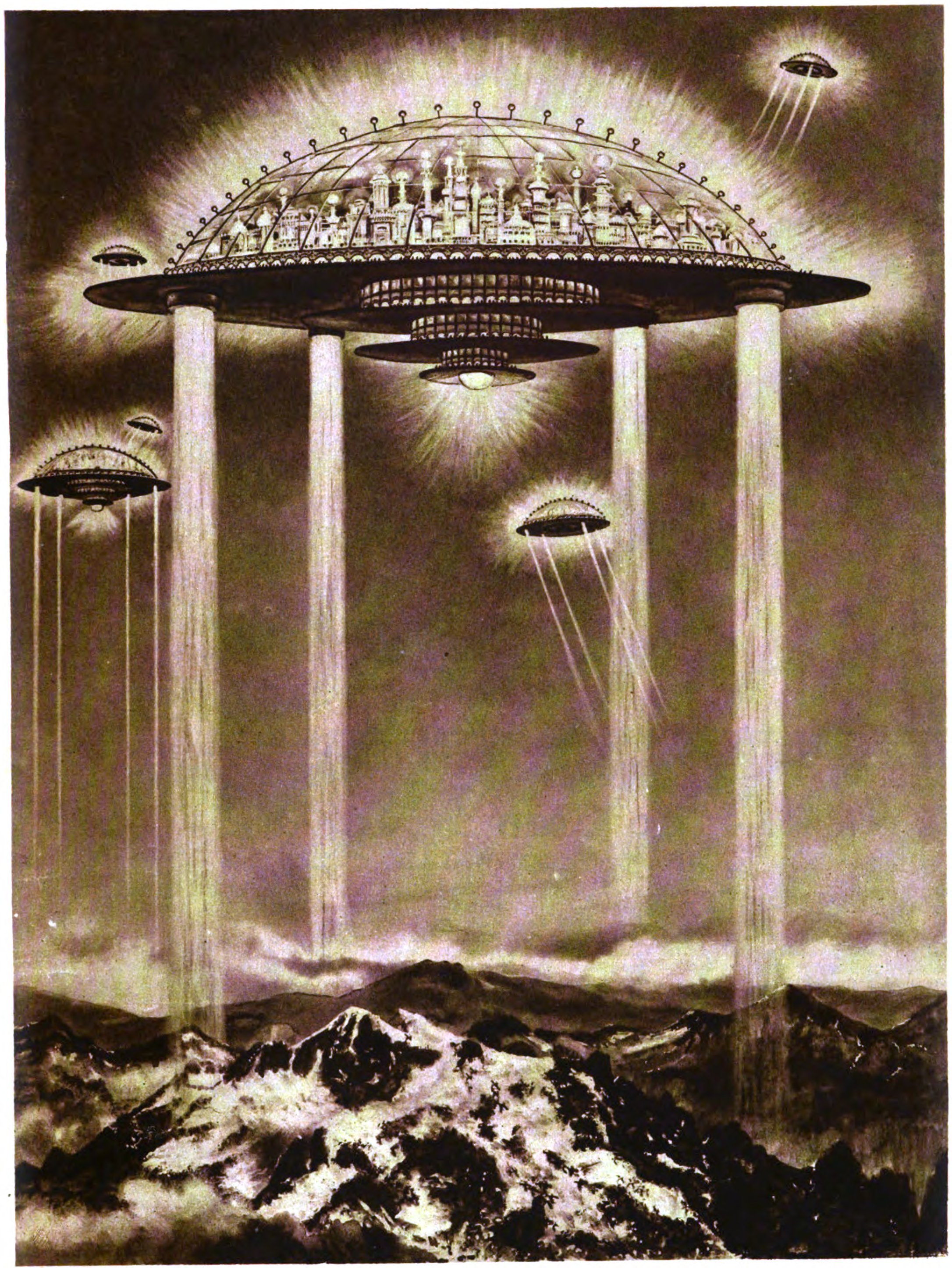
Large urban area enclosed within a dome
A domed city is a hypothetical structure that encloses a large urban area under a single roof. In most descriptions, the dome is airtight and pressurized, creating a habitat that can be controlled for air temperature, composition and quality, typically due to an external atmosphere (or lack thereof) that is inimical to habitation for one or more reasons. Domed cities have been a fixture of science fiction and futurology since the early 20th century, offer inspirations for potential utopias and may be situated on Earth, a moon or other planet.
Origin
The social reformer Charles Fourier proposed in 1808 that an ideal city must be connected by glass galleries and the botanist J. C. Loudon wrote in his An Encyclopedia of Gardening (1822) about whole cities covered by a giant glass roof
In Northern countries, civilized man could not exist without glass; and if coal is not discovered in these countries, say in Russia, the most economical mode of procuring temperature will be at once covering whole towns with immense teguments of glass, and heating by steam or otherwise, the enclosed air common to all inhabitants.
In fiction
One of the earliest examples of domed cities in fiction is the city of Vitrea in the anonymously written utopian novel Mrs. Maberly (1836). Domed cities appear frequently in underwater environments. In Robert Ellis Dudgeon's novel Colymbia (1873), glass domes are used for underwater conversation. In William Delisle Hay's novel Three Hundred Years Hence (1881), whole cities are covered by domes beneath the sea. Survivors of Atlantis are found living in an underwater glass-domed city in André Laurie's novel Atlantis (1895). The same idea is found later in David M. Parry's The Scarlet Empire (1906) and Stanton A Coblentz's The Sunken World (1928). In William Gibson's Sprawl trilogy, the namesake of the series is a massive supercity in the USA, stretching from Boston to Atlanta and housed in a series of geodesic domes.
Authors used domed cities in response to many problems, sometimes to the benefit of the people living in them and sometimes not. The problems of air pollution and other environmental destruction are a common motive, particularly in stories of the middle to late 20th century. As in the Pure trilogy of books by Julianna Baggott. In some works, the domed city represents the last stand of a human race that is either dead or dying. The 1976 film Logan's Run shows both of these themes. The characters have a comfortable life within a domed city, but the city also serves to control the populace and to ensure that humanity never again outgrows its means.
The domed city in fiction has been interpreted as a symbolic womb that both nourishes and protects humanity. Where other science fiction stories emphasize the vast expanse of the universe, the domed city places limits on its inhabitants, with the subtext that chaos will ensue if they interact with the world outside.
In some works cities are getting "domed" to quarantine its inhabitants.
Engineering proposals
During the 1960s and 1970s, the domed city concept was widely discussed outside the confines of science fiction. In 1960, visionary engineer Buckminster Fuller described the Dome over Manhattan, a 3 km geodesic dome spanning Midtown Manhattan that would regulate weather and reduce air pollution. A domed city was proposed in 1979 for Winooski, Vermont and in 2010 for Houston.
Seward's Success, Alaska, was a domed city proposed in 1968 and designed to hold over 40,000 people along with commercial, recreational and office space. Intended to capitalize on the economic boom following the discovery of oil in northern Alaska, the project was canceled in 1972 due to delays in constructing the Trans-Alaska Pipeline.

In order to test whether an artificial closed ecological system was feasible, Biosphere 2 (a complex of interconnected domes and glass pyramids) was constructed in the late 1980s. Its original experiment housed eight people and remains the largest such system attempted to date.
In 2010, a domed city known as Eco-city 2020 of 100,000 was proposed for the Mir mine in Siberia. In 2014, the ruler of Dubai announced plans for a climate-controlled domed city, named the Mall of the World, covering an area of 48 million square feet (4.5 square kilometers), but as of 2016, the project has been redesigned without the dome.
Notes
References
- (23 November 2018). "Dome, sweet home: climate shelters past, present and future". Nature.
- (1991). "Houses of Glass: A Nineteenth-Century Building Type". MIT Press.
- (7 September 2022). "A Review of Domed Cities and Architecture: Past, Present and Future". Future Cities and Environment.
- (1996). "The Glasshouse". Phaidon Press.
- (1822). "An Encyclopaedia of Gardening". Longman.
- (2010). "Origins of Futuristic Fiction". University of Georgia Press.
- (1836). "Mrs. Maberly; Or, The World as it Will be".
- (1990). "Science-fiction, the early years". Kent State University Press.
- (1990). "Science-fiction, the early years". Kent State University Press.
- (24 November 2010). "The Crystal City Under the Sea". Black Cat Press.
- "SFE: Atlantis".
- Yanarella, Ernest J.. (2001). "The Cross, the Plow and the Skyline".
- Díaz-Diocaretz, Myriam. (2006). "The Matrix in Theory and Practice".
- Kreuziger, Frederick A.. (1986). "The Religion of Science Fiction".
- (June 9, 2008). "Weird Science".
- (10 December 1979). "Environment: A Dome for Winooski?".
- [http://dsc.discovery.com/tv/mega-engineering/explore/houston-dome.html Discovery Channel: A Dome over Houston] {{webarchive. link. (July 22, 2010)
- Davis, Jim. (March 1970). "An entire city under glass".
- Porco, Peter. (3 November 2002). "City of tomorrow a failed dream of yesterday - Thinking big: Domed suburb across Knik Arm was planned in detail". Anchorage Daily News.
- Zimmer, Carl. (2019-03-29). "The Lost History of One of the World's Strangest Science Experiments". The New York Times.
- Geere, Duncan. (17 November 2010). "Russia plans domed city in Siberian mine".
- (12 January 2016). "Dubai's Mall of the World no longer going to be globe's largest". What's On.
This article was imported from Wikipedia and is available under the Creative Commons Attribution-ShareAlike 4.0 License. Content has been adapted to SurfDoc format. Original contributors can be found on the article history page.
Ask Mako anything about Domed city — get instant answers, deeper analysis, and related topics.
Research with MakoFree with your Surf account
Create a free account to save articles, ask Mako questions, and organize your research.
Sign up freeThis content may have been generated or modified by AI. CloudSurf Software LLC is not responsible for the accuracy, completeness, or reliability of AI-generated content. Always verify important information from primary sources.
Report