From Surf Wiki (app.surf) — the open knowledge base
Dome C

| Field | Value |
|---|---|
| name | Dome C |
| settlement_type | Antarctic base |
| image_skyline | DomeCSummerCamp.jpg |
| imagesize | 270 |
| flag_size | 110px |
| flag_border | yes |
| nicknames | dome Circe, |
| Dome Charlie and dome Concordia | |
| mapsize | 270px |
| pushpin_map | Antarctica |
| pushpin_map_alt | Location of Dome C Station in Antarctica |
| pushpin_map_caption | Location of Dome C Station in Antarctica |
| pushpin_mapsize | 270 |
| pushpin_relief | yes |
| coordinates | |
| established_title | Established |
| subdivision_type1 | Location in Antarctica |
| subdivision_name1 | Dome C |
| Antarctic Plateau | |
| subdivision_type3 | Administered by |
| subdivision_name3 | National Science Foundation |
| elevation_m | 3,233 |
Dome Charlie and dome Concordia
Antarctic Plateau
Dome C, also known as dôme Circe, Dome Charlie (US) or dôme Concordia, is located at Antarctica at an elevation of 3233 m above sea level, on one of several domes of the Antarctic Ice Sheet. Dome C is located on the Antarctic Plateau, 1100 km inland from the French research station at Dumont D'Urville, 1100 km inland from the Australian Casey Station and 1200 km inland from the Italian Zucchelli Station at Terra Nova Bay. Russia's Vostok Station is 560 km away. Dome C is the site of the Concordia Research Station, jointly operated by France and Italy.
History
In the 1970s, dome C was the site of ice core drilling by field teams of several nations. Designated Dome Charlie (NATO Phonetic Alphabet code for the letter C) by the U.S. Naval Support Force, Antarctica, and its Squadron VXE-6, which provided logistical support to the field teams, in January and November 1975, three LC-130 Hercules aircraft suffered severe damage during attempted takeoffs. In November 1975 and November 1976, the U.S. Navy established field camps on Dome Charlie to recover the aircraft. Following major structural repairs and replacement of engines in the field, the three LC-130s were flown to McMurdo Station on December 26, 1975, January 14, 1976, and Christmas Day 1976.

From November 1977 to March 1978 a French party of 13 settled down in the existing camp left by the aircraft rescuers. They brought several tons of equipment—thanks to the VXE-6 airplanes—and while there ice-cored down to 980 m extracting samples 45,000 to 50,000 years old.
During the Antarctic summer of 1979, the camp was re-occupied by Americans and French, under the auspices of the US Antarctic Research Program, sponsored by the National Science Foundation. Deep ice core drilling, meteorology and seismic studies were conducted. The camp, with a maximum summer population of 18, was operated and maintained by four employees of ITT Antarctic Services and one US Navy medical corpsman. When the camp was shut down for the season in about January, 1980, it was left mostly intact, with a radio-isotope powered remote weather station operational.

In 1992, France decided to build a new station on the Antarctic Plateau. The program was later joined by Italy. In 1996, a French-Italian team established a summer camp at dome C. The two main objectives of the camp were the provision of logistical support for the European Project for Ice Coring in Antarctica (EPICA) and the construction of a permanent research station. The new all-year facility, Concordia Station, became operational in 2005.
The Advisory Committee on Antarctic Names (US-ACAN) considers "Dome Charlie" to be superior to the informal name, "dome C," and that it has precedence over "dome Circe", a name suggested from Greek mythology after Circe, the bewitching queen of Aeaea island, one of the children of solar god Helios and the Oceanid nymph Perse, who changed men into animals by magic, by members of the SPRI airborne radio echo sounding team in 1982. Later, it was named "dome Concordia" after that same French/Italian scientific base.
In February 2025, scientists confirmed the successful extraction of the oldest continuous ice core ever with distinct layers of the ice frozen between 900,000 and 1.2-million years ago.
Climate
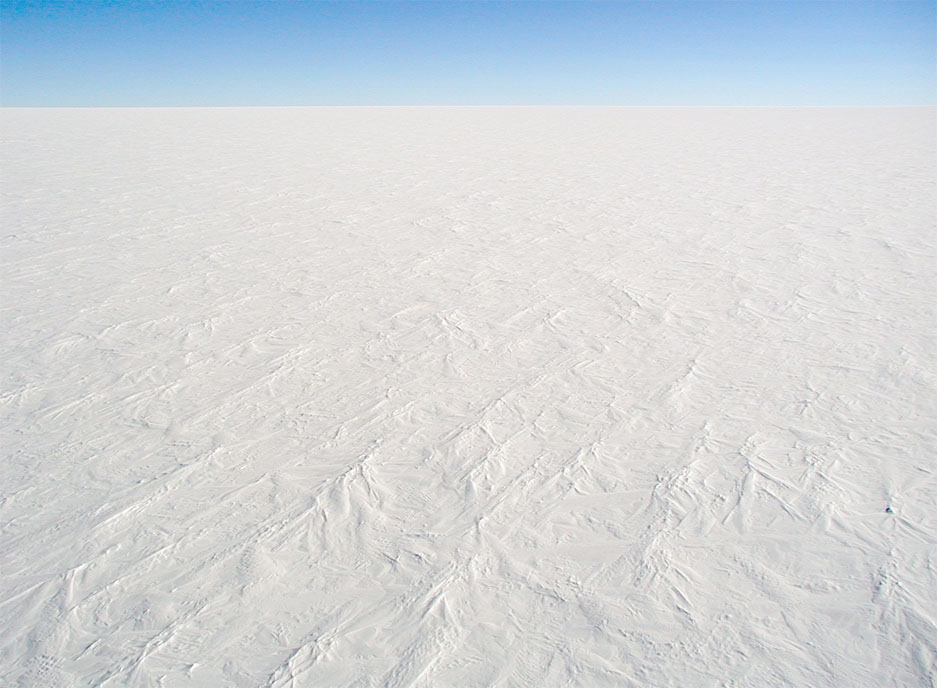
Dome C is one of the coldest places on Earth. Temperatures hardly rise above −25 C in summer and can fall below −80 C in winter. The annual average air temperature is −54.5 C. Humidity is low and it is also very dry, with very little or no precipitation throughout the year.
Dome C does not experience the katabatic winds typical of the coastal regions of Antarctica because of its elevated location and its relative distance from the edges of the Antarctic Plateau. Typical wind speed in winter is 2.8 m/s (6 mph).
Dome C is situated on top of the Antarctic Polar Plateau, the world's largest frozen desert. No animals or plants live at a distance of more than a few hundred meters from the Southern Ocean. However, south polar skuas have been spotted overflying the station, 1200 km away from their nearest food sources. It is believed that these seabirds have learned to cross the frozen white continent instead of circumnavigating it.
|Jan record high C= -5.4 |Feb record high C= -12.9 |Mar record high C= -30.8 |Apr record high C= -32.9 |May record high C= -27.0 |Jun record high C= -26.0 |Jul record high C= -25.4 |Aug record high C= -26.5 |Sep record high C= -30.3 |Oct record high C= -23.1 |Nov record high C= -16.9 |Dec record high C= -5.5 |year record high C= |Jan record low C= -46.7 |Feb record low C= -59.9 |Mar record low C= -73.6 |Apr record low C= -76.3 |May record low C= -79.6 |Jun record low C= -79.9 |Jul record low C= -79.9 |Aug record low C= -79.9 |Sep record low C= -81.9 |Oct record low C= -74.0 |Nov record low C= -61.9 |Dec record low C= -47.3 |year record low C=
Astronomical observatory

Dome C is notable for its potential to be an extremely good astronomical observation site; the transparency of the Antarctic atmosphere allows stars to be observed, even when the Sun is at its highest possible elevation angle of 38°. The good viewing is due to very low infrared sky emission, extremely low humidity, a high percentage of cloud-free time, low atmospheric aerosol and dust content, and freedom from light pollution and background light other than auroras and moonlight. This location was a serious candidate for the ESO's E-ELT project. However, sky coverage is less than at lower latitude locations as northern celestial hemisphere objects never rise or are too low above the horizon.
The Proceedings of the Astronomical Society of the Pacific discuss the suitability of the site for astronomy in terms of the seeing.
An earlier paper considered the site and concluded that "Dome C is the best ground-based site to develop a new astronomical observatory".{{cite journal |url-status = dead |archive-url = https://web.archive.org/web/20060325210146/http://www.phys.unsw.edu.au/nature/nature02929.pdf |archive-date = 2006-03-25
The 2004 experiments to measure the astronomical conditions at the site were unattended, controlled by a computer system that had to supervise the generation of its own electricity using a jet-fuel powered Stirling engine. The computer, running Linux, communicated with the outside world using an Iridium phone.
ESA research
.jpg)
Since Concordia Station is a prime space mission analogue, the European Space Agency (ESA) conducts biomedical research there in collaboration with the French (IPEV) and Italian (ENEA/PNRA) Antarctic programs. Living conditions upon Dome C simulate what astronauts have to go through in long-duration spaceflights: isolation and confinement, different atmospheric pressure conditions, an abnormal day/night cycle. ESA sends a doctor each year to winterover at Concordia Station and facilitate biomedical experiments on the crew. These experiments are selected over a variety of tests proposed to ESA by European universities and participation from the rest of the crew is voluntary.
References
References
- Subbaraman, Nidhi. (2025-02-04). "Ancient Air, Frozen in Time, Holds Clues to Modern Mystery".
- "Moyennes 1981-2010 Antarctique".
- "Météo Climat stats for Dome C". Météo Climat.
This article was imported from Wikipedia and is available under the Creative Commons Attribution-ShareAlike 4.0 License. Content has been adapted to SurfDoc format. Original contributors can be found on the article history page.
Ask Mako anything about Dome C — get instant answers, deeper analysis, and related topics.
Research with MakoFree with your Surf account
Create a free account to save articles, ask Mako questions, and organize your research.
Sign up freeThis content may have been generated or modified by AI. CloudSurf Software LLC is not responsible for the accuracy, completeness, or reliability of AI-generated content. Always verify important information from primary sources.
Report