From Surf Wiki (app.surf) — the open knowledge base
Domain of a function
Set of all things that may be the input of a mathematical function
Set of all things that may be the input of a mathematical function

In mathematics, the domain of a function is the set of inputs accepted by the function. It is sometimes denoted by \operatorname{dom}(f) or \operatorname{dom }f, where f is the function. In layman's terms, the domain of a function can generally be thought of as "what x can be".
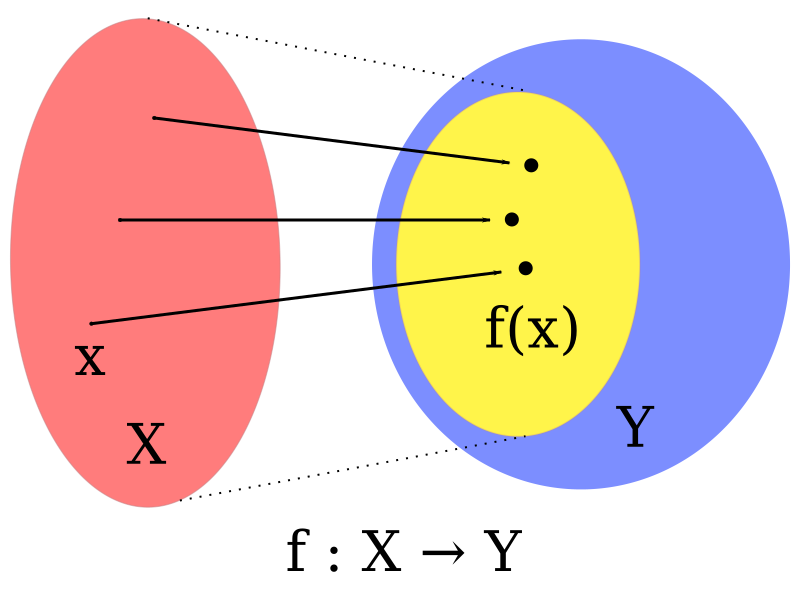
More precisely, given a function f\colon X\to Y, the domain of f is X. In modern mathematical language, the domain is part of the definition of a function rather than a property of it.
In the special case that X and Y are both sets of real numbers, the function f can be graphed in the Cartesian coordinate system. In this case, the domain is represented on the x-axis of the graph, as the projection of the graph of the function onto the x-axis.
For a function f\colon X\to Y, the set Y is called the codomain: the set to which all outputs must belong. The set of specific outputs the function assigns to elements of X is called its range or image. The image of f is a subset of Y, shown as the yellow oval in the accompanying diagram.
Any function can be restricted to a subset of its domain. The restriction of f \colon X \to Y to A, where A\subseteq X, is written as \left. f \right|_A \colon A \to Y.
Natural domain
If a real function f is given by a formula, it may be not defined for some values of the variable. In this case, it is a partial function, and the set of real numbers on which the formula can be evaluated to a real number is called the natural domain or domain of definition of f. In many contexts, a partial function is called simply a function, and its natural domain is called simply its domain.
Examples
- The function f defined by f(x)=\frac{1}{x} cannot be evaluated at 0. Therefore, the natural domain of f is the set of real numbers excluding 0, which can be denoted by \mathbb{R} \setminus { 0 } or {x\in\mathbb R:x\ne 0}.
- The piecewise function f defined by f(x) = \begin{cases} 1/x&x\not=0\ 0&x=0 \end{cases}, has as its natural domain the set \mathbb{R} of real numbers.
- The square root function f(x)=\sqrt x has as its natural domain the set of non-negative real numbers, which can be denoted by \mathbb R_{\geq 0}, the interval 0,\infty), or {x\in\mathbb R:x\geq 0}.
- The [tangent function, denoted \tan, has as its natural domain the set of all real numbers which are not of the form \tfrac{\pi}{2} + k \pi for some integer k, which can be written as \mathbb R \setminus {\tfrac{\pi}{2}+k\pi: k\in\mathbb Z}.
Other uses
The term domain is also commonly used in a different sense in mathematical analysis: a domain is a non-empty connected open set in a topological space. In particular, in real and complex analysis, a domain is a non-empty connected open subset of the real coordinate space \R^n or the complex coordinate space \C^n.
Sometimes such a domain is used as the domain of a function, although functions may be defined on more general sets. The two concepts are sometimes conflated as in, for example, the study of partial differential equations: in that case, a domain is the open connected subset of \R^{n} where a problem is posed, making it both an analysis-style domain and also the domain of the unknown function(s) sought.
Set theoretical notions
For example, it is sometimes convenient in set theory to permit the domain of a function to be a proper class X, in which case there is formally no such thing as a triple (X, Y, G). With such a definition, functions do not have a domain, although some authors still use it informally after introducing a function in the form f: X → Y.
Notes
References
References
- (10 April 2023). "Domain, Range, Inverse of Functions".
- {{Harvnb. Eccles. 1997, p. 91 ([{{Google books. Mac Lane. 1998, [{{Google books. Scott. Jech. 1971, [{{Google books. Sharma. 2010, [{{Google books. Stewart. Tall. 1977, [{{Google books
This article was imported from Wikipedia and is available under the Creative Commons Attribution-ShareAlike 4.0 License. Content has been adapted to SurfDoc format. Original contributors can be found on the article history page.
Ask Mako anything about Domain of a function — get instant answers, deeper analysis, and related topics.
Research with MakoFree with your Surf account
Create a free account to save articles, ask Mako questions, and organize your research.
Sign up freeThis content may have been generated or modified by AI. CloudSurf Software LLC is not responsible for the accuracy, completeness, or reliability of AI-generated content. Always verify important information from primary sources.
Report