From Surf Wiki (app.surf) — the open knowledge base
Django Unchained
2012 Western film by Quentin Tarantino
2012 Western film by Quentin Tarantino
| Field | Value | |
|---|---|---|
| name | Django Unchained | |
| image | Django Unchained Poster.jpg | |
| caption | Theatrical release poster | |
| director | Quentin Tarantino | |
| producer | {{Plainlist | |
| writer | Quentin Tarantino | |
| starring | {{Plainlist | |
| cinematography | Robert Richardson | |
| editing | Fred Raskin | |
| production_companies | {{Plainlist | |
| * A Band Apart<ref name | "var" | |
| * Columbia Pictures<ref name | "var" /}} | |
| distributor | {{Plainlist | |
| * The Weinstein Company<ref name | "afi" / (United States) | |
| * Columbia Pictures<ref name | "var" / (through Sony Pictures Releasing International; International) | |
| released | ||
| runtime | 165 minutes | |
| country | United States | |
| language | English | |
| budget | $100 million | |
| gross | $449 million |
- Stacey Sher
- Reginald Hudlin
- Pilar Savone
- Jamie Foxx
- Christoph Waltz
- Leonardo DiCaprio
- Kerry Washington
- Samuel L. Jackson
- Walton Goggins
- Dennis Christopher
- James Remar
- Michael Parks
- Don Johnson
- A Band Apart
- Columbia Pictures}}
- The Weinstein Company (United States)
- Columbia Pictures (through Sony Pictures Releasing International; International)
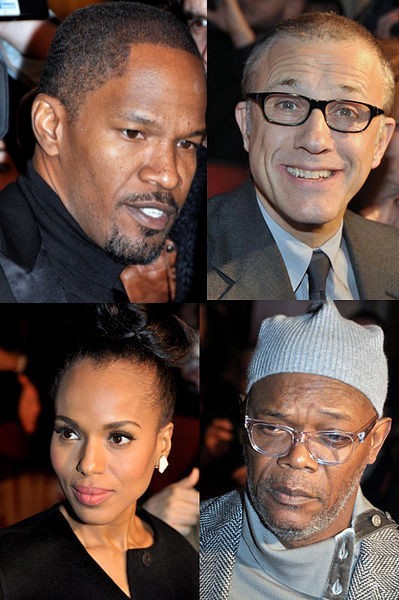
Django Unchained ( ) is a 2012 American revisionist Western film written and directed by Quentin Tarantino. Produced by Tarantino's A Band Apart and Columbia Pictures, it stars Jamie Foxx, Christoph Waltz, Leonardo DiCaprio, Kerry Washington, and Samuel L. Jackson with Walton Goggins, Dennis Christopher, James Remar, Michael Parks, and Don Johnson in supporting roles. The film, set in the Antebellum South and Old West follows the story of an enslaved man who trains under a German bounty hunter with the ultimate goal of reuniting with his wife. It is a highly stylized, revisionist tribute to spaghetti Westerns, with its title referring particularly to the 1966 Italian film Django by Sergio Corbucci.
Development of Django Unchained began in 2007, when Tarantino was writing a book on Corbucci. By April 2011, Tarantino sent his final draft of the script to The Weinstein Company (TWC). Casting began in the summer of 2011, with Michael K. Williams and Will Smith being considered for the role of the title character before Foxx was cast. Principal photography took place from November 2011 to March 2012 in California, Wyoming, and Louisiana.
Django Unchained premiered at the Ziegfeld Theatre in New York City on December 11, 2012, and was theatrically released by The Weinstein Company on December 25, in the United States, with Sony Pictures Releasing International handling international distribution. It was a commercial success, grossing $449.8 million worldwide against a $100 million budget, becoming Tarantino's highest-grossing film to date, as well as the highest-grossing Western film of all time.
The film received widespread acclaim from critics, who praised the performances especially those of Waltz, DiCaprio and Jackson and Tarantino's direction and screenplay, though the film's extensive graphic violence and frequent use of racial slurs were source of controversy. It was named one of the top ten films of the year by the American Film Institute and by the National Board of Review, and received numerous accolades, gathering five nominations at the 85th Academy Awards—including for Best Picture—winning for Best Supporting Actor (Waltz) and Best Original Screenplay (Tarantino). It also received five nominations with two wins at both the 70th Golden Globe Awards and the 66th British Academy Film Awards.
Plot
In 1858 Texas, several male African American slaves are being "driven" by the Speck Brothers, Ace and Dicky. Among the shackled slaves is Django, sold off and separated from his wife, Broomhilda. The Speck Brothers are stopped by Dr. King Schultz, a German ex-dentist and bounty hunter from Düsseldorf. Schultz asks to buy one of the slaves, but while questioning Django about his knowledge of the Brittle Brothers, for whom Schultz is carrying a warrant, he irritates Ace, who aims his shotgun at Schultz. Schultz quickly kills Ace and leaves Dicky at the mercy of the other newly freed slaves, who kill him. Since Django can identify the Brittle Brothers, Schultz offers Django his freedom in exchange for his help in tracking them down.
Django discovers Schultz is a bounty hunter, as Schultz kills an outlaw named Willard Peck, who was posing as the Sheriff in a small town. Schultz and Django then track the Brittle Brothers down, leading them to a plantation. Django shoots dead the first brother, brutally whips the second before shooting him too, while Schultz kills the third brother. They then ambush and kill the plantation owner who leads a group of lynchers. Django partners with Schultz through the winter and becomes his apprentice, and Schultz discovers Django's natural ability with gunslinging. Schultz explains that, being the first person he has ever given freedom to, he feels responsible for Django and is driven to help him in his quest to rescue Broomhilda.
Django, now fully trained, collects his first bounty, keeping the handbill as a good luck charm. In Mississippi, Schultz uncovers the identity of Broomhilda's owner: Calvin Candie, the charming but brutal owner of the Candyland Plantation, where black slaves are forced to fight in wrestling deathmatches called "Mandingo fights". Schultz, expecting Candie will not sell Broomhilda if they ask for her directly, plots to feign interest in purchasing one of Candie's prized fighters, offer to purchase Broomhilda on the side for a reasonable sum, then take her and escape before the Mandingo deal is finalized. Schultz and Django meet Candie at his gentleman's club in Greenville and submit their offer. His greed tickled, Candie invites them to Candyland. After secretly briefing Broomhilda on the plan, Schultz claims to be charmed by the German-speaking Broomhilda and offers to buy her after arranging to buy a fighting slave.
During dinner, Candie's staunchly loyal house slave, Stephen, becomes suspicious. Deducing that Django and Broomhilda know each other and that the sale of the Mandingo fighter is just a misdirection, Stephen alerts and privately admonishes Candie on his greed. Candie is humiliated at being fooled by a black man, but he contains his anger long enough to theatrically display his knowledge of phrenology which he uses to justify white superiority and black inferiority. Candie's bodyguard suddenly bursts into the room with his shotgun trained on the two bounty hunters, and Candie furiously threatening to kill Broomhilda. He extorts Schultz for the complete bid amount, and taunts him by demanding a formal handshake to finalize the deal before he leaves. Tired of his arrogance, Schultz fatally shoots Candie with a concealed derringer and his henchman kills him in turn. Django grabs a revolver and, after a violent shootout, is forced to surrender when Broomhilda is taken hostage at gunpoint.
The next morning, Stephen tells Django that he will be sold to a mine where he will labor for the rest of his life. En route to the mine, Django proves to his dim-witted Australian escorts that he is a bounty hunter by showing them the handbill from his first kill. He convinces them that there is a large bounty for outlaws who are hiding at Candyland, and promises that they would receive most of the money. The escorts release him and give him a pistol, and he kills them before stealing a horse and leaving for Candyland.
Django returns to the plantation and kills more of Candie's henchmen. He takes Broomhilda's freedom papers from Schultz's pocket, bidding his friend and mentor a final farewell before freeing Hildi from a nearby cabin. When Candie's mourners return from his burial, Django kills Candie's few remaining henchmen and his sister Lara, releases the two remaining house slaves, and kneecaps Stephen. Django then ignites dynamite that he has planted throughout the mansion. He and Broomhilda watch from a distance as the mansion explodes, killing Stephen, before riding off together.
Cast
- Jamie Foxx as Django Freeman
- Christoph Waltz as Dr. King Schultz
- Leonardo DiCaprio as "Monsieur" Calvin J. Candie
- Kerry Washington as Broomhilda "Hildi" von Shaft
- Samuel L. Jackson as Stephen
- Walton Goggins as Billy Crash
- Dennis Christopher as Leonide "Leo" Moguy
- James Remar as Butch Pooch / Ace Speck
- David Steen as Mr. Stonecipher
- Dana Gourrier as Cora
- Nichole Galicia as Sheba
- Laura Cayouette as Lara Lee Candie-Fitzwilly
- Ato Essandoh as D'Artagnan
- Sammi Rotibi as Rodney
- Clay Donahue Fontenot as Luigi
- Escalante Lundy as Big Fred
- Miriam F. Glover as Betina
- Don Johnson as Spencer "Big Daddy" Bennett
- Franco Nero as Amerigo Vessepi
Other roles include: James Russo as Dicky Speck, brother of Ace Speck and erstwhile owner of Django; Tom Wopat, Omar J. Dorsey, and Don Stroud play US Marshal Gill Tatum, Chicken Charlie, and as Sheriff Bill Sharp / Willard Peck respectively; Bruce Dern appears as Old Man Carrucan, the owner of the Carrucan Plantation; M. C. Gainey, Cooper Huckabee, and Doc Duhame portray brothers Big John Brittle, Roger "Lil Raj" Brittle, and Ellis Brittle respectively, overseers of both Carrucan and Big Daddy's plantations.
Jonah Hill plays Bag Head #2, a member of Bennett's masked white supremacist group. Additional roles include Lee Horsley as Sheriff Gus, Rex Linn as Tennessee Harry, Misty Upham as Minnie, and Danièle Watts as Coco. Russ Tamblyn and his daughter Amber appear as townspeople in Daugherty, Texas; their roles are respectively credited as "Son of a Gunfighter" and "Daughter of Son of a Gunfighter". Zoë Bell, Michael Bowen, Robert Carradine, Jake Garber, Ted Neeley, James Parks, and Tom Savini play Candyland trackers. Jacky Ido, who played Marcel in Tarantino's 2009 film Inglourious Basterds, makes an uncredited appearance as a slave. Michael Parks as Roy and John Jarratt as Floyd, alongside Tarantino himself in a cameo appearance as Frankie, play the LeQuint Dickey Mining Company employees. Tarantino also appears in the film as a masked Bag Head named Robert.
Production
Development

In 2007, Quentin Tarantino discussed an idea for a type of spaghetti Western set in the United States of America's pre-American Civil War Deep South. He called this type of film "a Southern", stating that he wanted:
Tarantino later explained the genesis of the idea:
Tarantino finished the script on April 26, 2011, and handed in the final draft to The Weinstein Company. In October 2012, frequent Tarantino collaborator RZA said that he and Tarantino had intended to cross over Django Unchained with RZA's Tarantino-presented martial-arts film The Man with the Iron Fists. The crossover would have seen a younger version of the blacksmith character from RZA's film appear as a slave in an auction. However, scheduling conflicts prevented RZA's participation.
One inspiration for the film is Corbucci's 1966 Spaghetti Western Django, whose star Franco Nero has a cameo appearance in Django Unchained. Another inspiration is the 1975 film Mandingo, about a slave trained to fight other slaves. Tarantino included scenes in the snow as a homage to the 1968 film The Great Silence. "Silenzio takes place in the snow. I liked the action in the snow so much, Django Unchained has a big snow section in the middle," Tarantino said in an interview. Tarantino credits the character and attitude of the German dentist turned bounty hunter King Schultz to the German Karl May Wild West films of the 1960s, namely their hero Old Shatterhand.
The title Django Unchained alludes to the titles of the 1966 Corbucci film Django; Hercules Unchained, the American title for the 1959 Italian epic fantasy film Ercole e la regina di Lidia, about the mythical hero's escape from enslavement to a wicked master; and to Angel Unchained, the 1970 American biker film about a biker exacting revenge on a large group of rednecks.
Casting
Among those considered for the title role of Django, Michael K. Williams, Will Smith, and Idris Elba were mentioned as possibilities, but in the end Jamie Foxx was cast in the role. Smith later said he turned down the role because it "wasn't the lead" and was "not for me," but stated he thought the movie was brilliant. Tyrese Gibson sent in an audition tape as the character. Franco Nero, the original Django from the 1966 Italian film, was rumored for the role of Calvin Candie, but instead was given a cameo appearance as a minor character. Nero suggested that he play a mysterious horseman who haunts Django in visions and is revealed in an ending flashback to be Django's father; Tarantino opted not to use the idea. Kevin Costner was in negotiations to join as Ace Woody, a Mandingo trainer and Candie's right-hand man, but Costner dropped out due to scheduling conflicts. Kurt Russell was cast instead but also later left the role. When Kurt Russell dropped out, the role of Ace Woody was not recast; instead, the character was merged with Walton Goggins's character, Billy Crash.
Jonah Hill was offered the role of Scotty Harmony, a gambler who loses Broomhilda to Candie in a poker game, but turned it down due to scheduling conflicts with The Watch. Sacha Baron Cohen was also offered the role, but declined in order to appear in Les Misérables. Neither Scotty nor the poker game appear in the final cut of the film. Hill later appeared in the film in a different role. Joseph Gordon-Levitt said that he "would have loved, loved to have" been in the film but would be unable to appear because of a prior commitment to direct his first film, Don Jon.
Costume design

In a January 2013 interview with Vanity Fair, costume designer Sharen Davis said much of the film's wardrobe was inspired by spaghetti Westerns and other works of art. For Django's wardrobe, Davis and Tarantino watched the television series Bonanza and referred to it frequently. The pair even hired the hatmaker who designed the hat worn by the Bonanza character Little Joe, played by Michael Landon. Davis described Django's look as a "rock-n-roll take on the character". Django's sunglasses were inspired by Charles Bronson's character in The White Buffalo (1977). Davis used Thomas Gainsborough oil painting The Blue Boy () as a reference for Django's valet outfit.
In the final scene, Broomhilda wears a dress similar to that of Ida Galli's character in Blood for a Silver Dollar (1965). Davis said the idea of Calvin Candie's costume came partly from Rhett Butler, and that Don Johnson's signature Miami Vice look inspired Big Daddy's cream-colored linen suit in the film. King Schultz's faux chinchilla coat was inspired by Telly Savalas in Kojak. Davis also revealed that many of her costume ideas did not make the final cut of the film, leaving some unexplained characters such as Zoë Bell's tracker, who was intended to drop her bandana to reveal an absent jaw.
Filming
Principal photography for Django Unchained started in California in November 2011 continuing in Wyoming in February 2012 and at the National Historic Landmark Evergreen Plantation in Wallace, Louisiana, outside of New Orleans, in March 2012. The film was shot in the anamorphic format on 35 mm film. Although originally scripted, a sub-plot centering on Zoë Bell's masked tracker was cut, and remained unfilmed, due to time constraints. After 130 shooting days, the film wrapped up principal photography in July 2012. Kerry Washington sought to bring authenticity to her performance in several ways. The actor playing her overseer used a fake whip, but Washington insisted the lashings really hit her back. And to dramatize her punishment inside an underground, coffin-size metal container, she and Tarantino agreed she would spend time barely clothed in the "hot box" before the filming began so the feeling of confinement would be as realistic as possible.
Django Unchained was the first Tarantino film not edited by Sally Menke, who died in 2010. Editing duties were instead handled by Fred Raskin, who had worked as an assistant editor on Tarantino's Kill Bill. Raskin was nominated for a BAFTA Award for Best Editing but lost to William Goldenberg for his work on Argo.
Broken glass incident
During the scene when DiCaprio's character explains phrenology, DiCaprio cut his left hand upon striking the table and smashing a small glass. Despite his hand bleeding profusely, DiCaprio barely reacted and remained in character under the astonished eyes of his fellow actors. He is seen taking out pieces of broken glass from his hand during the scene. After Tarantino's cut, there was a standing ovation by the other actors to praise DiCaprio's performance despite the incident; Tarantino, therefore, decided to keep this sequence in the final cut. DiCaprio is seen with his left hand bandaged in the scene after when he is signing Broomhilda's papers. Contrary to popular belief, DiCaprio wiped fake blood on Washington's face in a separate take.
Music
Main article: Django Unchained (soundtrack)

The film features both original and existing music tracks. Tracks composed specifically for the film include "100 Black Coffins" by Rick Ross and produced by and featuring Jamie Foxx, "Who Did That To You?" by John Legend, "Ancora qui" by Ennio Morricone and Elisa, and "Freedom" by Anthony Hamilton and Elayna Boynton. The theme, "Django", was also the theme song of the 1966 film.
Musician Frank Ocean wrote an original song for the film's soundtrack, but it was rejected by Tarantino, who explained that "Ocean wrote a fantastic ballad that was truly lovely and poetic in every way, but there just wasn't a scene for it." Ocean later published the song, entitled "Wiseman", on his Tumblr blog. The film also features a few famous pieces of western classical music, including Beethoven's "Für Elise" and "Dies Irae" from Verdi's Requiem. Tarantino has stated that he avoids using full scores of original music: "I just don't like the idea of giving that much power to anybody on one of my movies." The film's soundtrack album was released on December 18, 2012.
Morricone made statements criticizing Tarantino's use of his music in Django Unchained and stated that he would "never work" with the director after this film, but later agreed to compose an original film score for Tarantino's The Hateful Eight in 2015. In a scholarly essay on the film's music, Hollis Robbins notes that the vast majority of film music borrowings comes from films made between 1966 and 1974 and argues that the political and musical resonances of these allusions situate Django Unchained squarely in the Vietnam and Watergate era, during the rise and decline of Black Power cinema. Jim Croce's hit "I Got a Name" was featured in the soundtrack.
Release
Marketing
The first teaser poster was inspired by a fan-art poster by Italian artist Federico Mancosu. His artwork was published in May 2011, a few days after the synopsis and the official title were released to the public. In August 2011, at Tarantino's request, the production companies bought the concept artwork from Mancosu to use for promotional purposes as well as on the crew passes and clothing for staff during filming.
Theatrical run
Django Unchained was released on December 25, 2012, in the United States by The Weinstein Company and released on January 18, 2013, by Sony Pictures Releasing in the United Kingdom. The film was screened for the first time at the Directors Guild of America on December 1, 2012, with additional screening events having been held for critics leading up to the film's wide release. The premiere of Django Unchained was delayed by one week following the Sandy Hook Elementary School shooting in Newtown, Connecticut, on December 14, 2012.
The film was released on March 22, 2013, by Sony Pictures in India. In March 2013, Django Unchained was announced to be the first Tarantino film approved for official distribution in China's strictly controlled film market. Lily Kuo, writing for Quartz, wrote that "the film depicts one of America's darker periods, when slavery was legal, which Chinese officials like to use to push back against criticism from the United States". The film was released in China on May 12, 2013.
Home media
The film was released on DVD, Blu-ray, and digital download on April 16, 2013. In the United States, the film has grossed $35.5 million from DVD sales and $31.1 million from Blu-ray sales, making a total of $66.6 million.
Reception
Box office
Django Unchained grossed $162.8 million in the United States and Canada and $287 million in other territories, for a worldwide total of $449.8 million, against a production budget of $100 million. , Django Unchained is Tarantino's highest-grossing film, surpassing his previous film, Inglourious Basterds (2009), which grossed $321.4 million worldwide. It is also the highest-grossing Western film of all time, having surpassed the previous record holder, Dances With Wolves (1990).
In North America, the film made $15 million on Christmas Day, finishing second behind fellow opener Les Misérables. It was the third-biggest opening day figure for a film on Christmas, following Sherlock Holmes ($24.6 million) and Les Misérables ($18.1 million). It went on to make $30.1 million in its opening weekend (a six-day total of $63.4 million), finishing second behind holdover The Hobbit: An Unexpected Journey.
Critical response

On review aggregator Rotten Tomatoes, the film holds an approval rating of 87% based on 296 reviews, and an average rating of 8/10. The website's critical consensus reads, "Bold, bloody, and stylistically daring, Django Unchained is another incendiary masterpiece from Quentin Tarantino." Metacritic, which assigns a rating to reviews, gives the film a weighted average score of 81 out of 100, based on 42 critics, indicating "universal acclaim". Audiences polled by CinemaScore gave the film an average grade of "A−" on an A+ to F scale.
Roger Ebert of the Chicago Sun-Times gave the film four stars out of four and said: "The film offers one sensational sequence after another, all set around these two intriguing characters who seem opposites but share pragmatic, financial and personal issues." Ebert also added, "had I not been prevented from seeing it sooner because of an injury, this would have been on my year's best films list." Peter Bradshaw, film critic for The Guardian, awarded the film five stars, writing: "I can only say Django delivers, wholesale, that particular narcotic and delirious pleasure that Tarantino still knows how to confect in the cinema, something to do with the manipulation of surfaces. It's as unwholesome, deplorable and delicious as a forbidden cigarette."
Writing in The New York Times, critic A. O. Scott compared Django to Tarantino's earlier Inglourious Basterds: "Like Inglourious Basterds, Django Unchained is crazily entertaining, brazenly irresponsible and also ethically serious in a way that is entirely consistent with its playfulness." Designating the film a Times "critics" pick, Scott said Django is "a troubling and important movie about slavery and racism." Filmmaker Michael Moore praised Django, tweeting that the movie "is one of the best film satires ever." Dan Jolin of Empire magazine praised DiCaprio's performance, saying he "plays [the role of Candie] to hateful perfection: a spiteful, brown-toothed bully, avaricious, vain and prone to flattery", but criticized Foxx as a comparatively weak link whose "soft, musical voice [...] jars against Django's terse deliveries".
To the contrary, Owen Gleiberman, film critic for the Entertainment Weekly, wrote: "Django isn't nearly the film that Inglourious was. It's less clever, and it doesn't have enough major characters – or enough of Tarantino's trademark structural ingenuity – to earn its two-hour-and-45-minute running time." In his review for the Indy Week, David Fellerath wrote: "Django Unchained shows signs that Tarantino did little research beyond repeated viewings of Sergio Corbucci's 1966 spaghetti Western Django and a blaxploitation from 1975 called Boss Nigger, written by and starring Fred Williamson." New Yorkers Anthony Lane was "disturbed by their [Tarantino's fans'] yelps of triumphant laughter, at the screening I attended, as a white woman was blown away by Django's guns."
An entire issue of the academic journal Safundi was devoted to Django Unchained in "Django Unchained and the Global Western," featuring scholars who contextualize Tarantino's film as a classic "Western". Dana Phillips writes: "Tarantino's film is immensely entertaining, not despite but because it is so very audacious—even, at times, downright lurid, thanks to its treatment of slavery, race relations, and that staple of the Western, violence. No doubt these are matters that another director would have handled more delicately, and with less stylistic excess, than Tarantino, who has never been bashful. Another director also would have been less willing to proclaim his film the first in a new genre, the 'Southern'."
In 2025, it ranked number 59 on the "Readers' Choice" edition of The New York Times list of the "100 Best Movies of the 21st Century."
Top ten lists
Django Unchained was listed on many critics' top ten lists of 2012.
- 1st – Amy Nicholson, Movieline
- 2nd – Mick LaSalle, San Francisco Chronicle
- 2nd – Drew McWeeny, Hitfix
- 2nd – Michelle Orange, The Village Voice
- 2nd – Nathan Rabin, The A.V. Club
- 2nd – Betsy Sharkey, Los Angeles Times (tied with Lincoln)
- 3rd – Richard Jameson, MSN Movies
- 3rd – Alan Scherstuhl, The Village Voice
- 4th – Mark Mohan, The Oregonian
- 4th – Joe Neumaier, New York Daily News
- 4th – James Rocchi, MSN Movies
- 4th – Kristopher Tapley, HitFix
- 4th – Drew Taylor & Caryn James, Indiewire
- 5th – The Huffington Post
- 5th – David Ehrlich, Movies.com
- 5th – Scott Foundas, The Village Voice
- 5th – Wesley Morris, The Boston Globe
- 6th – James Berardinelli, Reelviews
- 6th – Lisa Kennedy, Denver Post
- 6th – Kat Murphy, MSN Movies
- 6th – Richard Roeper, Chicago Sun-Times
- 6th – Mike Scott, The Times-Picayune
- 7th – Drew Hunt, Chicago Reader
- 7th – A.O. Scott, The New York Times
- 8th – Ty Burr, The Boston Globe
- 9th – Todd McCarthy, The Hollywood Reporter
- 10th – Karina Longworth, The Village Voice
- 10th – Joshua Rothkopf, Time Out New York
- 10th – Marlow Stern, The Daily Beast
- 10th – Peter Travers, Rolling Stone
- Top 10 (ranked alphabetically) – Claudia Puig, USA Today
- Top 10 (ranked alphabetically) – Joe Williams, St. Louis Post-Dispatch
- Top 10 (ranked alphabetically) – Stephanie Zacharek, Film.com
Accolades
Main article: List of accolades received by Django Unchained
Django Unchained garnered several awards and nominations. The American Film Institute named it one of its Top Ten Movies of the Year in December 2012. The film received five Golden Globe Award nominations, including Best Picture, and Best Director and Best Screenplay for Tarantino. Tarantino won an Academy Award for Best Original Screenplay. Christoph Waltz received the Academy Award for Best Supporting Actor, the Golden Globe Award for Best Supporting Actor, and the BAFTA Award for Best Supporting Actor, his second time receiving all three awards, having previously won for his role in Tarantino's Inglourious Basterds. The NAACP Image Awards gave the film four nominations, while the National Board of Review named DiCaprio their Best Supporting Actor. Django Unchained earned a nomination for Best Theatrical Motion Picture from the Producers Guild of America. In 2021, members of Writers Guild of America West (WGAW) and Writers Guild of America, East (WGAE) voted its screenplay 74th in WGA’s 101 Greatest Screenplays of the 21st Century (so far).
Controversies
Use of racial slurs and portrayal of slavery
Some commentators thought that the film's over-usage of the word "nigger" was inappropriate; they objected to that even more than to the extensive violence depicted against the slaves. Other reviewers have defended the usage of the language in the historical context of race and slavery in the United States.
African American filmmaker Spike Lee, in an interview with Vibe, said he would not see the film, explaining "All I'm going to say is that it's disrespectful to my ancestors. That's just me ... I'm not speaking on behalf of anybody else." Lee later wrote, "American slavery was not a Sergio Leone Spaghetti Western. It was a Holocaust. My ancestors are slaves stolen from Africa. I will honor them."
Actor and activist Jesse Williams has contrasted accuracy of the racist language used in the film with what he sees as the film's lack of accuracy about the general lives of slaves, too often portrayed as "well-dressed Negresses in flowing gowns, frolicking on swings and enjoying leisurely strolls through the grounds, as if the setting is Versailles, mixed in with occasional acts of barbarism against slaves ... That authenticity card that Tarantino uses to buy all those 'niggers' has an awfully selective memory." He also criticizes what seems to be a lack of solidarity among slave characters, and their general lack of a will to escape from slavery, with Django as the notable exception.
Wesley Morris of The Boston Globe praised the realism of the villain Stephen, played by Samuel L. Jackson, comparing him to such black Republicans as Clarence Thomas or Herman Cain.
Jackson said that he believed his character to have "the same moral compass as Clarence Thomas does". Jackson defended the extensive use of the word "nigger": "Saying Tarantino said 'nigger' too many times is like complaining they said 'kyke' [sic] too many times in a movie about Nazis." The review by Jesse Williams notes, however, that these antisemitic terms were not used nearly as frequently in Tarantino's film about Nazis, Inglourious Basterds, as he used "nigger" in Django. He suggested that the Jewish community would not have accepted it.
Writing in the Los Angeles Times, journalist Erin Aubry Kaplan noted the difference between Tarantino's Jackie Brown and Django Unchained: "It is an institution whose horrors need no exaggerating, yet Django does exactly that, either to enlighten or entertain. A white director slinging around the n-word in a homage to '70s blaxploitation à la Jackie Brown is one thing, but the same director turning the savageness of slavery into pulp fiction is quite another."
While hosting NBC's Saturday Night Live, Jamie Foxx joked about being excited "to kill all the white people in the movie". Conservative columnist Jeff Kuhner responded to the SNL skit for The Washington Times, saying: "Anti-white bigotry has become embedded in our postmodern culture. Take Django Unchained. The movie boils down to one central theme: the white man as devil—a moral scourge who must be eradicated like a lethal virus."
Samuel L. Jackson said to Vogue Man that "Django Unchained was a harder and more detailed exploration of what the slavery experience was than 12 Years a Slave, but director Steve McQueen is an artist and since he's respected for making supposedly art films, it's held in higher esteem than Django, because that was basically a blaxploitation movie."
Violence
The film became infamous for its brutality, with some reviews criticizing it for being much too violent. The originally planned premiere of Django was postponed following the Sandy Hook Elementary School shooting on December 14, 2012. Thomas Frank criticized the film's use of violence as follows:
Not surprisingly, Quentin Tarantino has lately become the focus for this sort of criticism (about the relationship between the movies and acts of violence). The fact that Django Unchained arrived in theaters right around the time of the Sandy Hook massacre didn't help. Yet he has refused to give an inch in discussing the link between movie violence and real life. Obviously I don't think one has to do with the other. Movies are about make-believe. It's about imagination. Part of the thing is trying to create a realistic experience, but we are faking it. Is it possible that anyone in our cynical world credits a self-serving sophistry like this? Of course an industry under fire will claim that its hands are clean, just as the NRA has done – and of course a favorite son, be it Tarantino or LaPierre, can be counted on to make the claim louder than anyone else. But do they really believe that imaginative expression is without consequence?
The Independent said the movie was part of "the new sadism in cinema" and added, "There is something disconcerting about sitting in a crowded cinema as an audience guffaws at the latest garroting or falls about in hysterics as someone is beheaded or has a limb lopped off".
Adam Serwer from Mother Jones said, "Django, like many Tarantino films, also has been criticized as cartoonishly violent, but it is only so when Django is killing slave owners and overseers. The violence against slaves is always appropriately terrifying. This, if nothing else, puts Django in the running for Tarantino's best film, the first one in which he discovers violence as horror rather than just spectacle. When Schultz turns his head away from a slave being torn apart by dogs, Django explains to Calvin Candie—the plantation owner played by Leo DiCaprio—that Schultz just isn't used to Americans."
"Mandingo" fights
Although Tarantino has said about Mandingo fighting, "I was always aware those things existed", there is no definitive historical evidence that slave owners ever staged gladiator-like fights to the death between male slaves like the fight depicted in the movie. Historian Edna Greene Medford notes that there are only undocumented rumors that such fights took place. David Blight, the director of Yale's center for the study of slavery, said it was not a matter of moral or ethical reservations that prevented slave owners from pitting slaves against each other in combat, but rather economic self-interest: slave owners would not have wanted to put their substantial financial investments at risk in gladiatorial battles.
The non-historical term "Mandingo" for a fine fighting or breeding slave comes not from Tarantino, but the 1975 film Mandingo, which was itself based on a 1957 novel with the same title.
Historical inaccuracies
Writing in The New Yorker, William Jelani Cobb observed that Tarantino's occasional historical elasticity sometimes worked to the film's advantage. "There are moments," Cobb wrote, "where this convex history works brilliantly, like when Tarantino depicts the Ku Klux Klan a decade prior to its actual formation in order to thoroughly ridicule its members' veiled racism." Tarantino holds that the masked marauders depicted in the film were not the KKK, but a group known as "The Regulators". They were depicted as spiritual forebears of the later post-civil war KKK and not as the actual KKK.
On the matter of historical accuracy, Christopher Caldwell wrote in the Financial Times: "Of course, we must not mistake a feature film for a public television documentary", pointing out that the film should be treated as entertainment, not as a historical account of the period it is set in. "Django uses slavery the way a pornographic film might use a nurses' convention: as a pretext for what is really meant to entertain us. What is really meant to entertain us in Django is violence." Richard Brody, however, wrote in The New Yorker that Tarantino's "vision of slavery's monstrosity is historically accurate.... Tarantino rightly depicts slavery as no mere administrative ownership but a grievous and monstrous infliction of cruelty."
Notes
References
References
- Debruge, Peter. (December 11, 2012). "Django Unchained".
- "Django Unchained". [[AFI Catalog of Feature Films]].
- (May 9, 2011). "Sony to co-finance Tarantino's "Django Unchained"". Blavity.
- (December 17, 2012). "''Django Unchained'' (18)". [[British Board of Film Classification]].
- "''Django Unchained'' (2012)". [[Box Office Mojo]].
- "''Django Unchained'' (2012)". [[The Numbers (website).
- DeMarco, Laura. (September 22, 2016). "A dozen magnificent modern Westerns, from "Unforgiven" to "The Hateful Eight" (photos)". [[The Plain Dealer]].
- Vagg, Stephen. (12 January 2026). "Not Quite Movie Stars: Russ Tamblyn".
- (April 11, 2024). "Every Quentin Tarantino Cameo In His Own Movies (& Where To Spot Them)". Screen Rant.
- Hiscock, John. (April 27, 2007). "Quentin Tarantino: I'm proud of my flop". The Daily Telegraph.
- Franich, Darren. (July 14, 2012). "'Django Unchained' Comic-Con panel: Tarantino talks links to other movies, Don Johnson talks Foghorn Leghorn".
- Child, Ben. (May 5, 2011). "Tarantino's Django Unchained script: The word is out". [[The Guardian]].
- Lyttleton, Oliver. (October 22, 2012). "RZA Would Have Played His Character From 'The Man with the Iron Fists' In 'Django Unchained'". [[IndieWIRE]].
- Child, Ben. (June 7, 2012). "Django Unchained trailer: will Tarantino be a slave to the dialogue?". The Guardian.
- Edwards, Gavin. (December 30, 2012). "Quentin Tarantino: my inspiration for Django Unchained". [[The Guardian]].
- Suchsland, Rüdiger. (January 17, 2013). "Quentin Tarantino: Es macht mir unendliches Vergnügen, mit Christoph Waltz zu arbeiten". Artechock.
- Zach Baron. (December 21, 2012). "Cinemetrics: Quentin Tarantino's History Lesson: The hilarious but painfully dark truths of 'Django Unchained'".
- Pack, Howery. (December 26, 2012). "In honor of "Django Unchained," a look at a dozen Spaghetti Westerns worth your time". [[Dallas Morning News]].
- Dwyer, Sean. (June 22, 2011). "Will Smith Out, Jamie Foxx in for Django Unchained".
- Eisenberg, Eric. (November 16, 2011). "Michael K. Williams Can't Do Django Unchained, Has A Role in Snitch with the Rock". Cinema Blend.
- [https://www.okayplayer.com/quentin-tarantino-almost-cast-idris-elba-over-jamie-foxx-in-django-unchained/400831 Quentin Tarantino Almost Cast Idris Elba Over Jamie Foxx in "Django Unchained"]
- (March 26, 2013). "Will Smith on why he rejected Django". 3 News NZ.
- Jagernauth, Kevin. (February 3, 2014). "Watch: Tyrese Gibson's 6-Minute Audition Tape For The Role Of Django In Quentin Tarantino's 'Django Unchained'".
- Laster, Ryan. (May 6, 2011). "Quentin Tarantino wants Will Smith for lead in DJANGO UNCHAINED". If It's Movies.
- Lyman, Eric J.. (January 1, 2013). "Original 'Django' Franco Nero on His Iconic Character and the Film's Legacy (Q&A)". The Hollywood Reporter.
- "Franco Nero interview".
- Franklin, Garth. (July 18, 2011). "Kevin Costner Joins Tarantino's "Unchained"". Dark Horizons.
- Enk, Brian. (September 15, 2011). "Kevin Costner Frees Himself From 'Django Unchained'".
- Yamato, Jen. (September 30, 2011). "Kurt Russell to Replace Kevin Costner in Tarantino's Django Unchained".
- Child, Ben. (May 11, 2012). "Sacha Baron Cohen and Kurt Russell leave Django Unchained". The Guardian.
- Rich, Katey. (May 10, 2012). "Walton Goggins Will Absorb Kurt Russell's Role in Django Unchained".
- The Deadline Team. (December 27, 2012). "OSCARS Q&A: Sacha Baron Cohen".
- Virtel, Louis. (November 10, 2011). "Jonah Hill was Offered a Part in Tarantino's Django Unchained, But...".
- Holmes, Matt. (November 11, 2011). "Jonah Hill Turned Down Quentin Tarantino's DJANGO UNCHAINED". Obsessed with Film LTD.
- Goldberg, Matt. (June 15, 2012). "Jonah Hill Joins Django Unchained".
- O'Connell, Sean. (April 5, 2012). "Joseph Gordon-Levitt Exits 'Django Unchained,' Opts To Direct His Own Film Instead".
- Hanel, Marnie. (January 4, 2013). "From Sketch to Still: The Spaghetti-Western Wit of Sharen Davis's Django Unchained Costumes". [[Vanity Fair (magazine).
- Universe, Filmic. (March 10, 2024). "Django Unchained – Ultimate Trivia Book: Trivia, Curious Facts And Behind The Scenes Secrets Of The Film Directed By Quentin Tarantino". Filmic Universe.
- Sandle, Tim. (January 27, 2012). "Django Unchained: new Tarantino movie begins shooting".
- (February 15, 2012). "Tarantino wraps up Wyoming filming for new movie". The Washington Times.
- Christine. (February 25, 2012). "Quentin Tarantino's 'Django Unchained' begins filming at the Evergreen Plantation in Louisiana on Monday".
- Nicoletti, Karen. (February 24, 2012). "Oscar Chat: A Conversation With Best Cinematography Nominees Jeff Cronenweth and Robert Richardson".
- Fox, Jesse David. (January 28, 2012). "Zoe Bell Explains What Was Up With Her Masked Character From Django Unchained".
- Thompson, Anne. (July 25, 2012). "Tarantino Officially Wraps 'Django Unchained,' Hits the Editing Room".
- (December 31, 2012). "'Django Unchained' was more than a role for Kerry Washington". www.latimes.com.
- Chitwood, Adam. (November 16, 2011). "Quentin Tarantino May Have Found His Editor and Director of Photography for Django Unchained".
- "Film {{!}} Editing in 2013". [[British Academy of Film and Television Arts]].
- Appelo, Tim. (December 20, 2012). "'Django' to the Extreme: How Panic Attacks and DiCaprio's Real Blood Made a Slavery Epic Better".
- (April 17, 2021). "Why fans think Dicaprio wiped real blood on the face of Washington".
- (November 28, 2012). "'Django Unchained' Soundtrack Details".
- Lewis, Randy. (December 25, 2012). "Quentin Tarantino discusses the music of 'Django Unchained'". Los Angeles Times.
- Soghomonian, Talia. (December 1, 2012). "Quentin Tarantino reveals why Frank Ocean was scrapped from 'Django Unchained' soundtrack". NME.
- Milian, Mark. (August 22, 2009). "Quentin Tarantino's method behind 'Inglourious Basterds' soundtrack mix-tape". [[Los Angeles Times]].
- Mayrand, Alain. (October 29, 2009). "Tarantino on Composers". Getting the Score.
- Lyman, Eric J.. (March 15, 2013). "Italian Composer Ennio Morricone: I'll Never Work With Tarantino Again". The Hollywood Reporter.
- (2015). "Django Unchained: Repurposing [[Western (genre)". Safundi.
- "Django Unchained Poster by Federico Mancosu".
- Reynolds, Simon. (June 6, 2012). "'Django Unchained' trailer to premiere tonight". [[Digital Spy]].
- Chitwood, Adam. (June 6, 2012). "First Trailer for Quentin Tarantino's Django Unchained".
- Breznican, Anthony. (December 2, 2012). "First Oscars: Academy hopefuls turn out at honorary Governors Awards".
- Child, Ben. (December 18, 2012). "Django Unchained premiere cancelled after Connecticut shooting". The Guardian.
- (March 22, 2013). "Rashid Irani's review: Django Unchained".
- McClintock, Pamela. (March 13, 2013). "'Django Unchained' Set for China Release". The Hollywood Reporter.
- (March 13, 2013). "Why China is letting 'Django Unchained' slip through its censorship regime". [[Quartz (publication).
- "'Django Unchained' Has a (New) Release Date in China". BOXOFFICE Media, LLC.
- Sampson, Michael. (February 6, 2013). "'Django Unchained' DVD Release Date Announced".
- (January 17, 2013). "'Django Unchained' Becomes Quentin Tarantino's Highest-Grossing Movie".
- D'Alessandro, Anthony. (September 28, 2025). "How Quentin Tarantino Bounced Back After 'Death Proof' Tanked At Box Office; Filmmaker Honored By Burbank Film Festival".
- (January 15, 2017). "Highest-grossing western at the global box office". [[Guinness World Records]].
- (February 27, 2023). "10 Highest Grossing Westerns of All Time".
- Cunningham, Todd. (December 24, 2012). "'Django Unchained' vs. 'Les Miserables': Battle of Sexes at the Multiplexes". The Wrap News.
- Subers, Ray. (December 26, 2012). "Christmas Report: Great Debuts for 'Les Mis,' 'Django'". Box Office Mojo.
- "Weekend Report: 'Hobbit' Holds Off 'Django' on Final Weekend of 2012". Box Office Mojo.
- "Django Unchained". [[Fandango Media.
- "Django Unchained".
- "Find CinemaScore". [[CinemaScore]].
- Ebert, Roger. (January 7, 2013). "Faster, Quentin! Thrill! Thrill!". Chicago Sun-Times.
- Bradshaw, Peter. (December 12, 2012). "Django Unchained – first look review". The Guardian.
- Scott, A. O.. (December 24, 2012). "The Black, The White and the Angry". The New York Times.
- (December 31, 2012). "'Django Unchained' was more than a role for Kerry Washington".
- (May 7, 2012). "Django Unchained Review". [[Empire (magazine).
- Gleiberman, Owen. (December 25, 2012). "Django Unchained".
- Fellerath, David. (December 26, 2012). "Django Unchained". Indy Week.
- Anthony Lane. (January 7, 2013). "'Les Misérables,' 'Django Unchained,' and 'Amour'".
- (August 24, 2015). "Special Issue: Django Unchained and the Global Western". Safundi.
- Phillips, Dana. "Introduction: Django Unchained and the Global Western". ''Safundi'' 16.3 (2015): 253–255.
- (July 2, 2025). "Readers Choose Their Top Movies of the 21st Century".
- "Film Critic Top 10 Lists – Best of 2012".
- (December 10, 2012). "American Film Institute Announces AFI Awards 2012 Official Selections". [[The Sacramento Bee]].
- Reynolds, Simon. (December 13, 2012). "Golden Globes nominations 2013: Movies list in full". [[Digital Spy]].
- Andrew Pulver. "Quentin Tarantino wins best original screenplay Oscar for Django Unchained | Film". The Guardian.
- Heller, Corinne. (January 13, 2013). "Golden Globe Awards: Christoph Waltz of 'Django Unchained' wins Supporting Actor – Drama".
- "Oscars – The Nominees". The Academy Awards of Motion Pictures and the Arts.
- (February 25, 2013). "Oscars 2013: the full list of winners". The Guardian.
- (December 11, 2012). "The '44th NAACP Image Awards' nominees announced". [[National Association for the Advancement of Colored People]].
- (December 5, 2012). "Awards for 2012". [[National Board of Review]].
- Serjeant, Jill. (January 2, 2013). ""Lincoln," "Zero Dark Thirty," up for Producers Guild awards". [[Reuters]].
- "101 Greatest Screenplays of the 21st Century (*so far)".
- Pedersen, Erik. (2021-12-06). "101 Greatest Screenplays Of The 21st Century: Horror Pic Tops Writers Guild’s List".
- (January 5, 2012). "Surviving 'Django'". [[BuzzFeed]].
- McCarthy, Todd. (December 11, 2012). "Django Unchained: Film Review". [[The Hollywood Reporter]].
- "Django Unchained and Race: Here's What Drudge Doesn't Tell You". The Village Voice.
- (December 21, 2012). "Spike Lee slams Django Unchained:'I'm not Gonna See It'". [[Vibe (magazine).
- Blumsom, Amy. (November 24, 2015). "Tarantino will never work with 'that son of a b____' Spike Lee again". [[The Daily Telegraph]].
- Williams, Jesse. (February 21, 2013). "Django, in chains". [[CNN]].
- Morris, Wesley. (December 25, 2012). "Tarantino blows up the spaghetti western in 'Django Unchained'". [[Boston Globe]].
- Ryzik, Melena. (December 19, 2012). "Supporting Actor Category Is Thick With Hopefuls". [[The New York Times]].
- "Samuel L Jackson hits out at Kamau Bell over Django Unchained criticism".
- Kaplan, Erin Aubry. (December 28, 2012). "'Django' an unsettling experience for many blacks". [[Los Angeles Times]].
- (December 10, 2012). "Jamie Foxx Jokes About Killing 'All The White People'". Fox Nation.
- (December 13, 2012). "KUHNER: Jamie Foxx and the rise of black bigotry". [[The Washington Times]].
- (April 4, 2018). "Samuel L Jackson cover story". MATT POMROY.
- Dershowitz, Jessica. (December 25, 2012). ""Django Unchained": Critics weigh in on Quentin Tarantino film". CBS News.
- Battersby, Matilda. (December 17, 2012). "'Give me a break' – Tarantino tires of defending ultra-violent films after Sandy Hook massacre". [[The Independent]].
- [[Thomas Frank (political commentator). Frank, Thomas]] (March 2013) "Blood Sport." ''[[Harper's Magazine]]''; page 6-7.
- McNabb, Geoffrey. (January 11, 2013). "Django Unchained and the 'new sadism' in cinema". The Independent.
- Serwer, Adam. (January 7, 2013). "In Defense of Django". [[Mother Jones (magazine).
- Rodriguez, Rene. (December 26, 2012). "Tarantino talks 'Django Unchained'". [[The Miami Herald]].
- (December 24, 2012). "Was There Really "Mandingo Fighting," Like in Django Unchained?". [[Slate (magazine).
- "'Django' Unexplained: Was Mandingo Fighting a Real Thing? – NextMovie". NextMovie.
- Daniel Bernardi, The Persistence of Whiteness: Race and Contemporary ...- 2013 "For the purposes of breeding chattel, he must also buy a "Mandingo" buck, a male slave. In the film, a "Mandingo" represents the finest stock of slaves deemed most suitable for fighting and breeding."{{page needed. (January 2015)
- Cobb, Jelani. (January 2, 2013). "Tarantino Unchained".
- Holslin, Peter. (July 14, 2012). "Quentin Tarantino and Cast Reveal 'Django' Details at Comic-Con".
- Moore, Nolan. (July 7, 2015). "Q: Is "Django Unchained" historically accurate and does it matter?". Screenprism.
- Brody, Richard. (December 28, 2012). "The Riddle of Tarantino".
- "DC Comics: ''Django Unchained''".
- "DC Comics: ''Django Unchained''".
- "Dynamite® Django / Zorro #1".
- Alexander, Bryan. (May 24, 2014). "Tarantino wants to make 'Django' TV mini-series". [[USA Today]].
- Staskiewicz, Keith. (December 11, 2015). "Quentin Tarantino explains how Hateful Eight began as a Django novel".
- Sneider, Jeff. (June 3, 2019). "Exclusive: Quentin Tarantino Working with Jerrod Carmichael on 'Django/Zorro' Movie".
- Moss, Emma-Lee. (July 28, 2014). "Comic-Con 2014: Quentin Tarantino on the ''Django-Zorro'' crossover".
- Sharf, Zack. (June 21, 2022). "'We Wrote a $500 Million Film': Tarantino's 'Crazy' Django/Zorro Film Hooked Antonio Banderas". Variety.
This article was imported from Wikipedia and is available under the Creative Commons Attribution-ShareAlike 4.0 License. Content has been adapted to SurfDoc format. Original contributors can be found on the article history page.
Ask Mako anything about Django Unchained — get instant answers, deeper analysis, and related topics.
Research with MakoFree with your Surf account
Create a free account to save articles, ask Mako questions, and organize your research.
Sign up freeThis content may have been generated or modified by AI. CloudSurf Software LLC is not responsible for the accuracy, completeness, or reliability of AI-generated content. Always verify important information from primary sources.
Report