From Surf Wiki (app.surf) — the open knowledge base
Diyala Governorate
Governorate of Iraq

Governorate of Iraq
| Field | Value |
|---|---|
| official_name | Diyala Governorate |
| native_name | محافظة ديالى |
| native_name_lang | ar |
| settlement_type | Governorate |
| image_flag | Flag of Diyala Governorate.png |
| image_map | Diyala in Iraq.svg |
| mapsize | 200px |
| coordinates | |
| subdivision_type | Country |
| subdivision_name | Iraq |
| subdivision_type1 | Capital |
| subdivision_type2 | Governor |
| subdivision_name1 | Baqubah |
| subdivision_name2 | Adnan al-Shimmari |
| area_total_km2 | 17685 |
| population_total | 1,637,226 |
| population_as_of | 2018 |
| population_density_km2 | auto |
| iso_code | IQ-DI |
| blank_name_sec2 | HDI (2021) |
| blank_info_sec2 | 0.695 |
Diyala Governorate ( ar) or Diyala Province is a governorate in northeastern Iraq.
Provincial Government
- Governor: Adnan al-Shimmari
- Deputy Governor: Mustafa al-Luhaybi
- Provincial Council Chairman: Omar al-Kirwi
Geography
Diyala Governorate extends to the northeast of Baghdad as far as the Iranian border. Its capital is Baqubah. It covers an area of 17,685 square kilometres (6,828 sq mi).
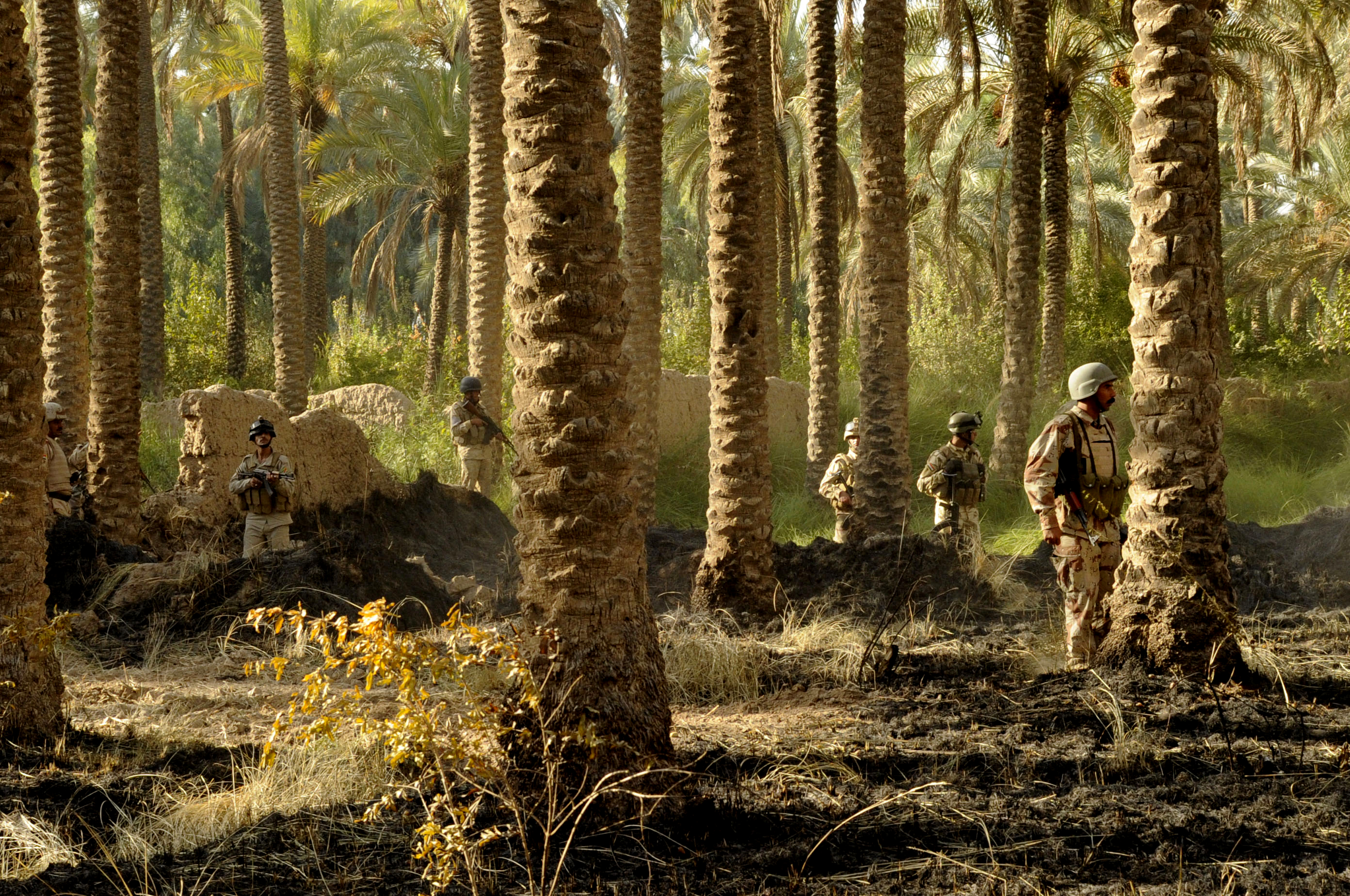
A large portion of the province is drained by the Diyala River, a major tributary of the Tigris. Because of its proximity to two major sources of water, Diyala's main industry is agriculture, primarily dates grown in large groves. The province also contains one of the largest olive groves in the Middle East. It is also recognized as the orange capital of the Middle East. The Hamrin Mountains pass through the governorate.
Population
The governorate is home to a diverse population of Arabs, Kurds and Turkmen. According to the latest statistics, the number of inhabitants is approximately 1,6 million.
Culture
Sports
Diyala is home to Diyala SC that plays in Iraq Stars League, the highest division of the Iraqi football league system, following promotion from Iraqi Premier Division League in 2024. The club is based in Baqubah and Ba'quba Stadium is its home stadium.
Administrative districts
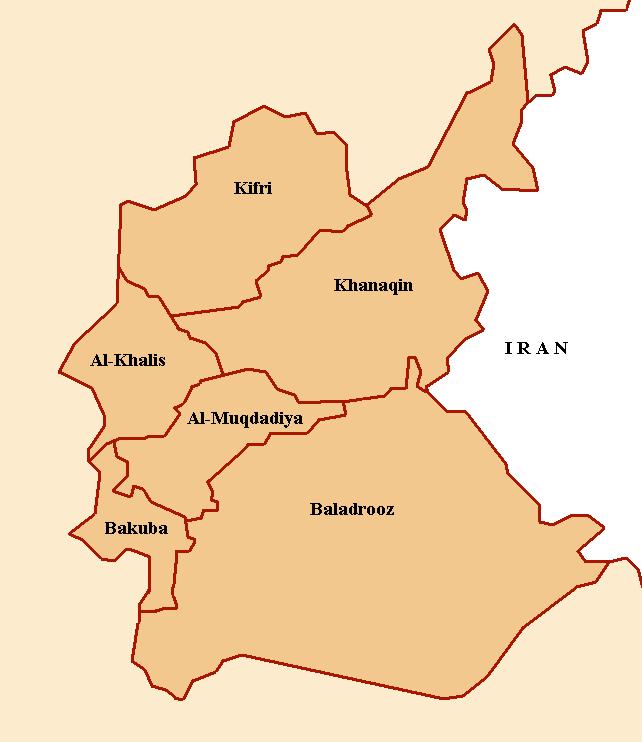
Diyala Governorate comprises seven districts, listed below with their areas and populations as estimated in 2003:
| District | Area in | |
|---|---|---|
| sq. km | Population | |
| in 2003 | ||
| Name | ||
| in Arabic | ||
| Ba'quba | بعقوبة | 1,630 |
| Al-Muqdadiya | المقدادية | 1,033 |
| Khanaqin | خانقين | 3,512 |
| Al-Khalis | الخالص | 2,994 |
| Kifri | كفري | 1,139 |
| Balad Ruz | بلد روز | 6,280 |
| Mandali | مندلي | |
| *Total* | 17,685 |
Cities, towns, and villages
- Baqubah (provincial capital)
- Nahrawan
- Miqdadiyah
- Hibhib
- Khanaqin
- Balad Ruz
- Al Khalis
- Bani Sa'ad
- Jalawla (or Jalula)
- Al-Sadiyah
- Mansouryat al-Jabel
- Camp Ashraf
- Dwelah
- Kingirban{{cite web | access-date = 2007-05-28
- Naft Khana
- Al-Ghalibiyah
- Abd Allah Bayk
- Safra'
- Marfu Village
- Village of Nye
- Udame
- Kan’aan
- Al Wajihiya
- Al Muntheriya
- Abu Saydah
- Buhriz
- Mandali
- Qaryat Imam ʽAskar
- Kifri
- Qara Tapa
Infrastructure
The Diyala Province boasts the Diyala Media Center which has one of the Middle East's tallest radio and television antennas at 349 metres (1,047 ft). The Diyala Media Center was built under contract by a Japanese architectural firm in 1989. It is one of Iraq's few independent radio and television stations that offer local television and radio news coverage as well as rebroadcasting state-run television.
Civil unrest/Iraq War
There is evidence that Al-Qaeda in Iraq moved its base of operations from Anbar province to Diyala in 2006 and during late 2006, Baqubah and majority of the Diyala province were reported to have come under Sunni insurgent control.{{cite news | author-link = Richard Engel | access-date = 2007-05-28 | archive-url = https://web.archive.org/web/20160119055306/http://onthescene.msnbc.com/baghdad/2006/12/reporting_under.html#posts | archive-date = January 19, 2016 | url-status = dead This insurgent control is reported to have continued through 2007 and into early 2008.{{cite web |access-date = 2007-05-28 |url-status = dead |archive-url = https://web.archive.org/web/20071102170117/http://worldblog.msnbc.msn.com/archive/2007/01/17/32969.aspx |archive-date = November 2, 2007
On May 11, 2007, Army Maj. Gen. Benjamin Mixon, commander of the Multi-National Division North said he needed more troops in order to contain the current level of violence in the Diyala province, this coming in the recent wake of a troop "surge", involuntary recalls by the U.S. military, and the public debate about the level of commitment from the U.S. government.{{cite web | access-date = 2007-05-28 By mid-2007 the Islamic State of Iraq, already holding Baqubah and most of the province under its control, declared its capital to be Baqubah. The Sunni insurgent group Jamaat Ansar al-Sunna was also active in the region around this time.
In June 2007, US forces launched Operation Arrowhead Ripper with night air assaults in Baqubah. By August 19, Baqubah was largely secured, although some insurgent presence remained in the city and surrounding areas. Fighting continued in the Diyala River valley but by the beginning of October, US and Iraqi forces held most of the province while the insurgents were in retreat to the north and west. On October 27 the Islamic State of Iraq attacked a police base in Baqubah, killing 28 Iraqi policemen and police recruits, showing that insurgent cells still remain in the province.
In January 2008 Operation Phantom Phoenix was launched in an attempt to eradicate the remaining insurgents following the Diyala campaign between 2006 and 2007.
Mid-2008 saw many changes in Diyala province with an increased effort by U.S. Forces and a substantial Iraqi Army presence, and in the Baqubah region, Islamic State of Iraq's activity was dramatically hampered, and the Sons of Iraq program served only to further weaken Islamic State in Iraq.
Declaration of autonomy
In December 2011, the governing council in Diyala province declared itself a semi-autonomous region within Iraq. This comes two months after Saladin Governorate made a similar declaration. The council in Diyala, using Article 119 of the Iraqi Constitution as justification, made the declaration because of suspicion of the Shi'a-dominated government of Prime Minister Nouri al-Maliki. Unlike Salah ad Din province however, Diyala province is more ethnically and religiously mixed, and such an announcement led to the outbreak of protests in the province.
References
References
- "Sub-national HDI - Area Database". Global Data Lab.
- "New Diyala Governor Adnan Al-Shammari takes office amid tensions". +964.
- [http://www.iraq-businessnews.com/2010/09/06/biggest-olive-groves-in-middle-east-in-diyala/ Biggest Olive Groves in Middle East – in Diyala]
- "Diyala".
- "الصفحة الرئيسية - الجهاز المركزي للاحصاء".
- COSIT (Central Organization for Statistics and Information Technology), Baghdad.
- NGO Co-ordination Committee.
- "Iraq's Diyala province demands semi-autonomous status". Xinhua.
- Hammoudi, Laith. "A second Iraqi province seeks autonomy from Baghdad". Miami Herald.
This article was imported from Wikipedia and is available under the Creative Commons Attribution-ShareAlike 4.0 License. Content has been adapted to SurfDoc format. Original contributors can be found on the article history page.
Ask Mako anything about Diyala Governorate — get instant answers, deeper analysis, and related topics.
Research with MakoFree with your Surf account
Create a free account to save articles, ask Mako questions, and organize your research.
Sign up freeThis content may have been generated or modified by AI. CloudSurf Software LLC is not responsible for the accuracy, completeness, or reliability of AI-generated content. Always verify important information from primary sources.
Report