From Surf Wiki (app.surf) — the open knowledge base
Disdyakis triacontahedron
Catalan solid with 120 faces
Catalan solid with 120 faces
| Disdyakis triacontahedron | ||
|---|---|---|
| [[Image:disdyakis triacontahedron (green).png | 240px | Disdyakis triacontahedron]] |
| (rotating and 3D model) | ||
| Type | ||
| Conway notation | ||
| Coxeter diagram | ||
| Face polygon | ||
| Faces | ||
| Edges | ||
| Vertices | ||
| Face configuration | ||
| Symmetry group | ||
| Rotation group | ||
| Dihedral angle | ||
| Dual polyhedron | ||
| Properties | ||
| [[File:Disdyakis 30 net.svg | 240px | Disdyakis triacontahedron]]net |
In geometry, a disdyakis triacontahedron, hexakis icosahedron, decakis dodecahedron, kisrhombic triacontahedron or d120 is a Catalan solid with 120 faces and the dual to the Archimedean truncated icosidodecahedron. As such it is face-uniform but with irregular face polygons. It slightly resembles an inflated rhombic triacontahedron: if one replaces each face of the rhombic triacontahedron with a single vertex and four triangles in a regular fashion, one ends up with a disdyakis triacontahedron. That is, the disdyakis triacontahedron is the Kleetope of the rhombic triacontahedron. It is also the barycentric subdivision of the regular dodecahedron and icosahedron. It has the most faces among the Archimedean and Catalan solids, with the snub dodecahedron, with 92 faces, in second place.
If the bipyramids, the gyroelongated bipyramids, and the trapezohedra are excluded, the disdyakis triacontahedron has the most faces of any other strictly convex polyhedron where every face of the polyhedron has the same shape.
Projected into a sphere, the edges of a disdyakis triacontahedron define 15 great circles. Buckminster Fuller used these 15 great circles, along with 10 and 6 others in two other polyhedra to define his 31 great circles of the spherical icosahedron.
Geometry
Being a Catalan solid with triangular faces, the disdyakis triacontahedron's three face angles \alpha_4, \alpha_6, \alpha_{10} and common dihedral angle \theta must obey the following constraints analogous to other Catalan solids:
:\sin(\theta/2) = \cos(\pi/4) / \cos(\alpha_4/2) :\sin(\theta/2) = \cos(\pi/6) / \cos(\alpha_6/2) :\sin(\theta/2) = \cos(\pi/10) / \cos(\alpha_{10}/2) :\alpha_4 + \alpha_6 + \alpha_{10} = \pi
The above four equations are solved simultaneously to get the following face angles and dihedral angle:
:\alpha_4 = \arccos \left(\frac{7-4\phi}{30} \right) \approx 88.992^{\circ} :\alpha_6 = \arccos \left( \frac{17-4\phi}{20} \right) \approx 58.238^{\circ} :\alpha_{10} = \arccos \left( \frac{2+5\phi}{12} \right) \approx 32.770^{\circ} :\theta = \arccos \left( -\frac{155 + 48\phi}{241} \right) \approx 164.888^{\circ}
where \phi = \frac{\sqrt{5}+1}{2} \approx 1.618 is the golden ratio.
As with all Catalan solids, the dihedral angles at all edges are the same, even though the edges may be of different lengths.
Cartesian coordinates
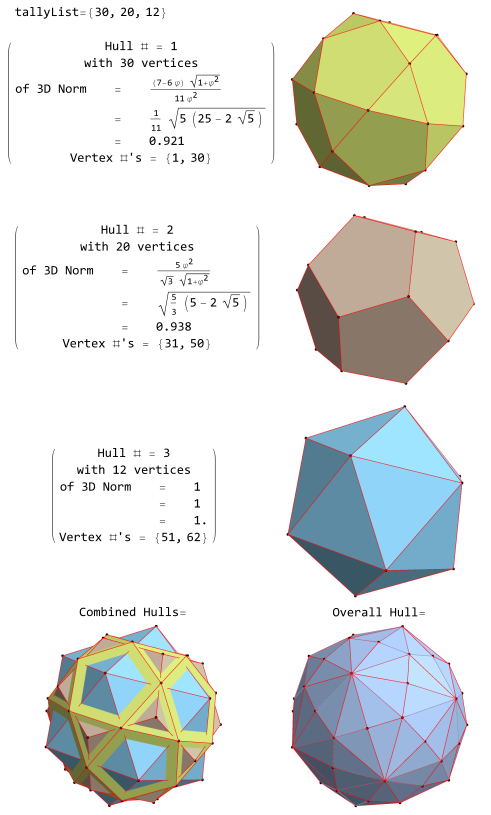
The 62 vertices of a disdyakis triacontahedron are given by:
-
Twelve vertices \left(0, \frac{\pm 1}{\sqrt{\phi+2}} , \frac{\pm \phi}{\sqrt{\phi+2}} \right) and their cyclic permutations,
-
Eight vertices \left(\pm R, \pm R, \pm R\right),
-
Twelve vertices \left(0, \pm R\phi, \pm \frac{R}{\phi}\right) and their cyclic permutations,
-
Six vertices \left(\pm S, 0, 0\right) and their cyclic permutations.
-
Twenty-four vertices \left(\pm \frac{S\phi}{2}, \pm\frac{S}{2}, \pm\frac{S}{2\phi}\right) and their cyclic permutations,
where :R = \frac{5}{3\phi\sqrt{\phi+2}} = \frac{\sqrt{25 - 10\sqrt{5}}}{3} \approx 0.5415328270548438, :S = \frac{(7\phi - 6) \sqrt{\phi+2}}{11} = \frac{(2\sqrt{5} - 3) \sqrt{25 + 10\sqrt{5}}}{11} \approx 0.9210096876986302, and :\phi = \frac{1 + \sqrt{5}}{2} \approx 1.618 is the golden ratio.
In the above coordinates, the first 12 vertices form a regular icosahedron, the next 20 vertices (those with R) form a regular dodecahedron, and the last 30 vertices (those with S) form an icosidodecahedron.
Normalizing all vertices to the unit sphere gives a spherical disdyakis triacontahedron, shown in the adjacent figure. This figure also depicts the 120 transformations associated with the full icosahedral group Ih.
Symmetry
The edges of the polyhedron projected onto a sphere form 15 great circles, and represent all 15 mirror planes of reflective Ih icosahedral symmetry. Combining pairs of light and dark triangles define the fundamental domains of the nonreflective (I) icosahedral symmetry. The edges of a compound of five octahedra also represent the 10 mirror planes of icosahedral symmetry.
| [[File:Disdyakis 30.png | x120px]] | |
|---|---|---|
| Disdyakis | ||
| triacontahedron | [[File:Disdyakis 30 in deltoidal 60.png | x120px]] |
| Deltoidal | ||
| hexecontahedron | [[File:Disdyakis 30 in rhombic 30.png | x120px]] |
| Rhombic | ||
| triacontahedron | [[File:Disdyakis 30 in Platonic 12.png | x125px]] |
| Dodecahedron | [[File:Disdyakis 30 in Platonic 20.png | x125px]] |
| Icosahedron | [[File:Disdyakis 30 in pyritohedron.png | x125px]] |
| Pyritohedron |
| Spherical polyhedron | |
|---|---|
| [[File:Disdyakis 30 spherical.png | 170px]] |
| (see rotating model) | |
| The fundamental domains of icosahedral symmetry form a spherical version of a disdyakis triacontahedron. | |
| Each triangle can be mapped to another triangle of the same color by means of a 3D rotation alone. | |
| Triangles of different colors can be mapped to each other with a reflection or inversion in addition to rotations. |
| Stereographic projections | 2-fold | 3-fold | 5-fold | |||
|---|---|---|---|---|---|---|
| [[File:Spherical disdyakis triacontahedron as compound of five octahedra.png | 250px]] | |||||
| [[File:Brückner Vielflache Tafel 02.jpg | thumb | 300px | The 5-fold projection is the main drawing on the right page. | |||
| [[Max Brückner]]: Vielecke und Vielflache (1900)]] | ||||||
| [[File:Disdyakis triacontahedron stereographic d2 colored.svg | x150px]] | [[File:Disdyakis triacontahedron stereographic d3 colored.svg | x150px]] | [[File:Disdyakis triacontahedron stereographic d5 colored.svg | x150px]] | |
| [[File:Disdyakis triacontahedron stereographic d2 colored crop.svg | x120px]] | [[File:Disdyakis triacontahedron stereographic d3 colored crop.svg | x120px]] | [[File:Disdyakis triacontahedron stereographic d5 colored crop.svg | x120px]] | |
| Colored as compound of five octahedra, with 3 great circles for each octahedron. | ||||||
| The area in the black circles below corresponds to the frontal hemisphere of the spherical polyhedron. |
Orthogonal projections
The disdyakis triacontahedron has three types of vertices which can be centered in orthogonally projection:
| Projective | |||||
|---|---|---|---|---|---|
| symmetry | Image | Dualimage | |||
| [2] | [6] | [10] | |||
| [[File:Dual dodecahedron_t012_f4.png | 100px]] | [[File:Dual dodecahedron_t012_A2.png | 100px]] | [[File:Dual dodecahedron_t012_H3.png | 100px]] |
| [[File:Dodecahedron_t012_f4.png | 100px]] | [[File:Dodecahedron_t012_A2.png | 100px]] | [[File:Dodecahedron_t012_H3.png | 100px]] |
Uses

The disdyakis triacontahedron, as a regular dodecahedron with pentagons divided into 10 triangles each, is considered the "holy grail" for combination puzzles like the Rubik's Cube. Such a puzzle currently has no satisfactory mechanism. It is the most significant unsolved problem in mechanical puzzles, often called the "big chop" problem.
This shape was used to make 120-sided dice using 3D printing.
Since 2016, the Dice Lab has used the disdyakis triacontahedron to mass-market an injection-moulded 120-sided die. It is claimed that 120 is the largest possible number of faces on a fair die, aside from infinite families (such as right regular prisms, bipyramids, and trapezohedra) that would be impractical in reality due to the tendency to roll for a long time.
A disdyakis triacontahedron projected onto a sphere was previously used as the logo for Brilliant, a website containing series of lessons on STEM-related topics.
Because the disdyakis triacontahedron has the highest sphericity of any isohedral figure, it has been studied for its potential use in constructing discrete global grid systems for satellite imaging.
References
- (Section 3-9)
- (The thirteen semiregular convex polyhedra and their duals, Page 25, Disdyakistriacontahedron)
- The Symmetries of Things 2008, John H. Conway, Heidi Burgiel, Chaim Goodman-Strauss, https://web.archive.org/web/20100919143320/https://akpeters.com/product.asp?ProdCode=2205 (Chapter 21, Naming the Archimedean and Catalan polyhedra and tilings, page 285, kisRhombic triacontahedron)
References
- Conway, Symmetries of things, p.284
- "DisdyakisTriacontahedron".
- "Big Chop".
- "Kevin Cook's Dice Collector website: d120 3D printed from Shapeways artist SirisC".
- "The Dice Lab".
- "This D120 is the Largest Mathematically Fair Die Possible {{!".
- "Brilliant".
- Hall, John. (2022-04-01). "Disdyakis Triacontahedron Discrete Global Grid System". [[University of Calgary Press]].
- [http://www.cgl.uwaterloo.ca/csk/papers/bridges2001.html Symmetrohedra: Polyhedra from Symmetric Placement of Regular Polygons] {{Webarchive. link. (2017-03-17 Craig S. Kaplan)
This article was imported from Wikipedia and is available under the Creative Commons Attribution-ShareAlike 4.0 License. Content has been adapted to SurfDoc format. Original contributors can be found on the article history page.
Ask Mako anything about Disdyakis triacontahedron — get instant answers, deeper analysis, and related topics.
Research with MakoFree with your Surf account
Create a free account to save articles, ask Mako questions, and organize your research.
Sign up freeThis content may have been generated or modified by AI. CloudSurf Software LLC is not responsible for the accuracy, completeness, or reliability of AI-generated content. Always verify important information from primary sources.
Report