From Surf Wiki (app.surf) — the open knowledge base
Dinosaur Park Formation
Uppermost member of the Belly River Group geologic unit in Alberta, Canada

Uppermost member of the Belly River Group geologic unit in Alberta, Canada
| Field | Value | |
|---|---|---|
| name | Dinosaur Park Formation | |
| image | Dinosaur Park Fm.jpg | |
| caption | Dinosaur Park Formation exposed along the Red Deer River in Dinosaur Provincial Park, southeastern Alberta, Canada. | |
| type | Geological formation | |
| prilithology | Sandstone (lower) | |
| Mudstone and siltstone (upper) | ||
| otherlithology | Bentonite and coal | |
| namedfor | Dinosaur Provincial Park | |
| namedby | Eberth, D.A. and Hamblin, A.P. | |
| year_ts | 1993 | |
| region | Alberta | |
| country | Canada | |
| coordinates | ||
| paleocoordinates | ||
| underlies | Bearpaw Formation | |
| overlies | Oldman Formation | |
| unitof | Belly River Group | |
| extent | Western Canadian Sedimentary Basin | |
| age | Late Cretaceous, Campanian, | |
| period | Campanian | |
| map | {{Location map+ | Canada#Alberta |
| relief | 1 | |
| width | 250 | |
| float | center | |
| lat_deg | 49.2 | |
| lon_deg | -110.4 | |
| mark | Lightgreen pog.svg | |
| marksize | 10 |
Mudstone and siltstone (upper)
The Dinosaur Park Formation is the uppermost member of the Belly River Group (also known as the Judith River Group), a major geologic unit in southern Alberta. It was deposited during the Campanian stage of the Late Cretaceous, between about 76.5 and 74.4 million years ago. It was deposited in alluvial and coastal plain environments, and it is bounded by the nonmarine Oldman Formation below it and the marine Bearpaw Formation above it.
The Dinosaur Park Formation contains dense concentrations of dinosaur skeletons, both articulated and disarticulated, which are often found with preserved remains of soft tissues. Remains of other animals such as fish, turtles, and crocodilians, as well as plant remains, are also abundant. The formation has been named after Dinosaur Provincial Park, a UNESCO World Heritage Site where the formation is well exposed in the badlands that flank the Red Deer River.
Research history
The Dinosaur Park Formation has been a significant source of terrestrial vertebrate fossils for over a century. The first recorded account of fossils was in 1871 by the priest Jean-Baptiste L'Heureux who was shown bones of the "grandfather of the buffalo" by the Blackfoot Confederacy he was living with, though these notes were never published. Official reports of dinosaur bones in western Canada were reported by George Mercer Dawson in 1874 from southern Saskatchewan and Alberta along the Milk River. Further discoveries by Dawson and his colleagues of the Geological Survey of Canada continued in the 1880s, including the 1884 discovery by Joseph Burr Tyrrell of the skull of a theropod identified as Laelaps by American palaeontologist Edward Drinker Cope but named in 1905 as Albertosaurus by American palaeontologist Henry Fairfield Osborn. In 1889 rich fossil beds in the areas of Deadlodge Canyon and Berry Creek were found by Thomas Chesmer Weston along the Red Deer River. The areas along the Red Deer River would be more completely surveyed by Canadian palaeontologist Lawrence Lambe from 1897 until 1901, when he, along with Osborn, described the fossils found in what was then considered to be the Belly River Formation of mid-Cretaceous age.
Geological setting
The Dinosaur Park Formation is composed of sediments that were derived from the erosion of the mountains to the west. It was deposited on an alluvial to coastal plain by river systems that flowed eastward and southeastward to the Bearpaw Sea, a large inland sea that was part of the Western Interior Seaway. That sea gradually inundated the adjacent coastal plain, depositing the marine shales of the Bearpaw Formation on top of the Dinosaur Park Formation.
The Dinosaur Park Formation is about 70 m thick at Dinosaur Park. The lower portion of the formation was laid down in fluvial channel environments and consists primarily of fine- to medium-grained, crossbedded sandstones. The upper portion, which was deposited in overbank and floodplain environments, consists primarily of massive to laminated, organic-rich mudstones with abundant root traces, and thin beds of bentonite. The Lethbridge Coal Zone, which consists of several seams of low-rank coal interbedded with mudstones and siltstones, marks the top of the formation.
The sediments of the Dinosaur Park Formation are similar to those of the underlying Oldman Formation and they were originally included in that formation. The two formations are separated by a regional disconformity, however, and are distinguished by petrographic and sedimentologic differences. In addition, articulated skeletal remains and bonebeds are rare in the Oldman Formation but abundant in the Dinosaur Park Formation.
Biostratigraphy
The Dinosaur Park Formation can be divided into at least two distinct faunas. The lower part of the formation is characterized by the abundance of Corythosaurus and Centrosaurus. This group of species is replaced higher in the formation by a different ornithischian fauna characterized by the presence of Lambeosaurus and Styracosaurus. The appearance of several new, rare species of ornithischian at the very top of the formation may indicate that a third distinct fauna had replaced the second during the transition into younger, non-Dinosaur Park sediments, at the same time an inland sea transgresses onto land, but there are fewer remains here. An unnamed pachyrhinosaur, Vagaceratops irvinensis, and Lambeosaurus magnicristatus may be more common in this third fauna.
Fossil content
Dinosaurs

Remains of the following dinosaurs have been found in the formation:
Ornithischians
Remains of the following ornithischians have been found in the formation:
Ankylosaurs
Numerous specimens that cannot be definitively assigned to ankylosaurs are known from the formation, including fragmentary cranial, dental, postcranial, and armour material. As all ankylosaurids from the Campanian of Alberta and Montana were historically referred to Euoplocephalus sensu lato, the taxonomy is variable between studies and ranges from one to seven valid genera between the Dinosaur Park, Judith River, Two Medicine, and Horseshoe Canyon Formations.
| Ankylosaurs from the Dinosaur Park Formation | Genus | Species | Location | Stratigraphic position | Material | Notes | Images | |
|---|---|---|---|---|---|---|---|---|
| Anodontosaurus | A. inceptus | Hilda, Alberta | Middle DPF | Two skulls, one with partial skeleton | Previously considered specimens of Euoplocephalus but then referred to Anodontosaurus lambei, otherwise only known from the Horseshoe Canyon Formation, before being given the new species A. inceptus. | [[File:Anodontosaurus LM.png | 150px]] | |
| Dyoplosaurus | D. acutosquameus | Q002 | Lower DPF | Partial skull and skeleton, two tail clubs | Thought to be a synonym of Euoplocephalus for a time but separated as a distinct taxon. | [[File:Dyoplosaurus.tif | 150px]] | |
| Edmontonia | E. rugosidens | Q009, Q043, Q101, Q201, Q229, Q230 | Lower DPF | At least six partial skulls and skeletons | A nodosaurid also known from the Two Medicine Formation | [[File:Edmontonia TD.png | 150px]] | |
| Euoplocephalus | E. tutus | Q059, Q198 | Lower to middle DPF | Partial skulls and skeletons | An ankylosaurid historically including all material from the formation. While some studies include up to 11 specimens even with Anodontosaurus, Dyoplosaurus and Scolosaurus separated, others limit it to 5 specimens and also separate Platypelta. | [[File:Euoplocephalus TD.png | 150px]] | |
| Panoplosaurus | P. mirus | Q008, Q228 | Middle DPF | Skulls and skeleton | A nodosaurid 1/3 less common than Edmontonia. | [[File:Panoplosaurus 055.JPG | 150px]] | |
| Platypelta | P. coombsi | Q052 | Lowermost DPF | Skulls and skeletons | Considered specimens of Euoplocephalus by some studies, but separated as a distinct genus by others. | [[File:Platypelta AMNH 5337.tiff | 150px]] | |
| Scolosaurus | S. cutleri | Q080, Q089 | Base of DPF | Skull(s?) and skeletons | Thought to be a synonym of Euoplocephalus for a time but separated as a distinct taxon. Has been suggested to include Oohkotokia from the Two Medicine Formation, and also to be from the top of the Oldman Formation if the quarry is incorrectly mapped. | [[File:Scolosaurus SW.png | 150px]] | |
| S. thronus | Quarry No. 112 | Upper DPF | Skull and partial skeletons | Considered indeterminate ankylosaurids or specimens of Euoplocephalus by some studies, but separated as a distinct species by others. | [[File:Euoplocephalus ROM1930.tif | 150px]] |
Ceratopsians
An unnamed Pachyrhinosaurus-like taxon has been recovered from the formation.
| Ceratopsians from the Dinosaur Park Formation | Genus | Species | Location | Stratigraphic position | Material | Notes | Images | |||||||||||||||||||
|---|---|---|---|---|---|---|---|---|---|---|---|---|---|---|---|---|---|---|---|---|---|---|---|---|---|---|
| Centrosaurus | C. apertus | Middle, 76.2-75.5Ma ago | last1=RYAN | first1=M. J. | last2=RUSSELL | first2=A. P. | last3=EBERTH | first3=D. A. | last4=CURRIE | first4=P. J. | date=2001-10-01 | title=The Taphonomy of a Centrosaurus (Ornithischia: Certopsidae) Bone Bed from the Dinosaur Park Formation (Upper Campanian), Alberta, Canada, with Comments on Cranial Ontogeny | journal=PALAIOS | volume=16 | issue=5 | pages=482–506 | doi=10.1669/0883-1351(2001)0162.0.co;2 | bibcode=2001Palai..16..482R | s2cid=130116586 | issn=0883-1351}} C. nasicornis may be a synonym. | A centrosaurine ceratopsid | [[File:Centrosaurus.png | center | 200px]] | ||
| Chasmosaurus | C. belli | Middle, 76–75.5Ma ago | "[Twelve] skulls, several skeletons." | A chasmosaurine ceratopsid | [[File:Chasmosaurus BW.jpg | center | 200px]] | |||||||||||||||||||
| C. russelli | Lower, 76.5-76Ma ago | "[Six] complete or partial skulls." | ||||||||||||||||||||||||
| Mercuriceratops | last1 = Ryan | first1 = Michael J. | last2 = Evans | first2 = David C. | last3 = Currie | first3 = Phillip J. | last4 = Loewen | first4 = Mark A. | year = 2014 | title = A New chasmosaurine from northern Laramidia expands frill disparity in ceratopsid dinosaurs | journal = Naturwissenschaften | volume = 101 | issue = 6 | pages = 505–512 | doi = 10.1007/s00114-014-1183-1 | pmid = 24859020 | bibcode = 2014NW....101..505R | s2cid = 13957187 }} | Lower, ~77Ma ago | "one apomorphic squamosal" | A chasmosaurine ceratopsid | [[File:Mercuriceratops NT small.jpg | center | 200px]] | ||
| Monoclonius | M. lowei | A dubious centrosaurine ceratopsid. Possibly synonymous with Centrosaurus. | ||||||||||||||||||||||||
| Pentaceratops | P. aquilonius | Uppermost, 74.8 MA | two frill fragments | A dubious chasmosaurine ceratopsid that may be the same species as Spiclypeus shipporum. | [[File:Pentaceratops BW.jpg | center | 200px]] | |||||||||||||||||||
| last=Farke | first=Andrew A. | author2=Michael J. Ryan | author3=Paul M. Barrett | author4=Darren H. Tanke | author5=Dennis R. Braman | author6=Mark A. Loewen | author7=Mark R. Graham | year=2011 | title=A new centrosaurine from the Late Cretaceous of Alberta, Canada, and the evolution of parietal ornamentation in horned dinosaurs | url=http://www.app.pan.pl/archive/published/app56/app20100121.pdf | journal=Acta Palaeontologica Polonica | volume=56 | issue=4 | pages=691–702 | doi=10.4202/app.2010.0121 | s2cid=13717580 }} | S. sternbergorum | Lower, 76.5Ma | "partial parietal bone, partial dentary, unidentifiable limb fragments, partial skull, and partial right squamosal." | A centrosaurine ceratopsid. It may actually be from the upper Oldman Formation. | [[File:Spinops NT.jpg | center | 200px]] | |||
| Styracosaurus | S. albertensis | Upper, 75.5-75.2Ma ago | "[Two] skulls, [three] skeletons, additional material in bone beds." | A centrosaurine ceratopsid | [[File:Styracosaurus BW.jpg | center | 200px]] | |||||||||||||||||||
| Unescoceratops | U. koppelhusae | author1=Michael J. Ryan | author2=David C. Evans | author3=Philip J. Currie | author4=Caleb M. Brown | author5=Don Brinkman | year=2012 | title=New leptoceratopsids from the Upper Cretaceous of Alberta, Canada | journal=Cretaceous Research | volume=35 | pages=69–80 | doi=10.1016/j.cretres.2011.11.018 | bibcode=2012CrRes..35...69R }} | A leptoceratopsid thought to have been between one and two meters long and less than 91 kilograms. Its teeth were the roundest of all leptoceratopsids. | ||||||||||||
| Vagaceratops | V. irvinensis | Upper, 75Ma ago | "[Three] skulls, skeleton lacking tail." | author1=Scott D. Sampson | author2=Mark A. Loewen | author3=Andrew A. Farke | author4=Eric M. Roberts | author5=Catherine A. Forster | author6=Joshua A. Smith | author7=Alan L. Titus | year=2010 | title=New Horned Dinosaurs from Utah Provide Evidence for Intracontinental Dinosaur Endemism | journal=PLOS One | volume=5 | issue=9 | article-number=e12292 | doi=10.1371/journal.pone.0012292 | pmid=20877459 | pmc=2929175 | bibcode = 2010PLoSO...512292S | doi-access=free }} | [[File:Vagaceratops NT.jpg | center | 200px]] |
Ornithopods
At least one indeterminate thescelosaurid specimen has been recovered from the formation.
In a 2001 review of hadrosaur eggshell and hatchling material from the Dinosaur Park Formation, Darren H. Tanke and M. K. Brett-Surman concluded that hadrosaurs nested in both the ancient upland and lowlands of the formation's depositional environment. The upland nesting grounds may have been preferred by the less common hadrosaurs, like Brachylophosaurus or Parasaurolophus. However, the authors were unable to determine what specific factors shaped nesting ground choice in the formation's hadrosaurs. They suggested that behavior, diet, soil condition, and competition between dinosaur species all potentially influenced where hadrosaurs nested.
Sub-centimeter fragments of pebbly-textured hadrosaur eggshell have been reported from the Dinosaur Park Formation. This eggshell is similar to the hadrosaur eggshell of Devil's Coulee in southern Alberta as well as that of the Two Medicine and Judith River Formations in Montana, United States. While present, dinosaur eggshell is very rare in the Dinosaur Park Formation and is only found in two different microfossil sites. These sites are distinguished by large numbers of pisidiid clams and other less common shelled invertebrates like unionid clams and snails. This association is not a coincidence as the invertebrate shells would have slowly dissolved and released enough basic calcium carbonate to protect the eggshells from naturally occurring acids that otherwise would have dissolved them and prevented fossilization.
In contrast with eggshell fossils, the remains of very young hadrosaurs are actually somewhat common. Darren Tanke has observed that an experienced collector could actually discover multiple juvenile hadrosaur specimens in a single day. The most common remains of young hadrosaurs in the Dinosaur Park Formation are dentaries, bones from limbs and feet, as well as vertebral centra. The material showed little or none of the abrasion that would have resulted from transport, meaning the fossils were buried near their point of origin. Bonebeds 23, 28, 47, and 50 are productive sources of young hadrosaur remains in the formation, especially bonebed 50. The bones of juvenile hadrosaurs and fossil eggshell fragments are not known to have preserved in association with each other, despite both being present in the formation.
| Ornithopods from the Dinosaur Park Formation | Genus | Species | Location | Stratigraphic position | Material | Notes | Images | ||
|---|---|---|---|---|---|---|---|---|---|
| Corythosaurus | C. casuarius | Lower-Middle, 76.5-75.5Ma ago | "Approximately [ten] articulated skulls and associated postcrania, [ten to fifteen] articulated skulls, isolated skull elements, juvenile to adult." | A lambeosaurin lambeosaurine hadrosaur | [[File:Corythosaurus TD.png | center | 200px]] | ||
| Gryposaurus | G. notabilis | Lower, 76.2-76Ma ago | "Approximately [ten] complete skulls, [twelve] fragmentary skulls, associated postcrania." | A kritosaurin saurolophine hadrosaur | [[File:Gryposaurus-notabilis jconway.png | center | 200px]] | ||
| Lambeosaurus | L. lambei | Upper, 75.5-75Ma ago | "Approximately [seven] articulated skulls with associated postcrania, [possibly ten] articulated skulls, isolated skull elements, juvenile to adult." | [[File:Life reconstruction of Lambeosaurus lambei.png | center | 200px]] | |||
| L. magnicristatus | Upper/Bearpaw Formation, 74.8Ma ago | "[Two] complete skulls, one with associated, articulated postcrania." | [[File:Lambeosaurus magnicristatus DB.jpg | center | 200px]] | ||||
| Parasaurolophus | P. walkeri | Lower, 76.5-75.3Ma ago | "Complete skull and postcranial skeleton." | A parasaurolophin lambeosaurine hadrosaur. | [[File:Parasaurolophus walkeri.png | center | 200px]] | ||
| Prosaurolophus | P. maximus | Upper, 75.5 – 74.8 Ma | "[Twenty to twenty-five] individuals, including at least [seven] articulated skulls and associated postcrania." | A saurolophin saurolophine hadrosaur. | [[File:Prosaurolophus Maximus.jpg | center | 200px]] |
Pachycephalosaurs
| Pachycephalosaurs from the Dinosaur Park Formation | Genus | Species | Location | Stratigraphic position | Material | Notes | Images |
|---|
Theropods
In the Dinosaur Park Formation, small theropods are rare due to the tendency of their thin-walled bones to be broken or poorly preserved. Small bones of small theropods that were preyed upon by larger ones may have been swallowed whole and digested. In this context, the discovery of a small theropod dinosaur with preserved tooth marks was especially valuable. Possible indeterminate avimimid remains are known from the formation.
Ornithomimids
| Ornithomimids from the Dinosaur Park Formation | Genus | Species | Location | Stratigraphic position | Material | Notes | Images | |||||||||||||||||
|---|---|---|---|---|---|---|---|---|---|---|---|---|---|---|---|---|---|---|---|---|---|---|---|---|
| Ornithomimus | O. sp. | Type specimen | last1 = Longrich | first1 = N | year = 2008 | title = A new, large ornithomimid from the Cretaceous Dinosaur Park Formation of Alberta, Canada: Implications for the study of dissociated dinosaur remains | journal = Palaeontology | volume = 51 | issue = 4 | pages = 983–997 | doi = 10.1111/j.1475-4983.2008.00791.x | doi-access = | bibcode = 2008Palgy..51..983L }} | [[File:"Ornithomimus" sp. by Tom Parker.png | center | 200px]] | ||||||||
| Qiupalong | last1=McFeeters | first1=B. | last2=Ryan | first2=M. J. | last3=Schröder-Adams | first3=C. | last4=Currie | first4=P. J. | date=2017 | title=First North American occurrences of Qiupalong (Theropoda: Ornithomimidae) and the palaeobiogeography of derived ornithomimids | journal=FACETS | volume=2 | issue=1 | pages=355–373 | doi=10.1139/facets-2016-0074 | doi-access=free}} | Several specimens | An ornithomimid, possibly a radiation of this genus from Asia. | [[File:Qiupalong Restoration.png | center | 200px]] | |||
| Rativates | R. evadens | Type specimen | An ornithomimid, formerly a specimen of Struthiomimus. | [[File:Rativates.png | center | 200px]] |
Oviraptorosaurs
| Oviraptorosaurs from the Dinosaur Park Formation | Genus | Species | Location | Stratigraphic position | Material | Notes | Images | ||||||||||||||||
|---|---|---|---|---|---|---|---|---|---|---|---|---|---|---|---|---|---|---|---|---|---|---|---|
| Caenagnathus | C. collinsi | Mandible, type specimen | last1 = Longrich | first1 = N. R. | last2 = Barnes | first2 = K. | last3 = Clark | first3 = S. | last4 = Millar | first4 = L. | title = Caenagnathidae from the Upper Campanian Aguja Formation of West Texas, and a Revision of the Caenagnathinae | doi = 10.3374/014.054.0102 | journal = Bulletin of the Peabody Museum of Natural History | volume = 54 | pages = 23–49 | year = 2013 | s2cid = 128444961 }} which rivalled Anzu in size. | [[File:Caenagnathus dentaries-dorsal.jpg | center | 200px]] | |||
| Chirostenotes | C. pergracilis | Several fragmentary specimens, type specimen | A mid-sized caenagnathid. | [[File:Chirostenotes BW.jpg | center | 200px]] | |||||||||||||||||
| Citipes | C. elegans | Several fragmentary specimens, type specimen | Smallest caenagnathid from the formation. | [[File:Citipes elegans.jpg | center | 200px]] | |||||||||||||||||
| Macrophalangia | M. canadensis | Junior synonym of Chirostenotes pergracilis |
Paravians
A new taxon of troodontid based solely on teeth is known from the upper part of the formation.
| Paravians from the Dinosaur Park Formation | Genus | Species | Location | Stratigraphic position | Material | Notes | Images | ||
|---|---|---|---|---|---|---|---|---|---|
| cf. Baptornis | Indeterminate | A hesperornithine bird | |||||||
| cf. Cimolopteryx | Indeterminate | Partial coracoid | A possible charadriiform bird | ||||||
| Dromaeosaurus | D. albertensis | Several specimens and teeth, type specimen | A dromaeosaurid | [[File:Dromaeosaurus Restoration.png | center | 200px]] | |||
| Hesperonychus | H. elizabethae | Hip bones and partial toes and claws, type specimen | A dromaeosaurid or an avialan, also found in the Oldman Formation | [[File:Hesperonychus elizabethae.jpg | center | 200px]] | |||
| Latenivenatrix | L. mcmasterae | Hip bones, pelvis, skull fragments, type specimen | A large troodontid measuring 3-3.5 m. | [[File:Latenivenatrix (white background).png | center | 200px]] | |||
| cf. Palintropus | Unnamed | Partial shoulder girdles | An ambiortiform bird | ||||||
| cf. Paronychodon | cf. P. lacustris | Teeth | An indeterminate maniraptoran, also found in the Judith River | ||||||
| cf. Pectinodon | Indeterminate | Teeth | A troodont | ||||||
| Polyodontosaurus | P. grandis | Dentary, type specimen | Nomen dubium. Possibly synonymous with Latenivenatrix. | ||||||
| Richardoestesia | R. gilmorei | Mandible, type specimen | A dromaeosaurid | ||||||
| R. isosceles | Teeth | ||||||||
| Saurornitholestes | S. langstoni | Incomplete skeleton and teeth, type specimen. A dentary referred to Saurornitholestes was discovered that preserved tooth marks left by a young tyrannosaur. | A dromaeosaurid | [[File:Saurornitholestes digging Burrows wahweap.jpg | center | 200px]] | |||
| Stenonychosaurus | S. inequalis | Nearly complete skeleton and other partial skeletons, type specimen | A troodontid once thought to be a species of Troodon | [[File:Life reconstruction of Stenonychosaurus.png | center | 200px]] |
Tyrannosaurs
| Tyrannosaurs from the Dinosaur Park Formation | Genus | Species | Location | Stratigraphic position | Material | Notes | Images | |||||||||||
|---|---|---|---|---|---|---|---|---|---|---|---|---|---|---|---|---|---|---|
| Daspletosaurus | D. horneri | Middle-Upper, ~75,6-75 Ma ago | CMN 350, partial skull and skeleton with left dentary (TMP 2010.121.0001) | A tyrannosaurine tyrannosaurid, also present in the Two Medicine Formation. | [[File:FMNH Daspletosaurus.jpg | 200px]] | ||||||||||||
| D. wilsoni? | Middle-Upper, ~76,5-75,8 Ma ago | Several specimens | A tyrannosaurine tyrannosaurid. | |||||||||||||||
| Gorgosaurus | G. libratus | Lower-Middle, 76.5–75 Ma ago | last=Currie | first=Philip J. | author-link=Phil Currie | year=2003 | title=Cranial anatomy of tyrannosaurids from the Late Cretaceous of Alberta | journal=Acta Palaeontologica Polonica | volume=48 | issue=2 | pages=191–226 | url=https://www.app.pan.pl/article/item/app48-191.html}} | An albertosaurine tyrannosaurid whose fossils have been unearthed in the Judith River Formation and possibly the Two Medicine Formation. It was the most common large carnivore in the area. | [[File:Gorgosaurus.png | center | 200px]] |
Other reptiles
Choristoderes
Choristoderes, or champsosaurs, were aquatic reptiles. Small examples looked like lizards, while larger types were superficially similar to crocodilians. Remains of the following Choristoderes have been found in the formation:
- Champsosaurus (at least 3 species)
- Cteniogenys sp. cf. antiquus (possibly another genus)
Crocodylians
Remains of the following Crocodylians have been found in the formation:
- Albertochampsa
- Leidyosuchus
- at least 1 unnamed taxon
Lizards
Remains of the following lizards have been found in the formation:
- Helodermatids
- Labrodioctes
- Necrosaurids
- Parasaniwa
- Teiids
- Glyptogenys
- Socognathus
- Varanids
- Palaeosaniwa
- Xenosaurids
- ?Exostinus
Plesiosaurs
Remains of the following Plesiosaurs have been found in the formation:
- Fluvionectes
- indeterminate polycotylids (shorter-necked)
Pterosaurs
Remains of the following pterosaurs have been found in the formation:
- Cryodrakon (known from small and large specimens)
- 1 unnamed non-azhdarchid pterosaur
Turtles
Remains of the following turtles have been found in the formation:
- Adocus
- "Apalone"
- Aspideretoides (3 species)
- Basilemys
- Boremys
- Judithemys
- Neurankylus
- Plesiobaena
- 2 indeterminate taxa
Mammals
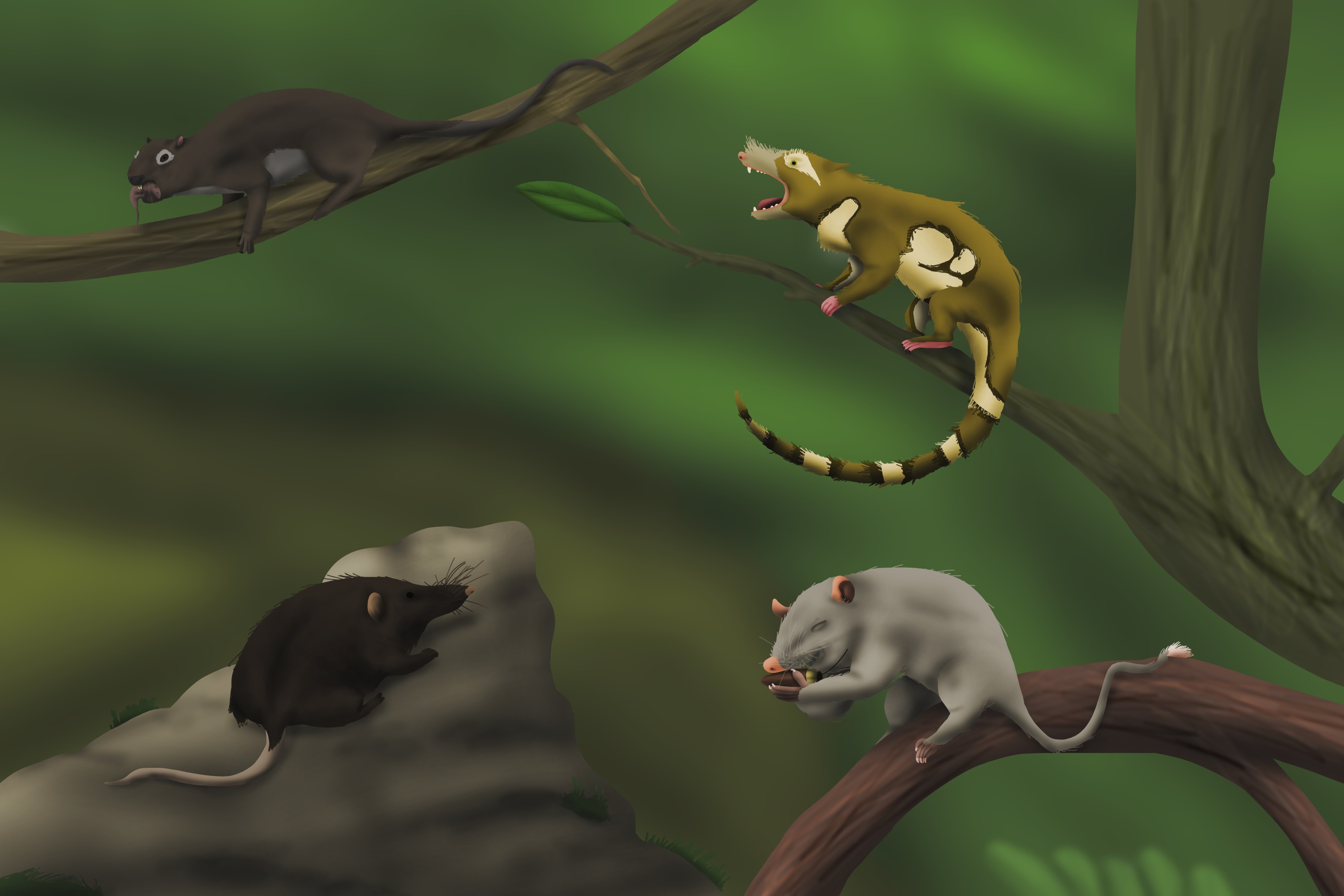
Remains of the following mammals have been found in the formation:
Multituberculata
| Multituberculatas from the Dinosaur Park Formation | Genus | Species | Location | Stratigraphic position | Material | Notes | Images |
|---|---|---|---|---|---|---|---|
| Cimexomys | C. sp. | ||||||
| * Cimolodon* spp. | |||||||
| Meniscoessus major | |||||||
| * Mesodma primaeva* |
Metatherians
| Multituberculatas from the Dinosaur Park Formation | Genus | Species | Location | Stratigraphic position | Material | Notes | Images |
|---|---|---|---|---|---|---|---|
| Alphadon | A. halleyi | An alphadontidae marsupial | |||||
| Eodelphis | E. browni | A stagodont metatherians | |||||
| E. cutleri | |||||||
| "Pediomys" | P. sp | ||||||
| P. sp | |||||||
| P. sp | |||||||
| P. sp | |||||||
| P. sp | |||||||
| Turgidodon | T. russelli | An alphadontidae marsupial | |||||
| T. praesagus |
Eutherians
| Multituberculatas from the Dinosaur Park Formation | Genus | Species | Location | Stratigraphic position | Material | Notes | Images |
|---|---|---|---|---|---|---|---|
| Cimolestes | C. sp. | A eutherian mammal with uncertain taxonomy | |||||
| Gypsonictops | G. lewisi | A leptictidan mammal | |||||
| Paranyctoides | P sternbergi | An early eutherian mammal |
Fish
Remains of the following fish have been found in the formation:
- Chondrichthyans
- Cretorectolobus olsoni (a carpet shark)
- Eucrossorhinus microcuspidatus (a carpet shark)
- Ischyrhiza mira (a sclerorhynchid)
- Meristodonoides montanensis (a hybodont shark)
- Myledaphus bipartitus (a ray)
- Protoplatyrhina renae (a guitarfish)
- indeterminate orectolobid
- "Edaphodontidae" indet. (a chimaera**)**
- Elasmodus sp. (a chimaera**)**
- Ischyodus bifurcatus (a chimaera*)***
- Euselachii indet.
- Archaeolamna kopingensis judithensis (a shark)
- Carcharias cf. samhammeri (a shark)
- Odontaspis aculeatus (a shark)
- Cretorectolobus olsoni (a shark)
- Batormophii indet.
- Protoplatyrhina renae (a Rhino Ray)
- Acipenseriformes (sturgeons)
- "Acipenser albertensis"
- Anchiacipenser acanthaspis
- unnamed sturgeon
- unnamed paddlefish
- Holostean fish
- Arotus hieroglyphus
- Lepisosteus occidentalis (the gar)
- unnamed bowfin
- at least 2 other holosteans
- Teleost fish
- Acronichthys sp. (an otophysan)
- Archaeosiilik sp. (a pike)
- Belonostomus longirostris
- Cretophareodus alberticus (an osteoglossomorph)
- Coriops amnicolus
- Dercetis cf. magnificus
- Enchodus indet.
- Enchodus gladiolus
- Enchodus petrosus
- Estesesox foxi (a pike)
- Horseshoeichthys armaserratus (an ellimmichthyiform)
- Nunikuluk gracilis (a pike)
- Oldmanesox canadensis (a pike)
- Paralbula (including Phyllodus)
- Paratarpon apogerontus (an elopomorph, like the tarpon)
- Primuluchara laramidensis (a characin)
- Sivulliusalmo sp. (a salmonid)
- Acanthomorpha indet.
- Clupeomorpha indet.
- Elopiformes indet.
- at least 8 other teleosts
Amphibians
Remains of the following amphibians have been found in the formation:
| Amphibians from the Dinosaur Park Formation | Genus | Species | Location | Stratigraphic position | Material | Notes | Images |
|---|---|---|---|---|---|---|---|
| Albanerpeton | A. gracilis | A salamander-like Albanerpetontid amphibian | |||||
| Habrosaurus | H. prodilatus | A salamander | |||||
| Lisserpeton | L. sp | A salamander | |||||
| Opisthotriton | O. kayi | A salamander | |||||
| Scapherpeton | S. tectum | A salamander | |||||
| Tyrrellbatrachus | T. brinkmani | A frog | |||||
| Hensonbatrachus | H. kermiti | A frog |
Invertebrates
Remains of the following invertebrates have been found in the formation:
-
Insects
- Cordualadensa acorni (a cavilabiatid dragonfly)
-
Freshwater bivalves
- Fusconaia
- Lampsilis
- Sphaerium (2 species)
-
Freshwater gastropods
- Campeloma (2 species)
- Elimia
- Goniobasis (3 species)
- Hydrobia
- Lioplacodes (2 species)
-
Marine Invertebrates
- Placenticeras sp.
- Palaeonephrops? (a clawed lobster)
Flora
Plant body fossils
The following plant body fossils have been found in the formation:
- various ferns
- Equisetum (Equisetaceae)
- Gymnosperms
- Platyspiroxylon (Cupressaceae)
- Podocarpoxylon (Podocarpaceae)
- Elatocladus (Taxodiaceae)
- Sequoia (Taxodiaceae)
- Sequoiaxylon (Taxodiaceae)
- Taxodioxylon (Taxodiaceae)
- Ginkgos
- Baiera
- Ginkgoites
- Angiosperms
- Artocarpus (Moraceae)
- Cercidiphyllum (Cercidiphyllaceae)
- Dombeyopsis (Sterculiaceae)
- Menispermites (Menispermaceae)
- Pistia (Araceae)
- Platanus (Platanaceae)
- Vitis (Vitaceae)
- Trapa (Trapaceae)
Palynomorphs
Palynomorphs are organic-walled microfossils, like spores, pollen, and algae. The following palynomorphs have been found in the formation:
- Unknown producers
- at least 8 species
- Fungi
- at least 35 taxa
- Chlorophyta (green algae and blue-green algae)
- at least 12 species
- Pyrrhophyta (dinoflagellates, a type of marine algae)
- unassigned cysts
- Bryophytes (mosses, liverworts, and hornworts)
- Anthocerotophyta (hornworts)
- at least 5 species
- Marchantiophyta (liverworts)
- at least 14 species
- Bryophyta (mosses)
- at least 5 species
- Anthocerotophyta (hornworts)
- Lycopodiophyta
- Lycopodiaceae (club mosses)
- at least 11 species
- Selaginellaceae (small club mosses)
- at least 6 species
- Isoetaceae (quillworts)
- at least 1 species
- Lycopodiaceae (club mosses)
- Polypodiophyta
- Osmundaceae (cinnamon ferns)
- at least 6 species
- Schizaeaceae (climbing ferns)
- at least 20 species
- Gleicheniaceae (Gleichenia and allies; coral ferns)
- at least 5 species
- Cyatheaceae (Cyathea and allies)
- at least 4 species
- Dicksoniaceae (Dicksonia and allies)
- at least 3 species
- Polypodiaceae (ferns)
- at least 4 species
- Matoniaceae
- at least 1 species
- Marsileaceae
- at least 1 species
- Osmundaceae (cinnamon ferns)
- Pinophyta (gymnosperms)
- Cycadaceae (cycads)
- at least 3 species
- Caytoniaceae
- at least 1 species
- Pinaceae (pines)
- at least 4 species
- Cupressaceae (cypresses)
- at least 3 species
- Podocarpaceae (Podocarpus and allies)
- at least 4 species
- Cheirolepidiaceae
- at least 2 species
- Ephedraceae (Mormon teas)
- at least 6 species
- Unknown gymnosperms: at least 3 species
- Cycadaceae (cycads)
- Magnoliophyta (angiosperms)
- Magnoliopsida (dicots)
- Buxaceae (boxwood)
- at least 1 species
- Gunneraceae (gunneras)
- at least 1 species
- Salicaceae (willows, cottonwood, quaking aspen)
- at least 1 species
- Droseraceae (sundews)
- at least 1 species
- Olacaceae (tallowwood)
- at least 2 species
- Loranthaceae (showy mistletoes)
- at least 1 species
- Sapindaceae (soapberry)
- at least 1 species
- Aceraceae (maples)
- at least 1 species
- Proteaceae (proteas)
- at least 9 species
- Compositae (sunflowers)
- at least 1 species
- Fagaceae (beeches, oaks, chestnuts)
- at least 2 species
- Betulaceae (birches, alders)
- at least 1 species
- Ulmaceae (elms)
- at least 1 species
- Chenopodiaceae (goosefoots)
- at least 1 species
- Buxaceae (boxwood)
- Liliopsida (monocots)
- Liliaceae (lilies)
- at least 6 species
- Cyperaceae (sedges)
- at least 1 species
- Sparganiaceae (bur-reeds)
- possibly 1 species
- Unknown angiosperms: at least 88 species
- Liliaceae (lilies)
- Magnoliopsida (dicots)
Footnotes
References
References
- Braman, D.R., and Koppelhus, E.B. 2005. Campanian palynomorphs. In: Currie, P.J., and Koppelhus, E.B. (eds), Dinosaur Provincial Park: A Spectacular Ancient Ecosystem Revealed. Indiana University Press: Bloomington and Indianapolis, 101–130.
- Brinkman, D.B. 2005. Turtles: diversity, paleoecology, and distribution. In: Currie, P.J., and Koppelhus, E.B. (eds), Dinosaur Provincial Park: A Spectacular Ancient Ecosystem Revealed. Indiana University Press: Bloomington and Indianapolis, 202–220.
- Caldwell, M.W. The squamates: origins, phylogeny, and paleoecology. In: Currie, P.J., and Koppelhus, E.B. (eds). 2005. Dinosaur Provincial Park: A Spectacular Ancient Ecosystem Revealed. Indiana University Press: Bloomington and Indianapolis, 235–248.
- Currie, P.J. 2005. Theropods, including birds. In: Currie, P.J., and Koppelhus, E.B. (eds), Dinosaur Provincial Park: A Spectacular Ancient Ecosystem Revealed. Indiana University Press: Bloomington and Indianapolis, 367–397.
- Currie, P.J., and Koppelhus, E.B. (eds). 2005. Dinosaur Provincial Park: A Spectacular Ancient Ecosystem Revealed. Indiana University Press: Bloomington and Indianapolis, 648 p.
- Eberth, D.A. 2005. The geology. In: Currie, P.J., and Koppelhus, E.B. (eds), Dinosaur Provincial Park: A Spectacular Ancient Ecosystem Revealed. Indiana University Press: Bloomington and Indianapolis, 54–82.
- Fox, R.C. 2005. Late Cretaceous mammals. In: Currie, P.J., and Koppelhus, E.B. (eds), Dinosaur Provincial Park: A Spectacular Ancient Ecosystem Revealed. Indiana University Press: Bloomington and Indianapolis, 417–435.
- K. Gao and Brinkman, D.B. 2005. Choristoderes from the Park and its vicinity. In: Currie, P.J., and Koppelhus, E.B. (eds), Dinosaur Provincial Park: A Spectacular Ancient Ecosystem Revealed. Indiana University Press: Bloomington and Indianapolis, 221–234.
- Gardner, J.D. 2005. Lissamphibians. In: Currie, P.J., and Koppelhus, E.B. (eds), Dinosaur Provincial Park: A Spectacular Ancient Ecosystem Revealed. Indiana University Press: Bloomington and Indianapolis, 186–201.
- Godfrey, S.J., and Currie, P.J. 2005. Pterosaurs. In: Currie, P.J., and Koppelhus, E.B. (eds), Dinosaur Provincial Park: A Spectacular Ancient Ecosystem Revealed. Indiana University Press: Bloomington and Indianapolis, 292–311.
- Johnston, P.A., and Hendy, A.J.W. 2005. Paleoecology of mollusks from the Upper Cretaceous Belly River Group. In: Currie, P.J., and Koppelhus, E.B. (eds), Dinosaur Provincial Park: A Spectacular Ancient Ecosystem Revealed. Indiana University Press: Bloomington and Indianapolis, 139–166.
- Koppelhus, E.B. 2005. Paleobotany. In: Currie, P.J., and Koppelhus, E.B. (eds), Dinosaur Provincial Park: A Spectacular Ancient Ecosystem Revealed. Indiana University Press: Bloomington and Indianapolis, 131–138.
- Neuman, A.G., and Brinkman, D.B. 2005. Fishes of the fluvial beds. In: Currie, P.J., and Koppelhus, E.B. (eds), Dinosaur Provincial Park: A Spectacular Ancient Ecosystem Revealed. Indiana University Press: Bloomington and Indianapolis, 167–185.
- Ryan, M.J., and Evans, D.C. 2005. Ornithischian dinosaurs. In: Currie, P.J., and Koppelhus, E.B. (eds), Dinosaur Provincial Park: A Spectacular Ancient Ecosystem Revealed. Indiana University Press: Bloomington and Indianapolis, 312–348.
- Sato, T., Eberth, D.A., Nicholls, E.L., and Manabe, M. 2005. Plesiosaurian remains from non-marine to paralic sediments. In: Currie, P.J., and Koppelhus, E.B. (eds), Dinosaur Provincial Park: A Spectacular Ancient Ecosystem Revealed. Indiana University Press: Bloomington and Indianapolis, 249–276.
- Tanke, D.H. and Brett-Surman, M.K. 2001. Evidence of Hatchling and Nestling-Size Hadrosaurs (Reptilia:Ornithischia) from Dinosaur Provincial Park (Dinosaur Park Formation: Campanian), Alberta, Canada. pp. 206–218. In: Mesozoic Vertebrate Life—New Research Inspired by the Paleontology of Philip J. Currie. Edited by D.H. Tanke and K. Carpenter. Indiana University Press: Bloomington. xviii + 577 pp.
- Xiao-Chun Wu. 2005. Crocodylians. In: Currie, P.J., and Koppelhus, E.B. (eds), Dinosaur Provincial Park: A Spectacular Ancient Ecosystem Revealed. Indiana University Press: Bloomington and Indianapolis, 277-291
References
- (1993). "Tectonic, stratigraphic, and sedimentologic significance of a regional discontinuity in the upper Judith River Group (Belly River wedge) of southern Alberta, Saskatchewan, and northern Montana". Canadian Journal of Earth Sciences.
- (2022-09-26). "Calibrating the zenith of dinosaur diversity in the Campanian of the Western Interior Basin by CA-ID-TIMS U–Pb geochronology". Scientific Reports.
- Eberth, D.A. 2005. The geology. In: Currie, P.J., and Koppelhus, E.B. (eds), ''[[iarchive:dinosaurprovinci0000unse. Dinosaur Provincial Park: A Spectacular Ancient Ecosystem Revealed]]''. Indiana University Press: Bloomington and Indianapolis, p.54-82. {{ISBN. 0-253-34595-2.
- Currie, P.J., and Koppelhus, E.B. (eds), Dinosaur Provincial Park: A Spectacular Ancient Ecosystem Revealed. Indiana University Press: Bloomington and Indianapolis, p. 277-291. {{ISBN. 0-253-34595-2.
- (2012). "Megaherbivorous dinosaur turnover in the Dinosaur Park Formation (upper Campanian) of Alberta, Canada". Palaeogeography, Palaeoclimatology, Palaeoecology.
- (September 2017). "An unusual hadrosaurid braincase from the Dinosaur Park Formation and the biostratigraphy of ''Parasaurolophus'' (Ornithischia: Lambeosaurinae) from southern Alberta". Canadian Journal of Earth Sciences.
- Arbour, V. M.. (2009). "A redescription of the ankylosaurid dinosaur ''Dyoplosaurus acutosquameus'' Parks, 1924 (Ornithischia: Ankylosauria) and a revision of the genus". Journal of Vertebrate Paleontology.
- Currie, P.J. 2005. Theropods, including birds. In: Currie, P.J., and Koppelhus, E.B. (eds), Dinosaur Provincial Park: A Spectacular Ancient Ecosystem Revealed. Indiana University Press: Bloomington and Indianapolis, p. 367-397. {{ISBN. 0-253-34595-2.
- Ryan, M.J., and Evans, D.C. 2005. Ornithischian dinosaurs. In: Currie, P.J., and Koppelhus, E.B. (eds), Dinosaur Provincial Park: A Spectacular Ancient Ecosystem Revealed. Indiana University Press: Bloomington and Indianapolis, p. 312-348. {{ISBN. 0-253-34595-2.
- (January 2010). "New Perspectives on Horned Dinosaurs".
- (2001-10-01). "The Taphonomy of a Centrosaurus (Ornithischia: Certopsidae) Bone Bed from the Dinosaur Park Formation (Upper Campanian), Alberta, Canada, with Comments on Cranial Ontogeny". PALAIOS.
- (2014). "A New chasmosaurine from northern Laramidia expands frill disparity in ceratopsid dinosaurs". Naturwissenschaften.
- Nicholas R. Longrich. (2014). "The horned dinosaurs ''Pentaceratops'' and ''Kosmoceratops'' from the upper Campanian of Alberta and implications for dinosaur biogeography". Cretaceous Research.
- Jordan C. Mallon. (2016). "''Spiclypeus shipporum'' gen. et sp. nov., a Boldly Audacious New Chasmosaurine Ceratopsid (Dinosauria: Ornithischia) from the Judith River Formation (Upper Cretaceous: Campanian) of Montana, USA". PLOS One.
- Farke, Andrew A.. (2011). "A new centrosaurine from the Late Cretaceous of Alberta, Canada, and the evolution of parietal ornamentation in horned dinosaurs". Acta Palaeontologica Polonica.
- (2012). "New leptoceratopsids from the Upper Cretaceous of Alberta, Canada". Cretaceous Research.
- (2010). "New Horned Dinosaurs from Utah Provide Evidence for Intracontinental Dinosaur Endemism". PLOS One.
- (2023). "Problematic putative pachycephalosaurids: Synchrotron µCT imaging shines new light on the anatomy and taxonomic validity of ''Gravitholus albertae'' from the Belly River Group (Campanian) of Alberta, Canada". Vertebrate Anatomy Morphology Palaeontology.
- (2023-11-15). "Two new species of small-bodied pachycephalosaurine (Dinosauria, Marginocephalia) from the uppermost Cretaceous of North America suggest hidden diversity in well-sampled formations". Papers in Palaeontology.
- (2014). "The horned dinosaurs ''Pentaceratops'' and ''Kosmoceratops'' from the upper Campanian of Alberta and implications for dinosaur biogeography". Cretaceous Research.
- (2008). "A new, large ornithomimid from the Cretaceous Dinosaur Park Formation of Alberta, Canada: Implications for the study of dissociated dinosaur remains". Palaeontology.
- (2017). "First North American occurrences of Qiupalong (Theropoda: Ornithomimidae) and the palaeobiogeography of derived ornithomimids". FACETS.
- (2016). "A new ornithomimid theropod from the Dinosaur Park Formation of Alberta, Canada". Journal of Vertebrate Paleontology.
- (2013). "Caenagnathidae from the Upper Campanian Aguja Formation of West Texas, and a Revision of the Caenagnathinae". Bulletin of the Peabody Museum of Natural History.
- Funston, Gregory. (2020-07-27). "Caenagnathids of the Dinosaur Park Formation (Campanian) of Alberta, Canada: anatomy, osteohistology, taxonomy, and evolution". Vertebrate Anatomy Morphology Palaeontology.
- (2002). "Small Theropod and Bird Teeth from the Late Cretaceous (Late Campanian) Judith River Group, Alberta". Journal of Paleontology.
- (2019-07-10). "A new paravian dinosaur from the Late Jurassic of North America supports a late acquisition of avian flight". PeerJ.
- (December 2020). "New Dromaeosaurid Dinosaur (Theropoda, Dromaeosauridae) from New Mexico and Biodiversity of Dromaeosaurids at the end of the Cretaceous". Scientific Reports.
- (2013-01-23). "Multivariate Analyses of Small Theropod Dinosaur Teeth and Implications for Paleoecological Turnover through Time". PLOS One.
- (2025). "First occurrence of ''Daspletosaurus horneri'' (Tyrannosauridae, Tyrannosaurinae) in the Dinosaur Park Formation of Dinosaur Provincial Park, Alberta (Treaty 7 Territory)". Historical Biology: An International Journal of Paleobiology.
- (2024). "Anagenesis and the tyrant pedigree: a response to "Re-analysis of a dataset refutes claims of anagenesis within ''Tyrannosaurus''-line tyrannosaurines (Theropoda, Tyrannosauridae)"". Cretaceous Research.
- Currie, Philip J.. (2003). "Cranial anatomy of tyrannosaurids from the Late Cretaceous of Alberta". Acta Palaeontologica Polonica.
- (January 2021). "Fossil record 7: NMMNH Bulletin 82". New Mexico Museum of Natural History and Science.
- K.Gao and Brinkman, D.B. 2005. Choristoderes from the Park and its vicinity. In: Currie, P.J., and Koppelhus, E.B. (eds), Dinosaur Provincial Park: A Spectacular Ancient Ecosystem Revealed. Indiana University Press: Bloomington and Indianapolis, p. 221-234. {{ISBN. 0-253-34595-2.
- Xiao-Chun Wu. 2005. Crocodylians. In: Currie, P.J., and Koppelhus, E.B. (eds), Dinosaur Provincial Park: A Spectacular Ancient Ecosystem Revealed. Indiana University Press: Bloomington and Indianapolis, p. 277-291. {{ISBN. 0-253-34595-2.
- Caldwell, M.W. The squamates: origins, phylogeny, and paleoecology. In: Currie, P.J., and Koppelhus, E.B. (eds). 2005. ''Dinosaur Provincial Park: A Spectacular Ancient Ecosystem Revealed.'' Indiana University Press: Bloomington and Indianapolis, p. 235-248. {{ISBN. 0-253-34595-2.
- Sato, T., Eberth, D.A., Nicholls, E.L., and Manabe, M. 2005. Plesiosaurian remains from non-marine to paralic sediments. In: Currie, P.J., and Koppelhus, E.B. (eds), ''Dinosaur Provincial Park: A Spectacular Ancient Ecosystem Revealed.'' Indiana University Press: Bloomington and Indianapolis, p. 249-276. {{ISBN. 0-253-34595-2.
- Godfrey, S.J., and Currie, P.J. 2005. Pterosaurs. In: Currie, P.J., and Koppelhus, E.B. (eds), Dinosaur Provincial Park: A Spectacular Ancient Ecosystem Revealed. Indiana University Press: Bloomington and Indianapolis, p. 292-311. {{ISBN. 0-253-34595-2.
- (2019). "''Cryodrakon boreas'' gen. et sp. nov. a Late Cretaceous Canadian azhdarchid pterosaur". Journal of Vertebrate Paleontology.
- Brinkman, D.B. 2005. Turtles: diversity, paleoecology, and distribution. In: Currie, P.J., and Koppelhus, E.B. (eds), Dinosaur Provincial Park: A Spectacular Ancient Ecosystem Revealed. Indiana University Press: Bloomington and Indianapolis, p. 202-220. {{ISBN. 0-253-34595-2.
- Fox, R.C. 2005. Late Cretaceous mammals. In: Currie, P.J., and Koppelhus, E.B. (eds), Dinosaur Provincial Park: A Spectacular Ancient Ecosystem Revealed. Indiana University Press: Bloomington and Indianapolis, p. 417-435. {{ISBN. 0-253-34595-2.
- Neuman, A.G., and Brinkman, D.B. 2005. Fishes of the fluvial beds. In: Currie, P.J., and Koppelhus, E.B. (eds), Dinosaur Provincial Park: A Spectacular Ancient Ecosystem Revealed. Indiana University Press: Bloomington and Indianapolis, p. 167-185. {{ISBN. 0-253-34595-2.
- "Fossilworks: Gateway to the Paleobiology Database".
- Nelson, Luke. (2025-12-23). "A marginal marine fauna from the upper Dinosaur Park Formation, Canada". Vertebrate Anatomy Morphology Palaeontology.
- (2018). "A rare, articulated sturgeon (Chondrostei: Acipenseriformes) from the Upper Cretaceous of Dinosaur Provincial Park, Alberta, Canada". Journal of Vertebrate Paleontology.
- Gardner, James D.. (2025-06-01). "Reidentification of the holotype of ‘Ceratodus’ hieroglyphus Cope from the Upper Cretaceous (Campanian) of Montana, USA, as the scale of a holostean fish". Palaeobiodiversity and Palaeoenvironments.
- Liu, Juan. (2025-10-02). "Marine origins and freshwater radiations of the otophysan fishes". Science.
- Crothers, Joel. (2026-01-13). "An actinopterygian-dominated fish fauna from the Upper Cretaceous Williams Fork Formation, northwestern Colorado, and evidence for provinciality across Laramidia at the Campanian/Maastrichtian boundary". Cretaceous Research.
- (2025). "Fishes from the Upper Cretaceous Prince Creek Formation, North Slope of Alaska, and their palaeobiogeographical significance". Papers in Palaeontology.
- (2009-11-07). "Seventy-five-million-year-old tropical tetra-like fish from Canada tracks Cretaceous global warming". Proceedings of the Royal Society B: Biological Sciences.
- Wick, Steven L.. (2021). "New early Campanian characiform fishes (Otophysi: Characiformes) from West Texas support a South American origin for known Late Cretaceous characiforms from North America". Cretaceous Research.
- Gardner, J.D. 2005. Lissamphibians. In: Currie, P.J., and Koppelhus, E.B. (eds), Dinosaur Provincial Park: A Spectacular Ancient Ecosystem Revealed. Indiana University Press: Bloomington and Indianapolis, p. 186-201. {{ISBN. 0-253-34595-2.
- "Fossilworks: Gateway to the Paleobiology Database".
- "Fossilworks: Gateway to the Paleobiology Database".
- Johnston, P.A., and Hendy, A.J.W. 2005. Paleoecology of mollusks from the Upper Cretaceous Belly River Group. In: Currie, P.J., and Koppelhus, E.B. (eds), Dinosaur Provincial Park: A Spectacular Ancient Ecosystem Revealed. Indiana University Press: Bloomington and Indianapolis, p. 139-166. {{ISBN. 0-253-34595-2.
- Mueller, André S.. (August 2025). "New family of fossil dragonfly (Odonata, Cavilabiata) from the late Cretaceous (Campanian) Dinosaur Park Formation, Alberta, Canada". Canadian Journal of Earth Sciences.
- Koppelhus, E.B. 2005. Paleobotany. In: Currie, P.J., and Koppelhus, E.B. (eds), Dinosaur Provincial Park: A Spectacular Ancient Ecosystem Revealed. Indiana University Press: Bloomington and Indianapolis, p. 131-138. {{ISBN. 0-253-34595-2.
- Braman, D.R., and Koppelhus, E.B. 2005. Campanian palynomorphs. In: Currie, P.J., and Koppelhus, E.B. (eds), Dinosaur Provincial Park: A Spectacular Ancient Ecosystem Revealed. Indiana University Press: Bloomington and Indianapolis, p. 101-130. {{ISBN. 0-253-34595-2.
- Currie, P.J.. (2005). "Dinosaur Provincial Park: A Spectacular Ancient Ecosystem Revealed". Indiana University Press.
- (2005). "Dinosaur Provincial Park: A Spectacular Ancient Ecosystem Revealed". Indiana University Press.
- (2005). "Dinosaur Provincial Park: A Spectacular Ancient Ecosystem Revealed". Indiana University Press.
- (2013). "''Euoplocephalus tutus'' and the Diversity of Ankylosaurid Dinosaurs in the Late Cretaceous of Alberta, Canada, and Montana, USA". PLOS One.
- [http://cgkn1.cgkn.net/weblex/weblex_litho_detail_e.pl?00053:004018 '''Lexicon of Canadian Geologic Units''': Dinosaur Park Formation] {{webarchive. link. (2013-02-21)
- Ryan and Evans (2005).
- "Table 21.1," in Weishampel, et al. (2004). Page 465.
- "Table 23.1," in Weishampel, et al. (2004). Page 495.
- "Table 23.1," in Weishampel, et al. (2004). Page 496.
- "Abstract," Tanke and Brett-Surman (2001). Page 206.
- "Introduction," Tanke and Brett-Surman (2001). Page 208.
- "Eggshell," Tanke and Brett-Surman (2001). Page 209.
- "Discussion," Tanke and Brett-Surman (2001). Page 212.
- "Conclusions," Tanke and Brett-Surman (2001). Page 212.
- "Table 20.1," in Weishampel, et al. (2004). Page 441.
- "Table 20.1," in Weishampel, et al. (2004). Page 440.
- "Table 20.1," in Weishampel, et al. (2004). Page 442.
- "Abstract," Jacobsen (2001). Page 58.
- "Introduction," Jacobsen (2001). Page 59.
- "Discussion," Jacobsen (2001). Page 61.
This article was imported from Wikipedia and is available under the Creative Commons Attribution-ShareAlike 4.0 License. Content has been adapted to SurfDoc format. Original contributors can be found on the article history page.
Ask Mako anything about Dinosaur Park Formation — get instant answers, deeper analysis, and related topics.
Research with MakoFree with your Surf account
Create a free account to save articles, ask Mako questions, and organize your research.
Sign up freeThis content may have been generated or modified by AI. CloudSurf Software LLC is not responsible for the accuracy, completeness, or reliability of AI-generated content. Always verify important information from primary sources.
Report