From Surf Wiki (app.surf) — the open knowledge base
Dimensionality reduction
Process of reducing the number of random variables under consideration
Process of reducing the number of random variables under consideration
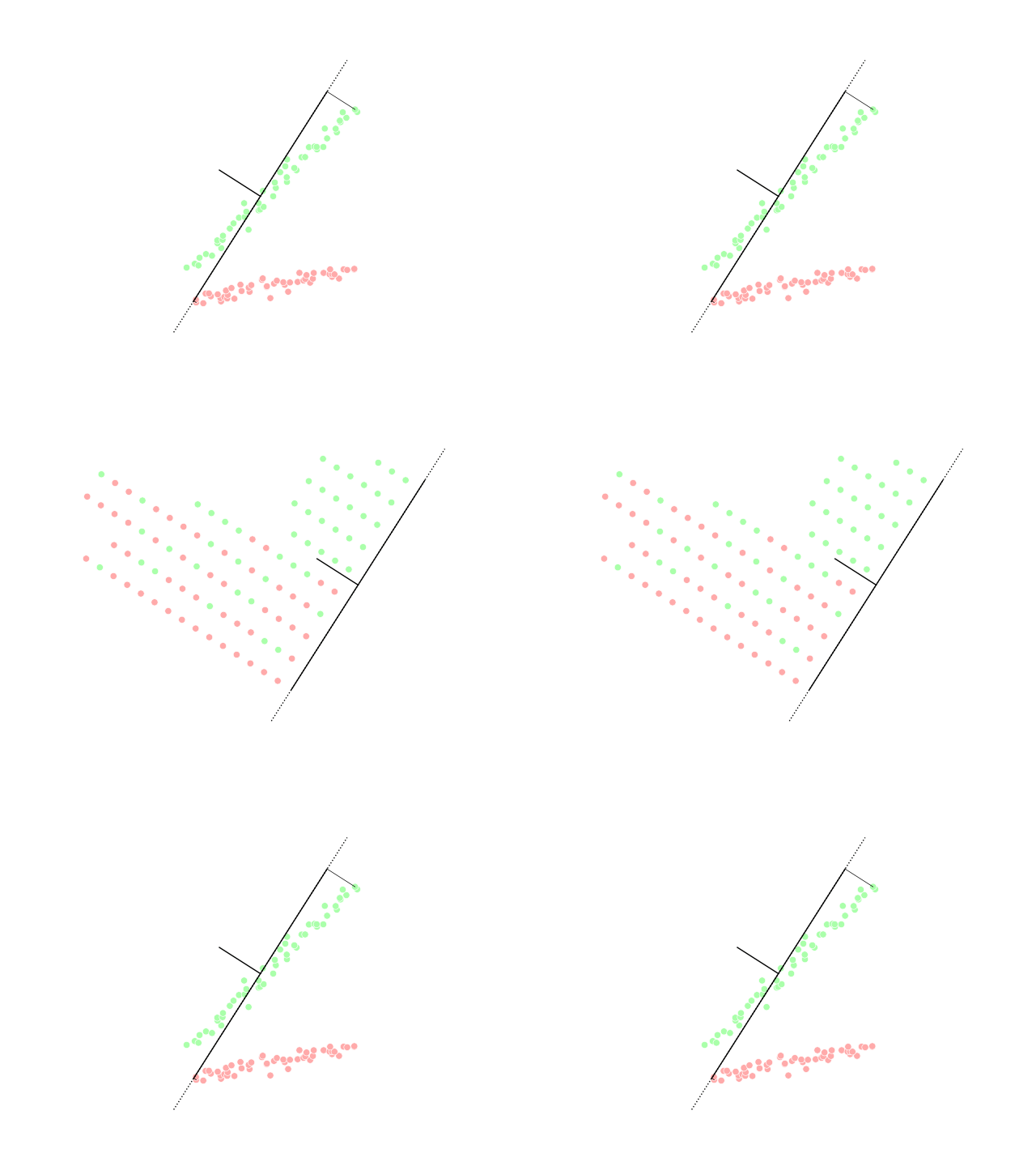
Dimensionality reduction, or dimension reduction, is the transformation of data from a high-dimensional space into a low-dimensional space so that the low-dimensional representation retains some meaningful properties of the original data, ideally close to its intrinsic dimension. Working in high-dimensional spaces can be undesirable for many reasons; raw data are often sparse as a consequence of the curse of dimensionality, and analyzing the data is usually computationally intractable. Dimensionality reduction is common in fields that deal with large numbers of observations and/or large numbers of variables, such as signal processing, speech recognition, neuroinformatics, and bioinformatics.
Methods are commonly divided into linear and nonlinear approaches. Linear approaches can be further divided into feature selection and feature extraction. Dimensionality reduction can be used for noise reduction, data visualization, cluster analysis, or as an intermediate step to facilitate other analyses.
Feature selection
Main article: Feature selection}}{{See also, Combinatorial optimization
The process of feature selection aims to find a suitable subset of the input variables (features, or attributes) for the task at hand. The three strategies are: the filter strategy (e.g., information gain), the wrapper strategy (e.g., accuracy-guided search), and the embedded strategy (features are added or removed while building the model based on prediction errors).
Data analysis such as regression or classification can be done in the reduced space more accurately than in the original space.{{cite journal
Feature projection
Main article: Feature extraction
Feature projection (also called feature extraction) transforms the data from the high-dimensional space to a space of fewer dimensions. The data transformation may be linear, as in principal component analysis (PCA), but many nonlinear dimensionality reduction techniques also exist. For multidimensional data, tensor representation can be used in dimensionality reduction through multilinear subspace learning.{{cite journal
Principal component analysis (PCA)
Main article: Principal component analysis
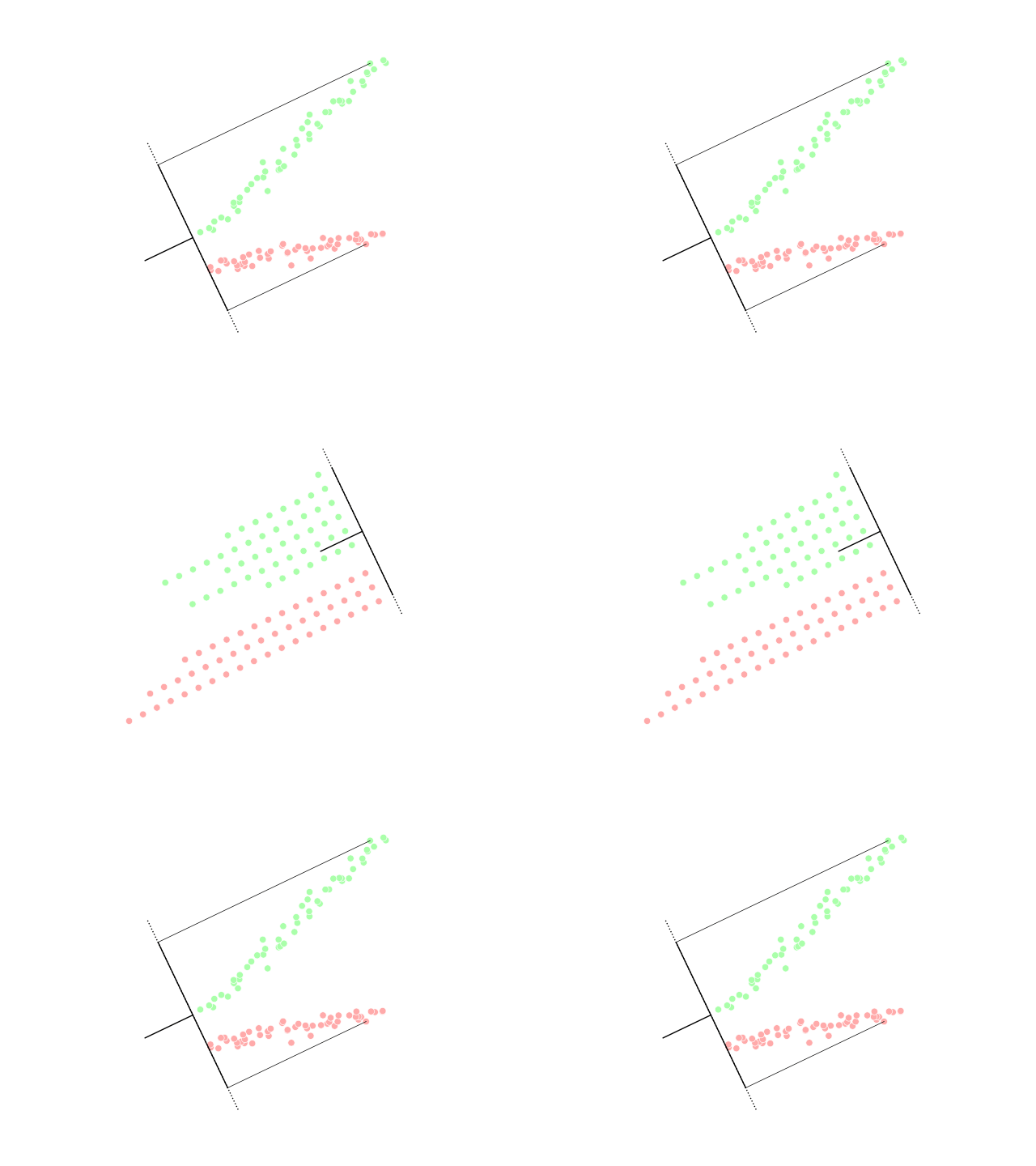
The main linear technique for dimensionality reduction, principal component analysis, performs a linear mapping of the data to a lower-dimensional space in such a way that the variance of the data in the low-dimensional representation is maximized. In practice, the covariance (and sometimes the correlation) matrix of the data is constructed and the eigenvectors on this matrix are computed. The eigenvectors that correspond to the largest eigenvalues (the principal components) can now be used to reconstruct a large fraction of the variance of the original data. Moreover, the first few eigenvectors can often be interpreted in terms of the large-scale physical behavior of the system, because they often contribute the vast majority of the system's energy, especially in low-dimensional systems. Still, this must be proved on a case-by-case basis as not all systems exhibit this behavior. The original space (with dimension of the number of points) has been reduced (with data loss, but hopefully retaining the most important variance) to the space spanned by a few eigenvectors.
Non-negative matrix factorization (NMF)
Main article: Non-negative matrix factorization
NMF decomposes a non-negative matrix to the product of two non-negative ones, which has been a promising tool in fields where only non-negative signals exist,{{cite journal |author2-link=Sebastian Seung |name-list-style=amp |name-list-style=amp |year=2001
With a stable component basis during construction, and a linear modeling process, sequential NMF is able to preserve the flux in direct imaging of circumstellar structures in astronomy, as one of the methods of detecting exoplanets, especially for the direct imaging of circumstellar discs. In comparison with PCA, NMF does not remove the mean of the matrices, which leads to physical non-negative fluxes; therefore NMF is able to preserve more information than PCA as demonstrated by Ren et al.
Kernel PCA
Main article: Kernel principal component analysis
Principal component analysis can be employed in a nonlinear way by means of the kernel trick. The resulting technique is capable of constructing nonlinear mappings that maximize the variance in the data. The resulting technique is called kernel PCA.
Graph-based kernel PCA
Other prominent nonlinear techniques include manifold learning techniques such as Isomap, locally linear embedding (LLE), Hessian LLE, Laplacian eigenmaps, and methods based on tangent space analysis. These techniques construct a low-dimensional data representation using a cost function that retains local properties of the data, and can be viewed as defining a graph-based kernel for Kernel PCA.
More recently, techniques have been proposed that, instead of defining a fixed kernel, try to learn the kernel using semidefinite programming. The most prominent example of such a technique is maximum variance unfolding (MVU). The central idea of MVU is to exactly preserve all pairwise distances between nearest neighbors (in the inner product space) while maximizing the distances between points that are not nearest neighbors.
An alternative approach to neighborhood preservation is through the minimization of a cost function that measures differences between distances in the input and output spaces. Important examples of such techniques include: classical multidimensional scaling, which is identical to PCA; Isomap, which uses geodesic distances in the data space; diffusion maps, which use diffusion distances in the data space; t-distributed stochastic neighbor embedding (t-SNE), which minimizes the divergence between distributions over pairs of points; and curvilinear component analysis.
A different approach to nonlinear dimensionality reduction is through the use of autoencoders, a special kind of feedforward neural networks with a bottleneck hidden layer. The training of deep encoders is typically performed using a greedy layer-wise pre-training (e.g., using a stack of restricted Boltzmann machines) that is followed by a finetuning stage based on backpropagation.
Linear discriminant analysis (LDA)
Main article: Linear discriminant analysis
Linear discriminant analysis (LDA) is a generalization of Fisher's linear discriminant, a method used in statistics, pattern recognition, and machine learning to find a linear combination of features that characterizes or separates two or more classes of objects or events.
Generalized discriminant analysis (GDA)
GDA deals with nonlinear discriminant analysis using kernel function operator. The underlying theory is close to the support-vector machines (SVM) insofar as the GDA method provides a mapping of the input vectors into high-dimensional feature space. Similar to LDA, the objective of GDA is to find a projection for the features into a lower dimensional space by maximizing the ratio of between-class scatter to within-class scatter.
Autoencoder
Main article: Autoencoder
Autoencoders can be used to learn nonlinear dimension reduction functions and codings together with an inverse function from the coding to the original representation.
t-SNE
Main article: t-distributed stochastic neighbor embedding
T-distributed Stochastic Neighbor Embedding (t-SNE) is a nonlinear dimensionality reduction technique useful for the visualization of high-dimensional datasets. It is not recommended for use in analysis such as clustering or outlier detection since it does not necessarily preserve densities or distances well.
UMAP
Main article: Uniform manifold approximation and projection
Uniform manifold approximation and projection (UMAP) is a nonlinear dimensionality reduction technique. Visually, it is similar to t-SNE, but it assumes that the data is uniformly distributed on a locally connected Riemannian manifold and that the Riemannian metric is locally constant or approximately locally constant.
Dimension reduction
For high-dimensional datasets, dimension reduction is usually performed prior to applying a k-nearest neighbors (k-NN) algorithm in order to mitigate the curse of dimensionality.
Feature extraction and dimension reduction can be combined in one step, using principal component analysis (PCA), linear discriminant analysis (LDA), canonical correlation analysis (CCA), or non-negative matrix factorization (NMF) techniques to pre-process the data, followed by clustering via k-NN on feature vectors in a reduced-dimension space. In machine learning, this process is also called low-dimensional embedding.
For high-dimensional datasets (e.g., when performing similarity search on live video streams, DNA data, or high-dimensional time series), running a fast approximate k-NN search using locality-sensitive hashing, random projection, "sketches", or other high-dimensional similarity search techniques from the VLDB conference toolbox may be the only feasible option.
Applications
A dimensionality reduction technique that is sometimes used in neuroscience is maximally informative dimensions, which finds a lower-dimensional representation of a dataset such that as much information as possible about the original data is preserved.
Notes
References
References
- (October 26, 2009). "Dimensionality Reduction: A Comparative Review". J Mach Learn Res.
- (1998). "Feature Extraction, Construction and Selection".
- Samet, H. (2006) ''Foundations of Multidimensional and Metric Data Structures''. Morgan Kaufmann. {{ISBN. 0-12-369446-9
- C. Ding, X. He, H. Zha, H.D. Simon, [https://escholarship.org/uc/item/8pv153t1 Adaptive Dimension Reduction for Clustering High Dimensional Data], Proceedings of International Conference on Data Mining, 2002
- (2007). "K-corrections and filter transformations in the ultraviolet, optical, and near infrared". The Astronomical Journal.
- (2018). "Non-negative Matrix Factorization: Robust Extraction of Extended Structures". The Astrophysical Journal.
- Zhu, Guangtun B.. (2016-12-19). "Nonnegative Matrix Factorization (NMF) with Heteroscedastic Uncertainties and Missing data".
- (2000). "Nonlinear Dimensionality Reduction by Locally Linear Embedding". Science.
- (2004). "Principal Manifolds and Nonlinear Dimensionality Reduction via Tangent Space Alignment". SIAM Journal on Scientific Computing.
- Hongbing Hu, Stephen A. Zahorian, (2010) [http://ws2.binghamton.edu/zahorian/pdf/Hu2010Dimensionality.pdf "Dimensionality Reduction Methods for HMM Phonetic Recognition"], ICASSP 2010, Dallas, TX
- (2000). "Generalized Discriminant Analysis Using a Kernel Approach". Neural Computation.
- (2015). "CloudID: Trustworthy cloud-based and cross-enterprise biometric identification". Expert Systems with Applications.
- (2017). "Similarity Search and Applications". Springer International Publishing.
- Kevin Beyer, Jonathan Goldstein, Raghu Ramakrishnan, Uri Shaft (1999) [http://citeseerx.ist.psu.edu/viewdoc/summary?doi=10.1.1.31.1422 "When is "nearest neighbor" meaningful?"]. ''Database Theory—ICDT99'', 217–235
- (2009). "Proceedings of the 26th Annual International Conference on Machine Learning – ICML '09".
- (2001). "Proceedings of the seventh ACM SIGKDD international conference on Knowledge discovery and data mining – KDD '01".
- Shasha, D High (2004) ''Performance Discovery in Time Series'' Berlin: Springer. {{ISBN. 0-387-00857-8
- Schütt, Heiko H.. (2024-11-13). "Bayesian Comparisons Between Representations".
This article was imported from Wikipedia and is available under the Creative Commons Attribution-ShareAlike 4.0 License. Content has been adapted to SurfDoc format. Original contributors can be found on the article history page.
Ask Mako anything about Dimensionality reduction — get instant answers, deeper analysis, and related topics.
Research with MakoFree with your Surf account
Create a free account to save articles, ask Mako questions, and organize your research.
Sign up freeThis content may have been generated or modified by AI. CloudSurf Software LLC is not responsible for the accuracy, completeness, or reliability of AI-generated content. Always verify important information from primary sources.
Report