From Surf Wiki (app.surf) — the open knowledge base
Dim sum
Chinese cuisine
Chinese cuisine
| Field | Value |
|---|---|
| title | Dim sum |
| pic | Dim Sum Trang.jpg |
| pic2 | Chinese DimSum (9023590541).jpg |
| t | 點心 |
| s | 点心 |
| showflag | jy |
| p | diǎnxīn |
| tp | diǎn-sin |
| w | |
| mi | |
| bpmf | ㄉㄧㄢˇ ㄒㄧㄣ |
| j | dim2 sam1 |
| y | dím sām |
| ci | |
| h | tiám-sîm |
| l | "Touch the heart" |
Dim sum () is a large range of small Chinese dishes that are traditionally enjoyed in restaurants for brunch. Most modern dim sum dishes are commonly associated with Cantonese cuisine, although dim sum dishes also exist in other Chinese cuisines. In the tenth century, when the city of Canton (Guangzhou) began to experience an increase in commercial travel, many frequented teahouses for small-portion meals with tea called "yum cha" (brunch). "Yum cha" includes two related concepts. The first is "jat zung loeng gin" ({{linktext|一盅兩件}}), which translates literally as "one cup, two pieces". This refers to the custom of serving teahouse customers two delicately made food items, savory or sweet, to complement their tea. The second is dim sum, which translates literally to "touch the heart", the term used to designate the small food items that accompanied the tea.
Teahouse owners gradually added various snacks called dim sum to their offerings. The practice of having tea with dim sum eventually evolved into the modern "yum cha". Cantonese dim sum culture developed rapidly during the latter half of the nineteenth century in Guangzhou. Cantonese dim sum was originally based on local foods. As dim sum continued to develop, chefs introduced influences and traditions from other regions of China. Cantonese dim sum has a very broad range of flavors, textures, cooking styles, and ingredients and can be classified into regular items, seasonal offerings, weekly specials, banquet dishes, holiday dishes, house signature dishes, and travel-friendly items, as well as breakfast or lunch foods and late-night snacks.
Some estimates claim that there are at least two thousand types of dim sum in total across China, but only about forty to fifty types are commonly sold outside of China. There are over one thousand dim sum dishes originating from Guangdong alone, a total that no other area in China comes even close to matching. In fact, the cookbooks of most Chinese food cultures tend to combine their own variations on dim sum dishes with other local snacks. But that is not the case with Cantonese dim sum, which has developed into a separate branch of cuisine.
Dim sum restaurants typically have a wide variety of dishes, usually totaling several dozen. The tea is very important, just as important as the food. Many Cantonese restaurants serve dim sum as early as five in the morning, while more traditional restaurants typically serve dim sum until mid-afternoon. Some restaurants in Hong Kong and Guangdong province even offers dim sum all day till late night. Dim sum restaurants have a unique serving method where servers offer dishes to customers from steam-heated carts. It is now commonplace for restaurants to serve dim sum at dinner and sell various dim sum items à la carte for takeout. In addition to traditional dim sum, some chefs also create and prepare new fusion-based dim sum dishes. There are also variations designed for visual appeal on social media, such as dumplings and buns made to resemble animals.
Etymology
The original meaning of the term "dim sum" remains unclear and contested. Some references state that the term originated in the Eastern Jin dynasty (317 AD–420 AD). According to one legend, to show soldiers gratitude after battles, a general had civilians make buns and cakes to send to the front lines. "Gratitude" or 點點心意 (), later shortened to , of which dim sum is the Cantonese pronunciation, came to represent dishes made similarly.
Some versions date the legend to the Southern Song dynasty (960–1279) after the term's earliest attestation in the Book of Tang (). Written in the Five Dynasties and Ten Kingdoms period (907–979), the book uses 點心 as a verb instead: 「治妝未畢, 我未及餐, 爾且可點心」(), which translates to "I have not finished preparing myself and am not ready for a proper meal; therefore, you can treat yourself to some small snacks." In this context, "dim sum" means "to barely fill your stomach". Dim sum dishes are usually associated with "yum cha" (), which is known as the Cantonese brunch tradition.****** Chinese food historian Yan-kit So has described dim sum as:Literally translated as "so close to the heart", they are, in reality, a large range of hors d'oeuvres Cantonese people traditionally enjoy in restaurants (previously teahouses) for breakfast and lunch but never for dinner, washed down with tea. "Let's go yum cha" (to drink tea) is understood among the Cantonese to mean going to a restaurant for dim sum; such is the twin linkage between the food and the beverage.
Cuisine
There are at least two thousand types of dim sum in total across China, and over one thousand available in Guangdong alone. Dim sum are usually eaten as breakfast or brunch. Cantonese dim sum has a very broad range of flavors, textures, cooking styles, and ingredients, and can be classified into regular items, seasonal offerings, weekly specials, banquet dishes, holiday dishes, house signature dishes, travel-friendly, as well as breakfast or lunch foods and late night snacks.
The subtropical climate of the southeast quadrant of Guangdong partly influences dim sum's portion size. It can cause a decrease in appetite, so that people prefer eating scaled-down meals throughout the day rather than the customary three large meals. Teahouses in Guangzhou served "three teas and two meals," which included lunch and dinner, and breakfast, afternoon, and evening teas with dim sum.
Many dim sum dishes are made of seafood, chopped meats, or vegetables wrapped in dough or thin wrappings and steamed, deep-fried, or pan-fried. A traditional dim sum brunch includes various types of steamed buns, such as cha siu bao (a steamed bun filled with barbecue pork), rice or wheat dumplings, and rice noodle rolls that contain a range of ingredients, including beef, chicken, pork, prawns, and vegetarian options. Many dim sum restaurants also offer plates of steamed green vegetables, stuffed eggplant, stuffed green peppers, roasted meats, congee and other soups. Dessert dim sum is also available and can be ordered at any time since there is not a set sequence for the meal.
It is customary to order "family-style", sharing the small dishes consisting of three or four pieces of dim sum among all members of the dining party. Small portion sizes allow people to try a wide variety of food.
Dishes
Dim sum restaurants typically have a wide variety of dishes, usually several dozen.
Dumplings
| Name | Image | Chinese | Description | |||||||
|---|---|---|---|---|---|---|---|---|---|---|
| Shrimp dumpling | [[File:Ha Gow (Cantonese Shrimp Dumplings).jpeg | 150px]] | (蝦餃; haa1 gaau2) | steamed dumpling with shrimp filling. | ||||||
| Teochew dumpling | [[File:Chaozhoufenguo.jpg | 150px]] | () | steamed dumpling with peanuts, garlic, Chinese chives, pork, dried shrimp, and Chinese mushrooms. | ||||||
| Chive dumpling | [[File:Food (27942342621).jpg | 150px]] | () | steamed dumpling with Chinese chives.{{cite book | ||||||
| Xiaolongbao | [[File:HK 灣仔 Wan Chai 柯布連道 30號 Obrien Road shop 三六九飯店 369 Restaurant Shanghai Food diner February 2019 SSG 20.jpg | 150px]] | dumplings containing a rich broth and filled with meat or seafood. | |||||||
| Tangbao | [[File:开封第一楼小笼包.JPG | 150px]] | soup-filled steamed buns | |||||||
| Guotie | [[File:Noodlecat - Lee Anne Wong - "Lucky Dumpring Jiao Zi" (6739677033).jpg | 150px]] | pan-fried dumpling, usually with meat and cabbage filling. | |||||||
| Shark fin dumpling | [[File:Shark fin dumplings, Holiday Restaurant, Semarang, 2014-06-19.jpg | 150px]] | steamed dumplings with shrimp, crab sticks, shiitake, and straw mushrooms. | |||||||
| Shumai | [[File:HK SW 上環 Sheung Wan 星月樓 Sky Cuisine Restaurant 飲早茶 morning tea meal steamed Cantonese shrimp shumai April 2021 SS2 09.jpg | 150px]] | 978-0-681-02584-4}}. p 38. | |||||||
| Taro dumpling | [[File:Fried taro cake.jpg | 150px]] | title=蜂巢炸芋角 | url=http://www.chinabaike.com/article/39/food/2007/20071021602559.html | access-date=6 September 2012 | work=chinabaike.com | archive-date=3 February 2019 | archive-url=https://web.archive.org/web/20190203143741/http://www.chinabaike.com/article/39/food/2007/20071021602559.html | url-status=live}} | |
| Haam seui gok | [[File:Salty Pastry 鹹水角 Tim Ho Wan, the Dim-Sum Specialists, Sham Shui Po 添好運點心專門店, 深水埗 SML.20120820.G12.00097 (7885046796).jpg | 150px]] | deep-fried dumpling with a slightly savory filling of pork and chopped vegetables in a sweet and sticky wrapping. | |||||||
| Dumpling soup | [[File:2016 0716 Guan Tong Gao.jpg | 150px]] | soup with one or two big dumplings.{{cite news | |||||||
| Wonton | [[File:Shaxian County snacks - wonton.jpg | 150px]] | dumpling filled with ground pork and shrimp |
Rolls
| Name | Image | Chinese | Description | |
|---|---|---|---|---|
| Spring roll | [[File:춘권.jpg | 150px]] | a deep-fried roll with various sliced vegetables (such as carrots, cabbage, mushrooms, and wood ear fungus) and sometimes meat. | |
| Tofu skin roll | [[File:09 Fu Pei Guen - tofu skin roll - East Harbor Dim Sum.jpg | 150px]] | 978-0-681-02584-4}}. p35. | |
| Fresh bamboo roll | [[File:HK dim sum food - streamed 蒸鮮竹卷芋頭 Feb-2014 MCK.jpg | 150px]] | a roll made of tofu skin filled with minced pork and bamboo shoot, typically served in an oyster sauce broth.{{cite book | |
| Four-treasure chicken roll | [[File:雞扎.jpg | 150px]] | a roll made of tofu skin filled with chicken, Jinhua ham, fish maw (), and Chinese mushroom.{{cite news | |
| Cifantuan | [[File:CiFanTuan.png | 150px]] | steamed glutinous rice rolls | |
| Rice noodle roll | [[File:Dried shrimp rice noodle roll.jpg | 150px]] | steamed rice noodles with or without meat or vegetable filling. Popular fillings include: beef, dough fritter, shrimp, and barbecued pork. Often served with sweetened soy sauce. | |
| Zhaliang | [[File:Zhaliang.jpg | 150px]] | steamed rice noodles rolled around youjagwai (), typically doused in soy sauce, hoisin sauce, or sesame paste, and sprinkled with sesame seeds. | |
| Duckfeet Roll | [[File:Duck leg dim sum - Chiang Rai - 2017-07-01.jpg | 150px]] | 鴨腳扎 | Duck feet wrapped in bean curd sheets. |
Buns
| Name | Image | Chinese | Description | ||||||||
|---|---|---|---|---|---|---|---|---|---|---|---|
| Barbecued pork bun | [[File:Barbeque pork bao.jpg | 150px]] | |||||||||
| [[File:07 Char Siu Bao - Steamed Pork Buns - East Harbor Seafood Palace.jpg | 150px]] | () | bun with barbecued pork filling steamed to be white and fluffy. is a variant that is glazed and baked for a golden appearance. | ||||||||
| Sweet cream bun | [[File:Flowing Custard Bun.JPG | 150px]] | () | steamed bun with milk custard filling.{{cite news | |||||||
| Lotus seed bun | [[File:Lianrongbao.jpg | 150px]] | () | steamed bun with lotus seed paste filling.{{cite web | |||||||
| Pineapple bun | [[File:Food 誠實菠蘿包, 點點心, Dimdimsum, 台北 (23775346279).jpg | 150px]] | () | date=13 July 2010 | title=Hong Kong food: 40 dishes we can't live without - 6. 'Pineapple' bun | newspaper=CNN Travel | url=http://travel.cnn.com/hong-kong/none/40-things-eat-hong-kong-coronary-arrest-820489 | access-date=5 January 2014 | archive-date=18 June 2017 | archive-url=https://web.archive.org/web/20170618024641/http://travel.cnn.com/hong-kong/none/40-things-eat-hong-kong-coronary-arrest-820489/ | url-status=dead}} |
| Longevity peach | [[File:糕餅店製作的壽桃包(shoutao).jpg | 150px]] | () | lotus seed bun sometimes with a filling made of red bean paste or lotus paste. | |||||||
| Steamed Chinese Sausage Rolls | [[File:HK SYP 西營盤 Sai Ying Pun Kwan Yick Building 名星海鮮酒家 Star Seafood Restaurant 臘腸卷 Lap cheong bunOctober 2020 SS2 03.jpg | 150px]] | () | steamed chinese sausage in a bun |
Cakes
| Name | Image | Chinese | Description | |||||||||
|---|---|---|---|---|---|---|---|---|---|---|---|---|
| Turnip cake | [[File:Food 臘味蘿蔔糕, 新葡苑, Shin Pu Yuan, 台北 (21551902251).jpg | 150px]] | pudding made from a mix of shredded white radish, bits of dried shrimp, Chinese sausage and mushroom that is steamed, sliced, and pan-fried. | |||||||||
| Taro cake | [[File:Food 香火腩芋頭糕, 新葡苑, Shin Pu Yuan, 台北 (21516902726).jpg | 150px]] | date=26 January 2009 | title=Chinese New Year Taro Cake | url=http://en.christinesrecipes.com/2009/01/chinese-new-year-taro-cake.html#.UEjM4_I6eio | access-date=6 September 2012 | work=christinesrecipes.com | archive-date=8 December 2015 | archive-url=https://web.archive.org/web/20151208093039/http://en.christinesrecipes.com/2009/01/chinese-new-year-taro-cake.html#.UEjM4_I6eio | url-status=live}} | ||
| Water chestnut cake | [[File:Waterchestnutcake.jpg | 150px]] | date=10 February 2010 | title=Water Chestnut Cake for Chinese New Year and sometimes Valentine's Day | url=http://www.tastehongkong.com/recipes/water-chestnut-cake-for-chinese-new-year-and-valentines-day/ | access-date=8 January 2007 | work=tastehongkong.com | archive-date=14 February 2010 | archive-url=https://web.archive.org/web/20100214170337/http://www.tastehongkong.com/recipes/water-chestnut-cake-for-chinese-new-year-and-valentines-day/ | url-status=live}} | ||
| Nian gao | [[File:Guangdong Nian cake.jpg | 150px]] | 年糕 | last=Roufs | first=Timothy | title=Sweet treats around the world : an encyclopedia of food and culture | publisher=ABC-CLIO | publication-place=Santa Barbara | year=2014 | isbn=978-1-61069-221-2 | oclc=890981785 | page=}} |
| Red Date Cake | [[File:Red Dates Cake From Dong Yuen Chinese Restaurant.jpg | 150px]] | 紅棗糕 | Dessert made with dried jujubes and tapioca flour. | ||||||||
| Thousand-layer cake | [[File:千層馬拉糕 (Cantonese sponge cake).jpg | 150px]] | a dessert made of many layers of salted egg dough.{{cite web | |||||||||
| Malay sponge cake | [[File:Sponge cake at Top Cantonese Restaurant.jpg | 150px]] | last=Ting | first=Chew-Peh | title=Chinese Immigration and the Growth of a Plural Society in Peninsular Malaysia. | publisher=Research in Race and Ethnic Relations | year=1982 | location=United States | pages=103–123}} | |||
| White sugar sponge cake | [[File:WhiteSugarCake.jpg | 150px]] | steamed sponge cake made with white sugar. |
Meats
| Name | Image | Chinese | Description | |||||||
|---|---|---|---|---|---|---|---|---|---|---|
| Steamed meatball | [[File:HK Pacific Plaza SYP 德韾苑 Tak Hing Yuen Seafood Restaurant beef meat balls Mar-2013 Bamboo steamer.JPG | 150px]] | title=Nutrient Values of Chinese Dim Sum | url=http://www.cfs.gov.hk/english/programme/programme_rafs/files/20070227_ra_dim_sum_pdf_full_e.pdf | access-date=11 June 2015 | publisher=Food and Environmental Hygiene Department | archive-date=24 July 2015 | archive-url=https://web.archive.org/web/20150724075155/http://www.cfs.gov.hk/english/programme/programme_rafs/files/20070227_ra_dim_sum_pdf_full_e.pdf | url-status=live}} | |
| Pearl meatballs | [[File:Pearl Meatballs with Sticky Rice.jpg | 150px]] | steamed meatballs coated with glutinous rice. Traditionally from Hubei and Hunan. | |||||||
| Lion's Head | [[File:Lions-head-MCB.jpg | 150px]] | pork meatballs or beef meatballs stewed with vegetables. | |||||||
| Phoenix claws | [[File:2015 0410 Chicken feet dim sum.jpg | 150px]] | deep fried, boiled, and then steamed chicken feet with douchi. "White Cloud Phoenix Claws" () is a plain steamed version. | |||||||
| Spare ribs | [[File:HK 灣仔 Wan Chai 莊士敦道 193 Johnston Road 君戶鍋貼大王 Kwan Wu Dumplings King Restaurant food 排骨豆鼓盅飯 pork meat steamed rice October 2019 SS2 02.jpg | 150px]] | steamed pork spare ribs with douchi and sometimes garlic and chili. | |||||||
| Beef tendon | [[File:單點特製牛筋, Braised Beef Tendon, 一膳食堂, 台北 (23345752366).jpg | 150px]] | Beef tendons are cooked for a long time until it is very tender. In Hong Kong, it is usually served together with beef brisket and/or radish. | |||||||
| Reticulum beef tripe | [[File:Reticulum Dim Sum.jpg | 150px]] | {{cite news | last = Fei Ying | ||||||
| Omasum beef tripe | [[File:2016 0716 Ngau Pak Yip.jpg | 150px]] | ||||||||
| (){{cite news | last = Lui | |||||||||
| Shrimp toast | [[File:Shrimp Toast.jpg | 150px]] | Bread coated with a paste made from minced shrimp and cooked by baking or deep frying. |
Seafood
| Name | Image | Chinese | Description | |
|---|---|---|---|---|
| Deep fried squid | [[File:Hong Kong fried squid.jpg | 150px]] | similar to fried calamari, the battered squid is deep-fried.{{cite book | |
| Curry squid | squid served in curry broth.{{cite magazine |
Vegetables
| Name | Image | Chinese | Description | |
|---|---|---|---|---|
| Steamed gai lan | [[File:Baby kailan chinese.jpg | 150px]] | Steamed vegetables served with oyster sauce, popular varieties include lettuce (), choy sum (), gai lan (), or water spinach ().{{cite web | |
| Fried tofu | [[File:Fried Tofu (炸豆腐).jpg | 150px]] | deep fried tofu with salt and pepper.{{cite book |
Rice
| Name | Image | Chinese | Description | |||||||||
|---|---|---|---|---|---|---|---|---|---|---|---|---|
| Lotus leaf rice | [[File:2016 0716 Lo Mai Gai.jpg | 150px]] | glutinous rice wrapped in a lotus leaf that typically contains egg yolk, dried scallop, mushroom, and meat (usually pork and chicken). A lighter variant is known as "pearl chicken" (). | |||||||||
| Chinese sticky rice | [[File:HK 大快活 Cafe de Coral Tea time 糯米飯 Glutinous Mochi Rice Nuo Mi Fan with 蔥粒 Spring Onion Jan-2012.jpg | 150px]] | author=Betty | date=8 January 2015 | title=No Mi Fan (糯米饭 ) without a steamer (Chinese Sticky Rice) | url=http://food52.com/recipes/32870-no-mi-fan-without-a-steamer-chinese-sticky-rice | access-date=13 September 2015 | work=Food52 | archive-date=2 November 2015 | archive-url=https://web.archive.org/web/20151102011558/http://food52.com/recipes/32870-no-mi-fan-without-a-steamer-chinese-sticky-rice | url-status=live}} | |
| Congee | [[File:Rice porridge with abalone flavor (9578736740).jpg | 150px]] | many kinds of rice porridge, such as the "Preserved Egg and Pork Porridge" (). |
Desserts
| Name | Image | Chinese | Description | |||||||||||
|---|---|---|---|---|---|---|---|---|---|---|---|---|---|---|
| Egg tart | [[File:Egg Tarts with Puff Pastry.jpg | 150px]] | date=13 December 2018 | title=Hong Kong egg tarts are not vegetarian – and here's why | url=https://www.scmp.com/magazines/style/travel-food/article/2177757/hong-kong-egg-tarts-are-not-vegetarian-and-heres-why | access-date=10 November 2019 | website=South China Morning Post | language=en | archive-date=11 November 2019 | archive-url=https://web.archive.org/web/20191111001711/https://www.scmp.com/magazines/style/travel-food/article/2177757/hong-kong-egg-tarts-are-not-vegetarian-and-heres-why | url-status=live}} | |||
| Douhua | [[File:HK CWB 香港怡東酒店 Excelsior Hotel 豆腐花 Soybean pudding Sugar Dec-2011.jpg | 150px]] | soft tofu served with a sweet ginger or jasmine syrup. | |||||||||||
| Sesame ball | [[File:Onde-onde isi kacang.JPG | 150px]] | ) | deep fried chewy dough with various fillings (lotus seed, black bean, red bean pastes) coated in sesame seeds. | ||||||||||
| Coconut pudding | [[File:Pudding Som Som Strawberi.jpg | 150px]] | light and spongy but creamy coconut milk pudding made with a thin, clear jelly layer made with coconut water on top. | |||||||||||
| Mango pudding | [[File:Mango pudding with heart style design.jpg | 150px]] | last=Olver | first=Lynne | author-link=Lynne Olver | date=10 March 2012 | title=puddings, custards & creams | url=http://www.foodtimeline.org/foodpuddings.html | access-date=12 August 2012 | work=The Food Timeline | archive-date=9 May 2018 | archive-url=https://web.archive.org/web/20180509195526/http://www.foodtimeline.org/foodpuddings.html | url-status=live}} | |
| Mango pomelo sago | [[File:Mango Pomelo Sago by Lei Garden.jpg | 150px]] | A Hong Kong dessert made with diced mango, pomelo, sago, coconut milk, and milk. | |||||||||||
| Black sesame roll | [[File:Sesame roll in dinner.jpg | 150px]] | Refrigerated thin layer of black sesame paste | |||||||||||
| Chinese flaky pastry | [[File:Char siew sou.JPG | 150px]] | Also called Char Siu So. They are triangular, flaky pastries filled with a savory and slightly sweet barbecued pork filling, topped with sesame seeds for added flavor. | |||||||||||
| Ox-tongue pastry | [[File:HK WCD 灣仔 Wan Chai 軒尼詩道 432 Hennessy Road 人和悅大廈 Yan Wo Yuet Building shop 忠記粥品 Chung Kee Restaurant 牛脷酥 Ox-tongue pastry night October 2022 Px3.jpg | 150px]] | a fried oval-shaped dough resembling an ox tongue that is similar to youjagwai, but sugar is added to the flour. | |||||||||||
| Tong sui | [[File:CantoneseHybridRedbeansoup.jpg | 150px]] | sweet dessert soups; popular varieties include black sesame soup (), red bean soup (), mung bean soup (), sai mai lo (), guilinggao (), peanut paste soup (), and walnut soup (). | |||||||||||
| Sweet potato soup | [[File:HK KTD 觀塘區 Kwun Tong Sau Mau Ping 安泰邨 On Tai Estate shop 名舫酒家 Famous Restaurant food Sweet potato soup January 2022 Px3 03.jpg | 150px]] | sweet dessert soups containing sweet potato, rock sugar, and ginger. | |||||||||||
| Black sesame soup | [[File:Black sesame paste.jpg | 150px]] | sweet dessert soups containing Black sesame seed flour; |
Tea
Main article: Yum cha
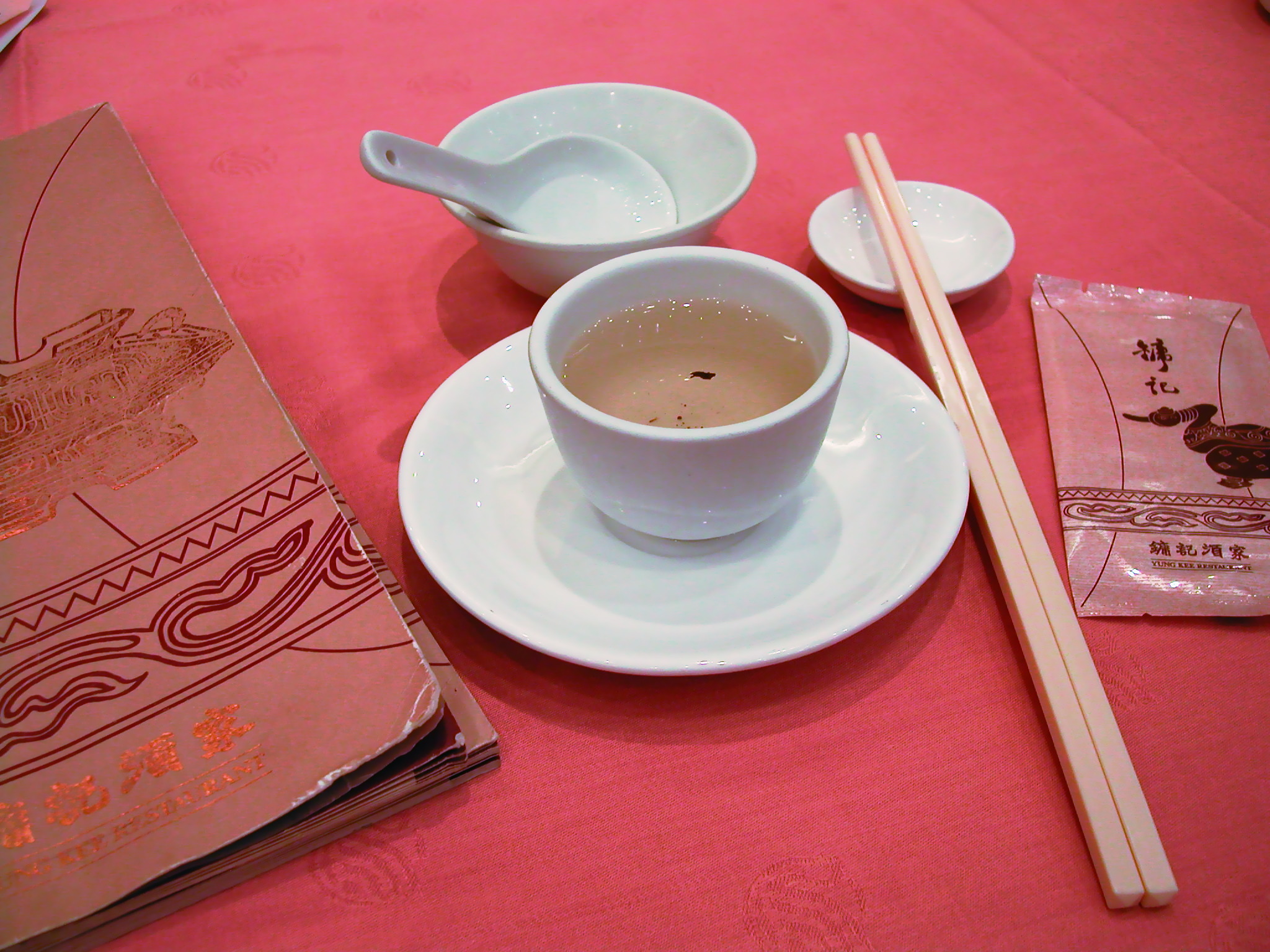
Tea is considered to be very important, so much so that it is considered just as important as the food itself. Teas served during dim sum include:
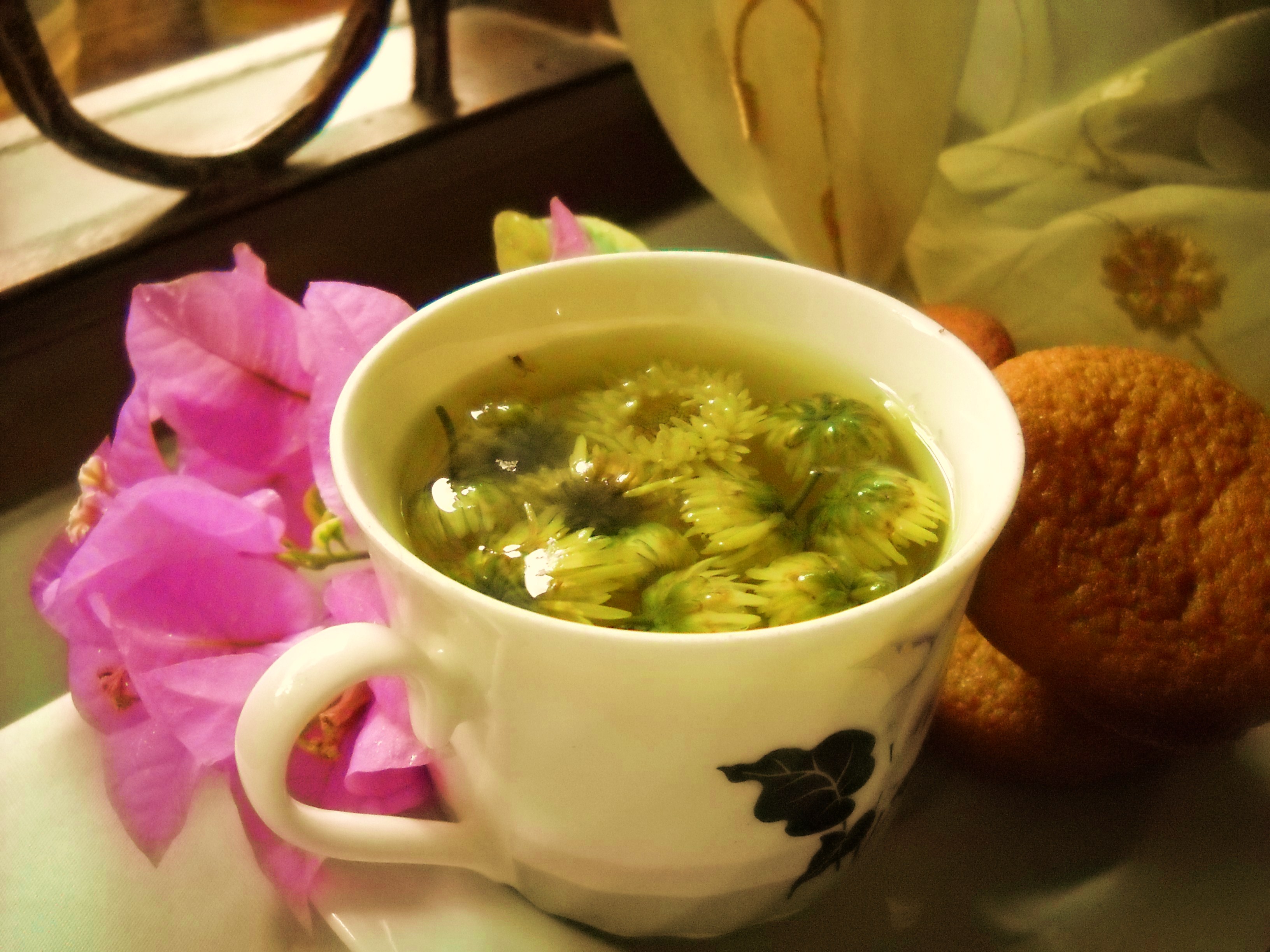
- Chrysanthemum tea: instead of tea leaves, it is a flower-based tisane (herbal tea) made from flowers of the species Chrysanthemum morifolium or Chrysanthemum indicum, which are the most popular in East Asia. To prepare the tea, chrysanthemum flowers (usually dried) are steeped in hot water (usually 90 to after cooling from a boil) in a teapot, cup, or glass. A common mix with pu-erh is called guk pou () from its component teas.
- Green tea: freshly picked leaves that go through heating and drying processes but not oxidation, so keep their original green color and chemical compounds, like polyphenols and chlorophyll. Produced all over China, and the most popular category of tea, green teas include the representative Dragon Well () and Biluochun from Zhejiang and Jiangsu provinces, respectively.
- Oolong tea: partially oxidizing, the tea leaves impart them with characteristics of both green and black teas. Oolong teas are closer in taste to green than black tea, yet have less of a "grassy" taste. Major oolong-tea producing areas such as Fujian, Guangdong, and Taiwan line the southeastern coast of China. Tieguanyin or Ti Kuan Yin (): one of the most popular, originated in Fujian province, and is a premium variety with a delightful fragrance.
- Pounei (Cantonese) or pu-erh tea (Mandarin): usually a compressed tea, pu-erh has unique, earthy notes derived from years of fermentation.
- Scented teas: various mixes of flowers with green, black, or oolong teas exist. Flowers used include jasmine, gardenia, magnolia, grapefruit flower, sweet-scented osmanthus, and rose. Strict rules govern the proportion of flowers to tea. Jasmine tea, the most popular scented tea, is the one most often served at "yum cha" establishments.
The tea service includes several customs. Typically, the server starts by asking diners which tea to serve. According to etiquette, the person closest to the teapot pours tea for the others. Sometimes, a younger person will serve an older person.
Those receiving tea express thanks by tapping their index and middle fingers twice on the table. According to one legend, the finger-tapping tradition evolved from an incident when an emperor poured tea for his servant in a public teahouse during a trip where the emperor concealed his identity to mingle with the commoners. Having been instructed by the emperor not to expose his identity to the public, the servant showed gratitude by improvising the finger-tapping gesture instead of what should have been a kowtow, which would have betrayed the emperor's noble status. The practice gradually evolved to represent gratitude for having tea poured by others.
Diners also flip open the lid (of hinged metal tea pots) or offset the tea pot cover (on ceramic tea pots) to signal an empty pot; servers will then refill the pot.
History

Dim sum is part of the Chinese tradition of snacks originating from the Song dynasty (960–1279), when royal chefs created various dishes such as minced pheasant, lark tongue, and desserts made from steamed milk and bean paste. Guangzhou experienced an increase in commercial travel in the tenth century At that time, travelers would frequent teahouses for small-portion meals with tea called "yum cha" or "tea" meals. Yum cha includes two related concepts. The first, 一盅兩件, translates literally as "one cup, two pieces". This refers to the custom of serving teahouse customers two delicately made food items, savory or sweet, to complement their tea. The second, 點心, which means dim sum, translates literally to "touch the heart" (i.e., heart touching). This is the term used to designate the small food items that accompanied the drinking of tea.
During the thirteenth century, when the Mongols invaded China, the royal court fled to southern China, bringing a royal influence to the dim sum of Guangzhou. Guangzhou was a wealthy, large port city that had international visitors, a temperate climate, and a coastline where fresh and tropical ingredients were grown, resulting in an ideal environment for food and entertainment. In Guangzhou, street vendors and teahouses sold dim sum. The practice of having tea with dim sum at tea houses eventually evolved into modern yum cha. While at the teahouses, travelers selected their preferred snacks from carts. Visitors to tea houses often socialized as they ate, and business people negotiated deals over dim sum.
During the Ming dynasty (1368–1644), the Tea and Horses Bureau was established to monitor tea production and improve tea quality. The improvements in tea quality also led to teahouse improvements.
Cantonese dim sum culture developed rapidly during the latter half of the nineteenth century in Guangzhou. Teahouse dining areas were typically located upstairs, and initial dim sum fare included steamed buns. Eventually, these evolved into specialized dim sum restaurants, and the variety and quality of dim sum dishes rapidly followed suit. Cantonese dim sum was originally based on local foods such as sweet roast pork called "char siu" and fresh rice noodles. As dim sum continued to develop, chefs introduced influences and traditions from other regions of China, which created a starting point for the wide variety of dim sum available today. Chefs created a large range of dim sum that even today comprises most of a teahouse's dim sum offerings. Part of this development included reducing portion sizes of larger dishes originally from northern China, such as stuffed steamed buns, so they could easily be incorporated into the dim sum menu. The rapid growth in dim sum restaurants was partly because people found the preparation of dim sum dishes to be time-consuming and preferred the convenience of dining out and eating a large variety of baked, steamed, pan-fried, deep-fried, and braised foods. Dim sum continued to develop and also spread southward to Hong Kong.
Although dim sum is normally considered Cantonese, it includes many additional influences. Over thousands of years, as people in China migrated in search of different places to live, they carried the recipes of their favorite foods and continued to prepare and serve these dishes. Many Han Chinese migrated south, seeking warmer climates. Settlements took shape in the Yangtze River Valley, the central highlands, and the coastal southeast, including Guangdong. The influence of Suzhou and Hangzhou is found in vegetarian soy skin rolls and pearl meatballs. The dessert squares flavored with red dates or wolfberries are influenced by Beijing desserts. Savory dishes, such as pot stickers and steamed dumplings, include Muslim influences because of people traveling from Central Asia across the Silk Road and into Guangdong. These are just a few examples of how a wide range of influences became incorporated into traditional Cantonese dim sum.
By 1860, foreign influences had shaped Guangdong's dim sum with culinary innovations such as ketchup, Worcestershire sauce, and curry, all of which came to be used in some savory dishes. Custard pies evolved into the miniature classics found in every teahouse. Other dim sum dishes evolved from Indian samosas, mango puddings, and Mexican conchas (snow-topped buns). Cantonese-style dim sum has an extremely broad range of tastes, textures, cooking styles, and ingredients. As a result, there are more than a thousand different varieties of dim sum.
During the 1920s, in Guangzhou, the foremost places to enjoy tea were its tea pavilions, which had refined and expansive surroundings. The customers were wealthy, and there were rather high standards for the privilege of enjoying tea pavilion service and dim sum. Upon entering a tea pavilion, customers would inspect tea leaves to ensure their quality and to verify the water temperature. Once satisfied, these guests were presented with a pencil and a booklet listing the available dim sum. A waiter would then tear their orders out of the booklet so that the kitchen could pan-fry, steam, bake, or deep-fry these dishes on demand. Customers dined upstairs in privacy and comfort. Servers carefully balanced the dishes on their arms or arranged them on trays as they climbed up and down the stairs. Eventually, dim sum carts were used to serve the steamers and plates.
People with average incomes also enjoyed tea and dim sum. Early every morning, customers visited inexpensive restaurants that offered filled steamed buns and hot tea. During the mid-morning, students and government employees ordered two or three kinds of dim sum and ate as they read their newspapers. In the late morning, people working at small businesses visited restaurants for breakfast and to use the restaurant as a small office space.
By the late 1930s, Guangzhou's teahouse culture included four high-profile dim sum chefs, with signs at the front doors of their restaurants. There was heavy competition among teahouses, and as a result, new varieties of dim sum were invented almost daily, including dishes influenced by the tea pastries of Shanghai, Beijing, and the Western world. Many new fusion dishes were also created, including puddings, baked rolls, turnovers, custard tarts, and Malay steamed cakes.
There were also significant increases in the variety of thin wrappers used in both sweet and savory items.If we concentrate only on the changes and developments in the variety of wrappers, the main types of dim sum wrappers during the 1920s included such things as raised (for filled buns), wheat starch, shao mai (i.e., egg dough), crystal bun, crispy batter, sticky rice, and boiled dumpling wrappers. By the 1930s, the varieties of wrappers commonly used by chefs included puff pastry, Cantonese short pastry, and so on, for a total of 23 types that were prepared by pan-frying, deep-frying, steaming, baking, and roasting.As the Chinese Civil War progressed from 1927 to 1949, many dim sum chefs left China and settled in Hong Kong, resulting in further refinements and innovations of the dim sum there. Very large dim sum restaurants in major cities like Hong Kong, San Francisco, Boston, Toronto, and New York were also established.
In the nineteenth century, Cantonese immigrants brought dim sum to the west and east coasts of the United States. Some of the earliest dim sum restaurants in the U.S. still operating today opened in the 1920s in San Francisco and New York City. The history of San Francisco's Chinese community is believed to have started about 30 years before the first dim sum restaurant opened in the city's Chinatown neighborhood. The Chinese preferred to live in the present Chinatown area because of its restaurants and theatres. In the late 1930s, some early U.S. newspaper references to dim sum began to appear. While some Chinese restaurants in the U.S. had offered dim sum for decades, it was not until the late 1980s that there was a broader public awareness of dim sum.
Although there was increased awareness of dim sum around this time, one chef from Hong Kong, who immigrated to San Francisco, noted that diners in the U.S. usually focused on the food itself and not the communal aspects of eating dim sum. Although dim sum is a Chinese meal, it is a communal dining and social experience that can span hours. It is customary for large groups to enjoy dishes together as a leisurely social activity. Diners go to restaurants early, around 10:00 AM, and rather than ordering a whole table of food, they order small amounts, have a cup of tea, read the newspaper, and wait for friends and family to join them. As a result, a visit to a dim sum restaurant can last from late morning well into the afternoon. For some people in Hong Kong, eating dim sum is a daily routine and a way of life. Since this dim sum tradition is not always present in some U.S. dim sum restaurants, however, approaches to generate interest and attract customers include customized seasoning and flavors of traditional dishes, as well as creating novel dishes with an emphasis on enhanced flavors and visual appeal.
One food reviewer notes that there has been an increase in popularity in posting dim sum photos on social media feeds, and that dim sum has become so popular that every U.S. state now has at least one high-quality dim sum restaurant. There is a restaurant, bar, and highly rated dance club complex in Las Vegas, NV, that features high-end Cantonese food (including dim sum), craft cocktails, dinner parties, and prominent disc jockeys in a chic setting.
The dim sum restaurants in Chicago's Chinatown serve mainly traditional dim sum dishes, but there has been recent growth in contemporary dim sum with new fusion dishes, as well as restaurants now located outside Chinatown.
In Hong Kong, many chefs are also introducing variants based on traditional Cantonese cuisine, which generates interest and provides both Hongkongers and tourists with new, fresh dim sum dishes.
Modern dim sum
In addition to traditional dim sum, some chefs also create and prepare new fusion-based dim sum dishes. Modern versions of buns include pork belly steamed buns with cucumber, green onion, cilantro, and ginger hoisin sauce, cocoa mushroom buns, and chili lamb buns. Dumplings include snow pea shoot and shrimp dumplings, and chili crab with fried garlic, siu mai with pork, shrimp, scallop, and caviar, dumplings stuffed with shrimp and peanut, dumplings with South Australian scallop, garoupa (grouper), caviar, gold leaf, and egg white, and bone marrow or beef short ribs in potstickers. Pastry puff dishes include Australian Wagyu beef puff, Assam curry chicken puff, and pumpkin puffs. Toast dishes include Hong Kong–style French toast with condensed milk and peanut butter and prawn toast. Additional examples are spring rolls filled with goat and duck skin and duck hearts cooked over a wood-fired grill and served with sesame-horseradish sauce.
One AAA four-diamond-award-winning Chinese restaurant in Miami Beach has a prix-fixe dim sum menu, prix-fixe "yum cha" menu and breakfast cocktails. Variations designed for visual appeal on social media, such as dumplings and buns made to resemble animals and fictional characters, also exist. Dim sum chefs have previously used cocoa powder as coloring to create steamed bread puffs to appear like forest mushrooms, espresso powder as both flavoring and coloring for deep-fried riblets, as well as pastry cream, and French puffs to create innovative dishes while paying tribute to the history of dim sum.
Dim sum has transitioned to become a global culinary staple. According to Britannica, dim sum restaurants exist worldwide. Modernly, many new establishments serve dim sum via order cards or computer systems rather than the traditional steam cart. In immigrant communities across North America, dim sum is adapted to local palates and dining. There are even fusion dim sum dishes now.
Fast food
Dim sum can often be purchased from grocery stores in major cities. They can be cooked easily by steaming, frying, or microwaving. Major grocery stores in Hong Kong, Vietnam, the Philippines, Singapore, Taiwan, China, Indonesia, Malaysia, Brunei, Thailand, Australia, the United States and Canada stock a variety of frozen or fresh dim sum. These include dumplings, shumai, pork buns, and others.
In Hong Kong and other cities in Asia, dim sum can be purchased from convenience stores, coffee shops and other eateries. Halal-certified dim sum that uses chicken instead of pork is very popular in Hong Kong,{{cite news | access-date = 10 August 2020 | archive-date = 15 August 2020 | archive-url = https://web.archive.org/web/20200815121955/https://www.scmp.com/week-asia/lifestyle-culture/article/2177964/halal-dim-sum-airport-prayer-rooms-how-hong-kong-japan | url-status = live | access-date = 10 August 2020 | archive-date = 13 August 2020 | archive-url = https://web.archive.org/web/20200813035015/https://www.thestar.com.my/metro/eat-and-drink/2017/06/16/halal-dim-sum-gains-steam-new-version-of-chinese-dumplings-find-a-place-in-ramadan-bazaar | url-status = live |trans-title = Friday night culinary: Started from dreaming about eating Halal Dim sum and very affordable |access-date = 10 August 2020 |archive-date = 5 October 2020 |archive-url = https://web.archive.org/web/20201005130755/https://www.liputan6.com/lifestyle/read/3889744/kuliner-malam-jumat-berawal-dari-mimpi-makan-dimsum-halal-dan-terjangkau |url-status = live HK SYP 西環 Sai Ying Pun 正街 Centre Street Dim Sum food shop March 2020 SS2 05.jpg|Streetside dim sum food shop in Hong Kong Frozen dimsum.JPG|Frozen dim sum are widely available at convenience stores Frozen Dim Sum in Grocery Store.jpg|Frozen dim sum in a grocery store in the United States File:Vancouver - Dim Sum Express.jpg|Express Dim Sum food truck, Canada Place, Vancouver, British Columbia.
Restaurants

Some Cantonese restaurants serve dim sum as early as five in the morning, while more traditional restaurants typically serve dim sum from mid-morning until mid-afternoon. It is common for restaurants to serve dim sum during dinner as well as for takeout.
Dim sum is served using a unique serving method whereby servers offer dishes to customers from carts, including some carts that are steam-heated. Diners often prefer tables nearest the kitchen since servers and carts pass by these tables first. Many restaurants place lazy susans on tables to help diners reach food and tea.
The pricing of dishes at these types of restaurants may vary, but traditionally they are classified as "small", "medium", "large", "extra-large", or "special". Servers record orders with a rubber stamp or an ink pen on a bill card that remains on the table. Servers in some restaurants use distinctive stamps to track sales statistics for each server. When they have finished eating, the customer calls the server over, and their bill is calculated based on the number of stamps or quantities marked in each priced section.
Another way of pricing the food that was consumed uses the number and color of the dishes left on the table. Some restaurants offer a new approach by using a conveyor belt format.
Other Cantonese restaurants may take orders from a pre-printed sheet of paper and serve à la carte, much like Spanish tapas restaurants, to provide fresh, cooked-to-order dim sum or because of real estate and resource constraints.

References
Sources
- Phillips, Carolyn (2006) The Dim Sum Field Guide: A Taxonomy of Dumplings, Buns, Meats, Sweets, and Other Specialties of the Chinese Teahouse. New York: Crown Publishing Group
References
- (2014). "The Oxford companion to food".
- "What Is Dim Sum? Chinese Dim Sum, Most Popular Dim Sum Dishes".
- (2019-02-14). "Why dumplings - the ultimate comfort food - are so popular right now".
- "A Visual Glossary for Dim Sum!".
- Jacobs, Harrison. "Here's how to navigate one of the most epic New York food traditions — 'Dim Sum' in Chinatown".
- Wiens, Mark. (2010-01-06). "Eating Cultural Dim Sum in Hong Kong".
- (2021-09-06). "Very Early or Extremely Late Dim Sum at Sun Hing Restaurant - Foodie".
- (2018-03-30). "The Ultimate Guangzhou Food Guide - The Food Ranger".
- Hayes, Janice Leung. (2018-03-05). "19 Best Dim Sum Spots in Hong Kong".
- Andrea Brown. (1 March 2018). "Piggy buns at Fashion Dim Sum will put a smile on your face".
- (2016). "點心點解叫「點心」?".
- 施, 莉雅. (2013). "精選美食王". 萬里.
- 蘇, 建新. (2011). "人人都要學的三分鐘國文課5: 常用詞語篇". 如果出版社.
- "Yum Cha – Cantonese Tea Brunch Tradition".
- Gao, Sally. (22 November 2016). "6 Things You Should Know Before Eating Dim Sum In Hong Kong".
- (2014). "[[The Oxford Companion to Food]]". [[Oxford University Press]].
- So, Yan-kit. (April 1997). "Classic food of China". [[Macmillan Publishers]].
- Simoons, Frederick J.. (1991). "Food in China: A Cultural and Historical Inquiry". [[CRC Press]].
- (2008). "Entertaining from Ancient Rome to the Super Bowl: An Encyclopedia". [[Greenwood Press]].
- "How to Order Dim Sum, According to the Head Chef of the First Chinese Restaurant in North America to Receive a Michelin Star".
- "Dim Sum". [[The New York Times]].
- (31 July 2018). "How the hot weather impacts your appetite".
- (25 July 2017). "What Is Dim Sum? The Beginner's Guide to South China's Traditional Brunch Meal".
- (7 December 2017). "The best thing you're not ordering at a dim sum restaurant".
- "Your Complete Guide to Dim Sum, the Traditional Chinese Brunch".
- "The Ultimate Guide to Dim Sum!".
- "Your Ultimate Guide to a Typical Chinese Dim Sum Menu".
- Millson, Alex. (6 December 2017). "Six Rules for Eating Dim Sum Like a Pro: A top chef in Hong Kong tells all". bloomberg.com.
- (5 January 2012). "Dim Sum Etiquette - Chinese/Lunar New Year".
- TODAY, Larry Olmsted, special for USA. "Great American Bites: Ping's serves savory dim sum in NYC's Chinatown".
- Albala, Ken. (2011). "Food Cultures of the World Encyclopedia". [[ABC-Clio]].
- Stone, A.. (2009). "Hong Kong. Con Cartina. Ediz. Inglese". [[Lonely Planet]].
- 古時面皮中有餡之物方稱爲饅頭。見曾维华,〈古代的馒头〉,《上海师范大学学报(哲学社会科学版)》1995年第2期,页157。
- Fong, Nathan. (5 February 2013). "Potstickers: A tasty traditional dish for Lunar New Year".
- Parkinson, Rhonda Lauret. (2003). "The Everything Chinese Cookbook: From Wonton Soup to Sweet and Sour Chicken". [[Simon & Schuster Canada]], Inc..
- Hsiung, Deh-Ta. Simonds, Nina. Lowe, Jason. [2005] (2005). The food of China: a journey for food lovers. Bay Books. {{ISBN. 978-0-681-02584-4. p 38.
- "蜂巢炸芋角". chinabaike.com.
- (6 November 2019). "Guide to Authentic Dim Sum Dishes for Yum Cha & Zao Cha {{!}} Welcome To China".
- yeinjee. (23 January 2008). "Maxim's Chinese Restaurant, Hong Kong International Airport". yeinjee.com.
- Hsiung, Deh-Ta. Simonds, Nina. Lowe, Jason. [2005] (2005). The food of China: a journey for food lovers. Bay Books. {{ISBN. 978-0-681-02584-4. p35.
- "晶莹剔透,香滑可口--肠粉". 美食天下.
- (17 August 2014). "的確涼布 拉出完美腸粉". [[Apple Daily]].
- "Gallery: The Serious Eats Guide to Dim Sum: Serious Eats".
- Hsiung, Deh-Ta. Simonds, Nina. Lowe, Jason. [2005]. ''The Food of China: A Journey for Food Lovers''. Bay Books. {{ISBN. 978-0-681-02584-4. p. 24.
- (13 July 2010). "Hong Kong food: 40 dishes we can't live without - 6. 'Pineapple' bun". [[CNN Travel]].
- Bartholomew, Ian. (24 January 2008). "New Year's Eve dinner: easy as pie". [[Taipei Times]].
- (23 February 2010). "Turnip or Radish Cake with Chinese Sausages". tastehongkong.com.
- (26 January 2009). "Chinese New Year Taro Cake". christinesrecipes.com.
- (10 February 2010). "Water Chestnut Cake for Chinese New Year and sometimes Valentine's Day". tastehongkong.com.
- Roufs, Timothy. (2014). "Sweet treats around the world : an encyclopedia of food and culture". ABC-CLIO.
- Ting, Chew-Peh. (1982). "Chinese Immigration and the Growth of a Plural Society in Peninsular Malaysia.". Research in Race and Ethnic Relations.
- Shimabukuro, Bitty. (21 May 2003). "Rice cake revelation". [[Honolulu Star-Bulletin]].
- 梅联华. (2008). "南昌民俗". 江西人民出版社.
- "Nutrient Values of Chinese Dim Sum". [[Food and Environmental Hygiene Department]].
- (13 July 2010). "40 Hong Kong foods we can't live without". CNN Go.
- Shimabukuro, Betty. [http://starbulletin.com/98/11/11/features/request.html "Dive In, Feet First"] {{Webarchive. link. (30 June 2012 , ''[[Honolulu Star-Bulletin]]'', 11 November 1998.)
- Phillips, Carolyn (2006) p. 167
- Hsiung, Deh-Ta. Simonds, Nina. Lowe, Jason. [2005] (2005). The food of China: a journey for food lovers. Bay Books. {{ISBN. 978-0-681-02584-4. p27.
- Betty. (8 January 2015). "No Mi Fan (糯米饭 ) without a steamer (Chinese Sticky Rice)". Food52.
- Jennifer Che. (1 September 2001). "Chinese Sticky Rice (Nuo Mi Fan)". [[Tiny Urban Kitchen]].
- Nado2003. (7 January 2008). "Chinese Sticky Rice Nuomi Fan) Recipe". Food.com.
- (1 April 2006). "Congee - Special Porridge". 米乐文化国际.
- (13 December 2018). "Hong Kong egg tarts are not vegetarian – and here's why".
- Gao, Sally. (4 October 2016). "Everything You Need To Know About The Hong Kong Egg Tart".
- link
- Mary Bai. (19 October 2011). "Tofu, a Healthy Traditional Food in China". China International Travel Service Limited.
- Misty, Littlewood and Mark Littlewood, 2008 ''Gateways to Beijing: a travel guide to Beijing'' {{ISBN. 981-4222-12-7, pp. 52.
- "Sesame Balls". [[Ching He Huang]].
- [http://www.wisegeek.com/what-is-a-coconut-bar.htm What is a coconut bar?] {{Webarchive. link. (5 September 2018 Wisegeek.com. Retrieved 31 March 2012.)
- Olver, Lynne. (10 March 2012). "puddings, custards & creams". [[The Food Timeline]].
- Johnny Law. (20 January 2011). "簡單粥品又一餐".
- (25 October 1981). "Fare of the Country; Why Dim Sum Is 'Heart's Delight'". [[The New York Times]].
- Stevenson, Rachel. (15 February 2018). "The Ideal Tea Pairing with Dim Sum Guide".
- Campbell, Dawn L.. (1995). "The Tea Book". [[Pelican Publishing Company.
- (2013). "Tea and health: studies in humans". [[Current Pharmaceutical Design]].
- Zhongguo Chajing pp. 222–234, 271–282, 412–419 chief editor: Chen Zhongmao, publisher: Shanghai Wenhua Chubanshe (Shanghai Cultural Publishers) 1991.
- 施海根,中國名茶圖譜、烏龍茶黑茶及壓製茶花茶特種茶卷 p2,上海文化出版社 2007 {{ISBN. 7-80740-130-3
- Joseph Needham, ''Science and Civilization in China'', vol. 6, [[Cambridge University Press]], 2000, part V, (f) Tea Processing and Use, pp. 535–550 "Origin and processing of oolong tea".
- Yoder, Austin. (13 May 2013). "Pu'er Vs. Pu-erh: What's the Deal with the Different Spellings?". Tearroir.
- {{harvp. Chen ZM. 1991
- (1 April 2009). "Entertaining from ancient Rome to the Super Bowl: an encyclopedia". [[Choice Reviews Online]].
- "The Serious Eats Guide to Dim Sum".
- (25 January 2017). "Chinese food lovers' guide to ordering, eating and appreciating dim sum".
- Chiang, Karen. (28 February 2019). "The yum cha rules you need to know". [[BBC]].
- Gourse, Leslie. (13 March 1988). "Dim Sum Has Come a Long Way, From Esoteric to Mass Popularity". [[Chicago Tribune]].
- Wong, Adele. (2016). "Hong Kong Food & Culture: From Dim Sum to Dried Abalone". Man Mo Media.
- (25 October 1981). "Fare of the Country; Why Dim Sum Is 'Heart's Delight'". [[The New York Times]].
- (13 May 2019). "Jian Dui -- Sesame Balls (煎堆)".
- Phillips, Carolyn. (1 February 2017). "Modern Chinese History as Reflected in a Teahouse Mirror". [[Gastronomica]].
- Tam, S. (1997). Eating Metropolitaneity: Hong Kong Identity in yumcha. ''[[Australian Journal of Anthropology]]'', 8(1), 291-306
- Feng, Mingquan. (1986). "A discussion on Guangzhou's teahouse industry. Guangzhou wenshi ziliao 廣州文史資料". Literary and Historical Materials on Guangzhou.
- (2008). "Entertaining from Ancient Rome to the Super Bowl: An Encyclopedia". [[Greenwood Press]].
- (December 2016). "Step Inside 98-Year-Old Hang Ah Tea Room, the Oldest Dim Sum Restaurant in America".
- (19 August 2015). "Nearly 100 Years Later, New York's First Dim Sum Restaurant Continues to Innovate".
- "How to Order Dim Sum, According to the Head Chef of the First Chinese Restaurant in North America to Receive a Michelin Star".
- (5 February 2016). "Where to Find the Best Dim Sum in Every State in America".
- (7 January 2020). "Tiësto, Zedd, Garrix, Aoki in Hakkasan Group's 2020 lineup".
- Kennedy, Marina. "Chef Spotlight: Executive Chef Pinyo Saewu of Hakkasasn Las Vegas".
- "Hakkasan Las Vegas - Las Vegas Restaurants - Las Vegas, United States".
- "Hakkasan". [[DJ magazine]].
- "Zagat".
- Springer, Janice Leung Hayes, Kate. (5 March 2018). "19 Best Dim Sum Spots in Hong Kong".
- (22 July 2015). "Four Hong Kong restaurants putting a modern spin on dim sum".
- Magyarics, Kelly. (26 January 2017). "4 Spots for modern take on Dim Sum".
- Kirouac, Matt. (21 March 2017). "Trend Watch: Dim Sum Goes Beyond Chinatown".
- (11 March 2020). "The best modern dim sum restaurants in Hong Kong".
- (2020-02-17). "Best Dim Sum in London, 7 Must-Try Restaurants to Yum Cha".
- "Hong Kong's most innovative dim sum restaurants {{!}} Hong Kong Tourism Board".
- (16 June 2014). "Hakkasan at Fontainebleau introduces new dim sum & prix-fixe menus for lunch".
- Schulman, Amy. (5 February 2019). "Hungerlust: One Man Is Reshaping Yum Cha in Hong Kong".
- (15 June 2020). "Cute dim sum is huge in Hong Kong and we love it! {{!}} Honeycombers".
- McNamee, Gregory Lewis. (17 January 2025). "Dim Sum".
- "How to Throw a Dim Sum Party Like A Pro".
- "How to Cook Frozen Dumplings".
- "A Super Guide to Asian Supermarkets".
- Sietsema, Robert. (21 May 2020). "Eater's Restaurant Critics Review NYC's Best Frozen Dumplings and Bao".
- Daley, Bill. (2 February 2018). "Who makes the best frozen pork pot stickers? We put 7 brands to the test".
- (17 December 2008). "Entertaining's easy with dim sum at the ready".
- (9 April 2019). "7-Eleven champions its dim sum with "Wholehearted, Simple and Tasty" campaign launch".
- "7-Eleven Now Sells 'Din Tai Fung' Style Garlic Fried Rice & Here's What We Think".
- 梁廣福. (2015). 再會茶樓歲月 (初版. ed.). 香港: 中華書局(香港)有限公司
- Scholem, Richard Jay. (16 August 1992). "A la Carte; Dim Sum Delights". [[The New York Times]].
- Phillips, C.. (2016). "The Dim Sum Field Guide: A Taxonomy of Dumplings, Buns, Meats, Sweets, and Other Specialties of the Chinese Teahouse". [[Ten Speed Press]].
- Guides, R.. (2010). "The Rough Guide to Southeast Asia On A Budget". [[Rough Guides]].
- Daniel A. Gross. "The Lazy Susan, the Classic Centerpiece of Chinese Restaurants, Is Neither Classic nor Chinese". [[Smithsonian Magazine]].
- (31 December 2014). "Everything You Need to Know About Dim Sum".
- En, Jennifer. (2017-02-27). "Everything You Need To Know About Dim Sum".
- (25 July 2017). "What Is Dim Sum? The Beginner's Guide to South China's Traditional Brunch Meal".
- Corporation, Ready-Market Online. "Dim Sum restaurant Solution Project".
- James, Trevor. (9 August 2019). "What is Dim Sum + The Ultimate Ordering Guide".
- (10 December 2017). "Six rules for eating dim sum like a pro".
- Embiricos, George. (16 June 2015). "Dim Sum Has Gotten The Hell Out Of Chinatown".
- (25 April 2016). "Britain's Dim Sum Trolleys Are Making Their Last Rounds".
This article was imported from Wikipedia and is available under the Creative Commons Attribution-ShareAlike 4.0 License. Content has been adapted to SurfDoc format. Original contributors can be found on the article history page.
Ask Mako anything about Dim sum — get instant answers, deeper analysis, and related topics.
Research with MakoFree with your Surf account
Create a free account to save articles, ask Mako questions, and organize your research.
Sign up freeThis content may have been generated or modified by AI. CloudSurf Software LLC is not responsible for the accuracy, completeness, or reliability of AI-generated content. Always verify important information from primary sources.
Report