From Surf Wiki (app.surf) — the open knowledge base
Dilogarithm
Special case of the polylogarithm
Special case of the polylogarithm
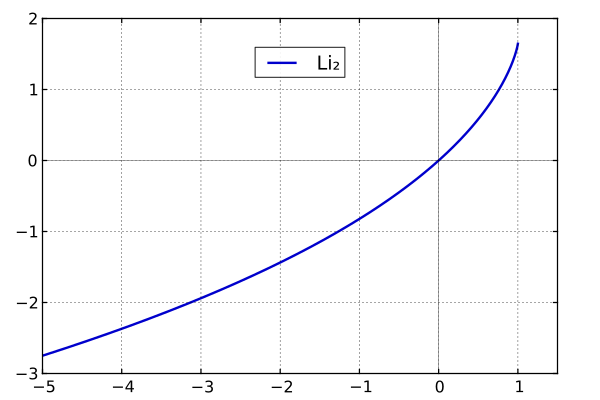
In mathematics, the dilogarithm (or Spence's function), denoted as Li2(z), is a particular case of the polylogarithm. Two related special functions are referred to as Spence's function, the dilogarithm itself: :\operatorname{Li}_2(z) = -\int_0^z{\ln(1-u) \over u}, du \text{, }z \in \Complex and its reflection. For ≤ 1, an infinite series also applies (the integral definition constitutes its analytical extension to the complex plane): :\operatorname{Li}2(z) = \sum{k=1}^\infty {z^k \over k^2}.
Alternatively, the dilogarithm function is sometimes defined as :\int_{1}^{v} \frac{ \ln t }{ 1 -t } dt = \operatorname{Li}_2(1-v).
In hyperbolic geometry the dilogarithm can be used to compute the volume of an ideal simplex. Specifically, a simplex whose vertices have cross ratio z has hyperbolic volume :D(z) = \operatorname{Im} \operatorname{Li}_2(z) + \arg(1-z) \log|z|. The function D(z) is sometimes called the Bloch-Wigner function. Lobachevsky's function and Clausen's function are closely related functions.
William Spence, after whom the function was named by early writers in the field, was a Scottish mathematician working in the early nineteenth century. He was at school with John Galt, who later wrote a biographical essay on Spence.
Analytic structure
Using the former definition above, the dilogarithm function is analytic everywhere on the complex plane except at z = 1, where it has a logarithmic branch point. The standard choice of branch cut is along the positive real axis (1, \infty). However, the function is continuous at the branch point and takes on the value \operatorname{Li}_2(1) = \pi^2/6.
Identities
:\operatorname{Li}_2(z)+\operatorname{Li}_2(-z)=\frac{1}{2}\operatorname{Li}_2(z^2). :\operatorname{Li}_2(1-z)+\operatorname{Li}_2\left(1-\frac{1}{z}\right)=-\frac{(\ln z)^2}{2}. :\operatorname{Li}_2(z)+\operatorname{Li}_2(1-z)=\frac{{\pi}^2}{6}-\ln z \cdot\ln(1-z). The reflection formula. :\operatorname{Li}_2(-z)-\operatorname{Li}_2(1-z)+\frac{1}{2}\operatorname{Li}_2(1-z^2)=-\frac{{\pi}^2}{12}-\ln z \cdot \ln(z+1). :\operatorname{Li}_2(z) +\operatorname{Li}_2\left(\frac{1}{z}\right) = - \frac{\pi^2}{6} - \frac{(\ln(-z))^2}{2}. :\operatorname{L}(x)+\operatorname{L}(y)=\operatorname{L}(xy)+\operatorname{L}\left(\frac{x(1-y)}{1-xy}\right)+\operatorname{L}\left(\frac{y(1-x)}{1-xy}\right). Abel's functional equation or five-term relation where \operatorname{L}(z)=\frac{\pi}{6}[\operatorname{Li}_2(z)+\frac12\ln(z)\ln(1-z)] is the Rogers L-function (an analogous relation is satisfied also by the quantum dilogarithm)
Particular value identities
:\operatorname{Li}_2\left(\frac{1}{3}\right)-\frac{1}{6}\operatorname{Li}_2\left(\frac{1}{9}\right)=\frac{{\pi}^2}{18}-\frac{(\ln 3)^2}{6}. :\operatorname{Li}_2\left(-\frac{1}{3}\right)-\frac{1}{3}\operatorname{Li}_2\left(\frac{1}{9}\right)=-\frac{{\pi}^2}{18}+\frac{(\ln 3)^2}{6}. :\operatorname{Li}_2\left(-\frac{1}{2}\right)+\frac{1}{6}\operatorname{Li}_2\left(\frac{1}{9}\right)=-\frac{{\pi}^2}{18}+\ln2\cdot \ln3-\frac{(\ln 2)^2}{2}-\frac{(\ln 3)^2}{3}. :\operatorname{Li}_2\left(\frac{1}{4}\right)+\frac{1}{3}\operatorname{Li}_2\left(\frac{1}{9}\right)=\frac{{\pi}^2}{18}+2\ln2\cdot\ln3-2(\ln 2)^2-\frac{2}{3}(\ln 3)^2. :\operatorname{Li}_2\left(-\frac{1}{8}\right)+\operatorname{Li}_2\left(\frac{1}{9}\right)=-\frac{1}{2}\left(\ln{\frac{9}{8}}\right)^2. :36\operatorname{Li}_2\left(\frac{1}{2}\right)-36\operatorname{Li}_2\left(\frac{1}{4}\right)-12\operatorname{Li}_2\left(\frac{1}{8}\right)+6\operatorname{Li}_2\left(\frac{1}{64}\right)={\pi}^2.
Special values
:\operatorname{Li}_2(-1)=-\frac{{\pi}^2}{12}. :\operatorname{Li}_2(0)=0. Its slope = 1. :\operatorname{Li}_2\left(\frac{1}{2}\right)=\frac{{\pi}^2}{12}-\frac{(\ln 2)^2}{2}. :\operatorname{Li}_2(1) = \zeta(2) = \frac{{\pi}^2}{6}, where \zeta(s) is the Riemann zeta function. :\operatorname{Li}_2(2)=\frac{{\pi}^2}{4}-i\pi\ln2. :\begin{align} \operatorname{Li}_2\left(-\frac{\sqrt5-1}{2}\right) &=-\frac{{\pi}^2}{15}+\frac{1}{2}\left(\ln\frac{\sqrt5+1}{2}\right)^2 \ &=-\frac{{\pi}^2}{15}+\frac{1}{2}\operatorname{arcsch}^2 2. \end{align} :\begin{align} \operatorname{Li}_2\left(-\frac{\sqrt5+1}{2}\right) &=-\frac{{\pi}^2}{10}-\ln^2 \frac{\sqrt5+1}{2} \ &=-\frac{{\pi}^2}{10}-\operatorname{arcsch}^2 2. \end{align} :\begin{align} \operatorname{Li}_2\left(\frac{3-\sqrt5}{2}\right) &=\frac{{\pi}^2}{15}-\ln^2 \frac{\sqrt5+1}{2} \ &=\frac{{\pi}^2}{15}-\operatorname{arcsch}^2 2. \end{align} :\begin{align} \operatorname{Li}_2\left(\frac{\sqrt5-1}{2}\right) &=\frac{{\pi}^2}{10}-\ln^2 \frac{\sqrt5+1}{2} \ &=\frac{{\pi}^2}{10}-\operatorname{arcsch}^2 2. \end{align}
In particle physics
Spence's Function is commonly encountered in particle physics while calculating radiative corrections. In this context, the function is often defined with an absolute value inside the logarithm:
: \operatorname{\Phi}(x) = -\int_0^x \frac{\ln|1-u|}{u} , du = \begin{cases} \operatorname{Li}_2(x), & x \leq 1; \ \frac{\pi^2}{3} - \frac{1}{2}(\ln x)^2 - \operatorname{Li}_2(\frac{1}{x}), & x 1. \end{cases}
Notes
References
- {{cite journal|first1=Robert |doi-access=free
- {{cite journal |doi-access=free
- {{cite journal
- {{cite journal
- {{ cite book
References
- Zagier p. 10
- "William Spence - Biography".
- "Biography – GALT, JOHN – Volume VII (1836-1850) – Dictionary of Canadian Biography".
- Zagier
- "Dilogarithm".
- Weisstein, Eric W.. "Rogers L-Function".
- Rogers, L. J.. (1907). "On the Representation of Certain Asymptotic Series as Convergent Continued Fractions". Proceedings of the London Mathematical Society.
This article was imported from Wikipedia and is available under the Creative Commons Attribution-ShareAlike 4.0 License. Content has been adapted to SurfDoc format. Original contributors can be found on the article history page.
Ask Mako anything about Dilogarithm — get instant answers, deeper analysis, and related topics.
Research with MakoFree with your Surf account
Create a free account to save articles, ask Mako questions, and organize your research.
Sign up freeThis content may have been generated or modified by AI. CloudSurf Software LLC is not responsible for the accuracy, completeness, or reliability of AI-generated content. Always verify important information from primary sources.
Report