From Surf Wiki (app.surf) — the open knowledge base
Dieu et mon droit
Royal motto of the United Kingdom
.svg)
Royal motto of the United Kingdom
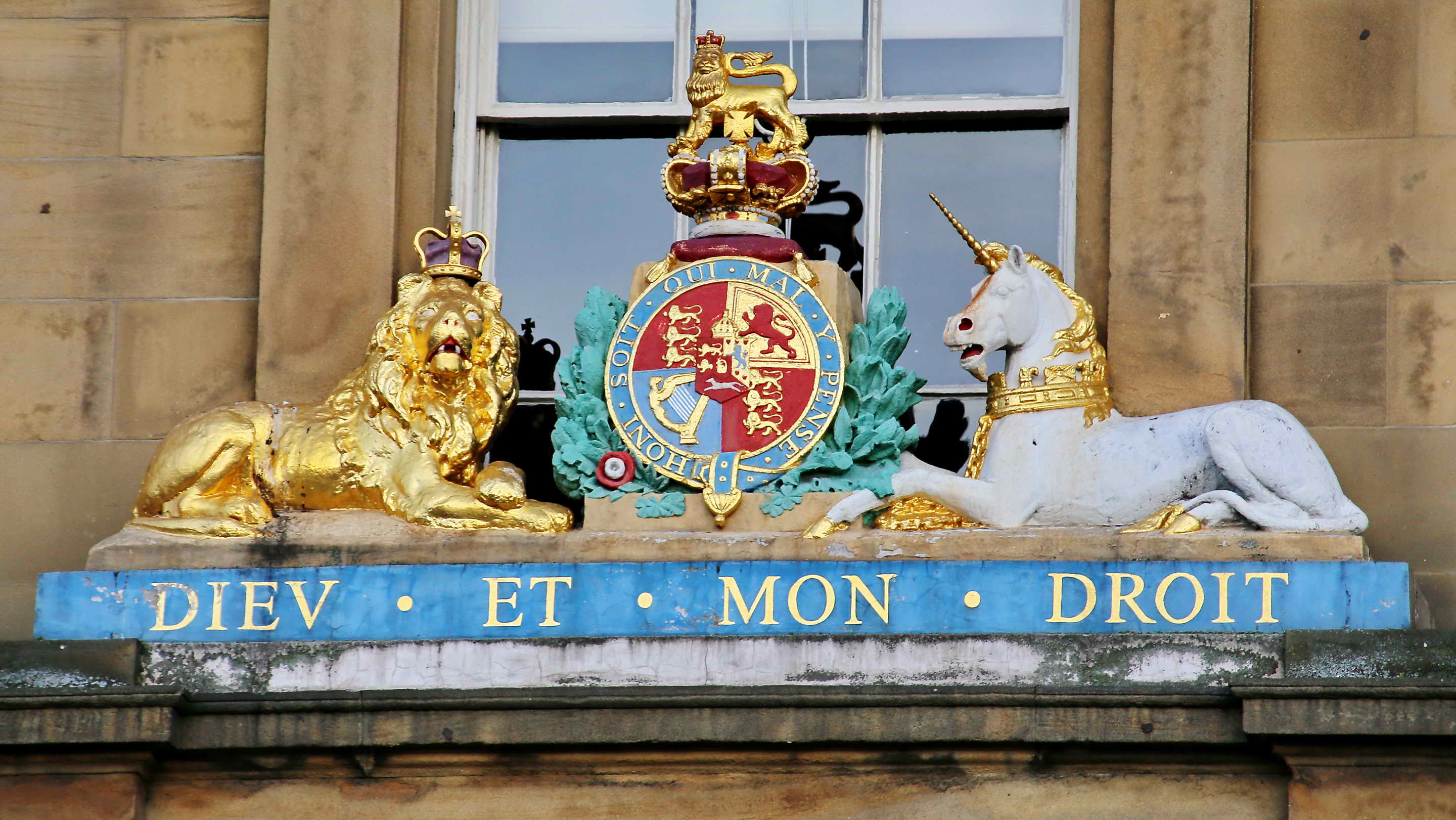
Dieu et mon droit (, ), which means , is the motto of the monarch of the United Kingdom. It appears on a scroll beneath the shield of the version of the coat of arms of the United Kingdom used outside Scotland. The motto is said to have first been used by Richard I (1157–1199) as a battle cry. It was adopted as the royal motto of England by King Henry V (1386–1422) with the phrase "and my right" referring to the divine right of kings.
Language
The motto is French for "God and my right", meaning that the king is "Rex Angliae Dei gratia" ("King of England by the grace of God"). It is used to imply that the monarch of a nation has a God-given (divine) right to rule. Henry V, in adopting it, may have also have intended a reference to his claim to the French crown.
It was not unusual for the royal coat of arms of the Kingdom of England to have a French rather than English motto, given that Norman French was the primary language of the English Royal Court and ruling class following the rule of William the Conqueror of Normandy and later the Plantagenets. Another Old French phrase also appears in the full achievement of the Royal Arms: the motto of the Order of the Garter, Honi soit qui mal y pense ("Shamed be the one who thinks ill of it"), appears on a representation of a garter behind the shield. Modern French spelling has changed honi to honni, but the motto has not been updated.
Other translations
Dieu et mon droit has been translated in several ways, including "God and my right", "God and my right hand", "God and my lawful right", and "God and my right shall me defend".
The literal translation of Dieu et mon droit is "God and my right". However, Kearsley's Complete Peerage, published in 1799, translates it to mean "God and my right hand" (in standard French that would be Dieu et ma main droite, not mon droit). The Kearsley volume appeared during publication of the 1st edition (1796–1808) of the German Brockhaus Enzyklopädie, which emphasised the raising of the "right hand" during installations and coronations of German Kings.
Use as royal motto

Dieu et mon droit has generally been used as the motto of English monarchs, and later by British monarchs, since being adopted by Henry V. It was first used as a battle cry by King Richard I in 1198 at the Battle of Gisors, when he defeated the forces of Philip II of France and after he made it his motto. Medieval Europeans did not believe that victory necessarily went to the side with the better army, but (as they also viewed personal trial by combat) to the side that God viewed with favour. Hence Richard wrote after his victory "It is not us who have done it but God and our right through us".
Alternatively, the Royal Arms may depict a monarch's personal motto. For example, Elizabeth I and Queen Anne's often displayed Semper Eadem; Latin for "Always the same", and James I's depicted Beati Pacifici, Latin for "Blessed are the peacemakers".
Current usages

Dieu et mon droit has been adopted along with the rest of the Royal Coat of Arms by The Times as part of its masthead. When it incorporated the Coat of Arms in 1875, half the newspapers in London were also doing so. Since 1982 the paper abandoned the use of the current Royal Coat of Arms and returned to using the Hanoverian coat of arms of 1785.
Variants

The Hearts of Oak, a revolutionary New York militia commanded by Alexander Hamilton, wore badges of red tin hearts on their jackets with the words "God and Our Right".
Diderot's Encyclopédie lists the motto as Dieu est mon droit, which Susan Emanuel translated as "God is my right". The motto in this form was also cited by Henry Hudson in 1612 and Joseph de La Porte in 1772.
References
References
- "Coats of arms". The Official Website of the British Monarchy.
- (September 2011). "Bejn kliem u storja: glossarju enċiklopediku dwar tradizzjonijiet – toponimi – termini storiċi Maltin". Best Print.
- Ted Ellsworth, ''Yank: Memoir of a World War II Soldier (1941–1945)'', Da Capo Press, 2009, p. 29.
- ''The Journal of the British Archaeological Association'', vol. 17, British Archaeological Association, 1861 p. 33.
- Henry Shaw, ''Dress and decoration of the Middle Ages'', First Glance Books, 1998, p. 92.
- ''Dresses and Decorations of the Middle Ages'', vol. 1, William Pickering, 1843, section 2.
- Juliet Barker. (2 September 2010). "Agincourt: The King, the Campaign, the Battle". Little, Brown Book Group.
- (1799). "Kearsley's Complete Peerage, of England, Scotland, and Ireland".
- Mary Ellen Snodgrass. (2003). "Coins and Currency: An Historical Encyclopedia".
- Foreign Service Journal (Pg 24) by American Foreign Service Association (1974)
- Edward Coke. (1671). "The Fourth part of the Institutes of Laws of England: Concerning the Jurisdiction of Courts".
- Pine, Leslie Gilbert. (1983). "A Dictionary of mottoes". Routledge.
- Norris, Herbert. (1999). "Medieval Costume and Fashion". Courier Dover Publications.
- (2005). "Medieval history writing and crusading ideology". Finnish Literature Society.
- Watkins, John. (2002). "Representing Elizabeth in Stuart England: literature, history, sovereignty". Cambridge University Press.
- Biden, William Downing. (1852). "The history and antiquities of the ancient and royal town of Kingston upon Thames". William Lindsey.
- Staff. (25 January 2007). "FAQ: infrequently asked questions: The Times and Sunday Times are newspapers with long and interesting histories". The Times.
- Chernow, Ron. ''Alexander Hamilton''. Penguin Press, (2004) ({{ISBN. 1-59420-009-2).
- (20 August 2013). "God is my right". Encyclopedia of Diderot & d'Alembert - Collaborative Translation Project.
- (26 December 2017). "[Illustrations de Descriptio ac delineatio geographica detectionis freti supra terras Americanas in China atque, Japonem ducturi] / [Non identifié] ; Henry Hudson, aut. du texte".
- La Porte, Joseph de (1714–1779) Auteur du texte. "L'esprit de l'Encyclopédie, ou Choix des articles les plus curieux, les plus agréables, les plus piquants, les plus philosophiques de ce grand dictionnaire...". Le Breton.
This article was imported from Wikipedia and is available under the Creative Commons Attribution-ShareAlike 4.0 License. Content has been adapted to SurfDoc format. Original contributors can be found on the article history page.
Ask Mako anything about Dieu et mon droit — get instant answers, deeper analysis, and related topics.
Research with MakoFree with your Surf account
Create a free account to save articles, ask Mako questions, and organize your research.
Sign up freeThis content may have been generated or modified by AI. CloudSurf Software LLC is not responsible for the accuracy, completeness, or reliability of AI-generated content. Always verify important information from primary sources.
Report