From Surf Wiki (app.surf) — the open knowledge base
Diamonds (suit)
Suit in French playing cards
Suit in French playing cards
| Field | Value |
|---|---|
| image | SuitDiamonds.svg |
| image_size | 120 |
| native_name | |
| deck | French-suited playing cards |
| invented | 15th century |
Diamonds () () is one of the four playing card suits in the standard French-suited playing cards. Diamonds along with the other French suits were invented in around 1480. It is the only French suit to not have been adapted from the German deck, taking the place of the suit of Bells. There was one early French pack that used crescents instead of diamonds, which may explain this anomaly. Rough coloring techniques on the red stripe on the German bells may have caused the circles to appear as irregularly shaped dots, and French cardmakers may have decided to drop the details and straighten out the sides.
Name
The original French name of the suit is Carreau; in German and Polish it is known as Karo.
In older German-language accounts of card games, Diamonds are frequently referred to as Eckstein ("cornerstone"). In Switzerland, the suit is still called Egge (Ecke i.e. "corner") today. The term "Karo" went into the German language in the 18th century from the French carreau, which goes back to the Latin word, quadrum, meaning "square" or "rectangle".
Characteristics
The diamond typically has a lozenge shape, a parallelogram with four equal sides, placed on one of its points. The sides are sometimes slightly rounded and the four vertices placed in a square, making the sign look like an astroid.
Normally, diamonds are red in colour so they can be used in some games as a pair with Hearts, like Klondike. They can however be depicted in blue, which is the case for example in bridge (where it is one of the two minor suits along with Clubs). In the official Skat tournament deck, diamonds are yellow or orange, assuming the color of their German-deck equivalent, which are usually golden.
The following gallery shows the diamonds from a standard 52-card deck of French-suited playing cards. Not shown is the Knight of Diamonds used in the tarot card games: File:01 of diamonds A.svg|Ace File:02 of diamonds.svg|2 File:03 of diamonds.svg|3 File:04 of diamonds.svg|4 File:05 of diamonds.svg|5 File:06 of diamonds.svg|6 File:07 of diamonds.svg|7 File:08 of diamonds.svg|8 File:09 of diamonds.svg|9 File:10 of diamonds - David Bellot.svg|10 File:Jack of diamonds fr.svg|Jack File:Queen of diamonds fr.svg|Queen File:King of diamonds fr.svg|King
Four-colour packs
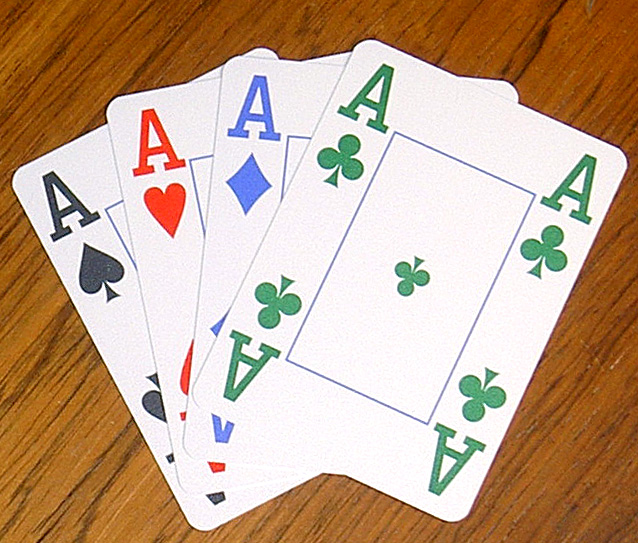
Four-color decks are sometimes used in tournaments or online. In such packs Diamonds may be:
- orange [[File:SuitDiamonds4colors.svg|20px|♦]] in English and German packs
- yellow [[File:SuitDiamondsyellow.png|20px|♦]] in American decks and German Skat tournament packs or
- blue [[File:Suitdiamondsblue.png|20px|♦]] in English and American Poker decks, French and Swiss four-colour packs.
Coding
The symbol ♦ is already in the CP437 and therefore also part of Windows WGL4. In Unicode a black ♦ and a white ♢ diamond have been defined:
References
Literature
References
- (1980). "The Game of Tarot". Duckworth.
- Pollett, Andrea. "An Introduction to Playing Cards: Historical and Iconographic Notes".
- Wolfgang Pfeifer: ''Etymologisches Wörterbuch des Deutschen.'' 8. Auflage. Deutscher Taschenbuch Verlag, Munich, 2005, {{ISBN. 3-423-32511-9.
- Sfetou, Nicholas. ''The Bridge Game''.
- [https://www.pokerstars.com/en/blog/tournaments/ept/2015/ept12-malta-trialling-the-four-colour-de-158758.shtml ''Trialling the four-colour deck''] at www.pokerstars.com. Retrieved 11 Jun 2018.
- Allan & Mackay (2007), p. 155.
- [http://a_pollett.tripod.com/cards19.htm ''Gallery 3 - Sizes, Shapes and Colours''] at a_pollett.tripod.com. Retrieved 4 Aug 2020.
- [https://www.pokernews.com/pokerterms/four-color-deck.htm ''Four-Color Deck''] at pokernews.com. Retrieved 4 August 2020.
This article was imported from Wikipedia and is available under the Creative Commons Attribution-ShareAlike 4.0 License. Content has been adapted to SurfDoc format. Original contributors can be found on the article history page.
Ask Mako anything about Diamonds (suit) — get instant answers, deeper analysis, and related topics.
Research with MakoFree with your Surf account
Create a free account to save articles, ask Mako questions, and organize your research.
Sign up freeThis content may have been generated or modified by AI. CloudSurf Software LLC is not responsible for the accuracy, completeness, or reliability of AI-generated content. Always verify important information from primary sources.
Report