From Surf Wiki (app.surf) — the open knowledge base
Dialogue with Trypho
Second-century Christian apologetic text by Justin Martyr
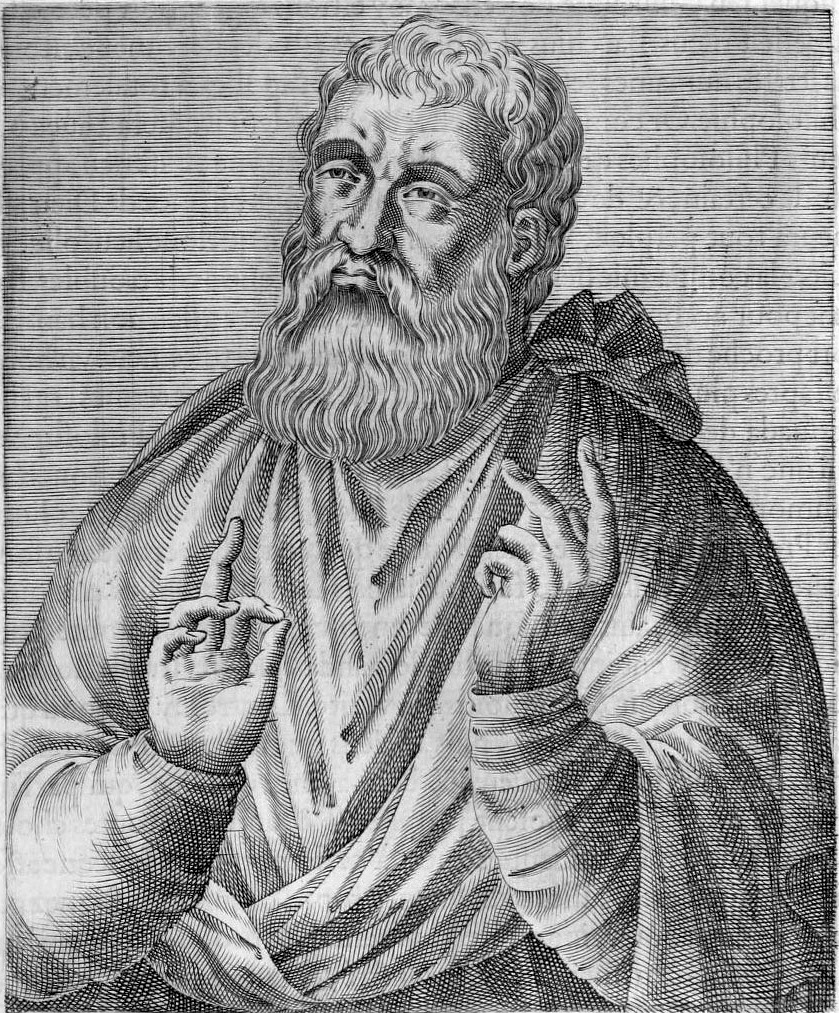
Second-century Christian apologetic text by Justin Martyr
The Dialogue with Trypho is an extant second-century Christian apologetic text by theologian Justin Martyr. Along with his First and Second Apologies, it is usually agreed to be dated in between AD 155 and 160. It is seen as documenting the attempts to show that Christianity is the new law for all men, and to prove from Scripture that Jesus is the Messiah.
The Dialogue utilizes the literary device of an intellectual conversation between Justin and Trypho, a Jew. The concluding section propounds that the Christians are the "true" people of God.
Identity of Trypho
The identity of Trypho as Rabbi Tarfon has been proposed, but many Jewish scholars do not accept this notion. They instead consider Trypho a fictional character invented by Justin for his literary purposes.
Setting and structure
The setting is presented as a chance meeting between Justin and Trypho in Ephesus. Justin had just converted to Christianity from a philosophical background and Trypho had just fled the disturbances in Judea.
When Justin suggests to Trypho to convert to Christianity, the dialogue becomes animated. Trypho criticizes Christians on a number of grounds, and Justin provides answers to each criticism.
In the opening of the Dialogue, Justin relates his vain search among the Stoics, Peripatetics, and Pythagoreans for a satisfying knowledge of God; his finding in the ideas of Plato wings for his soul, by the aid of which he hoped to attain the contemplation of the God-head; and his meeting on the sea-shore with an aged man who told him that by no human endeavor but only by divine revelation could this blessedness be attained, that the prophets had conveyed this revelation to man, and that their words had been fulfilled. Of the truth of this he assured himself by his own investigation; and the daily life of the Christians and the courage of the martyrs convinced him that the charges against them were unfounded. So he sought to spread the knowledge of Christianity as the true philosophy.
Justin also accuses Jews of being blind, fleshly beings who cannot see beyond the text of religious law: "'For your ears are closed, your eyes are blinded, and the heart is hardened,' Jeremiah has cried; yet not even then do you listen. The Lawgiver is present, yet you do not see Him; to the poor the Gospel is preached, the blind see, yet you do not understand. You have now need of a second circumcision, though you glory greatly in the flesh." This concept finds its origin in the New Testament: Paul writes in 2 Corinthians 3:13-15 that "to this very day whenever Moses is read, a veil lies over their minds; but when one turns to the Lord, the veil is removed."
In the Dialogue, Justin also wrote, "For I choose to follow not men or men's doctrines, but God and the doctrines [delivered] by Him. For if you have fallen in with some who are called Christians, but who do not admit this [truth], and venture to blaspheme the God of Abraham, and the God of Isaac, and the God of Jacob; who say there is no resurrection of the dead, and that their souls, when they die, are taken to heaven; do not imagine that they are Christians." This passage is sometimes cited as evidence that the early church subscribed to the doctrine of soul sleep, though some claim that Justin's emphasis is on saying that denial of the resurrection of the dead is what makes them non-Christian, especially considering that he claims that "even after death souls are in a state of sensation" in Chapter 18 of his First Apology.
In his critical edition (with French translation), Philippe Bobichon demonstrates the particular nature of this text, equally influenced by Greek and Rabbinic thought.
Dating
Because the text mentions Justin Martyr's First Apology, which was written sometime between AD 150 and 155, Dialogue with Trypho must have been written after it. The date of authorship has been suggested to have been written anywhere between 155 and 167, with some scholars favoring 155–160, or even a more specific date, c. 160.
Authenticity
The Dialogue with Trypho and the two Apologies are universally accepted by scholars as authentic works of Justin. Though they are preserved only in the Sacra parallela, they were known to Tatian, Methodius of Olympus, and Eusebius and their influence is traceable in Athenagoras, Theophilus of Antioch, the Pseudo-Melito, and especially Tertullian. Eusebius speaks of two Apologies, but he quotes them both as one, which indeed they are in substance. The identity of authorship is backed up not only by the reference in chapter 120 of the Dialogue to the Apology, but by the unity of treatment. Zahn showed that the Dialogue was originally divided into two books, that there is a considerable lacuna in chapter 74, as well as at the beginning.
Editions
English
- , from the Greek text in .
Greek
References
References
- ''Reading the Old Testament with the Ancient Church: Exploring the Formation of Early Christian Thought''; by Ronald E. Heine (Sep 1, 2007) pages 48-52
- Claudia Setzer, ''Jewish Responses to Early Christians'' (Nov 1, 1994) {{ISBN. 080062680X, p. 215
- 0830826785, p. 493
- Martyr, Justin. (1867). "Dialogue with Trypho". T. & T. Clark.
- "Bible Gateway passage: 2 Corinthians 3:13-15 - New International Version".
- [[s:Ante-Nicene Christian Library/Dialogue with Trypho#Chapter 80. Dialogue with Trypho, Chapter 80]]
- [[s:Ante-Nicene Christian Library/The First Apology of Justin Martyr#Chapter 18. First Apology, Chapter 18]]
- Philippe Bobichon (ed.), ''Justin Martyr, Dialogue avec Tryphon'', édition critique, introduction, texte grec, traduction, commentaires, appendices, indices, (Coll. Paradosis nos. 47, vol. I-II.) Editions Universitaires de Fribourg Suisse, (1125 pp.), 2003; Philippe Bobichon, "L'enseignement juif, païen, hérétique et chrétien dans l'œuvre de Justin Martyr", ''Revue des Études Augustiniennes'' 45/2 (1999), pp. 233-259 [https://www.academia.edu/7279724/Lenseignement_juif_pa%C3%AFen_h%C3%A9r%C3%A9tique_et_chr%C3%A9tien_dans_l%C5%93uvre_de_Justin_Martyr_Revue_des%C3%89tudes_Augustiniennes_45_2_1999_p_233_259 text online]
- (2002). "Revelation, Truth, Canon and Interpretation: Studies in Justin Martyr's Dialogue with Trypho". Brill.
- (2011). "Scriptural Interpretation and Community Self-Definition in Luke-Acts and the Writings of Justin Martyr". Brill.
- (1973). "Justin Martyr". Tübingen.
- (December 4, 2008). "Justin Martyr: His Life and Thought". Cambridge University Press.
This article was imported from Wikipedia and is available under the Creative Commons Attribution-ShareAlike 4.0 License. Content has been adapted to SurfDoc format. Original contributors can be found on the article history page.
Ask Mako anything about Dialogue with Trypho — get instant answers, deeper analysis, and related topics.
Research with MakoFree with your Surf account
Create a free account to save articles, ask Mako questions, and organize your research.
Sign up freeThis content may have been generated or modified by AI. CloudSurf Software LLC is not responsible for the accuracy, completeness, or reliability of AI-generated content. Always verify important information from primary sources.
Report