From Surf Wiki (app.surf) — the open knowledge base
Dharmapala
Guardian gods of Buddhism
Guardian gods of Buddhism
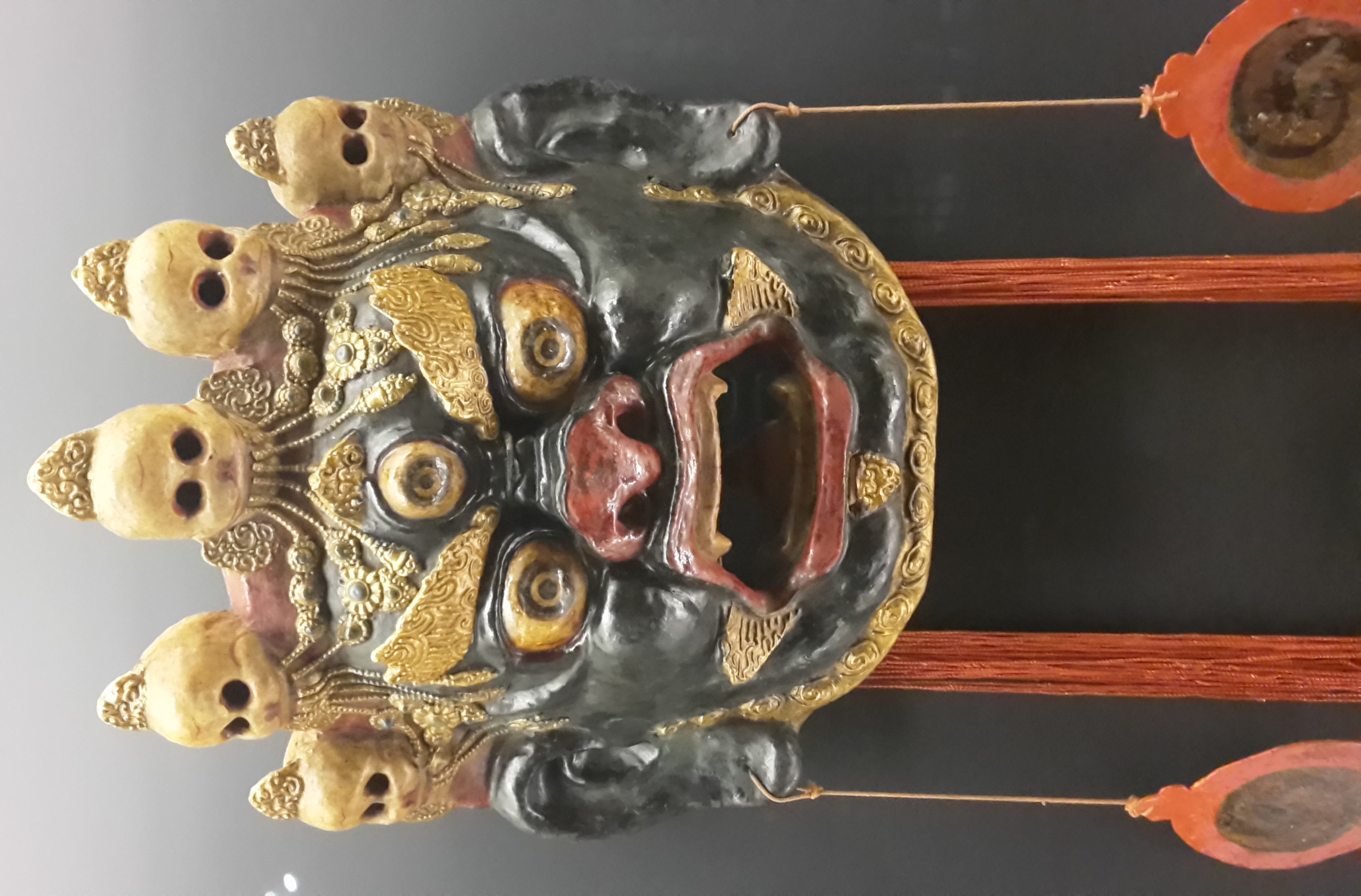
A dharmapāla is a type of wrathful god in Buddhism. The name means "dharma protector" in Sanskrit, and the dharmapālas are also known as the Defenders of the Justice (Dharma), or the Guardians of the Law. There are two kinds of dharmapala, Worldly Guardians (lokapala) and Wisdom Protectors (jnanapala). Only Wisdom Protectors are enlightened beings.
Description
A protector of Buddhist dharma is called a dharmapala. They are typically wrathful deities, depicted with terrifying iconography in the Mahayana and tantric traditions of Buddhism.
In Vajrayana iconography and thangka depictions, dharmapala are fearsome beings, often with many heads, many hands, or many feet. Dharmapala often have blue, black, or red skin, and a fierce expression with protruding fangs. Although dharmapala have a terrifying appearance, they only act in a wrathful way for the benefit of sentient beings.
The devotional worship of dharmapālas in the Tibetan tradition is traceable to early 8th-century.
Tibetan Buddhism
There are many different dharmapalas in Tibetan Buddhism. Each school has its own principle dharmapalas and most monasteries have a dedicated dharmapāla which was originally comparable to a genius loci. The many forms of Mahakala are emanations of Avalokiteshvara. Kalarupa and Yamantaka are considered by practitioners to be emanations of Manjushri the Bodhisattva of Wisdom.
Principal wisdom protector dharmapalas include:
- Prana Atma (Tib. Begtse)
- Ekajaṭī (Tib. ral chig ma)
- Mahakala (Tib. Nagpo Chenpo)
- Shri Devi (Tib. Palden Lhamo)
- Yamaraja/Dharmaraja/Kalarupa (Tib. Shinje)
Other dharmapalas include:
- Bhairava (Nepali: भैरव)
- Citipati
- Mahakali
- Yamantaka (Tib. Shinje Shed)
- Hayagriva (Tib. Tamdrin)
- Vaisravana (Tib. Kubera)
- Rāhula (Tib. gza)
- Vajrasādhu (Tib. Dorje Legpa)
- Brahma (Tib. "Tshangs Pa")
- Maharakta (Tib. tsog gi dag po, mar chen)
- Kurukulla (Tib. * rig che ma*)
- Vajrayakṣa (Takkiraja) (Tib. du pai gyal po)
The main functions of a dharmapāla are said to be to avert the inner and outer obstacles that prevent spiritual practitioners from attaining spiritual realizations, as well as to foster the necessary conditions for their practice.
Chinese Buddhism
In Chinese Buddhism, the Twenty-Four Protective Deities or the Twenty-Four Devas (Chinese: 二十四諸天; pinyin: Èrshísì Zhūtiān) are a group of gods who are venerated as dharmapālas. In addition, Wisdom Kings such as Acala, Ucchusma, Mahamayuri, and Hayagriva are venerated as dharmapālas as well.
Shingon Buddhism
In Japanese Shingon Buddhism, a descendant of Tangmi, or Chinese Esoteric Buddhism, dharmapālas such as Acala and Yamantaka are classified as Wisdom Kings. Other dharmapālas, notably Mahakala, belong to the Deva realm, the fourth and lowest class in the hierarchy of honorable beings.
Footnotes
References
Bibliography
- Kalsang, Ladrang (1996). The Guardian Deities of Tibet Delhi: Winsome Books. (Third Reprint 2003) .
- Linrothe, Rob (1999). Ruthless Compassion: Wrathful Deities in Early Indo-Tibetan Esoteric Buddhist Art London: Serindia Publications. .
- De Nebesky-Wojkowitz, Rene (1956). Oracles and Demons of Tibet. Oxford University Press. Reprint Delhi: Books Faith, 1996 - . Reprint Delhi: Paljor Publications, 2002 - .
References
- 「梵天帝釋二大天王 日本國中大小神祇 諸天善神 諸大眷屬」([[:ja:般若心経奉讃文. 般若心經奉讚文]])
- [https://www.himalayanart.org/search/set.cfm?setID=2404 Buddhist Protectors, Wisdom Deities: Dharmapalas at Himalayan Art Resource]
- (2013). "The Princeton Dictionary of Buddhism". Princeton University Press.
- ''Heart Jewel'': The Essential Practices of Kadampa Buddhism, pages 71-3, Tharpa Publications (2nd. ed., 1997) {{ISBN. 978-0-948006-56-2
- [http://www.skink.us/GIALABA/2_2/2_2_001/001.htm 曼荼羅 GIALABA]
This article was imported from Wikipedia and is available under the Creative Commons Attribution-ShareAlike 4.0 License. Content has been adapted to SurfDoc format. Original contributors can be found on the article history page.
Ask Mako anything about Dharmapala — get instant answers, deeper analysis, and related topics.
Research with MakoFree with your Surf account
Create a free account to save articles, ask Mako questions, and organize your research.
Sign up freeThis content may have been generated or modified by AI. CloudSurf Software LLC is not responsible for the accuracy, completeness, or reliability of AI-generated content. Always verify important information from primary sources.
Report