From Surf Wiki (app.surf) — the open knowledge base
Dhanushkodi
Former town in Tamil Nadu, India
Former town in Tamil Nadu, India
| Field | Value | |
|---|---|---|
| <!-- See Template:Infobox settlement for additional fields and descriptions --> | name | Dhanushkodi |
| settlement_type | Former settlement | |
| image_skyline | Final Dhanush 002.jpg | |
| image_alt | Dhanushkodi | |
| image_caption | Aerial view of the locality top end in its former state (now disturbed by an artificial extension of NH 87) | |
| nickname | Ram Setu | |
| pushpin_map | India Tamil Nadu#India | |
| pushpin_label_position | bottom | |
| pushpin_map_alt | Map showing location of Dhanushkodi within Tamil Nadu | |
| pushpin_map_caption | Location within Tamil Nadu | |
| coordinates | ||
| subdivision_type | Country | |
| subdivision_name | India | |
| subdivision_type1 | State | |
| subdivision_type2 | District | |
| subdivision_name1 | Tamil Nadu | |
| subdivision_name2 | Ramanathapuram | |
| extinct_title | Destroyed | |
| extinct_date | 1964 | |
| unit_pref | Metric | |
| area_magnitude | ||
| area_blank2_title | ||
| area_blank2_km2 | ||
| elevation_m | 0 | |
| population_total | 0 | |
| population_as_of | 2001 | |
| population_density_km2 | auto | |
| area_code_type | Telephone code | |
| area_urban_footnotes | ||
| area_rural_footnotes | ||
| area_metro_footnotes | ||
| timezone | IST | |
| utc_offset | +05:30 |
a town in Tamil Nadu
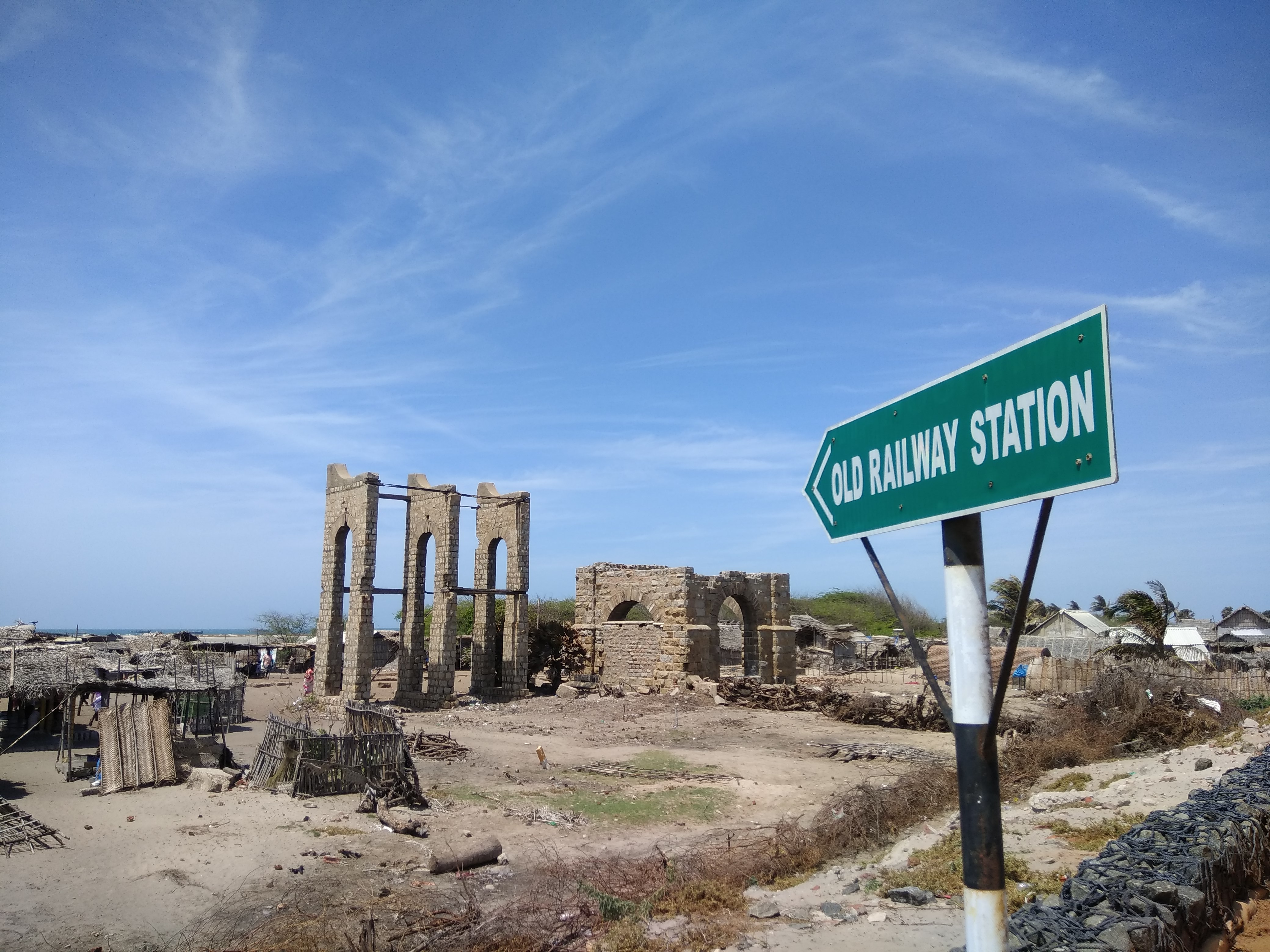
tags --| area_footnotes = Dhanushkodi is an abandoned town at the south-eastern tip of Pamban Island of the state of Tamil Nadu in India. It is south-east of Pamban and is about 24 km west of Talaimannar in Sri Lanka. The town was destroyed during the 1964 Rameswaram cyclone and remains uninhabited in the aftermath. Although devoid of inhabitants, Dhanushkodi remains a tourist attraction due to its historical and mythological relevance.
Geography
Dhanushkodi is on the tip of Pamban island, separated from the Indian mainland by the Palk Strait.
Transport
The National Highway completed the 9.5-km-long road – 5 km from Mukuntharayar Chathiram to Dhanushkodi and 4.5 km from Dhanushkodi to Arichal Munai. Until 2016, Dhanushkodi was reachable either on foot along the seashore or in jeeps. In 2016, a road was completed from the village of Mukundarayar Chathiram.
A metre gauge railway line connected Mandapam on mainland India to Dhanushkodi. Boat mail express ran from Chennai Egmore to Dhanushkodi till 1964 when the metre-gauge branch line from Pamban to Dhanushkodi was destroyed during the 1964 Dhanushkodi cyclone. In 2003, Southern Railway sent a project report to Ministry of Railways for re-laying a 16 km railway line to Dhanushkodi from Rameswaram. The planning commission looked into the possibility of a new railway line between Dhanushkodi and Rameswaram in 2010.
1964 cyclone
Main article: 1964 Rameswaram cyclone
The area around Rameswaram is prone to high-intensity geomorphic activity. A scientific study conducted by the Geological Survey of India indicated that the southern part of Dhanushkodi facing the Gulf of Mannar sank by almost 5 m in 1948 and 1949, due to vertical tectonic movement of land parallel to the coastline. As a result of this, a patch of land of about 0.5 km in width, stretching 7 km from north to south, was submerged under the sea.
On 17 December 1964, a tropical depression formed at 5°N 93°E in the South Andaman Sea. On 19 December, it intensified into a cyclonic storm. After 21 December 1964, it moved westwards, almost in a straight line, at the rate of 400 to per day. On 22 December, it crossed Vavuniya in Sri Lanka and made landfall at Dhanushkodi on the night of 22–23 December 1964. Estimated wind velocity was 280 km/h and tidal waves were 7 m high.
An estimated 1,800 people died in the cyclonic storm on 22 December including 115 passengers on board the Pamban-Dhanushkodi passenger train. The entire town was marooned and the Government of Madras declared Dhanushkodi as a ghost town, unfit for living.
Around the 40th anniversary of the deadly cyclone, the sea around Dhanushkodi receded about 500 m from the coastline, briefly exposing the submerged part of the town before massive tsunami waves struck the coast on 26 December 2004.
Gallery
File:Dhan6.jpg|Mini Trucks take people to Land's End, Dhanushkodi, through deep sand and shallows, using planks put under wheels by local kids as the vehicle struggles. File:Dhan5.jpg|The sea from Land's End, Dhanushkodi. Sri Lanka is about 15 miles from here. File:Kothandaramaswamy Temple.jpg|Front view of the Kothandaramaswamy Temple at Dhanushkodi File:Dhan18.jpg|The Gulf of Mannar Marine Sanctuary is host to many marine animals and birds. Birds sighted here include flamingoes, curlew, gulls, terns, sandpipers, plovers, reef herons and egrets. File:Dhan14.jpg|A church in Dhanushkodi.
References
References
- "Did you know? Dhanushkodi is the place where you can see the origin of the Ram Setu!".
- "Fascinating facts about Dhanushkodi that will leave you awestruck!". Times of India.
- Scott, D. J. Walter. (26 July 2017). "Modi to inaugurate Dhanushkodi road". Kasturi & Sons.
- (28 June 2010). "Dhanushkodi still attracts tourists". [[The Hindu]].
- D.J. Walter Scot. (4 February 2016). "Road to Dhanushkodi may be opened by month-end". [[The Hindu]].
- "Four-lane road planned for Dhanushkodi". [[The Hindu]].
- Jethwa, Raja Pawan. (2007). "Shree Kutch Gurjar Kshatriya Samaj: A brief History & Glory of our fore-fathers".
- Saqaf, Syed Muthahar. (11 June 2010). "'Boat Mail' to run on main line from August 1". [[The Hindu]].
- Jaishankar, C. (17 July 2006). "Their sentiment to metre gauge train is unfathomable". [[The Hindu]].
- C. Jaishankar. (26 February 2010). "Railway budget may put Dhanushkodi back on track". [[The Hindu]].
- (26 February 2011). "Poll-bound TN, Kerala will get more trains". The Asian Age.
- (10 March 2007). "Subsidence of southern part of erstwhile Dhanushkodi township, Tamil Nadu". Current Science.
- (June 1966). "Satellite Study of the Rameswaram Cyclonic Storm of 20–23 December 1964". Journal of Applied Meteorology and Climatology.
- (26 December 1964). "India Train, 150 Aboard, Swept Away By Big Wave". St. Petersburg Times.
- (28 December 1964). "1,800 Asians Feared Dead After Cyclone and Tidal Wave". Reading Eagle.
- (28 December 1964). "Ships, Planes Search for Survivors". The Age.
- [https://archive.org/details/dli.ministry.19565 Railway Accident Report], Government of India, 1967
- "Eye-witness account of the cyclone". [[The Hindu]].
- "Submerged temple tower visible in Dhanushkodi". Zee news.
- G. G. Vaz. (March 2007). "Subsidence of southern part of erstwhile Dhanushkodi township, Tamil Nadu – evidences from bathymetry, side scan and underwater videography". Current Science.
This article was imported from Wikipedia and is available under the Creative Commons Attribution-ShareAlike 4.0 License. Content has been adapted to SurfDoc format. Original contributors can be found on the article history page.
Ask Mako anything about Dhanushkodi — get instant answers, deeper analysis, and related topics.
Research with MakoFree with your Surf account
Create a free account to save articles, ask Mako questions, and organize your research.
Sign up freeThis content may have been generated or modified by AI. CloudSurf Software LLC is not responsible for the accuracy, completeness, or reliability of AI-generated content. Always verify important information from primary sources.
Report