From Surf Wiki (app.surf) — the open knowledge base
DF-21
| Field | Value |
|---|---|
| is_missile | yes |
| name | DF-21/CSS-5 Mod 1 |
| image | DF-21A TEL - Chinese Military Museum Beijing.jpg |
| caption | DF-21 and transporter erector launcher vehicle at the Beijing Military Museum. |
| origin | China |
| type | MRBM/IRBM |
| used_by | People's Liberation Army Rocket Force |
| Royal Saudi Strategic Missile Force | |
| service | 1991 |
| engine | Solid fueled |
| weight | 14700 kg |
| length | 10.7 m |
| diameter | 1.4 m |
| speed | Mach 10 (estimated maximum before re-entry) |
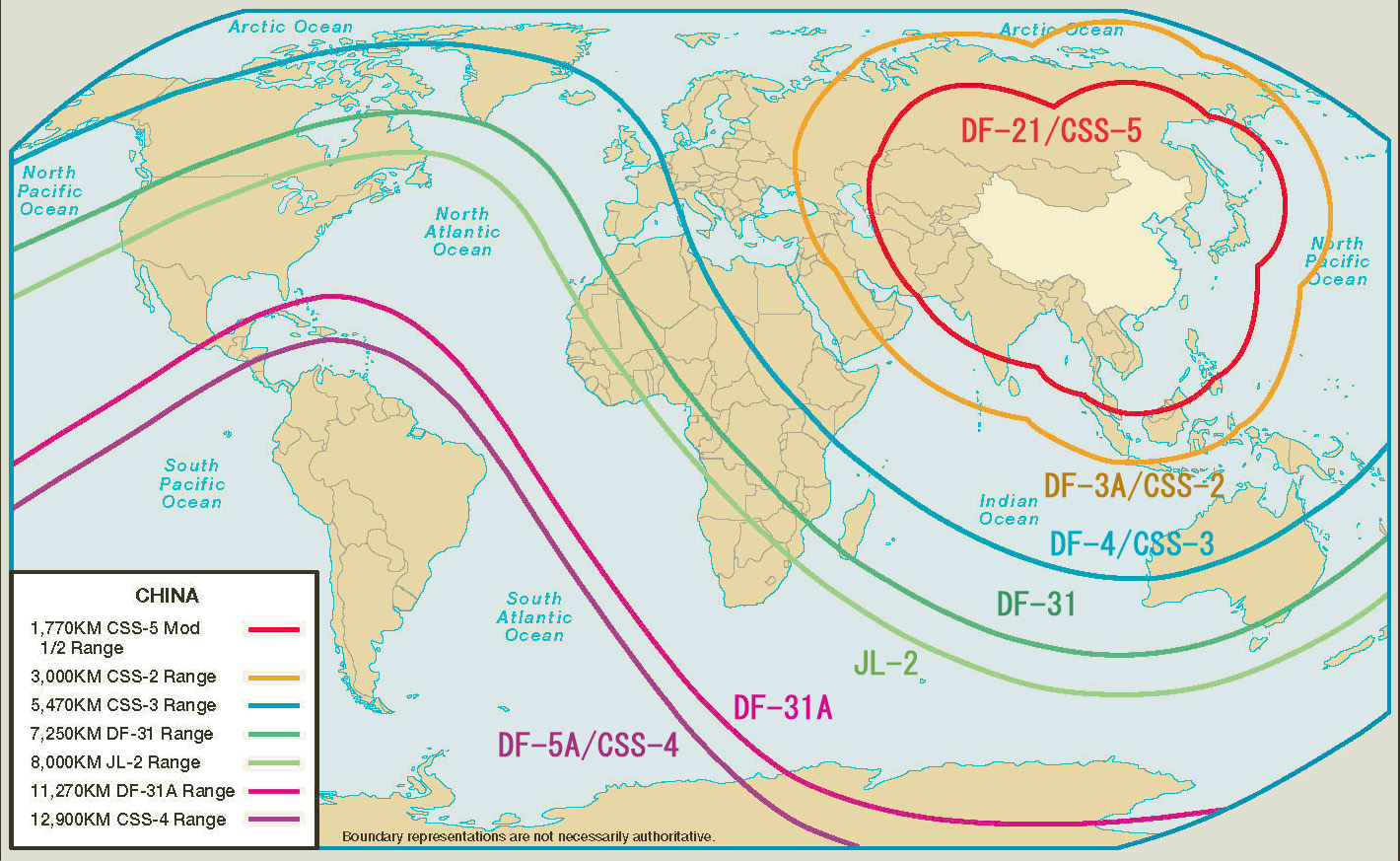
| vehicle_range | 1770 km (DF-21/DF-21A) |
| 1700 km (DF-21C) | |
| 1500 km (DF-21D ASBM) | |
| filling | conventional 600kg: 1, or 5-6 (improved variant) nuclear 200-300-500 kt nuclear |
| guidance | Inertial + terminal active radar guidance |
| accuracy | DF-21 700m, DF-21A 50m, DF-21B 10m CEP (with BeiDou Navigation Satellite System and active radar) |
| launch_platform | Mobile launcher |
Royal Saudi Strategic Missile Force 1700 km (DF-21C) 1500 km (DF-21D ASBM)
The Dongfeng 21 (DF-21; NATO reporting name CSS-5 - Dong-Feng () is a two-stage, solid-fuel, single-warhead medium-range ballistic missile (MRBM) developed by China's Changfeng Mechanics and Electronics Technology Academy. A part of the Dongfeng missile family, the DF-21's development started in the late 1960s, and it was completed around 1985–86, but not deployed until 1991. It was developed from the JL-1 submarine-launched missile, and is China's first solid-fuel land-based missile. The U.S. Department of Defense in 2008 estimated that China had 60-80 missiles and 60 launchers; approximately 10-11 missiles can be built annually.
Originally developed as a strategic weapon, the DF-21's later variants were designed for both nuclear and conventional missions. It is thought to be able to carry a high explosive, submunition for tactical/theater-level missions, or a 300 kt nuclear warhead for strategic strikes. The latest variant, the DF-21D, was said to be the world's first anti-ship ballistic missile (ASBM). The DF-21 has also been developed into the SC-19, an anti-ballistic missile and anti-satellite missile. , its KF-21 air-launched ballistic missile variant represents China's only air capability within its nuclear triad.
Though the launcher vehicle itself is mobile to reduce vulnerability, an actual launch unit requires support vehicles that can cover a 300×300-meter area, making it hard to move quickly and easier to detect. Also, the wheeled launcher is not made to travel off-road and requires firm ground when firing to prevent backblast and debris damage due to the hard launch, restricting its firing locations to roads and pre-made launch pads.
DF-21/A/C (CSS-5 Mod-1/2/3)
The basic variant DF-21 had a range of 1,770+ km, and a payload of 600 kg consisting of a single 500 kt nuclear warhead, with an estimated circular error probable (CEP) of 300~400 m; this version did not enter operational service. The DF-21A was operational by 1996 and has improved accuracy with an estimated CEP of 100~300 m. This version is reported to have a similar 1,770+ km range,
Revealed in 2006, the DF-21C is a terminally guided version and accuracy estimated to be 50~100m. The missile was the first dual-capable version, able to be armed with either a nuclear or conventional warhead. In 2010, the DF-21C was being deployed in central Western China.
{{Anchor|DF-21D|CSS-5 Mod-4|Anti-ship ballistic missile}} DF-21D (CSS-5 Mod-4) Anti-ship ballistic missile
Development
This is an anti-ship ballistic missile that has a maximum range exceeding 1450 km, according to the U.S. National Air and Space Intelligence Center. The Intelligence Center did not believe it was deployed in 2009.
The US Department of Defense stated in 2010 that China has developed and reached initial operating capability (IOC) of a conventionally armed high hypersonic land-based anti-ship ballistic missile based on the DF-21. This is the first ASBM and weapon system capable of targeting a moving aircraft carrier strike group from long-range, land-based mobile launchers. The DF-21D is thought to employ maneuverable reentry vehicles (MaRVs) with a terminal guidance system. Such a missile may have been tested in 2005-6, and the launch of the Jianbing/Yaogan satellites would give the Chinese targeting information from SAR (synthetic-aperture radar) and visual imaging respectively. The upgrades enhance China's ability to prevent US carriers from operating in the Taiwan Strait. Some have also suggested China could develop a DF-21D with multiple reentry vehicles.
To support this, a test range in the Taklamakan Desert has been seen on satellite, possibly used to test the DF-21 (and sister missiles). This facility, which features high-fidelity mock-ups of U.S. warships, is used to analyze the missile's reentry vehicle, guidance systems, and impact. The targets are part of the People's Liberation Army's efforts to develop its anti-access/area denial (A2/AD) capabilities.
Guidance and navigation
Between 2009 and 2012, China launched a series of satellites to support its ASBM efforts:
- Yaogan-VII electro-optical satellite - 9 December 2009
- Yaogan-VIII synthetic aperture radar satellite - 14 December 2009
- Yaogan-IX Naval Ocean Surveillance System (NOSS) constellation (3 satellites in formation) - 5 March 2010.
- Yaogan-XVI Naval Ocean Surveillance System (NOSS) constellation - 25 November 2012
China was reported to be working on an over-the-horizon radar in 2013 to locate the targets for the ASBM. An apparent test of the missile was made against a target in the Gobi Desert in January 2013.
Re-entry vehicle
In 2014, the U.S. Navy reported that images that have appeared on the internet showed similarities of a DF-21D re-entry vehicle to the American Pershing II missile's RV, which was withdrawn from service in 1988. The Pershing II's RV weighed 1,400 lb and was fitted with four control fins to perform a 25-G pull-up after reentering the atmosphere, traveling at Mach 8 and then gliding 30 nmi to the target to pitch into a terminal dive. Army training manuals about the missile are available on the internet and public open-source literature extensively describes it; the DF-21 has a comparable range and payload. Though much is made of the DF-21D's damage infliction ability based solely on velocity and kinetic energy, the Australian Strategic Policy Institute has calculated that the energy of an inert 500 kg RV impacting at Mach 6 had similar energy to the combined kinetic and explosive power of the American subsonic Harpoon anti-ship missile, which is one-quarter the energy of the Russian supersonic 12,800 lb Kh-22 missile traveling at Mach 4 with a 2,200 lb warhead.
Impact on naval warfare
In 2009, the United States Naval Institute stated that there was "currently ... no defense against [a warhead able to destroy an aircraft carrier in one hit]" if it worked as theorized. It was reported in 2010 that China was finalizing development of a MaRV warhead for the DF-21. The United States Navy has responded by switching its focus from a close blockade force of shallow water vessels to return to building deep water ballistic missile defense (BMD) destroyers. The United States has also assigned most of its ballistic missile defense capable ships to the Pacific, extended the BMD program to all Aegis destroyers and increased procurement of SM-3 BMD missiles. The United States also has a large network optimized for tracking ballistic missile launches which may give carrier groups sufficient warning in order to move away from the target area while the missile is in flight. Kinetic defenses against the DF-21D would be difficult. The Navy's primary ballistic missile interceptor, the SM-3, would not be effective since it is designed to intercept missiles in the mid-course phase in space, so it would have to be launched almost immediately to hit before reentry or from an Aegis ship positioned under its flight path. The SM-2 Block 4 can intercept missiles reentering the atmosphere, but the warhead will be performing high-G maneuvers that may complicate interception. By 2016, the US Navy was testing the vastly more capable SM-6, which is designed to intercept ballistic missiles in the terminal phase. The SM-6 began deployment in 2013.
In late 2013, a Russian Military Analysis report of the DF-21D concluded that the only way to successfully counter it would be through electronic countermeasures. Conventional interceptions of high-speed objectives have worked in the past, with the Russian report citing the 2008 interception of a malfunctioning satellite by a U.S. cruiser, but in that situation the warship had extensive knowledge of its location and trajectory. Against an attack from the Mach 10 DF-21D without knowing the missile's launch point, the U.S. Navy's only way to evade it would be through electronic countermeasures.
Use of such a missile has been said by some experts to potentially lead to nuclear exchange, regional arms races with India and Japan, and the end of the INF Treaty between the United States and the Soviet Union, to which the People's Republic of China is not a party.
Skepticism
The emergence of the DF-21D has some analysts claiming that the "carrier killer" missiles have rendered the American use of aircraft carriers obsolete, as they are too vulnerable in the face of the new weapon and not worth the expense. Military leaders in the U.S. Navy and Air Force, however, do not see it as a "game changer" to completely count carriers out.
First, the missile may not be able to single-handedly destroy its target, as the warhead is believed to only be enough to inflict a "mission kill" that makes a carrier unable to conduct flight operations.
Secondly, there is the problem of finding its target. The DF-21D has a range estimated between 1,035 to, so a carrier battle group would need to be located through other means before launching. Over-the-horizon radars cannot pinpoint a carrier's exact location, and would have to be used in conjunction with Chinese recon satellites. Though recon aircraft and submarines could also be used to look for the carrier, they are vulnerable to the carrier battle group's defenses.
Finally, although the DF-21D has radar and optical sensors for tracking, it has not yet been tested against a ship target moving at-sea at up to 55 km/h, let alone ones using clutter and countermeasures. The missile's "kill chain" requires processing and constantly updating a carrier's location details, preparing the launch, programming information and firing. The U.S. military's AirSea Battle concept involves disrupting such kill chains. Some U.S. analysts believe that the DF-21D does not fly any faster than Mach 5.
The DF-21D may also not be as fast as theorized. While ballistic missiles reenter the atmosphere at speeds between Mach 8-15 at an altitude of 50 km, increasing air resistance in the denser low-atmosphere region reduces terminal speed to around Mach 2 at 3-5 km. It cannot acquire its target until this point due to ionization blockage, leaving a relatively short time to actually search for a ship. This could enable the target to leave the area if the missile is detected soon enough before it engages its terminal sensors, and the slower speed upon reentry leaves it vulnerable to missile interceptors.
Appearances and deployments
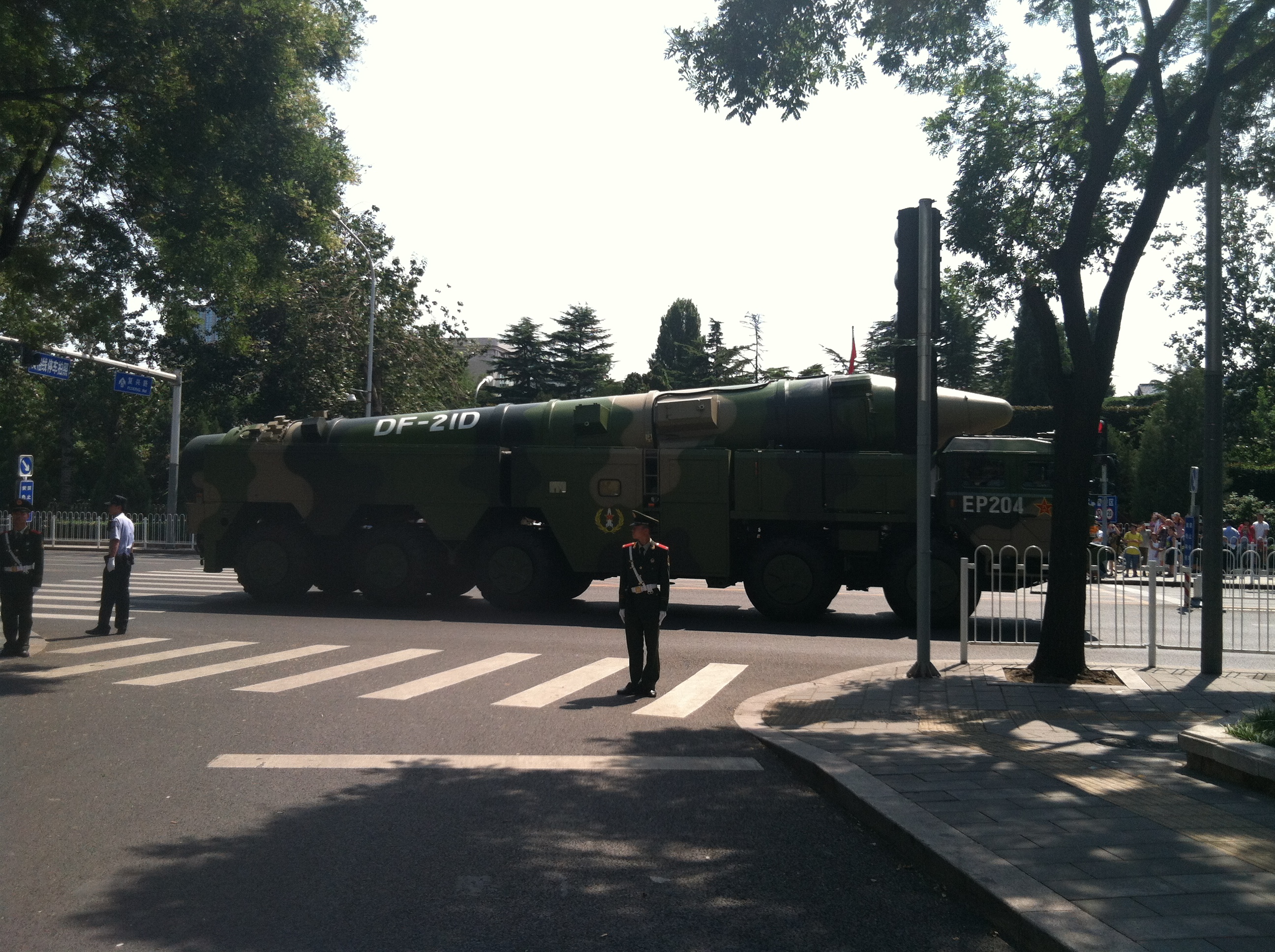
The missile was shown to the public during the parade in Beijing celebrating 70 years since the end of World War II on September 3, 2015. A parade video shows missiles marked as DF-21D.
On 26 August 2020, along with a DF-26B, a DF-21D was launched into an area of the South China Sea between Hainan and the Paracel Islands, one day after China said that an American U-2 spy plane entered a no-fly zone without its permission during a Chinese live-fire naval drill in Bohai Sea off its north coast and came as Washington blacklisted 24 Chinese companies and targeted individuals it said were part of construction and military activities in the South China Sea. US officials subsequently assessed that the People's Liberation Army Rocket Force (PLARF) had fired four medium-range ballistic missiles in total. The missile tests drew criticism from Japan, the Pentagon and Taiwan.
{{Anchor|DF-26|Dongfeng 26}} DF-26
Main article: DF-26
The DF-26 is an enhancement of the DF-21 with range increased to more than 5,000 km. Its existence was officially confirmed by the Chinese state in the mid-2010s, but it had already been in service for several years.
On 26 August 2020, a DF-26B was fired from Qinghai province into an area between Hainan and the Paracel Islands as a response to a U.S. U-2 spy plane entering into a no-fly zone during a Chinese live-fire naval drill the day earlier.
SC-19
The SC-19 is the anti-satellite and anti-ballistic missile version of the DF-21. Multiple tests of the missile have been conducted. It is capable of targeting ballistic missiles and satellites outside of the Earth's atmosphere.
KF-21
Main article: JL-1 (air-launched ballistic missile)
The "KF-21" (possible Chinese designation, NATO designation: CH-AS-X-13) is reported to be an air-launched variant of the DF-21 with a nuclear or anti-ship role. It is a two-stage missile, with its weight may be reduced by using composite materials. The War Zone reported two possible warhead configurations; a DF-21D-style "double-cone" tip, and a hypersonic glide vehicle (HGV) similar to the DF-ZF on the DF-17 missile.
It was in development by 2018. In 2018, the United States projected it would be ready for deployment by 2025.
The missile is carried by the Xian H-6N bomber; the aircraft has a recessed underside to carry the missile externally.
In September 2025, the JL-1 air-launched ballistic missile was revealed to the public on the 2025 China Victory Day Parade. Analysts believed the JL-1 is identical to the CH-AS-X-13.
Saudi Arabian purchase
Main article: Royal Saudi Strategic Missile Force
The DF-21 may have been exported to Saudi Arabia. In January 2014, Newsweek reported that the missiles were purchased in 2007. Conventionally-armed DF-3 missiles were bought by Saudi Arabia in 1988, but were not used during the 1990-1991 Gulf War due to their poor accuracy and the potential for collateral damage. Saudi Arabia wanted the shorter-ranged but much more accurate DF-21 as an upgrade. The United States approved of the purchase on the condition that the missiles were conventionally-armed. The Central Intelligence Agency (CIA) examined the modified nosecones and concluded that nuclear warheads that might be purchased from China or Pakistan could not be fitted.
References
References
- (2007). "The Military Power of the People's Republic of China - Annual Report to Congress". Office of the Secretary of Defense.
- (2013). "Military and Security Developments Involving the People's Republic of China". U.S. Department of Defense.
- Fisher Jr, Richard. (24 July 2007). "New Chinese Missiles Target the Greater Asian Region".
- (2007). "Nuclear Warhead Modernization". NTI.
- Duncan Lennox, ed., Jane's Strategic Weapon Systems, 51st ed. (Coulsdon, Surrey, U.K.:Jane's Information Group, 2010)
- "Military Power of the People's Republic of China 2008". Office of the Secretary of Defense.
- Pradun, Vitaliy. (2018-03-20). "From Bottle Rockets to Lightning Bolts—China’s Missile Revolution and PLA Strategy against U.S. Military Intervention". [[Naval War College Review]].
- (2025-03-04). "Chinese nuclear weapons, 2025". Bulletin of the Atomic Scientists.
- (September 28, 2010). "DF-21C Missile Deploys to Central China". Federation of American Scientists.
- (13 July 2007). "DF21C". SinoDefence.
- "DF-21 (Dong Feng-21 / CSS-5)".
- (April 2009). "Ballistic and Cruise Missile Threat". Air Force Intelligence, Surveillance and Reconnaissance Agency.
- "Pradun: From Bottle Rockets to Lightning Bolts, p.11".
- {{as of. 2009, the guidance system was thought to be still in an evolutionary process as more [[UAV]]s and satellites are added.[http://www.informationdissemination.net/2009/03/plan-asbm-development.html PLAN ASBM development], informationdissemination.net, March 28, 2009.
- "China's Carrier Killer Ballistic Missiles are Operational". Defense Tech.
- Sean O'Connor. (11 November 2008). "IMINT & Analysis". geimint.blogspot.com.
- (March 31, 2009). "Report: Chinese Develop Special "Kill Weapon" to Destroy U.S. Aircraft Carriers".
- Military Power of the People's Republic of China 2008, p. 2 (p12 of PDF)
- (10 July 2009). "How China could scupper US naval power". [[South China Morning Post.
- (28 December 2010). "U.S. commander says China aims to be a 'global military' power". [[Asahi Shimbun]].
- Gertz, Bill, "Inside the Ring: China's anti-carrier missiles", ''[[The Washington Times]]'', Sep 3, 2009, p. B1.
- Kazianis, Harry. "China's Anti-Access Missile".
- Panella, Chris. "Satellite images show China made an apparent Gerald R. Ford aircraft-carrier target out in the desert".
- "New carrier-shaped target in Chinese desert 'not uncommon,' expert says". Stars and Stripes.
- (2025-07-14). "Why China Is Building Ships in the Desert". neo.
- "Chinese Anti-ship Missile Could Alter U.S. Power", Wendell Minnick, [[Defense News]], p6a, 5 April 2010
- "CRS RL33153 China Naval Modernization: Implications for U.S. Navy Capabilities--Background and Issues for Congress".
- Daniel DeFraia. (30 January 2013). "China tests DF-21D missile on mock US aircraft carrier in Gobi desert". GlobalPost.
- (27 January 2014). "U.S. Navy Sees Chinese HGV As Part Of Wider Threat".
- (March 29, 2010). "China Testing Ballistic Missile 'Carrier-Killer'".
- (August 26, 2020). "China's anti-ship missile is nearly operational". Asahi Shimbin.
- (December 25, 2010). "China Testing Anti-Ship Ballistic Missile (ASBM); U.S. Preparing Accordingly–Updated With Latest Analysis & Sources".
- "China Naval Modernization: Implications for U.S. Navy Capabilities—Background and Issues for Congress.".
- Pomfret, John. [https://www.washingtonpost.com/wp-dyn/content/article/2010/12/24/AR2010122403009.html "Military strength is eluding China."] ''[[The Washington Post]]'', 25 December 2010.
- [http://nationalinterest.org/blog/the-buzz/chinas-carrier-killer-really-threat-the-us-navy-13765 Is China's "Carrier-Killer" Really a Threat to the U.S. Navy?] - Nationalinterest.org, 2 September 2015
- Majumdar, Dave. (December 16, 2016). "How the U.S. Navy is Trying to Make China's 'Carrier-Killer' Missiles Obsolete".
- "Projects: Standard Missile-6". Naval Technology.
- [http://www.navyrecognition.com/index.php/news/defence-news/year-2013-news/december-2013-navy-naval-forces-maritime-industry-technology-security-global-news/1423-electronic-countermeasures-maybe-only-way-to-counter-chinese-df-21d-ballistic-missile-.html Electronic Countermeasures maybe only way to counter Chinese DF-21D Ballistic Missile] - Navyrecognition.com, 14 December 2013
- (2009). "On the Verge of a Game-Changer". United States Naval Institute.
- Mark Stokes. (2 January 2011). "Can a treaty contain China's missiles?". The Washington Post.
- [http://www.airforcemag.com/MagazineArchive/Pages/2013/December%202013/1213china.aspx China's Carrier Killer: Threat and Theatrics] - AirForcemag.com, December 2013
- [http://breakingdefense.com/2014/01/house-gop-defense-heavies-slam-china-after-hypersonic-missile-test/ House GOP Defense Heavies Slam China After Hypersonic Missile Test] - Breakingdefense.com, 14 January 2014
- [https://www.taiwannews.com.tw/en/news/3996716 Can China's DF-21D missile destroy US aircraft carriers as advertised?]. ''[[Taiwan News]]''. 29 August 2020.
- "China's 'Carrier-Killer' Missile Is For Real". defenseworld.net.
- "Janes | Latest defence and security news".
- WORLD TV. (3 September 2015). "CHINA SHOWS OFF ITS MILITARY POWER ON V-DAY 70TH PARADE; Strategic Strikes Module Displays MISSILES".
- Huang, Kristin. (26 August 2020). "Chinese military fires 'aircraft-carrier killer' missile into South China Sea in 'warning to the United States'".
- (Aug 27, 2020). "China fires missiles into South China Sea as U.S. sanctions Beijing". The Japan Times.
- (Aug 26, 2020). "U.S. targets Chinese individuals, companies amid South China Sea dispute". Reuters.
- (August 27, 2020). "U.S., China trade jibes as military tensions worsen". Reuters.
- Richard D Fisher Jr, James Hardy. (30 August 2015). "China previews new ballistic missiles in practices for 3 September parade". IHS.
- "China Produces A Guam Killer". Missile Threat.
- Hsiao-Huang Shu*. "China's Missile Defense Capability".
- Weeden, Brian. "2007 Chinese Anti-Satellite Test Fact Sheet".
- Newdick, Thomas. (1 May 2024). "China's H-6K Bomber Seen Firing Air-Launched Ballistic Missile For First Time".
- (January 2024). "Long-range Strike Capabilities in the Asia-Pacific: Implications for Regional Stability". [[The International Institute for Strategic Studies]].
- Panda, Ankit. (10 April 2018). "Revealed: China's Nuclear-Capable Air-Launched Ballistic Missile".
- Trevithick, Joseph. (4 September 2025). "China's JL-1 Air Launched Ballistic Missile's Official Debut Is A Big Deal".
- (4 September 2025). "Nuclear Weapons At China's 2025 Victory Day Parade".
- The International Institute for Strategic Studies. (13 February 2024). "The Military Balance 2024". Routledge.
- (22 April 2014). "Exclusive: CIA Helped Saudis in Secret Chinese Missile Deal".
- (27 August 2021). "Saudi Arabia's ballistic-missile programme: an overview".
This article was imported from Wikipedia and is available under the Creative Commons Attribution-ShareAlike 4.0 License. Content has been adapted to SurfDoc format. Original contributors can be found on the article history page.
Ask Mako anything about DF-21 — get instant answers, deeper analysis, and related topics.
Research with MakoFree with your Surf account
Create a free account to save articles, ask Mako questions, and organize your research.
Sign up freeThis content may have been generated or modified by AI. CloudSurf Software LLC is not responsible for the accuracy, completeness, or reliability of AI-generated content. Always verify important information from primary sources.
Report