From Surf Wiki (app.surf) — the open knowledge base
Dewberry
Type of black berry
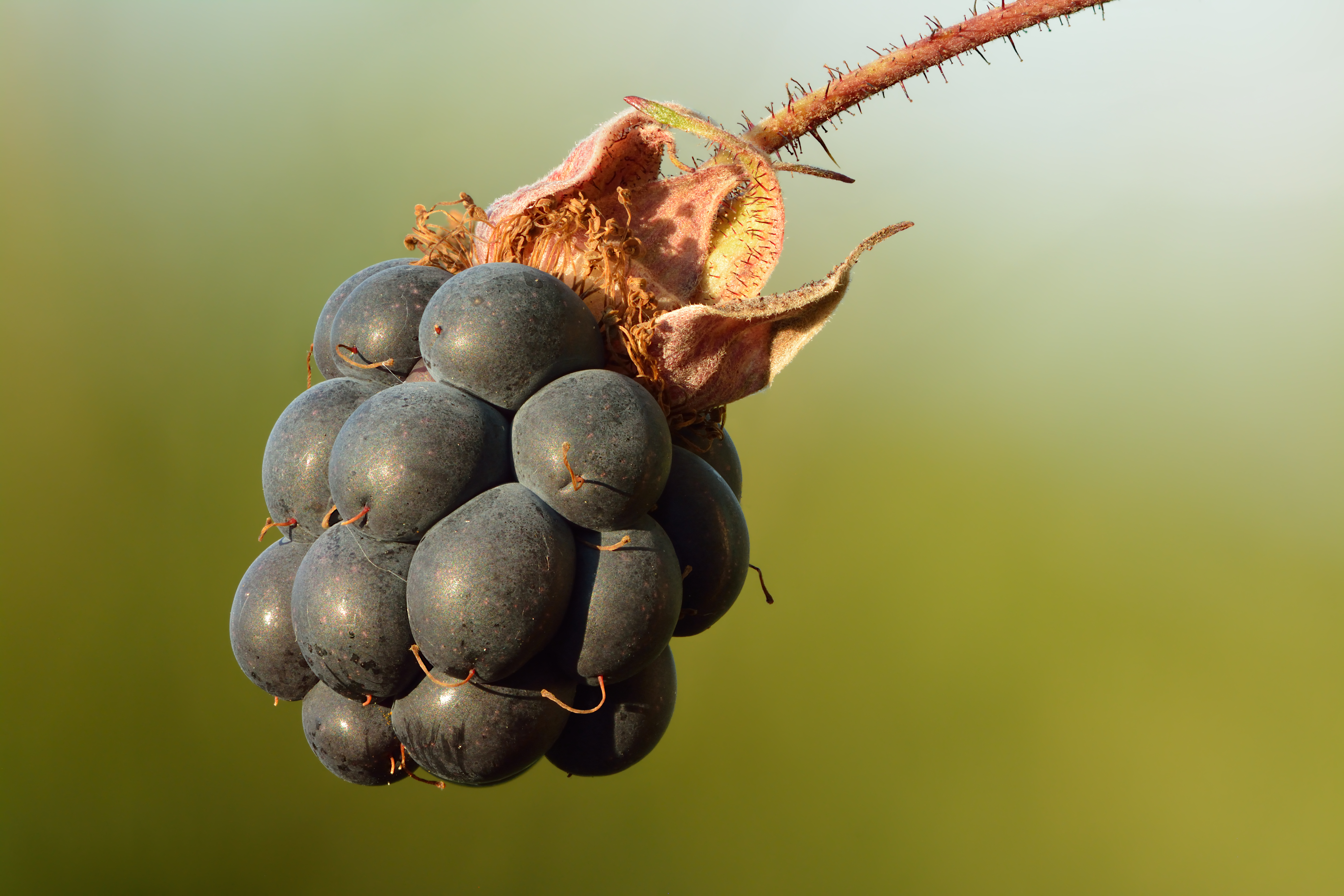
Type of black berry
the plants or their fruit


The dewberries are a group of species in the genus Rubus, section Rubus, closely related to the blackberries. They are small, trailing (rather than upright or high-arching) brambles with aggregate fruits, reminiscent of the raspberry, but are usually purple to black instead of red.
Description
The plants do not have upright canes like some other Rubus species, but have stems that trail along the ground, putting forth new roots along the length of the stem. The stems are covered with fine spines or stickers. Around March and April, the plants start to grow white flowers that develop into small, green berries. The tiny, green berries grow red and then a deep purple-blue as they ripen. When the berries are ripe, they are tender and difficult to pick in any quantity without squashing them. The berries are sweet and often less seedy than blackberries. In the winter, the leaves often remain on the stems, but may turn dark red.
The European dewberry, Rubus caesius, grows more upright like other brambles. Its fruits are a deep, almost black, purple and are coated with a thin layer or 'dew' of waxy droplets. Thus, they appear sky blue (caesius being Latin for pale blue). Its fruits are small and retain a markedly tart taste even when fully ripe.

Species
- Rubus section Caesii, European dewberry
- European dewberry, Rubus caesius L.
- Rubus section Flagellares, American dewberries
- Rubus aboriginum Rydb., synonyms:
- Rubus almus (L.H. Bailey) L.H.Bailey
- Rubus austrinus L.H.Bailey
- Rubus bollianus L.H.Bailey
- ''Rubus clair-brownii''' L.H.Bailey
- Rubus decor L.H. Bailey
- Rubus flagellaris Willd. var. almus L.H.Bailey
- Rubus foliaceus L.H. Bailey
- Rubus ignarus L.H. Bailey
- Rubus ricei L.H. Bailey
- Aberdeen dewberry, Rubus depavitus L.H.Bailey
- Northern dewberry, Rubus flagellaris Willd.
- Swamp dewberry, Rubus hispidus L.
- Upland dewberry, Rubus invisus (L.H.Bailey) Britton
- Pacific dewberry, Rubus ursinus Cham. & Schltdl.
- Southern dewberry Rubus trivialis L.H.Bailey
- Rubus aboriginum Rydb., synonyms:
Distribution and habitat
Dewberries are common throughout most of the Northern Hemisphere, and are thought of as a beneficial weed. R. caesius is frequently restricted to coastal communities, especially sand-dune systems.
Ecology
The leaves are sometimes eaten by the larvae of some Lepidoptera species, including peach blossom moths.
Uses
The leaves can be used to make an herbal tea (tisane), and the berries are edible and taste sweet. They can be eaten raw, or used to make cobbler, jam, or pie.
In the late 19th and early 20th centuries, the town of Cameron, North Carolina, was known as the "dewberry capital of the world" for large-scale cultivation of this berry, which was shipped out for widespread consumption. Local growers made extensive use of the railroads in the area to ship them nationally and internationally.
References
References
This article was imported from Wikipedia and is available under the Creative Commons Attribution-ShareAlike 4.0 License. Content has been adapted to SurfDoc format. Original contributors can be found on the article history page.
Ask Mako anything about Dewberry — get instant answers, deeper analysis, and related topics.
Research with MakoFree with your Surf account
Create a free account to save articles, ask Mako questions, and organize your research.
Sign up freeThis content may have been generated or modified by AI. CloudSurf Software LLC is not responsible for the accuracy, completeness, or reliability of AI-generated content. Always verify important information from primary sources.
Report