From Surf Wiki (app.surf) — the open knowledge base
Deva (Hinduism)
Male celestial being in Hinduism

Male celestial being in Hinduism
| Field | Value | ||
|---|---|---|---|
| title | Deva | ||
| en | Heavenly, divine, shiny, exalted, anything of excellence, donor of knowledge or resources. | ||
| sa | देव | ||
| sa-Latn | deva | ||
| th | เทวดา | ||
| th-Latn | thaevada | ||
| ban | ᬤᬾᬯ | ||
| ban-Latn | déwa | ||
| hi | देवता | ||
| hi-Latn | devatā | ||
| pa | ਦੇਵ | ||
| pa-Latn | Dēva | ||
| bn | দেবতা | ||
| bn-Latn | debota | ||
| jv | ꦢꦺꦮ | ||
| jv-Latn | déwa | ||
| kn | ದೇವ | ||
| kn-Latn | deva | ||
| km | ទេវ | ||
| km-Latn | tév | ||
| ml | ദേവൻ | ||
| ml-Latn | devan | ||
| mr | देव | ||
| mr-Latn | dev | ||
| ne | देवता | ||
| ne-Latn | devatā | ||
| ta | தேவர்கள் | ||
| ta-Latn | tevarkal̤ | ||
| te | దేవుడు | ||
| te-Latn | dēvuḍu | ||
| ma | dev | ||
| ma-Latn | देव | or=ଦେବତା | or-Latn=debôta |
| as | দেৱতা | ||
| as-Latn | dewatā | ks=دیو | ks-Latn=dev |
| sa-Latn = deva | th-Latn = thaevada | ban-Latn= déwa | hi-Latn = devatā | pa-Latn = Dēva | bn-Latn = debota | jv-Latn = déwa | kn-Latn = deva | km-Latn = tév | ml-Latn = devan | mr-Latn = dev | ne-Latn = devatā | ta-Latn = tevarkal̤ | te-Latn = dēvuḍu | ma-Latn = देव|or=ଦେବତା|or-Latn=debôta |as-Latn = dewatā|ks=دیو|ks-Latn=dev}} Deva (, ) means 'shiny', 'exalted', 'heavenly being', 'divine being', 'anything of excellence', and is also one of the Sanskrit terms used to indicate a deity in Hinduism. Deva is a masculine term; the feminine equivalent is Devi. The word is a cognate with Latin deus ('god') and Greek Zeus.
In the earliest Vedic literature, all supernatural beings are called Devas and Asuras. The concepts and legends evolved in ancient Indian literature, and by the late Vedic period, benevolent supernatural beings are referred to as Deva-Asuras. In post-Vedic Hindu texts, such as the Puranas and the Itihasas of Hinduism, the Devas represent the good, and the Asuras the bad.
Devas, along with Asuras, Yakshas (nature spirits), and Rakshasas (ghoulish ogres/demons), are part of Indian mythology, and Devas feature in many cosmological theories in Hinduism.
Etymology
Deva is a Sanskrit word found in Vedic literature of the 2nd millennium BCE. Sir Monier Monier-Williams translates it as "heavenly, divine, terrestrial things of high excellence, exalted, shining ones". The concept also is used to refer to deity.
The Sanskrit deva- derives from Indo-Iranian *daiv- which in turn descends from the Proto-Indo-European word, **deiwo-*, originally an adjective meaning "celestial" or "shining", which is a (not synchronic Sanskrit) vrddhi derivative from *diw, zero-grade of the root *dyew- meaning "to shine", especially as the day-lit sky. The feminine form of *deiwos is *deiwih2, which descends into Indic languages as devi, in that context meaning "female deity". Also deriving from *deiwos, and thus cognates of deva, are "Zeys/Ζεύς" - "Dias/Δίας", the Greek father of the gods, Lithuanian Dievas (Latvian Dievs, Prussian Deiwas), Germanic Tiwaz (seen in English "Tuesday") and the related Old Norse Tivar (gods), and Latin Deus "god" and divus "divine", from which the English words "divine" and "deity" are derived. It is related to *Dyeus which while from the same root, may originally have referred to the "heavenly shining father", and hence to "Father Sky", the chief God of the Indo-European pantheon, continued in Sanskrit Dyaus. The abode of the Devas is Dyuloka.
According to Douglas Harper, the etymological roots of Deva mean "a shining one," from *div- "to shine," and it is cognate with Greek dios "divine" and Zeus, and Latin deus "god" (Old Latin deivos). The word "Deva" shares similarities with Persian Daeva.
Deva is masculine; the related feminine equivalent is devi. Etymologically, Devi is cognate with Latin dea. When capitalized, Devi or Mata refers to a divine mother goddess in Hinduism. Deva is also referred to as Devatā, and Devi as Devika.
The word Deva is also a proper name or part of a name in Indian culture, where it refers to "one who wishes to excel, overcome" or the "seeker of, master of or a best among".
Another interpretation of the word is derived from the word "dibbati", which means to play or to sport. This denotes their playful nature and that they enjoy themselves with the five sensual pleasures.Malalasekera, Gunapala P., and W. G. Weeraratne. Encyclopaedia of Buddhism Fascicle 4: Dhammadhātu - Dveṣa. Government of Sri Lanka, 1989. p. 413.
This interpretation derives from the Khuddaka-Pátha.
Vedic literature
Main article: Rigvedic deities
Samhitas and Brahmanas
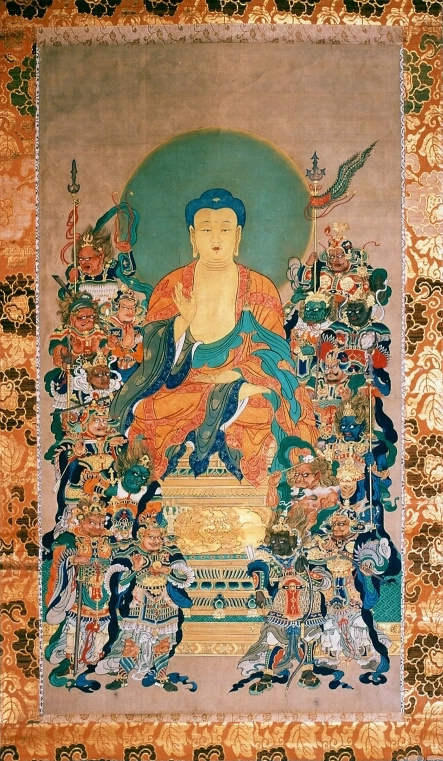
The Samhitas, which are the oldest layer of text in Vedas enumerate 33 devas,{{refn|group=note|The list of Vedic Devas somewhat varies across the manuscripts found in different parts of South Asia, particularly in terms of guides (Aswins) and personified Devas. One list based on Book 2 of Aitereya Brahmana is:
- Devas personified: Indra (), , Mitra, Aryaman, Bhaga, , Vidhatr (Brahma), , , Vivasvat, (Dhatr), Vishnu.
- Devas as abstractions or inner principles: Ānanda (bliss, inner contentment), Vijñāna (knowledge), Manas (mind, thought), Prāṇa (life-force), Vāc (speech), Ātmā (soul, self within each person), and five manifestations of Rudra/Shiva – Īśāna, Tatpuruṣa, Aghora, Vāmadeva, Sadyojāta
- Devas as forces or principles of nature – (earth), Agni (fire), Antarikṣa (atmosphere, space), Jal (water), Vāyu (wind), (aether or sky), Sūrya (sun), (stars), Soma (moon)
- Devas as guide or creative energy – Vasatkara, Prajāpati}} either 11 each for the three worlds, or as 12 Adityas, 11 Rudras, 8 Vasus and 2 Asvins in the Brahmanas layer of Vedic texts. The Rigveda states in hymn 1.139.11,
ये देवासो दिव्येकादश स्थ पृथिव्यामध्येकादश स्थ । अप्सुक्षितो महिनैकादश स्थ ते देवासो यज्ञमिमं जुषध्वम् ॥११॥
O ye eleven deities whose home is heaven, O ye eleven who make earth your dwelling, Ye who with might, eleven, live in waters, accept this sacrifice, O deities, with pleasure. – Translated by Ralph T. H. Griffith
Deities who are eleven in heaven; who are eleven on earth; and who are eleven dwelling with glory in mid-air; may ye be pleased with this our sacrifice. – Translated by HH Wilson |Rigveda 1.139.11||source=}}
Some devas represent the forces of nature and some represent moral values (such as the Adityas, Varuna, and Mitra), each symbolizing the epitome of a specialized knowledge, creative energy, exalted and magical powers (Siddhis). The most referred to Devas in the Rig Veda are Indra, Agni (fire) and Soma, with "fire deity" called the friend of all humanity, it and Soma being the two celebrated in a yajna fire ritual that marks major Hindu ceremonies. Savitr, Vishnu, Rudra, and Prajapati (later Brahma) are gods and hence Devas. Parvati (power and love) and Durga (victory) are some Devis or goddesses. Many of the deities taken together are worshiped as the Vishvedevas.
Important Devas
- Brahma the deity of creation
- Vishnu the deity of preservation
- Shiva the deity of destruction and time; associated with fertility and regeneration
- Ganesha the deity of new beginnings, wisdom, and luck
- Hanuman the deity associated to courage, reverence and strength/avatar of Shiva
- Kartikeya the deity of victory and war
- Dhanvantari the deity of doctors and Ayurveda/avatar of Vishnu
- Vishwakarma the deity of architecture
- Dyaus the deity of the aether (or sky)
- Vayu the deity of air, wind and breath
- Varuna the deity of water and rain
- Agni the deity of fire
- Yama the deity of death and justice
- Samudra the deity of the seas/form of Varuna
- Kubera the deity of opulence and wealth
- Kamadeva the deity of love
- Indra the deity of weather, storms and sky
- Ashwini Kumara the deity of health and medicine
- Surya the deity of the sun, light and day
- Chandra the deity of the moon and night
- Mangala the deity of Mars and Aggression
- Budha the deity of Mercury and Nature
- Brihaspati the deity of Jupiter and teacher of the Devas
- Shukra the deity of Venus and worship (bhakti) and teacher of the Asuras
- Shani the deity of Saturn and deeds (karma)
Henotheism
In Vedic literature, Deva is not a monotheistic God; rather a "supernatural, divine" concept manifesting in various ideas and knowledge, in a form that combines excellence in some aspects, wrestling with weakness and questions in other aspects, heroic in their outlook and actions, yet tied up with emotions and desires.
Max Muller states that the Vedic hymns are remarkable in calling every one of the different devas as "the only one, the supreme, the greatest".
Characteristics of Devas in the Vedic literature
Ananda Coomaraswamy states that Devas and Asuras in the Vedic lore are similar to the Olympian gods and Titans of Greek mythology. Both are powerful but have different orientations and inclinations, with the Devas representing the powers of Light and the Asuras representing the powers of Darkness in Hindu mythology. According to Coomaraswamy's interpretation of Devas and Asuras, both these natures exist in each human being, both the tyrant and the angel. The best and the worst within each person struggles before choices and one's own nature, and the Hindu formulation of Devas and Asuras is an eternal dance between these within each person.
The Devas and Asuras, Angels and Titans, powers of Light and powers of Darkness in Rigveda, although distinct and opposite in operation, are in essence consubstantial, their distinction being a matter not of essence but of orientation, revolution or transformation. In this case, the Titan is potentially an Angel, the Angel still by nature a Titan; the Darkness in actu is Light, the Light in potentia Darkness; whence the designations Asura and Deva may be applied to one and the same Person according to the mode of operation, as in Rigveda 1.163.3, "Trita art thou (Agni) by interior operation". |Ananda Coomaraswamy|Journal of the American Oriental Society}}
All-powerful beings, good or evil, are called Devas and Asuras in the oldest layer of Vedic texts. A much-studied hymn of the Rigveda states Devav asura (Asuras who have become Devas), and contrasts it with Asura adevah (Asuras who are not Devas). They are born from the same father, Prajapati, the primordial progenitor; his sons are envisioned as the Asuras and Devas. They all share the same residence (Loka), eat together the same food and drinks (Soma), and have innate potential, knowledge and special powers in Hindu mythology; the only thing that distinguishes "Asuras who become Devas" from "Asuras who remain Asuras" is intent, action and choices they make in their mythic lives.
Upanishads

The oldest Upanishads mention Devas, and their struggle with the Asuras. The Kaushitaki Upanishad, for example, in Book 4 states that "Indra was weaker than the Asuras when he did not know his own Atman (soul, self).
Chandogya Upanishad, in chapter 1.2, describes the battle between Devas and Asuras on various sensory powers.
Mantra 5.2.1 of the Brihadaranyaka Upanishad describes Devas, Men, and Asuras as sons of Prajapati, the primordial father.
Medieval era Indian scholars, in their Bhasya (review and commentaries) on the Upanishads, stated that the discussion of Devas and Asuras in the Upanishads is symbolic, and it represents the good and evil that resides and struggles within each human being. Adi Shankara, for example, in his commentary on Brihadaranyaka Upanishad asserted that Devas represent the human seeking for the sacred and spiritual, while the Asuras represent the human seeking for the worldly excesses. Edelmann and other modern era scholars also state that the Devas versus Asuras discussion in Upanishads is a form of symbolism.
In the later primary Upanishadic texts, Devas and Asuras discuss and act to seek knowledge, for different purposes. In one case, for example, they go to Prajāpati, their father, to understand what is Self (Atman, soul) and how to realize it. The first answer that Prajāpati gives is simplistic, which the Asuras accept and leave with, but the Devas led by Indra do not accept and question because Indra finds that he hasn't grasped its full significance and the given answer has inconsistencies. Edelmann states that this symbolism embedded in the Upanishads is a reminder that one must struggle with presented ideas, learning is a process, and Deva nature emerges with effort.
Puranas and Itihasas
In the Puranas and the Itihasas with the embedded Bhagavad Gita, the Devas represent the good, and the Asuras the bad.
Everyone starts as an Asura in Hindu mythology, born of the same father. "Asuras who remain Asura" share the character of powerful beings obsessed with their craving for more power, more wealth, ego, anger, unprincipled nature, force and violence. The hostility between the two is the source of extensive legends and tales in the Puranic and the Epic literature of Hinduism; however, many texts discuss their hostility in neutral terms and without explicit condemnation.
Bhagavata Purana
In Bhagavata Purana, Brahma had ten sons: Marichi, Atri, Angira, Pulastya, Pulaha, Kratu, Vasistha, Daksa, Narada. Marici had a son called Kasyapa. Kasyapa had thirteen wives: Aditi, Diti, Danu, Kadru etc. The sons of Aditi are called Adityas, the sons of Diti are called Daityas, and the sons of Danu are called Danavas. Bṛhaspati (Jupiter, son of Angiras) is a guru of devas (vedic gods). Shukracharya (Venus, son of Bhrigu) is a guru of asuras (vedic demons) or/and Danavas.
Symbolism

Edelmann states that the dichotomies present in the Puranas literature of Hinduism are symbolism for spiritual concepts. For example, god Indra (a Deva) and the antigod Virocana (an Asura) question a sage for insights into the knowledge of the self.
The god (Deva) and antigod (Asura), states Edelmann, are also symbolically the contradictory forces that motivate each individual and people, and thus Deva-Asura dichotomy is a spiritual concept rather than mere genealogical category or species of being. l
Classical Hinduism

In Hinduism, Devas are celestial beings associated with various aspects of the cosmos. The Devas Brahma, Vishnu, and Shiva, form the Hindu trinity known as the Trimurthi and preside over the functioning of the cosmos and the evolution of creation. Lesser devas may control the forces of nature, such as Vayu, the Lord of the wind, Varuna the Lord of water, and Agni, the Lord of fire. Hinduism also has many other lesser celestial beings, such as the married Gandharvas (male celestial musicians) and Apsaras (female celestial dancers).
Sangam literature
Tamil Sangam literature (300BC-300CE) describes the offerings for devas. In Silapathikaram, one of the five epics of Tamil by Ilango Adigal, is desccribed the offering for Four kind of devas.
Notes
References
References
- Klostermaier, Klaus K.. (2007). "A Survey of Hinduism". [[SUNY Press]].
- Monier Monier-Williams, A Sanskrit-English Dictionary” Etymologically and Philologically Arranged to cognate Indo-European Languages, Motilal Banarsidass, page 492
- [https://www.britannica.com/topic/deva-religious-being Encyclopaedia Britannica - Deva]
- [https://books.google.com/books?id=sEIngqiKOugC&dq=deva+in+vedic+india&pg=PA147 Encyclopedia of Ancient Deities by Charles Russell Coulter, Patricia Turner. Pg.147]
- George Williams (2008), A Handbook of Hindu Mythology, Oxford University Press, {{ISBN. 978-0195332612, pages 90, 112
- Wash Edward Hale (1999), Ásura in Early Vedic Religion, Motilal Barnarsidass, {{ISBN. 978-8120800618, pages 5-11, 22, 99-102
- Monier Monier-Williams, A Sanskrit-English Dictionary” Etymologically and Philologically Arranged to cognate Indo-European Languages, Motilal Banarsidass, page 121
- In some [[List of historic Indian texts|medieval works of Indian literature]], ''Devas'' are also referred to as '''''Suras''''' and contrasted with their equally powerful but malevolent [[half-brother]]s, referred to as the ''Asuras''.[https://www.britannica.com/EBchecked/topic/40167/asura/40167rellinks/Related-Links Encyclopædia Britannica]
- Don Handelman (2013), One God, Two Goddesses, Three Studies of South Indian Cosmology, Brill Academic, {{ISBN. 978-9004256156, pages 23-29
- Wendy Doniger (1988), Textual Sources for the Study of Hinduism, Manchester University Press, {{ISBN. 978-0719018664, page 67
- 978-0791470824, pages 101-102
- "Appendix I - Indo-European Roots".
- [http://www.ibiblio.org/sripedia/ebooks/mw/0500/mw__0533.html Dyuloka], Monier Monier-Williams, English Sanskrit Dictionary with Etymology, Oxford University Press, page 500
- [http://www.etymonline.com/index.php?allowed_in_frame=0&search=deva&searchmode=none Deva] Etymology Dictionary, Douglas Harper (2015)
- (2019-08-12). "Origin of Vedas". Notion Press.
- (2001). "Zoroastrians: Their Religious Beliefs and Practices". Psychology Press.
- (2018). "Essays on the History of Religions". BRILL.
- Monier Monier-Williams, A Sanskrit-English Dictionary” Etymologically and Philologically Arranged to cognate Indo-European Languages, Motilal Banarsidass, page 496
- John Stratton Hawley and Donna Marie Wulff (1998), Devi: Goddesses of India, Motilal Banarsidass, {{ISBN. 978-8120814912, page 2
- John Stratton Hawley and Donna Marie Wulff (1998), Devi: Goddesses of India, Motilal Banarsidass, {{ISBN. 978-8120814912, pages 18-21
- Hermann Oldenberg (1988), The Religion of the Veda, Motilal Banarsidass, {{ISBN. 978-8120803923, pages 110-114
- link. (2016-03-04 Nara National Museum, Japan)
- Hermann Oldenberg (1988), The Religion of the Veda, Motilal Banarsidass, {{ISBN. 978-8120803923, pages 23-50
- AA MacDonell, {{Google books. KCQ_AQAAMAAJ. Vedic mythology
- Francis X Clooney (2010), Divine Mother, Blessed Mother, Oxford University Press, {{ISBN. 978-0199738731, page 242
- [https://sa.wikisource.org/wiki/ऋग्वेद:_सूक्तं_१.१३९ ऋग्वेद: सूक्तं १.१३९] Sanskrit, Wikisource
- [https://archive.org/stream/rigvedasanhitc02wils#page/62/mode/2up The Rig Veda/Mandala 1/Hymn 139] Verse 11, Ralph T. H. Griffith, Wikisource
- [[Wikisource:The Rig Veda/Mandala 1/Hymn 139. The Rig Veda Samhita]] Verse 11, HH Wilson (Translator), Royal Asiatic Society, WH Allen & Co, London
- George Williams (2008), A Handbook of Hindu Mythology, Oxford University Press, {{ISBN. 978-0195332612, pages 24-33
- Bina Gupta (2011), An Introduction to Indian Philosophy, Routledge, {{ISBN. 978-0415800037, pages 21-25
- John Bowker (2014), God: A Very Short Introduction, Oxford University Press, {{ISBN. 978-0198708957, pages 88-96
- 978-1444330847, page 42
- Wash Edward Hale (1999), Ásura in Early Vedic Religion, Motilal Barnarsidass, {{ISBN. 978-8120800618, page 20
- Ananda Coomaraswamy (1935), Angel and Titan: An Essay in Vedic Ontology, Journal of the American Oriental Society, volume 55, pages 373-374
- Ananda Coomaraswamy (1935), Angel and Titan: An Essay in Vedic Ontology, Journal of the American Oriental Society, volume 55, pages 373-418
- Nicholas Gier (1995), [https://www.jstor.org/stable/1399510 Hindu Titanism], Philosophy East and West, Volume 45, Number 1, pages 76, see also 73-96
- Ananda Coomaraswamy (1935), [https://www.jstor.org/stable/594758 Angel and Titan: An Essay in Vedic Ontology], Journal of the American Oriental Society, volume 55, pages 373-374
- FBJ Kuiper (1975), The Basic Concept of Vedic Religion, History of Religion, volume 15, pages 108-112
- Wash Edward Hale (1999), Ásura in Early Vedic Religion, Motilal Barnarsidass, {{ISBN. 978-8120800618, pages 1-2; Note: Hale translates this to "Asuras without the Asura-Devas" in his book, see page 3 for example.;
For original Sanskrit, see Rigveda hymns 8.25.4 and 8.96.9 [https://sa.wikisource.org/wiki/ऋग्वेदः_मण्डल_८ Rigveda - Wikisource] - Mircea Eliade (1981), History of Religious Ideas, Volume 1, University of Chicago Press, {{ISBN. 978-0226204017, page 204, 199-202, 434-435
- 978-0226064567, pages 52-53
- Hermann Oldenberg (1988), The Religion of the Veda, Motilal Banarsidass, {{ISBN. 978-8120803923, pages 116-117
- [[Paul Deussen]], Sixty Upanishads of the Veda, Volume 1, Motilal Banarsidass, {{ISBN. 978-8120814684, pages 287-289
- Dominic Goodall (1996), Hindu Scriptures, University of California Press, {{ISBN. 978-0520207783, pages 175-176
- 978-8120814684, page 58
- 978-8120814684, pages 70-71
- 978-8120814684, pages 508-509
- [[Max Muller]], [https://archive.org/stream/upanishads02ml#page/78/mode/2up Brihadaranyaka Upanishad 1.3.1] Oxford University Press, page 78 with footnote 2
- Jonathan Edelmann (2013), Hindu Theology as Churning the Latent, Journal of the American Academy of Religion, Volume 81, Issue 2, pages 427-466
- Doris Srinivasan (1997), Many Heads, Arms and Eyes: Origin, Meaning, and Form of Multiplicity in Indian Art, Brill Academic, {{ISBN. 978-9004107588, pages 130-131
- Nicholas Gier (2000), Spiritual Titanism: Indian, Chinese, and Western Perspectives, State University of New York Press, {{ISBN. 978-0791445280, pages 59-76
- 978-1845193461, pages 253-262
- Christopher K Chapple (2010), The Bhagavad Gita: Twenty-fifth–Anniversary Edition, State University of New York Press, {{ISBN. 978-1438428420, pages 610-629
- The "Asuras who become Devas" in contrast are driven by an inner voice, seek understanding and meaning, prefer moderation, principled behavior, morals, knowledge, and harmony.Nicholas Gier (1995), [https://www.jstor.org/stable/1399510 Hindu Titanism], Philosophy East and West, Volume 45, Number 1, pages 76-80
- Stella Kramrisch and Raymond Burnier (1986), The Hindu Temple, Volume 1, Motilal Banarsidass, {{ISBN. 978-8120802230, pages 75-78
- 978-0877790440, page 455
- Bhagavata Purana 3.12.21-22
- Bhagavata Purana 4.1.13
- Bhagavata Purana 6.6.24-26
- Bhagavata Purana 8.13.6
- Bhagavata Purana 6.18.11
- Bhagavata Purana 5.24.30
- Virocana leaves with the first given answer, believing now he can use the knowledge as a weapon. In contrast, Indra keeps pressing the sage, churning the ideas, and learning about means to inner happiness and power. Edelmann suggests that the Deva-Asura dichotomies in Hindu mythology may be seen as "narrative depictions of tendencies within our selves".Jonathan Edelmann (2013), Hindu Theology as Churning the Latent, Journal of the American Academy of Religion, Volume 81, Issue 2, pages 439-441
- In the Bhāgavata Purana, saints and gods are born in families of Asuras, such as [[Mahabali]] and [[Prahlada]], conveying the symbolism that motivations, beliefs, and actions rather than one's birth and family circumstances define whether one is Deva-like or Asura-like.Jonathan Edelmann (2013), Hindu Theology as Churning the Latent, Journal of the American Academy of Religion, Volume 81, Issue 2, pages 440-442
- (1964). "Silappadikaram By S. Krishnamoorthy".
This article was imported from Wikipedia and is available under the Creative Commons Attribution-ShareAlike 4.0 License. Content has been adapted to SurfDoc format. Original contributors can be found on the article history page.
Ask Mako anything about Deva (Hinduism) — get instant answers, deeper analysis, and related topics.
Research with MakoFree with your Surf account
Create a free account to save articles, ask Mako questions, and organize your research.
Sign up freeThis content may have been generated or modified by AI. CloudSurf Software LLC is not responsible for the accuracy, completeness, or reliability of AI-generated content. Always verify important information from primary sources.
Report