From Surf Wiki (app.surf) — the open knowledge base
Detection error tradeoff
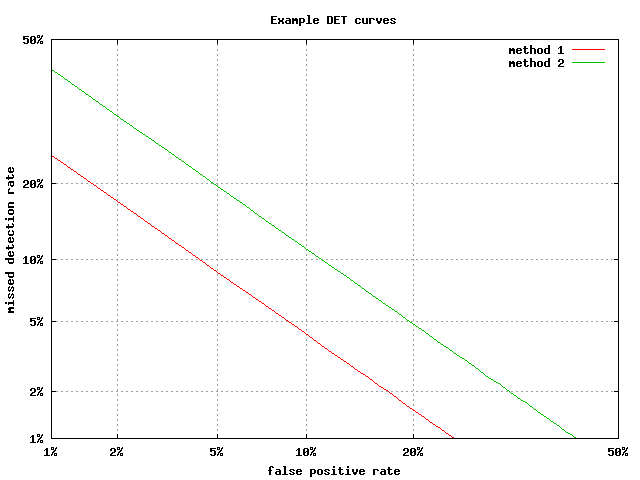

A detection error tradeoff (DET) graph is a graphical plot of error rates for binary classification systems, plotting the false rejection rate vs. false acceptance rate. The x- and y-axes are scaled non-linearly by their standard normal deviates (or just by logarithmic transformation), yielding tradeoff curves that are more linear than ROC curves, and use most of the image area to highlight the differences of importance in the critical operating region.
Axis warping
The normal deviate mapping (or normal quantile function, or inverse normal cumulative distribution) is given by the probit function, so that the horizontal axis is x = probit(Pfa) and the vertical is y = probit(Pfr), where Pfa and Pfr are the false-accept and false-reject rates.
The probit mapping maps probabilities from the unit interval [0,1], to the extended real line [−∞, +∞]. Since this makes the axes infinitely long, one has to confine the plot to some finite rectangle of interest.
References
References
- A. Martin, A., G. Doddington, T. Kamm, M. Ordowski, and M. Przybocki. "[https://web.archive.org/web/20171106100924/http://www.dtic.mil/docs/citations/ADA530509 The DET Curve in Assessment of Detection Task Performance]", Proc. Eurospeech '97, Rhodes, Greece, September 1997, Vol. 4, pp. 1895-1898.
This article was imported from Wikipedia and is available under the Creative Commons Attribution-ShareAlike 4.0 License. Content has been adapted to SurfDoc format. Original contributors can be found on the article history page.
Ask Mako anything about Detection error tradeoff — get instant answers, deeper analysis, and related topics.
Research with MakoFree with your Surf account
Create a free account to save articles, ask Mako questions, and organize your research.
Sign up freeThis content may have been generated or modified by AI. CloudSurf Software LLC is not responsible for the accuracy, completeness, or reliability of AI-generated content. Always verify important information from primary sources.
Report