From Surf Wiki (app.surf) — the open knowledge base
Derry City F.C.
Association football club based in Northern Ireland

Association football club based in Northern Ireland
| Field | Value | |
|---|---|---|
| clubname | Derry City | |
| image | Derry City F.C. crest.svg | |
| upright | 0.90 | |
| fullname | Derry City Football Club | |
| nickname | The Candystripes | |
| founded | ||
| ground | from=Q459622}} | |
| Derry, Northern Ireland | ||
| capacity | 6,242 | |
| current | 2025 League of Ireland Premier Division | |
| owner | Supporter owned | |
| chairman | Philip O'Doherty | |
| manager | Tiernan Lynch | |
| league | League of Ireland Premier Division | |
| season | 2025 | |
| position | 2nd of 10 | |
| website | ||
| pattern_la1 | _derrycity24h | |
| pattern_b1 | _derrycity24h | |
| pattern_ra1 | _derrycity24h | |
| pattern_sh1 | _derrycity24h | |
| pattern_so1 | _derrycity24h | |
| leftarm1 | FF0000 | |
| body1 | FF0000 | |
| rightarm1 | FF0000 | |
| shorts1 | 000000 | |
| socks1 | FFFFFF | |
| pattern_la2 | _derrycity24a | |
| pattern_b2 | _derrycity24a | |
| pattern_ra2 | _derrycity24a | |
| pattern_sh2 | _derrycity24a | |
| pattern_so2 | _derrycity24a | |
| leftarm2 | 171A49 | |
| body2 | 171A49 | |
| rightarm2 | 171A49 | |
| shorts2 | 171A49 | |
| socks2 | 171A49 |
Derry, Northern Ireland
Derry City Football Club are a professional football club based in Derry, Northern Ireland. They play in the League of Ireland Premier Division, the top tier of league football in the Republic of Ireland, and are its only member from Northern Ireland. The club's home ground is the Brandywell. Derry City wear red and white striped shirts from which their nickname, the Candystripes, derives. The club are also known as the Red and White Army, Derry or City.
The club, founded in 1928, initially played in the Irish League, the domestic league in Northern Ireland, and won a title in 1964–65. In 1971, security concerns related to the Troubles meant matches could not be played at the Brandywell and the team had to play home fixtures 30 mi away in Coleraine. While security force objections to the use of the Brandywell were withdrawn the following year, the Irish League insisted that the arrangement, an unsustainable one, continue and the club withdrew from the league. After 13 years in junior football, Derry City joined the League of Ireland's new First Division for 1985–86. They won the First Division title and achieved promotion to the Premier Division in 1987, remaining there until an administrative relegation in 2009. The club won a domestic treble in 1988–89.
After spending the majority of its time in the League of Ireland in the Premier Division, the club was expelled in November 2009 when it was discovered there were unofficial secondary contracts with players. It was reinstated a few weeks later but, as punishment, was demoted to the First Division. The club eventually won its way back to the Premier Division.{{cite news |access-date=13 February 2010
History
Main article: History of Derry City F.C.
Founded in 1928, the club decided against using the controversial official title of the city – Londonderry – in its name, while also deciding against continuing the name of the city's previous main club, Derry Celtic, so as to be more inclusive to all identities and football fans in the city. Derry City was granted entry into the Irish League in 1929 as professionals and was given permission by the Londonderry Corporation to use the municipal Brandywell Stadium. It repeated the feat in 1937, but did not win another major trophy until 1949, when it beat Glentoran to win its first Irish Cup. It won the Irish Cup for a second time in 1954, beating Glentoran again, and for a third time in 1964 – that year also winning the Gold Cup – despite the club's conversion to part-time status after the abolition of the maximum wage in 1961. This led to the club's first entry into European competition, in the 1964–65 UEFA Cup Winners' Cup, in which it was beaten by Steaua Bucharest 5–0 on aggregate. The club won the 1964–65 Irish League and subsequently became the first Irish League team to win a European tie over two legs, beating FK Lyn 8–6 on aggregate in the 1965–66 European Cup. Derry did not complete the next round, as the Irish Football Association (IFA) declared its ground was not up to standard, as it played in a mainly nationalist city and so had come to be supported largely by Catholics. The IFA, Belfast-based, was dominated by Protestants and it was widely suspected that it would rather have been represented by a traditionally unionist team. Relations between the club and IFA quickly deteriorated.
There had been no significant history of sectarian difficulties at matches in the first 40 years of the club's history, but in 1969 the Civil Rights campaign disintegrated into communal violence, which were followed by 30 years of the Troubles. Despite the social and political unrest, Derry reached the Irish Cup final in 1971, in which it was beaten 3–0 by Distillery. As the republican locality surrounding the Brandywell saw some of the worst violence, numerous unionist-supported clubs were reluctant to play there. The Royal Ulster Constabulary (RUC) ruled the zone unsafe for fixtures. With no other feasible local ground available, Derry had to travel to the majority unionist town of Coleraine, over 30 mi away, to play its "home" games at the Showgrounds. This situation lasted from September 1971 until October 1972 when, faced with dwindling crowds (most Derry fans were unwilling to travel to Coleraine due to the political situation and the longer journey) and dire finances, the club formally requested permission to return to the Brandywell. Despite a new assessment by the security forces concluding that the Brandywell was no longer any more dangerous than any other league ground and a lifting of the security ban, Derry's proposal fell by one vote at the hands of its fellow Irish League teams. Continuing without a ground was seen as unsustainable and on 13 October 1972 Derry withdrew from the league amidst a perception that it was effectively forced out.{{cite book | author=Eddie Mahon | title=Derry City | publisher=Guildhall Press | year=1998 | page=124 }}{{cite book | author=Hassan, David | title=Soccer and Society | publisher=Routledge | year=2002 | pages=vol. 3, no. 3, "People Apart: Soccer, Identity and Irish Nationalists in Northern Ireland", pp. 65–83 | issn=1466-0970 | no-pp=true }}
The club continued as a junior team during the 13-year-long 'wilderness years', playing in the local Saturday morning league, and sought re-admission to the Irish League. Each time, the club nominated the Brandywell as its chosen home ground but the Irish League refused re-admission. Suspecting refusal was driven by sectarianism, and believing it would never gain re-admission, Derry turned its attentions elsewhere.

Entry into the League of Ireland

Derry applied to join the reorganised League of Ireland (the league in the Republic of Ireland) in 1985 with the Brandywell as its home. The move required special dispensation from the IFA and FIFA, but eventually Derry was admitted to the league's new First Division for 1985, joining as semi-professionals.
Derry's first match in the new system was a 3–1 League of Ireland Cup win over Home Farm of Dublin at the Brandywell on 8 September 1985. The return of senior football to Derry attracted large crowds. The following year – 1987 – Derry won the First Division along with promotion to the Premier Division, remaining there for the subsequent 22 years. The club reached the 1988 FAI Cup final, but lost to Dundalk. The next season – 1988–89 – the club was financially forced to revert to semi-professional status but Jim McLaughlin's side managed to win a treble; the league, the League Cup and the FAI Cup. Qualifying for the 1989–90 European Cup, it met past winners, Benfica, in the first round.
Modern highs and lows
Since 1989, Derry has won the League of Ireland Premier Division once – in 1996–97 – but has been runner-up on three occasions. It added five more FAI Cups to its tally in 1995, 2002, 2006, 2012, and 2022, and was runner-up in 1994, 1997, 2008, and 2014 and has also won ten further League Cups.

The club has been beset by financial problems and was on the verge of bankruptcy due to an unpaid tax bill in 2000. An extensive fund-raising effort was undertaken by local celebrities and the city's people to save the club from extinction. Derry played high-profile friendlies against clubs such as Celtic, Manchester United, Barcelona and Real Madrid to raise extra money. This helped keep the club in operation, but difficulties remained and Derry nearly lost its Premier Division place in 2003 when it finished ninth and had to contest a two-legged relegation-promotion play-off with local rivals, Finn Harps. Derry won 2–1 on aggregate after extra-time at the Brandywell and remained in the top flight, avoiding further damage.
With finances secured, the club became the first in Ireland to be awarded a premier UEFA licence in 2004. Derry re-introduced professional football and its form improved, as it finished second in 2005. Derry's 2005 League Cup victory also saw the club qualify for the cross-border Setanta Cup for the first time in 2006. It entered the 2006–07 UEFA Cup's preliminary rounds, beating IFK Göteborg and Gretna to reach the first round where it faced Paris Saint-Germain; Derry finished second again in 2006, but went on to win the FAI Cup and League Cup double. It qualified for the 2007 Setanta Cup, as well as the preliminary rounds of the 2007–08 UEFA Champions League, and was accepted into the restructured Premier Division for 2007. The club had a disappointing league campaign in 2007, finishing seventh despite being pre-season favourites. It did manage to win its eighth League Cup, though, thanks to a 1–0 victory over Bohemians at the Brandywell.
The club, by owing huge debts, was expelled from the League of Ireland by the FAI in November 2009 for breaching the Participation Agreement and dissolved, but a new Derry club using the "Derry City" name joined for 2010 – with the FAI allowing it into the First Division{{cite web |access-date=9 November 2009 |url-status=dead |archive-url=https://web.archive.org/web/20091109015254/http://www.rte.ie/sport/soccer/2009/1107/derrycity.html |archive-date=9 November 2009 |access-date=20 March 2012
On Monday 15 February 2010, the new Derry City was awarded a First Division licence by the Independent Club Licensing Committee, allowing it eligibility to compete in the 2010 First Division.{{cite web |archive-url = https://archive.today/20130217190221/http://www.airtricityleague.ie/about/press-office/1404-independent-club-licensing-committee-awards-2010-licences |url-status = dead |archive-date = 17 February 2013 |access-date = 20 March 2012 By the end of October 2010 Derry had clinched the First Division title and with it, promotion back to the premier division after winning 1–0 away at Monaghan United in the last game of the season.
Derry's top goalscorer that season, Mark Farren, who finished with a tally of 20 goals, scored the winner against Monaghan before retiring from football for medical reasons as he sought to fight a benign tumour located in his brain. Farren died of cancer in February 2016 and his number 18 shirt was retired by the club.
He's been unbelievably courageous, I don't think people realise how brave he's been, although certainly all the players do."
Colours and crests
Main article: Traditions of Derry City F.C.

Derry City wore Aston Villa Football Club's famous claret and blue jerseys with white shorts for its first season – 1929–30. The colours lasted until 1932, when white jerseys with black shorts were adopted. He played for Sheffield United from 1913 until 1932, captaining them to a 1925 FA Cup win. The club's most capped player with 25 appearances for Ireland,
Derry have worn red and white stripes since, except from 1956 to 1962, when the club's players wore amber and black.
Derry have had various kit suppliers, including Adidas, Avec, Erreà, Fila, Le Coq Sportif, Matchwinner, Spall O'Neills, Hummel, and, currently, O'Neills. Commercial sponsorship logos to appear on the shirt's front have included Northlands, Warwick Wallpapers, Fruit of the Loom, Tigi Bed Head and Tigi Catwalk. For 2007, the logos of local media, Q102.9 and the Derry News, appeared on the back of the shirt just below the neck, along with the logo of Meteor Electrical on the jersey's front.
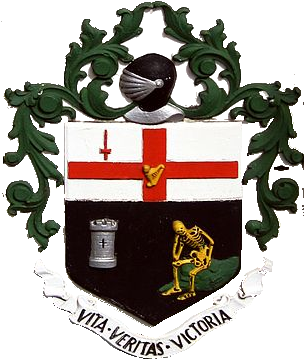
The club did not sport a crest on the club jersey throughout the Irish League years, nor for most of the first League of Ireland season. Instead, the coat of arms of the city appeared on club memorabilia such as scarves, hats and badges. The symbols on the arms are a skeleton, three-towered castle, red St. George's cross and sword. The sword and cross are devices of the City of London, and along with an Irish harp embedded within the cross, demonstrate the link between the two cities – the city's official name under UK law is Londonderry and the city itself was developed by The Honourable The Irish Society, a livery company of the City of London. The castle is thought to be an old local Norman keep built in 1305 by the de Burca clan. The skeleton is believed to be that of a knight of the same clan who was starved to death in the castle dungeons in 1332. This is accompanied by the Latin motto, "Vita, veritas, victoria", meaning "Life, truth, victory."

In April 1986 the club ran a competition in local schools to design a crest for them. The winning entry was designed by John Devlin, a St. Columb's College student, and was introduced on 5 May 1986 as Derry hosted Nottingham Forest for a friendly, with Liam Nelis and Paul Gormley (on his fifth birthday) acting as mascots. The crest depicted a simplified version of the city's Foyle Bridge, which had opened 18 months previously, the traditional red and white stripes of the jersey bordered by thin black lines, the year in which the club was founded and a football in the centre representing the club as a footballing entity. The name of the club appeared in Impact font.
With the novelty of the Foyle Bridge wearing off over time, the crest lasted until 15 July 1997, when the current one was unveiled at Lansdowne Road with the meeting of Derry City and Celtic during a pre-season friendly tournament. The modern crest also features a centred football, the year of founding and the club's name in a contemporary sans-serif font – Industria Solid. The famous red and white stripes are present along with a red mass of colour filling the left half of the crest, separated from the right by a white stripe. Known cultural landmarks or items associated with the city are absent from the minimalist design. The crests have always been positioned over the heart on the home jerseys.
Home ground
Main article: Brandywell Stadium
Derry City's home ground is the municipal Brandywell Stadium, situated just south-west of the Bogside in the Brandywell area of Derry. It is often abbreviated to "the Brandywell" and is also a local greyhound racing venue, with an ovoid track encircling the pitch. The dimensions of the pitch measure 111 x. The legal owner is the Derry City Council which lets the ground to the club. although it can accommodate 7,700 on a normal match-day, terraces included. The curved cantilever all-seated "New Stand" was constructed in 1991, while development on the still-insufficient facilities has been delayed numerous times and had yet to take place as of the end of the 2016 season.
Plans of Derry City's to purchase a pitch fell through after its formation due to the tight time-scale between its foundation in 1928 and the season's beginning in 1929 and so the Londonderry Corporation (now the Derry City Council) was approached for the use of the Brandywell which had been used for football up until the end of the 19th century. It agreed and the club still operates under the constraints of The Honourable The Irish Society charter limitations which declare that the Brandywell must be available for the recreation of the community. In effect, the club does not have private ownership and, thus, cannot develop by its own accord, with that discretion or whether to sell being left to the Derry City Council.

Derry City's first game at the Brandywell was a 2–1 loss to Glentoran on 22 August 1929. In 1933, the purchase of Bond's Field in the Waterside was mentioned, but it was thought to be too far away from the fan-base which had built up on the Cityside, especially in the Brandywell area. It also had first option on Derry Celtic's old ground, Celtic Park, but hesitated on a final decision and the Gaelic Athletic Association bought it ten years later. It also decided against buying Meenan Park for £1,500.
Because of Northern Ireland's volatile political situation during the Troubles and security fears for Protestants and those of the unionist tradition visiting the mainly nationalist city of Derry, the Brandywell has not always been the home ground of Derry City. In 1970 and 1971, Derry had to play its "home" ties against Linfield at Windsor Park in Belfast – the home-ground of Linfield. From September 1971 until October 1972 Derry was forced to play all its "home" games at the Showgrounds in mainly Protestant Coleraine, over 30 mi away, as police ruled the republican Brandywell area as too unsafe for visiting unionists, who themselves made up at least half of Derry City's own fanbase at that time. The Brandywell did not see senior football for another 13 years as the Irish Football League upheld a ban on the stadium and Derry decided to leave the league as a result. Only greyhound meetings and junior football were held during this time. Derry's admission to the League of Ireland in 1985 saw a return of senior games.
In December 2010 the club introduced a new credit card type season ticket system to ensure abuse of tickets could no longer occur and additionally ensuring more accurate attendance count at matches.
They played all their home matches of the 2017 season at Maginn Park in Buncrana due to renovation works at the Brandywell.
In 2025, Derry City agreed to a new proposed 25 year lease to the stadium that would put the club on the path to outright ownership of Ryan McBride Brandywell Stadium. This new lease will allow for Stormont grant funding via the Northern Ireland Football Fund to be approved and complete the second phase of development on the new stand, named after former player Mark Farren. The lease was approved unanimously by the city council with cross party support.
Supporters
Main article: Traditions of Derry City F.C.

By Irish standards, Derry City have a relatively large and loyal fan-base. The club was considered among the strongest and best-supported teams in the Irish League, and upon the club's entry into the League of Ireland in 1985, crowds of nearly 10,000 attended to the Brandywell for the return of matches. More recently, Derry City became the best supported team at an FAI Cup Final ever, when over 20,000 Derry supporters attended the 2022 FAI Cup Final, in which Derry overcame Shelbourne. Derry's average home attendance of 3,127 was the highest of any team for the 2006 season. The highest attendance was the last-night-of-the-season meeting between Derry and Cork City at the Brandywell on Friday 17 November when 6,080 watched Derry win 1–0. Domestically, Derry's supporters travel to away games in "bus-loads". and "some 3,000" went to Paris to see Derry play Paris Saint-Germain in the Parc des Princes. During the home legs, ticketless fans desperate to see the games watched from a distance while standing on the high vantage point overlooking the Brandywell offered by the City Cemetery in Creggan and parked hired double-decker buses outside the stadium to help them see over the ground's perimeter.
The club is known for its community spirit, and the supporters have played a pivotal role in the survival and successes of the club. When debts brought Derry close to extinction in the 2000–01 season, the local community responded en masse to help save the club. During the club's successful 2006 season, club captain, Peter Hutton said:
Likewise, former Social Democratic and Labour Party leader and Nobel Peace Prize winner John Hume, who was the club's president, stated in 1998 of the club's relationship with the community:
Support for the club is quite dependent on geography and crosses social boundaries. Fans come from both working class areas, such as the Brandywell area and Bogside, and more affluent regions of the city, like Culmore. The Cityside is seen as the traditional base of the club, especially the Brandywell area, although the Waterside is also home to a smaller number of supporters. The club are supported mainly by Derry's nationalist community. The connection is argued to be rooted mainly in geography, as well as social, cultural and historical circumstances, as opposed to the club or its fans pushing towards the creation of a certain identity. Indeed, prior to 1969, over half of the club's support base came from the sizeable Unionist community that lived in the cityside at the time. The onset of the troubles made the Brandywell's Nationalist location too dangerous to visit and Unionist support fell away to a small minority, in keeping with the rapid Unionist depopulation of the cityside as a whole. The city's wider Protestant community, almost entirely based in the Waterside, is largely apathetic, though some unionists and loyalists see the club as a symbol of Catholicism and nationalism as a result of the sectarian divide in support.For a more in-depth analysis and study of sectarian divisions and the politico-religious alignment of certain communities of fans to certain clubs within domestic Irish (especially Northern Irish) football, see: {{cite book | author=Cronin, Mike | title=Sport and Nationalism in Ireland: Gaelic Games, Soccer and Irish Identity Since 1884 | publisher=Four Courts Press | year=1999 | isbn=978-1-85182-456-4 | url-access=registration | url=https://archive.org/details/sportnationalism0000cron }}{{cite book |author1=Cronin, Mike |author2=Mayall, David | title=Sporting Nationalisms: Identity, Ethnicity, Immigration, and Assimilation | publisher=Routledge | year=1998 | isbn=978-0-7146-4449-3 }}{{cite book | author=Dunn, Seamus | title=Facets of the Conflict in Northern Ireland | publisher=Macmillan Press | year=1995 | isbn=0-312-12280-2 }}{{cite book |author1=Armstrong, Gary |author2=Giulianotti, Richard | title=Football Cultures and Identities | publisher=Palgrave Macmillan | year=1999 | isbn=978-0-333-73009-6 | page="The Territorial Politics of Soccer in Northern Ireland" by Bairner, Alan & Shirlow, Peter }}{{cite book |author1=Reilly, Thomas |author2=Lees, Adrian |author3=Davids, K. |author4=Murphy W.J. |name-list-style=amp | title=Science and Football | publisher=E. & F.N. Spon | year=1988 | pages="Sectarianism and Soccer Hooliganism in Northern Ireland" by Bairner, Alan & Sugden, John, pp. 572–578 }} title=Off the Ball | publisher=Longwood | year=1986 | pages="Observe the Sons of Ulster: Football and Politics in Northern Ireland" by Bairner, Alan & Sugden, John, pp. 146–157 | isbn=978-0-7453-0122-8 }} Joining the Republic of Ireland's league augmented the perception and, on occasion, Protestant hooligans have thrown missiles at Derry's supporter buses as they journeyed to or returned from games across the border.{{cite book |author1=Sugden, John |author2=Bairner, Alan | title=Sport, Sectarianism and Society in a Divided Ireland | publisher=Leicester University Press | year=1995 | isbn=978-0-7185-0018-4 | page=87 }} Minor nationalist elements within the Derry City support-base see football as a means of reinforcing sectarian divides.
With the city being a focal point of culture and activity serving the north-west region of Ireland, support stretches beyond the urban border and into the surrounding county; Limavady, Strabane in nearby County Tyrone and areas of bordering County Donegal contain support. The club has numerous supporter clubs, along with ultra fans, and support beyond Ireland – mainly emigrated city natives. Derry City Chat is a discussion website run by fans. Derry's fans share a rivalry with the supporters of Finn Harps and sing the Undertones' Teenage Kicks as a terrace anthem.
European record
Overview
| Competition | Matches | W | D | L | GF | GA | Win % |
|---|---|---|---|---|---|---|---|
| European Cup / UEFA Champions League | |||||||
| UEFA Cup / UEFA Europa League | |||||||
| UEFA Europa Conference League / UEFA Conference League | |||||||
| European Cup Winners' Cup / UEFA Cup Winners' Cup | |||||||
| TOTAL |
Matches
| Season | Competition | Round | Opponent | Home | Away | Aggregate | Representing Northern Ireland | Representing Republic of Ireland |
|---|---|---|---|---|---|---|---|---|
| 1964–65 | European Cup Winners' Cup | 1R | Romania Steaua București | 0–2 | 0–3 | 0–5 | ||
| 1965–66 | European Cup | PR | Norway Lyn Oslo | 3–5 | 5–1 | 8–6 | ||
| 1R | Belgium Anderlecht | w/o | 0–9 | 0–9 | ||||
| 1988–89 | European Cup Winners' Cup | 1R | Wales Cardiff City | 0–0 | 0–4 | 0–4 | ||
| 1989–90 | European Cup | 1R | Portugal Benfica | 1–2 | 0–4 | 1–6 | ||
| 1990–91 | UEFA Cup | 1R | Netherlands Vitesse | 0–1 | 0–0 | 0–1 | ||
| 1992–93 | UEFA Cup | 1R | Netherlands Vitesse | 0–3 | 1–2 | 1–5 | ||
| 1995–96 | UEFA Cup Winners' Cup | 1R | Bulgaria Lokomotiv Sofia | 1–0 | 0–2 | 1–2 | ||
| 1997–98 | UEFA Champions League | 1QR | Slovenia Maribor | 0–2 | 0–1 | 0–3 | ||
| 2003–04 | UEFA Cup | QR | Cyprus APOEL | 0–3 | 1–2 | 1–5 | ||
| 2006–07 | UEFA Cup | 1QR | Sweden IFK Göteborg | 1–0 | 1–0 | 2–0 | ||
| 2QR | Scotland Gretna | 2–2 | 5–1 | 7–3 | ||||
| 1R | France Paris Saint-Germain | 0–0 | 0–2 | 0–2 | ||||
| 2007–08 | UEFA Champions League | 1QR | Armenia Pyunik | 0–0 | 0–2 | 0–2 | ||
| 2009–10 | UEFA Europa League | 2QR | Latvia Skonto | 1–0 | 1–1 | 2–1 | ||
| 3QR | Bulgaria CSKA Sofia | 1–1 | 0–1 | 1–2 | ||||
| 2013–14 | UEFA Europa League | 2QR | Turkey Trabzonspor | 0–3 | 2–4 | 2–7 | ||
| 2014–15 | UEFA Europa League | 1QR | Wales Aberystwyth Town | 4–0 | 5–0 | 9–0 | ||
| 2QR | Belarus Shakhtyor Soligorsk | 0–1 | 1–5 | 1–6 | ||||
| 2017–18 | UEFA Europa League | 1QR | Denmark Midtjylland | 1–4 | 1–6 | 2–10 | ||
| 2018–19 | UEFA Europa League | 1QR | Belarus Dinamo Minsk | 0–2 | 2–1 | 2–3 | ||
| 2020–21 | UEFA Europa League | 1QR | Lithuania Riteriai | N/A | 2–3 | N/A | ||
| 2022–23 | UEFA Europa Conference League | 1QR | Latvia Riga FC | 0–2 | 0–2 | 0–4 | ||
| 2023–24 | UEFA Europa Conference League | 1QR | Faroe Islands HB Tórshavn | 1–0 | 0–0 | 1–0 | ||
| 2QR | Finland KuPS | 2−1 | 3−3 | 5−4 | ||||
| 3QR | Kazakhstan Tobol | 1−0 | 0–1 | 1−1 (5–6 p) | ||||
| 2024–25 | UEFA Conference League | 1QR | Gibraltar Bruno's Magpies | 2−1 | 0–2 | 2−3 | ||
| 2026–27 | UEFA Europa League | 1QR |
UEFA coefficient and ranking
Derry City's UEFA coefficient accumulates to a total value of 4.000 as of August 2023.
Current club ranking
- 290 Cyprus Aris Limassol
- 291 Cyprus AEL Limassol
- 292 Georgia Dila Gori
- 293 Ireland **Derry City FC **
- 294 Romania FCV Farul Constanța
- 295 Lithuania FK Panevėžys
296 Kazakhstan FC Ordabasy
https://kassiesa.net/uefa/data/method5/trank2024.html Main article: Derry City F.C. records
Players
;Current squad
Out on loan
;Retired numbers 5 – in honour of Ryan McBride
18 – in honour of Mark Farren
Non-playing staff
| Position | Staff |
|---|---|
| Manager | Tiernan Lynch |
| Assistant manager | Seamus Lynch |
| First-team coach | Andy Mitchell |
| Professional Development coach | Mark McChrystal |
| Goalkeeping coach | Anthony Fennelly |
| Strength & Conditioning coach | Danny Doherty |
Managerial history
| Manager | Start | Finish | |||
|---|---|---|---|---|---|
| Joe McCleery | 1929 | 1932 | |||
| Billy Gillespie | 1932 | 1940 | |||
| Management Team Committee (MTC) | 1940 | 1942 | |||
| Willie Ross | 1942 | 1953 | |||
| MTC | 1953 | 1958 | |||
| Tommy Houston | 1958 | 1959 | |||
| Matt Doherty | 1959 | 1961 | |||
| Willie Ross | 1961 | 1968 | |||
| Jimmy Hill | 1968 | 1971 | |||
| Doug Wood | 1971 | 1972 | |||
| Willie Ross | 1972 | 1972 | |||
| Jim Crossan | 1985 | 1985 | |||
| Noel King | 1985 | 1987 | |||
| Jim McLaughlin | 1987 | 1991 | |||
| Roy Coyle | 1991 | 1993 | |||
| Tony O'Doherty | 1993 | 1994 | |||
| Felix Healy | 1994 | 1998 | |||
| Kevin Mahon | 1998 | 2003 | |||
| Dermot Keely | 2003 | 2003 | |||
| Gavin Dykes | 2003 | 2004 | |||
| Peter Hutton | 2004 | 2004 | |||
| Stephen Kenny | 2004 | 2006 | |||
| Pat Fenlon{{cite web | title=Fenlon quits as Derry City boss | url=https://news.bbc.co.uk/sport2/hi/football/irish/6679571.stm | access-date=15 July 2013 | date=22 May 2007}} | December 2006 |
| Peter Hutton | May 2007 | July 2007 | |||
| John Robertson | 2 July 2007 | 28 December 2007 | |||
| Stephen Kenny | 28 December 2007 | 24 December 2011 | |||
| Declan Devine | 1 January 2012 | 27 October 2013 | |||
| Roddy Collins | 19 November 2013 | 12 May 2014 | |||
| Peter Hutton | 13 May 2014 | 15 September 2015 | |||
| Paul Hegarty | 16 September 2015 | 29 October 2015 | |||
| Kenny Shiels | 5 November 2015 | 27 October 2018 | |||
| Declan Devine | 12 November 2018 | 22 April 2021 | |||
| Ruaidhrí Higgins | 23 April 2021 | 15 November 2024 | |||
| Tiernan Lynch | 20 November 2024 | Present |
Honours

- Irish Football League: 1
- League of Ireland Premier Division: 2
- FAI Cup: 6
- League of Ireland Cup: 11
- President of Ireland's Cup: 2
- 2023, 2026
- Irish Cup: 3
- ** League of Ireland First Division: 2**
- League of Ireland First Division Shield: 1
- 1985–86
- City Cup: 2
- Gold Cup: 1
- Top Four Cup: 1
- Irish News Cup: 1
- A Championship: 1
- North West Senior Cup: 18
- 1931–32, 1932–33, 1933–34, 1934–35, 1935–36, 1936–37, 1938–39, 1945–46, 1951–52, 1953–54, 1957–58 (shared), 1959–60, 1961–62, 1962–63, 1963–64, 1965–66, 1968–69, 1970–71
- Northern Ireland Intermediate League: 2
- 1979–80, 1983–84
- Enda McGuill Cup: 2
- 2007, 2021
Records
Main article: Derry City F.C. records
Peter Hutton holds the club record for matches played in League of Ireland football with a total of more than 660 appearances for Derry City, a club record. Paul Curran has made the second highest number of appearances for the club in the League of Ireland with 518, followed by Sean Hargan with 408 since 1995.
The club's all-time highest goal-scorer is Jimmy Kelly with 363 goals between 1930 and 1951. Since the entry of the club into League of Ireland football, Mark Farren is Derry's top scorer with 114 goals after 209 competitive appearances for the club between 2003 and 2012. Derry's first ever scorer was Peter Burke at home to Glentoran on 22 August 1929 as the club lost 2–1. Two days later, Sammy Curran had the honour of scoring Derry's first hat-trick, as the club came back from 5 to 1 down away to Portadown, only to lose 6–5 to a late goal. Barry McCreadie was Derry's first scorer in the League of Ireland as he scored during a 3–1 home win over Home Farm on 8 September 1985. Derry's first hat-trick in the League of Ireland was scored by Kevin Mahon away to Finn Harps on 15 December 1985. Derry's 1000th league goal was scored by Conor Sammon on 9 May 2008 against Shamrock Rovers. A number of capped internationals have also played for Derry.
Derry's record League of Ireland defeat was to Longford Town in January 1986 – the score was 5–1.
The Brandywell's record attendance in the League of Ireland system is 9,800 people who attended an FAI Cup second round tie between Derry and Finn Harps on 23 February 1986.
In popular culture
Main article: Traditions of Derry City F.C.

Derry City have made numerous appearances in popular culture. In the world of music, the club was given exposure by Derry punk band, The Undertones, which had the cover of its 1980 hit single, "My Perfect Cousin", feature a Subbuteo figure sporting the colours of Derry City. The song's video included the group's front-man, Feargal Sharkey, kicking and leaping to head a ball while wearing the red and white jersey. Similarly, on the cover of its second ever single, Get Over You, the words "Derry City F.C." can be seen.{{cite journal | author=Wilson, David | title=Derry City FC: City Till I Die| journal=Derry City F.C. | publisher=Zero Seven Media | year=2007 | issn=1753-8904 | page=48}}
The club have also featured on popular television. Due to the fact that it is a club based in Northern Ireland playing in the league of the Republic of Ireland, it often receives the attention of broadcasters in both jurisdictions. In the BBC documentary series Who Do You Think You Are? shown the night before Derry's clash with Paris St. Germain in the 2006–07 UEFA Cup first round, it was highlighted that Archie McLeod, the grandfather of Doctor Who actor David Tennant, was a Derry City player. Derry had supplied a lucrative signing-on fee and had enticed him over from Scotland. Likewise, features about the club were run by Football Focus prior to and after the same UEFA Cup game. Irish television has also featured the club. Derry City played in the first League of Ireland match ever to be shown live on television when it visited Tolka Park to play Shelbourne during the 1996–97 season. The game was broadcast on RTÉ's Network 2 and finished 1–1 with Gary Beckett scoring for Derry.
Another medium to play host to the club has been the radio. On 20 April 2005, Derry City featured in an audio documentary The Blues and the Candy Stripes on RTÉ Radio 1's Documentary on One. The documentary was produced in the aftermath of the historic friendly game between Derry and Linfield that took place on 22 February 2005 – the first between the two teams to occur since a game on 25 January 1969 during which Linfield's fans had to be evacuated from the Brandywell by police at half-time due to civil unrest and ugly scenes within the ground. The 2005 match was organised as a kind of security test in the run-up to the likely possibility that both teams, with socially polar fan-bases, qualified for and be drawn against one another in a Setanta Cup competition.
Notes
References
- Cunningham, Vinny (2007) Derry City FC: A European Odyssey Derry City Development Committee (DVD)
- Ferry, Gary (2008) The Team I Loved So Well – City Print
- Ferry, Gary (2015) 30 Years – The Journey So Far – City Print
References
- "ECMI Minorities Blog. National and Linguistic Minorities in the Context of Professional Football across Europe: Five Examples from Kin-State Situations".
- "Albionroad.com".
- (17 October 2006). "Derry City 4–0 Sligo Rovers". GetTogether.at.
- Collins, Simon. (7 February 2019). "Treble winner Liam Coyle reflects on Jim McLaughlin's Derry City legacy". News Letter.
- (2006-12-06). "City name row lands in High Court".
- "Derry City FC – A Concise History". Derry City FC.
- Including "[[Celt]]ic" in the club's name would have been perceived as being a strong statement of Irish nationalist identity and would have alienated or proved unpopular with the minority Protestant community in the city.
- "Derry City FC – Honours List". Derry City FC.
- "The Great Cup Breakthrough". Derry City FC.
- (29 November 2006). "Derry City's FAI Cup history". RTÉ Sport.
- [https://archive.today/20120709060314/http://en.archive.uefa.com/competitions/ecwc/history/season=1964/round=770/index.html UEFA Cup Winners' Cup: Season 1964–65 preliminary round] UEFA, 16 January 2009; Retrieved 20 March 2012
- "Derry City vs FK Lyn". Derry City FC.
- "Catholics and Sport in Northern Ireland: Exclusiveness or Inclusiveness?".
- Burdsley, Daniel & Chappell, Robert. [http://physed.otago.ac.nz/sosol/v6i1/v6i1_1.html Soldiers, sashes and shamrocks: Football and social identity in Scotland and Northern Ireland], Sociology of Sport Online, Brunel University; Retrieved 11 May 2007
- Steve Bradley [https://web.archive.org/web/20110525192320/http://soccernet.espn.go.com/feature?id=379437& Derry ponder a French Revolution]" ''ESPN Soccernet'', 14 September 2006; Retrieved 11 May 2007
- Steve Bradley "[https://web.archive.org/web/20050321164424/http://soccernet.espn.go.com/feature?id=325744&cc=5739 Football's last great taboo?]", ''ESPN Soccernet'', 22 February 2005; Retrieved 30 April 2007
- "[https://www.rsssf.org/tablesn/nilcuphist.html Northern Ireland – Cup Finals]" Rec.Sport.Soccer Statistics Foundation, 2007; Retrieved 30 April 2007
- "Derry City 3–1 Home Farm". Derry City FC.
- "First League Title in LOI". Derry City FC.
- "Honours list". Derry City FC.
- Johnny Proby. (7 September 2000). "Derry City defeated Bohemians tonight in unusual circumstances". RTÉ Sport.
- "[https://news.bbc.co.uk/sport2/hi/northern_ireland/953092.stm Payback time for O'Neill]", BBC Sport, 2 October 2000; Retrieved 6 May 2007
- Lyle Jackson "[https://news.bbc.co.uk/sport2/hi/bbc_pundits/2368247.stm The belief of Derry]", BBC Sport, 28 October 2002; Retrieved 30 April 2007
- "[https://news.bbc.co.uk/sport1/hi/football/3140737.stm Busy Derry take on Barca]", BBC Sport, 12 August 2003; Retrieved 30 April 2007
- "[https://news.bbc.co.uk/sport2/hi/northern_ireland/1457149.stm The Real thing for Derry City]", BBC Sport, 25 July 2001; Retrieved 30 April 2007
- (2006). "Finn Harps Club History". FinnHarps.com.
- Mark O'Neill. (28 February 2004). "First Premier licence is awarded". RTÉ Sport.
- Jeremiah Allen. (1 March 2007). "Ireland News". A2Z Soccer.
- "[http://www.soccerbot.com/fai/tables/irprem2005.htm eircom Premier League 2005]" Soccerbot.com, 2005; Retrieved 30 April 2007
- Ritchie Kelly, BBC Radio Foyle. (25 February 2007). "Focus on Fenlon". BBC Sport.
- "Derry City FC – Setanta Sports Cup History". Derry City FC.
- after a home 0–0 draw it lost 2–0 away.Lyle Jackson [https://news.bbc.co.uk/sport2/hi/football/irish/5384114.stm PSG 2–0 Derry City (agg: 2–0)]", BBC Sport, 28 September 2006; Retrieved 30 April 2007
- (17 November 2006). "Derry win but must settle for second". RTÉ Sport.
- "[http://www.irishfootballonline.com/news/5784.html Derry triumph after Lansdowne Road drama] {{webarchive. link. (7 August 2011 ", Irish Football Online, 3 December 2006; Retrieved 30 April 2007)
- "[http://www.irishfootballonline.com/news/5402.html Jennings the hero as Derry retain League Cup] {{webarchive. link. (28 September 2008 ", Irish Football Online, 18 September 2006; Retrieved 30 April 2007)
- Derry City had initially qualified for the qualifying rounds of the [[2007–08 UEFA Cup]] by way of its 2006 FAI Cup win but took its position in the [[2007–08 UEFA Champions League]] after the 2006 League of Ireland champions, [[Shelbourne F.C.. Shelbourne]] opted out of competing. Club connections feared it would fail to be awarded a licence to compete because of its financial problems and were worried that its participation would prove detrimental to the [[UEFA coefficients. UEFA coefficient]] of the league as it had to release its whole first-team prior to the 2007 season and form a team of mainly youngsters. See: "[http://www.irishtimes.com/sports/soccer/2007/0330/1175003521034.html Shels opt out of Champions League]", ''The Irish Times'', 30 March 2007; Retrieved 30 April 2007
- Membership of the 2007 Premier Division was decided by the awarding of points for fulfilling [[2007 League of Ireland#The Independent Assessment group. on-field and off-field criteria]] determined by the [[Football Association of Ireland. FAI]]'s Independent Assessment Group other than just points attained during the previous season. Derry was awarded 830 points – the highest of all the teams included. See: [https://www.rsssf.org/tablesi/ier06.html Ireland 2006]. Rec.Sport.Soccer Statistics Foundation, 2006; Retrieved 30 April 2007
- "[http://www.rte.ie/sport/soccer/irish-soccer-league/2007/0420/216890-derrycity/ Derry City 0–1 UCD]", RTÉ Sport, 14 June 2007; Retrieved 23 March 2012
- Deeney, Donna. (2 November 2010). "Sadness behind Derry City's title party as tumour forces goal hero to quit". Belfast Telegraph.
- "Colours and Jerseys". Derry City FC.
- Moore, Cormac. (2015). "The Irish Soccer Split". [[Cork University Press]].
- Mahon (1998), p. 113
- Mahon (1998), p. 156
- Mahon (1998), p. 7
- [[Umbro]],Mahon (1998), p. 109
- (24 October 2017). "FOOTBALL: Exciting new Adidas kit deal for Derry City".
- Mahon (1998), p. 49
- Mahon (1998), p. 67
- "Derry City Football Club – General Information". Derry City FC.
- [http://www.geographia.com/northern-ireland/ukider01.htm History of Derry] Northern Ireland Tourist Board; Retrieved 30 April 2007
- Mahon (1998), pp. 189–192
- [http://homepage.eircom.net/~scroche/derry.htm Derry City] ''What's the score?'', 2000–01; Retrieved 30 April 2007
- "Brandywell Stadium". The Stadium Guide.
- "[https://news.bbc.co.uk/sport2/hi/football/irish/5085378.stm Brandywell revamp plan unveiled]", BBC Sport, 15 June 2006; Retrieved 1 October 2006
- [https://archive.today/20120629131950/http://www.belfasttelegraph.co.uk/northwest-edition/daily/article2146354.ece Big name to help City's bid for stadium]", ''Belfast Telegraph'', 12 January 2007; Retrieved 30 April 2007
- Arthur Duffy "[http://www.derryjournal.com/journal-sport/There39s-only-one-show-in.2060503.jp There's only one show in town! – Insist Brandywell Properties Trust] {{Webarchive. link. (6 December 2007 ", ''Derry Journal'', 20 February 2007; Retrieved 30 April 2007)
- "Re-development of the Brandywell Stadium and Showgrounds: Executive Summary". Brandywell Properties Trust and Peter Quinn Consultancy Services.
- "Re-development of the Brandywell Stadium and Showgrounds: Economic Appraisal".
- Steven Emerson [https://archive.today/20130121091953/http://www.derryjournal.com/journal/Plans-for-new-Brandywell-stadium.2843072.jp Plans for new Brandywell stadium put on hold]", ''Derry Journal'', 1 May 2007; Retrieved 13 March 2009
- Steven Emerson "[https://archive.today/20120730204011/http://www.derryjournal.com/journal/Key-questions-on-Brandywell-plan.2844769.jp Key questions on Brandywell plan remain unanswered]", ''Derry Journal'', 1 May 2007; Retrieved 13 March 2009
- [https://archive.today/20120729231626/http://www.derryjournal.com/journal/Councillor-views-on-Brandywell-redevelopment.2844774.jp Councillor views on Brandywell redevelopment]", ''Derry Journal'', 1 May 2007; Retrieved 13 March 2009
- (7 December 2010). "New fool-proof Derry City season tickets issued". Derry Journal.
- (8 December 2016). "Derry to start season at Maginn Park". Derry City FC.
- McBride, Mike. “Stadium proposal to assist club with multi-million pound bid” BBC News, October 21, 2025. https://www.bbc.com/news/articles/cx2gp0e1pzgo.
- "[https://archive.today/20130122231500/http://www.fifa.com/worldfootball/news/newsid=106365.html Derry City dream on in Paris]" FIFA, 27 September 2006; Retrieved 21 March 2012
- "[http://foot.ie/archive/index.php/t-48537.html Eircom League AGM – Acting Director's Report]" Foot.ie, 10 September 2006; Retrieved 21 March 2012
- "[http://tribune.maithu.com/article/2006/dec/10/derrys-game-with-cork-best-attended/ Derry's game with Cork best attended]"{{dead link. (November 2018 ''Sunday Tribune'', 10 December 2006; Retrieved 21 March 2012)
- They gave large support in the club's 2006 [[UEFA Cup]] run – around 3,000 travelled to [[Motherwell, Scotland. Motherwell]] and "maintained a wall of sound" as Derry beat [[Gretna F.C.. link. (3 December 2007 ", ''The Scotsman'', 11 August 2006; Retrieved 9 May 2007)
- "[https://news.bbc.co.uk/sport2/hi/football/europe/4782159.stm Kenny elated after Derry triumph]", BBC Sport, 10 August 2006; Retrieved 30 April 2007
- Hutcheon, Peter "[http://www.belfasttelegraph.co.uk/sport/football/local/so-where-did-it-all-go-wrong-for-derry-city-14557099.html So, where did it all go wrong for Derry City?]" Belfast Telegraph, 10 November 2009; Retrieved 21 March 2012
- Carton, Donna "[http://www.thefreelibrary.com/BUS+IS+JUST+THE+TICKET+FOR+FANS.-a0150811895 Bus is just the ticket for fans]", ''Sunday Mirror'', 3 September 2006; Retrieved 21 March 2012
- "[http://www.independent.ie/sport/soccer/derry-hordes-cheer-heroes-into-uncharted-territory-84648.html Derry hordes cheer heroes into uncharted territory]", ''Irish Independent'', 25 August 2006; Retrieved 11 May 2007
- Aidan Fitzmaurice [https://archive.today/20120710150900/http://en.archive.uefa.com/magazine/news/kind=134217728/newsid=457048.html Derry dare to dream]", UEFA, 15 September 2006; Retrieved 21 March 2012
- Mahon (1998), "Foreword" by [[John Hume. Hume, John]], p. 2
- "[https://archive.today/20130203130726/http://www.strabanedc.com/council/minutes/item.php?q=599 Minutes of the Special Meeting of Council]" Strabane District Council, 3 October 2006; Retrieved 21 March 2012
- "[http://www.derrycityfc.net/icandy/ iCandy Episode 3]" Derry City FC, May 2006 {{webarchive. link. (10 March 2007)
- "[https://kassiesa.net/uefa/data/method5/trank2024.html UEFA Team Ranking 2024]," ''Bert Kassies'', 2024.
- "Stephen Kenny". Airtricity League.
- (4 July 2007). "Derry spurred by Robertson rage". BBC Sport.
- "Stephen Kenny – Dundalk". Extratime.ie.
- (7 January 2012). "Declan Devine: Meet the gaffer". Derry City FC.
- (19 November 2013). "Roddy Collins takes over as manager of Derry City". Independent News and Media.
- (16 September 2015). "WATCH: Peter Hutton's managerial reign in pictures". Johnston Publishing.
- McNulty, Chris. (15 September 2015). "Paul Hegarty takes over as caretaker as Derry City sack Peter Hutton". Donegal Sport Hub.
- Collins, Simon. (5 November 2015). "Kenny Shiels appointed new Derry City manager". Johnston Publishing.
- Keenan, Shaun. (12 November 2018). "Declan Devine officially unveiled as Derry City manager". Derry Daily.net.
- (2024-11-18). "Derry City: Larne manager Tiernan Lynch to become Candystripes boss on three-year deal".
- "[https://news.bbc.co.uk/sport2/hi/football/irish/6204362.stm Derry see off St Pat's in decider]", BBC Sport, 3 September 2006; Retrieved 30 April 2007
- (13 November 2022). "Derry's 'prodigal sons' deliver for reborn City men". Irish Independent.
- "[https://news.bbc.co.uk/sport2/hi/football/irish/5358284.stm Derry win eircom League Cup final]", BBC Sport, 18 September 2006; Retrieved 30 April 2007
- [https://news.bbc.co.uk/sport2/hi/football/irish/7640131.stm Wexford Youths 1–6 Derry City]. BBC Sport, 27 September 2008; Retrieved 29 September 2008
- Won by Derry City Reserves.
- (10 April 2008). "'Pizza' reaches 600 mark for "Candy Stripes"". Derry Journal.
- [https://nifootball.blogspot.com/2007/01/jimmy-kelly.html Jimmy Kelly]. ''Northern Ireland's Footballing Greats'', 20 January 2007; Retrieved 4 May 2007.
- David Kelly "[http://www.independent.ie/sport/soccer/david-kelly-genius-finally-hangs-up-his-boots-189214.html Genius finally hangs up his boots]", ''Irish Independent'', 21 January 2004; Retrieved 4 May 2007.
- "They were the First...". Derry City FC.
- Gretna]] at [[Fir Park]], [[Motherwell, Scotland. Motherwell]] in the [[2006–07 UEFA Cup]] second qualifying round is the largest away winning margin for any League of Ireland team in European competition. Derry played a record number of 54 games in the whole [[League of Ireland 2006. 2006 season]], including all competitions. Previously, the record had been the 49 games played in all competitions during the treble-winning 1988–89 season.Wilson (2007), p. 50.
- In the Irish League, a crowd of 12,000 attended the 1929–30 season home game against [[Linfield F.C.. Linfield]].Mahon (1998), p. 63.
- (7 November 1991). "The Undertones Connection". Derry City FC.
- Dr Nick Barratt. (27 September 2006). ""WDYTYA? Series Three: Celebrity Gallery"". BBC History.
- (20 April 2005). "The Blues and the Candy Stripes". [[Doc on One]].
This article was imported from Wikipedia and is available under the Creative Commons Attribution-ShareAlike 4.0 License. Content has been adapted to SurfDoc format. Original contributors can be found on the article history page.
Ask Mako anything about Derry City F.C. — get instant answers, deeper analysis, and related topics.
Research with MakoFree with your Surf account
Create a free account to save articles, ask Mako questions, and organize your research.
Sign up freeThis content may have been generated or modified by AI. CloudSurf Software LLC is not responsible for the accuracy, completeness, or reliability of AI-generated content. Always verify important information from primary sources.
Report