From Surf Wiki (app.surf) — the open knowledge base
Dermatophagia
Compulsion towards biting one's own skin
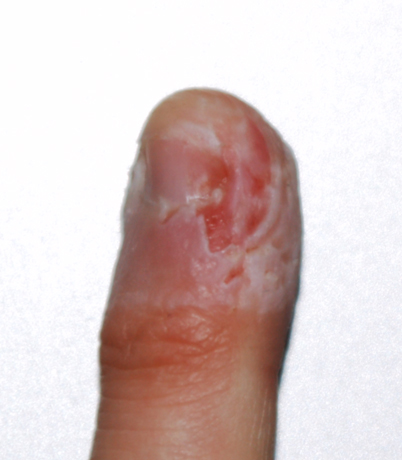
Compulsion towards biting one's own skin
| Field | Value |
|---|---|
| image | Dermatophagia.jpg |
| caption | Extreme nail biting / biting of skin as the result of obsessive compulsive disorder (OCD) or another condition leading to self mutilating behavior such as autistic spectrum disorders (as is the case in this example) or Lesch-Nyhan Syndrome |
| specialty | psychiatry |
| types | OCD |
Dermatophagia () or dermatodaxia () is a compulsion disorder of gnawing or biting one's own skin, most commonly at the fingers. This action can either be conscious or unconscious and it is considered to be a type of pica. Those affected with dermatophagia typically bite the skin around the nails, leading to bleeding and discoloration over time. Some people also bite on their skin on their finger knuckles which can lead to pain and bleeding just by moving their fingers.
In herpetology, dermatophagia is used to correctly describe the act in which amphibians and reptiles eat the skin they shed, but this is not what occurs in humans. Those diagnosed with this disorder do not develop wounds on the bitten areas of their hands or lose any skin. Instead, they experience a thickening of the skin being repeatedly bitten. Contemporary research suggests a link between impulse-control disorders and obsessive–compulsive disorders, and this was addressed in the DSM-5 when dermatophagia and other related disorders were classified as 'other specified obsessive-compulsive related disorders' and are given the specification of body focused repetitive behavior.
Behavior

People with dermatophagia chew their skin out of compulsion, and can do so on a variety of places on their body. Those with dermatophagia typically chew the skin surrounding their fingernails and joints. They also chew on the bottom of their feet/toes, inside of their mouth, cheeks, and/or lips, causing blisters in and outside of the mouth. If the behavior is left unchecked for an extended period, calluses may start to develop where most of the biting is done.
Skin chewing can be bolstered by times of apprehension and other unpleasant events. People who have dermatophagia can also be prone to infection as when they bite their fingers so frequently, they make themselves vulnerable to bacteria seeping in and causing infection. Dermatophagia can be considered a "sister" disorder to trichophagia, which involves compulsively biting and eating one's hair.
Management
Habit reversal training and variants thereof, like decoupling, are recommended for body-focused repetitive behaviors, including dermatophagia. Other techniques derived from cognitive-behavioral therapy recommend replacing things that do not actually dissolve with edibles that would. Moreover, it has been suggested to delay the urge by chewing gum, or on a soft drink straw.
Management in children with disabilities
There is no therapy known to effectively treat dermatophagia, but there have been attempts at stopping those affected from being able to chew on their skin. One notable method that is currently in development is focused on in curbing dermatophagia in children with cerebral palsy. This method is known as the PLAY (Protecting Little and Adolescent hands) hands protective glove. This method of intervention involves small, non-invasive plastic brackets being placed around the affected fingers. These brackets do not hinder movement or tactile feedback, and they are constructed from non-toxic durable plastic that can withstand the force of chewing. Presently PLAY hands protective gloves exist in concept and prototype only, but this intervention method could improve the quality of life of those with CP-induced dermatophagia.
References
References
- (2009). "Onychophagia as a Spectrum of Obsessive-compulsive Disorder". Acta Dermato-Venereologica.
- Brown, Jeremy. (January 20, 2025). "Skin Picking in Autism: Causes and Management".
- (2022). "Lesch Nyhan Syndrome". StatPearls [Internet].
- (August 2005). "Dermatophagia or dermatodaxia?". Journal of the American Academy of Dermatology.
- (January 1997). "Dermatophagia: 'wolf-biter'". Cutis.
- Weldon, Paul (June 1993). "A Survey of Shed Skin-Eating in Amphibians and Reptiles". ''Journal of Herpetology''. 27: 219–228.
- Grant. (January 2010). "Impulse-control disorders in children and adolescents with obsessive-compulsive disorder.". Psychiatry Res.
- American Psychiatric Association. (2016). "Supplement to Diagnostic and Statistical Manual of Mental Disorders".
- (2003). "Dermatophagia Simulating Callosities". Dermatology and Psychosomatics.
- Huzar, Timothy. (May 7, 2025). "Dermatophagia: Symptoms, causes, and treatment".
- (July 20, 2018). "Tragic Teenage Boy Presenting With Calluses Due to Dermatophagia".
- (August 2011). "Pediatric Psychocutaneous Disorders". American Journal of Clinical Dermatology.
- "Dermatophagia". FingerFreak.com.
- (2020). "Habit reversal therapy in the management of body focused repetitive behavior disorders". Dermatologic Therapy.
- (February 19, 2024). "Exploring Dermatophagia: Examining Its Causes, Impact, and Solutions".
- (May 22, 2024). "Understanding Dermathopagia: Causes, Risk factors, Symptoms, Treatment and more".
- (September 18, 2016). "Play Hands Protective Gloves: Technical Note on Design and Concept". Technology & Innovation.
This article was imported from Wikipedia and is available under the Creative Commons Attribution-ShareAlike 4.0 License. Content has been adapted to SurfDoc format. Original contributors can be found on the article history page.
Ask Mako anything about Dermatophagia — get instant answers, deeper analysis, and related topics.
Research with MakoFree with your Surf account
Create a free account to save articles, ask Mako questions, and organize your research.
Sign up freeThis content may have been generated or modified by AI. CloudSurf Software LLC is not responsible for the accuracy, completeness, or reliability of AI-generated content. Always verify important information from primary sources.
Report