From Surf Wiki (app.surf) — the open knowledge base
Dera Ismail Khan Tehsil
| Field | Value | |
|---|---|---|
| official_name | Dera Ismail Khan Tehsil | |
| native_name | {{nq | تحصیل ڈیره اسماعیل خان}} |
| {{script/Arabic | دېره اسماعيل خان تحصیل}} | |
| native_name_lang | ur | |
| settlement_type | Tehsil | |
| blank_emblem_size | 100px | |
| blank_emblem_type | Logo | |
| mapsize | 280px | |
| map_caption1 | Location within Pakistan | |
| subdivision_type | Country | |
| subdivision_name | Pakistan | |
| subdivision_type1 | Province | |
| subdivision_name1 | Khyber Pakhtunkhwa | |
| subdivision_type2 | District | |
| subdivision_name2 | Dera Ismail Khan | |
| seat | Dera Ismail Khan | |
| population_total | 724,895 | |
| population_urban | 217,457 | |
| population_rural | 507,438 | |
| population_as_of | 2017 | |
| population_footnotes | ||
| blank_name_sec1 | Number of towns | |
| blank_info_sec1 | 1 | |
| blank_name_sec2 | Number of Union Councils | |
| blank_info_sec2 | 21 | |
| timezone1 | PST | |
| utc_offset1 | +5 |
Dera Ismail Khan Tehsil is a tehsil located in Dera Ismail Khan District, Khyber Pakhtunkhwa, Pakistan.
Administration
The tehsil is administratively subdivided into 21 Union Councils, four of which form the headquarters - Dera Ismail Khan (DI Khan).
History

It is named after Baloch mercenary Ismail Khan, son of Malik Sohrab Dodai, who laid the foundation of the area.
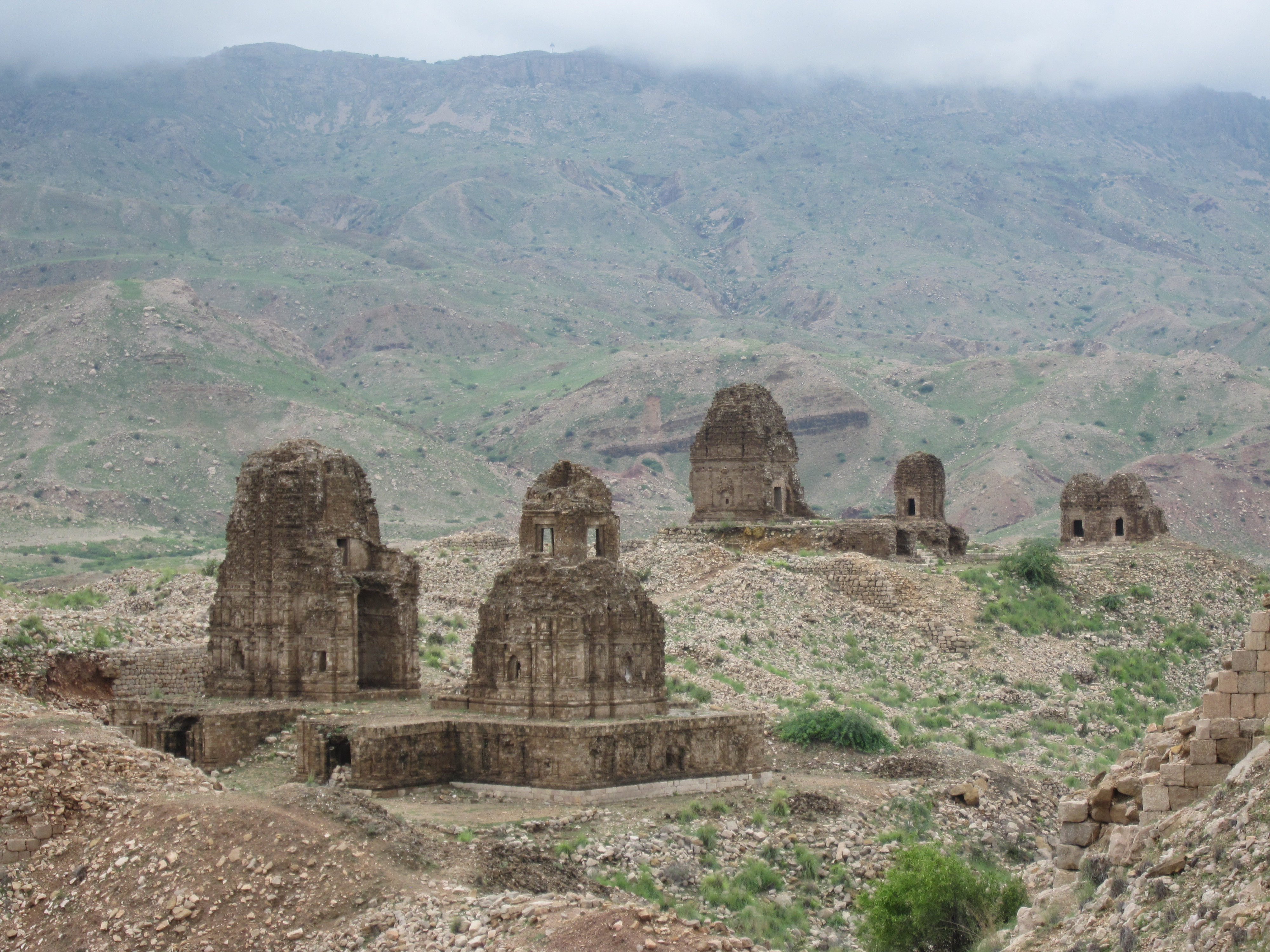
The Dera Ismail Khan Tehsil is littered with ruins from ancient civilizations. DI Khan is home to the collection of Hindu ruins at two separate sites 20 miles apart, jointly known as Kafir Kot.
The region came under the influence of the Nanda Empire of ancient India from 300 BCE, and with the rise of Chandragupta Maurya, the region came under the complete control of the Mauryan Empire. Afterward, the region was briefly and nominally controlled by the Shunga Empire. However, with the decline of the Shungas, the region passed to local Hindu and Buddhist rulers, and interrupted by foreign rulers. Many of these foreign rulers, like the Indo-Parthians, Sakas, and Kushans converted to Hinduism and Buddhism, and promoted these Indian religions throughout Central and South Asia. The region reached its height under the Buddhist ruler Kanishka the Great. After the fall of the Kushans, the region came under the control of the Gupta Empire of ancient India. During the period, Hindu and Buddhist art and architecture flourished in the area.
With the decline of the imperial Guptas, the Hindu Shahis came to rule the area. The Hindu Shahis built two massive forts in the northern edges of Dera Ismail Khan. The forts were later renamed as "Kafirkots" (forts of the infidel). These Hindu Shahi forts were known for high towers and steep defensive walls. The Hindus also built many Hindu temples around the area, however, much of them are now in rubble. The Hindu Shahis remained in control of the area until their defeat by the Turkic Muslim army of Ghaznavids.
The Tehsil is part of what was historically territory inhabited by the Baluch people during medieval India, who were invited to settle the region by Shah Husseyn, of the Langah Sultanate of Multan. These Baluch settlers were displaced by, or assimilated into, later waves of Pashtun settlement.
During British rule in colonial India, Dera Ismail Khan was the chief tehsil of the old Dera Ismail Khan District. The population was 144,337, according to the 1901 census, an increase of almost 11,000 since the 1891 census (133,809) - it was headquartered at the town of Dera Ismail Khan and contained 250 villages.
Politics
Dera Ismail Khan is represented in the National Assembly of Pakistan through two seats: NA-24 (DI Khan) and NA-25 (DI Khan cum Tank). The incumbent on these seats is Moulana Fazul Rehman of JUI-F from NA-24 and Dawer Khan Kundi of PTI from NA-25.
Traditionally, Dera Ismail Khan politics has been dominated by Jamiat Ullema Islam because of the charismatic and dynamic personality of Maulana Mufti Mahmood. After his death his son Fazlur Rehman became the chairman of JUI-F.
The people of D I Khan feel let down by the two dominant parties PPP and JUI-F as they have not done any significant efforts to improve the quality of life, build the city infrastructure or create jobs. People want change in the status quo which has provided a room for new leadership to emerge under the banner of Pakistan Tehrike Insaf (PTI). PTI has quickly gained ground in the city as many notables including Faqeer Jamshed Ahmed, Abdul Quayyum Khan Kundi, Khalid Awan, Humayon Khan Gandapur has joined the party. The youth wing of PTI in the leadership of Irfan Mallick has established district level wings to reach out to the voters. It is expected that in the next elections PTI will emerge as a leading party in the city. {}
References
References
- (2018-01-03). "DISTRICT AND TEHSIL LEVEL POPULATION SUMMARY WITH REGION BREAKUP: KHYBER PAKHTUNKHWA". [[Pakistan Bureau of Statistics]].
- link. (February 9, 2012)
- (April 20, 2010). "Baloch tribes of the Saraiki Waseb – by Farooq Miana".
- (1871). "The District of Dera Ismail Khan, Trans-Indus".
- (1971). "Ancient Pakistan". Chairman, Department of Archaeology, University of Peshawar..
- (1971). "Ancient Pakistan". Chairman, Department of Archaeology, University of Peshawar..
- [https://dsal.uchicago.edu/reference/gazetteer/pager.html?objectid=DS405.1.I34_V11_274.gif Dera Ismail Khān Tahsīl - Imperial Gazetteer of India, v. 11, p. 268.]
This article was imported from Wikipedia and is available under the Creative Commons Attribution-ShareAlike 4.0 License. Content has been adapted to SurfDoc format. Original contributors can be found on the article history page.
Ask Mako anything about Dera Ismail Khan Tehsil — get instant answers, deeper analysis, and related topics.
Research with MakoFree with your Surf account
Create a free account to save articles, ask Mako questions, and organize your research.
Sign up freeThis content may have been generated or modified by AI. CloudSurf Software LLC is not responsible for the accuracy, completeness, or reliability of AI-generated content. Always verify important information from primary sources.
Report