From Surf Wiki (app.surf) — the open knowledge base
Der (Sumer)
Ancient Sumerian city-state
.jpg)
Ancient Sumerian city-state
| Field | Value |
|---|---|
| name | Der |
| alternate_name | Tell Aqar |
| image | |
| map_type | Iraq |
| relief | yes |
| coordinates | |
| map_size | 200 |
| location | Iraq |
| type | settlement |
| epochs | Early Dynastic thru Neo-Assyrian |
| condition | Ruined |
| ownership | Public |
| public_access | Yes |
Der (Sumerian: 𒌷𒂦𒀭𒆠 uruBAD3.ANki; Akkadian: 𒌷𒂦𒀭𒆠 uruBAD3.ANki or urude-e-ru(ki)) was a Sumerian city-state at the site of modern Tell Aqar near al-Badra in Iraq's Wasit Governorate. It was east of the Tigris River on the border between Sumer and Elam. At one time it was thought that it might have been ancient Durum (Sumerian: uruBAD3ki) but more recent scholarship has rebutted that.
The principal god of Der was Ištaran. In the 1st millennium BC, he was also referred to as Anu rabû ("Great Anu") in Akkadian. The name of his temple at Der was Edimgalkalama.
History
Early Bronze
Der was occupied from the Early Dynastic period through Neo-Assyrian times. The local deity of the city was named Ishtaran, represented on Earth by his minister, the snake god Nirah.
Ur III period
In the late 3rd millennium, during the reign of Sulgi of the Third Dynasty of Ur, Der was mentioned twice. The Sulgi year name 11 was named "Year Ishtaran of Der was brought into his temple", and year 21 was named "Year Der was destroyed". During the time of Amar-Sin, when the king launched a long military campaign against Huhnuri, prince Shu-Sin, crown prince, left his post in Der to return and hold Ur.
Middle Bronze
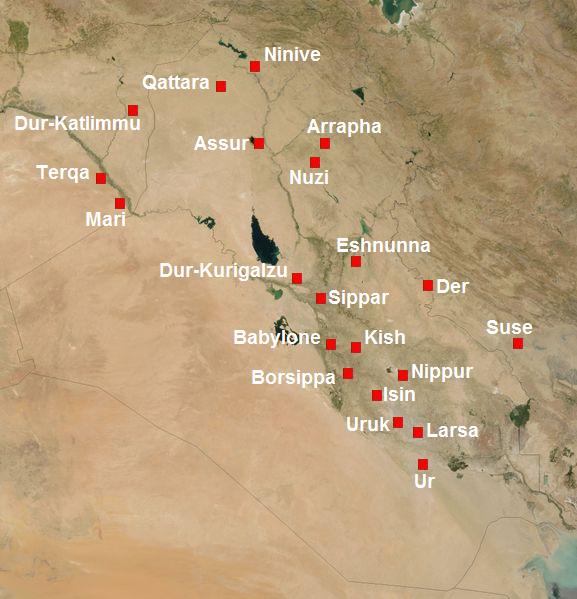
In the second millennium, Der was mentioned in a tablet discovered at Mari sent by Yarim-Lim I of Yamhad; the tablet includes a reminder to Yasub-Yahad king of Der about the military help given to him for fifteen years by Yarim-Lim, followed by a declaration of war against the city in retaliation for what Yarim-Lim described as evil deeds committed by Yasub-Yahad. Rim-Sin I of Larsa reported destroying Der in his 20th year. Ammi-Ditana of Babylon also recorded destroying the city wall of Der in his 37th year, that he said had been built earlier by Damqi-ilishu of the Sealand Dynasty.
In an inscription little known early Old Babylonian period ruler of Der, Ilum-muttabbil, claimed defeating the armies of Anshan, Elam, and Simaski, in alliance with Marhaši.
Iron Age
In 720 BC the Assyrian king Sargon II moved against Elam, but the Assyrian host was defeated near Der by the combined army of king Humban-Nikash I of Elam and king Marduk-apla-iddina II of Babylon. Following the Persian conquest of Babylon in 539 BC, the Cyrus Cylinder mentions repatriating the people and restoring the sanctuary of the god of Der, among other cities.
Archaeology
While it appears that no excavation has occurred at Der, several notable objects have been discovered nearby, including a kudurru (discovered in Sippar) which confirmed the name of the site. The site itself has been heavily damaged by water over the centuries and was considered not worth excavating.
List of rulers
The following list should not be considered complete:
| Portrait or inscription | Ruler | Approx. date and length of reign (Middle Chronology) | Comments, notes, and references for mentions | Portrait or inscription | Ruler | Approx. date and length of reign (MC) | Comments, notes, and references for mentions | Portrait or inscription | Ruler | Approx. date and length of reign (MC) | Comments, notes, and references for mentions | Portrait or inscription | Ruler | Approx. date and length of reign (MC) | Comments, notes, and references for mentions | Portrait or inscription | Ruler | Approx. date and length of reign (MC) | Comments, notes, and references for mentions | Portrait or inscription | Ruler | Approx. date and length of reign (MC) | Comments, notes, and references for mentions | |
|---|---|---|---|---|---|---|---|---|---|---|---|---|---|---|---|---|---|---|---|---|---|---|---|---|
| Akkadian period () | ||||||||||||||||||||||||
| Unknown | ||||||||||||||||||||||||
| Ur III period () | ||||||||||||||||||||||||
| Ursin | ||||||||||||||||||||||||
| Unknown | ||||||||||||||||||||||||
| Isin-Larsa period () | ||||||||||||||||||||||||
| Anum-muttabil | ||||||||||||||||||||||||
| Manana | ||||||||||||||||||||||||
| Naqimum | Uncertain | |||||||||||||||||||||||
| Sumu-iamutbala | ||||||||||||||||||||||||
| Manium | ||||||||||||||||||||||||
| Old Babylonian period () | ||||||||||||||||||||||||
| [[File:Foundation figurine of Warad-Sin for Inanna at Zabalam.jpg | 120px]] | Warad-Sin | ||||||||||||||||||||||
| (12 years) | ||||||||||||||||||||||||
| [[File:Rim-Sin foundation figurine, 1822-1763 BC - Oriental Institute Museum, University of Chicago - DSC07168.JPG | 120px]] | Rim-Sin I | ||||||||||||||||||||||
| (60 years) | ||||||||||||||||||||||||
| Yasub-Yahad | ||||||||||||||||||||||||
| [[File:Record of the sale of land in the reign of Samsu-Iluna.jpg | 120px]] | Rim-Sin II | ||||||||||||||||||||||
| Middle Elamite period () | ||||||||||||||||||||||||
| Lakti-Shikhu | ||||||||||||||||||||||||
| Neo-Elamite period () | ||||||||||||||||||||||||
| Unknown | ||||||||||||||||||||||||
| Tandaia | ||||||||||||||||||||||||
| [[File:Tammaritu (behind the bow), son of Urtak, leading Assyrian troops against Teumman, king of Elam.jpg | 120px]] | Tammaritu I |
Notes
References
- R., Borger. (1978). "Assyrisch-babylonische Zeichenliste".
- Katrien De Graef, Another Brick In the Wall: Durum In the Old-Elamite Susa, Akkadica, vol. 128, pp. 85-98, 2007
- Michalowski, Piotr, "Of Bears and Men: Thoughts on the End of Šulgi’s Reign and on the Ensuing Succession", Literature as Politics, Politics as Literature: Essays on the Ancient Near East in Honor of Peter Machinist, edited by David S. Vanderhooft and Abraham Winitzer, University Park, USA: Penn State University Press, pp. 285-320, 2013
- Michalowski, P., "Dūrum and Uruk During the Ur III Period", Mesopotamia 12, pp. 83–96. 1977
- [https://epub.ub.uni-muenchen.de/116650/1/0RINAP5_3_final.pdf]Novotny, Jamie, Joshua Jeffers, and Grant Frame, "The royal inscriptions of Ashurbanipal (668–631 BC), Aššur-etel-ilāni (630–627 BC) and Sîn-šarra-iškun (626–612 BC), kings of Assyria, Part 3", Eisenbrauns/Penn State University Press, 2023. P. 5, 93
- "Statue from Der".
- Lafont, Bertrand. "Game of Thrones: the Years when Šu-Sin Succeeded Amar-Suen in the Kingdom of Ur". The First Ninety Years: A Sumerian Celebration in Honor of Miguel Civil, edited by Lluís Feliu, Fumi Karahashi and Gonzalo Rubio, Berlin, Boston: De Gruyter, 2017, pp. 189-204
- Jack M. Sasson. (1969). "The Military Establishments at Mari".
- [https://findit.library.yale.edu/images_layout/view?parentoid=15763246&increment=40]D. O. Edzard, "Konigsinscriften Des Iraq Museums. II", Sumer 15, pp. 19-26, 1959
- Hayim Tadmor, The Campaigns of Sargon II of Assur: A Chronological-Historical Study, Journal of Cuneiform Studies, vol. 12, no. 1, pp. 22-40, 1958,
- [https://www.britishmuseum.org/research/search_the_collection_database/search_object_details.aspx?objectid=468579&partid=1] Kassite kudurru at the British Museum
- Sidney Smith, An Egyptian in Babylonia, The [[Journal of Egyptian Archaeology]], vol. 18, no. 1/2, pp. 28-32, 1932
This article was imported from Wikipedia and is available under the Creative Commons Attribution-ShareAlike 4.0 License. Content has been adapted to SurfDoc format. Original contributors can be found on the article history page.
Ask Mako anything about Der (Sumer) — get instant answers, deeper analysis, and related topics.
Research with MakoFree with your Surf account
Create a free account to save articles, ask Mako questions, and organize your research.
Sign up freeThis content may have been generated or modified by AI. CloudSurf Software LLC is not responsible for the accuracy, completeness, or reliability of AI-generated content. Always verify important information from primary sources.
Report