From Surf Wiki (app.surf) — the open knowledge base
Demographics of Ukraine
none
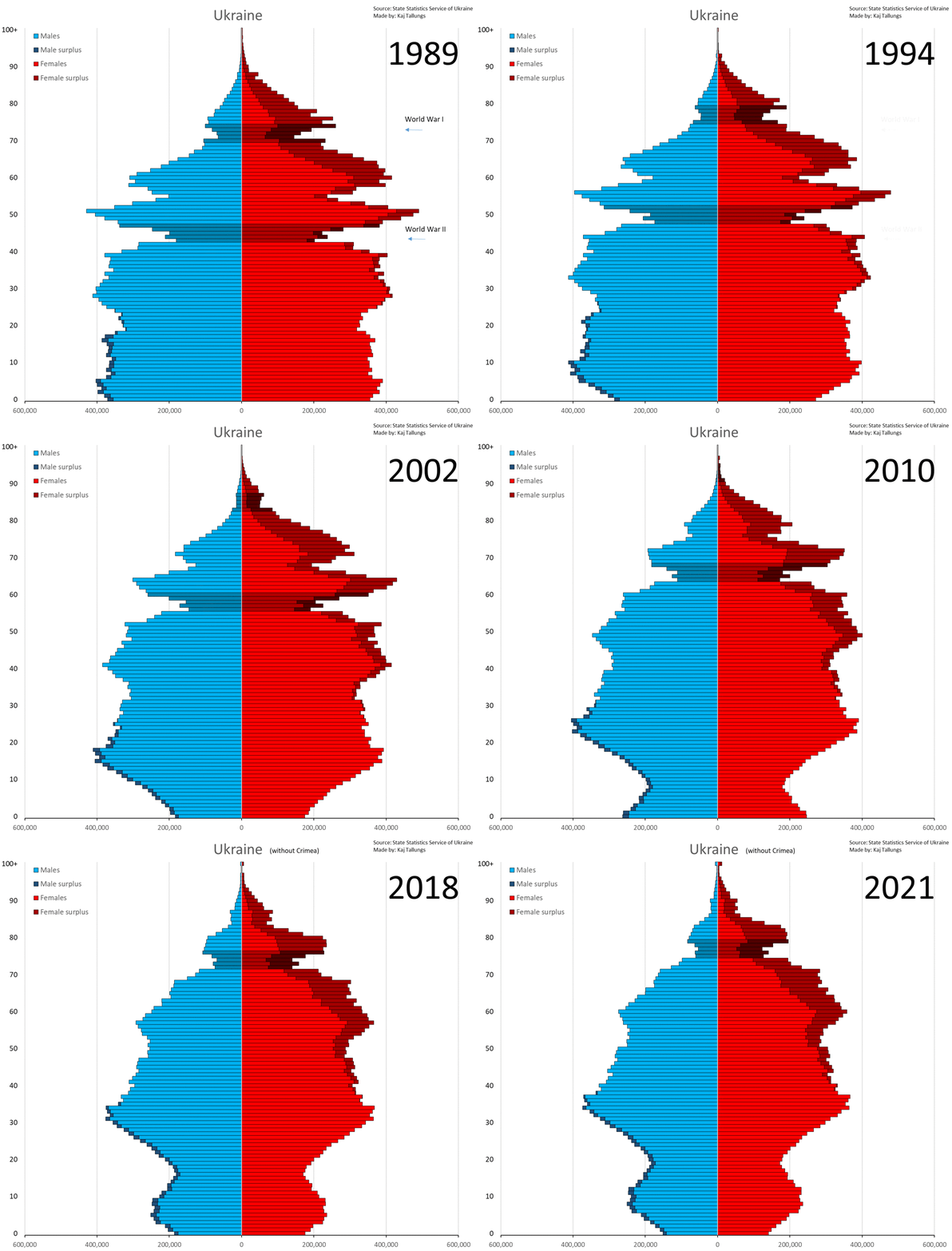
none
| Field | Value |
|---|---|
| place | Ukraine |
| image | Ukraine2024.jpg |
| image_size | 400 |
| caption | Ukraine's population pyramid, 2024 |
| size_of_population | Including Russian occupied territory in 2022: 41,130,432 (State Statistics Service of Ukraine) |
| Excluding Russian occupied territory: 36,744,636 (UN Department of Economic and Social Affairs) | |
| 33,443,000 estimate in 2024 (International Monetary Fund) | |
| growth | −6.6 people/1,000 population (2023) |
| birth | 5.4 births/1,000 population (2023) |
| death | 15.2 deaths/1,000 population (2023) |
| life | 71.76 years (2018) |
| life_male | 66.69 years |
| life_female | 76.72 years |
| infant_mortality | 7.0 deaths/1,000 infants (2019) |
| fertility | 1.26 children born/woman (2022) |
| net_migration | −5.4 migrant(s)/1,000 population (2015) |
| age_0-14_years | 15.4% |
| age_15-64_years | 68.4% |
| age_65_years | 16.2% (2017) |
| total_mf_ratio | 0.84 male(s)/female (2008 est.) |
| sr_at_birth | 1.06 male(s)/female |
| sr_under_15 | 1.06 male(s)/female |
| sr_15-64_years | 0.92 male(s)/female |
| sr_65_years_over | 0.51 male(s)/female |
| nation | noun: Ukrainian(s) adjective: Ukrainian |
| major_ethnic | Ukrainians (77.8%) 2001 |
| minor_ethnic | Russians (17.3%) 2001, Other (4.9%) 2001 |
| official | Ukrainian |
| spoken | Ukrainian, Russian, others |
Excluding Russian occupied territory: 36,744,636 (UN Department of Economic and Social Affairs) 33,443,000 estimate in 2024 (International Monetary Fund) | age_0-14_years = 15.4% | age_15-64_years = 68.4% | sr_15-64_years = 0.92 male(s)/female

According to the United Nations, Ukraine has a population of 37.9 million as of 2024.
In July 2023, Reuters reported that due to refugee outflows, the population of Ukrainian-controlled areas may have decreased to 28 million, a steep decline from Ukraine's 2020 population of almost 42 million.
This drop is in large part due to the ongoing Ukrainian refugee crisis and loss of territory caused by Russia's invasion of Ukraine, which resulted in mass emigration from the Ukrainian people. The demographic decline is also affected by a very low birth rate and a high death rate. The most recent (and only) census of post-Soviet Ukraine occurred in 2001, and much of the information presented is potentially inaccurate or outdated.
Since 2021, the Ukrainian fertility rate has fallen below 1.3, and is now one of the lowest in the world. By 2024, it was one of the ten lowest in the world, falling under 1.00.
History
Historical population
There were roughly four million Ukrainians at the end of the 17th century. However, population estimates from this period are approximate and may vary depending on methodology and available records.
The estimated population figures for Ukraine in the early 20th century are based on various sources. The 1931 population statistics were estimated by Professor Zenon Kuzelia, as an official census was not conducted in Soviet Ukraine during that year.
Population change
The following graph represents Ukraine's population trends since the early 20th century.
Data for 1926–2001 is based on official Soviet and Ukrainian censuses. The 2014 and 2020 figures are adjusted estimates, excluding Crimea and occupied territories in Donbas.
Natural change and migration
The natural population change, migration trends, and fertility rates are shown below:
Natural population change and migration data are sourced from the Ukrainian State Statistics Service. The fertility rate figures are derived from United Nations estimates.
Notes
- The population estimate for the 17th century is approximate and based on historical demographic models.
- The 1931 population figure is not from an official census but from an academic estimate.
- Post-2014 population figures exclude Crimea and parts of Donetsk and Luhansk regions under occupation.
Famines and migration
Demographic impact of the Holodomor and World War II
The Ukrainian famines of the 1930s and the devastation of World War II created a demographic catastrophe for Ukraine. In 1933, life expectancy at birth dropped to as low as 10 years for females and 7 years for males. During 1941–1944, life expectancy plateaued around 25 years for females and 15 years for males.
According to The Oxford Companion to World War II, over 7 million Ukrainians — more than one-sixth of the pre-war population — were killed during the conflict.
Migration trends in independent Ukraine
Following Ukraine's independence, significant migration occurred:
- 1991–1992: Over 1 million people moved into Ukraine, primarily from other former Soviet republics.
- 1991–2004: A total of 2.2 million immigrants arrived in Ukraine, with 2 million of these coming from other former Soviet Union states.
- Between 1991 and 2004, 2.5 million emigrated from Ukraine, with 1.9 million migrating to other former Soviet Union republics.
As of 2015, immigrants made up an estimated 11.4% of the total population of Ukraine, equating to 4.8 million people.
Ukrainian diaspora
In 2006, there were approximately 1.2 million Canadians of Ukrainian descent, giving Canada the third-largest Ukrainian population worldwide, behind Ukraine and Russia. Significant Ukrainian diaspora communities also exist in Poland, the United States, Brazil, Kazakhstan, and Argentina.
Recent migration trends and economic impact
Since about 2015, a growing number of Ukrainians have worked in the European Union, particularly in Poland. According to Eurostat, 662,000 Ukrainians received EU residence permits in 2017, with 585,439 of these residing in Poland.
World Bank statistics from 2019 revealed that remittances sent back to Ukraine had approximately doubled from 2015 to 2018, making up about 4% of Ukraine's GDP.
Ukraine records only citizens who apply for foreign citizenship, not those who seek foreign residency.
Migration during the Russian invasion of Ukraine
With the Russian invasion of Ukraine, approximately 8 million people fled Ukraine during the ensuing Ukrainian refugee crisis, Europe's largest refugee crisis since World War II. Most refugees sought asylum in Central Europe.
Population Decline

According to estimates by the State Statistics Service of Ukraine, the population of Ukraine (excluding Crimea) on 1 May 2021 was 41,442,615.
The country's population has been declining since the 1990s because of a high emigration rate, coupled with high death rates and low birth rates. The population has been shrinking by an average of over 300,000 annually since 1993.
In 2007, the country's rate of population decline was the fourth highest in the world. But between 2008 and 2010, over 1.5 million children were born in Ukraine, compared with fewer than 1.2 million in 1999–2001. In 2008, Ukraine posted record-breaking birth rates not seen since its 1991 independence. Infant mortality rates also dropped from 10.4 deaths to 8.3 per 1,000 children under one year of age, a lower rate than in 153 other countries.
In 2019, the Ukrainian government conducted an electronic census using multiple sources, including mobile phone and pension data, and estimated that Ukraine's population, excluding Crimea and parts of the Donbas, to be 37.3 million. About 20 million were of active working age.
The Russian invasion considerably deepened the country's demographic crisis due to the military occupation and forced annexation of multiple oblasts, numerous civilians fleeing the country, and high casualties. A July 2023 study by the Vienna Institute for International Economic Studies stated the following:"Regardless of how long the war lasts and whether or not there is further military escalation, Ukraine is unlikely to recover demographically from the consequences of the war. Even in 2040 it will have only about 35 million inhabitants, around 20% fewer than before the war (2021: 42.8 million) and the decline in the working-age population is likely to be the most severe and far-reaching."The study examined different scenarios, from a "best case", in which the war ended in 2023 without significant further escalation, to a "worst case", ending in 2025 after further escalation. Flight from war particularly affects the southern and eastern regions and especially educated women of child-bearing age and their children. With an estimate of more than 20% of refugees not returning, the author of the study Maryna Tverdostup concludes that this will lead to long-term shrinking and will significantly impair the conditions for reconstruction.
Fertility and natalist policies
As of 2020, the birth rate in Ukraine was 8.1 live births/1,000 population, and the death rate 14.7 deaths/1,000 population.
Lowest-low fertility, defined as total fertility below 1.3, is being encountered across Europe, attributed by many to postponement of the initiation of childbearing. Ukraine, where total fertility (1.1 in 2001), was one of the world's lowest, shows that there is more than one pathway to lowest-low fertility. Although Ukraine underwent immense political and economic transformations from 1991 to 2004, it maintained a young age at first birth and nearly universal childbearing. Analysis of official national statistics and the Ukrainian Reproductive Health Survey show that fertility declined to very low levels without a transition to a later pattern of childbearing. Findings from focus group interviews suggest that the early fertility pattern was explained by the persistence of traditional norms for childbearing and the roles of men and women, concerns about medical complications and infertility at a later age, and the link between early fertility and early marriage. Ukraine subsequently has one of the oldest populations in the world, with an average age of 40.8 years.
To help mitigate population decline, the government increased child support payments, providing one-time payments of 12,250 hryvnias for the first child, 25,000 hryvnias for the second and 50,000 hryvnias for the third and fourth, along with monthly payments of 154 hryvnias per child. The demographic trend showed signs of improvement as the birth rate grew steadily from 2001 to 2013. Five of the country's 24 provinces showed net population growth over the first nine months of 2007, and nationwide population decline showed signs of stabilization. In 2007, the highest birth rates were in the western oblasts. In 2008, Ukraine emerged from lowest-low fertility, and the upward trend continued to 2012, with population decline slowing year after year. If early 2010s trends had persisted, the population could have returned to positive growth later that decade. Similar trends occurred in Russia and Belarus, which experienced population growth in the 2010s.
In 2014, the strong drop in births returned, and 2018 saw fewer than half the number of births of 1989 (see demographic tables). In 2020, the number of births decreased to 293,000, reaching rates not seen in a quarter century.
Mass emigration and property destruction caused by the Russian invasion led Ukraine's birth to drop still further: it was 28% lower in the first half of 2023 than the first half of 2021. However, a small but meaningful increase in births may have occurred, with a potential fertility rate increase to 1.60 children per woman, higher than the 2012 peak of 1.53.
Population


Life expectancy

- total population: 71.37 years
- male: 66.34 years
- female: 76.22 years (2013 official)
Average life expectancy at birth of the total population.
| Period | Life expectancy in |
|---|---|
| Years | |
| 1950–1955 | 61.83 |
| 1955–1960 | 67.11 |
| 1960–1965 | 69.69 |
| 1965–1970 | 70.66 |
| 1970–1975 | 70.57 |
| 1975–1980 | 69.65 |
| 1980–1985 | 69.15 |
| 1985–1990 | 70.55 |
| 1990–1995 | 68.72 |
| 1995–2000 | 67.36 |
| 2000–2005 | 67.46 |
| 2005–2010 | 67.89 |
| 2010–2015 | 71.12 |

]]
Total fertility rate
- 1.12 children born/woman (2000)
- 1.44 children born/woman (2010)
- 1.22 children born/women (2020)
Vital statistics
Notable events in Ukrainian demographics:
- 1932–33 – Holodomor in Ukrainian Soviet Socialist Republic
- 1939 – Addition of western oblasts to Ukraine with the end of the Second Polish Republic due to German–Soviet invasion of Poland at the beginning of Second World War
- 1991 – Independence from the USSR
- 2004–2005 – Orange Revolution
- 2014 – Annexation of Crimea by the Russian Federation
- 2022 – Russian invasion of Ukraine
Ukrainian provinces of the Russian Empire (1900-1914)
The figures below refer to the nine governorates of the Russian Empire (Volhynia, Katerynoslav, Kyiv, Podilia, Poltava, Tauryda, Kharkiv, Kherson and Chernihiv) with a Ukrainian majority. Note: This table uses the sticky table format to make scrolling easier. If you prefer, you can disable it.
| Average population | Live births | Deaths | Natural change | Crude birth rate (per 1,000) | Crude death rate (per 1,000) | Natural change (per 1,000) | Total fertility rates |
|---|---|---|---|---|---|---|---|
| 1900 | 24,969,000 | 1,203,334 | 660,723 | 542,611 | 48.2 | 26.5 | 21.7 |
| 1901 | 25,505,000 | 1,123,519 | 657,883 | 465,636 | 44.1 | 25.8 | 18.3 |
| 1902 | 25,935,000 | 1,207,512 | 681,580 | 525,932 | 46.6 | 26.3 | 20.3 |
| 1903 | 26,449,000 | 1,188,404 | 663,067 | 525,337 | 44.9 | 25.1 | 19.9 |
| 1904 | 26,961,000 | 1,228,116 | 682,068 | 546,048 | 45.6 | 25.3 | 20.3 |
| 1905 | 27,210,000 | 1,160,308 | 779,107 | 381,201 | 41.1 | 27.6 | 14.0 |
| 1906 | 27,949,000 | 1,225,951 | 724,045 | 501,906 | 43.9 | 25.9 | 18.0 |
| 1907 | 28,418,000 | 1,279,027 | 701,451 | 577,576 | 45.0 | 24.7 | 20.3 |
| 1908 | 29,069,000 | 1,232,862 | 692,624 | 540,238 | 42.4 | 23.8 | 18.6 |
| 1909 | 29,700,000 | 1,226,155 | 744,818 | 481,337 | 41.3 | 25.1 | 16.2 |
| 1910 | 30,297,000 | 1,225,658 | 839,491 | 386,167 | 40.5 | 27.7 | 12.7 |
| 1911 | 30,858,000 | 1,240,985 | 670,742 | 570,243 | 40.2 | 21.7 | 18.5 |
| 1912 | 30,580,000 | 1,245,358 | 654,157 | 591,201 | 40.7 | 21.4 | 19.3 |
| 1913 | 31,142,000 | 1,222,277 | 715,924 | 506,353 | 39.2 | 23.0 | 16.3 |
| 1914 | 30,973,000 | 1,240,114 | 716,875 | 523,239 | 40.0 | 23.1 | 16.9 |
Between WWI and WWII (1924-1940)
Note: This table uses the sticky table format to make scrolling easier. If you prefer, you can disable it.
| title=The Crisis of the 1930s | url=https://www.demogr.mpg.de/books/drm/009/2.pdf}} | Average population | Live births | Deaths | Natural change | Crude birth rate (per 1,000) | Crude death rate (per 1,000) | Natural change (per 1,000) | Fertility rates | Life Expectancy (male) | Life Expectancy (female) |
|---|---|---|---|---|---|---|---|---|---|---|---|
| 1924 | 27,400,000 | 1,211,000 | 484,880 | 726,120 | 43.3 | 17.3 | 25.9 | ||||
| 1925 | 28,000,000 | 1,246,000 | 531,819 | 714,181 | 43.4 | 18.5 | 24.9 | 5.39 | |||
| 1926 | 28,700,000 | 1,258,000 | 518,656 | 739,344 | 42.5 | 17.5 | 25.0 | ||||
| 1927 | 29,589,000 | 1,228,000 | 579,000 | 649,000 | 40.6 | 19.1 | 21.5 | 43.3 | 46.8 | ||
| 1928 | 30,251,000 | 1,178,000 | 575,000 | 603,000 | 38.1 | 18.6 | 19.5 | 44.6 | 48.7 | ||
| 1929 | 30,894,000 | 1,115,000 | 585,000 | 530,000 | 35.5 | 18.6 | 16.9 | 42.8 | 46.7 | ||
| 1930 | 31,436,000 | 1,053,000 | 580,000 | 473,000 | 33.0 | 18.2 | 14.8 | 42.5 | 46.9 | ||
| 1931 | 31,882,000 | 1,001,000 | 553,000 | 448,000 | 31.0 | 17.1 | 13.9 | 43.5 | 47.9 | ||
| 1932 | 32,342,000 | 801,000 | 746,000 | 55,000 | 24.7 | 23.0 | 1.7 | 34.5 | 39.4 | ||
| 1933 | 32,456,000 | 564,000 | 2,104,000 | −1,540,000 | 17.4 | 64.8 | −47.4 | ||||
| 1934 | 30,916,000 | 562,000 | 508,000 | 54,000 | 18.1 | 16.4 | 1.7 | 37.6 | 42.1 | ||
| 1935 | 31,006,000 | 770,000 | 381,000 | 389,000 | 24.5 | 12.1 | 12.4 | 46.3 | 52.7 | ||
| 1936 | 31,423,000 | 905,000 | 403,000 | 502,000 | 28.3 | 12.6 | 15.7 | 47.6 | 53.0 | ||
| 1937 | 31,957,000 | 1,227,000 | 450,000 | 777,000 | 37.5 | 13.7 | 23.7 | 46.2 | 51.9 | ||
| 1938 | 32,742,000 | 1,123,000 | 451,000 | 672,000 | 33.6 | 13.5 | 20.1 | 47.9 | 52.7 | ||
| 1939 | 33,425,000 | 1,080,000 | 412,600 | 667,400 | 31.7 | 12.1 | 19.6 | 47.7 | 52.5 | ||
| 1940(b) | 40,649,000 | 1,243,000 | 30.6 | 3.80 | 47.4 | 52.4 |
(a) Information is given for Ukraine's territory within its old boundaries up to 17 September 1939 (b) Information is given for Ukraine's territory within its present-day boundaries, after the Soviet annexation of Eastern Galicia and Volhynia in September 1939.
After WWII (1945-present)
Source: State Statistics Service of Ukraine Note: This table uses the sticky table format to make scrolling easier. If you prefer, you can disable it.
| Average population | |||||||||||
|---|---|---|---|---|---|---|---|---|---|---|---|
| Live births | Deaths | Natural change | Crude birth rate (per 1,000) | Crude death rate (per 1,000) | Natural change (per 1,000) | Crude migration rate (per 1,000) | Fertility rates | Urban fertility | Rural fertility | Abortions, reported | |
| 1945 | 435,230 | ||||||||||
| 1946 | 753,493 | ||||||||||
| 1947 | 712,994 | ||||||||||
| 1948 | 757,783 | ||||||||||
| 1949 | 911,641 | ||||||||||
| 1950 | 36,905,000 | 844,585 | 315,300 | 529,300 | 22.9 | 8.5 | 14.3 | 2.81 | |||
| 1951 | 37,569,000 | 858,052 | 327,500 | 530,600 | 22.8 | 8.7 | 14.1 | 3.6 | 2.76 | ||
| 1952 | 38,141,000 | 846,434 | 325,700 | 520,700 | 22.2 | 8.5 | 13.7 | 1.4 | 2.64 | ||
| 1953 | 38,678,000 | 795,652 | 326,800 | 468,900 | 20.6 | 8.4 | 12.1 | 1.8 | 2.41 | ||
| 1954 | 39,131,000 | 845,128 | 318,500 | 526,600 | 21.6 | 8.1 | 13.5 | -1.9 | 2.48 | ||
| 1955 | 39,506,000 | 792,696 | 296,200 | 496,500 | 20.1 | 7.5 | 12.6 | -3.1 | 2.70 | ||
| 1956 | 40,082,000 | 822,569 | 293,000 | 529,600 | 20.5 | 7.3 | 13.2 | 1.2 | 2.29 | ||
| 1957 | 40,800,000 | 847,781 | 304,800 | 543,000 | 20.8 | 7.5 | 13.3 | 4.4 | 2.29 | ||
| 1958 | 41,512,000 | 873,483 | 286,700 | 586,800 | 21.0 | 6.9 | 14.1 | 3.1 | 2.30 | ||
| 1959 | 42,155,000 | 880,552 | 316,800 | 563,800 | 20.9 | 7.5 | 13.4 | 1.9 | 2.29 | ||
| 1960 | 42,469,000 | 878,768 | 296,171 | 582,597 | 20.7 | 7.0 | 13.7 | -6.4 | 2.24 | ||
| 1961 | 43,097,000 | 843,482 | 304,346 | 539,136 | 19.6 | 7.1 | 12.5 | 2.1 | 2.17 | ||
| 1962 | 43,559,000 | 823,151 | 331,454 | 491,697 | 18.9 | 7.6 | 11.3 | -0.7 | 2.14 | ||
| 1963 | 44,088,000 | 794,969 | 323,556 | 471,413 | 17.9 | 7.3 | 10.6 | 1.3 | 2.06 | ||
| 1964 | 44,664,000 | 741,668 | 315,340 | 426,328 | 16.5 | 7.0 | 9.5 | 3.4 | 1.96 | ||
| 1965 | 45,133,000 | 692,153 | 342,717 | 349,436 | 15.3 | 7.6 | 7.7 | 2.7 | 1.99 | ||
| 1966 | 45,548,000 | 713,492 | 344,850 | 368,642 | 15.6 | 7.5 | 8.1 | 1.9 | 2.02 | ||
| 1967 | 45,997,000 | 699,381 | 368,573 | 330,808 | 15.1 | 8.0 | 7.2 | 2.6 | 2.01 | ||
| 1968 | 46,408,000 | 693,064 | 374,440 | 318,624 | 14.9 | 8.0 | 6.9 | 2.0 | 1.99 | ||
| 1969 | 46,778,000 | 687,991 | 404,151 | 283,840 | 14.7 | 8.6 | 6.1 | 7.4 | 2.04 | ||
| 1970 | 47,127,000 | 719,213 | 418,679 | 300,534 | 15.2 | 8.9 | 6.4 | 1.0 | 2.10 | ||
| 1971 | 47,507,000 | 736,691 | 424,717 | 311,974 | 15.4 | 8.9 | 6.6 | 1.4 | 2.12 | ||
| 1972 | 47,903,000 | 745,696 | 443,038 | 302,658 | 15.5 | 9.2 | 6.3 | 2.0 | 2.08 | ||
| 1973 | 48,274,000 | 719,560 | 449,351 | 270,209 | 14.9 | 9.3 | 5.6 | 2.1 | 2.04 | ||
| 1974 | 48,571,000 | 736,616 | 455,970 | 280,646 | 15.1 | 9.4 | 5.8 | 0.3 | 2.04 | ||
| 1975 | 48,881,000 | 738,857 | 489,550 | 249,307 | 15.1 | 10.0 | 5.1 | 1.2 | 2.02 | ||
| 1976 | 49,151,000 | 747,069 | 500,584 | 246,485 | 15.2 | 10.2 | 5.0 | 0.5 | 1.99 | ||
| 1977 | 49,388,000 | 726,217 | 517,967 | 208,250 | 14.7 | 10.5 | 4.2 | 4.4 | 1.94 | ||
| 1978 | 49,578,000 | 732,187 | 529,681 | 202,506 | 14.7 | 10.7 | 4.1 | -0.3 | 1.96 | ||
| 1979 | 49,755,000 | 735,188 | 552,019 | 183,169 | 14.7 | 11.1 | 3.7 | -0.1 | 1.96 | ||
| 1980 | 50,044,000 | 742,489 | 568,243 | 174,246 | 14.8 | 11.4 | 3.5 | 2.3 | 1.95 | ||
| 1981 | 50,222,000 | 733,183 | 568,789 | 164,394 | 14.6 | 11.3 | 3.3 | 0.3 | 1.93 | ||
| 1982 | 50,388,000 | 745,591 | 568,231 | 177,360 | 14.8 | 11.3 | 3.5 | 3.0 | 1.94 | ||
| 1983 | 50,573,000 | 807,111 | 583,496 | 223,615 | 16.0 | 11.6 | 4.4 | -0.8 | 2.11 | ||
| 1984 | 50,768,000 | 792,035 | 610,338 | 181,697 | 15.6 | 12.0 | 3.6 | 0.3 | 2.08 | ||
| 1985 | 50,941,000 | 762,775 | 617,548 | 145,227 | 15.0 | 12.1 | 2.9 | 0.5 | 2.02 | ||
| 1986 | 51,143,000 | 792,574 | 565,150 | 227,424 | 15.5 | 11.1 | 4.4 | -0.5 | 2.13 | ||
| 1987 | 51,373,000 | 760,851 | 586,387 | 174,464 | 14.8 | 11.4 | 3.4 | 1.1 | 2.07 | ||
| 1988 | 51,593,000 | 744,056 | 600,725 | 143,331 | 14.4 | 11.6 | 2.8 | 1.5 | 2.04 | ||
| 1989 | 51,770,000 | 690,981 | 600,590 | 90,391 | 13.3 | 11.6 | 1.7 | 1.7 | 1.92 | 1.78 | 2.33 |
| 1990 | 51,838,500 | 657,202 | 629,602 | 27,600 | 12.7 | 12.1 | 0.5 | 1.3 | 1.84 | 1.69 | 2.27 |
| 1991 | 51,944,400 | 630,813 | 669,960 | −39,147 | 12.1 | 12.9 | −0.8 | 2.8 | 1.78 | 1.60 | 2.29 |
| 1992 | 52,056,600 | 596,785 | 697,110 | −100,325 | 11.4 | 13.4 | −1.9 | 4.1 | 1.67 | 1.48 | 2.23 |
| 1993 | 52,244,100 | 557,467 | 741,662 | −184,195 | 10.7 | 14.2 | −3.5 | 7.1 | 1.56 | 1.37 | 2.08 |
| 1994 | 52,114,400 | 521,545 | 764,669 | −243,124 | 10.0 | 14.7 | −4.7 | 2.2 | 1.47 | 1.28 | 1.98 |
| 1995 | 51,728,400 | 492,861 | 792,587 | −299,726 | 9.6 | 15.4 | −5.8 | -1,7 | 1.40 | 1.21 | 1.88 |
| 1996 | 51,297,100 | 467,211 | 776,717 | −309,506 | 9.2 | 15.2 | −6.0 | -2.4 | 1.34 | 1.16 | 1.79 |
| 1997 | 50,818,400 | 442,581 | 754,151 | −311,570 | 8.7 | 14.9 | −6.1 | -3.3 | 1.27 | 1.10 | 1.70 |
| 1998 | 50,370,800 | 419,238 | 719,954 | −300,716 | 8.4 | 14.4 | −6.0 | -2.9 | 1.21 | 1.05 | 1.64 |
| 1999 | 49,918,100 | 389,208 | 739,170 | −349,962 | 7.8 | 14.9 | −7.0 | -2.0 | 1.13 | 0.97 | 1.53 |
| 2000 | 49,429,800 | 385,126 | 758,082 | −372,956 | 7.8 | 15.4 | −7.6 | -2.3 | 1.12 | 0.97 | 1.51 |
| 2001 | 48,923,200 | 376,478 | 745,952 | −369,474 | 7.7 | 15.3 | −7.6 | -2.8 | 1.08 | 0.95 | 1.41 |
| 2002 | 48,457,102 | 390,688 | 754,911 | −364,223 | 8.1 | 15.7 | −7.6 | -2.1 | 1.10 | 0.97 | 1.43 |
| 2003 | 48,003,463 | 408,589 | 765,408 | −356,819 | 8.5 | 16.0 | −7.4 | -2.0 | 1.17 | 1.07 | 1.45 |
| 2004 | 47,622,434 | 427,259 | 761,261 | −334,002 | 9.0 | 16.0 | −7.0 | -1.0 | 1.22 | 1.13 | 1.46 |
| 2005 | 47,280,817 | 426,086 | 781,961 | −355,875 | 9.0 | 16.6 | −7.5 | 0.3 | 1.21 | 1.12 | 1.46 |
| 2006 | 46,929,525 | 460,368 | 758,092 | −297,724 | 9.8 | 16.2 | −6.3 | -1.1 | 1.31 | 1.21 | 1.59 |
| 2007 | 46,646,046 | 472,657 | 762,877 | −290,220 | 10.2 | 16.4 | −6.2 | 0.1 | 1.35 | 1.24 | 1.63 |
| 2008 | 46,372,664 | 510,589 | 754,460 | −243,871 | 11.0 | 16.3 | −5.3 | -0.6 | 1.46 | 1.35 | 1.75 |
| 2009 | 46,143,714 | 512,525 | 706,739 | −194,214 | 11.1 | 15.3 | −4.2 | -0.7 | 1.47 | 1.35 | 1.78 |
| 2010 | 45,962,947 | 497,689 | 698,235 | −200,546 | 10.8 | 15.2 | −4.4 | 0.4 | 1.44 | 1.31 | 1.77 |
| 2011 | 45,778,534 | 502,595 | 664,588 | −161,993 | 11.0 | 14.5 | −3.5 | -0.5 | 1.46 | 1.32 | 1.80 |
| 2012 | 45,633,637 | 520,705 | 663,139 | −142,434 | 11.4 | 14.5 | −3.1 | -0.1 | 1.53 | 1.39 | 1.87 |
| 2013 | 45,553,047 | 503,657 | 662,368 | −158,711 | 11.1 | 14.6 | −3.5 | 1.7 | 1.51 | 1.37 | 1.83 |
| 2014 | 45,426,249 | 465,882 | 632,296 | −166,414 | 10.3 | 14.0 | −3.7 | 0.9 | 1.50 | 1.35 | 1.83 |
| 2015 | 42,929,298 | 411,781 | 594,796 | −183,015 | 9.6 | 13.9 | −4.3 | -50.9 | 1.51 | 1.39 | 1.71 |
| 2016 | 42,760,516 | 397,037 | 583,631 | −186,594 | 9.3 | 13.6 | −4.3 | 0.4 | 1.47 | 1.36 | 1.64 |
| 2017 | 42,584,542 | 363,987 | 574,123 | −210,136 | 8.5 | 13.5 | −5.0 | 0.8 | 1.37 | 1.28 | 1.52 |
| 2018 | 42,386,403 | 335,874 | 587,665 | −251,791 | 7.9 | 13.9 | −6.0 | 1.3 | 1.30 | 1.22 | 1.43 |
| 2019 | 42,153,201 | 308,817 | 581,114 | −272,297 | 7.3 | 13.8 | −6.5 | 0.9 | 1.23 | 1.16 | 1.34 |
| 2020 | 41,902,416 | 293,457 | 616,835 | −323,378 | 7.0 | 14.7 | −7.7 | 1.7 | 1.22 | 1.13 | 1.36 |
| 2021 | 41,443,336 | 271,983 | 714,263 | −442,280 | 6.6 | 17.4 | −10.8 | -7.0 | 1.16 | 1.08 | 1.29 |
| 2022 | 41,130,432 | 206,032 | 541,739 | −335,707 | 6.0 | 15.4 | −9.4 | -139.2 | |||
| 2023 | 35,000,000(e) | 187,387 | 496,200 | 5.4 | 15.2 | -64.0 | 1.00 | ||||
| 2024 | 32,000,000(e) | 176,679 | 495,090 | 5.4 | 15.2 | -9.8 | -28.7 | 0.9 | |||
| 2025 | 28,700,000(e) | 168,778 | 485,296 | 0.88 |
Urban-Rural (1990-2019)
Note: This table uses the sticky table format to make scrolling easier. If you prefer, you can disable it.
| Urban live births | Urban deaths | Urban natural change | Urban crude birth rate (per 1,000) | Urban crude death rate (per 1,000) | Urban natural change (per 1,000) | Rural live births | Rural deaths | Rural natural change | Rural crude birth rate (per 1,000) | Rural crude death rate (per 1,000) | Rural natural change (per 1,000) |
|---|---|---|---|---|---|---|---|---|---|---|---|
| 1990 | 442,869 | 357,114 | 85,755 | 12.7 | 10.2 | 2.5 | 214,333 | 272,488 | −58,155 | 12.7 | 16.1 |
| 1991 | 419,205 | 380,988 | 38,217 | 11.9 | 10.8 | 1.1 | 211,608 | 288,972 | −77,364 | 12.6 | 17.2 |
| 1992 | 387,696 | 401,849 | −14,153 | 11.0 | 11.4 | −0.4 | 209,089 | 295,261 | −86,172 | 12.5 | 17.6 |
| 1993 | 356,833 | 432,462 | −75,629 | 10.1 | 12.2 | −2.1 | 200,634 | 309,200 | −108,566 | 12.0 | 18.5 |
| 1994 | 328,522 | 450,823 | −122,301 | 9.3 | 12.8 | −3.5 | 193,023 | 313,846 | −120,823 | 11.6 | 18.8 |
| 1995 | 308,408 | 476,434 | −168,026 | 8.8 | 13.6 | −4.8 | 184,453 | 316,153 | −131,700 | 11.1 | 19.1 |
| 1996 | 291,121 | 460,805 | −169,684 | 8.4 | 13.3 | −4.9 | 176,090 | 315,912 | −139,822 | 10.7 | 19.2 |
| 1997 | 274,961 | 444,446 | −169,485 | 8.0 | 13.0 | −5.0 | 167,620 | 309,705 | −142,085 | 10.2 | 18.9 |
| 1998 | 258,724 | 425,521 | −166,797 | 7.6 | 12.6 | −5.0 | 160,514 | 294,433 | −133,919 | 9.9 | 18.1 |
| 1999 | 239,408 | 439,986 | −200,578 | 7.1 | 13.1 | −6.0 | 149,800 | 299,184 | −149,384 | 9.3 | 18.5 |
| 2000 | 238,014 | 457,069 | −219,055 | 7.2 | 13.8 | −6.6 | 147,112 | 301,013 | −153,901 | 9.2 | 18.8 |
| 2001 | 237,228 | 450,329 | −213,101 | 7.2 | 13.8 | −6.6 | 139,250 | 295,623 | −156,373 | 8.7 | 18.6 |
| 2002 | 248,877 | 454,406 | −205,529 | 7.7 | 14.0 | −6.3 | 141,811 | 300,505 | −158,694 | 9.0 | 19.1 |
| 2003 | 266,415 | 459,965 | −193,550 | 8.3 | 14.3 | −6.0 | 142,174 | 305,443 | −163,269 | 9.1 | 19.6 |
| 2004 | 284,361 | 460,492 | −176,131 | 8.9 | 14.4 | −5.5 | 142,898 | 300,769 | −157,871 | 9.3 | 19.6 |
| 2005 | 284,257 | 471,561 | −187,304 | 8.9 | 14.8 | −5.9 | 141,829 | 310,400 | −168,571 | 9.4 | 20.5 |
| 2006 | 306,635 | 461,774 | −155,139 | 9.6 | 14.5 | −4.9 | 153,733 | 296,318 | −142,585 | 10.3 | 19.8 |
| 2007 | 314,065 | 466,253 | −152,188 | 9.9 | 14.7 | −4.8 | 158,592 | 296,624 | −138,032 | 10.7 | 20.1 |
| 2008 | 340,594 | 462,897 | −122,303 | 10.8 | 14.6 | −3.8 | 169,995 | 291,563 | −121,568 | 11.6 | 19.9 |
| 2009 | 339,497 | 432,294 | −92,797 | 10.8 | 13.7 | −2.9 | 173,028 | 274,445 | −101,417 | 11.9 | 18.9 |
| 2010 | 326,587 | 431,130 | −104,543 | 10.4 | 13.7 | −3.3 | 171,102 | 267,105 | −96,003 | 11.9 | 18.6 |
| 2011 | 328,934 | 411,025 | −82,091 | 10.5 | 13.1 | −2.6 | 173,661 | 253,563 | −79,902 | 12.1 | 17.7 |
| 2012 | 341,599 | 411,787 | −70,188 | 10.9 | 13.1 | −2.2 | 179,106 | 251,352 | −72,246 | 12.6 | 17.7 |
| 2013 | 330,284 | 412,553 | −82,269 | 10.5 | 13.2 | −2.7 | 173,373 | 249,815 | −76,442 | 12.3 | 17.7 |
| 2014 | 304,190 | 391,739 | −87,549 | 10.2 | 13.2 | −3.0 | 161,692 | 240,557 | −78,865 | 12.2 | 18.1 |
| 2015 | 266,082 | 358,749 | −92,667 | 10.4 | 13.2 | −2.8 | 145,699 | 236,047 | −90,348 | 11.3 | 18.0 |
| 2016 | 258,688 | 354,634 | −95,946 | 10.0 | 13.2 | −3.2 | 138,349 | 228,997 | −90,648 | 10.8 | 17.6 |
| 2017 | 237,874 | 350,549 | −112,675 | 9.2 | 13.0 | −3.8 | 126,113 | 223,574 | −97,461 | 9.9 | 17.3 |
| 2018 | 220,102 | 363,732 | −143,630 | 8.5 | 13.4 | −4.9 | 115,772 | 223,933 | −108,161 | 9.2 | 17.5 |
| 2019 | 202,646 | 362,660 | −160,014 | 7.9 | 13.4 | −5.5 | 106,171 | 218,454 | −112,283 | 8.5 | 17.2 |
Note: Data excludes Crimea starting in 2014.
Current vital statistics
| Period | Live births | Deaths | Natural increase |
|---|---|---|---|
| January-December 2024 | 176,679 | 495,090 | -318,411 |
| January-December 2025 | 168,778 | 485,296 | -316,518 |
| Difference | −7,901 (−4.47%) | -9,794 (-1.98%) | +1,893 |
| Source: |
Note: Russia occupied and later annexed the Crimean Peninsula in 2014. The annexation is internationally recognized only by a small number of nations. Following the occupation, the Ukrainian statistics service could no longer provide accurate data on Crimea. Thus, as of 2014, the territories of the Autonomous Republic of Crimea and the city of Sevastopol are not included in the Demographics of Ukraine but in the Demographics of Russia. All data from State Statistics Service of Ukraine.
Structure of the population
| Age group | Male | Female | Total | % | Age group | Male | Female | Total | Percent |
|---|---|---|---|---|---|---|---|---|---|
| Total | 19 195 376 | 22 223 341 | 41 418 717 | 100 | |||||
| 0–4 | 871 807 | 817 549 | 1 689 356 | 4.08 | |||||
| 5–9 | 1 184 223 | 1 113 485 | 2 297 708 | 5.55 | |||||
| 10–14 | 1 179 905 | 1 112 800 | 2 292 705 | 5.54 | |||||
| 15–19 | 978 279 | 923 149 | 1 901 428 | 4.59 | |||||
| 20–24 | 1 029 297 | 969 836 | 1 999 133 | 4.83 | |||||
| 25–29 | 1 323 862 | 1 255 946 | 2 579 808 | 6.23 | |||||
| 30–34 | 1 705 251 | 1 646 672 | 3 351 923 | 8.09 | |||||
| 35–39 | 1 758 922 | 1 739 010 | 3 497 932 | 8.45 | |||||
| 40–44 | 1 533 807 | 1 583 673 | 3 117 480 | 7.53 | |||||
| 45–49 | 1 420 874 | 1 541 601 | 2 962 475 | 7.15 | |||||
| 50–54 | 1 269 395 | 1 447 927 | 2 717 322 | 6.56 | |||||
| 55–59 | 1 285 999 | 1 603 824 | 2 889 823 | 6.98 | |||||
| 60–64 | 1 225 350 | 1 685 084 | 2 910 434 | 7.03 | |||||
| 65–69 | 921 671 | 1 454 610 | 2 376 281 | 5.74 | |||||
| 70–74 | 656 532 | 1 190 134 | 1 846 666 | 4.46 | |||||
| 75–79 | 323 037 | 740 699 | 1 063 736 | 2.57 | |||||
| 80–84 | 335 863 | 874 371 | 1 210 234 | 2.92 | |||||
| 85–89 | 113 869 | 308 482 | 422 351 | 1.02 | |||||
| 90–94 | 54 945 | 164 392 | 219 337 | 0.53 | |||||
| 95–99 | 15 892 | 37 973 | 53 865 | 0.13 | |||||
| 100+ | 6 596 | 12 124 | 18 720 | 0.05 | |||||
| 0–14 | 3 235 935 | 3 043 834 | 6 279 769 | 15.16 | |||||
| 15–64 | 13 531 036 | 14 396 722 | 27 927 758 | 67.43 | |||||
| 65+ | 2 428 405 | 4 782 785 | 7 211 190 | 17.41 |
Regional data
Population by oblast
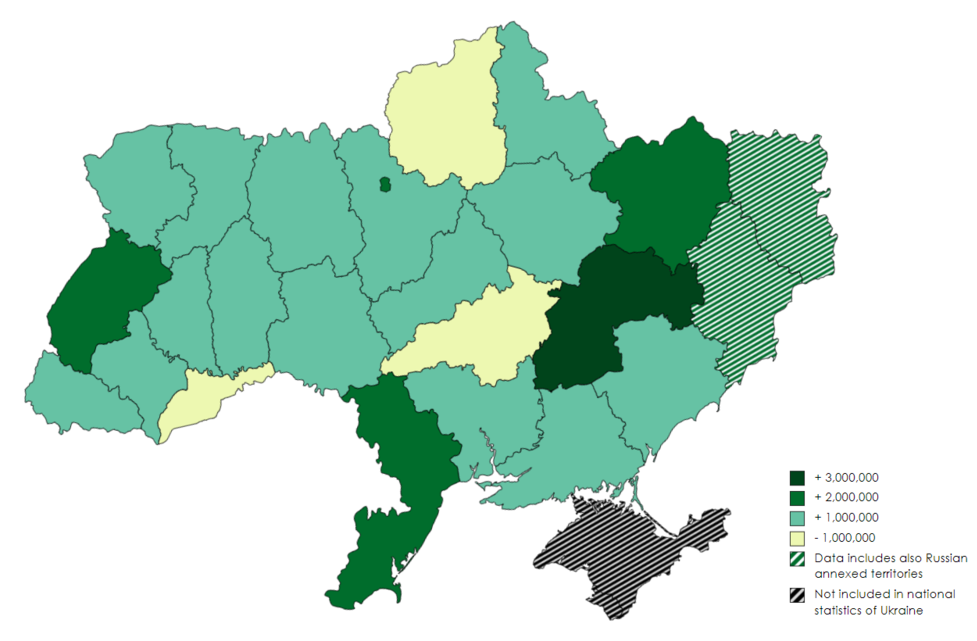
| Name of Oblast | Population as of Dec 2021 | According to the electronic census on December 1, 2019 |
|---|---|---|
| Donetsk Oblast | 4,062,839 | 1,981,200 |
| Dnipropetrovsk Oblast | 3,100,320 | 3,230,000 |
| Kyiv Kyiv City | 2,952,577 | 3,703,100 |
| Kharkiv Oblast | 2,602,207 | 2,795,000 |
| Lviv Oblast | 2,480,137 | 2,290,100 |
| Odesa Oblast | 2,352,648 | 2,347,900 |
| Luhansk Oblast | 2,104,531 | 1,127,500 |
| Kyiv Oblast | 1,795,099 | 2,286,400 |
| Zaporizhzhia Oblast | 1,640,876 | 1,656,700 |
| Vinnytsia Oblast | 1,511,574 | 1,331,400 |
| Poltava Oblast | 1,354,444 | 1,337,000 |
| Ivano-Frankivsk Oblast | 1,352,973 | 1,125,700 |
| Zakarpattia Oblast | 1,245,491 | 924,700 |
| Khmelnytskyi Oblast | 1,230,507 | 1,024,700 |
| Zhytomyr Oblast | 1,180,638 | 1,062,600 |
| Cherkasy Oblast | 1,162,439 | 1,088,100 |
| Rivne Oblast | 1,142,599 | 943,600 |
| Mykolaiv Oblast | 1,093,492 | 1,053,200 |
| Sumy Oblast | 1,037,237 | 932,500 |
| Ternopil Oblast | 1,022,625 | 763,600 |
| Volyn Oblast | 1,022,107 | 903,600 |
| Kherson Oblast | 1,002,923 | 913,700 |
| Chernihiv Oblast | 961,054 | 912,600 |
| Kirovohrad Oblast | 905,715 | 826,800 |
| Chernivtsi Oblast | 891,054 | 727,500 |
| Ukraine | 41,208,106 | 37,289,400 |
Birth data by oblast
Note: Recent data for Donetsk and Luhansk Oblasts have been affected by the war in Donbas, and may only include births within the government-held parts of the oblasts.
| Number of births by oblast for January–November | Birth/2016 | Birth/2015 | Death/2016 | Death/2015 |
|---|---|---|---|---|
| Kyiv Kyiv City | 33416 | 32382 | 27772 | 27767 |
| Dnipropetrovsk Oblast | 28473 | 30620 | 47934 | 49258 |
| Lviv Oblast | 25708 | 25007 | 29247 | 30010 |
| Odesa Oblast | 24246 | 25182 | 30479 | 31512 |
| Kharkiv Oblast | 21992 | 22864 | 38502 | 38965 |
| Donetsk Oblast | 17772 | 15608 | 33464 | 36883 |
| Kyiv Oblast | 17559 | 18485 | 25623 | 26046 |
| Zakarpattia Oblast | 14862 | 15525 | 13880 | 14164 |
| Rivne Oblast | 14454 | 14809 | 13261 | 13426 |
| Zaporizhzhia Oblast | 14430 | 15140 | 25533 | 25657 |
| Vinnytsia Oblast | 14153 | 15126 | 22521 | 23237 |
| Ivano-Frankivsk Oblast | 13547 | 14412 | 15616 | 16144 |
| Volyn Oblast | 12047 | 12307 | 12311 | 12602 |
| Zhytomyr Oblast | 11958 | 12526 | 18301 | 19085 |
| Khmelnytskyi Oblast | 11793 | 12768 | 18097 | 18702 |
| Poltava Oblast | 11503 | 12381 | 22084 | 22440 |
| Mykolaiv Oblast | 9904 | 10626 | 15834 | 16316 |
| Kherson Oblast | 9877 | 10476 | 14891 | 15055 |
| Cherkasy Oblast | 9721 | 10560 | 18437 | 18315 |
| Chernivtsi Oblast | 9461 | 9851 | 10399 | 10738 |
| Ternopil Oblast | 9177 | 9912 | 13584 | 13962 |
| Kirovohrad Oblast | 8189 | 8662 | 14810 | 14809 |
| Sumy Oblast | 8169 | 8959 | 16982 | 17322 |
| Chernihiv Oblast | 7816 | 8359 | 17515 | 18199 |
| Luhansk Oblast | 5960 | 4978 | 12689 | 13401 |
| Number of births by oblast | Birth/2014 | Birth/2013 | Birth/2012 | Birth/2011 | Death/2014 | Death/2013 | Death/2012 | Death/2011 |
|---|---|---|---|---|---|---|---|---|
| Dnipropetrovsk Oblast | 36497 | 36134 | 37087 | 36116 | 52722 | 51134 | 51486 | 52106 |
| Donetsk Oblast | 35595 | 41034 | 42839 | 41720 | 71799 | 69345 | 70496 | 71042 |
| Kyiv Kyiv City | 34821 | 33305 | 33887 | 32068 | 29992 | 28003 | 27840 | 27050 |
| Lviv Oblast | 30270 | 29542 | 30220 | 28904 | 32450 | 31666 | 31667 | 31162 |
| Odesa Oblast | 29465 | 29075 | 30384 | 29225 | 34155 | 33523 | 33648 | 33688 |
| Kharkiv Oblast | 27690 | 26700 | 27244 | 26317 | 41891 | 39465 | 40130 | 40079 |
| Kyiv Oblast | 20900 | 20511 | 20966 | 20083 | 28264 | 27198 | 27161 | 26847 |
| Zaporizhzhia Oblast | 18713 | 18134 | 18882 | 18198 | 27773 | 26498 | 26406 | 27033 |
| Zakarpattia Oblast | 18377 | 18490 | 18968 | 18460 | 14808 | 14801 | 14813 | 14588 |
| Vinnytsia Oblast | 17547 | 17437 | 18339 | 17894 | 25567 | 25453 | 25158 | 25376 |
| Rivne Oblast | 17169 | 17445 | 18316 | 17697 | 14714 | 14556 | 14302 | 14168 |
| Ivano-Frankivsk Oblast | 16886 | 16716 | 17101 | 16497 | 17670 | 17358 | 16801 | 16657 |
| Zhytomyr Oblast | 15115 | 15001 | 15486 | 15154 | 21185 | 20859 | 20685 | 20417 |
| Volyn Oblast | 14668 | 14700 | 15346 | 14620 | 13748 | 13666 | 13710 | 13842 |
| Khmelnytskyi Oblast | 14631 | 14548 | 14881 | 14492 | 20408 | 20581 | 20362 | 20116 |
| Poltava Oblast | 14504 | 14296 | 14635 | 14167 | 24784 | 24358 | 24223 | 24384 |
| Mykolaiv Oblast | 13076 | 13043 | 13515 | 13029 | 17750 | 17353 | 17277 | 17441 |
| Cherkasy Oblast | 12351 | 12100 | 12798 | 12473 | 20800 | 20477 | 20667 | 20848 |
| Kherson Oblast | 12308 | 12300 | 12643 | 12085 | 16141 | 16048 | 15904 | 15828 |
| Ternopil Oblast | 11717 | 11807 | 12202 | 11964 | 15180 | 14682 | 14838 | 14829 |
| Chernivtsi Oblast | 11679 | 11465 | 11592 | 11281 | 11619 | 11520 | 11321 | 11192 |
| Luhansk Oblast | 11442 | 20531 | 21743 | 21320 | 22755 | 35822 | 36316 | 37256 |
| Kirovohrad Oblast | 10576 | 10562 | 11029 | 10578 | 16716 | 16513 | 16521 | 16697 |
| Sumy Oblast | 10344 | 10411 | 11093 | 10473 | 19452 | 19219 | 19002 | 18833 |
| Chernihiv Oblast | 9552 | 9852 | 10222 | 10134 | 20324 | 19909 | 20208 | 20179 |
| Birth rate by oblast | Birth/2014 | Birth/2013 | Birth/2012 | Birth/2011 | Death/2014 | Death/2013 | Death/2012 | Death/2011 |
|---|---|---|---|---|---|---|---|---|
| Rivne Oblast | 14.8 | 15.1 | 15.9 | 15.3 | 12.7 | 12.6 | 12.4 | 12.3 |
| Zakarpattia Oblast | 14.6 | 14.7 | 15.1 | 14.8 | 11.8 | 11.8 | 11.8 | 11.7 |
| Volyn Oblast | 14.1 | 14.1 | 14.8 | 14.1 | 13.2 | 13.1 | 13.2 | 13.3 |
| Chernivtsi Oblast | 12.9 | 12.6 | 12.8 | 12.5 | 12.8 | 12.7 | 12.5 | 12.4 |
| Odesa Oblast | 12.3 | 12.1 | 12.7 | 12.2 | 14.3 | 14.0 | 14.1 | 14.1 |
| Ivano-Frankivsk Oblast | 12.2 | 12.1 | 12.4 | 12.0 | 12.8 | 12.6 | 12.2 | 12.1 |
| Kyiv Oblast | 12.1 | 11.9 | 12.2 | 11.7 | 16.4 | 15.8 | 15.8 | 15.6 |
| Kyiv Kyiv City | 12.1 | 11.7 | 12.0 | 11.4 | 10.4 | 9.8 | 9.8 | 9.6 |
| Zhytomyr Oblast | 12.0 | 11.9 | 12.2 | 11.9 | 16.8 | 16.5 | 16.3 | 16.0 |
| Lviv Oblast | 11.9 | 11.6 | 11.9 | 11.4 | 12.8 | 12.4 | 12.5 | 12.3 |
| Kherson Oblast | 11.5 | 11.4 | 11.7 | 11.1 | 15.1 | 14.9 | 14.7 | 14.6 |
| Mykolaiv Oblast | 11.2 | 11.1 | 11.5 | 11.0 | 15.2 | 14.8 | 14.7 | 14.8 |
| Khmelnytskyi Oblast | 11.2 | 11.1 | 11.3 | 11.0 | 15.6 | 15.7 | 15.5 | 15.2 |
| Dnipropetrovsk Oblast | 11.1 | 11.0 | 11.2 | 10.9 | 16.0 | 15.5 | 15.5 | 15.7 |
| Vinnytsia Oblast | 10.9 | 10.8 | 11.2 | 10.9 | 15.9 | 15.7 | 15.4 | 15.5 |
| Ternopil Oblast | 10.9 | 11.0 | 11.3 | 11.1 | 14.2 | 13.7 | 13.8 | 13.7 |
| Kirovohrad Oblast | 10.8 | 10.7 | 11.0 | 10.5 | 17.0 | 16.7 | 16.5 | 16.6 |
| Zaporizhzhia Oblast | 10.6 | 10.2 | 10.6 | 10.1 | 15.7 | 14.9 | 14.8 | 15.0 |
| Kharkiv Oblast | 10.1 | 9.8 | 9.9 | 9.6 | 15.3 | 14.4 | 14.6 | 14.6 |
| Poltava Oblast | 10.0 | 9.8 | 9.9 | 9.5 | 17.1 | 16.7 | 16.5 | 16.4 |
| Cherkasy Oblast | 9.8 | 9.6 | 10.1 | 9.8 | 16.5 | 16.2 | 16.2 | 16.3 |
| Sumy Oblast | 9.2 | 9.2 | 9.7 | 9.1 | 17.2 | 16.9 | 16.6 | 16.3 |
| Chernihiv Oblast | 9.0 | 9.2 | 9.4 | 9.3 | 19.2 | 18.6 | 18.7 | 18.5 |
| Donetsk Oblast | 8.2 | 9.4 | 9.8 | 9.5 | 16.6 | 15.9 | 16.1 | 16.1 |
| Luhansk Oblast | 5.1 | 9.1 | 9.6 | 9.3 | 10.2 | 15.9 | 16.0 | 16.3 |
Year in review 2013
Compared to 2012, the amount of attrition increased in 2013 by 16,278 persons, or 3.1 to 3.5 persons per 1,000 inhabitants (real). Natural decreases were observed in 23 oblasts of the country, while natural increases were recorded only in Kyiv and in the Zakarpattya, Rivne and Volyn oblasts (5,302, 3,689, 2,889 and 1,034 people, respectively).
Some regions registered a low natural decline, such as Chernivtsi, Ivano-Frankivsk, Sevastopol, Lviv, Ternopil, Crimea, Kherson and Odesa (−55, −642, −863, −2,124, −2,875, −2,974, −3,748 and −4,448 people, respectively). The largest declines were recorded in Donetsk, Luhansk, Dnipro, Kharkiv, Poltava and Chernihiv (−28,311, −15,291, −15,007, −12,765, −10,062 and −10,057, respectively), regions which share a low birth rate and high mortality of a large urban population and rapid aging of the rural population.
Net migration rate
−5.4 migrant(s)/1,000 population (2015).
Infant mortality rate
- 9.1 deaths/1,000 infants live births for 4,564 deaths (2010)
- 9.0 deaths/1,000 infants live births for 4,511 deaths (2011)
- 8.4 deaths/1,000 infants live births for 4,371 deaths (2012)
- 8.0 deaths/1,000 infants live births for 4,030 deaths (2013)
- 8.9 deaths/1,000 infants live births for 2,193 death for January–June 2011
- 8.6 deaths/1,000 infants live births for 2,190 death for January–June 2012
- 7.8 deaths/1,000 infants live births for 1,993 deaths for January–June 2013
| Infant mortality by oblast | Death/2012 | Death/2011 | Death/2010 | Death/2009 |
|---|---|---|---|---|
| Donetsk Oblast | 540 | 473 | 497 | 533 |
| Dnipropetrovsk Oblast | 370 | 343 | 347 | 329 |
| Odesa Oblast | 267 | 268 | 263 | 280 |
| Kyiv Kyiv City | 262 | 255 | 233 | 244 |
| Lviv Oblast | 233 | 272 | 266 | 238 |
| Kharkiv Oblast | 203 | 234 | 243 | 252 |
| Zakarpattia Oblast | 168 | 195 | 199 | 238 |
| Vinnytsia Oblast | 166 | 186 | 148 | 149 |
| Luhansk Oblast | 165 | 188 | 199 | 252 |
| Zaporizhzhia Oblast | 154 | 169 | 182 | 174 |
| Rivne Oblast | 147 | 156 | 158 | 164 |
| Khmelnytskyi Oblast | 134 | 89 | 109 | 174 |
| Zhytomyr Oblast | 124 | 134 | 135 | 127 |
| Cherkasy Oblast | 122 | 101 | 125 | 132 |
| Kyiv Oblast | 119 | 143 | 140 | 146 |
| Ivano-Frankivsk Oblast | 109 | 145 | 170 | 157 |
| Volyn Oblast | 106 | 116 | 123 | 118 |
| Kirovohrad Oblast | 103 | 139 | 112 | 119 |
| Kherson Oblast | 100 | 120 | 116 | 136 |
| Mykolaiv Oblast | 97 | 97 | 104 | 112 |
| Ternopil Oblast | 97 | 96 | 98 | 93 |
| Chernihiv Oblast | 94 | 80 | 82 | 103 |
| Chernivtsi Oblast | 92 | 96 | 90 | 91 |
| Poltava Oblast | 85 | 86 | 87 | 105 |
| Sumy Oblast | 76 | 78 | 97 | 91 |
| Infant mortality per 1,000 by Oblast | Death/2012 | Death/2011 | Death/2010 | Death/2009 |
|---|---|---|---|---|
| Donetsk Oblast | 12.7 | 11.4 | 12.0 | 12.3 |
| Dnipropetrovsk Oblast | 10.0 | 9.5 | 9.7 | 8.8 |
| Cherkasy Oblast | 9.6 | 8.1 | 10.0 | 10.5 |
| Kirovohrad Oblast | 9.4 | 13.2 | 10.6 | 10.9 |
| Chernihiv Oblast | 9.2 | 7.9 | 8.1 | 9.9 |
| Vinnytsia Oblast | 9.1 | 10.4 | 8.4 | 8.3 |
| Khmelnytskyi Oblast | 9.0 | 6.2 | 7.5 | 11.8 |
| Zakarpattia Oblast | 8.9 | 10.6 | 10.9 | 13.1 |
| Odesa Oblast | 8.8 | 9.2 | 9.2 | 9.7 |
| Zaporizhzhia Oblast | 8.2 | 9.3 | 10.1 | 9.4 |
| Rivne Oblast | 8.1 | 8.9 | 9.2 | 9.4 |
| Kherson Oblast | 8.0 | 9.9 | 9.4 | 11.0 |
| Zhytomyr Oblast | 8.0 | 8.9 | 9.1 | 8.5 |
| Chernivtsi Oblast | 8.0 | 8.5 | 8.2 | 8.2 |
| Ternopil Oblast | 8.0 | 8.0 | 8.2 | 7.5 |
| Lviv Oblast | 7.8 | 9.4 | 9.2 | 8.0 |
| Kyiv Kyiv City | 7.8 | 8.0 | 7.3 | 7.5 |
| Luhansk Oblast | 7.6 | 8.8 | 9.4 | 11.6 |
| Kharkiv Oblast | 7.5 | 8.9 | 9.2 | 9.3 |
| Mykolaiv Oblast | 7.3 | 7.5 | 8.1 | 8.5 |
| Volyn Oblast | 7.0 | 7.9 | 8.2 | 7.7 |
| Sumy Oblast | 6.9 | 7.5 | 9.3 | 8.5 |
| Ivano-Frankivsk Oblast | 6.4 | 8.8 | 10.3 | 9.1 |
| Poltava Oblast | 5.8 | 6.1 | 6.1 | 7.1 |
| Kyiv Oblast | 5.7 | 7.2 | 7.0 | 7.1 |
Total fertility rate by oblast
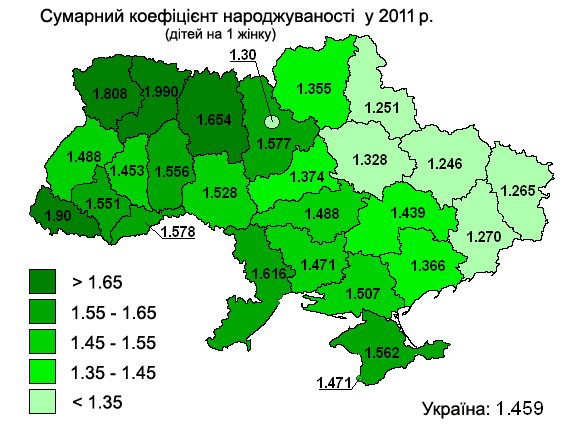
None of the oblasts in 2013 recorded a higher fertility rate than 2.10 children per woman, though rural areas saw higher rates in the Rivne Oblast (2.50) and Volyn Oblast (2.20). While close-to-generational renewal rates were achieved in the Odesa (2.04), Zakarpattia (2.00), Mykolaiv (1.95), Chernivtsi (1.93) and Zhytomyr (1.91) oblasts, they were weaker in the Luhansk (1.41), Sumy (1.47) and Cherkasy (1.53) oblasts.
The highest urban fertility rates were recorded in the Zakarpattia Oblast (1.80), city of Sevastopol (1.57), Volyn Oblast (1.56), Kyiv Oblast (1.56) and Rivne Oblast (1.54). The lowest were in the Sumy (1.23), Kharkiv (1.26), Cherkasy (1.28), Chernihiv (1.28), Chernivtsi (1.28), Luhansk (1.28), Poltava (1.29), Donetsk (1.29) and Zaporizhzhia (1.32) oblasts.
| Children born per woman by oblast | Total fertility rate/2020 | Total fertility rate/2012 | Total fertility rate/2011 | Total fertility rate/2010 |
|---|---|---|---|---|
| Rivne Oblast | 1.54 | 2.08 | 1.99 | 1.93 |
| Zakarpattia Oblast | 1.60 | 1.95 | 1.90 | 1.83 |
| Volyn Oblast | 1.51 | 1.92 | 1.81 | 1.85 |
| Zhytomyr Oblast | 1.20 | 1.71 | 1.65 | 1.61 |
| Odesa Oblast | 1.34 | 1.71 | 1.62 | 1.58 |
| Kyiv Oblast | 1.18 | 1.67 | 1.58 | 1.58 |
| Chernivtsi Oblast | 1.30 | 1.64 | 1.58 | 1.53 |
| Khmelnytskyi Oblast | 1.26 | 1.62 | 1.56 | 1.55 |
| Ivano-Frankivsk Oblast | 1.27 | 1.63 | 1.55 | 1.58 |
| Kherson Oblast | 1.20 | 1.61 | 1.51 | 1.51 |
| Kirovohrad Oblast | 1.10 | 1.61 | 1.51 | 1.50 |
| Lviv Oblast | 1.24 | 1.58 | 1.49 | 1.50 |
| Mykolaiv Oblast | 1.11 | 1.57 | 1.47 | 1.44 |
| Vinnytsia Oblast | 1.20 | 1.59 | 1.53 | 1.50 |
| Ukraine | 1.22 | 1.53 | 1.46 | 1.45 |
| Dnipropetrovsk Oblast | 1.09 | 1.52 | 1.44 | 1.43 |
| Ternopil Oblast | 1.13 | 1.50 | 1.45 | 1.46 |
| Zaporizhzhia Oblast | 1.03 | 1.46 | 1.37 | 1.34 |
| Poltava Oblast | 1.04 | 1.41 | 1.33 | 1.34 |
| Cherkasy Oblast | 1.01 | 1.43 | 1.37 | 1.36 |
| Chernihiv Oblast | 1.02 | 1.40 | 1.36 | 1.36 |
| Kyiv Kyiv City | 1.44 | 1.38 | 1.29 | 1.30 |
| Donetsk Oblast | 1.34 | 1.27 | 1.26 | |
| Kharkiv Oblast | 0.98 | 1.32 | 1.25 | 1.24 |
| Sumy Oblast | 0.93 | 1.36 | 1.25 | 1.23 |
| Luhansk Oblast | 1.33 | 1.27 | 1.23 |
Other demographics statistics


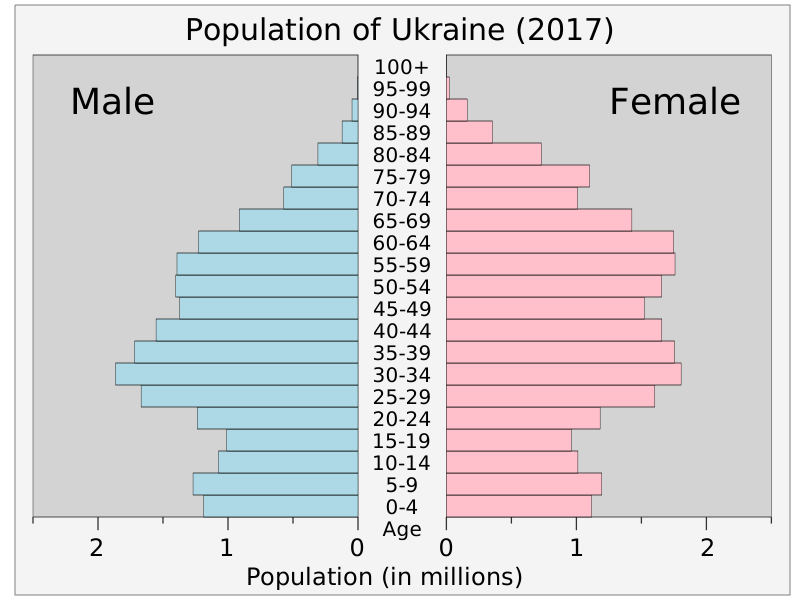




Demographic statistics according to the CIA World Factbook, unless otherwise indicated
:Age structure: :0–14 years: 15.95% (male 3,609,386/female 3,400,349) :15–24 years: 9.57% (male 2,156,338/female 2,047,821) :25–54 years: 44.03% (male 9,522,108/female 9,831,924) :55–64 years: 13.96% (male 2,638,173/female 3,499,718) :65 years and over: 16.49% (male 2,433,718/female 4,812,764) (2018 est.)
:0–14 years: 15.76% (male 3,571,358/female 3,366,380) :15–24 years: 9.86% (male 2,226,142/female 2,114,853) :25–54 years: 44.29% (male 9,579,149/female 9,921,387) :55–64 years: 13.8% (male 2,605,849/female 3,469,246) :65 years and over: 16.3% (male 2,409,049/female 4,770,461) (2017 est.)
:0–14 years: 15.1% = 6,449,171 (2015 official) :15–64 years: 69.3% = 29,634,710 :65 years and over: 15.6% = 6,675,780
:0–14 years: 14.8% = 6,989,802 :15–64 years: 69.2% = 32,603,475 :65 years and over: 16.0% = 7,507,185 (2005 official)
:0–14 years: 21.6% = 11,101,469 :15–64 years: 66.7% = 34,320,742 :65 years and over: 11.7% = 6,022,934 (1989 official)
;Median age: :total: 40.8 years. Country comparison to the world: 47th :male: 37.7 years :female: 43.9 years (2018 est.)
:total: 40.6 years :male: 37.4 years :female: 43.7 years (2017 est.)
:total: 39.8 years :male: 39.7 years :female: 40.1 years (2014 official) :total: 39.7 years :male: 39.5 years :female: 40.1 years (2013 official) :total: 34.8 years :male: 31.9 years :female: 37.7 years (1989 official)
;Birth rate: :10.1 births/1,000 population (2018 est.) Country comparison to the world: 190th :10.3 births/1,000 population (2017 est.)
;Death rate: :14.3 deaths/1,000 population (2018 est.) Country comparison to the world: 6th :14.4 deaths/1,000 population (2017 est.)
;Total fertility rate: :1.55 children born/woman (2018 est.) Country comparison to the world: 190th :1.54 children born/woman (2017 est.)
;Net migration rate: :4.6 migrant(s)/1,000 population (2018 est.) Country comparison to the world: 29th :0 migrant(s)/1,000 population (2017 est.)
;Mother's mean age at first birth: :24.9 years (2014 est.)
;Population growth rate: :0.04% (2018 est.) Country comparison to the world: 187th :−0.41% (2017 est.)
;Life expectancy at birth: :total population: 72.4 years. Country comparison to the world: 148th :male: 67.7 years :female: 77.4 years (2018 est.)
;Ethnic groups: Ukrainian 77.8%, Russian 17.3%, Belarusian 0.6%, Moldovan 0.5%, Crimean Tatar 0.5%, Bulgarian 0.4%, Hungarian 0.3%, Romanian 0.3%, Polish 0.3%, Jewish 0.2%, other 1.8% (2001 est.)
;Languages: Ukrainian (official) 67.5%, Russian (regional language) 29.6%, other (includes small Crimean Tatar-, Moldovan/Romanian-, and Hungarian-speaking minorities) 2.9% (2001 est.)
Note: in February 2018, the Constitutional Court ruled that 2012 language legislation entitling a language spoken by at least 10% of an oblast's population to be given the status of "regional language" – allowing for its use in courts, schools, and other government institutions – was unconstitutional, thus making the law invalid; Ukrainian remains the country's only official nationwide language.
;Religions: Orthodox (includes Ukrainian Autocephalous Orthodox (UAOC), Ukrainian Orthodox – Kyiv Patriarchate (UOC-KP), Ukrainian Orthodox – Moscow Patriarchate (UOC-MP)), Ukrainian Greek Catholic, Roman Catholic, Protestant, Muslim, Jewish
Note: Ukraine's population is overwhelmingly Christian; the vast majority – up to two-thirds – identify themselves as Orthodox, but many do not specify a particular branch; the UOC-KP and the UOC-MP each represent less than a quarter of the country's population, the Ukrainian Greek Catholic Church accounts for 8–10%, and the UAOC accounts for 1–2%; Muslim and Jewish adherents each compose less than 1% of the total population (2013 est.).
;Dependency ratios :total dependency ratio: 44.8 (2015 est.) :youth dependency ratio: 21.8 (2015 est.) :elderly dependency ratio: 23 (2015 est.) :potential support ratio: 4.3 (2015 est.) :Note: data include Crimea
;Urbanization: :urban population: 69.4% of total population (2018) :rate of urbanization: −0.33% annual rate of change (2015–20 est.)
;Literacy: definition: age 15 and over can read and write (2015 est.) :total population: 99.8% :male: 99.8% :female: 99.7% (2015 est.)
;School life expectancy (primary to tertiary education): :total: 15 years :male: 15 years :female: 16 years (2014)
;Unemployment, youth ages 15–24: :total: 23%. Country comparison to the world: 53rd :male: 24% :female: 21.5% (2016 est.)
Birth and death rates of regional capitals
| Birth rate in | Birth/2012 | Birth/2011 | Birth/2010 | Birth/2009 | Birth/2007 | Birth/2005 | Birth/2003 | |
|---|---|---|---|---|---|---|---|---|
| Simferopol | 13.6 | 12.8 | 11.8 | 11.8 | 11.0 | 9.5 | 9.2 | |
| Lutsk | 12.6 | 12.3 | 12.6 | 13.9 | 12.6 | 11.7 | 10.0 | |
| Rivne | 12.6 | 12.0 | 11.8 | 12.3 | 10.9 | 10.1 | 9.4 | |
| Uzhhorod | 12.1 | 11.9 | 12.0 | 12.4 | 12.8 | 12.6 | 10.8 | |
| Kyiv | 12.0 | 11.4 | 11.5 | 11.7 | 10.4 | 9.8 | 8.8 | |
| Khmelnytskyi | 12.0 | 11.2 | 11.8 | 11.5 | 10.4 | 10.2 | 9.2 | |
| Sevastopol | 12.0 | 11.1 | 11.0 | 11.2 | 10.5 | 9.6 | 8.7 | |
| Kherson | 11.9 | 11.1 | 10.1 | 10.5 | 9.6 | 8.6 | 8.5 | |
| Ternopil | 11.8 | 12.2 | 11.7 | 12.3 | 11.9 | 11.6 | 10.4 | |
| Ivano-Frankivsk | 11.6 | 11.6 | 10.1 | 10.8 | 11.3 | 10.7 | 9.3 | |
| Vinnytsia | 11.5 | 11.2 | 10.9 | 11.1 | 10.1 | 9.4 | 9.1 | |
| Kropyvnytskyi | 11.5 | 11.1 | 10.5 | 11.3 | 10.5 | 8.9 | 8.4 | |
| Zhytomyr | 11.4 | 11.5 | 10.8 | 11.7 | 10.6 | 9.5 | 8.7 | |
| Sumy | 11.3 | 10.3 | 10.0 | 10.3 | 9.6 | 8.2 | 7.8 | |
| Lviv | 11.0 | 10.4 | 10.0 | 10.5 | 9.7 | 9.3 | 9.0 | |
| Ukraine Urban | 10.9 | 10.5 | 10.4 | 10.8 | 9.9 | 8.9 | 8.3 | |
| Dnipro | 10.5 | 10.2 | 10.0 | 10.5 | 9.4 | 8.5 | 7.9 | |
| Luhansk | 10.5 | 9.8 | 8.8 | 9.2 | 8.2 | 7.4 | 6.8 | |
| Chernivtsi | 10.2 | 10.3 | 10.1 | 10.2 | 9.2 | 9.6 | 8.3 | |
| Odesa | 10.1 | 9.8 | 9.6 | 9.9 | 9.0 | 8.3 | 7.5 | |
| Cherkasy | 9.9 | 9.4 | 9.4 | 9.4 | 8.7 | 7.8 | 7.4 | |
| Poltava | 9.9 | 9.1 | 8.8 | 9.7 | 8.4 | 7.8 | 7.3 | |
| Zaporizhzhia | 9.5 | 9.2 | 9.2 | 9.3 | 8.9 | 8.2 | 7.5 | |
| Mykolaiv | 9.4 | 9.3 | 9.1 | 9.4 | 8.7 | 8.0 | 7.9 | |
| Chernihiv | 9.3 | 9.2 | 9.1 | 9.6 | 8.4 | 8.0 | 7.6 | |
| Kharkiv | 9.2 | 8.9 | 8.8 | 9.2 | 8.4 | 7.6 | 7.1 | |
| Donetsk | 9.1 | 8.7 | 8.6 | 9.0 | 8.2 | 7.5 | 6.6 |
| Death rate in | Death/2012 | Death/2011 | Death/2010 | Death/2009 | Death/2007 | Death/2005 | Death/2003 | |
|---|---|---|---|---|---|---|---|---|
| Kherson | 15.2 | 15.6 | 14.0 | 14.2 | 14.9 | 14.8 | 14.5 | |
| Luhansk | 14.2 | 14.3 | 13.6 | 13.4 | 13.8 | 14.2 | 14.1 | |
| Simferopol | 14.0 | 14.8 | 13.6 | 13.8 | 15.3 | 15.3 | 15.2 | |
| Sevastopol | 13.7 | 14.1 | 14.7 | 14.5 | 15.5 | 15.4 | 14.1 | |
| Kropyvnytskyi | 13.7 | 13.7 | 13.8 | 14.0 | 14.4 | 14.1 | 14.1 | |
| Dnipro | 13.5 | 13.7 | 14.1 | 13.8 | 15.1 | 15.1 | 16.0 | |
| Donetsk | 13.4 | 13.5 | 14.0 | 13.9 | 15.2 | 15.4 | 14.7 | |
| Zaporizhzhia | 13.2 | 13.4 | 14.2 | 13.8 | 15.0 | 14.7 | 14.2 | |
| Ukraine Urban | 13.1 | 13.1 | 13.7 | 13.7 | 14.7 | 14.8 | 14.3 | |
| Mykolaiv | 12.8 | 12.8 | 13.8 | 13.8 | 14.5 | 14.5 | 14.9 | |
| Poltava | 12.8 | 12.6 | 13.2 | 13.0 | 13.7 | 13.6 | 13.6 | |
| Sumy | 12.1 | 11.9 | 12.4 | 12.6 | 13.0 | 13.1 | 11.9 | |
| Kharkiv | 12.0 | 11.8 | 12.4 | 12.2 | 13.1 | 13.1 | 13.0 | |
| Odesa | 11.9 | 12.2 | 13.0 | 12.5 | 13.9 | 14.1 | 14.0 | |
| Cherkasy | 11.2 | 10.7 | 11.3 | 11.2 | 11.7 | 11.7 | 11.0 | |
| Chernihiv | 11.4 | 11.1 | 12.0 | 11.8 | 12.5 | 12.4 | 12.0 | |
| Lviv | 11.0 | 10.8 | 10.5 | 10.8 | 11.5 | 11.4 | 11.5 | |
| Zhytomyr | 10.7 | 10.9 | 11.2 | 11.1 | 12.0 | 12.2 | 11.4 | |
| Uzhhorod | 10.3 | 10.2 | 10.5 | 11.3 | 12.0 | 12.4 | 10.3 | |
| Kyiv | 9.8 | 9.6 | 10.3 | 10.2 | 11.4 | 11.2 | 10.7 | |
| Lutsk | 9.6 | 9.4 | 9.6 | 9.1 | 10.4 | 10.2 | 10.5 | |
| Chernivtsi | 9.5 | 9.4 | 9.9 | 10.3 | 11.0 | 11.0 | 10.8 | |
| Khmelnytskyi | 9.4 | 8.8 | 9.0 | 9.5 | 9.8 | 9.8 | 9.2 | |
| Vinnytsia | 9.1 | 9.0 | 9.2 | 9.2 | 10.2 | 10.2 | 10.0 | |
| Ivano-Frankivsk | 9.1 | 8.7 | 8.2 | 8.5 | 9.1 | 9.3 | 9.3 | |
| Ternopil | 8.1 | 7.6 | 8.1 | 7.7 | 8.5 | 8.5 | 7.7 | |
| Rivne | 7.9 | 7.8 | 8.7 | 8.6 | 9.0 | 9.2 | 8.8 |
Ethnic groups

]] In 2001, the ethnic composition of Ukraine was: Ukrainian 77.8%, Russian 17.3%, Romanian 1.1% (including Moldovan 0.8%), Belarusian 0.6%, Crimean Tatar 0.5%, Bulgarian 0.4%, Hungarian 0.3%, Polish 0.3%, Jewish 1.0%, Pontic Greek 0.2% and other 1.6% (including Armenians, Germans, Romas, Georgians, Slovaks, Albanians, Crimean Karaites, as well as Muslim Bulgarians, otherwise known as Torbesh, and a microcosm of Swedes of Gammalsvenskby). Rusyns are also not recognised by the Ukrainian government as a distinct ethnic group and are instead treated as a sub-group of Ukrainians.
According to the 2021 law “On the Indigenous Peoples of Ukraine”, the Crimean Tatars, Crimean Karaites and Krymchaks are the indigenous peoples of Ukraine.


Before World War II
| Ethnic | |||||||||
|---|---|---|---|---|---|---|---|---|---|
| group | census 19261 | census 19392 | Number | % | Number | % | Total | 29,018,187 | 30,946,218 |
| Ukrainians | 23,218,860 | 80.0 | 23,667,509 | 76.5 | |||||
| Russians | 2,677,166 | 9.2 | 4,175,299 | 13.5 | |||||
| Jewish | 1,574,428 | 5.4 | 1,532,776 | 5.0 | |||||
| Germans | 393,924 | 1.4 | 392,458 | 1.3 | |||||
| Polish | 476,435 | 1.6 | 357,710 | 1.2 | |||||
| Moldavians / Romanians | 257,794 | 0.9 | 230,698 | 0.8 | |||||
| Belarusians | 75,842 | 0.3 | 158,174 | 0.5 | |||||
| Pontic Greeks | 104,666 | 0.4 | 107,047 | 0.4 | |||||
| Bulgarians | 99,278 | 0.3 | 83,838 | 0.3 | |||||
| Tatars | 22,281 | 0.1 | 55,456 | 0.2 | |||||
| Roma | 13,578 | 0.0 | 10,443 | 0.0 | |||||
| Others | 103,935 | 0.4 | 174,810 | 0.6 | |||||
| 1 Source:. |
After World War II
| Ethnic | |||||||||||||||||||||
|---|---|---|---|---|---|---|---|---|---|---|---|---|---|---|---|---|---|---|---|---|---|
| group | census 19591 | census 19702 | census 19793 | census 19894 | census 20015 | Number | % | Number | % | Number | % | Number | % | Number | % | Total | 41,869,046 | 47,126,517 | 49,609,333 | 51,452,034 | 48,240,902 |
| Ukrainians | 32,158,493 | 76.8 | 35,283,857 | 74.9 | 36,488,951 | 73.6 | 37,419,053 | 72.7 | 37,541,693 | 77.5 | |||||||||||
| Russians | 7,090,813 | 16.9 | 9,126,331 | 19.4 | 10,471,602 | 21.1 | 11,355,582 | 22.1 | 8,334,141 | 17.2 | |||||||||||
| Romanians / Moldovans | 391,753 | 1.1 | 378,043 | 1.1 | 415,371 | 1.1 | 459,350 | 1.2 | 409,608 | 1.1 | |||||||||||
| Belarusians | 290,890 | 0.7 | 385,847 | 0.8 | 406,098 | 0.8 | 440,045 | 0.9 | 275,763 | 0.6 | |||||||||||
| Crimean Tatars | 193 | 0.0 | 3,554 | 0.0 | 6,636 | 0.0 | 46,807 | 0.1 | 248,193 | 0.5 | |||||||||||
| Bulgarians | 219,419 | 0.5 | 234,390 | 0.5 | 238,217 | 0.5 | 233,800 | 0.5 | 204,574 | 0.4 | |||||||||||
| Hungarians | 149,229 | 0.4 | 157,731 | 0.3 | 164,373 | 0.3 | 163,111 | 0.3 | 156,566 | 0.3 | |||||||||||
| Poles | 363,297 | 0.9 | 295,107 | 0.6 | 258,309 | 0.5 | 219,179 | 0.4 | 144,130 | 0.3 | |||||||||||
| Jewish | 840,311 | 2.0 | 777,126 | 1.7 | 634,154 | 1.3 | 486,628 | 1.0 | 103,591 | 0.2 | |||||||||||
| Armenians | 28,024 | 0.1 | 33,439 | 0.1 | 38,646 | 0.1 | 54,200 | 0.1 | 99,894 | 0.2 | |||||||||||
| Greeks | 104,359 | 0.3 | 106,909 | 0.2 | 104,091 | 0.2 | 98,594 | 0.2 | 91,548 | 0.2 | |||||||||||
| Tatars | 61,334 | 0.2 | 72,658 | 0.2 | 83,906 | 0.2 | 86,875 | 0.2 | 73,304 | 0.2 | |||||||||||
| Roma | 22,515 | 0.1 | 30,091 | 0.1 | 34,411 | 0.1 | 47,917 | 0.1 | 47,587 | 0.1 | |||||||||||
| Azerbaijanis | 6,680 | 0.0 | 10,769 | 0.0 | 17,235 | 0.0 | 36,961 | 0.1 | 45,176 | 0.1 | |||||||||||
| Georgians | 11,574 | 0.0 | 14,650 | 0.0 | 16,301 | 0.0 | 23,540 | 0.1 | 34,199 | 0.1 | |||||||||||
| Germans | 23,243 | 0.1 | 29,871 | 0.1 | 34,139 | 0.1 | 37,849 | 0.1 | 33,302 | 0.1 | |||||||||||
| Gagauz | 23,530 | 0.1 | 26,464 | 0.1 | 29,398 | 0.1 | 31,967 | 0.1 | 31,923 | 0.1 | |||||||||||
| Karaites | 3,301 | 0.0 | 2,596 | 0.0 | 1,845 | 0.0 | 1,404 | 0.0 | 1,196 | 0.0 | |||||||||||
| Others | 129,338 | 0.3 | 157,084 | 0.3 | 165,650 | 0.3 | 209,172 | 0.4 | 363,821 | 1.1 | |||||||||||
| 1 Source:. 2 Source:. 3 Source:. 4 Source:. 5 Source: http://2001.ukrcensus.gov.ua/. |
Languages
Main article: Languages of Ukraine

According to the 2001 census, the following languages are common in Ukraine: Ukrainian 67.5%, Russian 29.6%, Crimean Tatar, Urum (Turkic Greeks), Bulgarian, Moldovan/Romanian, Polish, Hungarian. The table below lists the total population of various ethnic groups in Ukraine and their native language, according to the 2001 census.

| Ethnic group | Population | Native | Ukrainian | Russian | Other |
|---|---|---|---|---|---|
| Ukrainians | 37,541,693 | 31,970,728 | – | 5,544,729 | 532 |
| Russians | 8,334,141 | 7,993,832 | 328,152 | – | 402 |
| Moldovans | 258,619 | 181,124 | 27,775 | 45,607 | 1242 |
| Belarusians | 275,763 | 54,573 | 48,202 | 172,251 | |
| Crimean Tatars | 248,193 | 228,373 | 184 | 15,208 | 43 |
| Bulgarians | 204,574 | 131,237 | 10,277 | 62,067 | 9 |
| Hungarians | 156,566 | 149,431 | 5,367 | 1,513 | 14 |
| Romanians | 150,989 | 138,522 | 9,367 | 2,297 | 170 |
| Polish | 144,130 | 18,660 | 102,268 | 22,495 | 390 |
| Hebrew | 103,591 | 3,213 | 13,924 | 85,964 | 16 |
| Armenians | 99,894 | 50,363 | 5,798 | 43,105 | 11 |
| Greeks | 91,548 | 5,829 | 4,359 | 80,992 | 9 |
| Tatars | 73,304 | 25,770 | 3,310 | 43,060 | 6 |
| Koreans | 49,817 | 2,223 | 37,932 | 9,662 | 0 |
| Roma | 47,587 | 21,266 | 10,039 | 6,378 | 6 |
| Azerbaijanis | 45,176 | 23,958 | 3,224 | 16,968 | 36 |
| Georgians | 34,199 | 12,539 | 2,818 | 18,589 | 15 |
| Germans | 33,302 | 4,056 | 7,360 | 21,549 | 20 |
| Gagauz | 31,923 | 22,822 | 1,102 | 7,232 | 2 |
| Uzbeks | 12,353 | 3,604 | 1,818 | 5,996 | 0 |
| Chuvash | 10,593 | 2,268 | 564 | 7,636 | 1 |
| Mordvinians | 9,331 | 1,473 | 646 | 7,168 | 0 |
| Turks | 8,844 | 7,923 | 133 | 567 | 0 |
| Lithuanians | 7,207 | 1,932 | 1,029 | 4,182 | 4 |
| Arabs | 6,575 | 4,071 | 897 | 1,235 | 0 |
| Slovaks | 6,397 | 2,633 | 2,665 | 335 | 0 |
| Czechs | 5,917 | 1,190 | 2,503 | 2,144 | 2 |
| Kazakhs | 5,526 | 1,041 | 822 | 3,470 | 11 |
| Latvians | 5,079 | 957 | 872 | 3,188 | 1 |
| Ossetians | 4,834 | 1,150 | 401 | 3,110 | 4 |
| Udmurts | 4,712 | 729 | 380 | 3,515 | 0 |
| Lezghinians | 4,349 | 1,507 | 330 | 2,341 | 4 |
| Tadjiks | 4,255 | 1,521 | 488 | 1,983 | 0 |
| Bashkirs | 4,253 | 843 | 336 | 2,920 | 0 |
| Mari people | 4,130 | 1,059 | 264 | 2,758 | 7 |
| Thai | 3,850 | 3,641 | 29 | 164 | 0 |
| Turkmens | 3,709 | 719 | 1,079 | 1,392 | 0 |
| Albanians | 3,308 | 1,740 | 301 | 1,181 | 0 |
| Assyrians | 3,143 | 883 | 408 | 1,730 | 0 |
| Chechens | 2,877 | 1,581 | 212 | 977 | 0 |
| Estonians | 2,868 | 416 | 321 | 2,107 | 4 |
| Chinese people | 2,213 | 1,817 | 73 | 307 | 0 |
| Kurds | 2,088 | 1,173 | 236 | 396 | 0 |
| Darghins | 1,610 | 409 | 199 | 955 | 0 |
| Komis | 1,545 | 330 | 127 | 1,046 | 0 |
| Karelians | 1,522 | 96 | 145 | 1,244 | 1 |
| Avars | 1,496 | 582 | 121 | 761 | 0 |
| Peoples of India and Pakistan | 1,483 | 1,092 | 26 | 192 | 0 |
| Abkhazians | 1,458 | 317 | 268 | 797 | 0 |
| Karaites | 1,196 | 72 | 160 | 931 | 0 |
| Komi-Permians | 1,165 | 160 | 79 | 898 | 1 |
| Kyrgyz people | 1,128 | 208 | 221 | 617 | 19 |
| Laks | 1,019 | 199 | 271 | 514 | 13 |
| Afghans | 1,008 | 551 | 60 | 213 | 0 |
| other | 3,228 | 1,027 | 144 | 790 | 0 |
| NA | 188,639 | 0 | 1,108 | 1,844 | 1 |
| Ukrainian | Russian | Romanian and Moldovan |
|---|
| Crimean Tatar | Bulgarian | Hungarian |
|---|
Religion
Main article: Religion in Ukraine
A 2018 survey conducted by the Razumkov Centre found that 71.7% of the population declared themselves believers in any religion, while 4.7% declared themselves non-believers, and 3.0% declared themselves atheists. Of the total Ukrainian population, 87.4% declared they were Christians, comprising 67.3% who declared themselves Eastern Orthodox, 10.2% Catholics (split into 9.4% Ukrainian Greek Catholics and 0.8% Latin Catholics), 7.7% "Christians", and 2.2% Protestants. Judaism comprises 0.4% of the population. In earlier surveys, between 1 and 2% of the population stated that it adhered to Islam.
According to data from 2018, among those Ukrainians declaring themselves Orthodox Christians, 28.7% said they were members of the Ukrainian Orthodox Church of the Kyivan Patriarchate (incorporated as of 5 January 2019 into the Orthodox Church of Ukraine), while 12.8% said they were members of the Ukrainian Orthodox Church of the Moscovian Patriarchate (an autonomous Eastern Orthodox church under the Russian Orthodox Church). A further 0.3% said they were members of the Ukrainian Autocephalous Orthodox Church, which, like the Kyivan Patriarchate, was incorporated in 2019 into the Orthodox Church of Ukraine. Among the remaining Orthodox Ukrainians, 23.4% declared themselves "simply Orthodox", without affiliation to any patriarchate, while a further 1.9% declared that they "did not know" which patriarchate or Orthodox church they belonged to.
Regional differences
Regional differences in population change
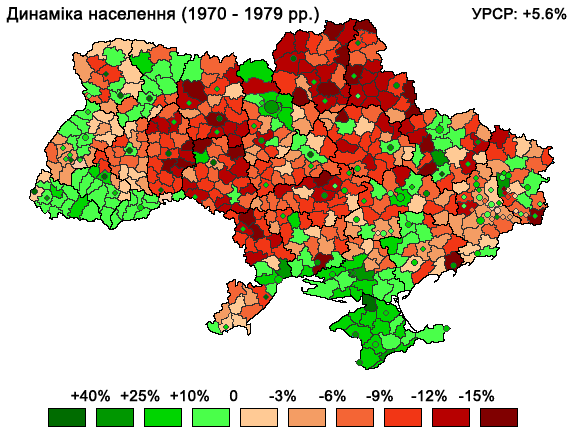
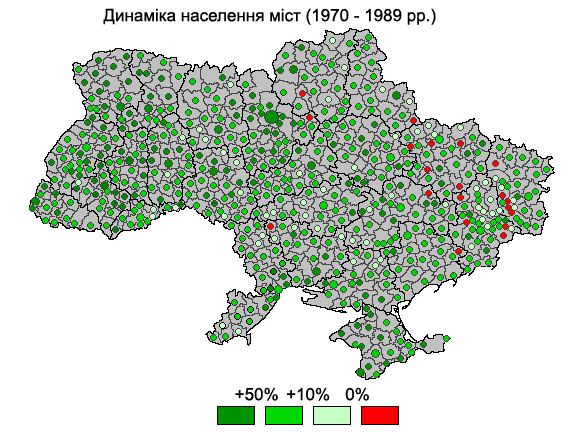
Between the Soviet census of 1989 and the Ukrainian census of 2001, Ukraine's population declined from 51,706,600 to 48,457,020, a loss of 2,926,700 people, or 5.7% of the 1989 population. However, this trend was quite uneven and subject to regional variation. Two oblasts in western Ukraine, Rivne and Zakarpattia, saw slight population increases of 0.3% and 0.5%, respectively. A third western Ukrainian oblast, Volyn, lost less than 0.1% of its population between 1989 and 2001. Collectively, between 1989 and 2001, the seven westernmost Ukrainian oblasts lost 167,500 people, or 1.7% of their 1989 population. The total population of these oblasts in 2001 was 9,593,800.
Between 1989 and 2001, the population of Kyiv City increased by 0.3% due to positive net migration. Outside Kyiv, the central, southern and eastern oblasts experienced a severe population declines. Between 1989 and 2001, the Donetsk Oblast lost 491,300 people, or 9.2% of its 1989 population, while the neighbouring Luhansk Oblast lost 11% of its population. Chernihiv Obast, in central Ukraine (northeast of Kyiv), lost 170,600 people, or 12% of its 1989 population, the highest percentage loss in of any Ukrainian oblast. In southern Ukraine, Odesa Oblast lost 173,600 people, or 6.6% of its 1989 population.
By 2001, Crimea's population declined by 29,900, representing only a 1.4% loss of its 1989 population. This however was due to the influx of approximately 200,000 Crimean Tatars – equivalent to approximately 10% of Crimea's 1989 population – who arrived in Crimea after 1989 and whose population in that region increased by a factor of 6.4 (from 38,000 to 243,400 between 1989 and 2001). Collectively, the net population loss in Ukraine outside the westernmost oblasts was 2,759,200, or 6.6% of the 1989 population. The total population of these regions in 2001 was 39,186,100.
Overall in 1989–2001, the pattern of population change was one of slight growth in Kyiv, slight declines in western Ukraine, large declines in eastern, central and southern Ukraine, and a relatively small decline in Crimea due to a large influx of Crimean Tatars.
| All population, 2012 | Urban population, 2009 | Rural population, 2009 |
|---|
Regional differences in birth and fertility rates
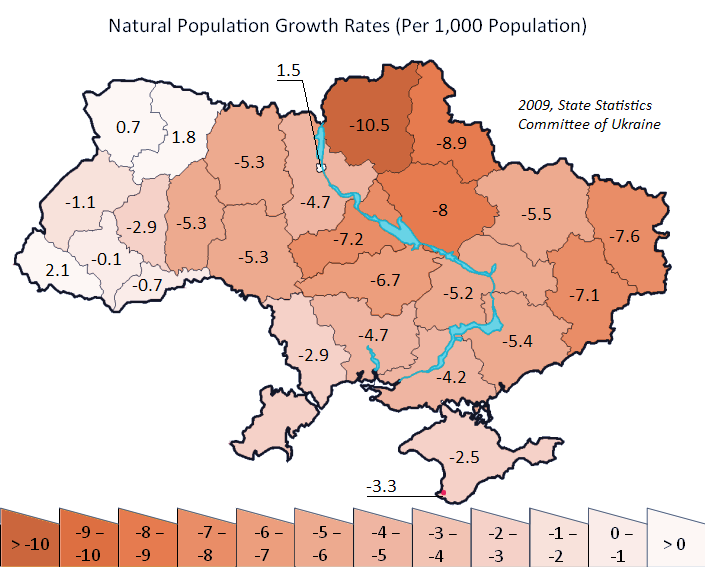
Ukraine's total fertility rate is one of the lowest in Europe. However, significant regional differences in birth rates may account for some of the demographic differences. In the third quarter of 2007, for instance, the highest birth rate among Ukrainian oblasts occurred in Volyn Oblast, with a birth rate of 13.4/1,000 people, compared to the Ukrainian countrywide average of 9.6/1,000 people. Volyn's birthrate was higher than the average birth rate of any European country except Iceland and Albania.
In 2007, for the first time since 1990, five Ukrainian oblasts (Zakarpattia, Rivne, Volyn, Lviv, and Kyiv oblasts) experienced more births than deaths. This demonstrated a positive trend of increasing birthrates in the preceding years throughout Ukraine. The ratio of births to deaths in those oblasts in 2007 was 119%, 117%, 110%, 100.7%, and 108%, respectively.
With the exception of the Kyiv Oblast, all of the oblasts with more births than deaths were in the less-industrially developed oblasts of western Ukraine. According to a spokesperson for Ukraine's Ministry of Justice, the overall ratio of births to deaths in Ukraine improved from 1 to 1.7 in 2004–2005 to 1 to 1.4 in 2008. However, the worst birth-to-death ratios in the country were in the eastern and central oblasts of Donetsk, Luhansk, Cherkasy and Poltava. These areas saw 2.1 deaths for every birth.
Notably, western Ukraine never experienced the Holodomor, as Poland, Czechoslovakia, and Romania ruled it at the time, helping to understand the more favorable demographic trends there, as the rural population was never devastated. Specifically, during the Holodomor, Poland ruled Ivano-Frankivsk, Lviv, Rivne, Ternopil, and Volyn oblasts, whereas Zakarpattia Oblast was under Czechoslovak rule, and Romania controlled Chernivtsi Oblast and the Budjak section of Odesa Oblast.
While abortion rates in the North, South, East and Center of Ukraine are relatively homogeneous, the Western region differs greatly. Overall, the abortion rate in western Ukraine is three times lower than in other regions. This is not due to increased use of modern contraceptive methods in the West, but to the fact that pregnant women in the Western regions are more likely to keep their babies. Donetsk and Dniproptrovsk oblasts in eastern and central Ukraine have the country's highest abortion rate.
| The birth rate in Ukraine, 2003. | The birth rate in Ukraine, 2010. | The death rate in Ukraine, 2010. |
|---|
Regional differences in death rates and health

Death rates also vary widely by region; eastern and southern Ukraine have the highest death rates in the country, and the life expectancy for children born in Chernihiv, Dnipropetrovsk, Donetsk, Kherson, Kropyvnytskyi, Luhansk, Mikolaiv, and Odesa oblasts is 1.5 years lower than the national average.
Ukraine had a suicide rate of 16.5 per 100,000 population in 2017, a significant decrease from the suicide rate of 29.6 per 100,000 in 1998. Suicides were more frequent in the central part of the country (the highest suicide rate was in Kirovohrad Oblast; in western Ukraine, the suicide rate was lower than the national average. Lviv Oblast had the lowest suicide rate (5.3).
Southern and eastern Ukraine also suffered from the highest rates of HIV and AIDS, which impacts life expectancy. In late 2000, 60% of all AIDS cases in Ukraine were concentrated in the Odesa, Dnipropetrovsk, and Donetsk oblasts. A major reason behind the higher rates was that the urbanized and industrialized oblasts in the East and South of Ukraine suffered most from the economic crisis in the 1990s, leading to the increased spread of unemployment, alcoholism, and drug abuse, setting the conditions for a wider spread of the epidemic.
Regional differences in income

The western and central oblasts of Ukraine had lower GDP per capita than Kyiv and the industrialized eastern oblasts of Ukraine. In December 2019, the average monthly salary in Ukraine was 12,264 hryvnias (519 US dollars). Chernihiv Oblast (northern Ukraine) and Kirovohrad Oblast (central Ukraine) had the lowest monthly salary of 8,851 and 9,450 hryvnias, respectively. In contrast, the monthly wage in the city of Kyiv was 18,869 hryvnias per month, and in Kyiv Oblast, 13,259 per month. In 2013, outside of the capital city of Kyiv, the wealthiest oblast was Donetsk with an annual income of 31,048 hryvnias. But as of 2017, it ranked second poorest after Luhansk Oblast, with annual incomes 25,278 hryvnias and 16,416 hryvnias, respectively. Both are in eastern Ukraine and sustained direct losses as a consequence of military actions.
Ukraine recorded one of the sharpest declines in poverty of any transition economy in 2001–2016. The poverty rate, measured against an absolute poverty line (below $1.25 per day, based on World Bank numbers) fell from a high of 32 percent in 2001 to 8 percent in 2005. In terms of poverty rates, the central and northern oblasts have the country's highest poverty rates: 10.0%. The western and southern oblasts are 9.1% and 9%, respectively. Kyiv City had the lowest poverty rate: 1.4%. The percent of the population living under $5.50 a day was 19% in 2005 and dropped to 4.0 percent in 2018.
Urbanization
| Urbanization rate, 2011 | Population density, 2013 | Median population of rural settlements, 2011 |
|---|
Migration
Emigration
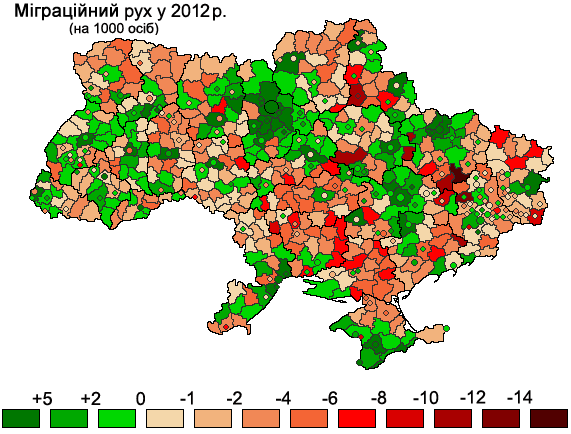
Ukraine is the major source of migrants for many EU member states. In the 1990s and early 2000s, Ukraine's sputtering economy and political instability contributed to rising emigration, especially to nearby Poland and Hungary, but also to other countries such as Italy, Portugal, Spain, Israel and Canada. Although estimates vary, approximately two to three million Ukrainian citizens were working abroad, in construction, service, housekeeping, and agriculture industries.
Between 1991 and 2004, the government counted 2,537,400 individuals who emigrated; 1,897,500 moved to other post-Soviet states, and 639,900 moved to other, mainly Western, states.
By the early 2000s, Ukrainian embassies reported that 300,000 Ukrainian citizens were working in Poland, 200,000 in Italy, approximately 200,000 in the Czech Republic, 150,000 in Portugal, 100,000 in Spain, 35,000 in Turkey, 20,000 in the United States and smaller but significant numbers in Austria, Belgium, France, Germany, Greece, Sweden, Switzerland and the United Kingdom. The largest number of Ukrainian workers abroad, about one million, were in Russia. Since 1992, 232,072 persons born in Ukraine have emigrated to the United States.
Yet absolute numbers are less relevant to the economic impact on host countries than the volume of immigration as a proportion of the native population. Italy had the highest rate of Ukrainian emigrants as a proportion of the native population, while the far more populous Russia had the largest absolute confirmed number of Ukrainian emigrants (excluding Poland, Portugal and the Czech Republic, for which there was conflicting data).
Immigration
Between 1991 and 2003, about 100,000 illegal immigrants were detained at the western borders of Ukraine. As of 2005, about 5,000 illegal immigrants were being detained yearly, mostly from China, India, Pakistan and Afghanistan. At the time, about 3,000 officially registered refugees resided in Ukraine, of whom most were Afghans.
Ukraine accepted some 62,000 refugees from Transnistria following its war in 1992. That same decade, thousands more were also accepted from other post-Soviet conflict zones in Abkhazia, Chechnya and Tajikistan.
Between the 1989 Soviet census and the 2001 census, an increased number of former CIS residents moved to Ukraine from war zones. The number of Armenians in Ukraine almost doubled to 99,900 people during this period, while the number of Georgians and Azerbaijanis also increased substantially.
As of April 2020, 1.4 million Ukrainians were internally displaced due to the war in Donbas.
Notes
References
References
- (11 October 2024). "World Economic Outlook database".
- "World Population Dashboard -Ukraine". United Nations Population Fund.
- Harmash, Olena. (2023-07-07). "Ukrainian refugees: how will the economy recover with a diminished population?". Reuters.
- (8 July 2022). "Ukraine – Emigration and Displacement in Past and Present".
- "Ukraine Population 1950-2023".
- Dickinson, Peter. (2022-02-02). "The new Ukraine needs a new census".
- (5 August 2024). "Ukraine's 2024 mortality rate is 3 times higher than birth rate, data shows".
- Subtelny, Orest. ''Ukraine: A History''. University of Toronto Press, 2000, p. 152.
- Kuzelia, Zenon. ''Ukraine: A Concise Encyclopedia Vol. 1''. University of Toronto Press, 1989, p. 134.
- State Statistics Service of Ukraine. ''Population Censuses in Ukraine''. Retrieved January 5, 2025.
- United Nations. ''World Population Prospects 2023''. Retrieved February 1, 2025.
- State Statistics Service of Ukraine. ''Demographic Reports 2024''. Retrieved January 5, 2025.
- United Nations Population Division. ''Fertility Rate Estimates 2023''. Retrieved February 1, 2025.
- (2002). "A New Estimate of Ukrainian Population Losses During the Crises of the 1930s and 1940s". [[Population Studies]].
- 0-19-860446-7
- Malynovska, Olena (January 2006). [http://www.migrationpolicy.org/article/caught-between-east-and-west-ukraine-struggles-its-migration-policy/ "Caught Between East and West, Ukraine Struggles with Its Migration Policy"]. National Institute for International Security Problems, Kyiv. Retrieved 3 July 2008.
- "United Nations Population Division". United Nations Department of Economic and Social Affairs.
- link. (18 August 2016 . ''Statistics Canada.'')
- Bershidsky, Leonid. (20 February 2019). "Eastern Europe Feeds on a Shrinking Ukraine". Bloomberg.
- Kiryukhin, Denys. (14 May 2019). "Losing Brains and Brawn: Outmigration from Ukraine". Woodrow Wilson International Center for Scholars.
- Tyshchuk, Tetyana. (20 June 2018). "The Great Migration: No One in Ukraine Knows How Many of Our Compatriots Have Moved Abroad".
- [https://archive.today/20120805214701/http://www.ukrstat.gov.ua/operativ/operativ2007/ds/nas_rik/nas_e/nas_rik_e.html State Statistics Committee of Ukraine] Retrieved 18 September 2009
- [http://demoscope.ru/weekly/ssp/sng_pop.php Demoscope] Retrieved 18 September 2009
- "Field Listing – Population growth rate".
- "Infant mortality rate, Ukraine". Cia.gov.
- (23 January 2020). "Ukraine's Population Shrinks By Nearly A Quarter". Radio Free Europe.
- "The government has estimated Ukraine's population at 37.3 million".
- (13 July 2023). "Ukraine: Population loss endangers reconstruction".
- (2005). "The Path to Lowest-low Fertility in Ukraine". [[Population Studies]].
- (July 12, 2018). "The World FactBook – Ukraine". [[The World FactBook]].
- "Bohdan Danylyshyn at the Economic ministry".
- "President meets with business bosses".
- {{in lang. uk [https://web.archive.org/web/20130725181241/http://www.ukrstat.gov.ua/express/expr2009/1109/238.zip The demographic situation in Ukraine in January–September 2009], [[State Statistics Committee of Ukraine]]
- [http://www.unian.info/society/69133-ukraines-birth-rate-shows-first-positive-signs-in-decade.html "Ukraine's birth rate shows first positive signs in decade"]. [[Ukrainian Independent Information Agency]] (UNIAN). 5 October 2007. Retrieved 3 July 2008.
- (2 August 2023). "Ukraine's birth rate plummets in aftermath of Russian invasion, data shows". The Guardian.
- "Because of the war: How Ukraine's population will change by 2030".
- "World Population Prospects – Population Division – United Nations".
- (2003). "Demographic yearbook, 2001". United Nations.
- link. Demoscope Weekly
- link. State Statistics Committee of Ukraine
- "Statistical Yearbooks of the Russian Empire".
- "The Crisis of the 1930s".
- "Державна служба статистики України".
- (19 June 2023). "Ukraine's population".
- (19 September 2025). "Вища мінімалка та податок на OLX: що ми дізнались про бюджет 2026". [[BBC]].
- "Table: 0301. Number of live births, deaths and natural increase (decrease) of the population (0,1)". State Statistics Service of Ukraine.
- "Ukraine Vital Statistics 2025".
- "UNSD — Demographic and Social Statistics".
- "Населення та міграція 2016".
- [http://www.ukrstat.gov.ua/operativ/operativ2010/ds/pp/pp_e/pp1210_e.html State Statistics Committee of Ukraine – Natural increase in population in 2010] Retrieved on 20 May 2011
- "Державна служба статистики України".
- (2017-07-18). "Phantom Syndrome: Ethnic Koreans in Ukraine".
- (2002). "Encyclopedia of Rusyn history and culture". University of Toronto Press.
- (20 December 2021). "The Law on the Indigenous Peoples of Ukraine. What does it bring to national minorities?". [[Culturico]].
- (2013-03-21). "Демоскоп Weekly – Приложение. Справочник статистических показателей". Demoscope.ru.
- (2013-03-21). "Демоскоп Weekly – Приложение. Справочник статистических показателей". Demoscope.ru.
- (2013-03-21). "Демоскоп Weekly – Приложение. Справочник статистических показателей". Demoscope.ru.
- (2013-03-21). "Демоскоп Weekly – Приложение. Справочник статистических показателей". Demoscope.ru.
- (2013-03-21). "Демоскоп Weekly – Приложение. Справочник статистических показателей". Demoscope.ru.
- "Ukraine People 2017 Source: 2017 CIA World Factbook and Other Sources".
- Nadia Kindrachuk. (2015). "The acceleration of the Ukrainians’ assimilation due to deliberate narrowing of the Ukrainian language: 60’s-70’s of the XXth century". Wydawnictwo Naukowe Uniwersytetu Mikołaja Kopernika.
- "Динамика численности этнических украинцев в УССР: на основе итогов Всесоюзных переписей населения 1959 г., 1970 г. и 1979 г.".
- "Population census 2001: Population by nationality".
- "ЛІНГВО-ЕТНІЧНА СТРУКТУРА УКРАЇНИ: РЕГІОНАЛЬНІ ОСОБЛИВОСТІ ТА ТЕНДЕНЦІЇ ЗМІН ЗА РОКИ НЕЗАЛЕЖНОСТІ".
- {{citation. link. (22 April 2018). [[Razumkov Center]] in collaboration with the All-Ukrainian Council of Churches
- "About number and composition population of Autonomous Republic of Crimea by data All-Ukrainian population census".
- [http://demoscope.ru/weekly/2007/0285/tema03.php Рождаемость в Украине самая низкая в Европе], Demoscope.ru, 16–29 April 2007 {{in lang. ru
- United Nations Department of Economic and Social Affairs, Population Division. (2007). "United Nations World Population Prospects: 2006 revision, Table A.15". UN.
- MIGnews: ''[http://mignews.com.ua/en/articles/274596.html Volyn Region – Fertility Leader in Ukraine] {{Webarchive. link. (12 October 2007 '', 10 October 2007. Retrieved 19 October 2007.)
- "CIA world factbook".
- Ukrainian News: ''[http://www.ukranews.com/eng/article/70952.html Birth Rate Exceeds Death Rate in Five Regions of Ukraine First Since 1990s] {{Webarchive. link. (18 February 2009 '' 4 October 2007. Retrieved 19 October 2007.)
- Inna Filipenko. ''The Day''. [http://www.day.kiev.ua/263848/ Births and deaths: A record-breaking half million children were born in Ukraine last year.] #3. 3 February 2009. Retrieved 8 December 2009.
- Natalia LEvchuk, Brienna Perelli-Harris. (2009). [http://www.demogr.mpg.de/papers/working/wp-2009-045.pdf Declining Fertility in UKraine: What is the role of abortion and contraception?] Max Planck Institute for Demographic Research
- "World Bank Report, Chapter 3: Demographic Forecast Under the HIV/AIDS Epidemic".
- UNICEF. (2004). [http://www.unicef-irc.org/research/ESP/countryreport2004/Ukraine_subnational.pdf The Situation of Children and Young People at the Regional Level in Ukraine Prepared by Ukraine Country Statistical Team Co-ordinator: Iryna Kalachova State Statistic Committee, Kyiv]
- "Home".
- The International Encyclopedia of Sexuality of the Kinsey Institute. Tamara V. Hovorun, Ph.D., and Borys M. Vornyk, Ph.D. (Medicine). Rewritten and updated in 2003 by T. V. Hovorun and B. M. Vornyk(2003) [http://www.kinseyinstitute.org/ccies/ua.php#contracep Ukraine] {{Webarchive. link. (23 January 2010)
- [http://europeandcis.undp.org/rhdr.aids2008/report/hiv_ukraine_en.pdf Vulnerability Assessment of People Living With HIV (PLHIV) in Ukraine] {{Webarchive. link. (24 July 2011 ''[[United Nations Development Programme]], page 24'' – Retrieved on 8 December 2009)
- "Average Monthly Salary".
- "Average Income in Ukraine Per Region, 2017 State Statistics Committee of Ukraine".
- "UKRAINE: Poverty Update".
- "Ukraine poverty rate".
- "World Bank, Poverty & Equity and M acroeconomics, Trade & Investment Global Update-Spring-2019".
- By Olena Malynovska, National Institute for International Security Problems, Kyiv [http://www.migrationinformation.org/Profiles/display.cfm?ID=365 Caught Between East and West, Ukraine Struggles with Its Migration Policy]
- (January 2006). "Caught Between East and West, Ukraine Struggles with Its Migration Policy". Migration Policy Institute.
- (21 January 2021). "National Monitoring System Report on the Situation of Internally Displaced Persons – March 2020 – Ukraine | ReliefWeb". Reliefweb.int.
- "Population estimate as of February 1, 2022". State Statistics Service of Ukraine.
- "Population of Ukraine". State Statistics Service of Ukraine.
- (2003). "All-Ukrainian population census of 2001". State Statistics Committee of Ukraine.
- "Ukraine - People and Society - Population". CIA The World Factbook.
- "Total Population by sex - Ukraine - 1990 to 2030". United Nations Department of Economic and Social Affairs.
This article was imported from Wikipedia and is available under the Creative Commons Attribution-ShareAlike 4.0 License. Content has been adapted to SurfDoc format. Original contributors can be found on the article history page.
Ask Mako anything about Demographics of Ukraine — get instant answers, deeper analysis, and related topics.
Research with MakoFree with your Surf account
Create a free account to save articles, ask Mako questions, and organize your research.
Sign up freeThis content may have been generated or modified by AI. CloudSurf Software LLC is not responsible for the accuracy, completeness, or reliability of AI-generated content. Always verify important information from primary sources.
Report