From Surf Wiki (app.surf) — the open knowledge base
Democratic Autonomous Administration of North and East Syria
De facto autonomous region in Syria

De facto autonomous region in Syria
| Field | Value | |||
|---|---|---|---|---|
| conventional_long_name | Democratic Autonomous Administration of North and East Syria | |||
| iso3166code | omit | |||
| native_name | {{Collapsible list | framestyle=border:none; padding:0 | liststyle=text-align:center; | titlestyle=text-align:center; item_style=font-size:85%; |
| title | ||||
| image_flag | Flag of the Democratic Administration of North and East Syria.svg | |||
| common_name | North and East Syria | |||
| status | De facto autonomous region in Syria | |||
| flag_type | Flag | |||
| image_coat | Emblem of the Democratic Administration of North and East Syria.svg | |||
| symbol_type | Emblem | |||
| image_map | ||||
| official_languages | ||||
| capital | Al-Hasakah (2026–present) | |||
| coordinates | ||||
| largest_city | Al-Hasakah | |||
| government_type | Federated diarchic presidential region | |||
| leader_title1 | Co-Presidents | |||
| leader_name1 | {{ubli | Îlham Ehmed | ||
| Mansur Selum<ref name | recognition}} | |||
| legislature | People's Democratic Council | |||
| area_km2 | 50,000 | |||
| area_footnote | ||||
| population_estimate_year | 2024 | |||
| population_estimate | 4,600,000 | |||
| sovereignty_type | Autonomous region | |||
| established_event1 | Transitional administration declared | |||
| established_date1 | 2013 | |||
| established_event2 | Cantons declare autonomy | |||
| established_date2 | January 2014 | |||
| established_event3 | Cantons declare federation | |||
| established_date3 | 17 March 2016 | |||
| established_event4 | New administration declared | |||
| established_date4 | 6 September 2018 | |||
| currency | Syrian pound | |||
| currency_code | SYP | |||
| time_zone | Arabia Standard Time | |||
| utc_offset | +3 | |||
| drives_on | right |
|ar|ku-Latn| syc|tr}} |Mansur Selum}} The Democratic Autonomous Administration of North and East Syria (DAANES), also known as Rojava, is a de facto autonomous region in northeastern Syria. It consists of self-governing sub-regions of Jazira and Euphrates. The region gained its de facto autonomy in 2012 in the context of the ongoing Rojava conflict and the wider Syrian civil war, in which its official military force, the Syrian Democratic Forces (SDF), has taken part.
While conducting some foreign relations, the region is neither officially recognized as autonomous by the government of Syria, state, or other governments institutions except for the Catalan Parliament. Northeastern Syria is polyethnic and home to sizeable ethnic Arab, Kurdish, and Assyrian populations, with smaller communities of ethnic Turkmen, Armenians, Circassians, and Yazidis.
Independent organizations providing healthcare in the region include the Kurdish Red Crescent, the Syrian American Medical Society, the Free Burma Rangers, and Doctors Without Borders. Since 2016, Turkish and Turkish-backed Syrian rebel forces have occupied parts of northern Syria through a series of military operations against the SDF.
Following the January 2026 northeastern Syria offensive by government forces, the DAANES lost 80% of the territory it had controlled, and the SDF retreated to Al-Hasakah Governorate.
Polity names and translations
Parts of northern Syria are known as Western Kurdistan, or simply Rojava among Kurds, one of the four parts of Greater Kurdistan. The name "Rojava" was thus associated with a Kurdish identity of the administration. As the region expanded and increasingly included areas dominated by non-Kurdish groups, mostly Arabs, "Rojava" was used less and less by the administration in hopes of deethnicising its appearance and making it more acceptable to other ethnicities. Regardless, the polity continued to be called "Rojava" by locals and international observers, with journalist Metin Gurcan noting that "the concept of Rojava [had become] a brand gaining global recognition" by 2019.
The territory around Jazira province of northeastern Syria is called Gozarto, part of the historical Assyrian homeland, by Syriac-Assyrians. The first name of the local government for the Kurdish-dominated areas in Afrin District, Ayn al-Arab District (Kobanî), and northern al-Hasakah Governorate was "Interim Transitional Administration", adopted in 2013. After the three autonomous cantons were proclaimed in 2014 together with a written Social Contract, Territories governed by the Democratic Union Party (Syria) (PYD) were also nicknamed "the Autonomous Regions" or "Democratic Autonomous Administration". On 17 March 2016, northern Syria's administration self-declared the establishment of a federal system of government as the Democratic Federation of Rojava – Northern Syria; sometimes abbreviated as NSR).
The updated December 2016 constitution of the polity uses the name Democratic Federation of Northern Syria (DFNS). On 6 September 2018, the Syrian Democratic Council adopted a new name for the region, naming it the Autonomous Administration of North and East Syria (NES or AANES) also sometimes translated into English as the Self-Administration of North and East Syria (SANES), encompassing the Euphrates and Jazira regions as well as the local civil councils in the regions of Raqqa, Tabqa, and Deir ez-Zor. In December 2023, the region adopted a new constitution, with a new name for the region, the Democratic Autonomous Administration of North and East Syria (DAANES). The YPG/PYD have at times used the names Federal Northern Syria and the Democratic Confederalist Autonomous Areas of Northern Syria.
History
Background

Northern Syria is part of the Fertile Crescent, and includes archaeological sites dating to the Neolithic, such as Tell Halaf. In antiquity, the area was part of the Mitanni kingdom, its centre being the Khabur river valley in modern-day Jazira Region. It was then part of Assyria, with the last surviving Assyrian imperial records, from between 604 BC and 599 BC, being found in and around the Assyrian city of Dūr-Katlimmu. Later, it was ruled by different dynasties and empires – the Achaemenids of Iran, the Hellenistic empires who succeeded Alexander the Great, the Artaxiads of Armenia, Rome, the Iranian Parthians and Sasanians, then by the Byzantines and successive Arab Islamic caliphates. In course of these regimes, different groups settled in northern Syria, often contributing to population shifts. Arab tribes have been present in the area for millennia. Under the Hellenistic Seleucid Empire (312–63 BC), different tribal groups and mercenaries were settled in northern Syria as military colonists; these included Arabs and possibly Kurds. Jan Retso argued that Abai, an Arab settlement where the Seleucid king Antiochus VI Dionysus was raised, was located in northern Syria. By the 3rd century, the Arab tribe of the Fahmids lived in northern Syria.
By the 9th century, northern Syria was inhabited by a mixed population of Arabs, Assyrians, Kurds, Turkic groups, and others. Kurdish tribes in the area often operated as soldiers for hire, and were still placed in specific military settlements in the northern Syrian mountains. There existed a Kurdish elite of which Saladin, the founder of the Ayyubid dynasty and the Emir of Masyaf in the 12th century were part of. Under Saladin's rule, northern Syria experienced a mass immigration of Turkic groups who came into conflict with Kurdish tribes, resulting in clashes that wiped out several Kurdish communities.
During the Ottoman Empire (1516–1922), large Kurdish-speaking tribal groups both settled in and were deported to areas of northern Syria from Anatolia. By the 18th century, five Kurdish tribes existed in northeastern Syria. The demographics of this area underwent a huge shift in the early part of the 20th century. Some Circassian, Kurdish and Chechen tribes cooperated with the Ottoman (Turkish) authorities in the massacres of Armenian and Assyrian Christians in Upper Mesopotamia, between 1914 and 1920, with further attacks on unarmed fleeing civilians conducted by local Arab militias. Many Assyrians fled to Syria during the genocide and settled mainly in the Jazira area. Starting in 1926, the region saw another immigration of Kurds following the failure of the Sheikh Said rebellion against the Turkish authorities. While many of the Kurds in Syria have been there for centuries, waves of Kurds fled their homes in Turkey and settled in Syrian Al-Jazira Province, where they were granted citizenship by the French Mandate authorities. The number of Turkish Kurds settled in al-Jazira province during the 1920s was estimated at 20,000 people, out of 100,000 inhabitants, with the remainder of the population being Christians (Syriac, Armenian, Assyrian) and Arabs.
Syria's independence and rule of the Ba'ath Party

Following Syria's independence, policies of Arab nationalism and attempts at forced Arabization became widespread in the country's north, to a large part directed against the Kurdish population. The region received little investment or development from the central government and laws discriminated against Kurds owning property, driving cars, working in certain professions and forming political parties. Property was routinely confiscated by government loansharks. After the Ba'ath Party seized power in the 1963 Syrian coup d'état, non-Arab languages were forbidden at Syrian public schools. This compromised the education of students belonging to minorities like Kurds, Turkmen, and Assyrians. Some groups like Armenians, Circassians, and Assyrians were able to compensate by establishing private schools, but Kurdish private schools were also banned. Northern Syrian hospitals lacked equipment for advanced treatment and instead patients had to be transferred outside the region. Numerous place names were arabized in the 1960s and 1970s. Kurdish cultural festivals like Newroz were effectively banned.

In many instances, the Syrian government arbitrarily deprived ethnic Kurdish citizens of their citizenship. The largest such instance was a consequence of a census in 1962, which was conducted for exactly this purpose. 120,000 ethnic Kurdish citizens saw their citizenship arbitrarily taken away and became stateless. This status was passed to the children of a "stateless" Kurdish father. In 1973, the Syrian authorities confiscated 750 km2 of fertile agricultural land in Al-Hasakah Governorate, which was owned and cultivated by tens of thousands of Kurdish citizens, and gave it to Arab families brought in from other provinces. In 2007, in the Al-Hasakah Governorate, 600 km2 around Al-Malikiyah were granted to Arab families, while tens of thousands of Kurdish inhabitants of the villages concerned were evicted. These and other expropriations was part of the so-called "Arab Belt initiative" which aimed to change the demographic fabric of the resource-rich region. Accordingly, relations between the Syrian government and the Syrian Kurdish population were tense.
The response of northern Syrian parties and movements to the policies of Hafez al-Assad's Ba'athist government varied greatly. Some parties opted for resistance, whereas others such as the Kurdish Democratic Progressive Party and the Assyrian Democratic Party attempted to work within the system, hoping to bring about changes through soft pressure. In general, parties that openly represented certain ethnic and religious minorities were not allowed to participate in elections, but their politicians were occasionally allowed to run as Independents. Some Kurdish politicians won seats during the Syrian elections in 1990. The government also recruited Kurdish officials, in particular as mayors, to ease ethnic relations. Regardless, northern Syrian ethnic groups remained deliberately underrepresented in the bureaucracy, and many Kurdish majority areas were run by Arab officials from other parts of the country. Security and intelligence agencies worked hard to suppress dissidents, and most Kurdish parties remained underground movements. The government monitored, though generally allowed this "sub-state activity" because the northern minorities including the Kurds rarely caused unrest with the exception of the 2004 Qamishli massacre. The situation improved after the death of Hafez al-Assad and the election of his son, Bashar al-Assad, under whom the number of Kurdish officials grew.
Despite the Ba'athist internal policies which officially suppressed a Kurdish identity, the Syrian government allowed the Kurdistan Workers' Party (PKK) to set up training camps from 1980. The PKK was a militant Kurdish group led by Abdullah Öcalan which was waging an insurgency against Turkey. Syria and Turkey were hostile toward each other at the time, resulting in the use of the PKK as proxy group. The party began to deeply influence the Syrian Kurdish population in the Afrin and Ayn al-Arab Districts, where it promoted Kurdish identity through music, clothing, popular culture, and social activities. In contrast, the PKK remained much less popular among Kurds in al-Hasakah Governorate, where other Kurdish parties maintained more influence. Many Syrian Kurds developed a long-lasting sympathy for the PKK, and a large number, possibly more than 10,000, joined its insurgency in Turkey. A rapprochement between Syria and Turkey brought an end to this phase in 1998, when Öcalan and the PKK were formally expelled from northern Syria. Regardless, the PKK maintained a clandestine presence in the region.
In 2002, the PKK and allied groups organized the Kurdistan Communities Union (KCK) to implement Öcalan's ideas in various Middle Eastern countries. A KCK branch was also set up in Syria, led by Sofi Nureddin and known as "KCK-Rojava". In an attempt to outwardly distance the Syrian branch from the PKK, the Democratic Union Party (PYD) was established as de facto Syrian "successor" of the PKK in 2003. The "People's Defense Units" (YPG), a paramilitary wing of the PYD, was also founded during this time, but remained dormant.
Establishment of de facto autonomy and war against ISIL
Main article: Rojava conflict, DAANES–Syria relations, Rojava–Islamist conflict

In 2011, a civil uprising erupted in Syria, prompting hasty government reforms. One of the issues addressed during this time was the status of Syria's stateless Kurds, as President Bashar al-Assad granted about 220,000 Kurds citizenship. In course of the next months, the crisis in Syria escalated into a civil war. The armed Syrian opposition seized control of several regions, while security forces were overstretched. In mid-2012 the government responded to this development by withdrawing its military from three mainly Kurdish areas and leaving control to local militias. This has been described as an attempt by the Assad regime to keep the Kurdish population out of the initial civil uprising and civil war.
Existing underground Kurdish political parties, namely the PYD and the Kurdish National Council (KNC), joined to form the Kurdish Supreme Committee (KSC). The People's Protection Units (YPG) militia was reestablished to defend Kurdish-inhabited areas in northern Syria. In July 2012, the YPG established control in the towns of Kobanî, Amuda and Afrin, and the Kurdish Supreme Committee established a joint leadership council to administer the towns. Soon YPG also gained control of the cities of Al-Malikiyah, Ras al-Ayn, al-Darbasiyah, and al-Muabbada and parts of Hasakah and Qamishli. Doing so, the YPG and its female wing, the Women's Protection Units (YPJ), mostly battled factions of the Free Syrian Army, and Islamist militias like the al-Nusra Front and Jabhat Ghuraba al-Sham. It also eclipsed rival Kurdish militias, and absorbed some government loyalist groups. According to researcher Charles R. Lister, the government's withdrawal and concurrent rise of the PYD "raised many eyebrows", as the relationship between the two entities was "highly contentious" at the time. The PYD was known to oppose certain government policies, but had also strongly criticised the Syrian opposition.

Following a deadly PYD repression of opposition demonstrations in Amuda, the Kurdish National Council withdrew from the Kurdish Supreme Committee. Unopposed, the PYD's political coalition, Movement for a Democratic Society (TEV-DEM), controlled the Kurdish Supreme Committee until the latter was dissolved by the cantonal Democratic Autonomous Administration. On 19 July 2013, the PYD announced that it had written a constitution for an "autonomous Syrian Kurdish region", and planned to hold referendum to approve the constitution in October 2013. Qamishli served as first de facto capital of the PYD-led governing body, which was official called the "Interim Transitional Administration". The announcement was widely denounced by both moderate as well as Islamist factions of the Syrian opposition. In January 2014, three areas declared their autonomy as cantons (later Afrin Region, Jazira Region and Euphrates Region) and an interim constitution (also known as social contract) was approved. The Syrian opposition and the Kurdish parties belonging to the KNC condemned this move, regarding the canton system as illegal, authoritarian, and supportive of the Syrian government. The PYD countered that the constitution was open to review and amendment, and that the KNC had been consulted on its drafting beforehand. From September 2014 to spring 2015, the YPG forces in Kobanî Canton, supported by some Free Syrian Army militias and leftist international and Kurdistan Workers' Party (PKK) volunteers, fought and finally repelled an assault by the Islamic State of Iraq and the Levant (ISIL) during the Siege of Kobanî, and in the YPG's Tell Abyad offensive of summer of 2015, the regions of Jazira and Kobanî were connected.
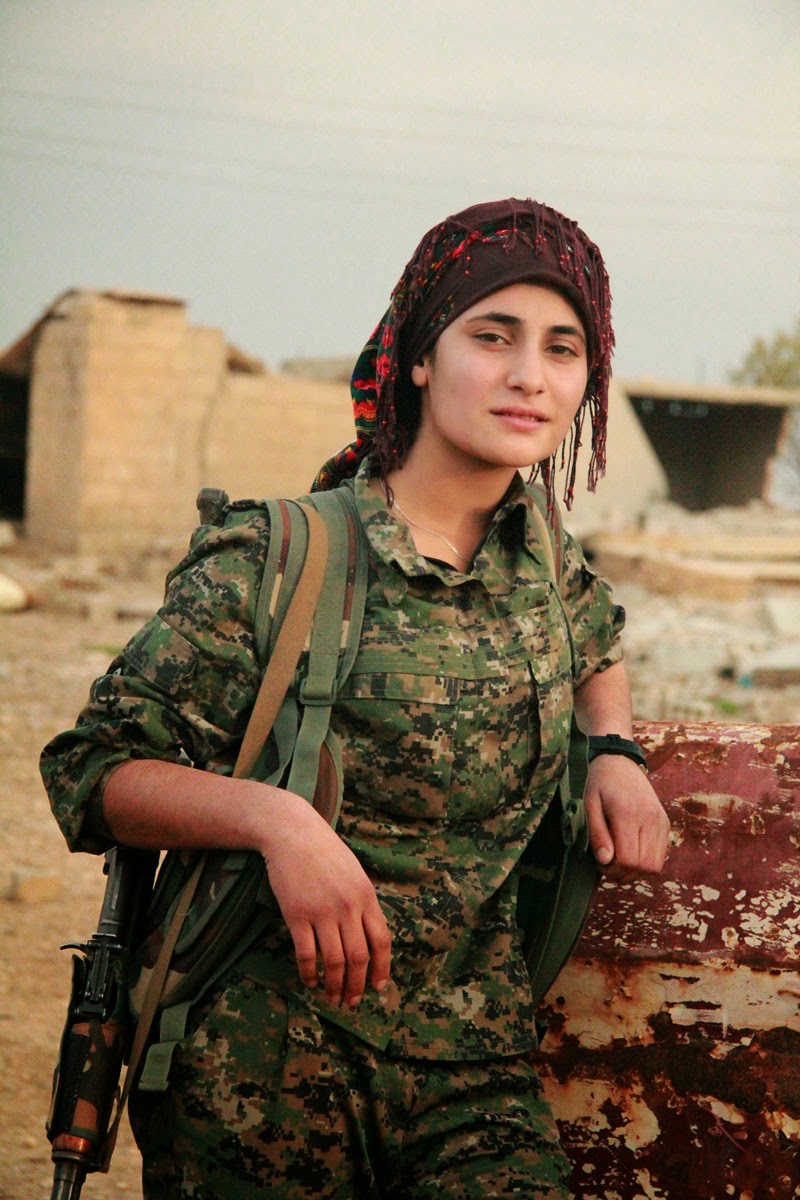
After the YPG victory over ISIL in Kobanî in March 2015, an alliance between YPG and the United States was formed, which greatly worried Turkey, because Turkey stated the YPG was a clone of the Kurdistan Workers' Party (PKK) which Turkey (and the U.S. and the E.U.) designate as terrorists. The declaration was quickly denounced by both the Syrian government and the National Coalition of Syrian Revolutionary and Opposition Forces.
In March 2016, Hediya Yousef and Mansur Selum were elected co-chairpersons for the executive committee to organise a constitution for the region, to replace the 2014 constitution. In July 2016, a draft for the new constitution was presented, based on the principles of the 2014 constitution, mentioning all ethnic groups living in Northern Syria and addressing their cultural, political and linguistic rights. The main political opposition to the constitution have been Kurdish nationalists, in particular the KNC, who have different ideological aspirations than the TEV-DEM coalition. On 28 December 2016, after a meeting of the 151-member Syrian Democratic Council in Rmelan, a new constitution was resolved; despite objections by 12 Kurdish parties, the region was renamed the "Democratic Federation of Northern Syria", removing the name "Rojava".
Turkish military operations and occupation
.jpg)
Since 2012, when the first YPG pockets appeared, Turkey had been alarmed by the presence of PKK-related forces at its southern border and grew concerned when the YPG entered into an alliance with the US to oppose ISIS forces in the region. The Turkish government refused to allow aid to be sent to the YPG during the Siege of Kobanî. This led to the Kurdish riots, the breakdown of the 2013–2015 peace process in July 2015 and the renewal of armed conflict between the PKK and Turkish forces. According to the Turkish pro-government newspaper Daily Sabah, the YPG's parent organisation, the PYD, provided the PKK with militants, explosives, arms and ammunition.
In August 2016, Turkey launched Operation Euphrates Shield to prevent the YPG-led Syrian Democratic Forces (SDF) from linking Afrin Canton (now Afrin Region) with the rest of Rojava and to capture Manbij from the SDF. Turkish and Turkish-backed Syrian rebel forces prevented the linking of Rojava's cantons and captured all settlements in Jarabulus previously under SDF control. The SDF handed over part of the region to the Syrian government to act as a buffer zone against Turkey. Manbij remained under SDF control.
In early 2018, Turkey launched Operation Olive Branch alongside the Turkish-backed Syrian National Army to capture the Kurdish-majority Afrin and oust the YPG/SDF from the region. Afrin Canton, a subdivision of the region, was occupied and over 100,000 civilians were displaced and relocated to Afrin Region's Shahba Canton which remained under SDF, then joint SDF-Syrian Arab Army (SAA) control. The remaining SDF forces later launched an ongoing insurgency against the Turkish and Turkish-backed Syrian rebel forces.
_bombalanıyor.jpg)
In 2019, Turkey launched Operation Peace Spring against the SDF. On 9 October, the Turkish Air Force launched airstrikes on border towns. On 6 October President of the United States Donald Trump had ordered United States troops to withdraw from northeastern Syria where they had been providing support to the SDF. Journalists called the withdrawal "a serious betrayal to the Kurds" and "a catastrophic blow to US credibility as an ally and Washington's standing on the world stage"; one journalist stated that "this was one of the worst US foreign policy disasters since the Iraq War". Turkish and Turkish-backed Syrian rebel forces captured 68 settlements, including Ras al-Ayn, Tell Abyad, Suluk, Mabrouka and Manajir during the 9-day operation before a 120-hour ceasefire was announced. The operation was condemned by the international community, and human rights violations by Turkish forces were reported. Media outlets labelled the attack "no surprise" because Turkish president Recep Tayyip Erdoğan had for months warned that the presence of the YPG on the Turkish-Syrian border despite the Northern Syria Buffer Zone was unacceptable. An unintended consequence of the attack was that it raised the worldwide popularity and legitimacy of the northeastern Syrian administration, and several PYD and YPG representatives became internationally known to an unprecedented degree. However, these events caused tensions within the KCK, as differences emerged between the PKK and PYD leadership. The PYD was determined to maintain the regional autonomy and hoped for a continued alliance with the United States. In contrast, the PKK central command was now willing to restart negotiations with Turkey, distrusted the United States, and emphasized the international success of its leftist ideology over the survival of Rojava as administrative entity.
Fall of the Assad regime and collapse
Main article: Manbij offensive (2024), East Aleppo offensive (2024–2025), 2026 northeastern Syria offensive
.jpg)
During the November 2024 Syrian opposition offensives, which toppled the Assad regime, the SDF captured the southeastern city of Deir ez-Zor. SDF forces withdrew from Deir ez-Zor following protests of local population and the city was swiftly occupied by Tahrir al-Sham. On 12 December, DAANES announced that it had adopted the flag of the Syrian revolution as the official flag of Syria.
Despite the collapse of the Assad regime, Turkey and Turkish-backed SNA fighters in northern Syria launched an offensive against SDF forces. On 9 December, SNA fighters captured the city of Manbij. The Turkish/SNA offensive continued with the 2024 Kobani clashes which ended in a victory for the SDF. This came following a US mediated truce and an SNA failure to capture Tishrin Dam and Qara-Qowzak Bridge. This was followed by a counter-offensive in the East Aleppo offensive (2024–2025). A ceasefire was signed to, the 10 March agreement, had been agreed too brokered by the International Coalition keeping the disputed dams under SDF control until the agreement expired on January 1, 2026.
In October and December 2025 clashes would break out over the SDF and DAANES' control over the Sheikh Maqsood enclave of Aleppo, however, both times the SDF and Government where able to hold diplomatic discussions and stop the clashes after a few days, preserving the status quo. Despite these clashes, on 18 December 2025 the United Nations issued a report that the SDF and DAANES should agree on a roadmap for integration into the new Syrian government. Talks were agreed too, however, negotiations with the new government quickly stalled due to DAANES criticism of the interim government's inclusivity. By 25 December the Syrian government had announced it was suspending all communications with the SDF and DAANES.
On 3 January 2026, Maryam Ibrahim, a spokesmen for the DAANES Negotiation Committee stated that although relations remain "a bit weak" that both sides are prioritizing military integration, and that there would be a finalized time-frame for such "in the coming days." However, on 6 January, the Syrian government announced that SDF forces had opened fire on their troops in Aleppo, resulting in the death of one government solider. A large scale combined arms assault would take place against the enclave on 7 January, and an infiltration attempt on 8 January, before the SDF forces in Sheikh Maqsood agreed to a government ceasefire on 9 January, that saw the SDF fighters, and those civilians that wished to accompany them, being bussed out of the enclave to the DAANES. A final government assault would take place on 10 January, seeing five Asayish operatives performing a suicide bombing against advancing government forces, as by the end of the day the enclave was in Government hands, with remaining SDF forces surrendering.
On 13 January 2026, the newly reorganized Syrian Army expanded its operation, launching a major offensive against the DAANES' holdings in Raqqa and Deir ez-Zor Governorates. The new government offensive saw Arab elements of the SDF disintegrate, as the Arab Tribal and Clan Forces waged a guerilla war against them in Deir-ez-Zor that secured strategic oil fields while Arab SDF units in predominantly Arab cities such as Raqqa defected en masse. On 18 January, a 14-point ceasefire agreement with the SDF, negotiated through the US envoy Tom Barrack, was announced, under which the SDF is set to be integrated into the Syrian government, and the governorates of Raqqa and Deir ez-Zor immediately handed over to the government, leaving the DAANES as a rump state in Al-Hasakah Governorate. Additionally the ceasefire outlined the administration of prisoner-of-war camps for Islamic State members, all border crossings and oil fields.
Politics
.svg)
The supporters of the region's administration state that it is an officially secular polity, promoting decentralization, gender equality, environmental sustainability, social ecology, and pluralistic tolerance for religious, cultural, and political diversity, and that these values are mirrored in its constitution, society, and politics, stating it to be a model for a federalized Syria as a whole rather than outright independence. Kurdification, and displacement. At the same time, DAANES has also been described by partisan and non-partisan sources as the most democratic system in Syria, with direct open elections, social equality, respecting human rights within the region, as well as defense of minority and religious rights within Syria.
DAANES has widespread support for its universal democratic, sustainable, autonomous, pluralist, equal, and feminist policies in dialogues with other parties and organizations.
The political system of the region is based on its adopted constitution, officially titled "Charter of the Social Contract". The first version of the constitution was ratified on 9 January 2014 and provides that all residents of the region shall enjoy fundamental rights such as gender equality and freedom of religion. The region's system of community government has direct democratic aspirations.
The former diplomat Carne Ross observed in September 2015 in The New York Times:
In 2016, a Chatham House research paper stated that power is heavily centralized in the hands of the Democratic Union Party (PYD). Abdullah Öcalan, a Kurdistan Workers' Party (PKK) leader imprisoned in İmralı, Turkey, has become an iconic figure in the region whose ideology of democratic confederalism has shaped the region's society and politics.
Besides the parties represented in TEV-DEM and the KNC, several other political groups operate in northern Syria. Several of these, such as the Kurdish National Alliance in Syria, the Democratic Conservative Party, the Assyrian Democratic Party, and others actively participate in governing the region.
.jpg)
The politics of the region has been described as having "libertarian transnational aspirations" influenced by the PKK's shift toward anarchism, but also includes various "tribal, ethno-sectarian, capitalist and patriarchal structures". The region has a "co-governance" policy in which each position at each level of government in the region includes a "female equivalent of equal authority" to a male. Similarly, there are aspirations for equal political representation of all ethno-religious components – Arabs, Kurds and Assyrians being the most sizeable ones. This has been compared this to the Lebanese confessionalist system, which is based on that country's major religions.
The PYD-led rule triggered protests in various areas since they first captured territory. In 2019, residents of tens of villages in the eastern Deir ez-Zor Governorate demonstrated for two weeks, regarding the new regional leadership as Kurdish-dominated and non-inclusive, citing arrests of suspected ISIL members, looting of oil, lack of infrastructure as well as forced conscription into the SDF as reasons. The protests resulted in deaths and injuries. In 2016, researcher Kheder Khaddour stated that leaders of local councils in Raqqa Governorate had been chosen by the SDF in a top-down way, and that the vetting process for identifying ISIL members placed obstacles for the return of refugees. He stated that there was dissent about the new structures as well as a lack of trust between the SDF and some demographic components of the local population.
Qamishli initially served as the de facto capital of the administration, but the area's governing body later relocated to Ayn Issa.
Separation of powers
During the period between 2018–2019, separation of powers in the political structure included three major components: the Syrian Democratic Council as a representative body of political parties and organisations; AANES itself; and TEV-DEM as a representative body of trade unions and civil society associations. AANES itself is approximately structured in the Montesquieu model, having the Executive Council with executive oversight responsibilities via offices and commissions; the General Council which coordinates legislation and aims to promote legal unification between regions; and the Justice Council that aims to coordinate the justice systems of the regions.
In the 2023 constitution, the People's Council has legislative power under Article 92, and the Law Council "develops laws and regulations based on ethics and democratic principles of rights" under Article 103.
Communes are intended to be the core political body, with a succession of higher level (neighbourhood, sub-district, district, canton, region) councils. Decisions are expected to be made according to the subsidiarity principle – at the most local level appropriate for the decision. Under the 2018–2019 structure, councils and committees have a gender quota requiring minima of 40% women and 40% men.
Administrative divisions
Main article: Jazira Region, Euphrates Region, Afrin Region
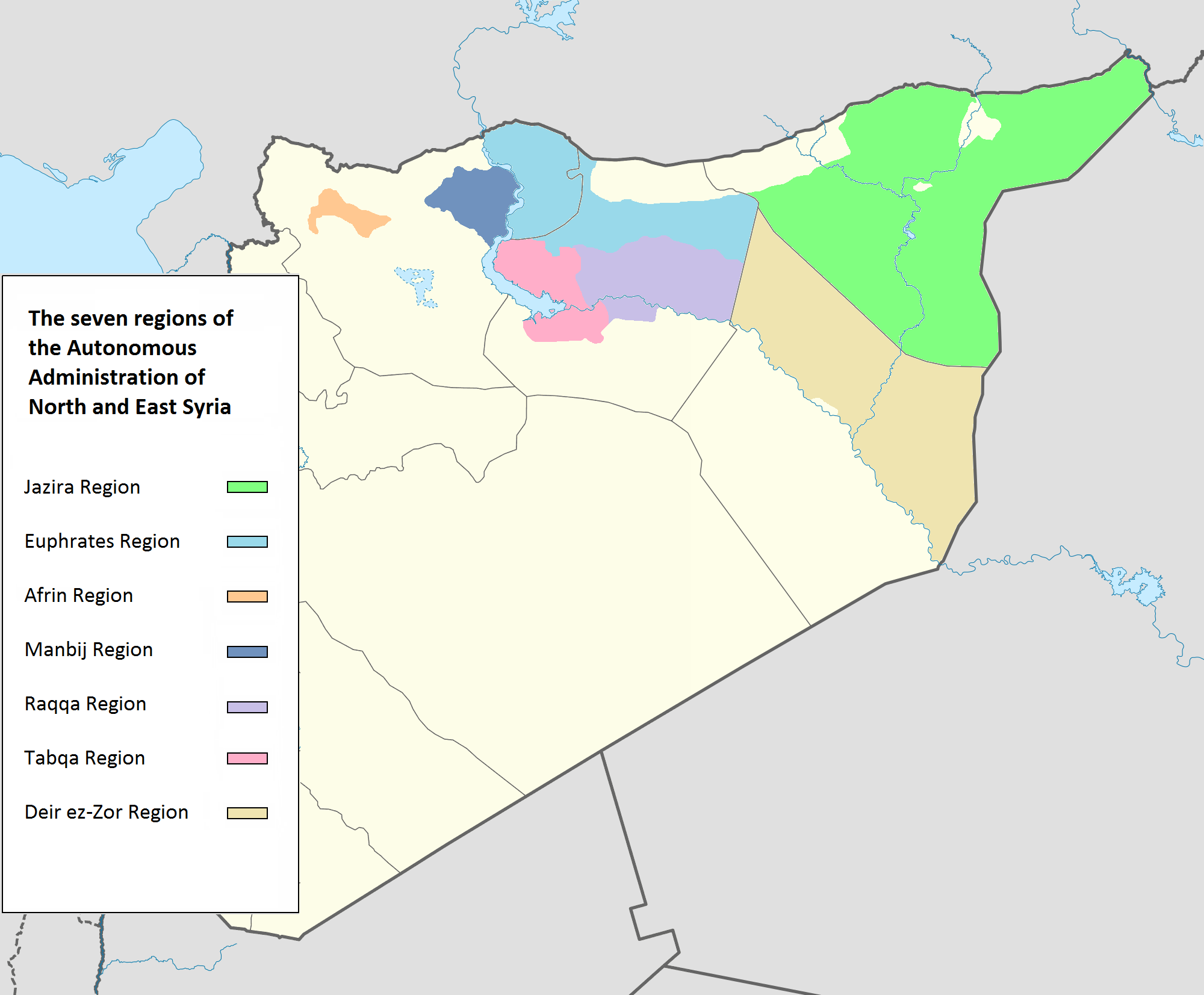
Article 8 of the 2014 constitution stipulates that "All Cantons in the autonomous regions are founded on the principle of local self-government. Cantons may freely elect their representatives and representative bodies, and may pursue their rights insofar as it does not contravene the articles of the Charter." The cantons were later reorganized into regions with subordinate cantons/provinces, areas, districts and communes. On 6 September 2018, during a meeting of the Syrian Democratic Council in Ayn Issa, a new name for the region was adopted, the "Autonomous Administration of North and East Syria", encompassing the Euphrates, Afrin, and Jazira regions as well as the local civil councils in the regions of Raqqa, Manbij, Tabqa, and Deir ez-Zor. During the meeting, a 70-member "General Council for the Autonomous Administration of North and East Syria" was formed.
The SDF withdrew from the Afrin region in 2018 from the Manbij region in 2024, and from the Deir ez-Zor, Raqqa, and Tabqa regions in 2026, as well as partially from the Jazira and Euphrates regions.
| Regions | Official name (languages) | Prime Ministers | Deputy Prime Ministers |
|---|---|---|---|
| Jazira Region | Akram Hesso | ||
| Euphrates Region | Enver Muslim |
Syrian Democratic Council
Main article: Syrian Democratic Council

In December 2015, during a meeting of the region's representatives in Al-Malikiyah, the Syrian Democratic Council (SDC) was established to serve as the political representative of the Syrian Democratic Forces. The co-leaders selected to lead the SDC at its founding were prominent human rights activist Haytham Manna and TEV-DEM Executive Board member Îlham Ehmed.
Elections
Method
Per the 2023 Constitution of AANES, three fifths of municipal representatives are elected by the general population and two fifths are representatives chosen by demographic components. The AANES-level Democratic Council of People of the North and East Syria is required to have fifty percent women.
The municipal governing bodies are referred to as city councils, town councils and for the smallest units, communes. As of July 2025, there were 36 city councils, 152 town councils and 3950 communes.
Commune and council elections
General elections were planned for 2014 and 2018, but were postponed due to fighting.
Local elections were held in March 2015.
Commune elections were held on 22 September 2017. 12,421 candidates competed for around 3,700 communal positions during the elections, which were organized by the High Electoral Commission.
Elections for the city and town councils of the Jazira Region, Euphrates Region and Afrin Region were held in December 2017. Most of Afrin Region was occupied by Turkish-led forces in early 2018, though the administrative division continued to operate from Tell Rifaat under joint YPG-Syrian Army control.
The planned 2024 elections were repeatedly postponed.
Education, media, and culture
School

Under the rule of the Ba'ath Party, school education consisted of only Arabic language public schools, supplemented by Assyrian private confessional schools. In 2015, the region's administration introduced primary education in the native language (either Kurdish or Arabic) and mandatory bilingual education (Kurdish and Arabic) for public schools, with English as a mandatory third language. There are ongoing disagreements and negotiations over curriculums with the Syrian central government,

In August 2016, the Ourhi Centre was founded by the Assyrian community in the city of Qamishli, to educate teachers in order to make Syriac-Aramaic an additional language in public schools in Jazira Region, which then started in the 2016/17 academic year. According to the region's Education Committee, in 2016/2017 "three curriculums have replaced the old one, to include teaching in three languages: Kurdish, Arabic and Syriac." In August 2017 Galenos Yousef Issa of the Ourhi Centre announced that the Syriac curriculum would be expanded to grade 6, which earlier had been limited to grade 3, with teachers being assigned to Syriac schools in Al-Hasakah, Al-Qahtaniyah and Al-Malikiyah. At the start of the academic year 2018–2019, the curricula in Kurdish and Arabic had been expanded to grades 1–12 and Syriac to grades 1–9. "Jineology" classes had also been introduced. In general, schools are encouraged to teach the administration's "uptopian doctrine" which promotes diversity, democracy, and the ideas of Abdullah Öcalan. Local reactions to the changes to the school system and curriculum were mixed. While many praised the new system because it encouraged tolerance and allowed Kurds and other minorities to be taught in their own languages, others have criticised it as de facto compulsory indoctrination.
The federal, regional and local administrations in the region put much emphasis on promoting libraries and educational centers, to facilitate learning and social and artistic activities. Examples are the Nahawand Center for Developing Children's Talents in Amuda (est. 2015) and the Rodî û Perwîn Library in Kobani (May 2016).
For Assyrian private confessional schools there had at first been no changes. However, in August 2018 it was reported that the region's authorities was trying to implement its own Syriac curriculum in private Christian schools that have been continuing to use an Arabic curriculum with limited Syriac classes approved by the Assad regime and originally developed by Syrian Education Ministry in cooperation with Christian clergy in the 1950s. The threatening of the closure of schools not complying with this resulted in protests erupting in Qamishli. A deal was later reached in September 2018 between the region's authorities and the local Syriac Orthodox archbishopric, where the two first grades in these schools would learn the region's Syriac curriculum and grades three to six would continue to learn the Damascus approved curriculum.
Higher education
As of 2024, the region has three universities: University of Rojava in Qamishli, Kobani University in Kobani, and Al-Sharq University in Raqqa and Tabqa. The three universities are represented by the Universities Council of Northern and Eastern Syria.
While there was no institution of tertiary education on the territory of the region at the onset of the Syrian Civil War, an increasing number of such institutions have been established by the regional administrations in the region since.
- In September 2014, the Mesopotamian Social Sciences Academy in Qamishli started classes.
- In August 2015, the traditionally-designed University of Afrin in Afrin started teaching, with initial programs in literature, engineering and economics, including institutes for medicine, topographic engineering, music and theater, business administration and the Kurdish language. After the Turkish army invaded Afrin in 2018, several of it students were transferred to the University of Rojava in Qamishli.
- In July 2016, Jazira Canton Board of Education started the University of Rojava in Qamishli, with faculties for Medicine, Engineering, Sciences, and Arts and Humanities. Programs taught include health, computer and agricultural engineering; physics, chemistry, history, psychology, geography, mathematics and primary school teaching and Kurdish literature. There is an additional Faculty for Petroleum and Pharmacology in Rmelan. Its language of instruction is Kurdish, and with an agreement with Paris 8 University in France for cooperation, the university opened registration for students in the academic year 2016–2017.
- In August 2016 Jazira Canton police forces took control of the remaining parts of Hasakah city, which included the Hasakah campus of the Arabic-language Al-Furat University, and with mutual agreement the institution continues to be operated under the authority of the Damascus government's Ministry of Higher Education.
Media

Incorporating the Universal Declaration of Human Rights, the International Covenant on Civil and Political Rights, the International Covenant on Economic, Social and Cultural Rights, as well as other internationally recognized human rights conventions, the 2014 Constitution of North and East Syria guarantees freedom of speech and freedom of the press. As a result, a diverse media landscape has developed in the region, in each of the Kurdish, Arabic, Syriac-Aramaic and Turkish languages of the land, as well as in English, and media outlets frequently use more than one language. Among the most prominent media in the region are Hawar News Agency and ARA News agencies and websites as well as TV outlets Rojava Kurdistan TV, Ronahî TV, and the bimonthly magazine Nudem. A landscape of local newspapers and radio stations has developed. However, media agencies often face economic pressure, as was demonstrated by the closure of news website Welati in May 2016. In addition, the autonomous regions have imposed some limits on press freedom, for example forcing the press to get work permits. These can be cancelled, thereby curtailing the ability of certain press agencies to operate. However, the extent of these restrictions differed greatly from area to area. By 2016, Kobani Canton was the least restrictive, followed by Jazira Canton which closely monitored and occasionally regulated press activity. Afrin Canton was the most restrictive, and many local reporters operated anonymously.
Political extremism in the context of the Syrian Civil War can put media outlets under pressure; for example in April 2016 the premises of Arta FM ("the first, and only, independent radio station staffed and broadcast by Syrians inside Syria") in Amuda was threatened and burned down by unidentified assailants. In December 2018 the Rojava Information Center was established. During the Turkish military operation in Afrin, the KDP-affiliated Iraqi Kurdish Rudaw Media Network was also banned from reporting in the region. On 2 September 2019, the Iraqi Kurdistan-based Kurdistan 24 network had its license to work in the region withdrawn and had its offices confiscated by Rojava authorities. International media and journalists operate with few restrictions in the region, one of the only regions in Syria where they can operate with some degree of freedom.
The arts

After the establishment of the de facto autonomous region, the Center of Art and Democratic Culture, located in Jazira Region, has become a venue for aspiring artists who showcase their work. Among major cultural events in the region is the annual Festival of Theater in March/April as well as the Rojava Short Story Festival in June, both in the city of Qamishli, and the Afrin Short Film Festival in April.
Economy
The Jazira Region is a major wheat and cotton producer and has a considerable oil industry. The Euphrates Region suffered most destruction of the three regions and has huge challenges in reconstruction, and has recently seen some greenhouse agriculture construction. Price controls are managed by local committees, which can set the price of basic goods such as food and medical goods.
It has been theorized that the Assad government had deliberately underdeveloped parts of Northern Syria in order to Arabize the region and make secession attempts less likely. In 2014, the Syrian government was still paying some state employees, but fewer than before. However, the administration of the region stated that "none of our projects are financed by the regime".

At first, there were no direct or indirect taxes on people or businesses in the region; instead, the administration raised money mainly through tariffs and selling oil and other natural resources. However, in July 2017, it was reported that the administration in the Jazira Region had started to collect income tax to provide for public services in the region. In May 2016, The Wall Street Journal reported that traders in Syria experience the region as "the one place where they aren't forced to pay bribes." The highest amount of energy is produced by the Tabqa Dam on the Euphrates river, Syria's largest.
The main sources of revenue for the autonomous region have been presented as: 1. Public properties such as grain silos and oil and gas in the Jazira Region, 2. Local taxation and customs fees taken at the border crossings, 3. Service delivery, 4. Remittances from Iraq and Turkey, and 5. Local donations. In 2015, the autonomous administration shared information about the region's finances where its 2014 revenue was about LS 3 billion (≈US$5.8 million) of which 50% was spent on "self-defense and protection", 18% for the Jazira Canton (now Jazira Region), 8.5% for the Kobani Canton (now Euphrates Region), 8.5% for the Afrin Canton (later Afrin Region), 15% for the "Internal Committee" and any remainder was a reserve for the next year. The DAANES still faced challenges with distribution, food security, and healthcare.
External economic relations

Oil and food production is substantial, so they are important exports. Agricultural products include sheep, grain and cotton. Important imports are consumer goods and auto parts. Trade with Turkey and access to humanitarian and military aid is difficult due to a blockade by Turkey. Turkey does not allow business people or goods to cross its border. The blockade from adjacent territories held by Turkey and ISIL, and partially also the KRG, temporarily caused heavy distortions of relative prices in Jazira Region and Euphrates Region (while separate, Afrin Region borders government-controlled territory since February 2016); for example in Jazira Region and Euphrates Region, through 2016 petrol cost only half as much as bottled water.
The Semalka Border Crossing with Iraqi Kurdistan had been intermittently closed by the Kurdistan Regional Government (KRG), but has been open permanently since June 2016, and along with the establishment of a corridor to Syrian government controlled territory in April 2017, economic exchange has increasingly normalized. Further, in May 2017 in northern Iraq, the Popular Mobilization Forces fighting ISIL cleared a corridor connecting the autonomous region and Iraqi government-controlled territory.
Economy policy framework

The autonomous region is ruled by a coalition which have been described as pursuing a model of economy that blends co-operative and private enterprise. In 2012, the PYD launched what it called the "Social Economy Plan", later renamed the "People's Economy Plan" (PEP). Private property and entrepreneurship are protected under the principle of "ownership by use". Dr. Dara Kurdaxi, a regional official, has stated: "The method in Rojava is not so much against private property, but rather has the goal of putting private property in the service of all the peoples who live in Rojava." Communes and co-operatives have been established to provide essentials. Co-operatives account for a large proportion of agricultural production and are active in construction, factories, energy production, livestock, pistachio and roasted seeds, and public markets. According to the region's "Ministry of Economics", approximately three-quarters of all property has been placed under community ownership and a third of production has been transferred to direct management by workers' councils.
Law and security

Legal system
Syrian civil laws are valid in the region if they do not conflict with the Constitution of the autonomous region. One example for amendment is personal status law, which in Syria is based on Sharia and applied by Sharia Courts, while the secular autonomous region proclaims absolute equality of women under the law, allowing civil marriage and banning forced marriage, polygamy and underage marriage.
A new criminal justice approach was implemented that emphasizes restoration over retribution. The death penalty was abolished. Prisons house mostly people charged with terrorist activity related to ISIL and other extremist groups. A September 2015 report of Amnesty International stated that 400 people were incarcerated by the region's authorities and criticized deficiencies in due process of the judicial system of the region.
At the local level, citizens create Peace and Consensus Committees, which make group decisions on minor criminal cases and disputes as well as in separate committees resolve issues of specific concern to women's rights like domestic violence and marriage. At the regional level, citizens (who need not be trained jurists) are elected by the regional People's Councils to serve on seven-member People's Courts. At the next level are four Appeals Courts, composed of trained jurists. The court of last resort is the Regional Court, which serves the region as a whole. Separate from this system, the Constitutional Court renders decisions on compatibility of acts of government and legal proceedings with the constitution of the region (called the Social Contract).
Policing and security
Main article: Asayish (Democratic Autonomous Administration of North and East Syria), Sutoro, Self-Defense Forces (NES regions), Raqqa Internal Security Forces
Policing in the region is performed by the Asayish armed formation. Asayish was established on 25 July 2013 to fill the gap of security when the Syrian security forces withdrew. Under the Constitution of North and East Syria, policing is a competence of the regions. The Asayish forces of the regions are composed of 26 official bureaus that aim to provide security and solutions to social problems. The six main units of Asayish are Checkpoints Administration, Anti-Terror Forces Command (HAT), Intelligence Directorate, Organized Crime Directorate, Traffic Directorate and Treasury Directorate. 218 Asayish centers were established and 385 checkpoints with 10 Asayish members in each checkpoint were set up. 105 Asayish offices provide security against ISIL on the frontlines across Northern Syria. Larger cities have general directorates responsible for all aspects of security including road controls. Each region has a HAT command, and each Asayish center organizes itself autonomously.
Throughout the region, the municipal Civilian Defense Forces (HPC) and the regional Self-Defense Forces (HXP) also serve local-level security. In Jazira Region, the Asayish are further complemented by the Assyrian Sutoro police force, which is organized in every area with Assyrian population, provides security and solutions to social problems in collaboration with other Asayish units. The Khabour Guards and Nattoreh, though not police units, also have a presence in the area, providing security in towns along the Khabur River. The Bethnahrain Women's Protection Forces also maintain a police branch. In the areas taken from ISIL during the Raqqa campaign, the Raqqa Internal Security Forces and Manbij Internal Security Forces operated as police forces. Deir ez-Zor also maintain an Internal Security Forces unit.
Militias
Main article: Syrian Democratic Forces, Self-Defense Forces (NES regions)

.jpg)
The main military force of the region is the Syrian Democratic Forces, an alliance of Syrian rebel groups formed in 2015. The SDF is led by the Kurdish majority People's Protection Units (Yekîneyên Parastina Gel, YPG). The YPG was founded by the PYD after the 2004 Qamishli clashes, but was first active in the Syrian Civil War. There is also the Syriac Military Council (MFS), an Assyrian militia associated with the Syriac Union Party. There are also Free Syrian Army groups in the alliance such as Army of Revolutionaries and the Northern Democratic Brigade, tribal militias like the Arab Al-Sanadid Forces, and municipal military councils in the Shahba region, like the Manbij Military Council, the Al-Bab Military Council or the Jarablus Military Council.
The Self-Defence Forces (HXP) is a territorial defense militia and the only conscript armed force in the region.
Human rights
Main article: Human rights in the Democratic Autonomous Administration of North and East Syria

In the course of the Syrian Civil War, including the years 2014 and 2015, reports by Human Rights Watch (HRW) and Amnesty International stated that militias associated with the autonomous region were committing war crimes, in particular members of the People's Protection Units (YPG). The reports from 2014 include reports of arbitrary arrests and torture, other reports include the use of child soldiers. After the report, the YPG publicly accepted the deficiencies and in October 2015 the YPG demobilized 21 minors from the military service in its ranks. Reports have been comprehensively debated and contested by both the YPG and other human rights organizations. In 2018, HRW again accused the YPG of recruiting minors. The YPG responded that if 16- and 17-year-olds are hired, the relatives are notified, but do not have to consent, and the minors are kept away from combat zones. Since September 2015, the YPG have received human rights training from Geneva Call and other international organizations. A September 2020 article from Syria Direct found that the SDF was continuing to recruit child soldiers, despite signing an action plan on July 1, 2019, with the United Nations to "end and prevent the recruitment and use of child soldiers."

The region's civil government has been hailed in international media for human rights advancement in particular in the legal system, concerning women's rights, ethnic minority rights, freedom of Speech and Press and for hosting inbound refugees.
Some persistent issues in the region concern ethnic minority rights. One issue of contention is the consequence of Baathist Syrian government's expropriation of land from Kurdish owners and settling of tribal Arabs there in 1973 and 2007.
During the ongoing Syrian Civil War, organizations such as the Turkish government, Amnesty International and the Middle East Observer have stated that SDF was forcibly displacing inhabitants of captured areas with predominantly Arab population such as Tell Abyad. These displacements were considered attempts at ethnic cleansing. However, the head of the Syrian Observatory for Human Rights rebutted these reports and the UN Independent International Commission of Inquiry find no evidence of YPG or SDF forces committing ethnic cleansing in order to change the demographic composition of territories under their control.
Demographics
.jpg)
The demographics of the region have historically been highly diverse, with several major shifts in regard to which groups form majorities or minorities in the last centuries. The Al-Hasakah Governorate historically been the domain of nomad and sedentary Arabs. Most of the Kurdish population in the area have immigrated from Turkey during the 20th century. One major shift in modern times was in the early part of the 20th century due to the Assyrian and Armenian genocides, when many Assyrians and Armenians fled to Syria from Turkey. In the 1920s after the failed Kurdish rebellions in Kemalist Turkey, there was a large influx of Kurds to Syria's northeast, called "Jazira province" at the time. It is estimated that 25,000 Kurds fled at this time to Syria, under French Mandate authorities, who encouraged their immigration, and granted them Syrian citizenship. Consequently, the French official reports show the existence of at most 45 Kurdish villages in Jazira prior to 1927. A new wave of refugees arrived in 1929. The mandatory authorities continued to encourage Kurdish immigration into Syria, and by 1939, the villages numbered between 700 and 800. Another account by Sir John Hope Simpson estimated the number of Kurds in Jazira province at 20,000 out of 100,000 people at the end of 1930. The number of Kurds continued to grow and the French geographers Fevret and Gibert estimated that in 1953 out of the total 146,000 inhabitants of Jazira, agriculturalist Kurds made up 60,000 (41%), nomad Arabs 50,000 (34%), and a quarter of the population were Christians.
Under the French Mandate of Syria, newly arriving Kurds were granted citizenship by French Mandate authorities and enjoyed considerable rights as the French Mandate authority encouraged minority autonomy as part of a divide and rule strategy and recruited heavily from the Kurds and other minority groups, such as Alawite and Druze, for its local armed forces. The last significant wave of Kurdish incoming migration from Turkey happened between 1945 and 1961 which strongly contributed to the growth of al-Hasakah Governorate's population from 240,000 to 305,000 between 1954 and 1961. In addition to the demographic changes brought about by the Kurdish immigration from Turkey, the Syrian government initiated Arabization policy. Therefore, 4000 Arab families from areas flooded by the Tabqa Dam in Raqqa and Aleppo were resettled in new village in al-Hasakah Governorate.
Another shift in modern times was the Baath policy of settling additional Arab population in northern Syria, while displacing local Kurds. However, as of January 2018, only two million people are estimated to remain in the area under the region's administration with estimates of around half a million people emigrating since the beginning of the civil war, to a large degree because of the economic hardships the region has faced during the war. As a result of the civil war, estimates as to the ethnic composition of northern Syria vary widely, ranging from claims about a Kurdish majority and Arab minority to claims about Kurds being a small minority; Al Jazeera stated in October 2019 that just 10 percent of the 4.5 million inhabitants of northern and northeastern Syria were Kurds.
Ethnic groups
Two ethnic groups have a significant presence throughout Northern Syria:
- Arabs are an ethnic group or ethnolinguistic group living throughout Northern Syria, mainly defined by Arabic as their first language. They encompass Bedouin tribes who trace their ancestry to the Arabian Peninsula as well as arabized indigenous peoples and preexisting Arab groups. Arabs form the majority or plurality in some parts of Northern Syria, in particular in the southern parts of the Jazira Region, in Tell Abyad District and in Azaz District. While in Shahba region the term Arab is mainly used to denote arabized Kurds and arabized Syrians, in Euphrates Region and in Jazira Region it mainly denotes ethnic Arab Bedouin populations.
- Kurds are an ethnic group living in northeastern and northwestern Syria, culturally and linguistically classified among the Iranian peoples. Many Kurds consider themselves descended from the ancient Iranian people of the Medes, using a calendar dating from 612 BC, when the Assyrian capital of Nineveh was conquered by the Medes. Kurds formed 55% of the 2010 population of what now is both Jazira Region and Euphrates Region.

Two ethnic groups have a significant presence in certain regions of Northern Syria:
- AssyriansFor Assyrians as indigenous to the Middle East, see
- Mordechai Nisan, Minorities in the Middle East: A History of Struggle and Self-Expression, p. 180
- Carl Skutsch, Encyclopedia of the World's Minorities, p. 149
- Steven L. Danver, Native Peoples of the World: An Encyclopedia of Groups, Cultures and Contemporary Issues, p. 517
- UNPO Assyria
- Richard T. Schaefer, Encyclopedia of Race, Ethnicity, and Society, p. 107 are in Syria in the Jazira Region of the autonomous region, particularly in the urban areas (Qamishli, al-Hasakah, Ras al-Ayn, Al-Malikiyah, Al-Qahtaniyah), in the northeastern corner and in villages along the Khabur River in the Tell Tamer area. They traditionally speak varieties of Northeastern Neo-Aramaic, a Semitic language.For Assyrians speaking a Neo-Aramaic language, see
- The British Survey, by the British Society for International Understanding, 1968, p. 3
- Carl Skutsch, Encyclopedia of the World's Minorities, p. 149
- Farzad Sharifian, René Dirven, Ning Yu, Susanne Niemeier, Culture, Body, and Language: Conceptualizations of Internal Body Organs across Cultures and Languages, p. 268
- UNPO Assyria There are many Assyrians among recent refugees to Northern Syria, fleeing Islamist violence elsewhere in Syria back to their traditional lands. In the secular polyethnic political climate of the region, the Dawronoye modernization movement has a growing influence on Assyrian identity in the 21st century.
- Turkmen are an ethnic group with a major presence in the area between Afrin Region and Euphrates Region, where they form regional majorities in the countryside from Azaz and Mare' to Jarabulus, and a minor presence in Afrin Region and Euphrates Region.
There are also smaller minorities of Armenians throughout Northern Syria as well as Chechens in Ras al-Ayn.
Languages

Regarding the status of different languages in the autonomous region, its "Social Contract" stipulates that "all languages in Northern Syria are equal in all areas of life, including social, educational, cultural, and administrative dealings. Every people shall organize its life and manage its affairs using its mother tongue." In practice, Arabic and Kurmanji are predominantly used across all areas and for most official documents, with Syriac being mainly used in the Jazira Region with some usage across all areas.
The four main languages spoken in Northern Syria are the following, and are from three different language families:
- Arabic in the North Mesopotamian Arabic dialect (Modern Standard Arabic in education and writing), a Central Semitic language from the Semitic branch of the Afroasiatic language family.
- Kurdish (in Northern Kurdish dialect), a Northwestern Iranian language from the Indo-European language family.
- Eastern Aramaic languages mainly in the Turoyo and Assyrian Neo-Aramaic varieties (mainly Syriac in education and writing), Northwest Semitic languages from the Semitic branch of the Afroasiatic language family.
- Turkish (in Syrian Turkmen dialect), from the Turkic language family.
For these four languages, three different scripts are in use in Northern Syria:
- The Arabic alphabet (abjad) for Arabic
- The Latin alphabet for Kurdish, Turkish and Turoyo
- The Syriac alphabet for Syriac, Turoyo and Assyrian Neo-Aramaic
Religion
Most ethnic Arab and Kurdish people in Northern Syria adhere to Sunni Islam, while ethnic Assyrian people generally are Syriac Orthodox, Chaldean Catholic, Syriac Catholic or adherents of the Assyrian Church of the East. There are also adherents to other religions, such as Yazidism. The dominant PYD party and the political administration in the region are decidedly secular.
Population
This list includes all cities and towns in the region with more than 10,000 inhabitants. The population figures are given according to the 2004 Syrian census.
| English name | Kurdish Name | Arabic Name | Syriac Name | Turkish Name | Population | Region |
|---|---|---|---|---|---|---|
| Raqqa | Reqa | الرقة | ܪܩܗ | Rakka | 220,488 | Raqqa |
| Al-Hasakah | Hesîçe | الحسكة | ܚܣܟܗ | Haseke | 188,160 | Jazira |
| Qamishli | Qamişlo | القامشلي | ܩܡܫܠܐ | Kamışlı | 184,231 | Jazira |
| Tabqa | Tebqa | الطبقة | ܛܒܩܗ | Tabka | 69,425 | Tabqa |
| Kobani | Kobanî | عين العرب | ܟܘܒܐܢܝ | Arappınar | 44,821 | Euphrates |
| Hajin | Hecîn | هجين | ܗܓܝܢ | 37,935 | Deir Ez-Zor | |
| Amuda | Amûdê | عامودا | ܥܐܡܘܕܐ | Amudiye | 26,821 | Jazira |
| Al-Malikiyah | Dêrika Hemko | المالكية | ܕܪܝܟ | Deyrik | 26,311 | Jazira |
| Gharanij | غرانيج | ܓܪܐܢܝܓ | 23,009 | Deir Ez-Zor | ||
| Abu Hamam | Ebû Hemam | أبو حمام | ܐܒܘ ܚܡܐܡ | 21,947 | Deir Ez-Zor | |
| Al-Shaafah | الشعفة | ܫܥܦܗ | 18,956 | Deir Ez-Zor | ||
| Al-Qahtaniyah | Tirbespî | القحطانية | ܩܒܪ̈ܐ ܚܘܪ̈ܐ | Kubur el Bid | 16,946 | Jazira |
| Al-Mansurah | المنصورة | ܡܢܨܘܪܗ | 16,158 | Tabqa | ||
| Al-Shaddadah | Şeddadê | الشدادي | ܫܕܐܕܝ | Şaddadi | 15,806 | Jazira |
| Al-Muabbada | Girkê Legê | المعبدة | ܡܥܒܕܗ | Muabbada | 15,759 | Jazira |
| Al-Kishkiyah | الكشكية | ܟܫܟܝܗ | 14,979 | Deir Ez-Zor | ||
| Al-Sabaa wa Arbain | Seba û Erbîyn | السبعة وأربعين | ܣܒܥܗ ܘܐܪܒܥܝܢ | El Seba ve Arbayn | 14,177 | Jazira |
| Rmelan | Rimêlan | رميلان | ܪܡܝܠܐܢ | Rimelan | 11,500 | Jazira |
| Al-Baghuz Fawqani | Baxoz | الباغوز فوقاني | ܒܐܓܘܙ ܦܘܩܐܢܝ | 10,649 | Deir Ez-Zor |
Health
Healthcare is organized through the region's "Health and Environment Authority" and through sub-region and canton-level Health Committees. Independent organizations providing healthcare in the region include the Kurdish Red Crescent, the Syrian American Medical Society, the Free Burma Rangers and Doctors Without Borders. The 2019 Turkish offensive left thousands of people in the region without access to basic necessities as the majority of international aid groups withdrew during the violence.
Relations with the Syrian governments
Main article: DAANES–Syria relations
The region does not state to pursue full independence but rather autonomy within a federal and democratic Syria.

The relations of the region to the Ba'athist government were determined within the context of the Syrian civil war. The 2012 constitution of Syria and the Constitution of the Democratic Autonomous Administration of North and East Syria were legally incompatible with respect to legislative and executive authority. In the military realm, combat between the People's Defense Units (YPG) and Syrian government forces were rare, in the most instances some of the territory still controlled by the Syrian government in Qamishli and al-Hasakah has been lost to the YPG. In some military campaigns, in particular in northern Aleppo governate and in al-Hasakah, YPG and Syrian government forces have tacitly cooperated against Islamist forces, the Islamic State of Iraq and the Levant (ISIL) and others.
In March 2015, the Syrian Information Minister announced that his government considered recognizing the Kurdish autonomy "within the law and constitution". While the region's administration is not invited to the Geneva III peace talks on Syria, or any of the earlier talks, Russia in particular calls for the region's inclusion and does to some degree carry the region's positions into the talks, as documented in Russia's May 2016 draft for a new constitution for Syria. In October 2016, there were reports of a Russian initiative for federalization with a focus on northern Syria, which at its core called to turn the existing institutions of the region into legitimate institutions of Syria; also reported was its rejection for the time being by the Syrian government. The Damascus ruling elite is split over the question whether the new model in the region can work in parallel and converge with the Syrian government, for the benefit of both, or if the agenda should be to centralize again all power at the end of the civil war, necessitating preparation for ultimate confrontation with the region's institutions.
An analysis released in June 2017 described the region's "relationship with the regime fraught but functional" and a "semi-cooperative dynamic". In late September 2017, Syria's Foreign Minister said that Damascus would consider granting Kurds more autonomy in the region once ISIL is defeated.
On 13 October 2019, the SDF announced that it had reached an agreement with the Syrian Army which allowed the latter to enter the SDF-held cities of Manbij and Kobani in order to dissuade a Turkish attack on those cities as part of the cross-border offensive by Turkish and Turkish-backed Syrian rebels. The Syrian Army also deployed in the north of Syria together with the SDF along the Syrian-Turkish border and entered into several SDF-held cities such as Ayn Issa and Tell Tamer. Following the creation of the Second Northern Syria Buffer Zone the SDF stated that it was ready to merge with the Syrian Army if or when a political settlement between the Syrian government and the SDF is achieved.
With the 2024 fall of the Assad regime, the autonomous administration was initially in an uncertain position between the ascendant rebel government and the Turkish government, who have been amicable and hostile towards the administration, respectively. On 10 March 2025, an agreement was signed to integrate the SDF into the structures of the transitional government. However, tensions resurfaced during a subsequent government offensive in northeastern Syria, prompting negotiations that culminated in a 14-point ceasefire and integration agreement announced on 18 January 2026. The agreement was finalized by 30 January, ending the fighting and providing for the withdrawal of forces, the entry of government troops into key Kurdish-held cities, the integration of SDF forces into state institutions, recognition of Kurdish civil rights, and the return of displaced persons.
External relations
Kurdish issues
The region's dominant political party, the Democratic Union Party (PYD), is a member organisation of the Kurdistan Communities Union (KCK) organization; however, the other KCK member organisations in the neighbouring states (Turkey, Iran and Iraq) with Kurdish minorities are either outlawed (Turkish Kurdistan, Iranian Kurdistan) or politically marginal with respect to other Kurdish parties (Iraq). Expressions of sympathy for Syrian Kurds have been numerous among Kurds in Turkey. During the Siege of Kobanî, some ethnic Kurdish citizens of Turkey crossed the border and volunteered in the defense of the town.
The region's relationship with the Kurdistan Regional Government in Iraq is complicated. One context is that the governing party there, the Kurdistan Democratic Party (KDP), views itself and its affiliated Kurdish parties in other countries as a more conservative and nationalist alternative and competitor to the KCK political agenda and blueprint in general. The political system of Iraqi Kurdistan stands in stark contrast to the region's system. Like the KCK umbrella organization, the PYD has some anti-nationalist ideological leanings while having Kurdish nationalist factions as well. They have traditionally been opposed by the Iraqi-Kurdish KDP-sponsored Kurdish National Council in Syria with more clear Kurdish nationalist leanings.
International relations
Main article: Foreign relations of the Democratic Autonomous Administration of North and East Syria
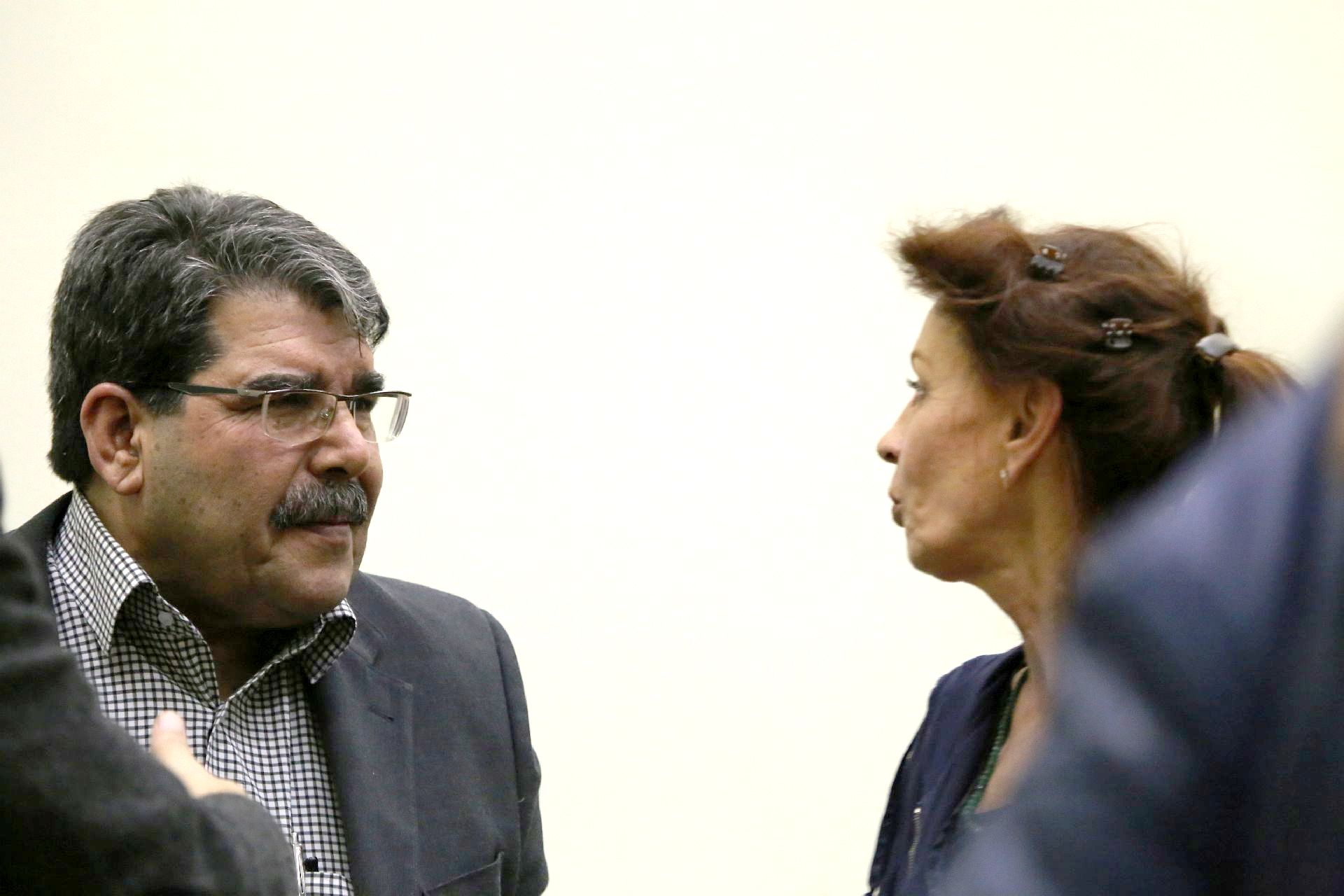
Aside of the representation offices DAANES has established in France, Sweden, Germany and Switzerland the region's role in the international arena is comprehensive military cooperation of its militias under the Syrian Democratic Forces (SDF) umbrella with the United States and the international (US-led) coalition against the Islamic State of Iraq and the Levant. In a public statement in March 2016, the day after the declaration of the regions autonomy, U.S. Defense Secretary Ashton Carter praised the People's Protection Units (YPG) militia as having "proven to be excellent partners of ours on the ground in fighting ISIL. We are grateful for that, and we intend to continue to do that, recognizing the complexities of their regional role." Late October 2016, U.S. Army Lt. Gen. Stephen Townsend, the commander of the international Anti-ISIL-coalition, said that the SDF would lead the impending assault on Raqqa, ISIL's stronghold and capital, and that SDF commanders would plan the operation with advice from American and coalition troops. At various times, the U.S. deployed U.S. troops embedded with the SDF to the border between the region and Turkey, in order to deter Turkish aggressions against the SDF. In February 2018, the United States Department of Defense released a budget blueprint for 2019 with respect to the region, which included $300 million for the Syrian Democratic Forces (SDF) and $250 million for border security. In April 2018, the President of France, Emmanuel Macron dispatched troops to Manbij and Rmelan in a bid to assist Syrian Democratic Forces (SDF) militias and in order to defuse tensions with Turkey.

In the diplomatic field, the de facto autonomous region lacks any formal recognition. While there is comprehensive activity of reception of the region's representatives and appreciation with a broad range of countries, only Russia has on occasion openly supported the region's political ambition of federalization of Syria in the international arena, while the U.S. does not. After peace talks between Syrian civil war parties in Astana in January 2017, Russia offered a draft for a future constitution of Syria, which would, among other things, change the "Syrian Arab Republic" into the "Republic of Syria", introduce decentralized authorities as well as elements of federalism like "association areas", strengthen the parliament at the cost of the presidency, and realize secularism by abolishing Islamic jurisprudence as a source of legislation. The region opened official representation offices in Moscow during 2016, Stockholm, Berlin, Paris, and The Hague. A broad range of public voices in the U.S. and Europe have called for more formal recognition of the region. International cooperation has been in the field of educational and cultural institutions, like the cooperation agreement of Paris 8 University with the newly founded University of Rojava in Qamishli, or planning for a French cultural centre in Amuda.
Neighbouring Turkey is consistently hostile, which has been attributed to a perceived threat from the region's emergence, in that it would encourage activism for autonomy among Kurds in Turkey in the Kurdish–Turkish conflict. In this context, in particular the region's leading Democratic Union Party (PYD) and the YPG militia being members of the Kurdistan Communities Union (KCK) network of organisations, which also includes both political and military Kurdish organizations in Turkey itself, including the Kurdistan Workers' Party (PKK). Turkey's policy towards the region is based on an economic blockade, opposition to the cooperation between the American-led anti-ISIL coalition and the Syrian Democratic Forces, and support of Islamist opposition fighters hostile to the autonomous region, with some reports even including ISIL among these. Turkey has on several occasions militarily attacked the region's territory and defence forces. This has resulted in some expressions of international solidarity with the region.
On 9 October 2019, Turkey launched an attack on northern Syria "to destroy the terror corridor" on the Turkish southern border, as president Erdogan put it, after US President Donald Trump abandoned his support. Subsequent media reports have speculated that the offensive would lead to the displacement of hundreds of thousands of people.
In December 2019, an international conference hosted by the International Alliance for the Defence of Rights and Freedoms (AIDL) was held at the European Parliament which condemned the Turkish invasion of northeastern Syria, and called for the self-declared Autonomous Administration of North East Syria to be recognized and to be included in UN-led Constitutional Committee tasked to draft a new constitution for Syria. The official position of the European Union remained the same however, that the Autonomous Administration should be "respected" and included in talks while rejecting "any recognition in the national sense of the word" and that "the territorial integrity of Syria is fundamental".
War crimes and criticism
Accusations of human rights violations, war crimes and ethnic cleansing have been made against the YPG since the beginning of the Syrian civil war, such as in the take-over of the border town of Tal Abyad from the Islamic State of Iraq and the Levant (ISIL) and other operations. Some of the accusations have come from Turkey and Turkish-backed Syrian militias and opposition groups in the region, while others have come from numerous human rights organizations, as well as Western and regional journalists. Amnesty International have gone on fact-finding missions, stating that:
By deliberately demolishing civilian homes, in some cases razing and burning entire villages, displacing their inhabitants with no justifiable military grounds, the Autonomous Administration is abusing its authority and brazenly flouting international humanitarian law, in attacks that amount to war crimes.
and:
In its fight against IS, the Autonomous Administration appears to be trampling all over the rights of civilians who are caught in the middle. We saw extensive displacement and destruction that did not occur as a result of fighting. This report uncovers clear evidence of a deliberate, co-ordinated campaign of collective punishment of civilians in villages previously captured by IS, or where a small minority were suspected of supporting the group.
In March 2017 the "United Nations Independent International Commission of Inquiry on Syria" was unable to find evidence to substantiate claims about ethnic cleansing, stating:
Though allegations of "ethnic cleansing continued to be received during the period under review, the Commission found no evidence to substantiate claims that YPG or SDF forces ever targeted Arab communities on the basis of ethnicity, nor that YPG cantonal authorities systematically sought to change the demographic composition of territories under their control through the commission of violations directed against any particular ethnic group
The region has also been criticized extensively by various partisan and non-partisan sides over political authoritarianism. A KDP-S politician accused the PYD of delivering him to the Assad regime.
It has also been criticized for banning journalists, media outlets and political parties that are critical of the YPG narrative in areas under its control.
Notes
References
Works cited
References
- "On the occasion of the victory of the will of the Syrians and the overthrow of the oppressive regime, the Democratic Peoples' Council decided to raise the flag of independence on...".
- "Syrian flag". Facebook.
- (2024-12-12). "AANES adopts flag of Syrian revolution".
- {{cite Q. Q135457503
- (17 July 2018). "Îlham Ehmed: Dê rêxistinên me li Şamê jî ava bibin". rudaw.net.
- (17 March 2016). "Syrian Kurds declare new federation in bid for recognition". Middle East Eye.
- "War Statistics / Syrian War Statistics – Syrian Civil War Map".
- Salih, Mohammed A.. (2024-01-31). "Syria's Kurdish Northeast Ratifies a New Constitution".
- "'Rojava' no longer exists, 'Northern Syria' adopted instead".
- (1 December 2017). "Electoral Commission publish video of elections 2nd stage {{!}} ANHA".
- (4 February 2016). "Delegation from the Democratic administration of Self-participate of self-participate in the first and second conference of the Shaba region". Cantonafrin.com.
- (14 October 2019). "Turkey's Syria offensive explained in four maps". BBC News.
- (31 December 2016). "Syria Kurds adopt constitution for autonomous federal region". TheNewArab.
- (26 October 2021). "Umar: Catalonian recognition of AANES is the beginning".
- van Wilgenburg, Wladimir. (21 October 2021). "Catalan parliament recognizes administration in northeast Syria".
- Schmidinger, Thomas. (2019). "The Battle for the Mountain of the Kurds". PM Press.
- (2017-06-22). "The medical care situation in Rojava".
- Smith, Noah. (2019-10-27). "In Northern Syria, Destruction and Displacement Confront Health Workers".
- Bachelard, Michael. (2019-11-04). "Free Burma Rangers activist and medic killed by Turkish drone strike in Syria".
- (23 August 2013). "Syria Crisis: MSF provides healthcare to Syrians crossing into Iraqi Kurdistan".
- (12 October 2019). "Kurdish-led SDF says Turkish invasion has revived IS, urges no-fly zone". Reuters.
- "SDF-Turkey".
- (23 January 2026). "22/01 Emergency Update".
- Lister, Tim. (2026-01-18). "Syria’s military has seized swathes of Kurdish-held territory. Here's what we know".
- {{harvnb. Lister. 2015
- (7 April 2015). "Yekîneya Antî Teror a Rojavayê Kurdistanê hate avakirin".
- ''Kurdish Awakening: Nation Building in a Fragmented Homeland'', (2014), by Ofra Bengio, University of Texas Press, p. 2
- (14 October 2019). "Turkey's military operation in Syria: All the latest updates". al Jazeera.
- Metin Gurcan. (7 November 2019). "Is the PKK worried by the YPG's growing popularity?". [[al-Monitor]].
- (31 October 2019). "Nordsyrien: Warum ein Deutscher sein Leben für die Kurden riskiert". ARD.
- (2007). "Aramaic (Assyrian/Syriac) Dictionary & Phrasebook: Swadaya-English, Turoyo-English, English-Swadaya-Turoyo". Hippocrene Books.
- {{cite Q. Q135455332
- (26 July 2018). "The Autonomous Administration in Northern Syria: Questions of Legitimacy and Identity". Omran Center for Strategic Studies.
- (17 March 2016). "Syria civil war: Kurds declare federal region in north".
- "Kurds Declare 'Federal Region' in Syria, Says Official". Wall Street Journal.
- "Reşnivîsa Hevpeymana Civakî ya Federaliya Demokratîk a Bakurê Sûriyeyê – ANHA".
- "Hevpeymana Civakî ya Federaliya Demokratîk ji bo Bakurê Sûriyê".
- {{cite Q. Q135457489
- (28 December 2016). "Second day of Northern Syria Constituent Assembly conference takes place". [[Hawar News Agency]].
- (29 December 2016). "Syrian Kurdish groups, allies say approve blueprint for federal system". Reuters.
- (31 December 2016). "'Rojava' no longer exists, 'Northern Syria' adopted instead". Kurdistan24.
- "ܩܝܡܐ ܟܢܘܫܝܝܐ ܕܦܕܪܐܠܝܘܬ݂ܐ ܕܝܡܩܪܐܛܝܬܐ ܕܓܪܒܝ ܣܘܪܝܐ".
- (April 2021). "Henchman, Rebel, Democrat, Terrorist".
- Assyria 1995: Proceedings of the 10th Anniversary Symposium of the Neo-Assyrian Text Corpus Project / Helsinki, 7–11 September 1995.
- (1985). "The Cambridge Ancient History Volume 9: The Last Age of the Roman Republic, 146–43 BC". Cambridge University Press.
- (2015). "The Human Record: Sources of Global History, Volume I: To 1500". Cengage Learning.
- (2014). "Sasanian Persia: The Rise and Fall of an Empire". I.B.Tauris.
- Burns, Ross. (2013). "Aleppo, A History". Routledge.
- Burns, Ross. (2013). "Aleppo, A History". Routledge.
- Travis, Hannibal. ''Genocide in the Middle East: The Ottoman Empire, Iraq, and Sudan''. Durham, NC: Carolina Academic Press, 2010, 2007, pp. 237–77, 293–294.
- link. (15 May 2024 . Accessed on 11 November 2014.)
- R. S. Stafford. (2006). "The Tragedy of the Assyrians". Gorgias Press, LLC.
- Tejel, Jordi. (2008). "Syria's Kurds: History, Politics and Society".
- (2001). "Ray J. Mouawad, Syria and Iraq – Repression Disappearing Christians of the Middle East". Middle East Forum.
- Abu Fakhr, Saqr, 2013. [[As-Safir]] daily Newspaper, Beirut. [http://assafir.com/Article/331189#.UrbZIuK_guh in Arabic] {{Webarchive. link. (13 November 2014 [http://araborthodoxy.blogspot.ca/2013/12/as-safir-on-history-of-persecution-of.html Christian Decline in the Middle East: A Historical View] {{Webarchive). link. (13 November 2014)
- (13 October 2019). "Abandoned by America: How the Kurds have once again been 'stabbed in the back'".
- Ross Burns (2013), p.138
- [[Dawn Chatty]]. (2010). "Displacement and Dispossession in the Modern Middle East". Cambridge University Press.
- Simpson, John Hope. (1939). "The Refugee Problem: Report of a Survey". Oxford University Press.
- (October 1996). "The Silenced Kurds". Human Rights Watch.
- (2009). "Blood and belief: the PKK and the Kurdish fight for independence". New York University Press.
- (6 November 2015). "After 52-year ban, Syrian Kurds now taught Kurdish in schools".
- (2015). "Syria". John Wiley & Sons.
- (16 June 2005). "A murder stirs Kurds in Syria". The Christian Science Monitor.
- (2009). "Persecution and Discrimination against Kurdish Citizens in Syria, Report for the 12th session of the UN Human Rights Council".
- Mardean Isaac. (20 December 2015). "The Assyrians of Syria: History and Prospects". Syria Comment.
- Gold, Danny. (31 October 2012). "Meet the YPG, the Kurdish militia that doesn't want help from anyone".
- (22 July 2012). "Armed Kurds Surround Syrian Security Forces in Qamishli". Rudaw.
- (24 July 2012). "Girke Lege Becomes Sixth Kurdish City Liberated in Syria". Rudaw.
- Roelants, Carolien. (15 October 2019). "Koerden zitten van alle kanten klem". [[NRC Handelsblad]].
- Glioti, Andrea. (13 February 2014). "Syrian Kurds recruit regime loyalists to fight jihadists". [[al-Monitor]].
- Khalaf, Rana. (2016). "Governing Rojava: Layers of Legitimacy in Syria". Chatham House.
- Duman, Yasin. (2017). "Peacebuilding in a conflict setting: Peace and reconciliation committees in de facto Rojava Autonomy in Syria". Journal of Peacebuilding & Development.
- (17 March 2016). "Syria's Kurds declare de-facto federal region in north". Associated Press News.
- (12 April 2016). "Syrian Kurds in six-month countdown to federalism". Reuters.
- (5 July 2016). "Syrian Kurds declare Qamishli as capital for the new federal system". [[ARA News]].
- (22 July 2016). "After approving constitution, what's next for Syria's Kurds?". Al-Monitor.
- (26 July 2016). "Kurds, Arabs and Assyrians talk to Enab Baladi about the 'Federal Constitution' in Syria".
- (28 December 2016). "Syrian Kurds, allies set to approve new government blueprint". Reuters.
- Kingsley, Patrick. (16 October 2019). "The World Condemns Erdogan's War on Kurds. But Turkey Applauds.". The New York Times.
- (24 July 2019). "Interpol removes top PKK-affiliated figure from its red notice list". Daily Sabah.
- (31 August 2016). "TSK: 32 Köy Terörist Unsurlardan Temizlendi". Yeni Asır.
- Illingworth, Andrew. (2 March 2017). "BREAKING: Kurdish-led SDF to handover huge section of territory to SAA". The New York Times.
- (20 January 2018). "Terrified children, empty streets in Syria's Afrin as Turkey attacks". France24.
- Iddon, Paul. (19 February 2019). "The significance of the Shahba Canton for the YPG". [[Rudaw Media Network]].
- McKernan, Bethan. (9 October 2019). "Turkey launches military operation in northern Syria". The Guardian.
- (7 October 2019). "Trump makes way for Turkey operation against Kurds in Syria". [[BBC News]].
- "US betrayal of Kurds destroys the West's credibility for years to come".
- "Trump's Syria move 'delivers a blow to US credibility worldwide'".
- (19 October 2019). "Trump's Gut, and the Gutting of American Credibility".
- (14 October 2019). "Trump's decision on Syria has already turned into a foreign policy disaster".
- (15 October 2019). "قوات النظام تبدأ دخول مدينة منبج شمال شرق حلب بالتزامن مع استمرار انسحاب قوات التحالف من المدينة • المرصد السوري لحقوق الإنسان". The Syrian Observatory for Human Rights.
- (15 October 2019). "Syrian Army enters strategic city in Al-Raqqa with heavy equipment: video".
- "Syrian army enters Kurdish-held city, air base to help counter Turkish assault".
- (14 October 2019). "Syrian army moves to confront Turkish forces as US withdraws".
- (16 October 2019). "Syrian forces enter key border town".
- "India slams Turkey for its 'unilateral military offensive' in northeast Syria". The Times of India.
- (18 October 2019). "Damning evidence of war crimes by Turkish forces and allies in Syria".
- (8 December 2024). "The fall of Bashar Assad after 13 years of war in Syria brings to an end a decades-long dynasty".
- (6 December 2024). "US-backed Syrian Kurds seize eastern city of Deir el-Zor, sources say".
- "Rebellen erobern Deir ez-Zor +++ Regierungschef an Flüchtlinge: "Kommen Sie zurück!"".
- (12 December 2024). "Kurdish Administration Says Adopts Syria's Independence Flag".
- (8 December 2024). "As Assad falls, fighting intensifying over northern Syria town". VOA News.
- (9 December 2024). "War Monitor Says Turkish Drone Strike Kills 11 Civilians In North Syria". Barron's.
- (9 December 2024). "Rebels take Syrian city from U.S.-backed group after U.S.-Turkey deal, source says". Reuters.
- (17 December 2024). "Turkish invasion into Syria 'could be imminent,' US officials fear – report". The Jerusalem Post.
- (17 December 2024). "Truce Extended At Syria Flashpoint Between Kurds, Pro-Turkish Fighters: US".
- (23 December 2024). "After taking control of three villages | SDF and military formations take control of surroundings of Tishrin Dam and launch combing operation – The Syrian Observatory For Human Rights".
- Mohammed, Daban. (29 April 2025). "A Source Tells Channel8: SDF and Turkish Army in Talks for Ceasefire Under Global Coalition Supervision".
- (7 October 2025). "SDF–government talks kick off in Damascus under US sponsorship".
- (7 October 2025). "Meeting between DAA's delegation, transitional govt kicks off in Damascus".
- (23 December 2025). "7 أسئلة توضح ملابسات الاشتباكات بحلب بين القوات السورية وقسد".
- "UN urges SDF and Transitional Government to agree quickly".
- "Monthly Forecast".
- (26 December 2025). "Diverging statements from Damascus, SDF on implementing March 10 agreement".
- "Syria denies media reports about reaching new agreement with SDF".
- (3 January 2026). "AANES official expects breakthrough on SDF integration talks in early 2026".
- (6 January 2025). ""الأسايش" ترد على القصف وتقتل عنصراً وتُصيب 4.. تواصل التصعيد على دير حافر وتل "سيرياتل".
- (7 January 2026). "Syria: The army began shelling the Kurdish districts of Aleppo".
- (8 January 2026). "Dramatic escalation three days on {{!}} Clashes and bombardment with heavy weapons across neighbourhoods in Aleppo city leave two civilians injured".
- Christou, William. (9 January 2026). "Syria announces ceasefire in Aleppo after three days of clashes with Kurds". The Guardian.
- (10 January 2026). ""Fida'i" attacks and infiltration operations {{!}} Members of Asayish Forces and government forces killed and wounded in Sheikh Maqsoud".
- (10 January 2026). "ISF members in Aleppo carry out self-sacrifice operations against Interim Govt.'s mercenaries".
- "Photos: Syrian army enters Deir Hafer after SDF withdrawal".
- (20 January 2025). "Iran Update, January 20, 2025".
- (18 January 2026). "Syrian government, US-backed Kurdish forces agree immediate ceasefire". Reuters.
- (18 January 2026). "Syrian army extends control in north, seizes oil fields". DW.
- (January 18, 2026). "Syrian Interim government and SDF announce ceasefire, integration agreement under U.S. sponsorship".
- (20 February 2016). "Syria Kurds challenging traditions, promote civil marriage". [[ARA News]].
- Colella, Chris. (Winter 2017). "The Rojava Revolution: Oil, Water, and Liberation – Commodities, Conflict, and Cooperation". [[Evergreen State College]].
- (2017). "Libertarian Socialism: Politics in Black and Red". [[PM Press]].
- (28 May 2016). "PYD leader: SDF operation for Raqqa countryside in progress, Syria can only be secular". [[ARA News]].
- Ross, Carne. (30 September 2015). "The Kurds' Democratic Experiment". [[The New York Times]].
- (2015). "Stateless Democracy". BAK.
- Jongerden, Joost. (6 December 2012). "Rethinking Politics and Democracy in the Middle East". [[Ekurd.net]].
- "Syria 2022".
- (2022). "Syria: Events of 2021".
- (2019-11-14). "The Future of the Kurds in Syria". [[Council on Foreign Relations]].
- (2017-02-07). "Have the Syrian Kurds Committed War Crimes?". [[Council on Foreign Relations]].
- (12 October 2015). "Syria: 'We had nowhere to go' – Forced displacement and demolitions in Northern Syria".
- (2014). "Communal Democracy: The Social Contract and Confederalism in Rojava". Comparative Islamic Studies.
- (1 January 2016). "The Rojava Experience: Possibilities and Challenges of Building a Democratic Life". South Atlantic Quarterly.
- Barkhoda, Dalir. (2016). "The Experiment of the Rojava System in Grassroots Participatory Democracy: Its Theoretical Foundation, Structure, and Strategies". Journal of Research in Humanities and Social Science.
- (2018). "When Öcalan met Bookchin: The Kurdish Freedom Movement and the Political Theory of Democratic Confederalism". Geopolitics.
- "Nation-building in Rojava: participatory democracy amidst the Syrian civl war".
- "Ruptures and ripple effects in the Middle East and beyond".
- (2018). "Beyond Orientalism: Exploring the Distinctive Feminism of democratic confederalism in Rojava". Geopolitics.
- "German MP Jelpke: Rojava needs help against Corona pandemic".
- (29 October 2018). "Gender Revolution in Rojava: The Voices beyond Tabloid Geopolitics". Geopolitics.
- Burç, Rosa. (22 May 2020). "Non-territorial autonomy and gender equality: The case of the Autonomous Administration of North and East Syria – Rojava". Philosophy and Society.
- (29 January 2014). "2014 Charter of the Social Contract of Rojava". Peace in Kurdistan.
- "A Very Different Ideology in the Middle East". Rudaw.
- "Governing Rojava Layers of Legitimacy in Syria". The Royal Institute of International Affairs.
- (16 January 2017). "Writings of Obscure American Leftist Drive Kurdish Forces in Syria". Voice of America.
- (15 February 2016). "'The Kurdish National Alliance', a new political entity in the column". Enab Baladi.
- (5 December 2017). "High Electoral Commission disclosed Local Administration elections' outcomes". [[Hawar News Agency]].
- link. buyer. (28 August 2017)
- (25 November 2017). "Electoral Commission publish video of elections 2nd stage". [[Hawar News Agency]].
- (29 November 2015). "A Dream of Secular Utopia in ISIS' Backyard". [[The New York Times]].
- (28 May 2015). "YPG, backed by al-Khabour Guards Forces, al-Sanadid army and the Syriac Military Council, expels IS out of more than 230 towns, villages and farmlands".
- (9 April 2016). "Rojava's commitment to Jineolojî: the science of women".
- (20 January 2016). "SDF plays central role in Syrian civil war". [[IHS Markit.
- (5 September 2019). "Anti-Kurdish protests in east Syria could endanger US plans". Associated Press.
- (2018). "Back to What Future? What Remains for Syria's Displaced People". Carnegie Middle East Center.
- {{cite Q. Q136529807
- "Final statement of Autonomous Administration of North, East Syria – ANHA".
- van Wilgenburg, Wladimir. "New administration formed for northeastern Syria".
- "Amina Omar: Autonomous Administration its purpose to serve people".
- (18 March 2018). "Syrian Rebels, Backed by Turkey, Seize Control of Afrin". The New York Times.
- (9 December 2024). "Rebels take Syrian city from U.S.-backed group after U.S.-Turkey deal, source says".
- "Dêrîk congress decides to establish Democratic Syria Assembly". kurdishinfo.
- (14 October 2015). "Haytham Manna Elected Joint Chairman of Syrian Democratic Council". The Syrian Observer.
- "Executive Board of Democratic Syria Assembly elected". Ajansa Nûçeyan a Firatê English.
- {{cite Q. Q135455160
- (14 March 2015). "Municipal elections called off in Syrian Tal Tamir because of ISIS fighting". [[Rudaw Media Network.
- Rodi Said. (22 September 2017). "Syrians vote in Kurdish-led regions of north". Reuters.
- (18 September 2019). "YPG attacks FSA-controlled Azaz province". Daily Sabah.
- Sabri, Baraa. (17 July 2019). "The Fate of Tel Rifaat Hangs in the Balance". Washington Institute.
- "Municipal elections in North-East Syria postponed".
- (5 December 2013). "Historical Dictionary of Syria". Scarecrow Press.
- (16 May 2016). "Education in Rojava after the revolution". ANF.
- (6 November 2015). "After 52-year ban, Syrian Kurds now taught Kurdish in schools". Al-Monitor.
- (29 August 2015). "Rojava schools to re-open with PYD-approved curriculum". Rudaw.
- (2 October 2015). "Kurds introduce own curriculum at schools of Rojava". [[ARA News]].
- (17 February 2015). "Revolutionary Education in Rojava". New Compass.
- (12 January 2014). "Education in Rojava: Academy and Pluralistic versus University and Monisma". Kurdishquestion.
- (19 August 2016). "Syriac Christians revive ancient language despite war". [[ARA News]].
- (3 October 2016). "Hassakeh: Syriac Language to Be Taught in PYD-controlled Schools". The Syrian Observer.
- (7 October 2016). "Rojava administration launches new curriculum in Kurdish, Arabic and Assyrian". [[ARA News]].
- "Syriacs will study their language in schools this year – ANHA".
- "The Syriacs are taught their language for the first time – ANHA".
- "What is reality of educational process in North Syria, new year's curricula? – ANHA {{!}} Ajansa Nûçeyan a Hawar".
- (7 July 2016). "Kurds establish university in Rojava amid Syrian instability". Kurdistan24.
- (13 September 2018). "Christians, Kurds at Odds Over Syria School Curriculum".
- (11 August 2018). "Why Did the Kurdish "Self-Management" Close the Syriac Private School in Eastern al-Hasakah?".
- "Rojava authority's efforts to provide Syriac education met with resistance". Rudaw.
- "Syrian Kurds open church in Kobani, once besieged by IS". Kurdistan24.
- "Syriacs protest Kurdish authorities over Syria school curriculum". Yahoo News.
- (6 October 2021). "Call from Rojava University to academics: Let's work together".
- (10 November 2024). "Universities Council of Northern and Eastern Syria established in Raqqa Canton".
- (18 May 2016). "Syria's first Kurdish university attracts controversy as well as students". Al-Monitor.
- (29 June 2018). "Afrin University students continuing their studies at Rojava's University".
- (4 July 2016). "'University of Rojava' to be opened". ANF.
- (15 August 2016). "Rojava university seeks to eliminate constraints on education in Syria's Kurdish region". [[ARA News]].
- (2015). "Syria Country report, Freedom of the Press 2015". Freedom House.
- (15 May 2016). "In blow to Kurdish independent media, Syrian Kurdish website shuts down". [[ARA News]].
- (27 April 2016). "Syria's first Kurdish radio station burnt". Kurdistan24.
- (27 April 2016). "Syrian Kurdish administration condemns burning of radio ARTA FM office in Amude". [[ARA News]].
- Bellingreri, Marta. (24 December 2019). "Rojava Information Center, a media bridge to the world outside".
- "Rudaw expresses regret over ban by Kobani authorities in Syria".
- "Statement from Kurdistan 24 Company for Media and Research Ltd.".
- Internet connections in the region are often slow due to inadequate infrastructure. Internet lines are operated by [[Syrian Telecom]], which as of January 2017 is working on a major extension of the fibre optic cable network in southern Jazira Region.. link. syriannewscenter.net. (12 January 2017)
- (19 July 2016). "Kurdish art, music flourish as regime fades from northeast Syria". Al-Monitor.
- link. (12 September 2015)
- (April 2017). "Syrian Kurds hold theatre festival in Rojava amid war". [[Kurdistan24]].
- "Efrîn Economy Minister Yousef: Rojava challenging norms of class, gender and power".
- (3 May 2016). "Will Syria's Kurds succeed at self-sufficiency?".
- "Flight of Icarus? The PYD's Precarious Rise in Syria". International Crisis Group.
- "| زمان الوصل".
- (22 December 2014). "Efrîn Economy Minister: Rojava Challenging Norms Of Class, Gender And Power".
- "Poor in means but rich in spirit". Ecology or Catastrophe.
- (11 July 2017). "Rojava Administration to Impose Tax System in Northern Syria".
- (24 May 2016). "In Syria's Mangled Economy, Truckers Stitch Together Warring Regions". Wall Street Journal.
- (June 2021). "Beyond Rojava: North and East Syria's Arab Regions".
- (9 August 2021). "Syrian Kurdish region increases salaries amid currency crash".
- "Renewed water shortages hit Hasaka".
- Cockburn, Patrick. (4 February 2021). "After IS". London Review of Books.
- "Striking out on their own". The Economist.
- "Kurds Fight Islamic State to Claim a Piece of Syria". The Wall Street Journal.
- "Das Embargo gegen Rojava". TATORT (Kurdistan Delegation).
- (29 December 2014). "Syrian Kurds risk their lives crossing into Turkey". Middle East Eye.
- (14 January 2017). "Rojava: The Economic Branches in Detail". cooperativeeconomy.info.
- (10 June 2016). "US welcomes opening of border between Rojava and Iraqi Kurdistan". ARA News.
- (22 April 2017). "Business booming in Rojava after outlet opened with Kurdistan Region". Kurdistan24.
- (26 June 2017). "First aid convoy arrives in Rojava through new land corridor". ARA News.
- (29 May 2017). "Iran-backed Iraqi force says takes Islamic State villages near Syria". Reuters.
- (29 May 2017). "Iraq paramilitaries reach Iraq's border with Syria". ABC News.
- (4 June 2017). "PKK planning to open trade route between Rojava and Iraq". Iraqi News.
- (19 April 2017). "Rojava, Syria: A revolution of hope and healing". [[Vancouver Observer]].
- (4 March 2015). "A Small Key Can Open a Large Door: The Rojava Revolution". Strangers in a Tangled Wilderness.
- Michael Knapp, [https://mesopotamia.coop/rojava-the-formation-of-an-economic-alternative-private-property-in-the-service-of-all/ 'Rojava{{snd the formation of an economic alternative: Private property in the service of all'] {{Webarchive. link. (16 April 2021 .)
- (19 November 2016). "How do cooperatives work in Rojava?". cooperativeeconomy.info.
- Dr. Ahmad Yousef. "Rojava experience of the social economy : reality and prospects".
- (4 March 2015). "A Small Key Can Open a Large Door: The Rojava Revolution". Strangers in a Tangled Wilderness.
- "Syria". Carnegie Endowment for International Peace.
- "Islamic Family Law: Syria (Syrian Arab Republic)". Law.emory.edu.
- (12 September 2016). "Kurdish 'Angelina Jolie' devalued by media hype". BBC.
- (15 November 2016). "Syrian Kurds tackle conscription, underage marriages and polygamy". [[ARA News]].
- Magpie, Jo. "Regaining hope in Rojava".
- (23 October 2015). "Power to the people: a Syrian experiment in democracy". Financial Times.
- Ayboğa, Ercan. (13 October 2014). "The New Justice System in Rojava". biehlonbookchin.com.
- (23 September 2015). "Syrian Kurds Get Outside Help to Manage Prisons". Voice of America.
- (7 September 2015). "Syria: Arbitrary detentions and blatantly unfair trials mar PYD fight against terrorism". Amnesty International.
- "Highest to Lowest – Prison Population Rate". World Prison Brief.
- (6 June 2016). "Rojava Asayish: Security institution not above but within the society". ANF.
- (31 October 2015). "Rojava Dispatch Six: Innovations, the Formation of the Hêza Parastina Cewherî (HPC)". Modern Slavery.
- Rudaw. (6 April 2015). "Rojava defense force draws thousands of recruits". Rudaw.
- Gold, Danny. (31 October 2010). "Meet the YPG, the Kurdish Militia That Doesn't Want Help from Anyone". Vice.
- (10 June 2020). "Translation: Law concerning military service in North and East Syria".
- (18 June 2014). "Syria: Abuses in Kurdish-run Enclaves". [[Human Rights Watch]].
- (13 October 2015). "Syria". [[Amnesty International]].
- (15 July 2015). "Syria: Kurdish Forces Violating Child Soldier Ban".
- (19 June 2014). "Under Kurdish Rule – Abuses in PYD-run Enclaves of Syria".
- [[United Nations Security Council. (5 June 2015). "Report of the Secretary-General: Children and armed conflict".
- (28 October 2015). "YPG demobilizes 21 children under the age of 18 from the military service in its ranks". [[Syrian Observatory for Human Rights]].
- (13 October 2015). "Amnesty accuses US-backed Syrian Kurdish group of demolishing homes". The Jerusalem Post.
- (24 October 2015). "Syria: Kurdish Forces Violating Child Soldier Ban Despite Promises, Children Still Fight". Hurriyet Daily News.
- (3 August 2018). "Syria: Armed Group Recruiting Children in Camps".
- (10 September 2015). "Western states train Kurdish force in Syria, force's leader says". [[Reuters]].
- (2020-09-17). "SDF continues to recruit child soldiers, despite pledges to stop the practice – Syria Direct".
- (9 November 2014). "Syrian Kurds give women equal rights, snubbing jihadists". Yahoo.
- (23 March 2016). "Assyrian leader accuses PYD of monopolizing power in Syria's north". ARA.
- Al-Jabassini, Abdullah. (December 2017). "Civil Resistance to Military Conscription in Kurdish Areas of Northern Syria: the Untold Story". Journal of Peacebuilding and Development.
- (16 June 2015). "Turkey accuses Kurdish forces of 'ethnic cleansing' in Syria".
- (13 October 2015). "Syria: US ally's razing of villages amounts to war crimes". Amnesty International.
- (14 August 2016). "Syria: Kurdish militias plan a demographic change in Manbij". Middle East Observer.
- (21 December 2018). "Tal Abyad: Achilles Heel of the Syrian Kurdish Belt". Middle East Observer.
- (18 May 2016). "Syrian Kurds accused of ethnic cleansing and killing opponents". The Telegraph.
- "''"There's no 'ethnic cleansing' in Til Abyad against the Turkmen and Arabic population."'', Gesellschaft für bedrohte Völker, 26. Juni 2015".
- (10 March 2017). "Syria, Report by UN Commission of Inquiry (March 2017)". [[International Committee of the Red Cross]].
- Fevret, Maurice. (1953). "La Djezireh syrienne et son réveil économique". Revue de géographie de Lyon.
- (2005). "A Companion to the History of the Middle East". Wiley-Blackwell.
- McDowell, David. (2005). "A Modern History of the Kurds". Tauris.
- Kreyenbroek, Philip G.. (1992). "The Kurds: A Contemporary Overview". Routledge.
- Yildiz, Kerim. (2005). "The Kurds in Syria : the forgotten people". Pluto Press, in association with Kurdish Human Rights Project.
- McDowall, David. Modern History of the Kurds, I. B. Tauris & Company, Limited, 2004. pp. 473–474.
- Si Sheppard. (25 October 2016). "What the Syrian Kurds Have Wrought. The radical, unlikely, democratic experiment in northern Syria". The Atlantic.
- (3 July 2016). "Syrian Kurds provide safe haven for thousands of Iraqis fleeing ISIS". [[ARA News]].
- (17 October 2016). "Rojava hosts thousands of displaced Iraqi civilians as war on ISIS intensifies". [[ARA News]].
- "Sectarianism in Syria's Civil War".
- "'We're Arabs just as much as Kurds': Syrian Kurds call for unity".
- "Culturally Sensitive Social Work Practice with Arab Clients in Mental Health Settings".
- (31 October 2011). "Ethnic Groups of Africa and the Middle East: An Encyclopedia". ABC-CLIO.
- (31 October 2011). "Ethnic Groups of Africa and the Middle East: An Encyclopedia". Abc-Clio.
- (1993). "The Arab world society, culture, and state". University of California Press.
- Dona J. Stewart. (22 December 2008). "The Middle East Today: Political, Geographical and Cultural Perspectives". Routledge.
- (2009). "Encyclopedia of the Peoples of Africa and the Middle East". Infobase Publishing.
- (1976). "Who Is an Arab?". Carnegie Council.
- Margaret Nydell. (23 March 2012). "Understanding Arabs, Fifth Edition: A Contemporary Guide to Arab Society". Nicholas Brealey.
- John Joseph. (2000). "The Modern Assyrians of the Middle East". BRILL.
- [https://news.bbc.co.uk/2/hi/europe/4555000.stm Killing of Iraq Kurds 'genocide'] , ''[[BBC]]'', "The Dutch court said it considered "legally and convincingly proven that the Kurdish population meets requirement under Genocide Conventions as an ethnic group"."
- (2014). "Kurds". Encyclopedia.com.
- (2009). "Encyclopaedia Islamica". Brill.
- Barbara A. West. (1 January 2009). "Encyclopedia of the Peoples of Asia and Oceania". Infobase Publishing.
- [[Richard N. Frye, Richard Nelson. "IRAN v. PEOPLES OF IRAN (1) A General Survey".
- (24 August 2016). "Rojava's Sustainability and the PKK's Regional Strategy". Washington Institute.
- (14 November 2014). "Glavin: In Iraq and Syria, it's too little, too late". Ottawa Citizen.
- "Social Contract – Democratic Federation of North Syria".
- "HISTORY OF THE KURDISH LANGUAGE". Encyclopædia Iranica.
- D. N. MacKenzie. (1961). "The Origins of Kurdish". Transactions of the Philological Society.
- (15 April 2015). "Could Christianity be driven from Middle East?". BBC.
- Carl Drott. (25 May 2015). "The Revolutionaries of Bethnahrin". Warscapes.
- (2015-11-24). "A Dream of Secular Utopia in ISIS' Backyard". The New York Times.
- (2004). "2004 Syrian Census".
- (10 July 2018). "أعمال وإنجازات مجلس المنصورة المدني خلال عامه الأول". قوات سوريا الديمقراطية – Syrian Democratic Forces.
- "Al-Hasaka Health Directorate: One person infection to endanger everyone's life – ANHA {{!}} HAWARNEWS {{!}} English".
- "هيئة الصحة والبيئة – المجلس التنفيذي".
- "An appeal from Health Body of Al-Jazeera region – ANHA {{!}} HAWARNEWS {{!}} English".
- (8 February 2020). "Search Results for "Health"".
- (28 October 2019). "In Northern Syria, Destruction and Displacement Confront Health Workers – Syrian Arab Republic".
- "Syria: Caring for displaced people and preparing for coronavirus in Idlib".
- van Wilgenburg, Wladimir. (21 March 2016). "ANALYSIS: 'This is a new Syria, not a new Kurdistan'".
- (13 February 2016). "Syria's war: Assad on the offensive". [[The Economist]].
- (14 March 2015). "KRG: Elections in Jazira are Not Acceptable". Basnews.
- (23 May 2016). "Syrian Kurds point finger at Western-backed opposition". Reuters.
- (24 May 2016). "Russia finishes draft for new Syria constitution". Now.MMedia/Al-Akhbar.
- Ghadi Sary. (September 2016). "Kurdish Self-governance in Syria: Survival and Ambition". Chatham House.
- Sam Heller. (30 June 2017). "The Signal in Syria's Noise". warontherocks.com.
- "Syria to consider granting Kurds greater autonomy".
- (14 October 2019). "Report: Syrian army to enter SDF-held Kobani, Manbij".
- (14 October 2019). "Syrian army to deploy along Turkish border in deal with Kurdish-led forces".
- (14 October 2019). "Syrian army moves to confront Turkish forces as US withdraws".
- (24 October 2019). "Syrian Kurds accuse Turkey of violations, Russia says peace plan on track".
- (2024-12-12). "America's closest ally in Syria is losing ground as a new order takes shape". [[AP News]].
- (10 March 2025). "Syria merges Kurdish-led Syrian Democratic Forces into state institutions".
- (18 January 2026). "Syria announces new ceasefire deal with Kurdish-led SDF". DW.
- (30 January 2026). "Syria: Kurdish-led SDF and government agree integration deal". DW.
- (8 November 2014). "What Kobani Means for Turkey's Kurds".
- (8 September 2015). "6 reasons why Turkey's war against the PKK won't last". Al-Monitor.
- (23 March 2016). "Kurdish Militants and Turkey's New Urban Insurgency". War on the Rocks.
- (18 August 2015). "Kurdistan's Politicized Society Confronts a Sultanistic System". Carnegie Middle East Center.
- (3 August 2016). "Syrian Kurdish leader: We will respect outcome of independence referendum". [[ARA News]].
- (4 August 2016). "Kurdish National Council announces plan for setting up 'Syrian Kurdistan Region'". [[ARA News]].
- Duchêne, Claude. "The opening of a Syrian Kurdish 'representation office' in Geneva stirs tensions". SWI swissinfo.ch.
- (10 August 2015). "Inside Syria: Kurds Roll Back ISIS, but Alliances Are Strained". [[The New York Times]].
- Wladimir von Wilgenburg. (23 May 2016). "ANALYSIS: Kurds welcome US support, but want more say on Syria's future". Middle East Eye.
- (18 March 2016). "Pentagon chief praises Kurdish fighters in Syria". Hurriyet Daily News.
- (26 October 2016). "US general: Syrian Democratic Forces will lead the assault on Raqqa". Stars and Stripes.
- Schrupp, Kenneth. (24 July 2018). "Iraq: Iranian Subversion and American Engagement".
- Carla Babb. (6 March 2017). "US Troops in Manbij to 'Deter' Skirmishes Between Turks, Kurds". VOA News.
- (1 May 2017). "Ever-closer ties between US and Kurds stoke Turkish border tensions". The Guardian.
- (2 May 2017). "Kurdish citizens 'rest easy' after American military patrols parade through cities in northern Syria". syriadirect.org.
- (4 May 2017). "How the US stood with Syria's Kurds". Al-Monitor.
- (12 February 2018). "Pentagon budget retains same troop levels in Iraq, Syria". Al-Monitor.
- (29 March 2018). "Syrie : Emmanuel Macron annonce l'envoi de soldats au secours des Kurdes". Le Parisien.
- (12 February 2015). "Hollande-PYD meeting challenges Erdogan".
- (23 June 2015). "YPJ Commander Nesrin Abdullah speaks in Italian Parliament". JINHA.
- (17 February 2016). "Syrian Kurdish PYD, Turkey's HDP leaders attend 'Ocalan conference' in Athens". eKurd.
- "Build Kurdistan relationship or risk losing vital Middle East partner – News from Parliament". UK Parliament.
- (5 April 2015). "Rome Declares Kobane 'Sister City'". Kurdishquestion.
- (7 November 2016). "Mark C. Toner, Deputy Spokesperson. Daily Press Briefing. Washington, DC. November 7, 2016". United States Department of State.
- (30 March 2017). "US-led coalition has no intention to create federal Kurdish state in Syria: official". Ara news.
- (25 January 2017). "Syria Opposition Rejects Russian Draft of New Constitution". Bloomberg.
- (26 January 2017). "Syrian draft constitution recognizes Kurdish language, no mentions of federalism". Rudaw.
- link. Rudaw
- (26 January 2017). "Moscow invites Kurds and Syrian opposition to explain Astana". [[ARA News]].
- (11 February 2016). "Rojava's first representation office outside Kurdistan opens in Moscow".
- (18 April 2016). "Syrian Kurds inaugurate representation office in Sweden". [[ARA News]].
- (7 May 2016). "Berlin'de Rojava temsilciliği açıldı".
- (24 May 2016). "Syrian Kurds open unofficial representative mission in Paris". Al Arabiya.
- (8 September 2016). "Syrian Kurds inaugurate representation office in the Netherlands". [[ARA News]].
- Meredith Tax. (14 October 2016). "The Rojava Model".
- Steven A. Cook. (14 March 2016). "Between Ankara and Rojava".
- Kamran Matin. (12 December 2016). "The Geneva Peace Talks on Syria and the Kurds". NRT.
- (27 March 2016). "L'écrivain Patrice Franceschi veut créer un centre culturel au Kurdistan syrien". Europe1.
- (9 August 2016). "French delegation seeks to open cultural center in Rojava". NRT.
- (8 September 2016). "Kurds plan to set up French institute in Syria". [[ARA News]].
- (28 May 2016). "Turkish President Erdoğan slams US over YPG support". Hurryiet Daily News.
- (19 February 2016). "How Can Turkey Overcome Its Foreign Policy Mess?". Lobolog (Graham E. Fuller).
- "Syria's Afrin: a plundered settlement one year on".
- Wladimir van Wilgenburg. (12 June 2015). "The Rise of Jaysh al-Fateh in Northern Syria". Jamestown Foundation.
- David L. Phillips. (11 September 2014). "Research Paper: ISIS-Turkey Links". Huffington Post.
- (28 July 2015). "Senior Western official: Links between Turkey and ISIS are now 'undeniable'". Businessinsider.
- Burak Bekdil. (Summer 2015). "Turkey's Double Game with ISIS". Middle East Quarterly.
- (27 July 2015). "Turkey accused of shelling Kurdish-held village in Syria". The Guardian.
- (19 February 2016). "Turkey strikes Kurdish city of Afrin northern Syria, civilian casualties reported". [[ARA News]].
- Christopher Phillips. (22 September 2016). "Turkey's Syria Intervention: A Sign of Weakness Not Strength". Newsweek.
- Fehim Taştekin. (9 September 2016). "US backing ensures Arab-Kurd alliance in Syria will survive". Al-Monitor.
- (28 August 2016). "Germany warns Turkey from attacking Kurds in Syria". Iraqi News.
- U.S. Senator John McCain, Chairman of the United States Senate Armed Services Committee. (27 October 2016). "Statement by SASC Chairman John McCain on Turkish Government Attacks on Syrian Kurds".
- "Turkey launches an attack on northern Syria". The Economist.
- [https://www.brusselstimes.com/all-news/eu-affairs/84361/eu-condemns-turkey-again-while-sticking-to-its-position-on-the-kurdish-administration-in-north-east-syria/ EU condemns Turkey again while sticking to its position on the Kurdish administration in north-east Syria], Brusselstimes.com, 17 December 2019.
- "Final declaration of the EP Conference on Rojava". Anf News.
- (29 August 2016). "Turkey accuses Syrian Kurds of 'ethnic cleansing'".
- "Syrian rebels accuse Kurdish forces of 'ethnic cleansing' of Sunni Arabs".
- (7 February 2017). "Have the Syrian Kurds Committed War Crimes?". The Nation.
- (15 June 2015). "Kurds accused of "ethnic cleansing" by Syria rebels".
- (13 October 2015). "Syria: US ally's razing of villages amounts to war crimes".
- (2017-03-21). "UN says no ethnic cleansing by Kurds in northern Syria".
- "UN: YPG and SDF have not committed ethnic cleansing".
- "A_HRC_34_CRP.3_E.docx".
- "Kurdish authorities handed over political prisoner to Syrian regime: Official".
- "Journalism in Rojava (II): Independent media between freedom and control".
This article was imported from Wikipedia and is available under the Creative Commons Attribution-ShareAlike 4.0 License. Content has been adapted to SurfDoc format. Original contributors can be found on the article history page.
Ask Mako anything about Democratic Autonomous Administration of North and East Syria — get instant answers, deeper analysis, and related topics.
Research with MakoFree with your Surf account
Create a free account to save articles, ask Mako questions, and organize your research.
Sign up freeThis content may have been generated or modified by AI. CloudSurf Software LLC is not responsible for the accuracy, completeness, or reliability of AI-generated content. Always verify important information from primary sources.
Report