From Surf Wiki (app.surf) — the open knowledge base
Deism
Belief in a God based on rational thought

Belief in a God based on rational thought
Deism ( or ; derived from the Latin term deus, meaning "god") is the philosophical position and rationalistic theology that generally rejects revelation as a source of divine knowledge and asserts that empirical reason and observation of the natural world are exclusively logical, reliable, and sufficient to determine the existence of a Supreme Being as the creator of the universe. More simply stated, Deism is the belief in the existence of God—often, but not necessarily, an impersonal and incomprehensible God who does not intervene in the universe after creating it, solely based on rational thought without any reliance on revealed religions or religious authority. Deism emphasizes the concept of natural theology—that is, God's existence is revealed through nature.
Since the 17th century and during the Age of Enlightenment, especially in 18th-century England, France, and North America, various Western philosophers and theologians formulated a critical rejection of the several religious texts belonging to the many organized religions, and began to appeal only to truths that they felt could be established by reason as the exclusive source of divine knowledge. Such philosophers and theologians were called "Deists", and the philosophical/theological position they advocated is called "Deism".
Deism as a distinct philosophical and intellectual movement declined toward the end of the 18th century but had a revival in the early 19th century. Some of its tenets continued as part of other intellectual and spiritual movements, like Unitarianism, and Deism continues to have advocates today, including with modern variants such as Christian deism and pandeism.
Early developments
Ancient history
Main article: History of philosophy
Deistical thinking has existed since ancient times; the roots of Deism can be traced back to the philosophical tradition of Ancient Greece. The 3rd-century Christian theologian and philosopher Clement of Alexandria explicitly mentioned persons who believed that God was not involved in human affairs, and therefore led what he considered a licentious life. However, Deism did not develop as a religio-philosophical movement until after the Scientific Revolution, which began in the mid-16th century in early modern Europe.
Divinity schools in Islamic theology
Main article: Aqidah, God in Islam
In the history of Islam, one of the earliest systematic schools of Islamic theology to develop was the Muʿtazila in the mid-8th century CE. Muʿtazilite theologians emphasized the use of reason and rational thought, positing that the injunctions of God are accessible through rational thought and inquiry, and affirmed that the Quran was created (makhlūq) rather than co-eternal with God, an affirmation that would develop into one of the most contentious questions in the history of Islamic theology.
In the 9th–10th century CE, the Ashʿarī school developed as a response to the Muʿtazila, founded by the 10th-century Muslim scholar and theologian Abū al-Ḥasan al-Ashʿarī. Ashʿarītes still taught the use of reason in understanding the Quran, but denied the possibility to deduce moral truths by reasoning. This position was opposed by the Māturīdī school; according to its founder, the 10th-century Muslim scholar and theologian Abū Manṣūr al-Māturīdī, human reason is supposed to acknowledge the existence of a creator deity (bāriʾ) solely based on rational thought and independently from divine revelation. He shared this conviction with his teacher and predecessor Abū Ḥanīfa al-Nuʿmān (8th century CE), whereas al-Ashʿarī never held such a view.
According to the Afghan-American philosopher Sayed Hassan Hussaini, the early schools of Islamic theology and theological beliefs among classical Muslim philosophers are characterized by "a rich color of Deism with a slight disposition toward theism".
Origins of ''Deism''
The terms deism and theism are both derived from words meaning "god": the Latin term deus and the Ancient Greek term theós (θεός), respectively. The word déiste first appeared in French in 1563 in a theological treatise written by the Swiss Calvinist theologian named Pierre Viret, but Deism was generally unknown in the Kingdom of France until the 1690s when Pierre Bayle published his famous Dictionnaire Historique et Critique, which contained an article on Viret. | author-link1 = Pierre Bayle | access-date = 2017-11-23 Bayle quotes Viret (see below) as follows: “J'ai entendu qu'il y en a de ceste bande, qui s'appellent déistes, d'un mot tout nouveau, lequel ils veulent opposer à l'athéiste,” remarking on the term as a neologism (un mot tout nouveau). (p.418)
In English, the words deist and theist were originally synonymous, but by the 17th century the terms started to diverge in meaning.{{cite book
Herbert of Cherbury and early English Deism
The first major statement of Deism in English literature is Lord Herbert of Cherbury's book De Veritate (1624). Lord Herbert, like his contemporary Descartes, searched for the foundations of knowledge. The first two-thirds of his book De Veritate (On Truth, as It Is Distinguished from Revelation, the Probable, the Possible, and the False) are devoted to an exposition of Herbert's theory of knowledge. Herbert distinguished truths from experience and distinguished reasoning about experience from innate and revealed truths. Innate truths are imprinted on our minds, as evidenced by their universal acceptance. Herbert referred to universally accepted truths as *notitiae communes—*Common Notions. Herbert believed there were five Common Notions that unify all religious beliefs.
- There is one Supreme God.
- God ought to be worshipped.
- Virtue and piety are the main parts of divine worship.
- We ought to be remorseful for our sins and repent.
- Divine goodness dispenses rewards and punishments, both in this life and after it.
Herbert himself had relatively few followers, and it was not until the 1680s that Herbert found a true successor in Charles Blount (1654 – 1693).{{Cite book
{{anchor|The rise of British deism (1690–1740)}}The peak of Deism (1696–1801)
The appearance of John Locke's Essay Concerning Human Understanding (1690) marks an important turning-point and new phase in the history of English Deism. Lord Herbert's epistemology was based on the idea of "common notions" (or innate ideas). Locke's Essay was an attack on the foundation of innate ideas. After Locke, deists could no longer appeal to innate ideas as Herbert had done. Instead, deists were forced to turn to arguments based on experience and nature. Under the influence of Newton, they turned to the argument from design as the principal argument for the existence of God.
Peter Gay identifies John Toland's Christianity Not Mysterious (1696), and the "vehement response" it provoked, as the beginning of post-Lockian Deism. Among the notable figures, Gay describes Toland and Matthew Tindal as the best known; however, Gay considered them to be talented publicists rather than philosophers or scholars. He regards Conyers Middleton and Anthony Collins as contributing more to the substance of debate, in contrast with fringe writers such as Thomas Chubb and Thomas Woolston.
Other English Deists prominent during the period include William Wollaston, Charles Blount, Henry St John, 1st Viscount Bolingbroke, and, in the latter part, Peter Annet, Thomas Chubb, and Thomas Morgan. Anthony Ashley-Cooper, 3rd Earl of Shaftesbury was also influential; though not presenting himself as a Deist, he shared many of the deists' key attitudes and is now usually regarded as a Deist.
Especially noteworthy is Matthew Tindal's Christianity as Old as the Creation (1730), which became, very soon after its publication, the focal center of the Deist controversy. Because almost every argument, quotation, and issue raised for decades can be found here, the work is often termed "the Deist's Bible".{{cite book
Enlightenment Deism
Aspects of Deism in Enlightenment philosophy
Enlightenment Deism consisted of two philosophical assertions: (1) reason, along with features of the natural world, is a valid source of religious knowledge, and (2) revelation is not a valid source of religious knowledge. Different Deist philosophers expanded on these two assertions to create what Leslie Stephen later termed the "constructive" and "critical" aspects of Deism.{{cite book
| author-link= Leslie Stephen
| access-date= 2019-01-04
| archive-date= 2015-06-30
| archive-url= https://web.archive.org/web/20150630043157/http://catalog.hathitrust.org/Record/001915511
| url-status= live
|editor-last= Gay (Fröhlich)
|editor-first= Peter Joachim
|editor-link= Peter Gay
- "All Deists were in fact both critical and constructive Deists. All sought to destroy in order to build, and reasoned either from the absurdity of Christianity to the need for a new philosophy or from their desire for a new philosophy to the absurdity of Christianity. Each deist, to be sure, had his special competence. While one specialized in abusing priests, another specialized in rhapsodies to nature, and a third specialized in the skeptical reading of sacred documents. Yet whatever strength the movement had—and it was at times formidable—it derived that strength from a peculiar combination of critical and constructive elements." (p.13) "Constructive" assertions—assertions that deist writers felt were justified by appeals to reason and features of the natural world (or perhaps were intuitively obvious or common notions)—included:
- God exists and created the universe.
- God gave humans the ability to reason.
"Critical" assertions—assertions that followed from the denial of revelation as a valid source of religious knowledge—were much more numerous, and included:
- Rejection of all books (including the Quran and the Bible) that claimed to contain divine revelation.
- Rejection of the incomprehensible notion of the Trinity and other religious "mysteries".
- Rejection of reports of miracles, prophecies, etc.
The origins of religion
A central premise of Deism was that the organized religions of their day were corruptions of an original religion that was pure, natural, simple, and rational. Humanity lost this original religion when it was subsequently corrupted by priests who manipulated it for personal gain and for the class interests of the priesthood,{{cite book | title-link= The Age of Reason
One implication of this premise was that current-day primitive societies, or societies that existed in the distant past, should have religious beliefs less infused with superstitions and closer to those of natural theology. This position became less and less plausible as Enlightenment philosophers such as David Hume began studying the natural history of religion and suggested that the origin of religion was not in reason but in emotions, such as the fear of the unknown.
Immortality of the soul
Different Deists had different beliefs about the immortality of the soul, about the existence of Hell and damnation to punish the wicked, and the existence of Heaven to reward the virtuous. Anthony Collins, Age of Reason, Pt I: I believe in one God, and no more; and I hope for happiness beyond this life. and (in the Recapitulation)
Miracles and divine providence
The most natural position for Deists was to reject all forms of supernaturalism, including the miracle stories in the Bible. The problem was that the rejection of miracles also seemed to entail the rejection of divine providence (that is, God taking a hand in human affairs), something that many Deists were inclined to accept. Those who believed in a watch-maker God rejected the possibility of miracles and divine providence. They believed that God, after establishing natural laws and setting the cosmos in motion, stepped away. He did not need to keep tinkering with his creation, and the suggestion that he did was insulting.See for instance {{cite book | title-link= The Age of Reason
Freedom and necessity
Enlightenment philosophers under the influence of Newtonian science tended to view the universe as a vast machine, created and set in motion by a creator being, that continues to operate according to natural law without any divine intervention. This view naturally led to what was then called "necessitarianism" (the modern term is "determinism"): the view that everything in the universe—including human behavior—is completely, causally determined by antecedent circumstances and natural law. (See, for example, La Mettrie's L'Homme machine.) As a consequence, debates about freedom versus "necessity" were a regular feature of Enlightenment religious and philosophical discussions. Reflecting the intellectual climate of the time, there were differences among Deists about freedom and determinism. Some, such as Anthony Collins, were actually necessitarians.
David Hume

Views differ on whether David Hume was a Deist, an atheist, or something else.Hume himself was uncomfortable with both terms, and Hume scholar Paul Russell has argued that the best and safest term for Hume's views is irreligion. |author-link= Paul Russell (philosopher) |access-date= 2009-12-17 | author-link= David Hume In Waring's words: {{blockquote|The clear reasonableness of natural religion disappeared before a semi-historical look at what can be known about uncivilized man— "a barbarous, necessitous animal," as Hume termed him. Natural religion, if by that term one means the actual religious beliefs and practices of uncivilized peoples, was seen to be a fabric of superstitions. Primitive man was no unspoiled philosopher, clearly seeing the truth of one God. And the history of religion was not, as the deists had implied, retrograde; the widespread phenomenon of superstition was caused less by priestly malice than by man's unreason as he confronted his experience.{{cite book
Deism in the United States

The Thirteen Colonies of North America – which became the United States of America after the American Revolution in 1776 – were part of the British Empire, and Americans, as British subjects, were influenced by and participated in the intellectual life of the Kingdom of Great Britain. English Deism was an important influence on the thinking of Thomas Jefferson and the principles of religious freedom asserted in the First Amendment to the United States Constitution. Other Founding Fathers who were influenced to various degrees by Deism were Ethan Allen,{{cite web |access-date = 2008-05-01 |archive-url = https://web.archive.org/web/20080502050943/http://www.ethanallenhomestead.org/HISTORY/oracle.htm#excerpts |archive-date = 2008-05-02 |url-status = dead Benjamin Franklin, Cornelius Harnett, Gouverneur Morris, Hugh Williamson, James Madison, and possibly Alexander Hamilton.
In the United States, there is a great deal of controversy over whether the Founding Fathers were Christians, Deists, or something in between.{{cite web |access-date=2006-09-14 |archive-date=2006-09-01 |archive-url=https://web.archive.org/web/20060901183307/http://firstthings.com/ftissues/ft0501/articles/dulles.htm |url-status=live |author-link=David L. Holmes |url-access=registration Particularly heated is the debate over the beliefs of Benjamin Franklin, Thomas Jefferson, and George Washington.{{cite news |access-date=20 September 2017 |archive-date=12 May 2017 |archive-url=https://web.archive.org/web/20170512144847/http://www.washingtonpost.com/wp-dyn/content/article/2006/06/08/AR2006060801123.html |url-status=live |access-date=2006-09-14 |archive-date=2006-08-30 |archive-url=https://web.archive.org/web/20060830123010/http://www.sullivan-county.com/id3/jefferson_deist.htm |url-status=live |archive-url=https://web.archive.org/web/20071012180005/http://findarticles.com/p/articles/mi_m2843/is_2_28/ai_114090213/pg_1 |url-status=dead |archive-date=2007-10-12
In his Autobiography, Franklin wrote that as a young man "Some books against Deism fell into my hands; they were said to be the substance of sermons preached at Boyle's lectures. It happened that they wrought an effect on me quite contrary to what was intended by them; for the arguments of the Deists, which were quoted to be refuted, appeared to me much stronger than the refutations; in short, I soon became a thorough Deist." |author-link=Benjamin Franklin |archive-url=https://archive.today/20121210090217/http://faculty.umf.maine.edu/~walters/web%20103/Ben%20Franklin.htm |url-status=dead |archive-date=2012-12-10 Like some other Deists, Franklin believed that, "The Deity sometimes interferes by his particular Providence, and sets aside the Events which would otherwise have been produc'd in the Course of Nature, or by the Free Agency of Man,"Benjamin Franklin, On the Providence of God in the Government of the World (1730). and at the Constitutional Convention stated that "the longer I live, the more convincing proofs I see of this truth—that God governs in the affairs of men."
Thomas Jefferson is perhaps the Founding Father who most clearly exhibits Deistic tendencies, although he generally referred to himself as a Unitarian rather than a Deist. His excerpts of the canonical gospels (now commonly known as the Jefferson Bible) strip all supernatural and dogmatic references from the narrative on Jesus' life. Like Franklin, Jefferson believed in God's continuing activity in human affairs.
Thomas Paine is especially noteworthy both for his contributions to the cause of the American Revolution and for his writings in defense of Deism, alongside the criticism of Abrahamic religions. In The Age of Reason (1793–1794) and other writings, he advocated Deism, promoted reason and freethought, and argued against institutionalized religions in general and the Christian doctrine in particular. The Age of Reason was short, readable, and probably the only Deistic treatise that continues to be read and influential today. Historian Mitch Horowitz noted that, "Colonials, at least those of means, had the capacity to participate in a fraternal order that enshrined and protected the individual spiritual search—and believed that the search belonged to no single congregation, doctrine, or dogma."
The last contributor to American Deism was Elihu Palmer (1764–1806), who wrote the "Bible of American Deism", Principles of Nature, in 1801. Palmer is noteworthy for attempting to bring some organization to Deism by founding the "Deistical Society of New York" and other Deistic societies from Maine to Georgia.
Deism in France and continental Europe
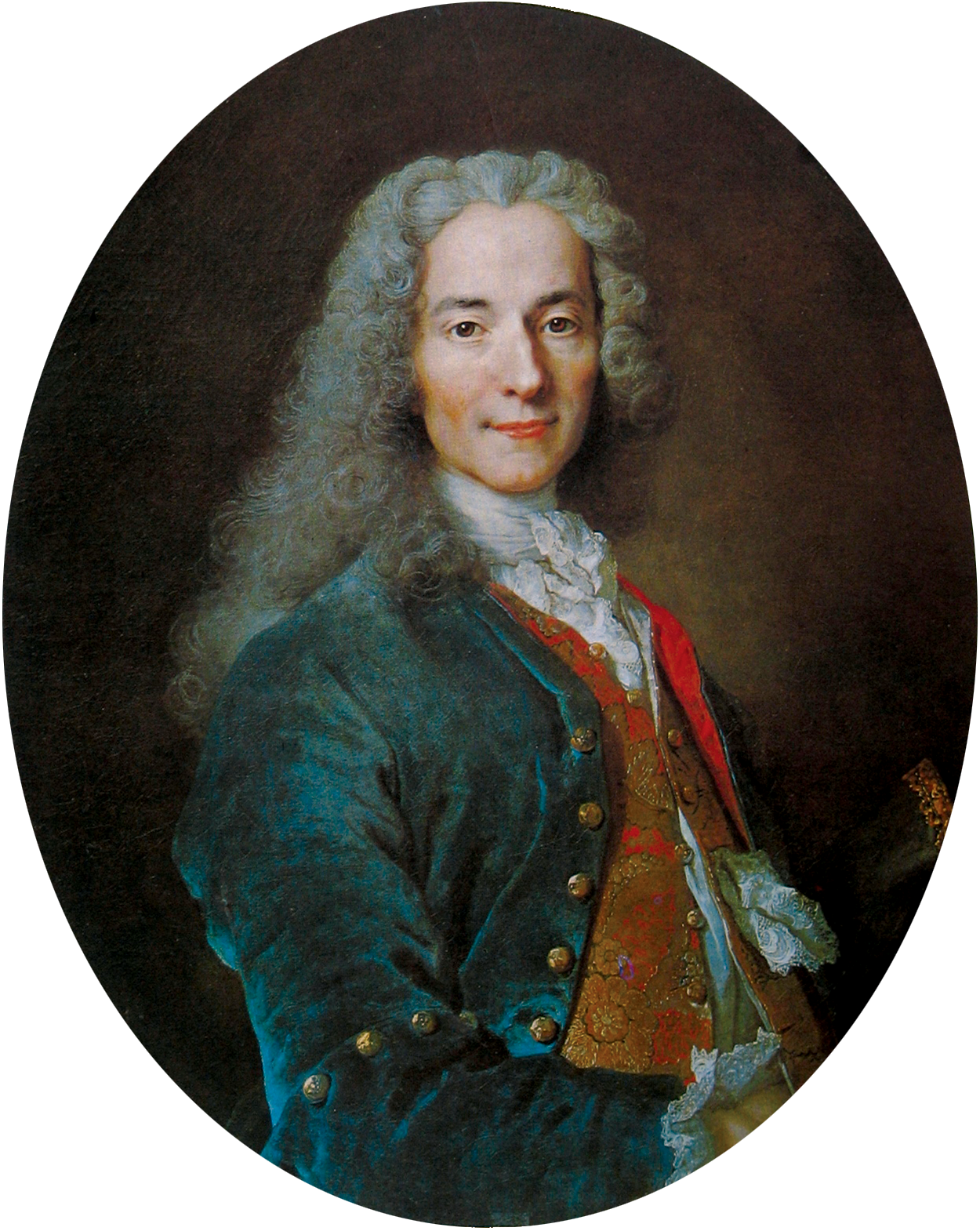
France had its own tradition of religious skepticism and natural theology in the works of Montaigne, Pierre Bayle, and Montesquieu. The most famous of the French Deists was Voltaire, who was exposed to Newtonian science and English Deism during his two-year period of exile in England (1726–1728). When he returned to France, he brought both back with him, and exposed the French reading public (i.e., the aristocracy) to them, in a number of books.
French Deists also included Maximilien Robespierre and Jean-Jacques Rousseau. During the French Revolution (1789–1799), the Deistic Cult of the Supreme Being—a direct expression of Robespierre's theological views—was established briefly (just under three months) as the new state religion of France, replacing the deposed Catholic Church and the rival atheistic Cult of Reason.
There were over five hundred French Revolutionaries who were deists. These deists do not fit the stereotype of deists because they believed in miracles and often prayed to God. In fact, over seventy of them thought that God miraculously helped the French Revolution win victories over their enemies. Furthermore, over a hundred French Revolutionary deists also wrote prayers and hymns to God. Citizen Devillere was one of the many French Revolutionary deists who believed God did miracles. Devillere said, "God, who conducts our destiny, deigned to concern himself with our dangers. He commanded the spirit of victory to direct the hand of the faithful French, and in a few hours the aristocrats received the attack which we prepared, the wicked ones were destroyed and liberty was avenged."
Deism in Germany is not well documented. We know from correspondence with Voltaire that Frederick the Great was a Deist. Immanuel Kant's identification with Deism is controversial.
Decline of Enlightenment Deism
Peter Gay describes Enlightenment Deism as entering slow decline as a recognizable movement in the 1730s.{{cite book “After the writings of Woolston and Tindal, English deism went into slow decline. ... By the 1730s, nearly all the arguments in behalf of Deism ... had been offered and refined; the intellectual caliber of leading Deists was none too impressive; and the opponents of deism finally mustered some formidable spokesmen. The Deists of these decades, Peter Annet (1693–1769), Thomas Chubb (1679–1747), and Thomas Morgan (?–1743), are of significance to the specialist alone. ... It had all been said before, and better. .” (p.140) A number of reasons have been suggested for this decline, including:
- The increasing influence of naturalism and materialism.
- The writings of David Hume and Immanuel Kant raising questions about the ability of reason to address metaphysical questions.
- The violence of the French Revolution.
- Christian revivalist movements, such as Pietism and Methodism (which emphasized a personal relationship with God), along with the rise of anti-rationalist and counter-Enlightenment philosophies such as that of Johann Georg Hamann.
Although Deism has declined in popularity over time, scholars believe that these ideas still have a lingering influence on modern society. One of the major activities of the Deists, biblical criticism, evolved into its own highly technical discipline. Deist rejection of revealed religion evolved into, and contributed to, 19th-century liberal British theology and the rise of Unitarianism.
Contemporary Deism
Contemporary Deism attempts to integrate classical Deism with modern philosophy and the current state of scientific knowledge. This attempt has produced a wide variety of personal beliefs under the broad classification of belief of "deism."
There are a number of subcategories of modern Deism, including monodeism (the default, standard concept of deism), pandeism, panendeism, spiritual deism, process deism, Christian deism, polydeism, scientific deism, and humanistic deism. Some deists see design in nature and purpose in the universe and in their lives. Others see God and the universe in a co-creative process. Some deists view God in classical terms as observing humanity but not directly intervening in our lives, while others see God as a subtle and persuasive spirit who created the world, and then stepped back to observe.
Recent philosophical discussions of Deism
In the 1960s, theologian Charles Hartshorne scrupulously examined and rejected both deism and pandeism (as well as pantheism) in favor of a conception of God whose characteristics included "absolute perfection in some respects, relative perfection in all others" or "AR," writing that this theory "is able consistently to embrace all that is positive in either deism or pandeism," concluding that "panentheistic doctrine contains all of deism and pandeism except their arbitrary negations."
Charles Taylor, in his 2007 book A Secular Age, showed the historical role of Deism, leading to what he calls an "exclusive humanism". This humanism invokes a moral order whose ontic commitment is wholly intra-human with no reference to transcendence.{{cite book One of the special achievements of such deism-based humanism is that it discloses new, anthropocentric moral sources by which human beings are motivated and empowered to accomplish acts of mutual benefit.{{cite book This is the province of a buffered, disengaged self, which is the locus of dignity, freedom, and discipline, and is endowed with a sense of human capability.{{cite book According to Taylor, by the early 19th century this Deism-mediated exclusive humanism developed as an alternative to Christian faith in a personal God and an order of miracles and mystery. Some critics of Deism have accused adherents of facilitating the rise of nihilism.
Deism in Nazi Germany
Main article: Gottgläubig, Ideology of the Nazi Party, Religion in Nazi Germany

In Nazi Germany, Gottgläubig (literally: "believing in God") was a Nazi religious term for a form of non-denominationalism practised by those German citizens who had officially left Christian churches but professed faith in some higher power or divine creator. Such people were called Gottgläubige ("believers in God"), and the term for the overall movement was Gottgläubigkeit ("belief in God"); the term denotes someone who still believes in a God, although without having any institutional religious affiliation. These National Socialists were not favourable towards religious institutions of their time, nor did they tolerate atheism of any type within their ranks. The 1943 Philosophical Dictionary defined Gottgläubig as: "official designation for those who profess a specific kind of piety and morality, without being bound to a church denomination, whilst however also rejecting irreligion and godlessness." The Gottgläubigkeit is considered a form of deism, and was "predominantly based on creationist and deistic views".
In the 1920 National Socialist Programme of the National Socialist German Workers' Party (NSDAP), Adolf Hitler first mentioned the phrase "Positive Christianity". The Nazi Party did not wish to tie itself to a particular Christian denomination, but with Christianity in general, and sought freedom of religion for all denominations "so long as they do not endanger its existence or oppose the moral senses of the Germanic race" (point 24). When Hitler and the NSDAP got into power in 1933, they sought to assert state control over the churches, on the one hand through the Reichskonkordat with the Roman Catholic Church, and the forced merger of the German Evangelical Church Confederation into the Protestant Reich Church on the other. This policy seems to have gone relatively well until late 1936, when a "gradual worsening of relations" between the Nazi Party and the churches saw the rise of Kirchenaustritt ("leaving the Church"). Although there was no top-down official directive to revoke church membership, some Nazi Party members started doing so voluntarily and put other members under pressure to follow their example. Those who left the churches were designated as Gottgläubige ("believers in God"), a term officially recognised by the Interior Minister Wilhelm Frick on 26 November 1936. He stressed that the term signified political disassociation from the churches, not an act of religious apostasy. The term "dissident", which some church leavers had used up until then, was associated with being "without belief" (glaubenslos), whilst most of them emphasized that they still believed in a God, and thus required a different word.
A census in May 1939, six years into the Nazi era, and after the annexation of the mostly Catholic Federal State of Austria and mostly Catholic German-occupied Czechoslovakia into German-occupied Europe, indicates that 54% of the population considered itself Protestant, 41% considered itself Catholic, 3.5% self-identified as Gottgläubig, and 1.5% as "atheist".
Deism in Turkey
Main article: Irreligion in Turkey

An early April 2018 report of the Turkish Ministry of Education, titled The Youth is Sliding towards Deism, observed that an increasing number of pupils in İmam Hatip schools was repudiating Islam in favour of Deism (irreligious belief in a creator god). The report's publication generated large-scale controversy in the Turkish press and society at large, as well as amongst conservative Islamic sects, Muslim clerics, and Islamist parties in Turkey.
The progressive Muslim theologian Mustafa Öztürk noted the Deistic trend among Turkish people a year earlier, arguing that the "very archaic, dogmatic notion of religion" held by the majority of those claiming to represent Islam was causing "the new generations [to become] indifferent, even distant, to the Islamic worldview." Despite a lack of reliable statistical data, numerous anecdotes and independent surveys appear to point in this direction. Although some commentators claim that the secularization of Turkey is merely a result of Western influence or even an alleged "conspiracy", other commentators, even some pro-government ones, have come to the conclusion that "the real reason for the loss of faith in Islam is not the West but Turkey itself".
Deism in the United States
Main article: Irreligion in the United States
Though Deism subsided in the United States post-Enlightenment, it never died out entirely. Thomas Edison, for example, was heavily influenced by Thomas Paine's The Age of Reason. Edison defended Paine's "scientific deism", saying, "He has been called an atheist, but atheist he was not. Paine believed in a supreme intelligence, as representing the idea which other men often express by the name of deity." In 1878, Edison joined the Theosophical Society in New Jersey, but according to its founder, Helena Blavatsky, he was not a very active member. In an October 2, 1910, interview in the New York Times Magazine, Edison stated:{{blockquote| Nature is what we know. We do not know the gods of religions. And nature is not kind, or merciful, or loving. If God made me—the fabled God of the three qualities of which I spoke: mercy, kindness, love—He also made the fish I catch and eat. And where do His mercy, kindness, and love for that fish come in? No; nature made us—nature did it all—not the gods of the religions. Edison was labeled an atheist for those remarks, and although he did not allow himself to be drawn into the controversy publicly, he clarified himself in a private letter:
He also stated, "I do not believe in the God of the theologians; but that there is a Supreme Intelligence I do not doubt."
The 2001 American Religious Identification Survey (ARIS) report estimated that between 1990 and 2001 the number of self-identifying Deists grew from 6,000 to 49,000, representing about 0.02% of the U.S. population at the time. The 2008 ARIS survey found, based on their stated beliefs rather than their religious identification, that 70% of Americans believe in a personal God:The American Religious Identification Survey (ARIS) report notes that while "[n]o definition was offered of the terms, [they] are usually associated with a 'personal relationship' with Jesus Christ together with a certain view of salvation, scripture, and missionary work" (p. 11). roughly 12% are atheists or agnostics, and 12% believe in "a deist or paganistic concept of the Divine as a higher power" rather than a personal God.
The term "ceremonial deism" was coined in 1962 by the dean of Yale Law School and American legal scholar Eugene V. Rostow, and has been used since 1984 by the Supreme Court to assess exemptions from the Establishment Clause of the First Amendment to the U.S. Constitution, thought to be expressions of cultural tradition and not earnest invocations of a deity. However, American academic and professor of philosophy Martha Nussbaum remarks that the term does not describe any school of thought within Deism itself.
References
Notes
Citations
Bibliography
Histories
- Betts, C. J. Early Deism in France: From the so-called 'deistes' of Lyon (1564) to Voltaire's 'Lettres philosophiques' (1734) (Martinus Nijhoff, 1984)
- Craig, William Lane. The Historical Argument for the Resurrection of Jesus During the Deist Controversy (Edwin Mellen, 1985)
- Hazard, Paul. European thought in the eighteenth century from Montesquieu to Lessing (1954). pp 393–434.
- Hudson, Wayne. Enlightenment and modernity: The English deists and reform (Routledge, 2015).
- Israel, Jonathan I. Enlightenment contested: philosophy, modernity, and the emancipation of man 1670-1752 (Oxford UP, 2006).
- Lemay, J. A. Leo, ed.Deism, Masonry, and the Enlightenment. Essays Honoring Alfred Owen Aldridge. (U of Delaware Press, 1987).
- Lucci, Diego. Scripture and deism: The biblical criticism of the eighteenth-century British deists (Peter Lang, 2008).
- McKee, David Rice. Simon Tyssot de Patot and the Seventeenth-Century Background of Critical Deism (Johns Hopkins Press, 1941)
- Orr, John. English Deism: Its Roots and Its Fruits (1934)
- Schlereth, Eric R. An Age of Infidels: The Politics of Religious Controversy in the Early United States (U of Pennsylvania Press; 2013) 295 pages; on conflicts between deists and their opponents.
- Willey, Basil. The Eighteenth Century Background: Studies on the Idea of Nature in the Thought of the Period (1940)
- Yoder, Timothy S. Hume on God: Irony, deism and genuine theism (Bloomsbury, 2008).
Primary sources
- Deism: An Anthology by Peter Gay (Van Nostrand, 1968)
- Deism and Natural Religion: A Source Book by E. Graham Waring (Frederick Ungar, 1967)
- The American Deists: Voices of Reason & Dissent in the Early Republic by Kerry S. Walters (University of Kansas Press, 1992), which includes an extensive bibliographic essay
- by Bob Johnson, founder of the World Union of Deists
- by Bob Johnson
- by Bob Johnson
Secondary sources
References
- (1990). "The Concise Oxford Dictionary". Oxford University Press.
- (2012). "Deist – Definition and More from the Free Merriam-Webster Dictionary". Merriam-webster.com.
- Harper, Leland Royce. (2020). "Multiverse Deism: Shifting Perspectives of God and the World". [[Rowman & Littlefield]].
- (2013). "Models of God and Alternative Ultimate Realities". [[Springer Verlag]].
- (2015). "The World of the American Revolution: A Daily Life Encyclopedia". [[Greenwood Publishing Group]], imprint of [[ABC-Clio]].
- Bristow, William. (Fall 2017). "Religion and the Enlightenment: Deism". The Metaphysics Research Lab, [[Center for the Study of Language and Information]], [[Stanford University]].
- (13 March 2020). "Deism". [[Encyclopædia Britannica, Inc.]].
- Gomes, Alan W.. (2012). "Deism". [[Wiley-Blackwell]].
- (1906). "Deism". [[Kopelman Foundation]].
- (1999). "Merriam-Webster's Encyclopedia of World Religions". [[Merriam-Webster]].
- (2022). "Deism". [[Routledge]].
- Herrick, James A.. (1997). "The Radical Rhetoric of the English Deists: The Discourse of Skepticism, 1680–1750". [[University of South Carolina Press]].
- Claeys, Gregory. (1989). "Thomas Paine: Social and Political Thought". [[Routledge]].
- ''Stromata'', book 7, ch. 3. Alexander Roberts and James Donaldson (eds.), ''Ante-Nicene Christian Library: Translations of the Writings of the Fathers down to AD 325'', vol. 12, p. 416
- Treiger, Alexander. (2016). "The Oxford Handbook of Islamic Theology". [[Oxford University Press]].
- (1980). "La théologie musulmane et l'étude du langage". Société d'histoire et d'Épistémologie des Sciences du Langage.
- (2016). "The Oxford Handbook of Islamic Theology". [[Oxford University Press]].
- (2016). "The Oxford Handbook of Islamic Theology". [[Oxford University Press]].
- Hussaini, Sayed Hassan. (2016). "Islamic Philosophy between Theism and Deism". Aletheia - Associação Científica e Cultural.
- (22 August 2005). "Déisme". Swiss Academy of Humanities and Social Sciences.
- Basil Willey, ''The Seventeenth Century Background: Studies in the Thought of the Age in Relation to Poetry and Religion'', 1934, p.59ff.
- Note that Locke himself was not a deist. He believed in both miracles and revelation. See Orr, pp.96-99.
- Tindal: "By natural religion, I understand the belief of the existence of a God, and the sense and practice of those duties which result from the knowledge we, by our reason, have of him and his perfections; and of ourselves, and our own imperfections, and of the relationship we stand in to him, and to our fellow-creatures; so that the religion of nature takes in everything that is founded on the reason and nature of things." ''Christianity as Old as the Creation'' (II), quoted in Waring ''(see above)'', p.113.
- Toland: “I hope to make it appear that the use of reason is not so dangerous in religion as it is commonly represented .. There is nothing that men make a greater noise about than the "mysteries of the Christian religion". The divines gravely tell us "we must adore what we cannot comprehend" .. [Some] contend [that] some mysteries may be, or at least seem to be, contrary to reason, and yet received by faith. [Others contend] that no mystery is contrary to reason, but that all are "above" it. On the contrary, we hold that reason is the only foundation of all certitude .. Wherefore, we likewise maintain, according to the title of this discourse, that ''there is nothing in the Gospel contrary to reason, nor above it; and that no Christian doctrine can be properly called a mystery''." ''Christianity Not Mysterious: or, a Treatise Shewing That There Is Nothing in the Gospel Contrary to Reason, Nor above It'' (1696), quoted in Waring ''(see above)'', pp. 1–12
- Stephens, William. (2019-01-05). "An Account of the Growth of Deism in England".
- “It can't be imputed to any defect in the light of nature that the pagan world ran into idolatry, but to their being entirely governed by priests, who pretended communication with their gods, and to have thence their revelations, which they imposed on the credulous as divine oracles. Whereas the business of the Christian dispensation was to destroy all those traditional revelations, and restore, free from all idolatry, the true primitive and natural religion implanted in mankind from the creation.” ''Christianity as Old as the Creation'' (XIV), quoted in Waring ''(see above)'', p.163.
- Most American Deists, for example, firmly believed in divine providence. See this article, [[#Deism in the United States. Deism in the United States]].
- David Hartley, for example, described himself as "quite in the necessitarian scheme. See Ferg, Stephen, "Two Early Works of David Hartley", ''Journal of the History of Philosophy'', vol. 19, no. 2 (April 1981), pp. 173–89.
- See for example ''Liberty and Necessity'' (1729).
- (1911). "The Records of the Federal Convention of 1787". Yale University Press.
- Gary Scott Smith. (2012). "The Religious Beliefs of America's Founders: Reason, Revelation, Revolution". University Press of Kansas.
- Gelpi, Donald L.. (2007). "Varieties of Transcendental Experience: A Study in Constructive Postmodernism". [[Wipf and Stock]].
- Fischer, Kirsten. (2010). ""Religion Governed by Terror": A Deist Critique of Fearful Christianity in the Early American Republic". Belin.
- Paine, Thomas. (2014). "Selected Writings of Thomas Paine". [[Yale University Press]].
- "Culture Wars in the Early Republic". Common-place.
- Horowitz, Mitch. (July 3, 2025). "Occult American".
- Walters, Kerry S.. (1992). "Rational Infidels: The American Deists". Longwood Academic.
- Devillere, Citizen. (1987). "Archives parlementaires de la révolution français". Éditions du Centre National de la Recherche Scientifique.
- Allen Wood argues that Kant was Deist. See "Kant's Deism" in P. Rossi and M. Wreen (eds.), ''Kant's Philosophy of Religion Reconsidered'' (Bloomington: Indiana University Press, 1991). An argument against Kant as deist is Stephen Palmquist's "Kant's Theistic Solution". http://www.hkbu.edu.hk/~ppp/srp/arts/KTS.html {{Webarchive. link. (2005-07-22)
- Van den Berg, Jan. (October 2019). "The Development of Modern Deism". [[Brill Publishers]].
- José M. Lozano-Gotor, "Deism", ''[https://link.springer.com/10.1007/978-1-4020-8265-8_1573 Encyclopedia of Sciences and Religions]'' (Springer: 2013). "[Deism] takes different forms, for example, humanistic, scientific, Christian, spiritual deism, pandeism, and panendeism."
- [[Mikhail Epstein]], ''Postatheism and the phenomenon of minimal religion in Russia'', in Justin Beaumont, ed., ''The Routledge Handbook of Postsecularity'' (2018), p. 83, n. 3: "I refer here to monodeism as the default standard concept of deism, distinct from polydeism, pandeism, and spiritual deism."
- [http://www.mnn.com/lifestyle/arts-culture/stories/what-is-deism What Is Deism?] {{Webarchive. link. (2016-04-17 , Douglas MacGowan, ''[[Mother Nature Network]]'', May 21, 2015: "Over time there have been other schools of thought formed under the umbrella of deism including [[Christian deism]], belief in deistic principles coupled with the moral teachings of [[Jesus of Nazareth]], and Pandeism, a belief that God became the entire universe and no longer exists as a separate being.")
- Hartshorne, Charles. (1964). "Man's Vision of God and the Logic of Theism". Archon Books.
- Essien, Anthonia M. "The sociological implications of the worldview of the Annang people: an advocacy for paradigm shift." Journal of Emerging Trends in Educational Research and Policy Studies 1.1 (2010): 29-35.
- Steigmann-Gall, Richard. (2003). "The Holy Reich: Nazi Conceptions of Christianity, 1919–1945". [[Cambridge University Press]].
- Ziegler, Herbert F.. (2014). "Nazi Germany's New Aristocracy: The SS Leadership, 1925-1939". [[Princeton University Press]].
- [[Michael Burleigh. link. (27 May 2016)
- (1943). "Philosophisches Wörterbuch Kröners Taschenausgabe. Volume 12".
- Bear, Ileen. (2016). "Adolf Hitler: A Biography". Alpha Editions.
- Johnson, Eric (2000). ''Nazi terror: the Gestapo, Jews, and ordinary Germans'' New York: Basic Books, [https://books.google.com/books?id=gmuw9TvbFdUC&pg=PA10 p. 10.]
- "Population by religious belief and sex by 1921, 1930, 1950, 1991, 2001 and 2011 censuses 1)". Czech Statistical Office.
- [[Richard J. Evans]]; ''The Third Reich at War''; Penguin Press; New York 2009, p. 546
- Lumans, Valdis O.. (1993). "Himmler's Auxiliaries: The Volksdeutsche Mittelstelle and the German National Minorities of Europe, 1933–1945". [[University of North Carolina Press]].
- {{cite encyclopedia. Cuthell. David Cameron Jr.. (2009). New York]]. [[Facts On File]]
- (2014). "Atatürk, Kemal". Philip's.
- Books, Market House Books Market House. (2003). "Atatürk, Kemal". Oxford University Press.
- McKernan, Bethan. (29 April 2020). "Turkish students increasingly resisting religion, study suggests". [[The Guardian]].
- Sarfati, Yusuf. (15 April 2019). "State Monopolization of Religion and Declining Piety in Turkey". [[Berkley Center for Religion, Peace, and World Affairs]] ([[Georgetown University]]).
- Bekdil, Burak. (20 May 2021). "Turks May Be Rediscovering the Merits of the Secular Paradigm". [[Begin–Sadat Center for Strategic Studies]] ([[Bar-Ilan University]]).
- Akyol, Mustafa. (12 June 2020). "How Islamists are Ruining Islam". [[Hudson Institute]].
- Bilici, Mucahit. (Fall 2018). "The Crisis of Religiosity in Turkish Islamism". [[Middle East Research and Information Project.
- Girit, Selin. (10 May 2018). "Losing their religion: The young Turks rejecting Islam". [[BBC News]].
- Külsoy, Ahmet. (6 May 2018). "What is pushing half of Turkey towards Deism?". [[Ahval News]].
- Akyol, Mustafa. (16 April 2018). "Why so many Turks are losing faith in Islam". [[Al-Monitor]].
- Israel, Paul. (2000). "Edison: A Life of Invention". John Wiley & Sons.
- "Theosophical Society Members 1875–1942 – Historical membership list of the Theosophical Society (Adyar) 1875–1942".
- Blavatsky, Helena Petrovna. (1980). "Collected Writings, Vol. XII". Theosophical Publishing House.
- (October 2, 1910). ""No Immortality of the Soul" says Thomas A. Edison. In Fact, He Doesn't Believe There Is a Soul—Human Beings Only an Aggregate of Cells and the Brain Only a Wonderful Machine, Says Wizard of Electricity". The New York Times.
- link. (June 19, 2020 '' (1970), G.W. Foote & Company, Volume 90, p. 147)
- (2001). "American Religious Identification Survey, 2001".
- (2009). "ARIS Summary Report, March 2009".
- (January 2010). "Of Christmas Trees and Corpus Christi: Ceremonial Deism and Change in Meaning over Time". [[Duke University School of Law]].
- [[Martha Nussbaum]], [http://www.law.uchicago.edu/alumni/magazine/fall2008/undergod Under God: The Pledge, Present and Future] {{Webarchive. link. (2017-08-07)
This article was imported from Wikipedia and is available under the Creative Commons Attribution-ShareAlike 4.0 License. Content has been adapted to SurfDoc format. Original contributors can be found on the article history page.
Ask Mako anything about Deism — get instant answers, deeper analysis, and related topics.
Research with MakoFree with your Surf account
Create a free account to save articles, ask Mako questions, and organize your research.
Sign up freeThis content may have been generated or modified by AI. CloudSurf Software LLC is not responsible for the accuracy, completeness, or reliability of AI-generated content. Always verify important information from primary sources.
Report