From Surf Wiki (app.surf) — the open knowledge base
Deinosuchus
Genus of a giant crocodylian

Genus of a giant crocodylian
(Emmons, 1858) originally [Polyptychodon]
- D. riograndensis (Colbert & Bird, 1954) [originally Phobosuchus]
- D. schwimmeri Cossette & Brochu, 2020
- Phobosuchus Nopcsa, 1924
Deinosuchus is an extinct genus of eusuchian, either an alligatoroid crocodilian or a stem-group crocodilian, which lived during the Late Cretaceous around . The first remains were discovered in North Carolina (United States) in the 1850s, and the genus was first described in 1909. Additional fragments were discovered in the 1940s and were later incorporated into an influential, though inaccurate, skull reconstruction at the American Museum of Natural History. Knowledge of Deinosuchus remains incomplete, but better cranial material found in recent years has expanded scientific understanding of this massive predator.
Although Deinosuchus was far larger than any modern crocodile or alligator, with the largest adults measuring 10.6 m in total length, its overall appearance was fairly similar to its smaller relatives. It had large, robust teeth built for crushing, and its back was covered with thick hemispherical osteoderms. One study indicated Deinosuchus may have lived for up to 50 years, growing at a rate similar to that of modern crocodilians, but maintaining this growth over a much longer time.
Deinosuchus fossils have been discovered in 12 U.S. states, including Texas, Montana, and many along the East Coast. Fossils have also been found in northern Mexico. It lived on both sides of the Western Interior Seaway, and was an opportunistic apex predator in the coastal regions of eastern North America. Deinosuchus reached its largest size in its western habitat, but the eastern populations were far more abundant. Opinion remains divided as to whether these two populations represent separate species. Deinosuchus was probably capable of killing and eating large dinosaurs. It may have also fed upon sea turtles, fish, and other aquatic and terrestrial prey.
Discovery and naming
In 1858, geologist Ebenezer Emmons described two large fossil teeth found in the Tar Heel Formation of Bladen County, North Carolina. Emmons assigned these teeth to Polyptychodon, which he then believed to be "a genus of crocodilian reptiles". Later discoveries showed that Polyptychodon was actually a pliosaur, a type of marine reptile. The teeth described by Emmons were thick, slightly curved, and covered with vertically grooved enamel; he assigned them a new species name, P. rugosus. Although not initially recognized as such, these teeth were probably the first Deinosuchus remains to be scientifically described. Another large tooth that likely came from Deinosuchus, discovered in Tar Heel sediments from neighboring Sampson County, was named Polydectes biturgidus by Edward Drinker Cope in 1869.
In 1903, at Willow Creek, Montana, several fossil osteoderms were discovered "lying upon the surface of the soil" by John Bell Hatcher and T.W. Stanton. These osteoderms were initially attributed to the ankylosaurid dinosaur Euoplocephalus. Excavation at the site, carried out by W.H. Utterback, yielded further fossils, including additional osteoderms, as well as vertebrae, ribs, and a pubis. When these specimens were examined, it became clear that they belonged to a large crocodilian and not a dinosaur; upon learning this, Hatcher "immediately lost interest" in the material. After Hatcher died in 1904, his colleague W. J. Holland studied and described the fossils. Holland assigned these specimens to a new genus and species, Deinosuchus hatcheri, in 1909. Deinosuchus comes from the Greek δεινός/deinos, meaning "terrible", and σοῦχος/suchos, meaning "crocodile".
A 1940 expedition by the American Museum of Natural History yielded more fossils of giant crocodilians, this time from Big Bend National Park in Texas. These specimens were described by Edwin H. Colbert and Roland T. Bird in 1954, under the name Phobosuchus riograndensis. Donald Baird and Jack Horner later assigned the Big Bend remains to Deinosuchus, which has been accepted by most modern authorities. The genus name Phobosuchus, which was initially created by Baron Franz Nopcsa in 1924, has since been discarded because it contained a variety of different crocodilian species that turned out to not be closely related to each other. In 2024, the replacement of the type species of Deinosuchus with Phobosuchus riograndensis has been petitioned to the ICZN.
The American Museum of Natural History incorporated the skull and jaw fragments into a plaster restoration, modeled after the present-day Cuban crocodile. Colbert and Bird stated this was a "conservative" reconstruction, since an even greater length could have been obtained if a long-skulled modern species, such as the saltwater crocodile had been used as the template. Because it was not then known that Deinosuchus had a broad snout, Colbert and Bird miscalculated the proportions of the skull, and the reconstruction greatly exaggerated its overall width and length. Despite its inaccuracies, the reconstructed skull became the best-known specimen of Deinosuchus, and brought public attention to this giant crocodilian for the first time.
Numerous additional specimens of Deinosuchus were discovered over the next several decades. Most were quite fragmentary, but they expanded knowledge of the giant predator's geographic range. As noted by Chris Brochu, the osteoderms are distinctive enough that even "bone granola" can adequately confirm the presence of Deinosuchus. Better cranial material was also found; by 2002, David R. Schwimmer was able to create a composite computer reconstruction of 90% of the skull.
Classification and species

Since the discovery of the earliest fragmentary remains that would come to be known as Deinosuchus, it was considered a relative of crocodiles and initially placed in their family (Crocodylidae) in 1954 based on dental features. However, the finding of new specimens from Texas and Georgia in 1999 led to phylogenetic analysis placing Deinosuchus in a basal position within the clade Alligatoroidea along with Leidyosuchus. This classification was bolstered in 2005 by the discovery of a well-preserved Deinosuchus brain case from the Blufftown Formation of Alabama, which shows some features reminiscent of those in the modern American alligator, although Deinosuchus was not considered a direct ancestor of modern alligators.
The species pertaining to Deinosuchus since the resurrection of the generic name in 1979 have been traditionally recognized as D. rugosus from Appalachia and the larger D. hatcheri/riograndensis from Laramidia, characterized by differences of the shape of their osteoderms and teeth. However, based on the lack of distinctive enough differences beyond size, they have increasingly been considered all the same species. In their overview of crocodyliform material from the Kaiparowits Formation of Utah, Irmis et al. (2013) noted that D. rugosus is dubious due to its holotype teeth being undiagnostic, and recommended using Deinosuchus hatcheri for Deinosuchus material from Laramidia, while stressing that cranial Deinosuchus material from Appalachia has not been described. In a 2020 study, Cossette and Brochu agreed that D. rugosus is dubious and undiagnostic, rendering it a nomen dubium, and alternatively named a new species D. schwimmeri (named after fellow paleontologist David R. Schwimmer) from Appalachia, which included several specimens previously ascribed to D. rugosus. They also noted that the highly incomplete D. hatcheri holotype can be distinguished by the unique shape of the edge of its indented osteoderms, although this may not be reliable because the osteoderms of the other species may simply not be as well preserved. However, due to the incomplete nature of the type species D. hatcheri, Cossette and Brochu proposed to transfer the type species to the better preserved D. riograndensis, which would allow for improved identification and differentiation of the Deinosuchus species.
Phylogenetic analysis places Deinosuchus as a basal member of Alligatoroidea, as shown in the simplified cladogram below:
In a 2025 study, Jules D. Walter and colleagues argue that many character states previously thought to be diagnostic for alligatoroids were actually much more widespread. In their analysis several genera traditionally viewed as basal alligatoroids, among them Deinosuchus, were found to not only fall outside of Alligatoroidea but to not even be true crocodilians, instead representing derived non-crocodilian eusuchians. Deinosuchus was recovered as having split from the lineage leading up to Crocodilia after Leidyosuchus but before the terrestrial Planocraniidae.
Description
Morphology
Despite its large size, the overall appearance of Deinosuchus was not considerably different from that of modern crocodilians. Deinosuchus had an alligator-like, broad snout, with a slightly bulbous tip.{{cite book |title=King of the Crocodylians: The Paleobiology of Deinosuchus |last=Schwimmer |first=David R. |publisher=Indiana University Press |pages=1–16 |chapter=The Life and Times of a Giant Crocodylian
Modern saltwater crocodiles (Crocodylus porosus) have the strongest recorded bite of any living animal, with a maximum force of 16414 N for a 4.59 m, 531 kg specimen. The bite force of Deinosuchus has been estimated to be 18000 N to 102803 N.
Deinosuchus had a secondary bony palate, which would have permitted it to breathe through its nostrils while the rest of the head remained submerged underwater. The vertebrae were articulated in a procoelous manner, meaning they had a concave hollow on the front end and a convex bulge on the rear; these would have fit together to produce a ball and socket joint. The secondary palate and procoelous vertebrae are advanced features also found in modern eusuchian crocodilians.
The osteoderms (scutes) covering the back of Deinosuchus were unusually large, heavy, and deeply pitted; some were of a roughly hemispherical shape. Deep pits and grooves on these osteoderms served as attachment points for connective tissue. Together, the osteoderms and connective tissue would have served as load-bearing reinforcement to support the massive body of Deinosuchus out of water. These deeply pitted osteoderms have been used to suggest that, despite its bulk, Deinosuchus could probably have walked on land much like modern-day crocodiles. However, more recent analyses of the taxon's hindlimb biomechanics find that Deinosuchus would have run into issues generating enough muscular force to support its body and prevent the adoption of an erect-limbed "high walk" gait. This would have limited Deinosuchus terrestrial capabilities to belly-dragging as its primary mode of locomotion over land, and would suggest the taxon would have spent most of its life in the water.
Size
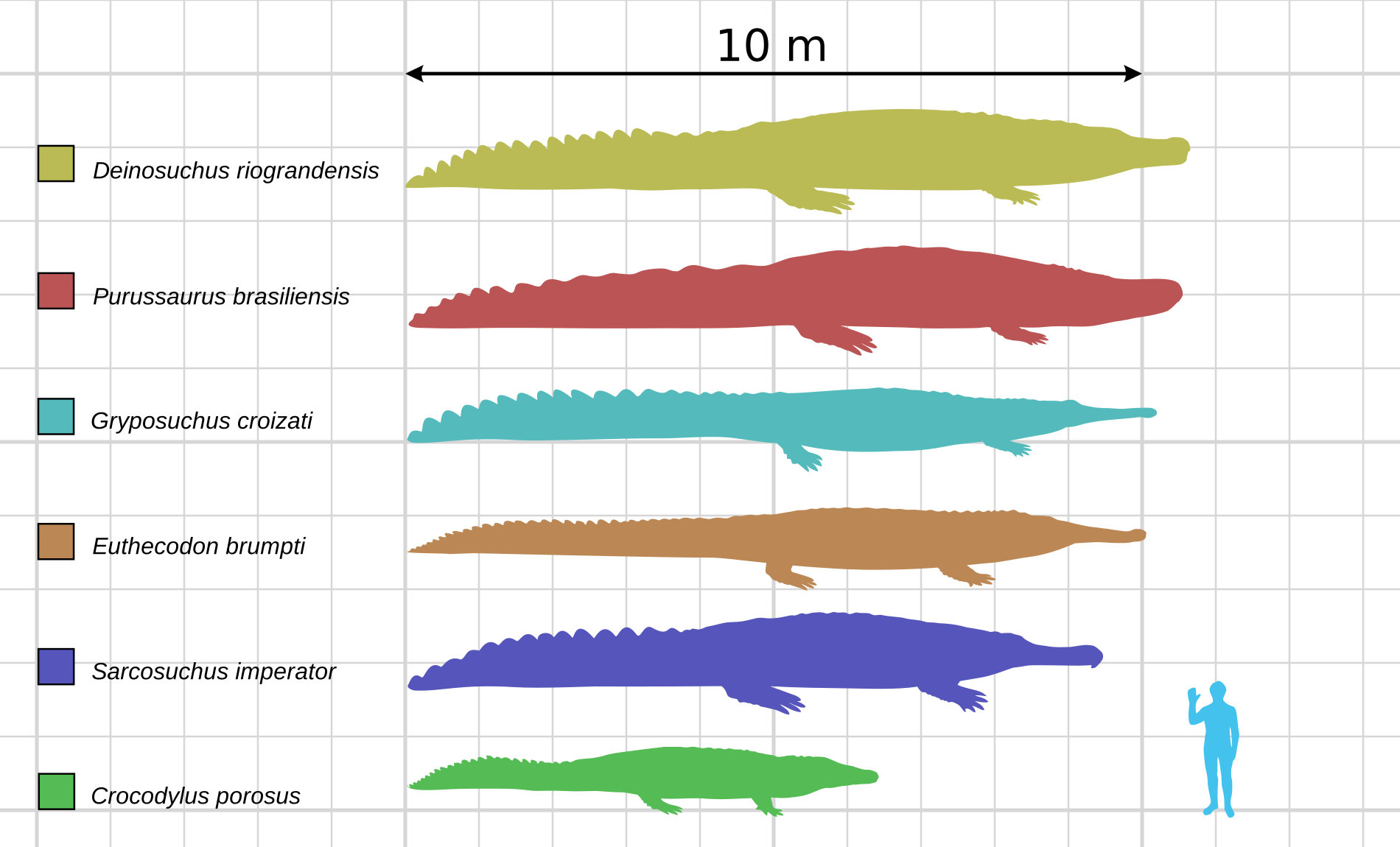
The large size of Deinosuchus has generally been recognized despite the fragmentary nature of the fossils assigned to it. However, estimates of how large it really was have varied considerably over the years. The original estimate from 1954 for the type specimen of the then-named "Phobosuchus riograndensis" were based on a skull of 1.5 m and a lower jaw of 1.8 m long, reconstructed with similar proportions to the Cuban crocodile giving a total estimated length of 15 m. However, this reconstruction is currently considered to be inaccurate. Using more complete remains, it was estimated in 1999 that the size attained by specimens of Deinosuchus varied from 8 to with weights from 2.5 to.{{cite journal
A particularly large mandibular fragment from a D. riograndensis specimen was estimated to have come from an individual with a skull length of 147.5 cm. This length was used in conjunction with a regression equation relating skull length to total length in the American alligator to estimate a total length of 10.64 m for this particular specimen. This is only slightly lower than previous estimates for the species. Deinosuchus has often been described as the largest crocodyliform of all time. In their 2025 reclassification of Deinosuchus as a eusuchian, Walter and colleagues stated that previous estimates may have overestimated its size as the genus has a relatively long snout, but these were based on taxa with shorter snouts such as the American alligator. The authors estimated the maximum total body length of D. riograndensis and D. schwimmeri at 10.5 m and 7.64 m respectively. They also suggested that Purussaurus would have been larger than Deinosuchus.
Paleobiology
Diet
|access-date=November 2, 2009 |archive-url=https://web.archive.org/web/20110719181856/http://geology.csustan.edu/julia/pdf/sankey-2001.pdf |archive-date=July 19, 2011 }}]] In 1954, Edwin H. Colbert and Roland T. Bird speculated that Deinosuchus "may very well have hunted and devoured some of the dinosaurs with which it was contemporaneous". Colbert restated this hypothesis more confidently in 1961: "Certainly this crocodile must have been a predator of dinosaurs; otherwise why would it have been so overwhelmingly gigantic? It hunted in the water where the giant theropods could not go."{{cite book |url-access=registration

Schwimmer and G. Dent Williams proposed in 1996 that Deinosuchus may have preyed on marine turtles.{{cite journal
Schwimmer concluded in 2002 that the feeding patterns of Deinosuchus most likely varied by geographic location; the smaller Deinosuchus specimens of eastern North America would have been opportunistic feeders in an ecological niche similar to that of the modern American alligator. They would have consumed marine turtles, large fish (such as Megalocoelacanthus), and smaller dinosaurs (including young theropods). The bigger, but less common, Deinosuchus that lived in Texas and Montana might have been more specialized hunters, capturing and eating dinosaurs (such as hadrosaurs, ceratopsians, and small and large theropods). Schwimmer noted no theropod dinosaurs in Deinosuchus eastern range approached its size, indicating the massive crocodilian could have been the region's apex predator.
Growth rates

A 1999 study by Gregory M. Erickson and Christopher A. Brochu suggested the growth rate of Deinosuchus was comparable to that of modern crocodilians, but was maintained over a far longer time. Their estimates, based on growth rings in the dorsal osteoderms of various specimens, indicated each Deinosuchus might have taken over 35 years to reach full adult size, and the oldest individuals may have lived for more than 50 years. This was a completely different growth strategy than that of large dinosaurs, which reached adult size much more quickly and had shorter lifespans. According to Erickson, a full-grown Deinosuchus "must have seen several generations of dinosaurs come and go".
Schwimmer noted in 2002 that Erickson and Brochu's assumptions about growth rates are only valid if the osteodermal rings reflect annual periods, as they do in modern crocodilians. According to Schwimmer, the growth ring patterns observed could have been affected by a variety of factors, including "migrations of their prey, wet-dry seasonal climate variations, or oceanic circulation and nutrient cycles". If the ring cycle were biannual rather than annual, this might indicate Deinosuchus grew faster than modern crocodilians, and had a similar maximum lifespan.
Paleoecology
Deinosuchus was present on both sides of the Western Interior Seaway.{{cite book |access-date=December 27, 2008 |archive-url=https://web.archive.org/web/20160222235454/https://gsa.confex.com/gsa/2008CD/finalprogram/abstract_133900.htm |archive-date=February 22, 2016
The distribution of Deinosuchus specimens indicates these giant crocodilians may have preferred estuarine environments. In the Aguja Formation of Texas, where some of the largest specimens of Deinosuchus have been found, these massive predators probably inhabited brackish-water bays.{{cite journal
It has been suggested that the presence of Deinosuchus may have been responsible for the lack of very large predatory theropods from the Late Cretaceous of Appalachia, with the giant crocodilian replacing such large theropods as the top predator of the Appalachian coastal plains.
References
References
- (2021). "First remains of the enormous alligatoroid ''Deinosuchus'' from the Upper Cretaceous Menefee Formation, New Mexico". PeerJ.
- Emmons, Ebenezer. (1858). "Report of the North Carolina Geological Survey". Henry D. Turner.
- Baird, D.. (1979). "Cretaceous dinosaurs of North Carolina". Brimleyana.
- [[International Commission on Zoological Nomenclature]]. (2024). "Notice of New Applications to the Commission (Cases 3885–3900)". Bulletin of Zoological Nomenclature.
- Brochu, Christopher A.. (February 7, 1998). "''Deinosuchus'' occurrences".
- Brochu, Christopher A.. (June 14, 1999). "Phylogenetics, Taxonomy, and Historical Biogeography of Alligatoroidea". Society of Vertebrate Paleontology Memoir.
- (2005). "Anatomy of the skull and braincase of a new ''Deinosuchus rugosus'' specimen from the Blufftown Formation, Russell County, Alabama". Geological Society of America Abstracts with Programs.
- Schwimmer, David R.. (2002). "King of the Crocodylians: The Paleobiology of Deinosuchus". [[Indiana University Press]].
- (2006). "The giant crocodylian ''Deinosuchus'' from the Upper Cretaceous of the San Juan Basin, New Mexico". New Mexico Museum of Natural History and Science Bulletin.
- (2013). "At the Top of the Grand Staircase: The Late Cretaceous of Southern Utah.". Indiana University Press.
- (2020). "A systematic review of the giant alligatoroid ''Deinosuchus'' from the Campanian of North America and its implications for the relationships at the root of Crocodylia". Journal of Vertebrate Paleontology.
- (2025). "Expanded phylogeny elucidates ''Deinosuchus relationships'', crocodylian osmoregulation and body-size evolution". Communications Biology.
- Schwimmer, David R.. (2002). "King of the Crocodylians: The Paleobiology of Deinosuchus". [[Indiana University Press]].
- Schwimmer, David R.. (2002). "King of the Crocodylians: The Paleobiology of Deinosuchus". [[Indiana University Press]].
- Schwimmer, David R.. (2002). "King of the Crocodylians: The Paleobiology of Deinosuchus". [[Indiana University Press]].
- (2012). "Insights into the Ecology and Evolutionary Success of Crocodilians Revealed through Bite-Force and Tooth-Pressure Experimentation". PLOS ONE.
- (1954). "A gigantic crocodile from the Upper Cretaceous beds of Texas". American Museum Novitates.
- Foster, John. (2007). "Jurassic West: The Dinosaurs of the Morrison Formation and Their World". [[Indiana University Press]].
- Cloudsley-Thompson, J.L.. (2005). "Ecology and Behaviour of Mesozoic Reptiles". [[Springer Science+Business Media.
- (1870). "Forms of Animal Life". Oxford at the Clarendon Press.
- Holland, W.J.. (1909). "''Deinosuchus hatcheri'', a new genus and species of crocodile from the Judith River beds of Montana". Annals of the Carnegie Museum.
- Schwimmer, David R.. (2002). "King of the Crocodylians: The Paleobiology of Deinosuchus". [[Indiana University Press]].
- (2025). "Biomechanical simulations of hindlimb function in ''Alligator'' provide insights into postural shifts and body size evolution". Science Advances.
- (January 1, 2020). "Vertebrae-Based Body Length Estimation in Crocodylians and Its Implication for Sexual Maturity and the Maximum Sizes". Integrative Organismal Biology.
- (November 2015). "Modes of ontogenetic allometric shifts in crocodylian vertebrae". Biological Journal of the Linnean Society.
- Farlow. (2005). "Femoral dimensions and body size of Alligator mississippiensis: estimating the size of extinct mesoeucrocodylians". Journal of Vertebrate Paleontology.
- Brochu, Christopher A.. (2003). "Review of ''King of the Crocodylians: The Paleobiology of Deinosuchus''". [[PALAIOS]].
- (April 16, 2014). "The 'death roll' of giant fossil crocodyliforms (Crocodylomorpha: Neosuchia): Allometric and skull strength analysis". Historical Biology.
- Milàn, J & Lucas, Spencer & Lockley, Martin & Spielmann, J & Schwimmer, David. (2010). BITE MARKS OF THE GIANT CROCODYLIAN DEINOSUCHUS ON LATE CRETACEOUS (CAMPANIAN) BONES. 51.
- Connor, Steve. (March 18, 1999). "Solved: Mystery of crocodile that feasted on dinosaurs". [[Independent News & Media]].
- "Dinosaurs in Delaware? {{!}} The Delaware Geological Survey".
- (2015). "A Late Cretaceous Dinosaur and Reptile Assemblage from South Carolina, Usa". Transactions of the American Philosophical Society.
- (July 1, 2015). "First report of a giant neosuchian (Crocodyliformes) in the Williams Fork Formation (Upper Cretaceous: Campanian) of Colorado". Cretaceous Research.
- Schwimmer, David R.. (2002). "King of the Crocodylians: The Paleobiology of Deinosuchus". Indiana University Press.
- Lehman, T. M.. (2001). "Mesozoic Vertebrate Life". Indiana University Press.
- Brownstein, Chase D.. (February 8, 2018). "The biogeography and ecology of the Cretaceous non-avian dinosaurs of Appalachia". Palaeontologia Electronica.
This article was imported from Wikipedia and is available under the Creative Commons Attribution-ShareAlike 4.0 License. Content has been adapted to SurfDoc format. Original contributors can be found on the article history page.
Ask Mako anything about Deinosuchus — get instant answers, deeper analysis, and related topics.
Research with MakoFree with your Surf account
Create a free account to save articles, ask Mako questions, and organize your research.
Sign up freeThis content may have been generated or modified by AI. CloudSurf Software LLC is not responsible for the accuracy, completeness, or reliability of AI-generated content. Always verify important information from primary sources.
Report