From Surf Wiki (app.surf) — the open knowledge base
Deep diving
Underwater diving to a depth beyond the norm accepted by the associated community

Underwater diving to a depth beyond the norm accepted by the associated community
Deep diving is underwater diving to a depth beyond the normal range accepted by the associated community. In some cases this is a prescribed limit established by an authority, while in others it is associated with a level of certification or training, and it may vary depending on whether the diving is recreational, technical or commercial. Nitrogen narcosis becomes a hazard below 30 m and hypoxic breathing gas is required below 60 m to lessen the risk of oxygen toxicity.
For some recreational diving agencies, "Deep diving", or "Deep diver" may be a certification awarded to divers that have been trained to dive to a specified depth range, generally deeper than 30 m. However, the Professional Association of Diving Instructors (PADI) defines anything from 18 to as a "deep dive" in the context of recreational diving (other diving organisations vary), and considers deep diving a form of technical diving. In technical diving, a depth below about 60 m where hypoxic breathing gas becomes necessary to avoid oxygen toxicity may be considered a deep dive. In professional diving, a depth that requires special equipment, procedures, or advanced training may be considered a deep dive.
Deep diving can mean something else in the commercial diving field. For instance early experiments carried out by COMEX using heliox and trimix attained far greater depths than any recreational technical diving. One example being its "Janus 4" open-sea dive to 501 m in 1977.
The open-sea diving depth record was achieved in 1988 by a team of COMEX and French Navy divers who performed pipeline connection exercises at a depth of 534 m in the Mediterranean Sea as part of the "Hydra 8" programme employing heliox and hydrox. The latter avoids the high-pressure nervous syndrome (HPNS) caused by helium and eases breathing due to its lower density. These divers needed to breathe special gas mixtures because they were exposed to very high ambient pressure (more than 54 times atmospheric pressure).
An atmospheric diving suit (ADS) allows very deep dives of up to 2300 ft. These suits are capable of withstanding the pressure at great depth permitting the diver to remain at normal atmospheric pressure. This eliminates the problems associated with breathing pressurised gases. In 2006 Chief Navy Diver Daniel Jackson set a record of 2000 ft in an ADS.
On 20 November 1992 COMEX's "Hydra 10" experiment simulated a dive in an onshore hyperbaric chamber with hydreliox. Théo Mavrostomos spent two hours at a simulated depth of 701 m.
Depth ranges in underwater diving
Assumed is the surface of the waterbody to be at or near sea level and underlies atmospheric pressure.
Not included are the differing ranges of freediving – without breathing during a dive.
| DepthAll depths specified for sea water. Fractionally deeper depths may apply in relation to freshwater due to its lower density. | Comments |
|---|---|
| 12 m | Recreational diving limit for divers aged under 12 years old and EN 14153-1 / ISO 24801-1 level 1 (Supervised Diver) standard. |
| 60 ft | Recreational diving limit for Open Water Divers (e.g. PADI, NAUI). |
| 20 m | Recreational diving limit for EN 14153-2 ISO 24801-2 level 2 "Autonomous Diver" standard. |
| 21 m | GUE Recreational Diver Level 1. |
| 30 m | date=January 2024}} and GUE Recreational Diver Level 2. Average depth at which nitrogen narcosis symptoms begin to be noticeable in adults. |
| 40 m | date=January 2024}} and GUE Recreational Diver Level 3. Depth limit for a French level 2 diver accompanied by an instructor (level 4 diver), breathing air. |
| 50 m | Depth limit for divers breathing air specified by the British Sub-Aqua Club and Sub-Aqua Association. |
| 60 m | Depth limit for a group of 2 to 3 French Level 3 recreational divers, breathing air. |
| 66 m | Depth at which breathing compressed air exposes the diver to an oxygen partial pressure of 1.6 bar. Greater depth is considered to expose the diver to an unacceptable risk of oxygen toxicity.Oxygen toxicity depends upon a combination of partial pressure and time of exposure, individual physiology, and other factors not fully understood. NOAA recommends that divers do not expose themselves to breathing oxygen at greater than 1.6 bar pO2, which occurs at 66 m when breathing air. |
| 100 m | One of the recommended technical diving limits. Maximum depth authorised for divers who have completed Trimix Diver certification with IANTD or Advanced Trimix Diver certification with TDI. |
| 156 m | Deepest scuba dive on compressed air (July 1999 in Puerto Galera, Philippines). |
| 200 m | Limit for surface light penetration sufficient for plant growth in clear water, though some visibility may be possible farther down.Assuming crystal clear water; surface light may disappear completely at much shallower depths in murky conditions. Minimal visibility is still possible far deeper. Deep sea explorer William Beebe reported seeing blueness, not blackness, at 1400 feet (424 metres). "I peered down and again I felt the old longing to go farther, although it looked like the black pit-mouth of hell itself—yet still showed blue." (William Beebe, "A Round Trip to Davey Jones's Locker", The National Geographic Magazine, June 1931, p. 660.) |
| 230 m | First dive on a hydrox-rebreather (14 February 2023 in the Pearse Resurgence, New Zealand). |
| 290 m | Deepest ocean dive on a rebreather (23 March 2014 in Gili Trawangan, Indonesia). |
| 312 m | Deepest cave diving on a rebreather (6 January 2024 in Font Estramar, France). |
| 316 m | Deepest dive on a rebreather (10 October 2018 in Lake Garda, Italy). |
| 332 m | Deepest scuba dive, deepest dive on trimix (18 September 2014 in Dahab, Egypt). |
| COMEX Hydra 8 dives on hydreliox (February 1988 offshore Marseille, France). |
Particular problems associated with deep dives
Deep diving has more hazards and greater risk than basic open-water diving. Nitrogen narcosis, the "narks" or "rapture of the deep", starts with feelings of euphoria and over-confidence but then leads to numbness and memory impairment similar to alcohol intoxication. Decompression sickness, or the "bends", can happen if a diver ascends too rapidly, when excess inert gas leaves solution in the blood and tissues and forms bubbles. These bubbles produce mechanical and biochemical effects that lead to the condition. The onset of symptoms depends on the severity of the tissue gas loading and may develop during ascent in severe cases, but is frequently delayed until after reaching the surface. Bone degeneration (dysbaric osteonecrosis) is caused by the bubbles forming inside the bones; most commonly the upper arm and the thighs. Deep diving involves a much greater danger of all of these, and presents the additional risk of oxygen toxicity, which may lead to convulsions underwater. Very deep diving using a helium-oxygen mixture (heliox) or a hydrogen-helium-oxygen mixture (hydreliox) carries the risk of high-pressure nervous syndrome and hydrogen narcosis. Coping with the physical and physiological stresses of deep diving requires good physical conditioning.
Using open-circuit scuba equipment, consumption of breathing gas is proportional to ambient pressure – so at 50 m, where the pressure is 6 bar, a diver breathes six times as much as on the surface (1 bar). Heavy physical exertion makes the diver breathe even more gas, and gas becomes denser requiring increased effort to breathe with depth, leading to increased risk of hypercapnia – an excess of carbon dioxide in the blood. The need to do decompression stops increases with depth. A diver at 6 m may be able to dive for many hours without needing to do decompression stops. At depths greater than 40 m, a diver may have only a few minutes at the deepest part of the dive before decompression stops are needed. In the event of an emergency, the diver cannot make an immediate ascent to the surface without risking decompression sickness. All of these considerations result in the amount of breathing gas required for deep diving being much greater than for shallow open water diving. The diver needs a disciplined approach to planning and conducting dives to minimise these additional risks.
Many of these problems are avoided by the use of surface supplied breathing gas, closed diving bells, and saturation diving, at the cost of logistical complexity, reduced maneuverability of the diver, and greater expense.
Limiting factors
In ambient pressure diving the work of breathing is a major limitation. Carbon dioxide elimination is limited by the capacity of the diver to cycle breathing gas through the lungs, and when this reaches the maximum, carbon dioxide will build up in the tissues and the diver will succumb to acute hypercapnia. Work of breathing is affected by breathing gas density, which is a function of the gas mixture and the pressure due to depth.
In atmospheric pressure diving the limitations include the ability of the diver to bend the joints of the suit under pressure, and for the joints to remain watertight while bending.
Dealing with depth

Both equipment and procedures can be adapted to deal with the problems of greater depth. Usually the two are combined, as the procedures must be adapted to suit the equipment, and in some cases the equipment is needed to facilitate the procedures.
Equipment adaptations for deeper diving
The equipment used for deep diving depends on both the depth and the type of diving. Scuba is limited to equipment that can be carried by the diver or is easily deployed by the dive team, while surface-supplied diving equipment can be more extensive, and much of it stays above the water where it is operated by the diving support team.
- Scuba divers carry larger volumes of breathing gas to compensate for the increased gas consumption and decompression stops.
- Rebreathers, though more complex, manage gas much more efficiently than open-circuit scuba.
- Use of helium-based breathing gases such as trimix reduces nitrogen narcosis and reduces the toxic effects of oxygen at depth.
- A diving shot, a decompression trapeze, or a decompression buoy can help divers control their ascent and return to the surface at a position that can be monitored by their surface support team at the end of a dive.
- Decompression can be accelerated by using specially blended breathing gas mixtures containing lower proportions of inert gas.
- Surface supply of breathing gases reduces the risk of running out of gas.
- In-water decompression can be minimized by using dry bells and decompression chambers.
- Hot-water suits can prevent hypothermia due to the high heat loss when using helium-based breathing gases.
- Diving bells and submersibles expose the diver to the direct underwater environment for less time, and provide a relatively safe shelter that does not require decompression, with a dry environment where the diver can rest, take refreshment, and if necessary, receive first aid in an emergency.
- Breathing gas s reduce the cost of using helium-based breathing gases, by recovering and recycling exhaled surface supplied gas, analogous to rebreathers for scuba diving.
- The most radical equipment adaptation for deep diving is to isolate the diver from the direct pressure of the environment, using armoured atmospheric diving suits that allow diving to depths beyond those currently possible at ambient pressure. These rigid, articulated exoskeleton suits are sealed against water and withstand external pressure while providing life support to the diver for several hours at an internal pressure of approximately normal surface atmospheric pressure. This avoids the problems of inert gas narcosis, decompression sickness, barotrauma, oxygen toxicity, high work of breathing, compression arthralgia, high-pressure nervous syndrome and hypothermia, but at the cost of reduced mobility and dexterity, logistical problems due to the bulk and mass of the suits, and high equipment costs.
Procedural adaptations for deeper diving
Procedural adaptations for deep diving can be classified as those procedures for operating specialized equipment, and those that apply directly to the problems caused by exposure to high ambient pressures.
- The most important procedure for dealing with physiological problems of breathing at high ambient pressures associated with deep diving is decompression. This is necessary to prevent inert gas bubble formation in the body tissues of the diver, which can cause severe injury. Decompression procedures have been derived for a large range of pressure exposures, using a large range of gas mixtures. These basically entail a slow and controlled reduction in pressure during ascent by using a restricted ascent rate and decompression stops, so that the inert gases dissolved in the tissues of the diver can be eliminated harmlessly during normal respiration.
- Gas management procedures are necessary to ensure that the diver has access to suitable and sufficient breathing gas at all times during the dive, both for the planned dive profile and for any reasonably foreseeable contingency. Scuba gas management is logistically more complex than surface supply, as the diver must either carry all the gas, must follow a route where previously arranged gas supply depots have been set up (stage cylinders). or must rely on a team of support divers who will provide additional gas at pre-arranged signals or points on the planned dive. On very deep scuba dives or on occasions where long decompression times are planned, it is a common practice for support divers to meet the primary team at decompression stops to check if they need assistance, and these support divers will often carry extra gas supplies in case of need.
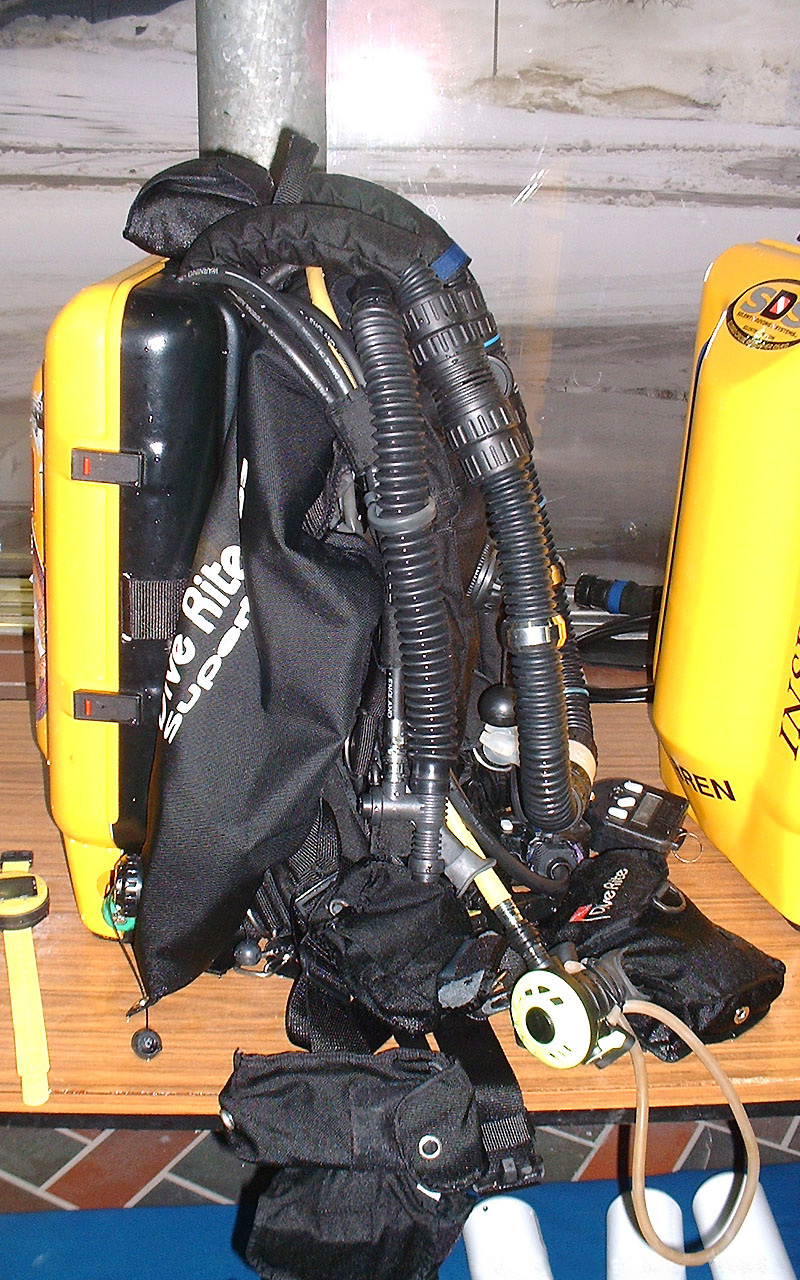
- Rebreather diving can reduce the bulk of the gas supplies for long and deep scuba dives, at the cost of more complex equipment with more potential failure modes, requiring more demanding procedures and higher procedural task loading.
- Surface supplied diving distributes the task loading between the divers and the support team, who remain in the relative safety and comfort of the surface control position. Gas supplies are limited only by what is available at the control position, and the diver only needs to carry sufficient bailout capacity to reach the nearest place of safety, which may be a diving bell or lockout submersible.
- Saturation diving is a procedure used to reduce the high-risk decompression a diver is exposed to during a long series of deep underwater exposures. By keeping the diver under high pressure for the whole job, and only decompressing at the end of several days to weeks of underwater work, a single decompression can be done at a slower rate without adding much overall time to the job. During the saturation period, the diver lives in a pressurized environment at the surface, and is transported under pressure to the underwater work site in a closed diving bell.
Ultra-deep diving
Mixed gas
Amongst technical divers, there are divers who participate in ultra-deep diving on scuba below 200 m. This practice requires high levels of training, experience, discipline, fitness and surface support. Only twenty-six people are known to have ever dived to at least 240 m on self-contained breathing apparatus recreationally.Statistics exclude military divers (classified), and commercial divers (commercial diving to those depths on scuba is not permitted by occupational health and safety legislation). In 1989, the US Navy Experimental Diving Unit published a paper that included a section on results from tests on the use of rebreathers at 850 ft.In 2007 a Turkish Navy diver dived with a closed-circuit rebreather to a depth of 998 ft off the coast of Cyprus, but that dive has not been independently verified. His dive was aborted due to equipment failure. It was a Turkish Navy experimental dive. The "Holy Grail" of deep scuba diving was the 300 m mark, first achieved by John Bennett in 2001, and has only been achieved five times since. Due to the short bottom times and long decompression, scuba dives to these depths are generally only done for deep cave exploration or as record attempts.
The difficulties involved in ultra-deep diving are numerous. Although commercial and military divers often operate at those depths, or even deeper, they are surface supplied. All of the complexities of ultra-deep diving are magnified by the requirement of the diver to carry (or provide for) their own gas underwater. These lead to rapid descents and "bounce dives". This has led to extremely high mortality rates amongst those who practice ultra-deep diving. Notable ultra-deep diving fatalities include Sheck Exley, John Bennett, Dave Shaw and Guy Garman. Mark Ellyatt, Don Shirley and Pascal Bernabé were involved in serious incidents and were fortunate to survive their dives. Despite the extremely high mortality rate, the Guinness World Records continues to maintain a record for scuba diving (although the record for deep diving with compressed air has not been updated since 1999, given the high accident rate). Amongst those who do survive significant health issues are reported. Mark Ellyatt is reported to have suffered permanent lung damage; Pascal Bernabé (who was injured on his dive when a light on his mask imploded) and Nuno Gomes reported short to medium term hearing loss.
Serious issues that confront divers engaging in ultra-deep diving on self-contained breathing apparatus include: ; Compression arthralgia: Deep aching pain in the knees, shoulders, fingers, back, hips, neck, and ribs caused by exposure to high ambient pressure at a relatively high rate of descent (i.e., in "bounce dives"). ; High-pressure nervous syndrome (HPNS): HPNS, brought on by breathing helium under extreme pressure causes tremors, myoclonic jerking, somnolence, EEG changes, visual disturbance, nausea, dizziness, and decreased mental performance. Symptoms of HPNS are exacerbated by rapid compression, a feature common to ultra-deep "bounce" dives. ; Isobaric counterdiffusion (ICD): ICD is the diffusion of one inert gas into body tissues while another inert gas is diffusing out. It is a complication that can occur during decompression, and that can result in the formation or growth of bubbles without changes in the environmental pressure. ; Decompression algorithm: There are no reliable decompression algorithms tested for such depths on the assumption of an immediate surfacing. Almost all decompression methodology for such depths is based upon saturation, and calculates ascent times in days rather than hours. Accordingly, ultra-deep dives are almost always a partly experimental basis.
In addition, "ordinary" risks like size of gas reserves, hypothermia, dehydration and oxygen toxicity are compounded by extreme depth and exposure and long in-water decompression times. Some technical diving equipment is simply not designed for the greater pressures at these depths, and reports of key equipment (including submersible pressure gauges) imploding are not uncommon.
| Name | Location | T | A | Depth | Year | ||||||||||
|---|---|---|---|---|---|---|---|---|---|---|---|---|---|---|---|
| url=http://www.guinnessworldrecords.com/news/2014/9/ahmed-gabr-breaks-record-for-deepest-scuba-dive-at-more-than-1000-feet-60537/ | title=Ahmed Gabr breaks record for deepest SCUBA dive at more than 1,000 feet | last=Janela | first=Mike | date=2014-09-22 | publisher=Guinness World Records | access-date=2023-06-18}} | |||||||||
| Pascal Bernabé | |||||||||||||||
| Nuno Gomes | |||||||||||||||
| Jarek Macedoński | |||||||||||||||
| Mark Ellyatt | |||||||||||||||
| Xavier Méniscus | |||||||||||||||
| John Bennett | |||||||||||||||
| Frédéric Swierczynski | |||||||||||||||
| Krzysztof Starnawski | |||||||||||||||
| Will Goodman | |||||||||||||||
| date=2020-03-23 | title=Deepest cave dive (Men) | url=https://divingalmanac.com/deepest-cave-dive-men/ | archive-url=https://web.archive.org/web/20190114233836/http://divingalmanac.com/deepest-cave-dive-men/ | url-status=dead | archive-date=January 14, 2019 | website=Almanac Book of Records | last=Gallanth | first=Jeffrey}} | |||||||
| Nuno Gomes | |||||||||||||||
| Krzysztof Starnawski | |||||||||||||||
| Jim Bowden | |||||||||||||||
| Krzysztof Starnawski | |||||||||||||||
| Han Ting | |||||||||||||||
| last1=Menezes de Oliveira | first1=Gilberto | title=As Grandes Cavernas do Brasil | chapter=Lagoa Misteriosa | chapter-url=https://lagoamisteriosa.eco.br/blog/lagoa-misteriosa/ | editor-last=Auler | editor-first=Augusto | editor2-last=Rubbioli | editor2-first=Ezio | editor3-last=Brandi | editor3-first=Roberto | publisher=Grupo Bambuí de Pesquisas Espeleológicas | year=2001 | isbn=978-85-902206-1-9 | access-date=2023-06-21 | language=pt-br}} |
| Nuno Gomes | |||||||||||||||
| David ShawSubsequently died during diving accident. | |||||||||||||||
| Frédéric Swierczynski | |||||||||||||||
| Pascal Bernabé | |||||||||||||||
| title=A Page Out of History: Sheck Exley's 1989 Mante Table (867 ft/265m) | url=https://gue.com/blog/sheck-exleys-1989-nacimiento-del-rio-mante-decompression-table-867-ft-265m/ | work=InDepth | publisher=GUE | date=2021-05-01 | access-date=2023-06-22}} | ||||||||||
| Krzysztof Starnawski | |||||||||||||||
| Sheck Exley | |||||||||||||||
| Luca Pedrali | |||||||||||||||
| Sheck Exley | |||||||||||||||
| Xavier Méniscus | |||||||||||||||
| Mark Ellyatt | |||||||||||||||
| Qian Chen | |||||||||||||||
| John Bennett | |||||||||||||||
| Michele Geraci | |||||||||||||||
| Jordi Yherla | |||||||||||||||
| Nuno Gomes | |||||||||||||||
| Don Shirley | |||||||||||||||
| Wacław Lejko | |||||||||||||||
| Xavier Méniscus | |||||||||||||||
| Karen van den Oever | |||||||||||||||
| Xavier Méniscus | |||||||||||||||
| C.J. Brossett | |||||||||||||||
| Richard Harris, Craig Challen | |||||||||||||||
| Frédéric Swierczynski | |||||||||||||||
| Guy Garman | |||||||||||||||
| Dariusz Wilamowski | |||||||||||||||
| Xavier Méniscus | |||||||||||||||
| Alexandre Fox | |||||||||||||||
| Jim Bowden | |||||||||||||||
| Xavier Méniscus | |||||||||||||||
| Pascal Bernabé |
Air
A severe risk in ultra-deep air diving is deep water blackout, or depth blackout, a loss of consciousness at depths below 50 m with no clear primary cause, associated with nitrogen narcosis, a neurological impairment with anaesthetic effects caused by high partial pressure of nitrogen dissolved in nerve tissue, and possibly acute oxygen toxicity. The term is not in widespread use at present, as where the actual cause of blackout is known, a more specific term is preferred. The depth at which deep water blackout occurs is extremely variable and unpredictable. Before the popular availability of trimix, attempts were made to set world record depths using air. The extreme risk of both narcosis and oxygen toxicity in the divers contributed to a high fatality rate in those attempting records. In his book, Deep Diving, Bret Gilliam chronicles the various fatal attempts to set records as well as the smaller number of successes. From the comparatively few who survived extremely deep air dives:
| shot line]]. | Year | style=width:12em; | Name | Location | E | Comment | |||||
|---|---|---|---|---|---|---|---|---|---|---|---|
| 106 msw (345 fsw) | |||||||||||
| 107 msw (350 fsw) | |||||||||||
| 109 msw (355 fsw) | |||||||||||
| 110 msw (360 fsw) | |||||||||||
| 120 msw (390 fsw) | |||||||||||
| 134 msw (437 fsw) | |||||||||||
| 135 msw (440 fsw) | |||||||||||
| 139 msw (452 fsw) | |||||||||||
| 146 msw (475 fsw) | |||||||||||
| 150 msw (490 fsw) | |||||||||||
In deference to the high accident rate, the Guinness World Records have ceased to publish records for deep air dives, after Manion's dive.
Risk
The risk of death in scuba depth record attempts is much greater than for surface-supplied diving to similar depths, where saturation divers do productive work at depths greater than scuba depth records The reasons are physiological and logistical. Deep surface-supplied diving is done using saturation mode, where the diver is compressed over a long period and can avoid or minimise inert gas narcosis, high-pressure nervous syndrome (HPNS), and compression arthralgia, and is decompressed from suturation in the relative comfort and safety of a diving chamber. The saturation diver is provided with an adequate and secure breathing gas supply, wears a diving helmet which protects the airways and is supported by a bellman. There is a range of opinions about the value of extreme exposure records, attempted intentionally, and the question may be asked whether the activity has any value beyond merely setting a new record.
Gas density and work of breathing
Main article: Work of breathing
A high work of breathing means that the diver has correspondingly less reserve capacity to deal with an incident in which high exertion is necessary to rectify a problem, even for a short time. For example, a sudden loss of buoyancy may require the diver to fin upwards until the problem can be more efficiently managed. If this burst of exertion overwhelms the capacity to eliminate the carbon dioxide that it generates, the diver may be unable to avoid being overwhelmed by hypercapnia. Breathing gas can be optimised for low work of breathing by using higher helium fraction and minimum nitrogen, a small amount of which is needed to limit HPNS in the fast descents used by scuba divers to make gas logistics practicable, and keep the in-water decompression requirements manageable. Use of rebreathers can help with gas supply logistics, but inherently increases work of breathing as the gas is circulated through the scrubber by the breathing of the diver. Use of hydrogen in the mixture is experimental, and while it does improve work of breathing, and appears to reduce HPNS, it can only be used at considerable depth due to explosion risks, so the gas logistics are further complicated. Even less data is available on decompressing from exposures to mixtures containing hydrogen than trimix and heliox exposures.
Decompression schedules
Decompression schedules for bounce dive profiles to record depths are experimental and untested, and the decompression risk is basically unknown, and can only be estimated by extrapolation when using current decompression theory. Profiles and schedules used by record holders who survives the dive may be of some use, as they at least worked once, but no allowance is made for environmental and personal variables, the effects of which are in any case not quantifiable by any currently available decompression algorithm.
Narcosis and HPNS
The choice of gas mix for extreme depth on scuba is a compromise between density considerations, which call for minimising nitrogen, narcosis issues, which call for minimising nitrogen, and HPNS considerations, which require some nitrogen and limiting the rate of compression. If hydrogen is considered as an alternative, a possible explosion risk is balanced against less narcosis than nitrogen, lower density, possible reduction of HPNS, and an unknown effect on decompression.
Inner ear decompression sickness
Main article: Inner ear decompression sickness
IEDCS is known to occur during ascent after some deep dives, but the causes are uncertain. Inner ear decompression sickness is known to result from isobaric counterdiffusion, but the known triggering conditions do not occur with closed-ircuit rebreathers. Nevertheless the symptoms of intense vertigo and nausea have occurred on both CCR and open circuit dives during ascent, which increase the risk of choking on aspired vomit, and drowning, and are likely to compromise decompression.
Thermal stress
Gas logistics
A scuba diver must carry enough breathing gas to manage any single reasonably foreseeable incident and the expected consequences of that incident. There is a choice between the mechanical simplicity and reliability but large mass and volume, and the need for multiple gas switches of open circuit equipment, and the complexity and larger number of possible failure modes, and generally higher work of breathing of CCR, with its smaller mass and volume, and integral gas mixture control.
Psychological issues
- Risk denial
- Target fixation
- Dunning–Kruger effect
- Sunk cost
Statistics
- Number of successful depth record attempts:
- Number of non-fatal failed depth record attempts:
- Number of fatal depth record attempts:
Fatalities during depth record attempts
Diving activities are inherently risky, due to the underwater environment, and the diver manages risk by the appropriate use of equipment, using skills developed by learning, training and practice, along with suitable support by the members of a skilled and prepared team. Scuba diving forgoes some of the most relevant safety equipment and procedures to gain mobility and range, and it is inherently riskier than surface supplied diving for a number of reasons, most notably, the limit on gas supply that the diver can carry.
Attempts to break depth records push the physiological limits, and this reduces the margin for error to the extent the diver may not be able to recover from an incident that could be managed at shallower depths, and the psychological situation may induce a diver to ignore a developing problem until it is too late. Consequently, depth record attempts have a poor safety record, with a high fatality rate.
- Maurice Fargues, a member of the GRS (Groupement de Recherches Sous-marines, Underwater Research Group headed by Jacques Cousteau), died in 1947 after losing consciousness at depth in an experiment to see how deep a scuba diver could go. He reached 120 m before failing to return line signals. He became the first diver to die while using an Aqua-Lung.
- Hope Root died on 3 December 1953 off the coast of Miami Beach trying set a deep diving record of 410 ft with an Aqua-Lung; he passed 500 ft and was not seen again.
- Archie Forfar and Ann Gunderson died on 11 December 1971 off the coast of Andros Island, while attempting to dive to 146 m, which would have been the world record at the time. Their third team member, Jim Lockwood, only survived due to his use of a safety weight that dropped when he lost consciousness at 122 m, causing him to start an uncontrolled ascent before being intercepted by a safety diver at a depth of around 300 ft. Sheck Exley, who was acting as another safety diver at 300 feet, inadvertently managed to set the depth record when he descended towards Forfar and Gunderson, who were both still alive at the 480-foot level, although completely incapacitated by narcosis. Exley was forced to give up his attempt at around 465 ft when the narcosis very nearly overcame him as well. The bodies of Forfar and Gunderson were never recovered.
- Sheck Exley died in 1994 at 879 ft in an attempt to reach the bottom of Zacatón in a dive that would have extended his own world record (at the time) for deep diving.
- Dave Shaw died in 2005 in an attempt at the deepest ever body recovery and deepest ever dive on a rebreather at 886 ft.The incident was triggered by difficulties managing the body, which led to overexertion and irreversible hypercapnia due to high work of breathing, possibly aggravated by negative pressure breathing.
- Brigitte Lenoir, planning to attempt the deepest dive ever made by a woman with a rebreather to 230 m, died on 14 May 2010 in Dahab while ascending from a training dive at 147 m.
- Guy Garman died on 15 August 2015 in an unsuccessful attempt to dive to 1200 ft. The Virgin Island Police Department confirmed that Guy Garman's body was recovered on 18 August 2015.
- Theodora Balabanova died at Toroneos Bay, Greece, in September 2017 attempting to break the women's deep dive record with 231 m. She did not complete the decompression stops and surfaced too early.
- Wacław Lejko attempting 275 m in Lake Garda, died in September 2017. His body was recovered with an ROV at 230 m.
- Adam Krzysztof Pawlik, attempting to break the deep-diving world record of 316 m by Jarek Macedoński in Lake Garda, died on 13 October 2018. His body was located at 284 m.
- Sebastian Marczewski was attempting to break the deep-diving world record going below 333 m in Lake Garda. He died on 6 July 2019 at 150 m.
- Han Ting, having renewed his own 234 m deepest Asian cave dive record to 277 m in April 2023 in Tianchuang, planned to set a world record for deepest cave dive there, aiming at 300 m on 12 October 2023. He failed to return from a preparatory dive on 7 October. His body was recovered by an ROV on 25 October 2023.
References
Footnotes
References
- Brylske, A.. (2006). "Encyclopedia of Recreational Diving, 3rd edition". [[PADI]].
- "«1965-2000» 36 years of deep diving and submarine techniques development". COMEX.
- (1987-11-10). "Hydra 8: Pre-commercial Hydrogen Diving Project".
- "Extreme Environment Engineering Departement Hyperbaric Experimental Centre - History".
- (1989-05-01). "Hydrogen Offshore Diving to a Depth of 530 m: Hydra VIII".
- "WASP Specifications". Oceaneering International, Inc..
- Logico, Mark G.. (2006-08-07). "Navy Diver Sets Record with 2,000 foot Dive". Navy News.
- Guinness World Records. "Deepest dive using an atmospheric diving suit".
- (1993). "HYDRA 10: A 701 MSW ONSHORE RECORD DIVE USING 'HYDRELIOX'". [[Compagnie maritime d'expertises.
- (1992-11-28). "Technology: Dry run for deepest dive".
- (1995). "ECG changes during the experimental human dive HYDRA 10 (71 atm/7,200 kPa)". Undersea and Hyperbaric Medicine.
- Guinness World Records. "Deepest "dive" in a hyperbaric chamber".
- "EN 14153-1 / ISO 24801-1 Recreational diving services – Safety related minimum requirements for the training of recreational scuba divers – Part 1: Level 1 "Supervised Diver"". EUF Certification International.
- "EN 14153-2 / ISO 24801-2 Recreational diving services – Safety related minimum requirements for the training of recreational scuba divers – Part 2: Level 2 "Autonomous Diver"". EUF Certification International.
- (2009). "Beginning With the End in Mind – the Fundamentals of Recreational Diving". Global Underwater Explorers.
- Cole, Bob. (March 2008). "The SAA BUhlmann DeeP-Stop System Handbook". Sub-Aqua Association.
- (2012-01-05). "Code du sport: Sous-section 2: Dispositions relatives aux établissements organisant la pratique de la plongée subaquatique à l'air". Légifrance.
- (2021-02-24). "Trimix Diver". [[IANTD]].
- "TDI Advanced Trimix Diver".
- Gomes, Nuno. (2009-10-07). "A Brief History of Deep Technical Diving in the last 20 Years".
- Stewart, Ashley. (2023-05-13). "N=1: The Inside Story of the First-Ever Hydrogen CCR Dive". Global Underwater Explorers.
- (2004-04-03). "British diver breaks rebreather World Record for depth – to 290m". The Scuba News.
- (7 July 2020). "Welt-Tiefenrekord für CCR und Scooter". Seacraft.
- Liang, John. (19 September 2014). "Ahmed Gabr Breaks Scuba Diving World Record". DeeperBlue.com.
- Guinness World Records. "Deepest scuba dive (male)".
- Egstrom, GH. (2006). "Historic Perspective: Scientific Deep Diving and the Management of the Risk". Smithsonian Institution.
- Southerland, DG. (2006). "Medical Fitness at 300 FSW". Smithsonian Institution.
- (2016). "Respiratory Physiology of Rebreather Diving". Rebreathers and Scientific Diving. Proceedings of NPS/NOAA/DAN/AAUS June 16–19, 2015 Workshop.
- (2007). "Fatal Respiratory Failure During a "Technical" Rebreather Dive at Extreme Pressure". Aviation, Space, and Environmental Medicine.
- Gomes, Nuno. (2014). "Beyond Blue Autobiography".
- "Profile - Pascal Bernabé". X-Ray Mag.
- (13 July 2015). "Doc Deep plans 1200' Dive". scubaboard.com.
- (1969). "Syndrome neurologique et electrographique des hautes pressions". Revue Neurologique.
- Janela, Mike. (2014-09-22). "Ahmed Gabr breaks record for deepest SCUBA dive at more than 1,000 feet". Guinness World Records.
- (2021-02-19). "No Foul Play – Ahmed Gabr is legitimately still the Guinness World Records holder for the Deepest Scuba Dive (Male)".
- Lowndes, Gareth J.. (July 2005). "World Record Sea Dive".
- "Nuno Gomes". Sterling divers.
- Ellyatt, Mark. "A dive to 313m…successfully". Inspired-Training.
- (2024-01-07). "Xavier Meniscus stabilisce il nuovo straordinario record mondiale di immersione in grotta alla Font Estramar : -312,10 mètres". scintilena.
- "A Journey To 308 Metres". Tech Dive Academy.
- (2023-11-16). "Record du monde de plongée souterraine à Font Estramar !".
- Jędrzejowski, Rafał. (2018-09-13). "Krzysztof Starnawski z rekordem świata CCR!". DIVERS24.
- Gallanth, Jeffrey. (2020-03-23). "Deepest cave dive (Men)".
- Farr, Martyn. "Guinness World Record".
- (2011-12-05). "Egipt. Krzysztof Starnawski zanurkował na... 283 metry!".
- Gilliam, Bret. (2013). "ZACATON: The tragic death of Sheck Exley".
- Starnawski, Krzysztof. (2016-07-24). "2016 / Albania / exploration in Viroit cave / 278m deep".
- (2016-07-25). "Polak pobił rekord świata w nurkowaniu jaskiniowym. Krzysztof Starnawski zszedł na 278 metrów". National Geographic Polska.
- (2001). "As Grandes Cavernas do Brasil". Grupo Bambuí de Pesquisas Espeleológicas.
- Shaw, Dave. (2005-04-13). "World Record Rebreather Dive Oct 28th 2004".
- (2021-05-01). "A Page Out of History: Sheck Exley's 1989 Mante Table (867 ft/265m)". [[Global Underwater Explorers.
- Pałahicki, Maciej. (2015-08-22). "Krzysztof Starnawski ustanowił nowy rekord Polski w nurkowaniu jaskiniowym". RMF24.
- Synnott, Mark. (2015). "Have These Divers Found the World's Deepest Underwater Cave?".
- (2017-09-17). "Luca Pedrali re degli abissi, immersione record a -264,8".
- Goutorbe, Christian. (2015-07-15). "Record du monde de plongée dans les Corbières". [[La Dépêche du Midi.
- Indepth. (2023-03-06). "in-depth".
- (2016-01-24). "An interview with Michele Geraci". [[Divers Alert Network.
- (July 2015). "La Font d'Estramar -253 m de profunditat". Bibliografia Espeleologia.
- Berger, Sebastian. (2008-03-06). "Ghosts of the abyss: the story of Don Shirley and Dave Shaw".
- Dydymska, Basia. (4 August 2017). "Rekord Polski w nurkowaniu służb mundurowych".
- Rapa, Rafal. "REKORD SŁUŻB MUNDUROWYCH WACŁAW LEJKO 249 METRÓW".
- Méniscus, Xavier. (24 September 2013). "Exploration de la résurgence de Font Estramar à -248m caméra Gopro".
- Guinness World Records. "Deepest scuba dive (female)".
- (2019). "Dive Files". The Hydrox Files.
- Harris, Richard. (2020). "The Pearce Resurgence". Seacraft.
- (June 2022). "Recession processes in Red Lake, Imotski".
- admin. (2022-09-28). "Crveno jezero: Biološka istraživanja i jedinstven živi svijet".
- Kieren, Jon. (2023-02-01). "I Trained "Doc Deep"". InDepth.
- "The result – 20 September 2012 – Summary".
- Bowden, Jim. (1998-03-07). "Thoughts on Diving To Great Depths". [[Global Underwater Explorers.
- (30 March 2021). "Diving Beyond 250 Meters: The Deepest Cave Dives Today Compared to the Nineties". [[Global Underwater Explorers.
- (1986). "Basic Cave Diving: A Blueprint for Survival". [[National Speleological Society]] Cave Diving Section.
- Eliott, David. (1996). "Deep water blackout". SPUMS Journal.
- (25 January 1995). "Deep Diving, an advanced guide to physiology, procedures and systems". Watersport publishing.
- Vidal Sola, Clemente. (1957-10-03). "España conquista la marca mundial de profundidad con escafandra autonoma". La Vanguardia Espanola.
- Falangola, Renata. (1959). "Il nuovo record mondiale di profondità. 130 metri... ma Novelli non lascia il segno".
- (2023). "Neal Watson". Cayman Islands Department of Tourism.
- (2009). "Caverns Measureless To Man". Cave Books.
- The record is not officially recognised; Marion's second dive computer registered a depth of 150 [[Metre sea water. msw]] (490 [[Feet sea water. fsw]]). See generally ''Deep Diving'' by Bret Gilliam, {{ISBN
- Pollock, Neal. (1 February 2023). "The Risk and Management of Record Chasing".
- Fifis, Dimitris. (7 August 2019). "Opinion: Don't Break That Record".
- (2003). "Bennett and Elliott's physiology and medicine of diving, 5th Rev ed". Saunders.
- Stewart, Ashley. (13 May 2023). "N=1: The Inside Story of the First-Ever Hydrogen CCR Dive". Global Underwater Explorers.
- Harris, Richard. (20–22 April 2023). "N=1, the World's First Hydrogen CCR Dive". Rebreather Forum 4.
- Pollock, Neal W.. (31 May 2023). "What is Undeserved in "Undeserved Decompression Sickness"?". GUE.
- Fogarty, Reilly. (2 June 2021). "High Pressure Problems on Über-Deep Dives: Dealing with HPNS".
- Zimmermann, Tim. (1 August 2005). "Raising the Dead". [[Outside (magazine).
- Matsen, Brad. (2009). "Jacques Cousteau: The Sea King". Pantheon Books.
- Cousteau, J. Y.; Dumas, Frédéric (1953). The Silent World. New York: Harper & Brothers Publishers. LCCN 52-5431.
- Ecott, Tim. (2001). "Neutral Buoyancy: Adventures in a Liquid World". Atlantic Monthly Press.
- (1953-12-04). "Diver lost After 500 Ft. Descent".
- (February 2007). "Fatal respiratory failure during a "technical" rebreather dive at extreme pressure". Aviat Space Environ Med.
- "The Last Dive of David Shaw".
- Jeffrey, Gallant. (2017-08-26). "Deepest rebreather dive [CCR – Freshwater – Women]". Diving Almanac.
- Dumas, Daisy. (18 August 2015). "'Doc Deep' Guy Garman dies in attempt to break world record scuba dive". Fairfax Media.
- Staff. (16 August 2015). "St. Croix's 'Dr. Deep' Guy Garman Dies in World Record Attempt". V.I. Source Publications, Inc..
- "The Recovery Operation: How Search Teams Located Guy Garman in the Virgin Islands".
- Helmy, Sam. (27 September 2017). "Tragedy Strikes Multiple Scuba Record Attempts".
- (2018-10-18). "Body of missing Polish diver found in Italy". TVPWorld.
- (2019-07-08). "Afghanistan veteran dies attempting to break deep diving record". TVPWorld.
- Evans, Mark. (2023-10-26). "Body of Chinese cave diver Han Ting recovered". Scuba Diver Mag.
- Weinman, Steve. (2023-10-27). "Body found in search for Chinese cave-diver". Divernet.
This article was imported from Wikipedia and is available under the Creative Commons Attribution-ShareAlike 4.0 License. Content has been adapted to SurfDoc format. Original contributors can be found on the article history page.
Ask Mako anything about Deep diving — get instant answers, deeper analysis, and related topics.
Research with MakoFree with your Surf account
Create a free account to save articles, ask Mako questions, and organize your research.
Sign up freeThis content may have been generated or modified by AI. CloudSurf Software LLC is not responsible for the accuracy, completeness, or reliability of AI-generated content. Always verify important information from primary sources.
Report