From Surf Wiki (app.surf) — the open knowledge base
Dedicated deck card game
Modern game with a unique set of cards and no board

Modern game with a unique set of cards and no board
A dedicated deck card game is one played with a deck specific to that game, rather than a pack of standard playing cards. Educational packs of cards were being printed by the late eighteenth century, initially designed merely to inform, but later becoming playable games. Modern card games are often sold with non-standard distributions of suits and ranks.
Unranked cards
By the late eighteenth century, educational packs of cards were being printed without suits or ranks, such as The Elements of Astronomy and Geography Explained, published by John Wallis in 1795. These served as teaching aids rather than being playable games. Charles Hodges' 1828 game Astrophilogeon was a deck of 60 cards showing 30 constellations and 30 terrestrial maps, with which players could play a game attempting to obtain corresponding pairs.
An early 20th century dedicated deck card game was Touring, published in 1906, and inspiring Mille Bornes in 1954.{{cite book
Play typically bears some resemblance to traditional card games of the Eights family including Mau Mau from which Uno may have been developed, as well as games of the Cuccu family, such as Kille in which there are no suits, but certain cards have artwork and names that determine their effect.
Modern dedicated deck card games such as Dominion and Munchkin use neither suits nor ranks, instead having text and artwork which describes their effect in the game.
Suits and ranks
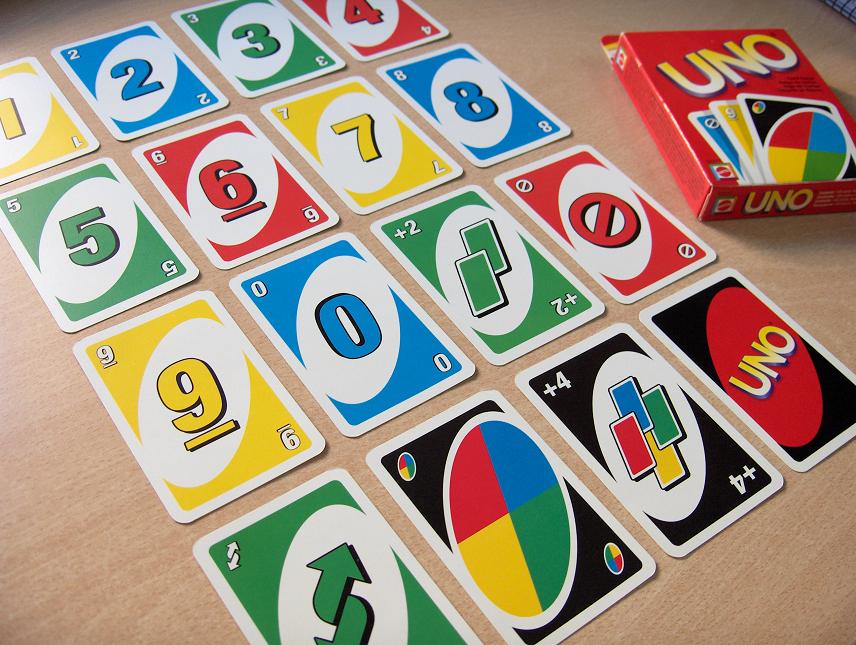
Some dedicated deck card games use the suit system of traditional playing cards, having a variety of suits, each containing a number of numbered or named ranks. Some ranks may have particular effects, like the numberless "skip a turn" cards in Uno, and the deck may contain additional suitless cards, echoing the jokers of traditional card games.
The French card game Gnav and its variants use a deck of two suits, each suit containing the numbers zero through 12 and a number of creatures and objects (such as the "Owl" and the "Pot"). The deck can only be used to play the game it is designed for.
The 1906 card game Rook was designed with coloured suits and an absence of face cards, to cater for Puritan and Mennonite players who disapproved of face cards and their association with gambling and cartomancy.
Modern commercial card games which use suits and ranks are typically designed to be played with dedicated decks, giving the player a reason to buy a physical copy rather than learning to play the game with regular playing cards. The game of Uno, for example, is very similar to the traditional card game Mau-Mau, but uses custom iconography which would be harder to remember when using regular playing cards. The game of Haggis has similar mechanics to several traditional card games, but features an extra suit, making it impossible to play with a regular deck.
References
References
- "Rare 19th century playing cards prove a strong hand at Chorleys auction".
- "Packet of Didactic Cards Entitled 'The Elements of Astronomy and Geography ...' by the Abbé Paris, Published by John Wallis, London, 1795 (MHS Record Details: Inventory number 11694)".
- "Astrophilogeon". British Museum.
- "Charles Hodges".
- "History of the "Take That!" Card Game".
- [https://books.google.com/books?id=ACUBSUGQCMYC&pg=PA174 Seeking a Sanctuary: Seventh-day Adventism and the American Dream - Malcolm Bull, Keith Lockhart - Google Boeken]
This article was imported from Wikipedia and is available under the Creative Commons Attribution-ShareAlike 4.0 License. Content has been adapted to SurfDoc format. Original contributors can be found on the article history page.
Ask Mako anything about Dedicated deck card game — get instant answers, deeper analysis, and related topics.
Research with MakoFree with your Surf account
Create a free account to save articles, ask Mako questions, and organize your research.
Sign up freeThis content may have been generated or modified by AI. CloudSurf Software LLC is not responsible for the accuracy, completeness, or reliability of AI-generated content. Always verify important information from primary sources.
Report