From Surf Wiki (app.surf) — the open knowledge base
Decree nisi
Type of court order with conditions
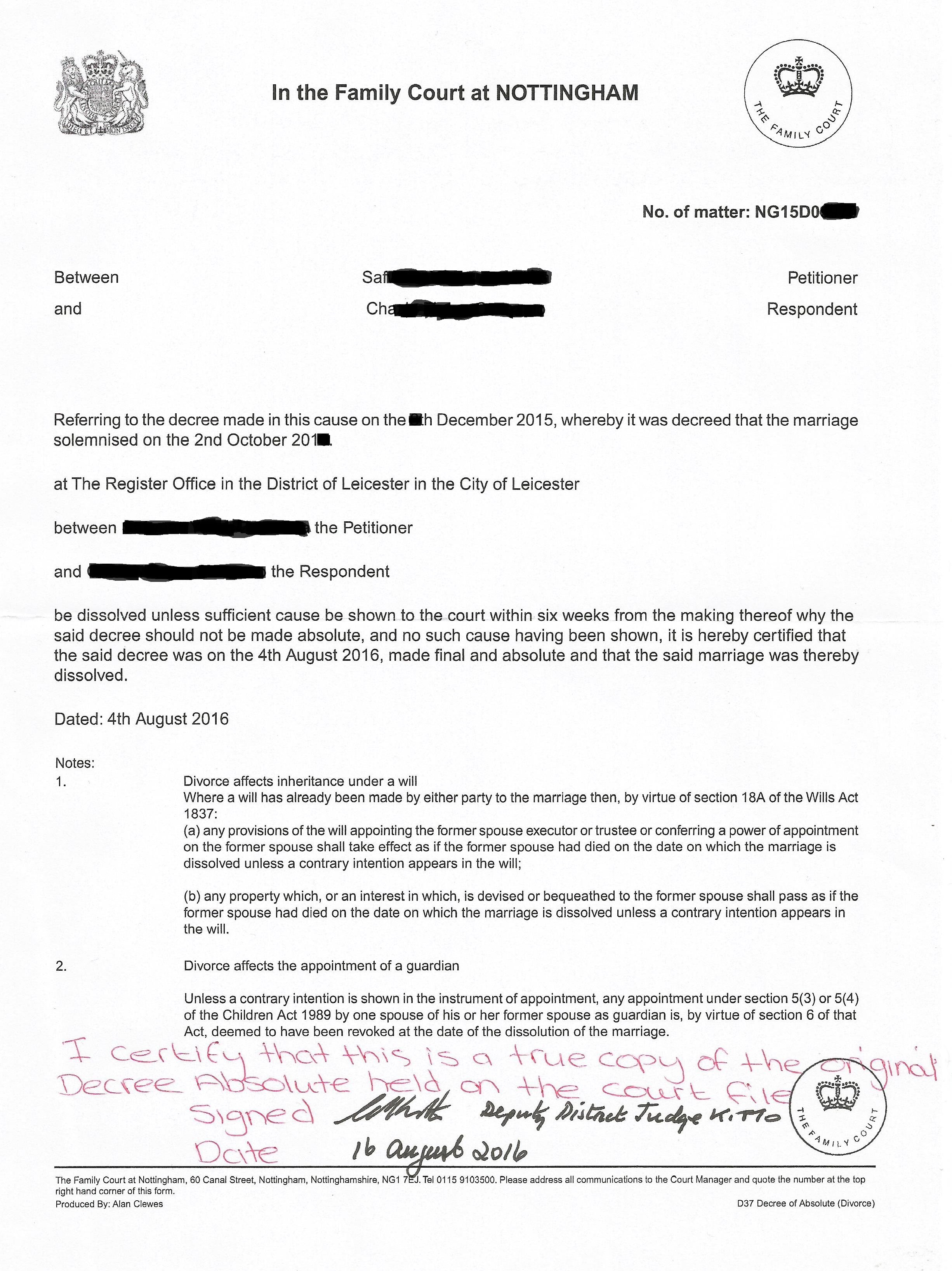
Type of court order with conditions
A decree nisi or rule nisi () is a court order that will come into force at a future date unless a particular condition is met. Unless the condition is met, the ruling becomes a decree absolute (rule absolute), and is binding.{{cite book|title=A Dictionary of Modern Legal Usage|page=253
Using the example of a divorce, the wording of such a decree is generally in the form of "that the marriage solemnized on (date) between AB and CD, be dissolved by reason of (grounds) UNLESS sufficient cause be shown to the court why this decree should not be made absolute within six weeks". This allows time for any party who objects to the divorce to come forward with those objections. When no objection is raised by either party, an automatic dissolution takes effect.
The term is used in many common law jurisdictions, but is more common in the United Kingdom than in the United States.
Usages
In most common law jurisdictions, a decree nisi must be obtained in possession proceedings before the court will order foreclosure under a mortgage enforcement.
This form of ruling has become a rarity in recent times, with few exceptions: in some jurisdictions, it is still a standard stage of divorce proceedings. In Hong Kong, and in England and Wales, section 1(5) of the Matrimonial Causes Act 1973 provides that "Every decree of divorce shall in the first instance be a decree nisi and shall not be made absolute before the expiration of six months from its grant", and section 9(1) allows any person (including the King's Proctor), before the decree is made absolute, to "show cause why the decree should not be made absolute by reason of material facts not having been brought before the court".
In England and Wales, the minimum interval between the granting of decree nisi and that of decree absolute was amended by the Family Law Act 1996 and is now six weeks. In practice, courts use an interval of six weeks and one day.
Another exception regarding orders nisi is where a creditor seeks to place a charge on land for money owed. A court, on the production of certain evidence, will make a charging order nisi and a hearing date is set. If the court is satisfied at the hearing that the creditor is entitled to have a charge on the debtor's property, it will grant a charging order absolute.
References
References
- Duhaime, Lloyd. "Legal Definition of Decree Nisi". Duhaime.org.
- "Matrimonial Causes Act 1973, § 1(5)". Office of Public Sector Information.
- "Family Law 1996, Schedule 8 (6)". The National Archives.
This article was imported from Wikipedia and is available under the Creative Commons Attribution-ShareAlike 4.0 License. Content has been adapted to SurfDoc format. Original contributors can be found on the article history page.
Ask Mako anything about Decree nisi — get instant answers, deeper analysis, and related topics.
Research with MakoFree with your Surf account
Create a free account to save articles, ask Mako questions, and organize your research.
Sign up freeThis content may have been generated or modified by AI. CloudSurf Software LLC is not responsible for the accuracy, completeness, or reliability of AI-generated content. Always verify important information from primary sources.
Report