From Surf Wiki (app.surf) — the open knowledge base
Death Valley
Valley in the Mojave Desert, Eastern California

Valley in the Mojave Desert, Eastern California
| Field | Value |
|---|---|
| name | Death Valley |
| native_name | |
| photo | Death Valley from space.JPG |
| photo_size | 224 |
| photo_caption | Death Valley as seen from Space Shuttle Columbia in October 1995 |
| map | California |
| map_size | 224 |
| relief | 1 |
| label_position | bottom |
| coordinates | |
| coordinates_ref | |
| location | California |
| elevation | −282 ft (−86 m) |
| elevation_ref | |
| area | 3000 sqmi |
| watercourses | Furnace Creek |
| Amargosa River |
the valley
Amargosa River
Death Valley ( ) is a desert valley in Eastern California, United States, in the northern Mojave Desert, bordering the Great Basin Desert. It is thought to be the hottest place on Earth during summer.
Death Valley's Badwater Basin is the point of lowest elevation in North America, at 282 ft below sea level. On the afternoon hours of July10, 1913, the United States Weather Bureau recorded a temperature of 134 °F (56.7 °C) at Furnace Creek in Death Valley, which stands as the highest ambient air temperature ever recorded on the surface of the Earth. However, this reading and several others taken in that period are disputed by some modern experts.
Lying mostly in Inyo County, California, near the border of California and Nevada, in the Great Basin, east of the Sierra Nevada mountains, Death Valley constitutes much of Death Valley National Park and is the principal feature of the Mojave and Colorado Deserts Biosphere Reserve. It runs from north to south between the Amargosa Range on the east and the Panamint Range on the west. The Grapevine Mountains and the Owlshead Mountains form its northern and southern boundaries, respectively. It has an area of about 3000 sqmi. The highest point in Death Valley National Park is Telescope Peak, in the Panamint Range, which has an elevation of 11043 ft.
A group of European-American pioneers got lost in the valley in the winter of 1849–1850, while looking for a shortcut to the gold fields of California, giving Death Valley its grim name. Although only one of the group members died there, they all assumed that the valley would be their grave. Death Valley is home to the Timbisha tribe of Native Americans, formerly known as the Panamint Shoshone, who have inhabited the valley for at least the past millennium.
Etymology
The native name for Death Valley is Tümpisa in the Timbisha language, meaning "rock paint". This is in reference to the rich sources of red ochre in the valley.
Geology
Main article: Geology of the Death Valley area
Death Valley is a graben—a downdropped block of land between two mountain ranges. It lies at the southern end of a geological trough, Walker Lane, which runs north to Oregon. The valley is bisected by a right lateral strike slip fault system, comprising the Death Valley Fault and the Furnace Creek Fault. The eastern end of the left lateral Garlock Fault intersects the Death Valley Fault. Furnace Creek and the Amargosa River flow through part of the valley and eventually disappear into the sands of the valley floor.
Death Valley also contains salt pans. According to current geological consensus, at various times during the middle of the Pleistocene era, which ended roughly 10,000–12,000 years ago, an inland lake, Lake Manly, formed in Death Valley. The lake was nearly 100 mi long and 600 ft deep, the end-basin in a chain of lakes that began with Mono Lake in the north and continued through basins down the Owens River Valley, through Searles and China Lakes and the Panamint Valley, to the immediate west.
As the area turned to desert the water evaporated, leaving an abundance of evaporitic salts, such as common sodium salts and borax, which were later exploited during the modern history of the region, primarily 1883 to 1907.
Climate

Death Valley has a subtropical, hot desert climate (Köppen: BWh), with long, extremely hot summers; short, warm winters; and little rainfall.
The valley is extremely dry because it lies in the rain shadow of four major mountain ranges (including the Sierra Nevada and Panamint Range). Moisture moving inland from the Pacific Ocean must pass eastward over the mountains to reach Death Valley; as air masses are forced upward by each range, they cool and moisture condenses, to fall as rain or snow on the western slopes. When the air masses reach Death Valley, most of the moisture in the air has already been lost and thus there is little left to fall as precipitation.
The extreme heat of Death Valley is attributable to a confluence of geographic and topographic factors. Scientists have identified a number of key contributors:
;Solar heating: The valley's surface (consisting of soil, rocks, sand, etc.) undergoes intense solar heating because the air is clear and dry, and the land is dark and sparsely vegetated. This is especially noticeable in mid-summer, when the sun is nearly directly overhead. ;Trapping of warm air: Warm air naturally rises and cools; in Death Valley this air is subject to continual reheating as it is trapped by high, steep valley walls and recycled back to the valley floor. Warm air also is trapped by the valley's north–south orientation, which runs perpendicular to prevailing west-to-east winds. ;Migration of warm air from other areas (advection): Warm desert regions adjacent to Death Valley, especially to the south and east, often heat air before it arrives in Death Valley. ;Warm mountain winds: As winds are forced up and over mountains (e.g. the numerous ranges west of Death Valley), the winds can be warmed in several ways. The resulting dry, warm winds are known as foehn winds. Their warmth can in part be caused by the release of latent heat, which occurs when water vapor condenses into clouds. The extremely low elevation below sea level compresses the air which heats it further.
Severe heat and dryness contribute to perpetual drought-like conditions in Death Valley and prevent much cloud formation from passing through the confines of the valley, where precipitation is often in the form of a virga.
The depth and shape of Death Valley strongly influence its climate. The valley is a long, narrow basin that descends below sea level and is walled by high, steep mountain ranges. The clear, dry air and sparse plant cover allow sunlight to heat the desert surface. Summer nights provide little relief: overnight lows may dip just into the 82 to range. Moving masses of super-heated air blow through the valley, creating extremely high ambient temperatures.

The hottest air temperature ever recorded in Death Valley was 134 °F, on July 10, 1913, at Greenland Ranch (now Furnace Creek), which, as of today, is the highest atmospheric temperature ever recorded on the Earth's surface. On June 30, 2013, a verified temperature of 129.2 F was recorded and is tied with Mitribah, Kuwait, for the hottest reliably measured air temperature ever recorded on Earth. A temperature of 130 °F was recorded at the Furnace Creek weather station on August 16, 2020, but has not yet been officially verified. The valley again recorded that temperature on July 9, 2021; however, that temperature has not yet been officially verified either. The valley's lowest temperature, recorded at Greenland Ranch (now Furnace Creek) on January 2, 1913, was 15 °F.
The highest surface temperature ever recorded in Death Valley was 201.0 °F, on July 15, 1972, at Furnace Creek, which is the highest ground surface temperature ever recorded on earth, as well as the only recorded surface temperature of above 200 °F.
The greatest number of consecutive days with a maximum temperature of at least 100 °F was 154, in the summer of 2001. The summer of 1996 had 40 days over 120 °F, and 105 days over 110 °F. The summer of 1917 had 52 days when the temperature reached 120 °F or above, 43 of them consecutive.
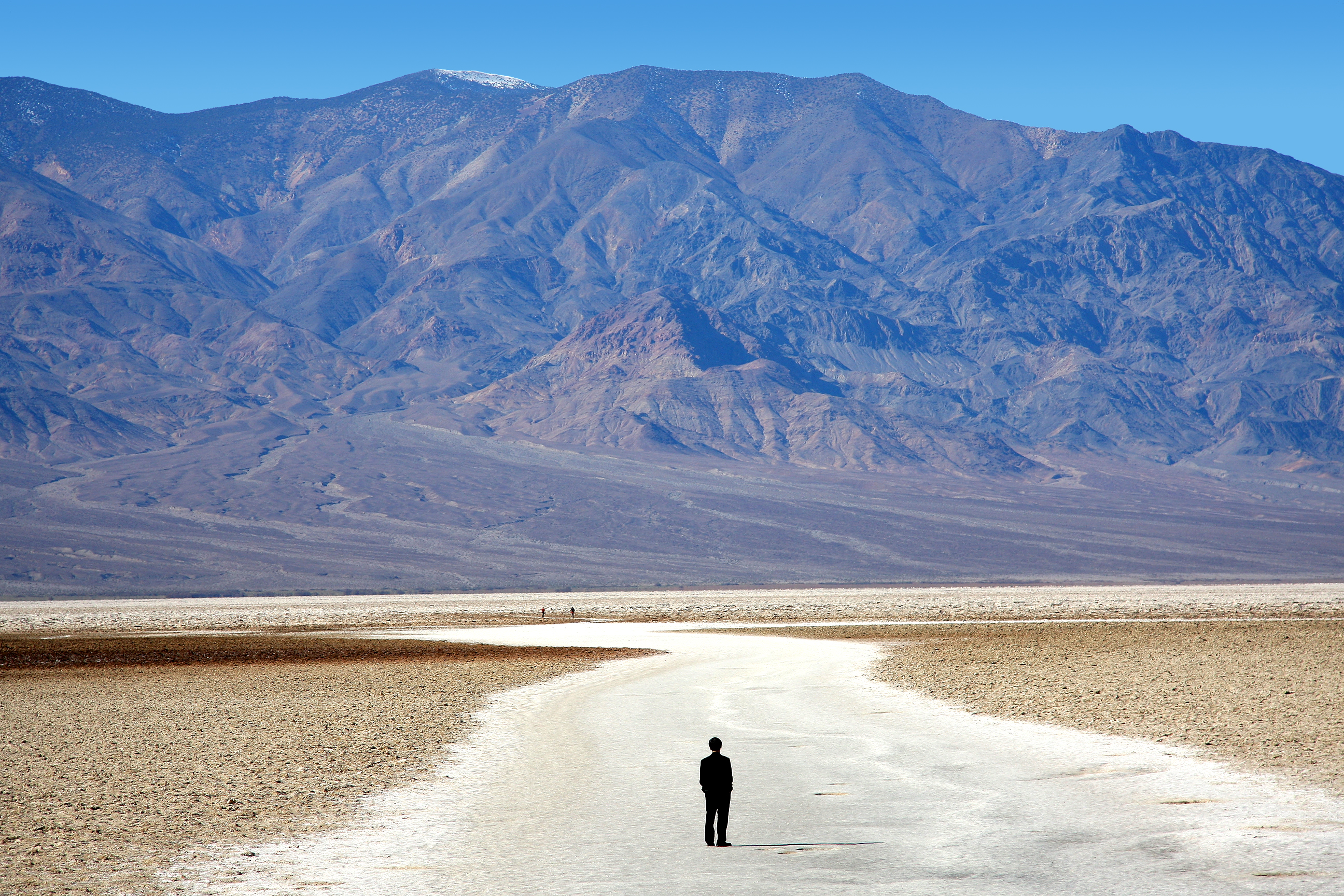
The highest overnight or low temperature recorded in Death Valley is 110 °F, recorded on July 5, 1918. However, this value is disputed; a record high low of 107 °F on July 12, 2012, is considered reliable. This is one of the highest values ever recorded. Also on July 12, 2012, the mean 24-hour temperature recorded at Death Valley was 117.5 °F, which makes it the world's warmest 24-hour temperature on record. July 2024 was the hottest month ever recorded in Death Valley, with a mean daily average temperature over the month of 108.5 °F.
Four major mountain ranges lie between Death Valley and the ocean, each one adding to an increasingly drier rain shadow effect, and in 1929, 1953, and 1989, no rain was recorded for the whole year. The period from 1931 to 1934 was the driest stretch on record, with only 0.64 in of rain over a 40-month period. The average annual precipitation in Death Valley is 2.36 in, while the Greenland Ranch station averaged 1.58 in. The wettest month on record is January 1995, when 2.59 in fell on Death Valley. The wettest period on record was mid-2004 to mid-2005, in which nearly 6 in of rain fell in total, leading to ephemeral lakes in the valley and the region and tremendous wildflower blooms. Snow with accumulation has only been recorded in January 1922, while scattered flakes have been recorded on other occasions.
| Jan record high F = 90 | Feb record high F = 97 | Mar record high F = 104 | Apr record high F = 113 | May record high F = 122 | Jun record high F = 129 | Jul record high F = 134 | Aug record high F = 130 | Sep record high F = 127 | Oct record high F = 114 | Nov record high F = 98 | Dec record high F = 89 | year record high F = 134 | Jan avg record high F = 78.4 | Feb avg record high F = 85.1 | Mar avg record high F = 95.4 | Apr avg record high F = 106.0 | May avg record high F = 113.6 | Jun avg record high F = 117.5 | Jul avg record high F = 125.9 | Aug avg record high F = 124.0 | Sep avg record high F = 118.1 | Oct avg record high F = 106.2 | Nov avg record high F = 90.0 | Dec avg record high F = 77.8 | year avg record high F = 126.7 | Jan avg record low F = 30.5 | Feb avg record low F = 36.1 | Mar avg record low F = 42.8 | Apr avg record low F = 49.8 | May avg record low F = 58.5 | Jun avg record low F = 67.9 | Jul avg record low F = 78.3 | Aug avg record low F = 75.3 | Sep avg record low F = 65.4 | Oct avg record low F = 49.5 | Nov avg record low F = 35.9 | Dec avg record low F = 29.0 | year avg record low F = 28.0 | Jan record low F = 15 | Feb record low F = 20 | Mar record low F = 26 | Apr record low F = 35 | May record low F = 42 | Jun record low F = 49 | Jul record low F = 62 | Aug record low F = 65 | Sep record low F = 41 | Oct record low F = 32 | Nov record low F = 24 | Dec record low F = 19 | year record low F = 15
| Jan record high F = 84 | Feb record high F = 89 | Mar record high F = 100 | Apr record high F = 110 | May record high F = 120 | Jun record high F = 125 | Jul record high F = 126 | Aug record high F = 125 | Sep record high F = 123 | Oct record high F = 111 | Nov record high F = 95 | Dec record high F = 84 | year record high F = 126 | Jan record low F = 19 | Feb record low F = 30 | Mar record low F = 33 | Apr record low F = 45 | May record low F = 52 | Jun record low F = 54 | Jul record low F = 69 | Aug record low F = 69 | Sep record low F = 57 | Oct record low F = 40 | Nov record low F = 32 | Dec record low F = 27 | year record low F = 19
Flooding


In 2005, Death Valley received four times its average annual rainfall of 1.5 in. As it has done before for hundreds of years, the lowest spot in the valley filled with a wide, shallow lake, but the extreme heat and aridity immediately began evaporating the ephemeral lake.
The pair of images (seen at right) from NASA's Landsat 5 satellite documents the short history of Death Valley's Lake Badwater: formed in February 2005 (top) and evaporated by February 2007 (bottom). In 2005, a big pool of greenish water stretched most of the way across the valley floor. By May 2005, the valley floor had resumed its more familiar role as Badwater Basin, salt-coated salt flats. In time, this freshly dissolved and recrystallized salt will darken.
The western margin of Death Valley is traced by alluvial fans. During flash floods, rainfall from the steep mountains to the west pours through narrow canyons, picking up everything from fine clay to large rocks. When these torrents reach the mouths of the canyons, they widen and slow, branching out into distributary channels. The paler the fans, the younger they are.
Ecology
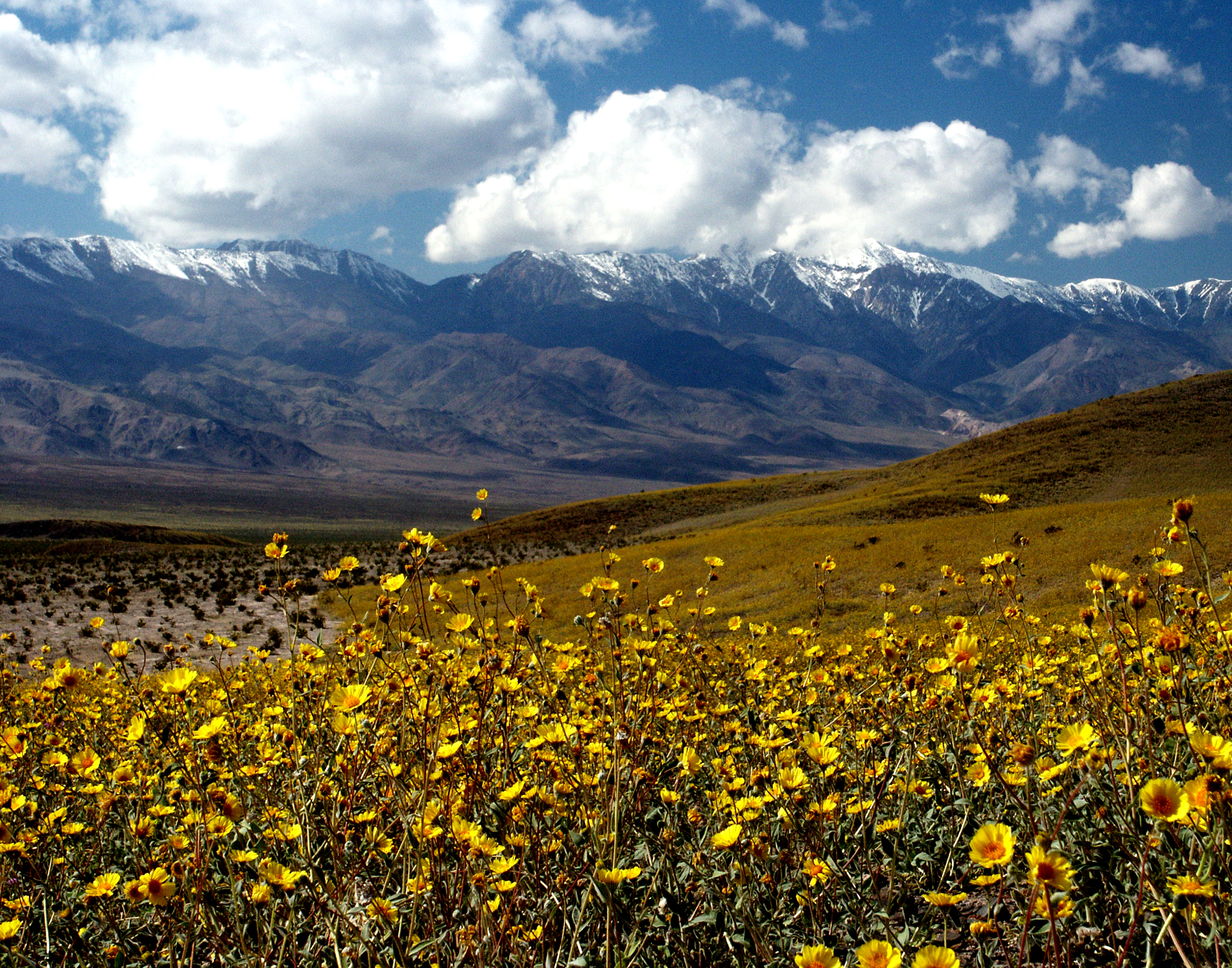
In spite of the overwhelming heat and sparse rainfall, Death Valley exhibits considerable biodiversity. Flowers, watered by snowmelt, carpet the desert floor each spring, continuing into June. Bighorn sheep, red-tailed hawks, and feral donkeys may be seen. Death Valley has over 600 springs and ponds. Salt Creek, a mile-long shallow depression in the center of the valley, supports Death Valley pupfish. These isolated pupfish populations are remnants of the wetter Pleistocene climate.
Darwin Falls, on the western edge of Death Valley Monument, falls 100 ft into a large pond surrounded by willows and cottonwood trees. More than 80 species of bird have been recorded around the pond.
Efflorescence, also known as salt flowers, is a rare occurrence in Death Valley that occurs when rain soaks into the soil and dissolves salt beneath the surface causing the ground to appear as if there is a light dusting of snow.
History
Death Valley is home to the Timbisha tribe of Native Americans, formerly known as the Panamint Shoshone, who have inhabited the valley for at least the past millennium. The Timbisha name for the valley, tümpisa, means "rock paint" and refers to the red ocher paint that can be made from a type of clay found in the valley. Some families still live in the valley at Furnace Creek. Another village was in Grapevine Canyon near the present site of Scotty's Castle. It was called maahunu in the Timbisha language, whose meaning is uncertain, although it is known that hunu means 'canyon'.
The valley received its English name in 1849 during the California Gold Rush. It was called Death Valley by prospectors and others who sought to cross the valley on their way to the gold fields, after 13 pioneers perished from one early expedition of wagon trains. During the 1850s, gold and silver were extracted in the valley. In the 1880s, borax was discovered and extracted by mule-drawn wagons.
Death Valley National Monument was proclaimed on February 11, 1933, by President Herbert Hoover, placing the area under federal protection. In 1994, the monument was redesignated as Death Valley National Park, as well as being substantially expanded to include Saline and Eureka Valleys.
Notable attractions and locations

Main article: Places of interest in the Death Valley area
- Badwater Basin
- China Ranch
- Dante's View
- Darwin Falls
- Devils Hole
- Father Crowley Viewpoint
- Furnace Creek
- Harmony Borax Works
- Hells Gate
- Myers Ranch
- Oasis at Death Valley
- Russell Camp
- New Ryan
- Upper and Lower Noonday Camp
- Racetrack Playa, a large dry lakebed within the Valley
- Sailing stones, famous moving stones of Death Valley
- Scotty's Castle
- Shoreline Butte
- Stovepipe Wells
- Tecopa
- Tecopa Hot Springs
- West Side Borax Camp
- Wilson Ranch
- Wildrose Ranger Station
- Zabriskie Point
In literature and the arts
Films
A number of movies have been filmed in Death Valley, including:
- Chimmie Fadden Out West (1915)
- The Dawn of Understanding (1918)
- Greed (1924)
- The Air Mail (1925)
- The Brute (1927)
- The Chinese Parrot (1927)
- Fair Warning (1931)
- The Border Patrolman (1936)
- Danger Valley (1937)
- 20 Mule Team (1940)
- The Bride Came C.O.D. (1941)
- Castle in the Desert (1942)
- Accomplice (1946)
- Death Valley (1946)
- 3 Godfathers (1948)
- Yellow Sky (1948)
- Death Valley Gunfighter (1949)
- The Walking Hills (1949)
- Surrender (1950)
- The Gunfighter (1950)
- Cattle Drive (1951)
- Westward the Women (1951)
- City of Bad Men (1953)
- Escape from Fort Bravo (1953)
- Tumbleweed (1953)
- War Paint (1953)
- The Law and Jake Wade (1958)
- One-Eyed Jacks (1961)
- The Reward (1965)
- The Professionals (1966)
- Zabriskie Point (1970)
- Star Wars (1977)
- Raiders of the Lost Ark (1981)
- Death Valley (1982)
- Cherry 2000 (1987)
- Phantasm IV: Oblivion (1998)
- Six-String Samurai (1998)
- Gerry (2002)
- Daft Punk's Electroma (2006)
- The Legend of God's Gun (2007)
- Ancient Caves (2020)
Music
- Death Valley Suite (1949), a symphonic suite by Ferde Grofé, inspired by the history and geography of Death Valley
- "Death Valley" (2013), a song from the studio album Save Rock and Roll by Fall Out Boy, is named after Death Valley, as well as containing lyrics inspired by this location
- "Death Valley '69" (1984), a song by Sonic Youth and Lydia Lunch, is about the valley, and the video features imagery of it.
- "Death Valley Nights" (1977), a song from the studio album Spectres by Blue Öyster Cult, takes place in the valley, using the extreme climate to mirror a dramatic love/hate relationship.
- "Canyon Moon" (2014), a song by Andrew McMahon in the Wilderness, contains lyrics about driving through Death Valley.
- "Who Feels Love?", a song by Oasis, had its music video filmed in Death Valley.
- "Death Valley High" (2024), a song by Orville Peck and Beck, a song about Death Valley.
Television
- Death Valley Days (1930–1945 radio series; 1952–1970 TV series), an American radio and television anthology series that presented true stories of the American Old West, a number of which featured the Death Valley area.
- The retired wrestler and WWE Hall of Famer The Undertaker is billed from Death Valley, apart from when he was the American Badass from 2000 to 2003.
- The FX horror anthology series American Horror Story has a tenth season titled American Horror Story: Double Feature, which is split into two parts. While the first part, Red Tide, takes place by the sea, the second part of the season, Death Valley, focuses on a group of teens uncovering a conspiracy involving Dwight D. Eisenhower and strange occurrences in a desert partially inspired by Death Valley involving aliens and UFOs.
Notes
References
References
- {{cite GNIS. 270787. Feature Detail Report for: Death Valley
- (September 21, 2015). "USGS National Elevation Dataset (NED) 1 meter Downloadable Data Collection from The National Map 3D Elevation Program (3DEP) – National Geospatial Data Asset (NGDA) National Elevation Data Set (NED)". United States Geological Survey.
- (10 January 2020). "Tümpisa: Connecting to Purpose".
- "World Heat Record Overturned – A Personal Account". WunderBlog.
- "Find Distance and Azimuths Between 2 Sets of Coordinates". Federal Communications Commission.
- "World Meteorological Organization World Weather / Climate Extremes Archive".
- El Fadli, KI. (September 2012). "World Meteorological Organization Assessment of the Purported World Record 58°C Temperature Extreme at El Azizia, Libya (13 September 1922)". Bulletin of the American Meteorological Society.
- (August 17, 2020). "'Highest temperature on Earth' recorded in US". BBC News.
- (1981). "Death Valley National Monument: Proposed Natural and Cultural Resources Management Plan and Draft Environmental Impact Statement". U.S. Department of the Interior.
- (2006). "The New York Times Almanac". Penguin Books.
- (2016). "Hiking Death Valley National Park". Rowman & Littlefield.
- "Frequently Asked Questions – Death Valley National Park (U.S. National Park Service)". National Park Service.
- Dotson, Danny. "Research Guides: National Parks: Death Valley National Park".
- (1997). "Geology Underfoot in Death Valley and Owens Valley". Mountain Press Publishing.
- (March 18, 2009). "Image of the Day: Lake Badwater, Death Valley". NASA.
- (2009). "Boron Minerals of Death Valley". Clark Science Center, Smith College.
- (2003). "The Climate of Death Valley, California". Bulletin of the American Meteorological Society.
- Fischer, Barry. (December 20, 2018). "Why is it colder at higher elevations? A thorough and visual explanation.".
- "Death Valley Weather". US National Park Service.
- (May 23, 2008). "Weather and Climate". U.S. National Park Service.
- "Weather and Climate". National Park Service.
- Masters, Jeff. "Historic Heat Wave {{sic". Wunderground.
- Sumenow, Jason. (October 25, 2016). "New analysis shreds claim that Death Valley recorded Earth's highest temperature in 1913". The Washington Post.
- Graham Readfearn. (August 17, 2020). "Death Valley temperature rises to 54.4C – possibly the hottest ever reliably recorded". The Guardian.
- (August 17, 2020). "'Highest temperature on Earth' as Death Valley, US hits 54.4C". BBC News.
- NWS Las Vegas. "DEATH VALLEY UPDATE Thermometer High temp at Death Valley today = 130F. Warning sign If this says anything about how hot SAT-SUN will be, HEED THESE WARNINGS. Do not put yourself, nor first responders in danger this weekend! This observed high temp is considered preliminary & not yet validated.".
- . (July 12, 2021). ["Death Valley, California, breaks the all-time world heat record for the second year in a row"](https://yaleclimateconnections.org/2021/07/death-valley-california-breaks-the-all-time-world-heat-record-for-the-second-year-in-a-row/). *Yale climate connections*.
- . (July 12, 2021). ["Death Valley, California, breaks the all-time world heat record for the second year in a row"](https://yaleclimateconnections.org/2021/07/death-valley-california-breaks-the-all-time-world-heat-record-for-the-second-year-in-a-row/). *Yale climate connections*.
- WRCC. "Period of Record General Climate Summary – Temperature". Desert Research Institute.
- (2001). "A possible world record maximum natural ground surface temperature". Weather.
- "July Daily Normals And Records". [[National Weather Service]].
- Masters, Jeff. (July 16, 2013). "Death Valley records a low of 107 °F (41.7 °C): a world record". Weather Underground.
- (June 21, 2017). "A World Record Low Humidity? {{convert".
- Jeff Masters. "Death Valley records a low of 107 °F (41.7 °C): a world record". [[Weather Underground]].
- (August 1, 2024). "Almanac for DEATH VALLEY NATIONAL PARK, CA – July 31, 2024". [[National Weather Service]].
- WRCC. "Monthly Climate Summary". Desert Research Institute.
- (March 3, 2005). "Wet Winter Brings Life to Death Valley". [[NPR]].
- "NOWData – NOAA Online Weather Data". [[National Oceanic and Atmospheric Administration]].
- "Summary of Monthly Normals 1991–2020". [[National Oceanic and Atmospheric Administration]].
- "Cow Creek, California, Monthly Climate Summary, 1934–1961". Western Regional Climate Center, Desert Research Institute.
- Daley, Jason (2019). [https://www.smithsonianmag.com/smart-news/flooding-creates-10-mile-long-lake-death-valley-180971699/ Flooding Creates a 10-Mile-Long Lake in Death Valley]. Smithsonian Magazine. Retrieved June 29, 2020.
- Lema, Sean. (2008). "Phenotypic Plasticity of Death Valley's Pupfish".
- (May 2008). "Not So Dead".
- Hayley Smith. (September 16, 2021). "Snow in Death Valley, the hottest place on Earth? It's not what it looks like".
- Jon P. Dayley, ''Tümpisa (Panamint) Shoshone Dictionary'', University of California Publications in Linguistics Volume 116 (1989, University of California Press), page 89.
- Lingenfelter, Richard E.. (1988). "Death Valley Lore, Classic Tales of Fantasy, Adventure and Mystery". University of Nevada Press.
- (1894). "Death Valley in '49". The Pacific Tree and Vine Co..
- Reynolds, Jerry. "Paradise Found". Santa Clarita Valley Historical Society.
- Schneider, Jerry L.. (2016). "Western Filming Locations California Book 6". [[Barnes & Noble]].
- (April 2, 2022). "Death Valley in Movies and Television". [[National Park Service]].
This article was imported from Wikipedia and is available under the Creative Commons Attribution-ShareAlike 4.0 License. Content has been adapted to SurfDoc format. Original contributors can be found on the article history page.
Ask Mako anything about Death Valley — get instant answers, deeper analysis, and related topics.
Research with MakoFree with your Surf account
Create a free account to save articles, ask Mako questions, and organize your research.
Sign up freeThis content may have been generated or modified by AI. CloudSurf Software LLC is not responsible for the accuracy, completeness, or reliability of AI-generated content. Always verify important information from primary sources.
Report