From Surf Wiki (app.surf) — the open knowledge base
Death metal
Extreme subgenre of heavy metal music

Extreme subgenre of heavy metal music
| Field | Value |
|---|---|
| name | Death metal |
| stylistic_origins | |
| cultural_origins | Mid-1980s, United States |
| subgenres | * Brutal death metal |
| fusiongenres | * Blackened death-doom |
| regional_scenes | * Brazil |
| local_scenes | * New York City |
| other_topics | * Extreme metal |
- slam death metal
- industrial death metal
- melodic death metal
- old school death metal
- symphonic death metal
- technical death metal
- blackened death metal (melodic black-death
- war metal)
- death-doom (funeral doom)
- deathcore
- deathgrind
- deathrash
- death 'n' roll
- goregrind
- pornogrind
- Florida
- Indonesia
- Netherlands
- Sweden
- Norway
- Poland
- blast beat
- death growl
- list of bands
- Christian death metal
Death metal is an extreme subgenre of heavy metal music. It typically employs heavily distorted and low-tuned guitars, played with techniques such as palm muting and tremolo picking; deep growling vocals; aggressive, powerful drumming, featuring double kick and blast beat techniques; minor keys or atonality; abrupt tempo, key, and time signature changes; and chromatic chord progressions.{{cite web |last=Wiederhorn |first=Jon
Building from the musical structure of thrash metal and early black metal, death metal emerged during the mid-1980s. Bands such as Venom, Celtic Frost, Slayer, and Kreator were important influences on the genre's creation. Possessed, Death, Necrophagia, Obituary, Autopsy, and Morbid Angel are often considered pioneers of the genre.
Since then, death metal has diversified, spawning several subgenres. Melodic death metal combines death metal elements with those of the new wave of British heavy metal. Technical death metal is a complex style, with uncommon time signatures, atypical rhythms, and unusual harmonies and melodies. Death-doom combines the deep growled vocals and double-kick drumming of death metal with the slow tempos and melancholic atmosphere of doom metal. Deathgrind, goregrind, and pornogrind mix the complexity of death metal with the intensity, speed, and brevity of grindcore. Deathcore combines death metal with metalcore traits. Death 'n' roll combines death metal's growled vocals and highly distorted, detuned guitar riffs with elements of 1970s hard rock and heavy metal.
History
Emergence and early history (early to mid–1980s)
Possessed, a band that formed in the San Francisco Bay Area during 1983, is described by AllMusic as "connecting the dots" between thrash metal and death metal with their 1985 debut album, Seven Churches. While attributed as having a Slayer influence, current and former members of the band had actually cited Venom and Motörhead, as well as early work by Exodus, as the main influences on their sound. Although the group had released only two studio albums and an EP in their formative years, they have been described by music journalists and musicians as either being "monumental" in developing the death metal style, or as being the first death metal band. Earache Records noted that "the likes of Trey Azagthoth and Morbid Angel based what they were doing in their formative years on the Possessed blueprint laid down on the legendary Seven Churches recording. Possessed arguably did more to further the cause of 'Death Metal' than any of the early acts on the scene back in the mid-late 80's."
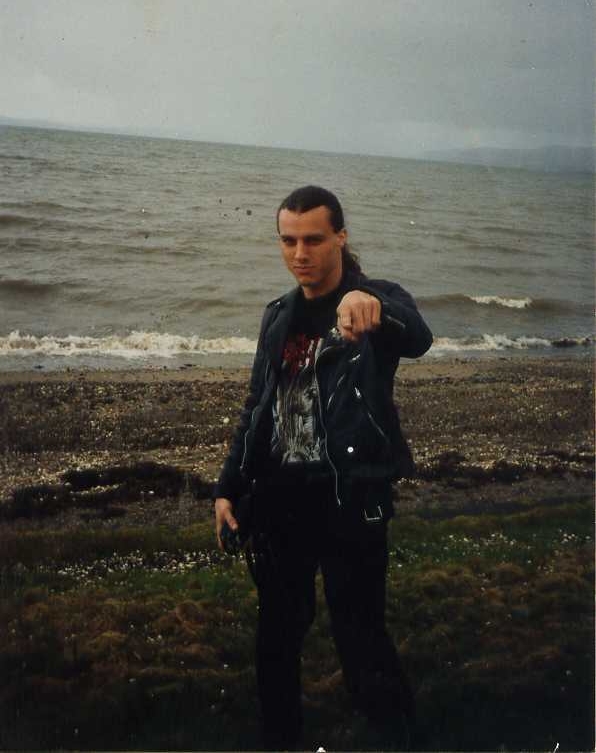
During the same period as the dawn of Possessed, a second influential metal band was formed in Orlando, Florida. Originally called Mantas, Death was formed in 1983 by Chuck Schuldiner, Kam Lee, and Rick Rozz. Inspired by the Brandon, Florida act Nasty Savage, they took the sound of Nasty Savage and deepened it. In 1984, they released their first demo entitled Death by Metal, followed by several more. The tapes circulated through the tape trader world, quickly establishing the band's name. With Death guitarist Schuldiner adopting vocal duties, the band made a major impact in the emerging Florida death metal scene. The fast minor-key riffs and solos were complemented with fast drumming, creating a style that would catch on in tape trading circles. Schuldiner has been credited by AllMusic's Eduardo Rivadavia for being widely recognized as the "Father of Death Metal". Death's 1987 debut release, Scream Bloody Gore, has been described by About.com's Chad Bowar as being the "evolution from thrash metal to death metal", and "the first true death metal record" by the San Francisco Chronicle. In an Interview Jeff Becerra talked about the discussions of being the creator of the genre, saying that Schuldiner cited Possessed as a massive influence, and Death were even called "Possessed clones" early on. Along with Possessed and Death, other pioneers of death metal in the United States include Macabre, Master, Massacre, Immolation, Cannibal Corpse, Obituary, and Post Mortem.
Growing popularity (late 1980s to late 1990s)
By 1989, many bands had been signed by eager record labels wanting to cash in on the subgenre, including Florida's Obituary, Morbid Angel and Deicide. This collective of death metal bands hailing from Florida are often labeled as "Florida death metal". Morbid Angel pushed the genre's limits both musically and lyrically, with the release of their debut album Altars of Madness in 1989. The album "redefined what it meant to be heavy while influencing an upcoming class of brutal death metal." According to Jason Birchmeier of AllMusic, "Venom and Slayer redefined the extent to which a metal band could align itself with all things evil during the beginning of the decade, but Morbid Angel made these two groups sound like children's music."
Following the original death metal innovators, new subgenres began to develop the end of the decade, such as melodic death metal. Death released their fourth album Human in 1991, which has become a hallmark in technical death metal. Death's founder Schuldiner helped push the boundaries of the genre with uncompromising speed and technical virtuosity, combining intricate rhythm guitar work with complex arrangements and emotive guitar solos.[[File:Deicide band 016.jpg|thumb|300x300px|[[Deicide (band)|Deicide]] drummer [[Steve Asheim]]]]
Earache Records, Relativity Records and Roadrunner Records became the genre's most important labels, with Earache releasing albums by Carcass, Napalm Death, Morbid Angel, and Entombed, and Roadrunner releasing albums by Obituary, and Pestilence. Although these labels had not been death metal labels, they initially became the genre's flagship labels at the beginning of the 1990s. In addition to these, other labels formed as well, such as Nuclear Blast, Century Media, and Peaceville. Many of these labels would go on to achieve successes in other genres of metal throughout the 1990s.
In September 1990, Death's manager Eric Greif held one of the first North American death metal festivals, Day of Death, in Milwaukee suburb Waukesha, Wisconsin, and featured 26 bands including Autopsy, Broken Hope, Hellwitch, Obliveon, Revenant, Viogression, Immolation, Atheist, and Cynic.
Death metal's popularity achieved its initial peak during 1992–1993, with some bands such as Morbid Angel and Cannibal Corpse enjoying mild commercial success. However, the genre as a whole never broke into the mainstream. The genre's mounting popularity may have been partly responsible for a strong rivalry between Norwegian black metal and Swedish death metal scenes. Fenriz of Darkthrone has noted that Norwegian black metal musicians were "fed up with the whole death metal scene" at the time. According to Joel McIver of Metal Hammer, "Many metalheads were fixated on the new wave of black metal emanating from Scandinavia, the UK and the US. Just as grunge had killed glam back in 1991, a new movement of corpsepainted bands was making the death metal scene look tedious, or worse, obsolete. Only the best would survive." Consequently, death metal diversified in the 1990s, spawning a variety of subgenres that maintain cult followings to the present day.
Later history (2000–present)

In the 2000s, a number of bands in the hardcore punk scene, including Black Breath and Trap Them began to incorporate elements of death metal into their sound. This was followed by a wave of bands expanding upon the death-doom style of Incantation while incorporating elements of ambient music, including Dead Congregation and Necros Christos.
In the 2010s, a movement of bands reviving the sound of original 1980s death metal emerged, termed the "New Wave of Old School Death Metal". One of the earliest groups in this wave was Horrendous, who formed in 2009, who along with Tomb Mold took a progressive take the genre. Tomb Mold, Necrot, Undergang and Blood Incantation were some of the earliest bands to gain traction in the 2010s, with the COVID-19 pandemic amplifying the amount of attention drawn to the movement, through Cryptic Shift, Slimelord and Vaticinal Rites. In a 2022 article by MetalSucks writer Christopher Krovatin stated "Right now, as a music journalist, all I hear about is death metal." In the UK, this movement became the "New Wave of British Death Metal", fronted by Mortuary Spawn, Vacuous and Celestial Sanctuary, this name being coined by Tom Cronin, of Celestial Sanctuary, in order to separate these hardcore-indebted bands from the country's prior movements. The earliest bands in this wave were Cruciamentum and Grave Miasma.
A large part of the New Wave of Old School Death Metal was death metal bands who originated from the hardcore scene, some of which merge elements of hardcore into their style. Xibalba and Fuming Mouth were two of the earliest groups, with the wave being solidified by Gatecreeper, 200 Stab Wounds, Creeping Death, Sanguisugabogg and Kruelty. Venom Prison came from this scene and gained particular attention for their confrontation of what Kerrang! called death metal's "misogyny problem", by instead writing "rape-revenge narrative[s]". Their lead vocalist Larissa Stupar was described by the publication as "metal's most important - and uncompromising - voice".
Characteristics

Death metal vocals are referred to as death growls, which are coarse roars/snarls. Death growling is mistakenly thought to be a form of screaming using the lowest vocal register known as vocal fry, but vocal fry is actually a form of overtone screaming. While growling can be performed this way by experienced vocalists who use the fry screaming technique, "true" death growling is in fact created by an altogether different technique. Growling has been called Cookie Monster vocals, tongue-in-cheek, due to the vocal similarity to the voice of the popular Sesame Street character. Although often criticized, death growls serve the aesthetic purpose of matching death metal's aggressive lyrical content.
The lyrical themes of death metal may invoke slasher film-stylised violence, but may also extend to topics like religion (sometimes including Satanism), occultism, Lovecraftian horror, nature, mysticism, mythology, theology, philosophy, science fiction, and politics. Although violence may be explored in various other genres as well, death metal may elaborate on the details of extreme acts, including blood and gore, psychopathy, delirium, mutilation, mutation, dissection, exorcism, torture, rape, cannibalism, and necrophilia. Sociologist Keith Kahn-Harris commented this apparent glamorisation of violence may be attributed to a "fascination" with the human body that all people share to some degree, a fascination that mixes desire and disgust. Heavy metal author Gavin Baddeley also stated there does seem to be a connection between one's degree of mortality salience and "how much they crave images of death and violence" via the media. Additionally, contributing artists to the genre often defend death metal as little more than an extreme form of art and entertainment, similar to horror films in the motion picture industry. This explanation has brought such musicians under fire from activists internationally, who claim that this is often lost on a large number of adolescents, who are left with the glamorisation of such violence without social context or awareness of why such imagery is stimulating.
According to Alex Webster, bassist of Cannibal Corpse, "The gory lyrics are probably not, as much as people say, [what's keeping us] from being mainstream. Like, 'death metal would never go into the mainstream because the lyrics are too gory?' I think it's really the music, because violent entertainment is totally mainstream." Christian death metal bands often utilize the gory themes of death metal to invoke violent imagery against Satan, demons, sin and sinners, much of the violent imagery being drawn from the Bible. Satanic and anti-Christian imagery is also frequently inverted.
Etymology
Verifiable uses of the term "death metal" began around 1983, however it was largely interchangeable with what is now understood as thrash metal. The 1983 premier issue of the zine Metal Chaos used the term to describe the music that disc-jockey Gene Khoury played on WMSC (FM) and the Winter 1983–1984 issue of Metal Forces used the term to describe Metal Church and Hellhammer.
During 1984, use of the term began to gravitate towards more extreme bands, such as Bathory, Destruction, Onslaught, Slayer and Sodom. Hellhammer, in particular, put a significant emphasis on the term, being used in the liner notes for Apocalyptic Raids (1984), and being used as the name for both Thomas Fischer and Martin Ain's zine, and their split album Death Metal (1984). The same year Possessed released their demo, Death Metal; featuring an eponymous song which would also be featured on the band's 1985 debut album, Seven Churches. In an interview for Choosing Death: The Improbable History of Death Metal & Grindcore, Possessed vocalist and bassist Jeff Becerra said he coined the term for a high school English class assignment, stating "I figured speed metal and black metal were already taken, so what the fuck? So I said death metal, because that word wasn't associated with Venom or anybody else. It wasn't even about redefining it. We were playing this music and we were trying to be the heaviest thing on the face of the planet. We wanted just to piss people off and send everybody home. And that can't be, like, flower metal."
Subgenres and fusion genres
Cited examples are not necessarily exclusive to one particular style. Many bands can easily be placed in two or more of the following categories, and a band's specific categorization is often a source of contention due to personal opinion and interpretation. The musical genres in this list are sorted alphabetically.
Blackened death-doom
Blackened death-doom is a microgenre that combines the slow tempos and monolithic drumming of doom metal, the complex and loud riffage of death metal and the shrieking vocals of black metal. Examples of blackened death-doom bands include Morast, Dragged into Sunlight, Hands of Thieves, and Soulburn. Kim Kelly, journalist from Vice, has called Faustcoven "one of the finest bands to ever successfully meld black, death, and doom metal into a cohesive, legible whole."
Blackened death metal
Main article: Blackened death metal

Blackened death metal is commonly death metal that incorporates musical, lyrical or ideological elements of black metal, such as an increased use of tremolo picking, anti-Christian or Satanic lyrical themes and chord progressions similar to those used in black metal. Blackened death metal bands are also more likely to wear corpse paint and suits of armour, than bands from other styles of death metal. Lower range guitar tunings, death growls and abrupt tempo changes are common in the genre. Examples of blackened death metal bands are Belphegor, Behemoth, Akercocke, and Sacramentum.
Melodic black-death
Melodic black-death (also known as blackened melodic death metal or melodic blackened death metal) is a genre of extreme metal that describes the style created when melodic death metal bands began being inspired by black metal and European romanticism. However, unlike most other black metal, this take on the genre would incorporate an increased sense of melody and narrative. Some bands who have played this style include Dissection, Sacramentum, Naglfar, God Dethroned, Dawn, Unanimated, Thulcandra, Skeletonwitch and Cardinal Sin.
War metal
War metal (also known as war black metal or bestial black metal) described by Rock Hard journalist Wolf-Rüdiger Mühlmann as "rabid" Archgoat, Bestial Warlust, and Zyklon-B.
Brutal death metal
.jpg)
Main article: Brutal death metal
Brutal death metal is a subgenre of death metal that prioritizes heaviness, speed, and complex rhythms over other aspects, such as melody and timbres. Brutal death metal bands employ high-speed, palm-muted power chording and single-note riffage. Dying Fetus, Cryptopsy, and Skinless.
Slam death metal
Slam death metal is a brutal death metal microgenre that evolved from the 1990s New York death metal scene, incorporating elements of hardcore punk. In contrast to other death metal styles, it is not generally focused on guitar solos and blast beats; instead, it employs mid-tempo rhythms, breakdowns, and palm-muted riffing, as well as hip hop-inspired vocal and drum beat rhythms. The breakdown riff of Suffocation's "Liege of Inveracity" has been credited by Rolling Stone as the first slam riff in death metal. The first wave of bands in the genre were New York bands like Internal Bleeding and Pyrexia, with notable subsequent acts including Devourment and Cephalotripsy.
Death-doom
Main article: Death-doom

Death-doom is a style that combines the slow tempos and pessimistic atmosphere of doom metal with the deep growling vocals and double-kick drumming of death metal. Influenced mostly by the early work of Hellhammer and Celtic Frost, the style emerged during the late 1980s and gained a certain amount of popularity during the 1990s. Death-doom was also pioneered by bands such as Winter, Disembowelment, Paradise Lost, Autopsy, Anathema, and My Dying Bride.
Funeral doom
Main article: Funeral doom
Funeral doom is a genre that crosses death-doom with funeral dirge music. It is played at a very slow tempo, and places an emphasis on evoking a sense of emptiness and despair. Typically, electric guitars are heavily distorted and dark ambient aspects such as keyboards or synthesizers are often used to create a dreamlike atmosphere. Vocals consist of mournful chants or growls and are often in the background.
Death 'n' roll
Main article: Death 'n' roll
Death 'n' roll is a style that combines death metal's growled vocals and highly distorted detuned guitar riffs along with elements of 1970s hard rock and heavy metal. Notable examples include Entombed, Gorefest, and Six Feet Under.
Deathcore
Main article: Deathcore
Deathcore is a subgenre that merges the intensity of death metal with the aggressive elements of metalcore. It is characterized by fast drumming, including blast beats, down-tuned guitars, tremolo picking, growled vocals, high-pitched shrieks, and the breakdowns typical of metalcore. Decibel magazine noted that "one of Suffocation's trademarks, breakdowns, has spawned an entire metal subgenre: deathcore." Dying Fetus was also influencing deathcore through their extensive use of slam riffs, breakdowns, and hardcore-inspired grooves. Their 1996 album Purification Through Violence and 1998's Killing on Adrenaline introduced a mix of brutal death metal and hardcore elements that would later be adopted by deathcore bands. Bands such as Despised Icon, Suicide Silence, Salt the Wound and All Shall Perish combine the technicality of death metal with the breakdown-driven structures of metalcore, creating a distinct and influential sound.
Deathgrind, goregrind and pornogrind
Main article: Deathgrind, Goregrind, Pornogrind

Goregrind, deathgrind and pornogrind are styles that mix grindcore with death metal, with goregrind focused on themes like gore and forensic pathology, and pornogrind dealing with sexual and pornographic themes. Some notable examples of these genres are Brujeria, Cattle Decapitation, Cephalic Carnage, Pig Destroyer, Circle of Dead Children, Rotten Sound, Gut, and Cock and Ball Torture.
Deathrash
Deathrash, also known as death-thrash, is a shorthand term to describe bands who play a fusion of death metal and thrash metal. The genre gained notoriety in Bali, Indonesia, where it attracted criticism of being related to the accelerated tourism development on the island and the superseding of its local culture, particularly by Jakartan one. Notable bands include Grave, Mortification, The Crown, Incapacity, Darkane, Deathchain,
Industrial death metal
Industrial death metal is a genre of death metal that adds elements of industrial music. Some notable bands include Fear Factory, Anaal Nathrakh, Autokrator, and Meathook Seed.
Melodic death metal
Main article: Melodic death metal
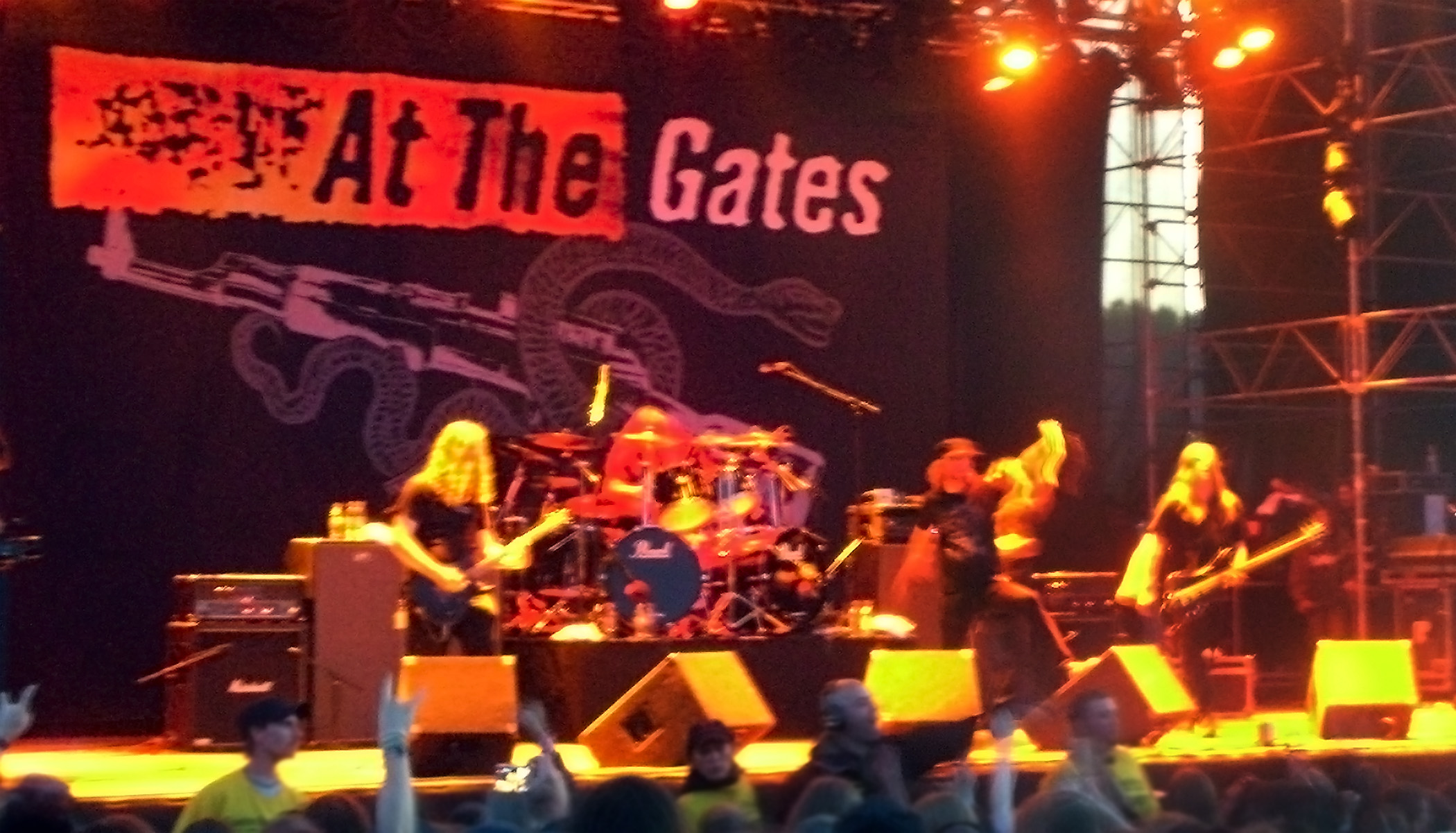
Swedish death metal could be considered the forerunner of "melodic death metal". Melodic death metal, occasionally shortened to "melodeath", is a fusion of heavy metal with elements of death metal. The subgenre is heavily influenced by the new wave of British heavy metal. Unlike most other death metal, melodeath usually features screams instead of growls, slower tempos, and much stronger emphasis on melody. Clean vocals may be used on occasion. Carcass is sometimes credited with releasing the first melodic death metal album with 1993's Heartwork, although Swedish bands In Flames, Dark Tranquillity, and At the Gates are usually mentioned as the main pioneers of the genre and of the Gothenburg metal sound.
Old school death metal
Old school death metal is a style of death metal that is characterized by slower tempos and simpler song structures.The style typically employs fewer blast beats and is less concerned with the technical aspects of songwriting. It gained prominence in the late 1990s, with bands like Repugnant, Thanatos, Necrophagia, Abscess, Bloodbath and Mortem.
Symphonic death metal
Symphonic death metal is a genre of death metal that adds elements of classical music. Bands described as symphonic death metal include Fleshgod Apocalypse, Septicflesh, Necronomicon, and Children of Bodom. Haggard's 2000 album, Awaking the Centuries, has been described as death metal-styled symphonic metal.
Technical death metal
Main article: Technical death metal
.jpg)
Technical death metal (also known as tech-death, progressive death metal, or prog-death) is a subgenre of death metal that employs dynamic song structures, uncommon time signatures, atypical rhythms and unusual harmonies and melodies. Bands described as technical death metal or progressive death metal usually fuse common death metal aesthetics with elements of progressive rock, jazz or classical music. While the term technical death metal is sometimes used to describe bands that focus on speed and extremity as well as complexity, the line between progressive and technical death metal is thin. Tech death and prog death, for short, are terms commonly applied to such bands as Nile, Edge of Sanity, and Opeth. Necrophagist and Spawn of Possession are known for a classical music-influenced death metal style. Death metal pioneers Death also refined their style in a more progressive direction in their final years. Some albums for this subgenre are Hallucinations (1990) by the German band Atrocity and Death's Human (1991). This style has significantly influenced many bands, creating a stream that in Europe was carried out at first by bands such as Gory Blister and Electrocution. The Polish band Decapitated gained recognition as one of Europe's primary modern technical death metal acts.
References
Bibliography
References
- Bayer, Gerd. (2009). "Heavy Metal Music in Britain". [[Ashgate Publishing]].
- Moynihan, Michael, and Dirik Søderlind (1998). Lords of Chaos (2nd ed.). Feral House. {{ISBN. 0-922915-94-6, p. 27
- "Death Metal".
- (16 June 2021). "All About Death Metal: 5 Notable Death Metal Bands". [[MasterClass]].
- (August 5, 2005). "Metal: A Headbanger's Journey". Dunn, Sam.
- Rivadavia, Eduardo. "Possessed Biography".
- Renda, Patricia. (1999). "Chuck Schuldiner: The pain of a genius". [[Metal Rules]].
- Rivadavia, Eduardo. "Necrophagia Biography".
- Jason Birchmeier. "Obituary | Biography".
- "Autopsy's Chris Reifert Comments On First New Material In 15 Years - Blabbermouth.net". BLABBERMOUTH.NET.
- Prato, Greg. "Morbid Angel Biography".
- Heeg, Robert. (April 1993). "Is Metal Still Alive?". [[WATT]].
- Lee, Cosmo. (March 14, 2007). "Phazm: Antebellum Death 'n' Roll".
- Rivadavia, Eduardo. "Venom: Welcome to Hell".
- Ankeny, Jason. "Venom Biography".
- de Paola, Enrico. (March 2000). "Into The Lungs of Hell". Empty Words.
- Huey, Steve. "Slayer Biography".
- McPadden, Mike. (March 22, 2015). "'Hell Awaits' by Slayer Turns 30, Still Head Of The Thrash Class of '85".
- Huey, Steve. "Slayer: Reign in Blood".
- Rivadavia, Eduardo. "Possessed: Seven Churches".
- Rivadavia, Eduardo. "Possessed Biography".
- McIver, Joel. (2008). "The Bloody Reign of Slayer". [[Omnibus Press]].
- "Interview With Jeff Becerra". [[Earache Records]].
- (October 22, 2009). "The way the music died: The earliest days of Tampa Death Metal". [[Times Publishing Company]].
- Rivadavia, Eduardo. "Death Biography".
- Bowar, Chad. "Death Profile". About.com.
- (2006). "Heavy metal Thunder". [[San Francisco Chronicle]].
- (August 20, 2017). "JEFF BECERRA Puts an End to Debate over Who Was the First Death Metal Band: DEATH or POSSESSED".
- Norton, Justin M.. (February 19, 2009). "Post Mortem - 'Coroner's Office' Retrospective". [[About.com]].
- Marquard, Bryan. (February 8, 2009). "John McCarthy, at 40; was lead singer for local thrash rocker Post Mortem". [[The Boston Globe]].
- Sullivan, Andy. (August 25, 2012). "Death metal, the sound of Tampa, won't be heard at Republican convention". Yahoo News.
- "Morbid Angel - "Altars of Madness"". Decibel Magazine.
- (June 6, 2013). "No. 4: Morbid Angel, 'Altars of Madness' – Best Debut Metal Albums".
- "Altars of Madness - Morbid Angel {{!}} Album {{!}} AllMusic".
- "Welcome to Empty Words".
- 'Death Metal Special: Dealers in Death' ''Terrorizer #151''
- {{usurped
- Zebyb, Bill. (2007). "Black Metal: A Documentary".
- McIverpublished, Joel. (2024-12-28). ""There's an unlimited amount of bad things happening in the world, real and imagined. It's not hard for us to come up with stuff": The story of Cannibal Corpse's Gallery Of Suicide, the album that helped keep 90s death metal alive".
- (December 31, 2018). "In 2018, Death Metal Reigned Supreme".
- (February 19, 2015). "BEGINNER'S GUIDE TO OLD SCHOOL DEATH METAL".
- (August 17, 2020). "A History of North American Death Metal in 30 Albums".
- (January 11, 2022). "The Young Upstarts of UK Death Metal".
- (June 30, 2022). "Poll: Which Band in the New Wave of Death Metal Is Your Favorite?".
- "What the hell is the New Wave of British Death Metal?".
- (September 15, 2022). "Hardcore And Death Metal: Two Great Tastes That Taste Great Together".
- (March 15, 2023). "Kruelty – "Untopia"".
- (August 29, 2019). "How Brutal Death Metal Is Confronting Its Misogyny Problem".
- (27 May 2019). "Venom Prison the Remarkable Story of the Rise and Rise of Metal's Most Important - and Uncompromising - Voice". [[Kerrang!]].
- [http://heavymetal.about.com/od/heavymetal101/p/melodicdeathmetalprofile.htm Marsicano, D. ''Melodic Death Metal''] {{Webarchive. link. (February 2, 2017)
- Interview with Samuel Deschaine, Death Metal Vocal Instructor 2011
- "Cookie Monster Vocals". [[About.com]].
- Sharpe-Young, Garry. ''Death Metal'', {{ISBN. 0-9582684-4-4
- Baddeley, Gavin. ''Raising Hell!: The Book of Satan and Rock 'n' Roll''
- "Alex Webster (Cannibal Corpse) interview".
- Partridge, Christopher. (2014). "The Lyre of Orpheus: Popular Music, the Sacred, and the Profane". [[Oxford University Press.
- Kiryushkin, Alexander. (October 26, 2019). "10 Bands You Won't Believe Are Actually Christian".
- (2024-08-15). "Catholic death metal band 'Voluntary Mortification' proudly reclaims aspects of faith that confound non-Christians".
- Félix-Jäger, Steven. (2017-01-11). "With God on Our Side: Towards a Transformational Theology of Rock and Roll". [[Wipf and Stock Publishers]].
- (April 30, 2010). "A history of death metal".
- (March 6, 2025). "HEAVY METAL SUBGENRES ΚΑΤΑ ΤΗΝ ΔΕΚΑΕΤΙΑ ΤΟΥ '80 – ΟΡΟΛΟΓΙΑ, ΑΠΑΡΧΕΣ, ΝΟΗΜΑΤΟΔΟΤΗΣΗ ΚΑΙ ΜΕΤΕΠΕΙΤΑ ΕΞΕΛΙΞΗ - ΜΕΡΟΣ 1ο". Metalzone.
- (1983). "Northwest Metal". Metal Chaos.
- (1984). "Metal Church Let Us Pray". [[Metal Forces]].
- (1984). "Demo-Lition". [[Metal Forces]].
- (March 29, 2017). "Morast Expertly Synthesize Black, Death, and Doom Metal on 'Ancestral Void'".
- (February 7, 2017). "DON'T LOOK BELOW: HARVEST GULGALTHA – 'ALTARS OF DEVOTION' REVIEW + STREAM".
- (October 31, 2012). "Dragged Into Sunlight 'Widowmaker' (album stream)".
- (August 31, 2016). "The Black Market: The Month In Metal – August 2016".
- "ERIC DANIELS / SOULBURN".
- (June 11, 2014). "Soulburn: Band Of The Day".
- "Sound, Symbol, Sociality: The Aesthetic Experience of Extreme Metal Music".
- Henderson, Alex. "Ninewinged Serpent - Devian". [[AllMusic]].
- Bowar, Chad. "Hacavitz - Venganza Review". [[About.com]].
- "Studies in Symbolic Interaction".
- Dunn, Sam. (2016-10-05). "Blackened Death Metal band debate with Jason Deaville of Bravewords {{!}} LOCK HORNS (archive)".
- (October 21, 2011). "Belphegor Suspends All Activities". [[Terrorizer (magazine).
- Prato, Greg. "Behemoth". [[AllMusic]].
- Lee, Cosmo. (February 21, 2006). "Akercocke – Words That Go Unspoken, Deeds That Go Undone – Review – Stylus Magazine". [[Stylus Magazine]].
- Pretorious, Neil (July 30, 2009). "Review - Sacramentum - Far Away from the Sun"]. ''The Metal Observer''. "If you think that Blackened Death Metal begins and ends with DISSECTION, then think again. SACRAMENTUM seriously dropped the (snow) ball with 'The Coming of Chaos' and 'Thy Black Destiny', but on 'Far Away from the Sun' they really delivered the goods on all fronts."
- (February 19, 2015). "Blackened Melodic Death Metal: A History Lesson".
- "Swedish Death Metal".
- (5 April 2017). "GOD DETHRONED RETURN WITH 'THE WORLD ABLAZE,' UNLEASH DEATHLY MELODIC NEW SINGLE 'ON THE WRONG SIDE OF THE WIRE'".
- (18 June 2018). "SKELETONWITCH: HOW AN ANTON LAVEY–LOVING EX–CHOIR MEMBER PUSHED THRASHERS TO NEW LEVEL".
- "Top 5 Dissection Clones".
- Robert Müller: ''Wollt Ihr den ewigen Krieg?''. ''Der tote Winkel''. In: ''[[Metal Hammer]]'', November 2011.
- Wolf-Rüdiger Mühlmann: ''SARCOFAGO''. ''I.N.R.I.'' In: ''Rock Hard'', Nr. 304, September 2012, p. 73.
- Wolf-Rüdiger Mühlmann: ''War Black Metal: Die Extremsten der Extremen''. ''Was bleibt, ist Schutt und Asche''. In: ''Rock Hard'', no. 279, pp. 71–73.
- (2013). "Florida's Top Ten Black Metal Bands". [[Miami New Times]].
- (October 30, 2017). "The 13 Most Satanic Metal Bands".
- Christe, Ian. (February 17, 2004). "Sound of the beast: the complete headbanging history of heavy metal". [[HarperCollins]].
- Phillipov, Michelle. (August 31, 2018). "Death Metal and Music Criticism: Analysis at the Limits". Lexington Books.
- (September 17, 2015). "Death Metal Music: The Passion and Politics of a Subculture". [[McFarland & Company]].
- (March 10, 2010). "Extreme Metal II". [[Wise Music Group.
- (June 21, 2017). "Best Metal Bands From 40 Different Subgenres".
- Stewart-Panko, Kevin. (December 2, 2011). "Cryptopsy - "None so Vile"".
- (August 13, 2013). "Reunited Skinless: 'We're Back To Destroy'". [[Blabbermouth.net]].
- (June 26, 2006). "Trample The Weak, Hurdle the Dead Skinless". [[Blabbermouth.net]].
- Shteamer, Hank. (November 19, 2018). "Farewell, Frank Mullen: Suffocation's Death-Metal Maestro Goes Out on Top".
- (September 17, 2015). "Death Metal Music: The Passion and Politics of a Subculture". [[McFarland & Company]].
- (September 17, 2015). "Death Metal Music: The Passion and Politics of a Subculture". [[McFarland & Company]].
- Zorgdrager, Bradley. (August 29, 2019). "How Brutal Death Metal Is Confronting Its Misogyny Problem". [[Kerrang!]].
- "Cannabis Corpse - Beneath Grow Lights Thou Shalt Rise LP". Don't be Swindle.
- "Doom Metal Special: Doom/Death", ''Terrorizer #142''.
- Davis, Cody. (September 9, 2016). "Funeral Doom Friday: FUNERAL MOURNING's Blackened, Deadly Inertia of Dissonance (A Sermon in Finality)". Metal Injection.
- (February 2, 2017). "Doom Metal: A Brief Timeline". Bandcamp daily.
- Ebner, Arne. (July 25, 2010). "Ästhetik des Doom".
- Funeral doom was pioneered by [[Mournful Congregation]] (Australia), [[Esoteric (band). Esoteric]] (United Kingdom), [[Evoken]] (United States), [[Funeral (band). Funeral]] (Norway), [[Thergothon]] (Finland), and [[Skepticism (band). Skepticism]] (Finland).James Minton, Kim Kelly, and Jenn Selby, "Filth Parade", ''Terrorizer'' #188, September 2009, p. 56.
- Steve, Huey. "Gorefest Biography".
- Lee, Cosmo. (September 2009). "Suffocation reclaim their rightful place as kings of death metal". [[Decibel (magazine).
- (January 2026). "How Dying Fetus Influenced Deathcore".
- (January 2026). "The History of Deathcore: How The Red Chord, Despised Icon, and Whitechapel Defined a Genre".
- Rivadavia, Eduardo. "Aborted Biography".
- Brown, Jonathon. (September 6, 2007). "Everything you ever wanted to know about pop (but were too old to ask)". [[The Independent]].
- Badin, Olivier (2009). "Goregrind". ''Terrorizer'', 181, p.41.
- Anderson, Vicki. "Running the musical gauntlet". [[The Press]].
- Hess, Amanda. "Brick and Mordor: A record store heavy on the metal spins its last gloom and doom". [[Washington City Paper]].
- (April 13, 2007). "Pop and Rock Listings:The Locust, Cattle Decapitation, Daughters". [[The New York Times]].
- Reed, Bryan. (July 19, 2007). "The Daily Tar Heel Column". [[The Daily Tar Heel]].
- Hess, Amanda. (January 18, 2008). "Brick and Mordor: A record store heavy on the metal spins its last gloom and doom". [[Washington City Paper]].
- Mincemoyer, John. (2002). "Gore International". [[Terrorizer (magazine).
- Sharpe-Young, Garry. "Deaden Biography". [[MusicMight]].
- FORD, LEYLA. (January 3, 2012). "ALBUM OF THE DAY: DEATHCHAIN'S DEATHRASH ASSAULT". Metal Sucks.
- (June 26, 2003). "Gesturing elsewhere: the identity politics of the Balinese death/thrash metal scene". Popular Music.
- (October 9, 2012). "A Very Heavy Halloween II: Into the Darkness, Into the Grave".
- "Mortification". [[Australia Council for the Arts]] ([[Government of Australia]]).
- Kaye, Don. (1997). "Arise". [[Roadrunner Records]].
- Arnopp, Jason. (1993). "Industrial Metal: A User's Guide".
- Huey, Steve. "Fear Factory — Biography". All Media Network.
- (May 21, 2018). "ANAAL NATHRAKH Announces New Album A New Kind Of Horror".
- "Hell Is Empty, and All the Devils Are Here - Anaal Nathrakh - Songs, Reviews, Credits - AllMusic".
- (2015). "Autokrator, a get to the point interview and a review". No Clean Singing.
- (November 17, 2003). "It's Official: CANNIBAL CORPSE Are The Top-Selling Death Metal Band Of The SoundScan Era". BLABBERMOUTH.NET.
- "What is Melodic Death Metal?".
- (14 November 2019). "Tobias Forge får Stims Platinagitarr 2019".
- Lewis, James. (April 4, 2019). "Interview: Old-School Dutch Death Metallers Thanatos at 35 Years, with New Compilation, New Label, and New Album in 2020". [[Decibel Magazine]].
- (February 5, 2016). "Album Review: FLESHGOD APOCALYPSEKing - Metal Injection". Metal Injection.
- (September 27, 2016). "10 of the best metal bands from Greece". Metal Hammer.
- (September 8, 2016). "Marduk Couldn't Make It, But Rotting Christ, Carach Angren and Necronomicon Put On Quite The Show - Metal Injection". Metal Injection.
- Distefano, Alex. (December 5, 2016). "Children of Bodom Prepare For a Night of Shredding at Observatory". OC Weekly.
- (November 2, 2016). "The 10 Essential Symphonic Metal Albums". Metal Hammer.
- Simms, Kelley. "''Obscura Interview''". [[About.com]].
- Vitolo, Eduardo. (2012). "Sub Terra". Tsunami Edizioni.
- Rivadavia, Eduardo. "Decapitated Biography".
- (February 3, 2010). "Decapitated's New Lineup Performs Live For First Time". [[Blabbermouth.net]].
This article was imported from Wikipedia and is available under the Creative Commons Attribution-ShareAlike 4.0 License. Content has been adapted to SurfDoc format. Original contributors can be found on the article history page.
Ask Mako anything about Death metal — get instant answers, deeper analysis, and related topics.
Research with MakoFree with your Surf account
Create a free account to save articles, ask Mako questions, and organize your research.
Sign up freeThis content may have been generated or modified by AI. CloudSurf Software LLC is not responsible for the accuracy, completeness, or reliability of AI-generated content. Always verify important information from primary sources.
Report