From Surf Wiki (app.surf) — the open knowledge base
De Viris Illustribus (Jerome)
Collection of biographies by 4th-century Latin Church Father, Jerome
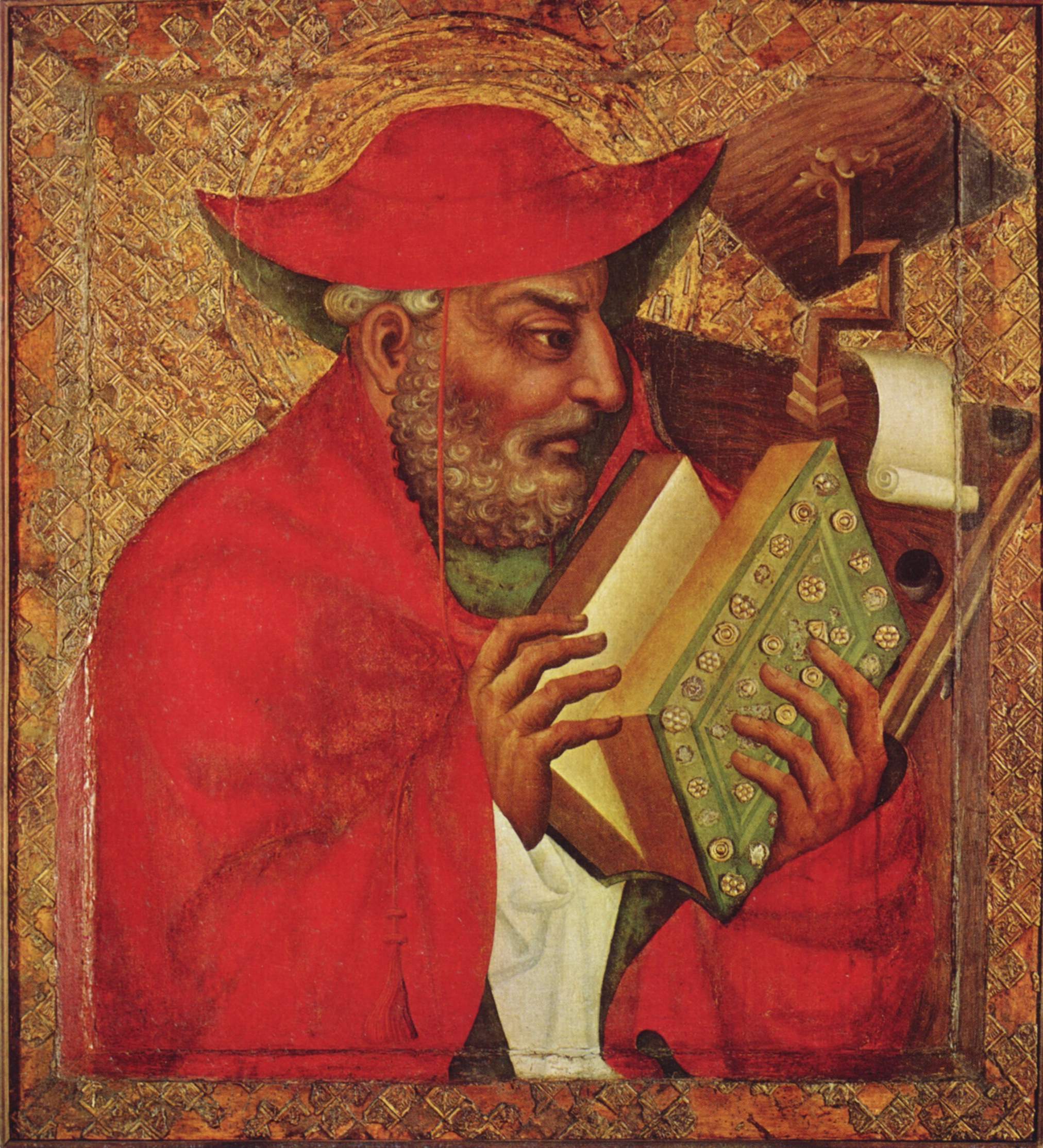
Collection of biographies by 4th-century Latin Church Father, Jerome
| Field | Value |
|---|---|
| italic title | |
| name | De Viris Illustribus |
| image | De viris illustribus.JPEG |
| caption | Manuscript of the late 15th century, with this page showing entries for Musanus, Modestus and Bardaisan. |
| author | Jerome |
| title_orig | De viris illustribus |
| orig_lang_code | la |
| translator | Ernest Cushing Richardson |
| Ernest J. Engler | |
| Philip Schaff | |
| Thomas P. Halton | |
| country | Roman Empire (Palaestina Prima) |
| language | Latin |
| genre | Biography, bibliography |
| published | AD 393 |
| media_type | Manuscript |
| dewey | 270.1 |
| congress | BR60.F3 J4713 |
| preceded_by | |
| followed_by | |
| native_wikisource | De viris illustribus (Hieronymus) |
| wikisource | Nicene and Post-Nicene Fathers: Series II/Volume III/Lives of Illustrious Men/Jerome |
Ernest J. Engler Philip Schaff Thomas P. Halton
De Viris Illustribus (On Illustrious Men) is a collection of short biographies of 135 authors, written in Latin, by the 4th-century Latin Church Father Jerome. He completed this work at Bethlehem in 392–393 AD. The work consists of a prologue plus 135 chapters, each consisting of a brief biography. Jerome himself is the subject of the final chapter. A Greek version of the book, possibly by the same Sophronius who is the subject of Chapter 134, also survives. Many biographies take as their subject figures important in Christian Church history and pay especial attention to their careers as writers. It "was written as an apologetic work to prove that the Church had produced learned men." The book was dedicated to Flavius Lucius Dexter, who served as high chamberlain to Theodosius I and as praetorian prefect to Honorius. Dexter was the son of Saint Pacianus, who is eulogized in the work.
Composition
De Viris Illustribus was composed in Latin in 392 and early 393, after Jerome translated Origen's Homilies on Ezekiel and before he wrote his Commentary on Ezekiel. It was written during Jerome's first period of literary activity following his move to Bethlehem.
It was modelled after the works of earlier Greek and Latin authors. In a letter to Desiderius he wrote that he had "written a book on illustrious men from the apostles to our time in imitation of Suetonius and Apollonius the Greek." It reinvented a tradition of biographical collections used by Suetonius and Plutarch for a Christian world.
Purpose and dedication
De Viris Illustribus was dedicated to Nummius Aemilianus Dexter, the son of Saint Pacianus and a Roman official and a Christian who had encouraged Jerome to create a survey of Christian authors. SanPietro argues that this dedication was a pretext for Jerome to disguise his real intentions while Van Hoof argues that evidence for a close relationship between Jerome and Dexter is limited.
It was written as an apologetic work to demonstrate the accomplishments of prominent Christian authors, with Jerome including himself among them, at a time when Christian writing was seen as inferior. In the preface Jerome states that he aims "to do for [Christian] writers what [Suetonius] did for the illustrious men of letters among the Gentiles", reinforcing this a few lines later where he states his desire to create a collection similar to Cicero's Brutus, covering the Christian writers whose texts "founded, built, and adorned the Church".
Audience
The intended audience of De Viris Illustribus was the educated classes of the Mediterranean. Whiting describes it as a reference text for intra-Christian disputes, intended to "inform those who had no time to read extensively or had no thorough knowledge of Greek".
Contents
Summary
De Viris Illustribus is a biobibliography covering four centuries of primarily Christian writers running from the apostolic age to Jerome himself. The first seventy-eight chapters are copied with minimal changes from Eusebius' Historia ecclesiastica, while the last fifty-seven chapters reflect Jerome's own research.**
The entries vary in length, from brief notices to longer entries. They are all under 500 words long and follow a set pattern: the author's name, a short identification of their office or status, and a list of writings.
The notices are usually bibliographical rather than hagiographical, but some refer to hagiographic legends associated with figures already venerated as saints. Jerome uses the work to denigrate authors he did not approve of and praise those he did. He knew some of the subjects personally or had read their works, while others were virtually unknown to him.
The subjects are mainly Christian writers, with Jerome explaining his criteria as having "published anything memorable on the Holy Scriptures from the time of Christ's passing down to the 14th year of the emperor Theodosius". They are largely figures Jerome treats as reputable and orthodox, though he also includes authors he considers heterodox.
In the preface he describes the book as a catalogue of Christian men who were philosophers, eloquent, or learned, but he does not apply that description consistently, describing the writing of some authors such as Fortunatianus as "rustic".
Subjects
Listed below are the subjects of Jerome's 135 biographies. The numbers given are the chapter numbers found in editions.
-
- Simon Peter
-
- James the Just
-
- Matthew
-
- Jude
-
- Paul
-
- Barnabas
-
- Luke
-
- Mark
-
- John
-
- Hermas
-
- Philo the Jew
-
- Lucius Annaeus Seneca
-
- Josephus
-
- Justus
-
- Clement
-
- Ignatius of Antioch
-
- Polycarp
-
- Papias
-
- Quadratus
-
- Aristides
-
- Agrippa
-
- Hegesippus
-
- Justin
-
- Melito of Asia
-
- Theophilus
-
- Apollinaris
-
- Dionysius of Corinth
-
- Pinytus of Crete
-
- Tatian
-
- Philip of Crete
-
- Musanus
-
- Modestus
-
- Bardesanes of Mesopotamia
-
- Victor
-
- Irenaeus
-
- Pantaenus
-
- Rhodo
-
- Clemens
-
- Miltiades
-
- Apollonius
-
- Serapion
-
- Apollonius
-
- Theophilus
-
- Bacchylus
-
- Polycrates
-
- Heraclitus
-
- Maximus
-
- Candidus
-
- Appion
-
- Sextus
-
- Arabianus
-
- Judas
-
- Tertullian
-
- Origen
-
- Ammonius
-
- Ambrose
-
- Trypho
-
- Minucius Felix
-
- Gaius
-
- Beryllus
-
- Hippolytus
-
- Alexander of Cappadocia
-
- Julius Africanus
-
- Geminus
-
- Theodorus (Gregory of Neocaesarea)
-
- Cornelius
-
- Cyprian of Africa
-
- Pontius
-
- Dionysius of Alexandria
-
- Novatianus
-
- Malchion
-
- Archelaus
-
- Anatolius of Alexandria
-
- Victorinus
-
- Pamphilus the Presbyter
-
- Pierius
-
- Lucianus
-
- Phileas
-
- Arnobius
-
- Firmianus (Lactantius)
-
- Eusebius of Caesarea
-
- Reticius
-
- Methodius
-
- Juvencus
-
- Eustathius
-
- Marcellus
-
- Athanasius
-
- Anthony
-
- Basil of Ancyra
-
- Theodorus
-
- Eusebius of Emesa
-
- Triphylius
-
- Donatus
-
- Asterius
-
- Lucifer of Cagliari
-
- Eusebius of Sardinia
-
- Fortunatianus of Aquileia
-
- Acacius
-
- Serapion
-
- Hilary
-
- Victorinus
-
- Titus
-
- Damasus
-
- Apollinaris
-
- Gregory of Elvira
-
- Pacianus
-
- Photinus
-
- Phoebadius
-
- Didymus
-
- Optatus
-
- Acilius Severus
-
- Cyril of Jerusalem
-
- Euzoius
-
- Epiphanius
-
- Ephraim
-
- Basil of Caesarea
-
- Gregory of Nazianzen
-
- Lucius
-
- Diodorus
-
- Eunomius
-
- Priscillianus
-
- Latronianus
-
- Tiberianus
-
- Ambrose of Milan
-
- Evagrius
-
- Ambrose, disciple of Didymus
-
- Maximus
-
- Gregory of Nyssa
-
- John the presbyter
-
- Gelasius
-
- Theotimus
-
- Dexter
-
- Amphilochius
-
- Sophronius
-
- Jerome the presbyter
Final chapter on Jerome
At the conclusion of De Viris Illustribus, Jerome provided his own biography as the latest example of the scholarly work of Christians. In Chapter 135, Jerome summarized his career to date:
Whiting argues that the entry functioned as a catalogue of Jerome's writings, allowing correspondents to request copies they lacked.
Reception and influence
De Viris Illustribus circulated widely soon after its completion, becoming the most influential Christian biographical collection and defining a canon of knowledge that could be expanded and augmented. It was used as a reference work in intra-Christian debate but was criticised for including heretics, including by Augustine in 398.
The work was continued and revised, most notably by Gennadius of Marseilles in the fifth century and Isidore of Seville in the seventh, and the three texts circulated as a single corpus. It influenced later biobibliographical compilations and its material was repurposed in other contexts*.*
In the sixth century Cassiodorus recommended reading Jerome's work alongside its continuation by Gennadius. Bede, a Northumbrian monk, later treated its completion as a sacred event, writing "Jerome, the translator of sacred history, wrote a book about the most illustrious men of the Church".
By the ninth century collations of De Viris Illustribus and its continuations were used as lists in monastic libraries to check their holdings. McKitterick argues that the text was important in the formation and organisation of library catalogues and collections and contributed to a "book-based" way of thinking about the past while Whiting argues that it was used to help identify forgeries. It remained relevant even after many of the works covered by the text were lost, acting as a record of what had been written as well as what should be read.
The work continued to circulate in the twelfth century and was a model for a revival of the bio-bibliographic genre.
Modern scholarship
Modern scholarship has criticised De Viris Illustribus as rushed and incomplete, being flattering and insulting depending on the subject and Jerome's opinion of them, as well as self-aggrandising in the final chapter.
Kelly describes it as a "propagandist history" and criticises its reliance on Eusebius, arguing that Jerome at times misunderstood or mistranslated him. Langelaar et al. describe the intent as to "develop a Christian vision of history and to appropriate the past of the Roman Empire".
SanPietro argues that it worked to transmit orthodoxy, with Jerome creating it by working backwards from a list of works he believed should be included in Christianity's intellectual foundation.
Editions
- Jerome and Gennadius: Lives of Illustrious Men, English translation by Ernest Cushing Richardson
- Jerome's De Viris Illustribus: Latin text (includes an informative introduction, in Latin)
- Jerome's De Viris Illustribus: Greek version
Notes
References
- De Viris Illustribus (On Illustrious Men) - Full English version.
- The Catholic Encyclopedia, Published 1910 in New York by Robert Appleton Company.
References
- "This work [De viris illustribus], as he reveals at its start and finish, was completed in the fourteenth year of Theodosius, that is, between 19 January 392 and 18th January 393." A. D. Booth, "The Chronology of Jerome's Early Years", Phoenix 35 (1981), p. 241.
- [[Louis Saltet]], "[http://www.newadvent.org/cathen/08341a.htm St. Jerome]," ''Catholic Encyclopedia'', New York: 1910.
- "Irondequoit Catholic Communities - - Pacian".
- Rebenich, Stefan. (2002). "Jerome". Routledge.
- SanPietro, Irene. (2017). "The Making of a Christian Intellectual Tradition in Jerome’s De Viris Illustribus". Memoirs of the American Academy in Rome.
- Langelaar, Reinier. (2022). "Writing Strategies". Medieval Worlds.
- Van Hoof, Lieve. (2017-03-09). "The omnimoda historia of Nummius Aemilianus Dexter: A Latin Translation of Eusebius’ Chronography?". Vigiliae Christianae.
- Koeppler, H.. (1936). ""De Viris Illustribus" and Isidore of Seville". The Journal of Theological Studies.
- Kramer, Rutger. (2022). "Audience and Reception". Medieval Worlds.
- Whiting, Colin. (2015). "Shifting genres in Late Antiquity". Ashgate.
- Ward, Graeme. (2022). "Reading Jerome’s De viris illustribus in the Post-Roman World: Cataloguing Community in Gennadius of Marseille and Frechulf of Lisieux". Medieval Worlds.
- Byrne, Philippa. (2021-05-19). "Cutting out the camel-like knees of St. James: the de viris illustribus tradition in the twelfth-century renaissance". Historical Research.
- Jerome, ''De Viris Illustribus'', chapter 135.
- Mahoney, Daniel. (2022). "Introduction. Medieval Biographical Collections in Comparison". Medieval Worlds.
- Koeppler, H.. (1936). ""De Viris Illustribus" and Isidore of Seville". The Journal of Theological Studies.
This article was imported from Wikipedia and is available under the Creative Commons Attribution-ShareAlike 4.0 License. Content has been adapted to SurfDoc format. Original contributors can be found on the article history page.
Ask Mako anything about De Viris Illustribus (Jerome) — get instant answers, deeper analysis, and related topics.
Research with MakoFree with your Surf account
Create a free account to save articles, ask Mako questions, and organize your research.
Sign up freeThis content may have been generated or modified by AI. CloudSurf Software LLC is not responsible for the accuracy, completeness, or reliability of AI-generated content. Always verify important information from primary sources.
Report