From Surf Wiki (app.surf) — the open knowledge base
De Telegraaf
Dutch newspaper
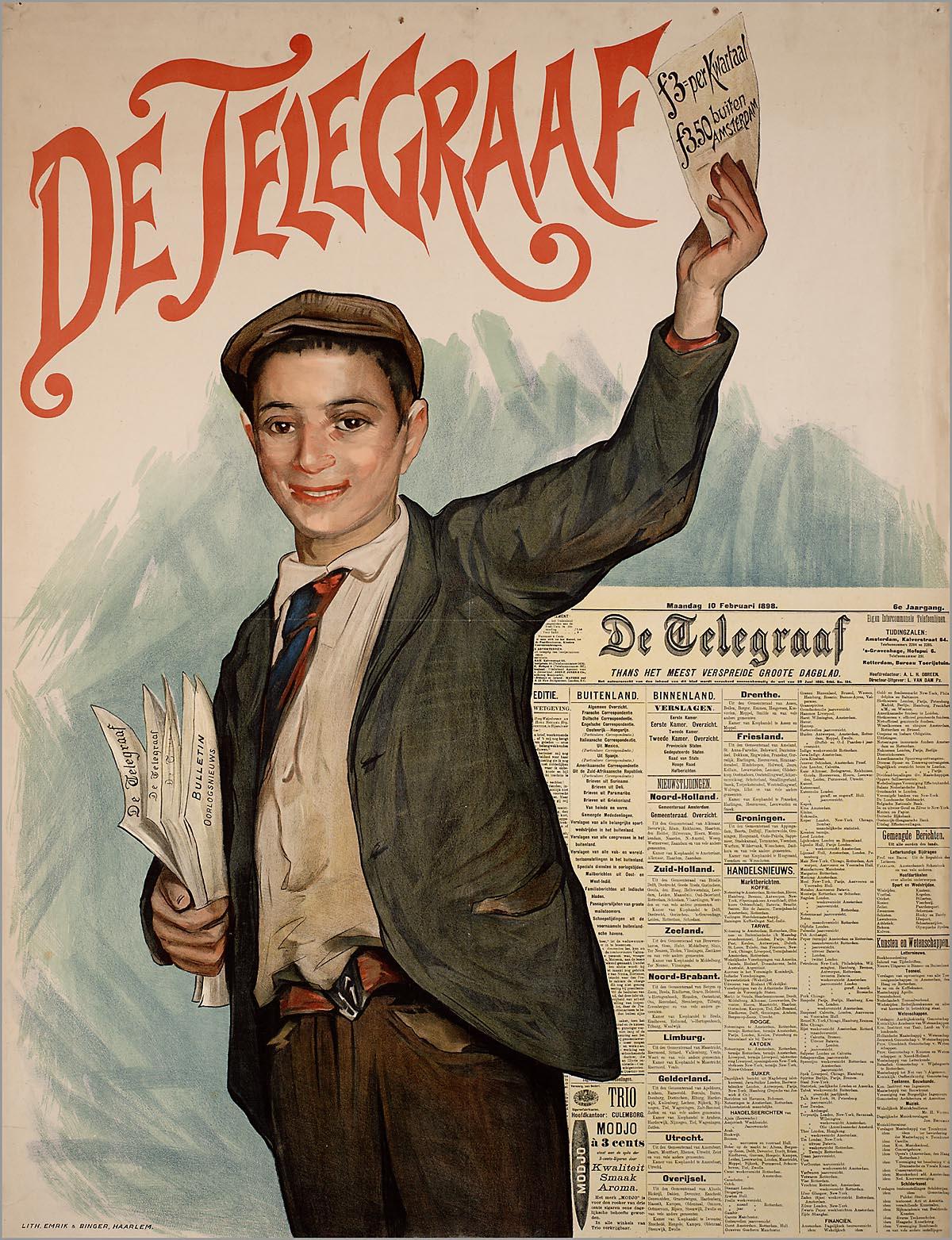
Dutch newspaper
| Field | Value | ||
|---|---|---|---|
| name | De Telegraaf | ||
| logo | Telegraaf.svg | ||
| image | [[File:DeTelegraaf050809.JPG | frameless | upright=1.15]] |
| type | Daily morning newspaper | ||
| format | Compact | ||
| founded | |||
| owners | Mediahuis | ||
| chief_editor | |||
| language | Dutch | ||
| circulation | (2017) | ||
| headquarters | Basisweg 30 | ||
| Amsterdam, Netherlands | |||
| website |
Amsterdam, Netherlands
De Telegraaf (; ) is the largest Dutch daily morning newspaper. Paul Jansen has been the editor-in-chief since August 2015. De Telegraaf is based in Amsterdam and is owned by the Belgian company Mediahuis.
History
19th century
De Telegraaf was founded by , who simultaneously started another paper De Courant (). The first issue appeared on 1 January 1893.
20th century
Following Tindal's death on 31 January 1902 the printer HMC Holdert, with backing from financiers, took over De Telegraaf and De Courant on 12 September 1902. This proved to be a good investment, particularly with regard to De Courant, enabling Holdert between 1903 and 1923 to take over one newspaper after another, suspending publication as he went. He added the name Amsterdamsche Courant ("Amsterdam Gazette") as a subtitle to De Telegraaf, and Het Nieuws van den Dag ("The News of the Day") to De Courant.
During World War I, when the Netherlands was officially neutral, Holdert's French sympathies and his pro-British standpoint caused De Telegraaf to be the focus of some controversy, as the Netherlands were usually pro-German at the time.
In 1926, Holdert began construction of a new printing facility at the Nieuwezijds Voorburgwal in Amsterdam, designed by J. F. Staal and G. J. Langhout. Construction was completed and the building occupied in 1930.
During World War II, the Telegraaf companies published pro-Nazi German papers, which led to a thirty-year ban on publishing after the war. The prohibition was lifted in 1949 and De Telegraaf flourished anew to become the biggest newspaper in the Netherlands.
At one point, in June 1966, the Telegraaf building was besieged by angry construction workers and Provo followers, after a false report that a victim of a labour dispute had been killed not by the police but by a co-worker. In 1974, De Telegraaf moved to a new location on the Basisweg.
In 1995–1996 De Telegraaf had a circulation of 760,000 copies, making it the best-selling paper in the country.
De Courant/Nieuws van de Dag ceased publication in 1998. In 1999, the circulation of the paper was 808,000 copies, making it the ninth best-selling European newspaper.
21st century
De Telegraaf was the eighth top European newspaper with a circulation of 807,000 copies in 2001. De Telegraaf changed from broadsheet to compact format in October 2014. In 2014, was , dropping to in 2015. Distribution had been reduced to 393,537 in 2017.
On 26 June 2018, a delivery van intentionally rammed into the office building of De Telegraaf, catching fire afterwards which was probably started by the driver who made his getaway with another car. The building took considerable damage. Police believe the attack was done within organized crime circles; four days earlier the building of Panorama was also a target, possibly because both publications write about serious crime.
Editorial content
The newspaper contains many sensational and sports-related articles, and one or more pages supplied by the gossip-magazine Privé ("Private"). The financial news coverage is more serious in tone. The paper targets a broad audience, mostly in a conservative and populist style.
References
References
- "T, ABN-uitspraakgids, P.C. Paardekooper".
- {{in lang. nl Haro Kraak, "[http://www.volkskrant.nl/economie/gaat-paul-jansen-de-crisis-bij-de-telegraaf-oplossen~a4111495/ Gaat Paul Jansen de crisis bij De Telegraaf oplossen?]", ''[[de Volkskrant]]'', 2015. Retrieved 1 August 2015.
- (24 September 1998). "Media Policy: Convergence, Concentration & Commerce". SAGE Publications.
- (24 November 2000). "Top 100 Dailies 1999". campaign.
- nl "[http://www.telegraaf.nl/dft/bedrijven/telegraaf/22190489/Betaalde_oplage_grootste_kranten_daalt_verder.html Betaalde oplage grootste kranten daalt verder]", ''De Telegraaf'', 2014.
- Adam Smith. (15 November 2002). "Europe's Top Papers". campaign.
- (10 October 2014). "Telegraaf moves to compact format and Metro becomes more complete". Publicitas.
- {{in lang. nl "[http://nos.nl/artikel/2035268-papieren-oplage-kranten-daalt-verder.html Papieren oplage kranten daalt verder]", ''[[Nederlandse Omroep Stichting. NOS]]'', 2015. Retrieved 1 August 2015.
- Pasveer, Lars. (2016). "Parool, Trouw en Volkskrant vergroten printoplage". Villamedia.
- "Car rams Dutch newspaper office". BBC News.
- (26 June 2018). "Na Panorama is nu de Telegraaf aan de beurt: auto vernielt kantoorpui". Trouw.
- Hermes, Joke. (2005). "Re-reading Popular Culture". Wiley-Blackwell.
This article was imported from Wikipedia and is available under the Creative Commons Attribution-ShareAlike 4.0 License. Content has been adapted to SurfDoc format. Original contributors can be found on the article history page.
Ask Mako anything about De Telegraaf — get instant answers, deeper analysis, and related topics.
Research with MakoFree with your Surf account
Create a free account to save articles, ask Mako questions, and organize your research.
Sign up freeThis content may have been generated or modified by AI. CloudSurf Software LLC is not responsible for the accuracy, completeness, or reliability of AI-generated content. Always verify important information from primary sources.
Report