From Surf Wiki (app.surf) — the open knowledge base
De Havilland Canada DHC-5 Buffalo
Short takeoff and landing utility transport turboprop aircraft

Short takeoff and landing utility transport turboprop aircraft
| Field | Value |
|---|---|
| name | DHC-5 Buffalo |
| image | File:DehavillandCC-115Buffalo12.JPG |
| caption | A CC-115 Buffalo of 442 Transport & Rescue Squadron at Rockcliffe Airport in Ottawa, 2004 |
| type | Utility aircraft |
| manufacturer | de Havilland Canada |
| first_flight | 9 April 1964 |
| introduction | 1965 |
| status | In limited use |
| primary_user | Royal Canadian Air Force |
| produced | 1965–1972, 1974–1986 |
| number_built | 122 |
| developed_from | De Havilland Canada DHC-4 Caribou |
The de Havilland Canada DHC-5 Buffalo is a short takeoff and landing (STOL) utility transport turboprop aircraft developed from the earlier piston-powered DHC-4 Caribou. The aircraft has extraordinary STOL performance and is able to take off in distances much shorter than even most light aircraft can manage. The aircraft was originally designed by de Havilland Canada, with the type certificate now owned by the De Havilland Canada founded in 2019.
Design and development
The Buffalo arose from a 1962 United States Army requirement for a STOL transport capable of carrying the same payload as the CH-47A Chinook helicopter. de Havilland Canada based its design to meet the requirement on an enlarged version of its DHC-4 Caribou, already in large-scale service with the United States Army, to be powered by General Electric T64 turboprops rather than the Pratt & Whitney R-2000 piston engines of the Caribou. (It had already flown a T64-powered Caribou on 22 September 1961).
De Havilland's design, the DHC-5 Buffalo, was chosen as the winner of the United States Army competition in early 1963, with four DHC-5s, designated YAC-2 (later CV-7A and subsequently C-8A) ordered. The first of these aircraft made its maiden flight on 9 April 1964. All four aircraft were delivered in 1965, the Buffalo carrying nearly twice the payload as the Caribou while having better STOL performance. The prototype CV-7A was exhibited by the manufacturer at the 1965 Paris Air Show wearing US Army markings. No further US orders followed, however, as at the start of 1967 (See the Johnson-McConnell agreement of 1966), inter-service politics led to large fixed-wing transports being transferred to the United States Air Force, who considered themselves adequately equipped with the Fairchild C-123 Provider.
Company data claims a takeoff distance over a 50 ft obstacle of 1210 ft at 41000 lb and a landing distance of over a 50 ft obstacle of 980 ft at 39100 lb for the DHC-5A model.
In the early 1980s, de Havilland Canada attempted to modify the Buffalo for civilian use. The aircraft was to be branded as the "Transporter." After loss of the demonstration aircraft (SN 103 C-GCTC) at the 1984 Farnborough Airshow, the project was abandoned.
A production DHC-5D Buffalo was used for breaking time-to-height records for the weight category 12,000–16,000 kg on 16 February 1976, reaching 3,000 m in 2 min 12.75 sec, 6,000 m in 4 min 27.5 sec and 9,000 m in 8 min 3.5 sec.
New production
On 24 February 2006, Viking Air of Victoria, British Columbia, a manufacturer of replacement parts for all out-of-production de Havilland Canada aircraft, purchased the type certificates from Bombardier Aerospace for all versions of the DHC-1 through DHC-7 series aircraft, giving Viking exclusive rights to manufacture and sell new aircraft of those types. In December 2008, Viking Air indicated their intention to put the Buffalo series back into production at their home factory in Victoria, British Columbia or in Calgary, Alberta. A potential new production Buffalo would have had Pratt & Whitney Canada PW150 turboprops, a glass cockpit, enhanced vision and night vision goggle capability. The aircraft was proposed as a replacement for the Royal Canadian Air Force fleet of existing DHC-5As but was not one of the three aircraft in the final assessment, in 2016, which selected the EADS CASA C-295. Several letters of intent for the DHC-5NG were received in 2014.
Operational history

In late 1965, one of the prototype DHC-5s operated by the U.S. Army was deployed to Bien Hoa Air Base in South Vietnam for a three-month evaluation period, assigned to the 2nd Flight Platoon of the 92nd Aviation Company.
The Royal Canadian Air Force first acquired 15 DHC-5A designated as CC-115 for tactical transports. These were initially operated at CFB St Hubert, QC by No. 429 Squadron in a tactical aviation role as part of Mobile Command. In 1970, the Buffalo aircraft were transferred to a transport and rescue role with No. 442 Squadron, No. 413 Squadron and No. 424 Squadron as part of Transport Command. No. 426 Squadron also flew the aircraft for training. Some were leased back or loaned back to the factory for trials and eventually returned to military service.
Three of the aircraft were also deployed on UN missions to the Middle East with No. 116 Transport Unit until 1979. They had a white paint scheme which was retained while they were serving in domestic transport with 424 Sqn in between deployments. On 9 August 1974, Canadian Forces CC-115 Buffalo 115461 was shot down by a Syrian surface-to-air missile, killing all nine CF personnel on board. This represents the single biggest loss of Canadian lives on a UN mission as well as the most recent Canadian military aircraft to be shot down.
Production of the DHC-5A ended in 1972 after sales to Brazil and Peru but restarted with the DHC-5D model in 1974. This variant sold to several overseas air forces beginning with Egypt. Production of the DHC-5D ended in December 1986.
In 1975, the Buffalo dropped its tactical transport role and was converted to domestic search and rescue, except for a few that kept serving on UN missions. The initial paint scheme for the SAR converted aircraft were white and red while others still had the original drab paint. The previous drab paint and white paint were eventually replaced with the distinctive yellow and red scheme commonly seen today. The number of aircraft have been reduced to eight, with six on active service, one in storage (recently dismantled) and one used for battle damage training. The remaining operational Buffalos operate in the Search and Rescue role for No. 442 Squadron at CFB Comox. Air Command was renamed the Royal Canadian Air Force in 2011, meaning the CC-115 has served with the RCAF, Air Command and now the RCAF once again. The Buffalo was replaced by the CC-130 Hercules aircraft at search-and-rescue bases in CFB Greenwood and CFB Trenton. As early as 2002, Canada has tried to replace both the Buffalo fleet and the SAR Hercules fleet with a newer aircraft. For some time, the Alenia C-27J Spartan was seen as the likely replacement, with the government considering sole-sourcing the new aircraft. However, after changes in Canada's defence budget as well as accusations of bias from the aerospace industry, the Buffalo replacement program was relaunched as an open competition. After review from the National Research Council, the Department of National Defence as well as consultation with the Canadian aerospace industry, a request for proposal was published in 2015. Bidders included Alenia offering the C-27J Spartan, Airbus Defence and Space with its C-295 and Embraer with its KC-390. In 2016, the Department of National Defence awarded Airbus a contract for 16 C-295s with delivery scheduled to begin in 2019 and running through 2022.
On 15 January 2022, the RCAF officially retired the final two operational CC-115s. The last operational aircraft is preserved at Canada Aviation and Space Museum in Ottawa.
Demonstrators for new technologies
The Buffalo was a suitable airframe for converting to demonstrate some new technologies.

Augmented Wing Jet-flap STOL Research Aircraft
A cooperative NASA/Canadian Government research program on augmentor wing concepts started in 1965 and culminated in the need for a proof-of-concept aircraft. A NASA C-8A Buffalo (later named Bisontennial in 1976) was modified in 1972 for augmentor-wing jet STOL research. The modifications were done by Boeing, de Havilland Canada and Rolls-Royce of Canada Ltd. The wing had a reduced span to give a wing loading representative of future aircraft. It also had full-span leading edge slats, blown ailerons and double-surface flaps enclosing a venturi-shaped passage. The usual turboprop engines were replaced with Rolls-Royce Spey 801 SF (Split Flow) bypass engines with a new bypass duct which separated the hot and cold flows to provide both propulsion and augmentor airflow to the powered lift system. The hot flow was directed through Pegasus-engine swivelling nozzles to ensure it deflected with the flap downwash. The cold flow was directed into the flap venturi and entrained extra airflow. Beginning in 1972 with its first flight in this experimental configuration, this aircraft was used jointly by the NASA Ames Research Center and the Canadian Department of Industry, Trade and Commerce for STOL research.
Quiet Short-Haul Research Aircraft
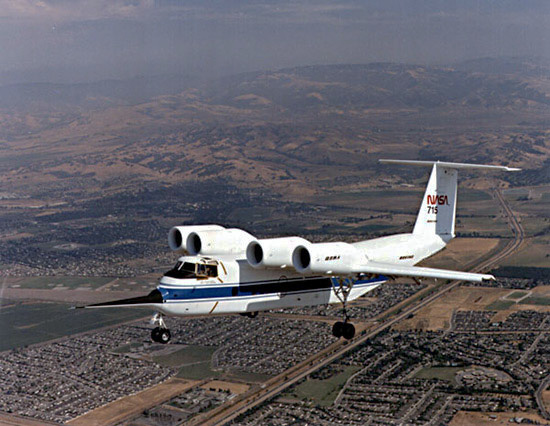
In the late 1970s and early 1980s, NASA used another C-8A Buffalo in the Quiet Short-Haul Research Aircraft program.
Boeing designed and installed an experimental swept, supercritical wing incorporating a boundary layer control system. Instead of the standard engines, this aircraft was powered by four prototype Avco Lycoming YF102 high-bypass turbofan engines (originally from the Northrop YA-9 program) mounted above the wing to take advantage of the Coandă effect. In 1980, this aircraft participated in carrier trials aboard USS Kitty Hawk, demonstrating STOL performance without the use of catapults or arrestor gear.
The aircraft is currently stored at NASA's Ames Research Center in Mountain View, California.
Air Cushion Landing System Aircraft
After demonstrations by Bell aircraft using a Lake LA-4 fitted with an Air Cushion Landing Gear, the USAF and the Canadian Government wished to further explore the applications of the ACLS. They did so by retrofitting a similar system to a C-8A Buffalo. The air cushion system was inflated by two underwing air supply packages consisting of PT6F-70 turbofans powering two-stage axial flow fans. The aircraft also had underwing combination floats/skids.
Variants


;DHC-5 Buffalo: Originally designed as a twin-engined STOL tactical, utility transport aircraft for the US Army. Original US Army designation AC-2. ;DHC-5A :Utility transport aircraft for the Brazilian Air Force, Royal Canadian Air Force and Peruvian Air Force. Canadian designation CC-115. ;DHC-5B : Proposed version, powered by two General-Electric CT64-P4C turboprop engines. Not built. ;DHC-5C : Proposed version, powered by two Rolls-Royce Dart RDa.12 turboprop engines. Not built. ;DHC-5D : Improved version, powered by two 2,336 kW (3,133 shp) General Electric CT64-820-4 turboprop engines. ;DHC-5E Transporter : Civil transport version. ;NASA / DITC C-8A AWJSRA : One C-8A aircraft converted into an augmentor wing research aircraft. ;XC-8A ACLS : One C-8A aircraft converted into an air-cushion landing system research aircraft. ;NASA / Boeing QSRA C-8A : One C-8A converted into a quiet short-haul research aircraft. ;Viking DHC-5NG Buffalo NG : Proposed redesigned new production version to be built by Viking Air. NG is the company marketing term indicating Next Generation
Canadian military designations
;CC-115 :Canadian military designation for 15 DHC-5As.

United States military designations
;AC-2 :Designation for four DHC-5s for evaluation by the United States Army. ;CV-7A :Redesignation of four United States Army AC-2s. ;C-8A :United States Air Force designation for four CV-7As transferred from the Army in 1967.
Brazilian military designations
;C-115 :Designation for the DHC-5A.
Operators
Civil
;
- Summit Air (8199400 Canada Inc.) operated two DHC-5D (ex-Oman Police Air Wing 1979 and 1981/Shuttle Air Cargo (Congo); transferred from Arctic Sunwest Charters in 2013); C-FASV was sold to Nyassa Air Taxi (Malawi) 2015 with lease to UN OFP and C-FASY stored since 2012 (civil registration cancelled in 2015) ;
- Ethiopian Airlines 1 DHC-5D (ET-AHI lost in crash 1988) ;
- Nyassa Air Taxi 1 ex-Summit Air DHC-5D
Military


This is a list of former military operators. The last six RCAF Buffalos served with No. 442 Transport and Rescue Squadron based in Comox, BC, until the type was finally retired in 2022 after 55 years of service.
;Abu Dhabi /
- Abu Dhabi Defence Forces Air Wing – (Retired).
- United Arab Emirates Air Force (Retired) ;
- Brazilian Air Force (Retired) ;
- Cameroon Air Force (Retired) ;
- Royal Canadian Air Force (Retired) ;
- Chilean Air Force (Retired) ; (previously )
- Air Force of the Democratic Republic of the Congo (Retired) ;
- Ecuadorian Air Force (Retired)
- Ecuadorian Army (Retired) ;
- Egyptian Air Force (9) (Retired)

;
- Indonesian Army (ex-UAE, Retired)
- Indonesian Navy (ex-UAE, Retired) ;
- Kenya Air Force (Retired) ;
- Mauritanian Air Force - bought four DHC-5Ds in 1978 (Retired)

;
- Mexican Navy (Retired) ;
- Royal Oman Police Air Wing (Retired) ;
- Peruvian Air Force (Retired) ;
- Sudanese Air Force – 4 (Retired) ;
- Tanzania Air Force Command – 6 (retired) ;
- Military of Togo (Retired) ;
- United States Army (Retired)
- NASA 2 C-8A at Ames Research Center (Retired) ;
- Zambian Air Force (Retired)
Accidents and incidents
In total, 26 accidents involving hull losses have been recorded.
- On 9 August 1974, a Canadian Forces CC-115 operating for the United Nations was shot down over Syria with the loss of five crew and four passengers.
- On 27 May 1979, a Mauritania Islamic Air Force DHC-5D crashed in the sea off the coast of Dakar, Senegal, killing all 12 occupants of the aircraft. The Prime Minister of Mauritania Ahmed Ould Bouceif died in the crash.
- On 22 December 1979, a Peruvian Air Force DHC-5D (reg. FAP-348, msn. 55) on a flight from Pucallpa Airport crashed near Puerto Esperanza, in Peru's Amazon jungle, killing all 29 occupants.
- At the 1984 Farnborough Airshow, a DHC-5D STOL demonstration ended in a very heavy landing which destroyed the aircraft.
- On 21 June 1989, a Peruvian Air Force DHC-5D Buffalo crashed into a mountain near Tarma, killing all six crew and 53 passengers in the deadliest accident involving the DHC-5 Buffalo.
- On 17 February 1990, a Zambian Air Force DHC-5D Buffalo crashed on approach to Lusaka Airport in Lusaka, Zambia, killing all 29 people on board.
- On 16 April 1992, a Kenya Air Force DHC-5D Buffalo lost power in one of its engines, and during its final approach, it overshot the runway and crashed into a residential area near Moi Air Base, Kenya. The accident killed all 42 passengers and four crew members and six people on the ground.
- On 27 April 1993, a Zambian Air Force DHC-5D Buffalo carrying most of the Zambian national football team to a FIFA World Cup Qualifier against Senegal in Dakar crashed shortly after takeoff from a refuelling stop in Libreville, Gabon. There were no survivors.
- On 22 March 2025, a Trident Aviation DHC-5D Buffalo crashed near Ceel Xabaalbow, Somalia, killing all five people on board.
Aircraft on display
Canada
- 811 – DHC-5A on static display at the Canadian Warplane Heritage Museum in Mount Hope, Ontario.
- 115451 – CC-115 on static display at Air Force Heritage Park in Summerside, Prince Edward Island.
- 115452 – CC-115 on static display at the Canada Aviation and Space Museum in Ottawa, Ontario.
- 115456 – CC-115 on static display at the National Air Force Museum of Canada in Astra, Ontario.
- 115457 – CC-115 on static display at the Comox Air Force Museum at CFB Comox in Comox, British Columbia.
- 115462 – CC-115 on static display at the Royal Aviation Museum of Western Canada in Winnipeg, Manitoba.
Specifications (DHC-5D)
|prime units?=kts General characteristics
|max takeoff weight lb=49200 |max takeoff weight note= Powerplant
Performance
|never exceed speed kts= |never exceed speed note= |minimum control speed kts= |minimum control speed note= |wing loading lb/sqft= |fuel consumption lb/mi= |power/mass=
- Take-off run: 2300 ft
- Take-off distance to 50 ft: 2750 ft (mid cg range)
- Landing run: 850 ft
- Landing distance from 50 ft: 2010 ft
References
Notes
Bibliography
References
- ''Air International'' August 1976, p. 59.
- Harding 1990, p. 104.
- ''Air International'' August 1976, p. 70.
- de Havilland Canada: ''DHC-5A Buffalo STOL Tactical Transport'', page 6. de Havilland Canada, May 1971
- "Accident description de Havilland Canada DHC-5D Buffalo Tuesday 4 September 1984 16:18".
- ''Air International'' August 1976, p. 64.
- Niles, Russ. (23 December 2008). "Viking Proposes Resurrection Of DHC-5 Buffalo". AVweb.com.
- Brewster, Murray. (8 December 2016). "Airbus chosen to build replacements for 50-year-old RCAF search planes". [[CBC.ca]].
- Sarsfield, Kate. (12 July 2012). "FARNBOROUGH: Viking evaluates market for DHC-5 Buffalo relaunch". [[FlightGlobal]].
- "De Havilland (DHC-5) Buffalo, Page 2".
- Taylor 1988, p. 21.
- Trimble, Stephen. (8 December 2016). "C295 wins Canadian FWSAR contest". FlightGlobal.
- (3 January 2007). "DND to look at single bid for search planes: report". CBC.ca.
- (7 February 2018). "Procurement timeline: Fixed-wing search and rescue aircraft". Public Services and Procurement Canada.
- Defence, National. (2022-01-16). "Final operational flight of the CC-115 Buffalo aircraft".
- (8 December 2023). "Last Operational CC-115 Buffalo Finds Final Resting Place at Canada Aviation and Space Museum". Skies.
- Baugher, Joseph F. [http://home.att.net/~jbaugher/1963.html "1963 USAF Serial Numbers."] {{webarchive. link. (12 January 2009 ''USAAS-USAAC-USAAF-USAF Aircraft Serial Numbers—1908 to Present'', 2008. Retrieved: 13 September 2009.)
- Buser, Wayne E. [http://www.dhc4and5.org/Buffalo9.html "NASA Buffalos."] {{Webarchive. link. (30 October 2008 ''The deHavilland Caribou (DHC-4) and Buffalo (DHC-5) Website'', 2006. Retrieved: 13 September 2009.)
- [http://history.arc.nasa.gov/Astrogram/astrogram_1972_5.pdf "First Augmentor Wing Aircraft Flight."] {{Webarchive. link. (20 March 2009 ''The Astrogram'', Volume XIV, Issue 16, 11 May 2005, pp. 1–2. Retrieved: 13 September 2009.)
- link. (12 January 2009 ''Airliners.net'', Aviation Photos. Retrieved: 13 September 2009.)
- https://www.flightglobal.com/pdfarchive/view/1972/1972%20-%200443.html {{Dead link. (February 2022)
- [http://www.flightglobal.com/pdfarchive/view/1972/1972%20-%201112.html "STOL Buffalo Flies."] {{Webarchive. link. (8 October 2012 ''Flight International'', Volume 101, Issue 3295, p. 658. Retrieved: 13 September 2009.)
- link. (10 October 2016 Reston, VA: AIAA, 2002. {{ISBN). 978-1-56347-576-4.
- [http://www.globalsecurity.org/military/systems/aircraft/c-8.htm "CV-7 / C-8A Buffalo / DHC-5."] {{Webarchive. link. (11 December 2008 ''GlobalSecurity.org''. Retrieved: 13 September 2009.)
- Shovlin, Michael D. and John A. Cochrane. [https://ntrs.nasa.gov/archive/nasa/casi.ntrs.nasa.gov/19790002863_1979002863.pdf "An Overview of the Quiet Short-Haul Research Aircraft Program."] {{Webarchive. link. (22 February 2014 ''nasa.gov'', 1978. Retrieved: 13 September 2009.)
- link. (12 January 2009 ''Airliners.net'', Aviation Photos. Retrieved: 13 September 2009.)
- "Google Maps".
- Earl, T.D.. (April 1979). "Air Cushion Landing Gear Applications Study". NASA.
- (1989). "Power: The Pratt & Whitney Canada Story". CANAV Books.
- (February 2022)
- [http://www.vikingair.com/uploadedFiles/News/News_Item/DHC-5NG%20versus%20C27J%20January%202009.pdf "DHC-5NG Buffalo versus C-27J Spartan."] {{webarchive. link. (29 December 2009 ''Viking Air'', January 2009. Retrieved: 13 September 2009.)
- link. (23 February 2010 ''Viking Air'', January 2009. Retrieved: 13 September 2009.)
- "Brazilian Military Aircraft Designations".
- Rohde, Andreas. "Riding a Buffalo – with Arctic Sunwest Charters." ''Airways'', Volume 15, No. 12, Issue 156, February 2009, pp. 30–35. ISSN 1074-4320. Note: Only two of the 126 Buffalos built were for a commercial operator – Ethiopian Airlines.
- (18 July 2022). "De Havilland Canada DHC-5 / CC-115 Buffalo".
- [http://www.dhc4and5.org/BuffaloRev4.pdf Buffalo roster] {{Webarchive. link. (27 April 2016 , DHC4and5.org)
- [http://www.airforce.forces.gc.ca/v2/equip/cc115/index-eng.asp Canadian Forces Air Command – CC-115 – Overview] {{webarchive. link. (5 December 2010 and [http://www.airforce.forces.gc.ca/v2/equip/cc115/specs-eng.asp Canadian Forces Air Command – CC-115 – Technical Specifications] {{webarchive). link. (6 December 2010)
- (2018). "Showdown in Western Sahara, Volume 1: Air Warfare Over the Last African Colony, 1945-1975". Helion & Company Publishing.
- Ranter, Harro. "de Havilland Canada CC-115 Buffalo 115461". [[Aviation Safety Network]].
- "Accident de Havilland Canada DHC-5D Buffalo 5T-MAX, Sunday 27 May 1979".
- https://asn.flightsafety.org/wikibase/328438
- https://www.nytimes.com/1979/12/26/archives/29-dead-in-peruvian-air-crash.html
- Ranter, Harro. "ASN Aircraft accident de Havilland Canada DHC-5D Buffalo C-GCTC Farnborough Airport (FAB)". Aviation Safety Network.
- (16 April 2008). "YouTube".
- Ranter, Harro. "ASN Aircraft accident de Havilland Canada DHC-5D Buffalo FAP-329 Tarma". Aviation Safety Network.
- Ranter, Harro. "ASN Aircraft accident de Havilland Canada DHC-5D Buffalo AF-316 Lusaka Airport (LUN)". Aviation Safety Network.
- Ranter, Harro. "Accident Description". Aviation Safety Network.
- (11 May 1993). "Team Crashes".
- "de Havilland Canada DHC-5A Buffalo".
- "History of Buffalo C/N 85".
- (2020). "de Havilland Canada CC-115 Buffalo Royal Canadian Air Force Serial Numbers & Individual Histories". Kestrel Publications.
- (22 November 2021). "Transatlantic Effort Pays Off with Installation of Retired CC-115 Buffalo Aircraft in Summerside Park". PNI Atlantic News.
- (8 December 2023). "Last Operational CC-115 Buffalo Finds Final Resting Place at Canada Aviation and Space Museum". Skies.
- "CC-115 Buffalo".
- "De Havilland Canada DHC-5 / CC-115 Buffalo".
- Taylor 1982, pp. 25–26
This article was imported from Wikipedia and is available under the Creative Commons Attribution-ShareAlike 4.0 License. Content has been adapted to SurfDoc format. Original contributors can be found on the article history page.
Ask Mako anything about De Havilland Canada DHC-5 Buffalo — get instant answers, deeper analysis, and related topics.
Research with MakoFree with your Surf account
Create a free account to save articles, ask Mako questions, and organize your research.
Sign up freeThis content may have been generated or modified by AI. CloudSurf Software LLC is not responsible for the accuracy, completeness, or reliability of AI-generated content. Always verify important information from primary sources.
Report