From Surf Wiki (app.surf) — the open knowledge base
Daylight saving time by country
none
none
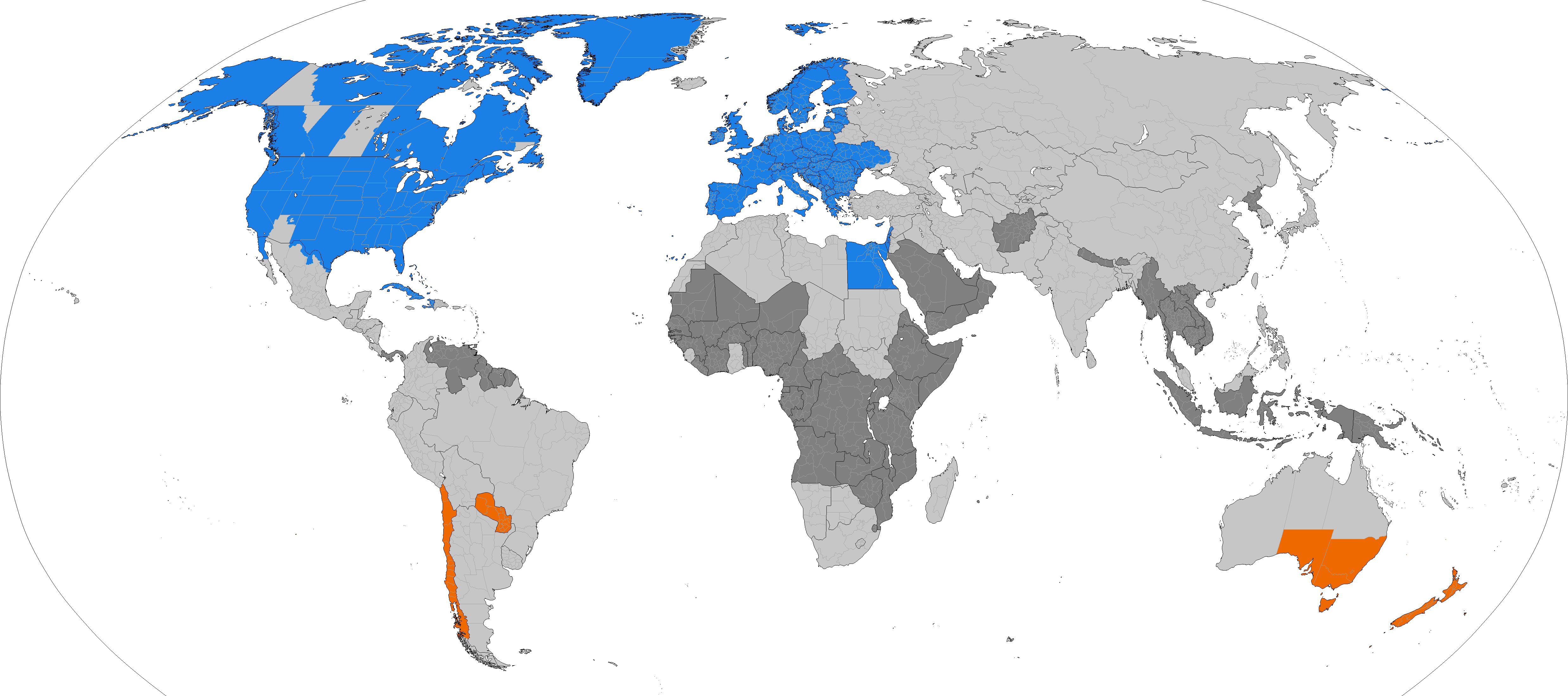
]] Daylight saving time (DST), also known as summer time, is the practice of advancing clocks during part of the year, typically by one hour around spring and summer, so that daylight ends at a later time of the day. , DST is observed in most of Europe, most of North America and parts of Africa and Asia around the Northern Hemisphere summer, and in parts of South America and Oceania around the Southern Hemisphere summer. It was also formerly observed in other areas.
Scheduled observance

, the following locations were scheduled to start and end DST at the following times:
| Locations | DST start | DST end | Shift |
|---|---|---|---|
| Second Sunday in March at 02:00 | First Sunday in November at 02:00 | ||
| Second Sunday in March at 00:00 | First Sunday in November at 01:00 | ||
| Last Sunday in March at 01:00 UTC | Last Sunday in October at 01:00 UTC | ||
| Last Sunday in March at 02:00 | Last Sunday in October at 03:00 | ||
| Last Sunday in March at 00:00 | Last Sunday in October at 00:00 | ||
| Friday before last Sunday in March at 02:00 | Last Sunday in October at 02:00 | ||
| Second Saturday after Ramadan at 02:00 | Saturday before last Sunday in October at 02:00 | ||
| Last Friday in April at 00:00 | Last Thursday in October at 24:00 | ||
| First Saturday in September at 24:00 UTC−04:00 | First Saturday in April at 24:00 UTC−03:00 | ||
| First Sunday in October at 02:00 | First Sunday in April at 03:00 | ||
| First Sunday in October at 02:00 | First Sunday in April at 02:00 | ||
| Last Sunday in September at 02:00 UTC+12:00 | First Sunday in April at 03:00 UTC+13:00 |
In the table above, the DST start and end times refer to the local time before each change occurs, unless otherwise specified. The shift is the amount of time added at the DST start time and subtracted at the DST end time. For example, in Canada and the United States, when DST starts, the local time changes from 02:00 to 03:00, and when DST ends, the local time changes from 02:00 to 01:00. As the time change depends on the time zone, it does not occur simultaneously in all parts of these countries. Conversely, in almost all parts of Europe that observe DST, the time change occurs simultaneously at 01:00 UTC regardless of their time zone.
Morocco, including the portion of Western Sahara that it administers, also observes an annual time change but not related to seasonal daylight. The local time is decreased by one hour on the Sunday before Ramadan at 03:00, and increased by one hour on the Sunday after Ramadan at 02:00 (in 2025, the dates are 23 February and 6 April).
Historical observance
| Location | Last year of time changes | Notes |
|---|---|---|
| Akrotiri and Dhekelia | Observed DST since 1939. | |
| Albania | Observed DST in 1940–1943, and since 1974. | |
| Algeria | 1981 | Observed DST in 1916–1921, in the autumn of 1939, in 1944–1945, 1971, 1977–1978, and 1980–1981. |
| Andorra | Observed DST since 1985. | |
| Argentina | 2009 | Observed DST in 1930–1969, 1974, 1988–2000, and 2007–2009. |
| Armenia | 2011 | Observed DST in 1981–1995, 1997–2011. |
| Australia | DST used only in the Australian Capital Territory, Jervis Bay Territory, New South Wales, Norfolk Island, South Australia, Tasmania, and Victoria. | |
| Austria | Observed DST in 1916–1918, 1920, 1940–1948 (as part of Germany between 1940 and 1945) and since 1980. | |
| Azerbaijan | 2015 | Observed DST in 1981–1992 and 1996–2015. |
| Bahamas | Observed DST since 1964. | |
| Bangladesh | 2009 | Observed DST during World War II from 1942 to 1945 as a part of the Bengal Presidency of India. Also observed in 2009. |
| Barbados | 1980 | Observed DST from 1977 to 1980. |
| Belarus | 2010 | Observed DST in 1941–1944, 1981–2010. |
| Belgium | Observed DST in 1916–1940, 1942–1946 and since 1977. | |
| Belize | 1983 | Observed DST in 1973–1974 and 1982–1983. |
| Bermuda | Observed DST since 1974. | |
| Bolivia | 1932 | Observed DST in 1931–1932. |
| Bosnia and Herzegovina | Observed DST in 1916–1918 when it was part of Austria-Hungary, in 1941–1945 and since 1983 when it was part of Yugoslavia or independent. | |
| Botswana | 1944 | Observed DST in 1943–1944. |
| Brazil | 2019 | Observed DST in 1931–1933, 1949–1953, 1963–1968, and 1985–2019. |
| Bulgaria | Observed DST in 1943–1944 and since 1979. | |
| Canada | Yukon, most of Saskatchewan, and parts of British Columbia, Nunavut, Ontario and Quebec do not observe DST. Yukon and most of Saskatchewan use time zones equivalent to permanent DST. | |
| Cape Verde | 1945 | Observed DST in 1942–1945. |
| Chad | 1980 | Observed DST in winter 1979–1980. |
| Chile | Observed DST in 1927–1946 (excluding Easter Island, which observed it in 1932–1946) and again, as consequence of hydropower scarcity during the Great Drought of 1968, from 1968 to 2015. Chile observed year-round DST in 2015, but reintroduced regular DST in 2016. Magallanes Region since December 2016 and Aysén Region since March 2025 do not observe DST. | |
| China | 1991 | Observed DST in 1940–1941 (when it was Republic of China) and 1986–1991. |
| Colombia | 1993 | Observed DST in 1992–1993. |
| Cook Islands | 1991 | Observed DST in 1978–1991. |
| Costa Rica | 1992 | Observed DST in 1954, 1979–1980 and 1991–1992. |
| Croatia | Observed DST in 1916–1918 when it was part of Austria-Hungary, in 1941–1945 and since 1983 when it was part of Yugoslavia or independent. | |
| Cuba | Observed DST in 1928, 1940–1942, 1945–1946, and since 1965. | |
| Cyprus | Observed DST since 1975. | |
| Czech Republic | Observed DST in 1916–1918 when it was part of Austria-Hungary, 1940–1949 and since 1979 when it was part of Czechoslovakia or independent. | |
| Denmark | Observed DST in 1916, 1940–1948, and since 1980. | |
| Dominican Republic | 1974 | Observed DST in 1966–1967, 1969–1974. |
| Egypt | Observed DST in 1940–1945, 1957–2010, 2014, and since 2023. | |
| El Salvador | 1988 | Observed DST in 1987–1988. |
| Estonia | Observed DST in 1918, 1940–1944, 1981–1988, 1997–1999, and since 2002. | |
| Faroe Islands | Observed DST since 1981. | |
| Falkland Islands | 2010 | Observed DST in 1937–1942 and 1983–2010. |
| Fiji | 2021 | Observed DST in 1998–2000 and 2009–2021. |
| Finland | Observed DST in 1942 and since 1981. | |
| France | Observed DST in 1916–1945 and since 1976. | |
| Georgia | 2005 | Observed DST in 1981–2005. |
| Germany | Observed DST in 1916–1918, 1940–1949, and since 1980. | |
| Ghana | 1942 | Observed DST in 1936–1942. |
| Greece | Observed DST in 1932–1952 and since 1975. | |
| Greenland | Observed DST since 1980. Follows European Union practice as part of the Kingdom of Denmark, hence start and end times correspond to 01:00 UTC on the respective Sunday. See Daylight saving time in the Americas—Greenland. The Pituffik Space Base uses the DST schedule of Canada and the United States. Stations on the east coast of Northeast Greenland National Park do not observe DST. | |
| Guatemala | 2006 | Observed DST in 1973–1974, 1983, 1991, and 2006. |
| Guernsey | Observed DST in 1916–1968 and since 1972. | |
| Haiti | Observed DST in 1983–1997, 2005–2006, 2012–2015, and since 2017. | |
| Honduras | 2006 | Observed DST in 1987–1988 and 2006. |
| Hong Kong | 1979 | Observed DST in 1941, 1945–1976, and 1979. |
| Hungary | Observed DST in 1916–1920, 1941–1950, 1954–1957, and since 1980. | |
| Iceland | 1968 | Observed DST in 1917–1918 and 1939–1968. |
| India | 1945 | Observed DST during World War II from 1941 to 1945. Briefly observed during the Sino-Indian War of 1962 and the Indo–Pakistani Wars of 1965 and 1971. |
| Iraq | 2007 | Observed DST in 1982–2007. |
| Iran | 2022 | Observed DST in 1977–1980, 1991–2005, and 2008–2022. |
| Ireland | Observed DST in 1916–1968 and since 1972. | |
| Isle of Man | Observed DST in 1916–1968 and since 1972. | |
| Israel | Observed DST in 1940–1946, 1948–1957, 1974–1975, 1980, and since 1984. | |
| Italy | Observed DST in 1916–1920, 1940–1948, and since 1966. | |
| Jamaica | 1983 | Observed DST in 1974–1983. |
| Japan | 1951 | Observed DST in 1948–1951. |
| Jersey | Observed DST in 1916–1968 and since 1971. | |
| Jordan | 2022 | Observed DST with annual time changes in 1973–1978 and 1985–2011, permanently in 2012–2013, with annual time changes in 2014–2022, and permanently since 2022. |
| Kazakhstan | 2004 | Observed DST in 1981–1990 and 1992–2004. |
| Kosovo | Observed DST 1941–1945 and since 1983 when it was part of Yugoslavia, Serbia and Montenegro, Serbia or independent. | |
| Kyrgyzstan | 2005 | Observed DST in 1981–2005. |
| Latvia | Observed DST in 1918–1919, 1941–1944, and since 1981. | |
| Lebanon | Observed DST in 1920–1923, 1957–1961, 1972–1978, and since 1984. | |
| Lesotho | 1944 | Observed DST in 1943–1944. |
| Libya | 2013 | Observed DST in 1951–1959, 1982–1989, 1996–1997, and 2012–2013. |
| Liechtenstein | Observed DST since 1981. | |
| Lithuania | Observed DST in 1941–1944, 1981–1999, and since 2003. | |
| Luxembourg | Observed DST in 1916–1946 and since 1977. | |
| Macau | 1979 | Observed DST in 1941–1943, 1945–1976 and 1979. |
| Madagascar | 1954 | Observed DST in 1954. |
| Malaysia | 1936 | Observed DST in 1933–1936. The time zone in Malaysia also changed many times in the past. |
| Malta | Observed DST in 1916–1920, 1940–1948, and since 1966. | |
| Martinique | 1980 | Observed DST in 1980. |
| Mauritius | 2009 | Observed DST in 1982–1983 and 2008–2009. |
| Mexico | Baja California started observing DST in 1976. Durango, Coahuila, Nuevo León and Tamaulipas observed DST in 1988. The whole country started observing DST in 1996, but Sonora discontinued the observance after 1998, Quintana Roo after 2014, and the rest of the country after 2022, except Baja California and municipalities near the U.S. border in Chihuahua, Coahuila, Nuevo León and Tamaulipas, which continued observing DST according to the U.S. schedule. | |
| Midway Atoll | 1956 | Observed DST in 1956. |
| Moldova | Observed DST in 1932–1944, 1981–1989, and since 1991. | |
| Monaco | Observed DST in 1916–1945 and since 1976. | |
| Mongolia | 2016 | Observed DST in 1983–1998, 2001–2006, and 2015–2016. |
| Montenegro | Observed DST 1941–1945 and since 1983 when it was part of Yugoslavia, Serbia and Montenegro or independent. | |
| Morocco | 2018 | Observed DST in 1939–1945, 1950, 1967, 1974, 1976–1978, and 2008–2018. In 2012–2018, DST was suspended during the month of Ramadan. Since 2018 Morocco uses UTC+1 all year, equivalent to permanent DST, except during the month of Ramadan, when it observes UTC±0. |
| Namibia | 2017 | Adopted standard time of UTC+2 in 1903. Observed annual changes to summer time in 1942–1943 (UTC+3 summer, UTC+2 standard). Observed annual changes to winter time in 1994–2017 (UTC+2 standard, UTC+1 winter) in all regions except Zambezi, which remained in UTC+2 all year. |
| Netherlands | Observed DST in 1916–1945 and since 1977. | |
| New Caledonia | 1997 | Observed DST in 1977–1979 and 1996–1997. |
| New Zealand | Observed DST in 1927–1946 and since 1974. | |
| Nicaragua | 2006 | Observed DST in 1973–1975, 1979–1980, 1992–1994, and 2005–2006. |
| Norfolk Island | Observed DST in 1974–1975 and since 2019. | |
| North Macedonia | Observed DST in 1941–1945 and since 1983 when it was part of Yugoslavia or independent. | |
| Northern Cyprus | Observed DST since 2017. Maintained permanent DST from September 2016 to October 2017. | |
| Norway | Observed DST in 1916, 1940–1945, 1959–1965, and since 1980. Follows European Union practice, although not a member. | |
| Pakistan | 2009 | Observed DST in 1942–1945 as a part of the British Raj. Also observed in 2002 and from 2008 to 2009. |
| Palestine | Since 1974, observed DST in the same years when Israel did, but not always with the same start and end dates. | |
| Paraguay | 2024 | Observed DST in 1975–2024. In October 2024 adopted UTC–3, equivalent to permanent DST. |
| Peru | 1994 | Observed DST in 1938–1940, 1986–1987, 1990, and 1994. |
| Philippines | 1978 | Observed DST in 1936–1937, 1954, and 1978. |
| Poland | Observed DST in 1916–1919, 1940–1949, 1957–1964, and since 1977. | |
| Portugal | Observed DST in 1916–1921, 1924, 1926–1929, 1931–1932, 1934–1949, 1951–1965, and since 1977. | |
| Puerto Rico | 1945 | Observed DST in 1942–1945. |
| Romania | First time when DST was observed in Romania was in 1917, due to World War I. Observed DST in 1932–1939 and since 1979. | |
| Russia | 2014 | Observed DST in 1917–1919, 1921 (some areas), and 1981–2010. In 2011–2014, used permanent DST. In 2014, left permanent DST and switched to permanent standard time. |
| Saint Pierre and Miquelon | Observed DST since 1987. | |
| Samoa | 2021 | Observed DST in 2010–2021. |
| San Marino | Observed DST in 1916–1920, 1940–1948, and since 1966. | |
| Serbia | Observed DST in 1941–1945 and since 1983 when it was part of Yugoslavia, Serbia and Montenegro or independent. | |
| Sierra Leone | 1962 | Observed DST in 1935–1942 and 1957–1962. |
| Singapore | 1935 | Observed DST in 1933–1935 by adding 20 minutes to standard time. On January 1, 1936, country changed their time zone to UTC+07:20. |
| Slovakia | Observed DST in 1916–1918 when it was part of Austria-Hungary, 1940–1949 and since 1979 when it was part of Czechoslovakia or independent. | |
| Slovenia | Observed DST in 1916–1918 when it was part of Austria-Hungary, in 1941–1945 and since 1983 when it was part of Yugoslavia or independent. | |
| South Africa | 1944 | Observed DST in 1942–1944. |
| South Korea | 1988 | Observed DST in 1948–1951, 1955–1960, and 1987–1988. |
| South Sudan | 1985 | Observed DST in 1970–1985, when it was part of Sudan. |
| Spain | Observed DST in 1917–1919, 1924, 1926–1929, 1937–1946, 1949, and since 1974. The Canary Islands observed DST since 1980. | |
| Sri Lanka | 2006 | Observed DST during the World War II, from 1942 to 1945 just as the rest of the Indian subcontinent. Advanced one hour to UTC+6:30 in May 1996, reduced 30 minutes to UTC+6 in October 1996, and reduced 30 minutes to UTC+5:30 in April 2006. |
| Sudan | 1985 | Observed DST in 1970–1985. |
| Sweden | Observed DST 15 May–30 September 1916, in a test run. Observed DST since 1980. Dates: 1980, first Sunday of April to last Sunday of September; 1981–1995, last Sunday of March to last Sunday of September; since 1996, last Sunday of March to last Sunday of October. | |
| Switzerland | Observed DST in 1941–1942 and since 1981. Follows European Union practice, although not a member. | |
| Syria | 2022 | Observed DST in 1920–1923, 1962–1978, 1983–1984, and 1986–2022. In 2022 switched to UTC+03:00, equivalent to permanent DST. |
| Taiwan | 1979 | Observed DST in 1945–1962, 1974, 1975, and 1979. |
| Tajikistan | 1991 | Observed DST in 1981–1991. |
| Tonga | 2017 | Observed DST in 1999–2002 and 2016–2017. |
| Tunisia | 2008 | Observed DST in 1939–1945, 1977–1978, 1988–1990, and 2005–2008. |
| Türkiye (Turkey) | 2016 | Observed DST in 1916, 1920–1922, 1924–1925, 1940–1942, 1945–1951, 1962, 1964, 1970–1983, and 1985–2016. Followed European Union practice in general. In 2016, Turkey adopted the new Turkey Time time zone (UTC+03:00), moving in effect to permanent DST. |
| Turkmenistan | 1991 | Observed DST in 1981–1991. |
| Turks and Caicos | Observed DST in 1979–2015 and since 2018. | |
| Ukraine | Observed DST in 1941–1943, 1981–1989, and since 1992. Follows European Union practice, although not a member. Since 2014, occupied territories of Ukraine do not de facto observe DST. | |
| United Kingdom | Observed DST (commonly referred to as British Summer Time (BST)) since 1916. Year-round Summer Time (BST) + Double Summer Time (BDST) 1940–1945. Two-stage Double Summer Time (BDST) 1947. Year-round Summer Time (BST) 1968–1971. Follows European Union practice, although no longer a member. | |
| United States | Arizona (except the Navajo Nation) and Hawaii do not observe DST. Year-round DST observed in 1942–1945 and 1974–1975. | |
| Uruguay | 2015 | Observed DST in 1923–1926, 1933–1943, 1959–1960, 1965–1970, 1972, 1974–1980, 1987–1993, and 2004–2015. |
| Uzbekistan | 1991 | Observed DST in 1981–1991. |
| Vanuatu | 1993 | Observed DST in 1983–1993. |
| Vatican City | Observed DST in 1916–1920, 1940–1948, and since 1966. | |
| Western Sahara | 2018 | The portion administered by Morocco since 1976 observed DST whenever the country did. |
Proposals to abolish seasonal changes
Many countries and territories have abolished annual time changes after observing them for many years: Argentina, Armenia, Azerbaijan, Belarus, Brazil, Cook Islands, Falkland Islands, Fiji, Georgia, Hong Kong, Iceland, Iran, Iraq, Jamaica, Jordan, Kazakhstan, Kyrgyzstan, Macau, Mongolia, Namibia, Paraguay, Russia, Samoa, Sudan, Syria, Turkey, Uruguay, Vanuatu, and most of Mexico. To select the time to be used all year, some of them adopted the time previously used outside their DST period, but others adopted the time previously used during their DST period, an effect known as "permanent DST".
European Union
On 8 February 2018, the European Parliament voted to ask the European Commission to re-evaluate DST in the European Union. An online survey was performed between 4 July and 16 August 2018, in which 4.6 million EU citizens responded. The survey was especially popular in Germany, resulting in 68% of all respondents located in that country. Out of all the participants, about 84% did not desire to adjust clocks twice annually. Based on this poll, on 12 September 2018 the European Commission decided to propose an end to seasonal clock changes (repealing Directive 2000/84/EC). In order for this proposal to be valid, the European Union legislative procedure must be followed, mainly that the Council of the European Union and the European Parliament must both approve it.
The seasonal changes were supposed to stop in 2021, but the Council of the European Union asked the European Commission for a detailed impact assessment before countries would decide on how to proceed.
United States
Main article: Daylight saving time in the United States
Since 2018, several U.S. states have passed laws to abolish seasonal changes and adopt permanent DST, but these laws cannot take effect without approval from the federal government. States may freely choose whether to observe DST or not, but if they observe it they must follow the national schedule, and changing their standard time also requires approval from the federal government.
The proposed Sunshine Protection Act would change federal law to abolish annual time changes and permanently advance by one hour the standard time in all areas of the United States that previously observed DST, effectively adopting permanent DST. The proposal has been introduced in every term of the United States Congress since 2018. In 2022, it passed the Senate with unanimous consent but expired without consideration by the House of Representatives.
Notes
classnowrap stylepadding-right:0.3em Austria
Belgium
Bulgaria
Croatia
Cyprus
Czech Republic
Denmark
Estonia
Finland stylepadding-right:0.3em France
Germany
Greece
Hungary
Ireland
Italy
Latvia
Lithuania
Luxembourg Malta
Netherlands
Poland
Portugal
Romania
Slovakia
Slovenia
Spain
Sweden } }}
References
References
- "The World Clock (extended version)". timeanddate.com.
- "Time zone database and code". [[Paul Eggert]].
- (22 January 2024). "قرار مجلس الوزراء رقم (18/240/13/م.و/م.ا) لعام 2024م". Council of Ministers of Palestine.
- (20 March 2025). "Decreto 1286: Modifica decreto supremo Nº 253 del Ministerio del Interior, disponiendo cambios en la hora oficial de Chile Continental, de la Región de Magallanes y la Antártica Chilena y de Chile Insular Occidental". Library of the National Congress of Chile.
- "Time change". Hydrographic and Oceanographic Service of the Navy of Chile.
- (6 July 2007). "New Zealand Daylight Time Order 2007". New Zealand Government.
- "Clock changes in Yerevan". timeanddate.com.
- "Sunday, March 10: Daylight Saving Time Begins in USA & Canada". timeanddate.com.
- Bertin, Ximena. (April 26, 2014). "El hombre que cambió la hora". [[La Tercera]].
- Ministerio del Interior. (1968-11-02). "Decreto 1474: Adelanta la hora oficial en 60 minutos". Biblioteca del Congreso Nacional.
- [https://mm.icann.org/pipermail/tz/attachments/20230315/562d95e3/AnnouncementonchangingofstandardtimeforGreenland-0001.pdf Announcement on changing of standard time for Greenland], Government of Greenland, 3 March 2023.
- (24 March 2016). "GRN evaluates winter time change". [[New Era (Namibia).
- "DST Begins in Australia and New Zealand".
- "Time Zone in North Nicosia, Northern Cyprus".
- (14 October 2024). "Peña promulga horario de verano todo el año".
- "Russia returns to permanent Standard Time".
- (20 August 2018). "Serbia to legislate Daylight Saving Time, EU may end it – English – on B92.net".
- "Time zone in Singapore". timeanddate.com.
- "No habrá cambio de hora este verano". Montevideo Portal.
- "EU Parliament Votes to Re-Evaluate DST in Europe".
- (2020-10-24). "Stopping the clock on seasonal time changes? Not anytime soon".
- (31 August 2018). "Summertime Consultation: 84% want Europe to stop changing the clock". [[European Commission]].
- (12 September 2018). "State of the Union 2018: Q&A on the Commission's proposal to put an end to seasonal clock changes". [[European Commission]].
- (March 4, 2025). "Daylight Saving Time {{!}} State Legislation".
- (16 March 2022). "S.623 – Sunshine Protection Act of 2021". United States Congress.
This article was imported from Wikipedia and is available under the Creative Commons Attribution-ShareAlike 4.0 License. Content has been adapted to SurfDoc format. Original contributors can be found on the article history page.
Ask Mako anything about Daylight saving time by country — get instant answers, deeper analysis, and related topics.
Research with MakoFree with your Surf account
Create a free account to save articles, ask Mako questions, and organize your research.
Sign up freeThis content may have been generated or modified by AI. CloudSurf Software LLC is not responsible for the accuracy, completeness, or reliability of AI-generated content. Always verify important information from primary sources.
Report