From Surf Wiki (app.surf) — the open knowledge base
Dawson City
.jpeg)
| Field | Value |
|---|---|
| name | Dawson City |
| official_name | City of Dawson |
| nickname | Paris of the North |
| settlement_type | Town |
| image_skyline | Dawson_Yukon_June_07.jpg |
| image_caption | Aerial view of Dawson City and the Yukon River |
| pushpin_map | Canada Yukon |
| pushpin_map_caption | Location of Dawson City |
| subdivision_type | Country |
| subdivision_name | Canada |
| subdivision_type1 | Territory |
| subdivision_name1 | Yukon |
| leader_title | Mayor |
| leader_name | Stephen Johnson |
| established_title | Settled |
| established_date | 1896 |
| established_title2 | City |
| established_date2 | 1902 |
| established_title3 | Town |
| established_date3 | 1980 |
| area_footnotes | |
| area_total_km2 | 32.45 |
| population_as_of | 2016 |
| population_footnotes | |
| population_total | 1,577 |
| population_density_km2 | 42.4 |
| timezone | MST |
| utc_offset | −07:00 |
| coordinates | |
| elevation_footnotes | |
| elevation_m | 370 |
| elevation_ft | 1,214 |
| postal_code_type | Canadian Postal code |
| postal_code | Y0B 1G0 |
| area_code | 867 |
| blank_name | NTS Map |
| blank_info | |
| blank1_name | GNBC Code |
| blank1_info | KAHFT |
| blank2_name | Climate |
| blank2_info | Dfc |
| website | |
| footnotes | {{designation list |
| embed | yes |
| designation1 | WHS |
| designation1_partof | Tr’ondëk-Klondike |
| designation1_date | 2023 (45th session) |
| designation1_number | 1564-006 |
| designation1_criteria | iii, iv |
| designation1_type | Cultural |
| designation1_free1name | UNESCO region |
| named_for | George Mercer Dawson |
Dawson City is a town in the Canadian territory of Yukon. It is inseparably linked to the Klondike Gold Rush (1896–1899). Its population was 1,577 as of the 2021 census, making it the second-largest municipality in Yukon.
History
Prior to the late modern period the area was used for hunting and gathering by the Hän-speaking people of the Tr’ondëk Hwëch’in and their forebears. The heart of their homeland was Tr'ochëk, a fishing camp at the confluence of the Klondike River and Yukon River, now a National Historic Site of Canada, just across the Klondike River from modern Dawson City. This site was also an important summer gathering spot and a base for moose-hunting on the Klondike Valley.
The current settlement was founded by Joseph Ladue and named in January 1897 after noted Canadian geologist George M. Dawson, who had explored and mapped the region in 1887. It served as Yukon's capital from the territory's founding in 1898 until 1952, when the seat was moved to Whitehorse.
.jpeg)
.jpg)
Dawson City was the centre of the Klondike Gold Rush. It began in 1896 and changed the First Nations camp into a thriving city of 16,000–17,000 by 1898. By 1899, the gold rush had ended and the town's population plummeted as all but 8,000 people left. When Dawson was incorporated as a city in 1902, the population was under 5,000. St. Paul's Anglican Church, also built that same year, is a National Historic Site. The downtown was devastated by fire in November 1897 (started when dance hall girl Dolly Mitchell threw a lamp at another girl in an argument), 1899 (started in the Bodega Saloon), 1900 (started at the Monte Carlo Theatre) and flooding in 1925, 1944, 1966, 1969 and 1979.
The population dropped after World War II when the Alaska Highway bypassed it 518 km to the south. The economic damage to Dawson City was such that Whitehorse, the highway's hub, replaced it as territorial capital in 1953. Dawson City's population languished around the 600–900 mark through the 1960s and 1970s, but has risen and held stable since then. The high price of gold has made modern placer mining operations profitable, and the growth of the tourism industry has encouraged the development of facilities. In the early 1950s, Dawson was linked by road to Alaska, and in fall 1955, with Whitehorse along a road that now forms part of the Klondike Highway.
In 1978, another kind of buried treasure was discovered with the Dawson Film Find when a construction excavation inadvertently uncovered a forgotten collection of more than 500 discarded films on highly flammable nitrate film stock from the early 20th century that were buried in (and preserved by) the permafrost. These silent-era film reels, dating from "between 1903 and 1929, were uncovered in the rubble beneath [an] old hockey rink". Owing to its dangerous chemical volatility, the historical find was moved by military transport to Library and Archives Canada and the U.S. Library of Congress for both transfer to safety film and storage. A documentary about the find, Dawson City: Frozen Time, was released in 2016.
Another film, *City of Gold (1957) *, by Colin Low and Wolf Koenig, and narrated by Pierre Berton, chronicling Dawson City during the Klondike Gold Rush, made innovative use of archival photos, winning First Prize for documentary film at the 1957 Cannes Film Festival.
The City of Dawson and the nearby ghost town of Forty Mile are featured prominently in the novels and short stories of American author Jack London, including The Call of the Wild. London lived in the Dawson area from October 1897 to June 1898. Other writers who lived in and wrote of Dawson City include Pierre Berton and the poet Robert Service. The childhood home of the former is now used as a residency and retreat for professional writers administered by the Writers' Trust of Canada.
In 2023, the Dawson City townsite became part of the Tr’ondëk-Klondike UNESCO World Heritage Site, because of its archaeological record highlighting the transformation of the site from predominantly Indigenous to predominantly European use, and the adaptations that the Indigenous people made in response to European colonialism.
Geography
Dawson City lies on the Tintina Fault. This fault has created the Tintina Trench and continues eastward for several hundred kilometres. Erosional remnants of lava flows form outcrops immediately north and west of Dawson City.
Climate
Dawson City has a subarctic climate (Köppen climate classification: Dfc), with significantly higher continentality (greater temperature swings) than the territory capital of Whitehorse.
The average temperature in July is 15.9 C and in January is -25.7 C. The highest temperature ever recorded is 35.0 C on 9 July 1899 and 18 June 1950. The lowest temperature ever recorded is -58.3 C on 3 February 1947. It experiences a wide range of temperatures surpassing 30 C in most summers and dropping below -40 C in winter. In the very cold month of December 1917, the temperature did not rise above -37.2 C and it averaged -46.3 C.
The community is at an elevation of 320 m and the average rainfall in July is 53.3 mm and the average snowfall in January is 28.4 cm. Dawson has an average total annual snowfall of 161.9 cm and averages 77 frost free days per year. The town is built on a layer of frozen earth, which may pose a threat to the town's infrastructure in the future if the permafrost melts.
Demographics
.jpg)
|1901|9142 |1911|3013 |1921|975 |1931|819 |1941|1043 |1951|783 |1956|851 |1961|881 |1966|742 |1971|762 |1976|838 |1981|697 |1986|896 |1991|972 |1996|1287 |2001|1251 |2006|1327 |2011|1319 |2016|1375 |2021|1577
In the 2021 Census of Population conducted by Statistics Canada, Dawson had a population of living in of its total private dwellings, a change of from its 2016 population of . With a land area of 30.91 km2, it had a population density of in 2021.
Ethnicity
According to the 2021 Census, the town is predominantly European Canadian with 60.8% of the population with Indigenous Canadians accounting for 31.4% of the population and East Asian Canadians accounting for 3.0% of the population.
| Panethnic group | 2021 | 2016 | 2011 | 2006 | 2001 | Pop. | % | Pop. | % | Pop. | % | Pop. | % | Pop. | % | Total responses | 1,480 | 1,340 | 1,295 | 1,320 | 1,245 | Total population | 1,577 | 1,375 | 1,319 | 1,327 | 1,251 |
|---|---|---|---|---|---|---|---|---|---|---|---|---|---|---|---|---|---|---|---|---|---|---|---|---|---|---|---|
| European | 900 | 940 | 830 | 915 | 885 | ||||||||||||||||||||||
| Indigenous | 465 | 310 | 435 | 390 | 340 | ||||||||||||||||||||||
| East Asian | 45 | 0 | 0 | 0 | 0 | ||||||||||||||||||||||
| South Asian | 25 | 0 | 0 | 0 | 20 | ||||||||||||||||||||||
| Southeast Asian | 20 | 60 | 0 | 0 | 0 | ||||||||||||||||||||||
| African | 15 | 15 | 0 | 10 | 10 | ||||||||||||||||||||||
| Latin American | 10 | 20 | 0 | 0 | 0 | ||||||||||||||||||||||
| Middle Eastern | 0 | 0 | 0 | 10 | 0 | ||||||||||||||||||||||
| Other/multiracial | 0 | 0 | 35 | 0 | 0 | ||||||||||||||||||||||
| Note: Totals greater than 100% due to multiple origin responses |
Economy
Today, Dawson City's main industries are tourism and gold mining.
Energy
Electricity is provided by Yukon Energy Corporation (YEC). Most of the grid power is hydroelectric power through the north-south grid from dams near Mayo, Whitehorse and Aishihik Lake. After the local hydroelectric power plant for the gold dredges was shut down in 1966, YEC provided electrical power from local diesel generators. In 2004 YEC connected Dawson to its grid system. Since then the diesel generators function as a backup to the grid.
Gold mining
Gold mining started in 1896 with the Bonanza (Rabbit) Creek discovery by George Carmack, Tagish Charlie and Skookum Jim Mason (Keish). The area's creeks were quickly staked and most of the thousands who arrived in the spring of 1898 for the Klondike Gold Rush found that there was very little opportunity to benefit directly from gold mining. Many instead became entrepreneurs to provide services to miners.

Starting approximately 10 years later, large gold dredges began an industrial mining operation, scooping huge amounts of gold out of the creeks, and completely reworking the landscape, altering the locations of rivers and creeks and leaving tailing piles in their wake. A network of canals and dams were built to the north to produce hydroelectric power for the dredges. The dredges shut down for the winter, but one built for "Klondike Joe Boyle" was designed to operate year-round, and Boyle had it operate all through one winter. That dredge (Dredge No. 4) is open as a National Historic Site of Canada on Bonanza Creek.
The last dredge shut down in 1966, and the hydroelectric facility, at North Fork, was closed when the City of Dawson declined an offer to purchase it. Since then, placer miners returned to the status of being the primary mining operators in the region until recently. In 2016, Goldcorp announced a takeover of Kaminak Gold's Coffee Project south of Dawson. This marked a shift in the region, drawing the interest of the major gold mining companies in the Yukon. In 2017, Newmont Mining Corporation, Barrick Gold and Agnico Eagle Mines Limited have all committed significant investment, engaging in the exploration of properties across the Central Yukon.
Tourism
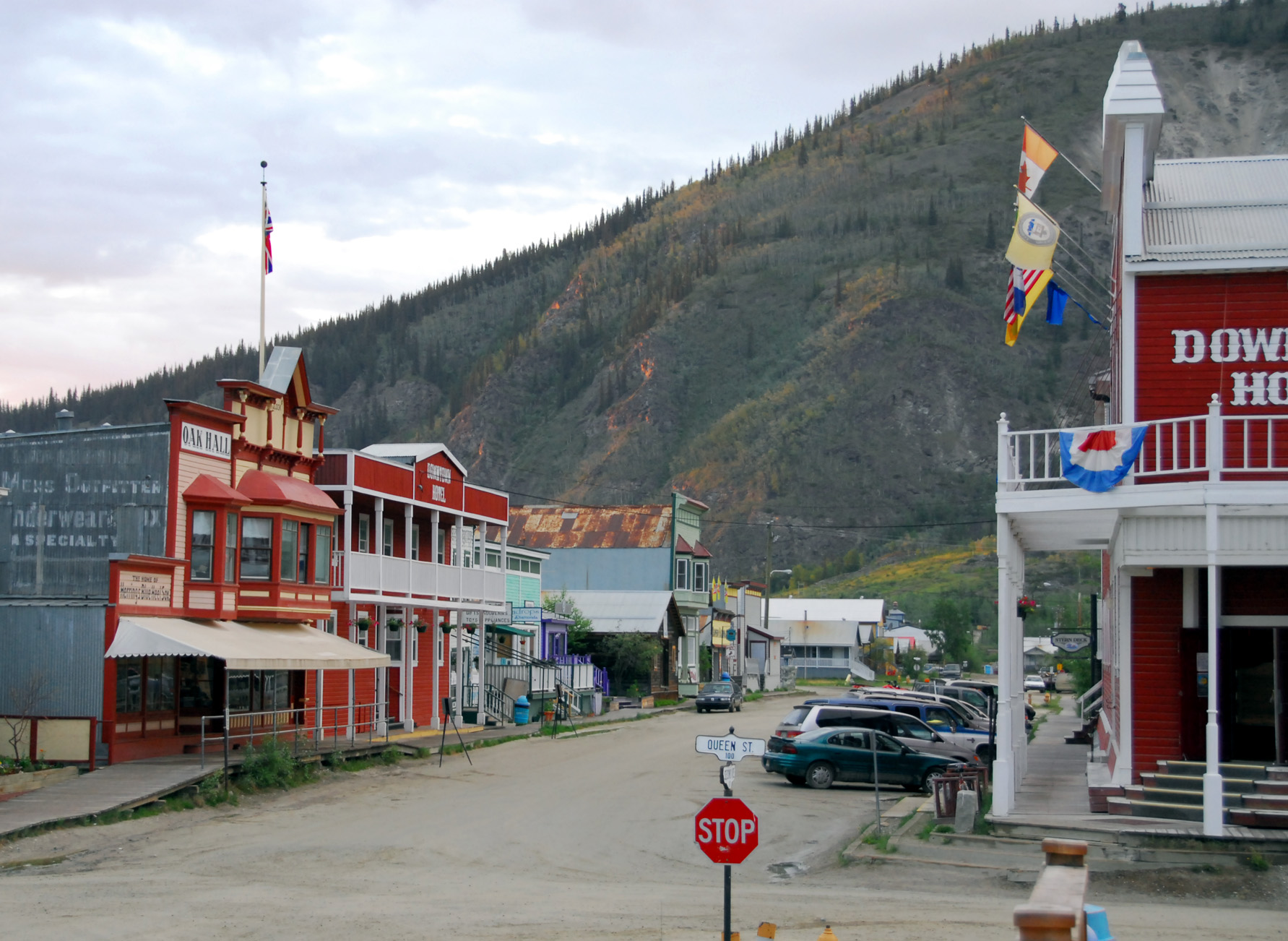
There are eight National Historic Sites of Canada located in Dawson, including the "Dawson Historical Complex", a National Historic Site encompassing the historic core of the town.
The Downtown Hotel at Second Avenue and Queen Street has garnered media attention for its unusual Sourtoe Cocktail, which features a real mummified human toe. The hotel and the toe received increased attention in June 2017 after the toe was stolen; it was soon returned to the hotel by mail along with a written apology.
Bonanza Creek has two National Historic Sites; the Discovery Claim and the Dredge No. 4.
Tr'ochëk is the site of a traditional Hän fishing camp on the flats at the confluence of the Klondike River and Yukon River. The site is owned and managed by the Tr’ondëk Hwëch’in First Nation. In addition to the fishing camp remains, the site includes traditional plant harvesting areas and lookout points.
Diamond Tooth Gertie's Gambling Hall puts on nightly vaudeville shows during tourist season, from May to September.
Sports

Every February, Dawson City acts as the halfway mark for the Yukon Quest International Sled Dog Race. Mushers entered in the event have a mandatory 36-hour layover in Dawson City while getting their rest and preparing for the second half of the world's toughest sled dog race.
Dawson City also hosts a softball tournament which brings teams from Inuvik in late summer. Furthermore, a volleyball tournament is held annually at the end of October and is attended by various high schools across Yukon.
The city was home to the Dawson City Nuggets hockey team, which in 1905 challenged the Ottawa Silver Seven for the Stanley Cup. Travelling to Ottawa by dog sled, ship, and train, the team lost the most lopsided series in Stanley Cup history, losing two games by the combined score of 32 to 4.
Government
In 2004, the Yukon government removed the mayor and the town council, as a result of the town going bankrupt. The territorial government accepted a large portion of the responsibility for this situation in March 2006, writing off $3.43 million of the debt and leaving the town with $1.5 million still to pay off. Elections were set for June 15, 2006. John Steins, a local artist and one of the leaders of the movement to restore democracy to Dawson, was acclaimed as mayor, while 13 residents ran for the four council seats. Steins was succeeded in office by former mayor Peter Jenkins, who in turn was succeeded by Wayne Potoroka.
In 2021, four candidates ran for mayor, and former city councillor William (Bill) Kendrick won the election and is the current mayor of Dawson City.
Other past mayors of Dawson City have included Art Webster, Colin Mayes, Yolanda Burkhard, Mike Comadina and Vi Campbell.
In the Legislative Assembly of Yukon, Dawson City is in the electoral district of Klondike, currently represented by Brent McDonald of the Yukon NDP.
The government of Tr’ondëk Hwëch’in, now a self-governing First Nation, is also located in Dawson.
In 2024, councillors refused to swear allegiance to King Charles III, in solidarity with councillor-elect Darwyn Lynn, who refused in protest against the historic relations between the monarchy and the First Nations.
City or town status


Dawson was incorporated as a city in 1902 when it met the criteria for "city" status under the municipal act of that time. It retained the incorporation even as the population plummeted. When a new municipal act was adopted in the 1980s, Dawson met the criteria of "town", and was incorporated as such although with a special provision to allow it to continue to use the word "City", partially for historical reasons and partially to distinguish it from Dawson Creek, a small city in northeastern British Columbia.
Dawson Creek is also named in honour of George M. Dawson. This led the territorial government to post the following signs at the boundaries of the town: "Welcome to the Town of the City of Dawson". As of the 2001 Municipal Act, the town's official legal name is now simply the "City of Dawson".
Infrastructure


- Airports: Dawson City Airport is located 8 NM east of town. Dawson City Water Aerodrome is located next to the community on the Yukon River. Both are classified as an airport of entry and, as such, can handle aircraft with up to 30 passengers. The water aerodrome is one of only two in Canada that is able to handle aircraft with more than 15 passengers.
- Road: Klondike Highway (Yukon route 2) from Whitehorse-open year-round; Top of the World Highway (Yukon route 9) and Taylor Highway (Alaska route 5) from Tok, Alaska, open seasonally May to September.
- Winter transportation: During the winter, Dawson City is accessible via the North Klondike Highway. There is an ice bridge across the Yukon River, for both foot and vehicle traffic, that is operated and maintained by the Yukon Department of Highways.
- Rail: None currently. See Klondike Mines Railway
- Boat: The George Black Ferry connects the North Klondike Hwy to the Top of the World Highway, by operating vehicle and passenger ferry service across the Yukon River. This is part of the Territorial highway system, and operates from May to October, weather dependent. There is no cost to use this ferry. The Yukon River is navigable (when not frozen) and historically was travelled by commercial riverboats to Whitehorse and downstream into Alaska and the Bering Sea.
- Cable television: municipal government-owned system with several channels via satellite
- Telephone/Internet: Northwestel telephone exchange. and ran fibre internet to the community in 2021.
Education
Yukon School of Visual Arts, a university level accredited art program, is based in Dawson City.
Robert Service School, Dawson City's only grade school, is named in honour of British-Canadian poet and writer Robert William Service (January 16, 1874 – September 11, 1958). The Robert Service School offers Kindergarten – Grade 12 and is one of only 28 schools in the Yukon Territory.
Media
Television
| OTA channel | Call sign | Network |
|---|---|---|
| 9 (VHF) | CH4261 | Aboriginal Peoples Television Network |
Radio
| Frequency | Call sign | Branding | Format | Owner | Notes |
|---|---|---|---|---|---|
| AM 560 | CBDN | CBC Radio One | Talk radio, public radio | Canadian Broadcasting Corporation | Rebroadcaster of CFWH-FM (Whitehorse) |
| FM 90.5 | VF2049 | – | Community radio | Northern Native Broadcasting | First Nations community radio; rebroadcaster of CHON-FM (Whitehorse) |
| FM 104.9 | CBDN-FM | CBC Radio 2 | Adult contemporary, public radio | Canadian Broadcasting Corporation | Rebroadcaster of CBU-FM (Vancouver) |
| FM 106.9 | CFYT-FM | CFYT: The Spirit of Dawson | Community radio | Dawson City Community Radio Society | Rebroadcasts CKRW-FM (Whitehorse) when not airing local programming |
- Dawson City is not served by a daily newspaper. The local Klondike Sun is published every two weeks, and the Whitehorse-based Yukon News is available two days per week.
Notable people==


- Pierre Berton: Dawson City is home of the Berton House Writers' Retreat program, housing established Canadian writers for four three-month get-away-from-it-all subsidized residencies each year. Berton House was the childhood home of popular-history writer Berton. The program is now administered by the Writers' Trust of Canada. Berton narrated the 1957 film City of Gold which describes the excitement of Dawson City during the gold rush. He also wrote the book Klondike, an historical account of the gold rush to the Klondike in 1896–1899.
- Martha Black, the second woman elected to the House of Commons of Canada, as a single mother in Dawson earned a living by staking gold mining claims and running a sawmill and a gold ore-crushing plant. She later married George Black, Commissioner of Yukon, and in 1935 was elected to the House of Commons for the riding of Yukon as an Independent Conservative taking the place of her ill husband.
- Joseph W. Boyle, "Klondike Joe," entrepreneur, hockey organizer and adventurer.
- Suzanne Crocker, documentary filmmaker.
- John D. Ferry, chemist and biochemist, was born in Dawson in 1912
- Lulu Mae Johnson, manager of Dawson's dance hall in the early 1900s. She died on the SS Princess Sophia.
- Victor Jory, actor of stage, film, and television, was born in Dawson in 1902 to American parents.
- William Judge, a Jesuit priest who during the 1897 Klondike Gold Rush established a facility in Dawson which provided shelter, food and any available medicine to the many hard-at-luck gold miners who filled the town and its environs.
- Jack London spent the late Autumn of 1897 and Spring of 1898 in Dawson. He spent part of the winter 1897–1898 in a cabin that was originally on Henderson Creek, a tributary of the Stewart River. In the 1960s, it was disassembled and moved to its present location adjacent to downtown Dawson.
- Micí Mac Gabhann, an Irish language storyteller (seanchaí) who lived in Dawson in 1897–98 and whose memoirs of the Klondyke Gold Rush Rotha Mór an tSaoil were published posthumously in 1959.
- William Ogilvie, a Dominion land surveyor, explorer and Commissioner of the Yukon, surveyed the townsite of Dawson City and was responsible for settling many disputes between miners.
- Alexander Pantages, impresario, had his start in Dawson City. He opened a small theatre to serve the city. Soon, however, his activities expanded and the thrifty Greek went on and became one of America's greatest theatre and movie tycoons.
- Robert W. Service, known as The Bard of the Yukon for his famous poems "The Shooting of Dan McGrew", "The Cremation of Sam McGee" and many others which depicted the Gold Rush and the culture of the Klondike. Service was transferred to the Dawson branch of the Canadian Bank of Commerce in Dawson City in 1908. Then, he dwelt in a log cabin where he would pursue his writings with The Trail of 98.
- Joe Vogler, Alaskan politician, buried in Dawson.
- Jan Eskymo Welzl was a Moravian adventurer, hunter, gold prospector, Eskimo chief and chief justice on New Siberia island and later a story-teller and writer. During his life in Dawson City he was called Perpetual Motion Man and was also known as an inventor. Books based on his stories were published in many countries all over the world. Buried in Dawson City.
- Black Mike Winage, a Serbian-Canadian miner, pioneer, and adventurer, who lived to be 107 years old, lived in Dawson City.
- Weldy Young, professional hockey player for the Ottawa Silver Seven.
Freedom of the City
The following people and military units have received the Freedom of the City of Dawson City.
Military Units
- The Canadian Rangers: 22 August 2022.
Notes
References
References
- "Paris of the North". City of Dawson.
- (February 8, 2017). "Population and dwelling counts, for Canada, provinces and territories, and census subdivisions (municipalities), 2016 and 2011 censuses – 100% data (Yukon)". [[Statistics Canada]].
- {{cite cgndb
- "NWMP Census of Dawson City, July 19, 1898". Government of Canada.
- (16 March 2016). "Force of nature: New exhibit displays destruction and resiliency in Yukon – Yukon News".
- "Forestview to Dawson City".
- (24 May 2013). "A different sort of Klondike treasure". Yukon News.
- (2016). "Dawson City: Frozen Time". Kino Lorber.
- Weschler, Lawrence. (September 14, 2016). "The Discovery, and Remarkable Recovery, of the King Tut's Tomb of Silent-Era Cinema".
- "Berton House Writers' Retreat".
- "Berton House".
- "Executive Summary".
- Elevation of the Dawson City Water Aerodrome from the {{WAS
- (5 April 2009). "Yukon's Dawson City treading on thin ice". The Globe and Mail.
- "Melting permafrost plagues Dawson City".
- (March 8, 1963). "1961 Census of Canada". [[Statistics Canada.
- (July 1973). "1971 Census of Canada". [[Statistics Canada]].
- (June 1977). "1976 Census of Canada: Population – Geographic Distributions". [[Statistics Canada]].
- (May 1992). "1981 Census of Canada: Census subdivisions in decreasing population order". [[Statistics Canada]].
- (September 1987). "1986 Census: Population – Census Divisions and Census Subdivisions". [[Statistics Canada]].
- (April 1992). "91 Census: Census Divisions and Census Subdivisions – Population and Dwelling Counts". [[Statistics Canada]].
- (April 1997). "96 Census: A National Overview – Population and Dwelling Counts". [[Statistics Canada]].
- (August 15, 2012). "Population and Dwelling Counts, for Canada, Provinces and Territories, and Census Subdivisions (Municipalities), 2001 and 1996 Censuses – 100% Data (Yukon Territory)". [[Statistics Canada]].
- (August 20, 2021). "Population and dwelling counts, for Canada, provinces and territories, and census subdivisions (municipalities), 2006 and 2001 censuses – 100% data (Yukon Territory)". [[Statistics Canada]].
- (July 25, 2021). "Population and dwelling counts, for Canada, provinces and territories, and census subdivisions (municipalities), 2011 and 2006 censuses (Yukon)". [[Statistics Canada]].
- (February 8, 2017). "Population and dwelling counts, for Canada, provinces and territories, and census subdivisions (municipalities), 2016 and 2011 censuses – 100% data (Yukon)". [[Statistics Canada]].
- (February 9, 2022). "Population and dwelling counts: Canada, provinces and territories, and census subdivisions (municipalities), Yukon". [[Statistics Canada]].
- Government of Canada, Statistics Canada. (2022-10-26). "Census Profile, 2021 Census of Population".
- Government of Canada, Statistics Canada. (2021-10-27). "Census Profile, 2016 Census".
- Government of Canada, Statistics Canada. (2015-11-27). "NHS Profile".
- Government of Canada, Statistics Canada. (2019-08-20). "2006 Community Profiles".
- Government of Canada, Statistics Canada. (2019-07-02). "2001 Community Profiles".
- "Goldcorp Inc. – Investors".
- "Dawson". [[Parks Canada]].
- {{CRHP. 6253. Dawson Historical Complex National Historic Site of Canada. 6 September 2013
- Andrew Hempstead. (10 June 2014). "Moon British Columbia: Including the Alaska Highway". Avalon Travel Publishing.
- (7 June 2010). "The Rough Guide to Canada". Rough Guides.
- D. Larraine Andrews. (12 May 2014). "Great Walks of the World". Rocky Mountain Books.
- Philippe Morin. (23 June 2017). "'Sincerely, A Drunken Fool': Thief mails apology, mummified toe to Dawson City bar". CBC News.
- "Diamond Tooth Gertie's". Dawson City.
- "Sled Dog Veterinary Care in Dawson City". Yukon Quest.
- McKinley, Michael. (2000). "Putting a roof on winter". Greystone Books.
- (7 April 2022). "Official Voting Results Raw Data (poll by poll results in Poll 2)". Elections Canada.
- (September 24, 2009). "Jenkins seeks Dawson City mayor's job, again". [[CBC News]].
- Cecco, Leyland. (2024-11-20). "Standoff as Canada Yukon town council refuses to swear oath to King Charles". The Guardian.
- (2002). "Municipal Act". Government of Yukon.
- {{CFS
- (2021-11-03). "Unlimited internet now available in Dawson City, Watson Lake".
- "Yukon Schools". Association of Yukon School Councils.
- "Martha Louise Black, National Historic Person". Parks Canada.
- [http://www.biographi.ca/009004-119.01-e.php?BioId=41600&query= ''Lulu Mae Johnson'' at the ''Dictionary of Canadian Biography Online'']
- "Father William Judge, S. J. National Historic Person". Parks Canada.
- "William Ogilvie National Historic Person". Parks Canada.
- "Robert W. Service (1874–1958) Yukon Bard & Adventurer: Biographie". robertwservice.blogspot.fr.
- Zingel, Avery. (22 August 2022). "Canadian Rangers celebrate 75 years in their birthplace — Dawson City, Yukon".
This article was imported from Wikipedia and is available under the Creative Commons Attribution-ShareAlike 4.0 License. Content has been adapted to SurfDoc format. Original contributors can be found on the article history page.
Ask Mako anything about Dawson City — get instant answers, deeper analysis, and related topics.
Research with MakoFree with your Surf account
Create a free account to save articles, ask Mako questions, and organize your research.
Sign up freeThis content may have been generated or modified by AI. CloudSurf Software LLC is not responsible for the accuracy, completeness, or reliability of AI-generated content. Always verify important information from primary sources.
Report