From Surf Wiki (app.surf) — the open knowledge base
Davos
Municipality in the Grisons, Switzerland

Municipality in the Grisons, Switzerland
| Field | Value | ||
|---|---|---|---|
| subject_name | Davos | ||
| image_photo | City of Davos.jpg | ||
| image_caption | Top: View of the Sertig Valley, Middle left: World Economic Forum congress centre, Middle right: Lake Davos, Bottom: View over Davos | ||
| municipality_type | municipality and village | ||
| imagepath_flag | CHE Davos Flag.svg | ||
| imagepath_coa | CHE Davos COA.svg | ||
| canton | Grisons | ||
| iso-code-region | CH-GR | ||
| district | Prättigau/Davos | ||
| coordinates | |||
| position | east | ||
| postal_code | 7260 Davos Dorf, 7265 Davos Wolfgang, 7270 Davos Platz, 7272 Davos Clavadel, 7276 Davos Frauenkirch, 7277 Davos Glaris, 7278 Davos Monstein, 7294 Davos Wiesen | ||
| municipality_code | 3851 | ||
| area | 283.99 | ||
| elevation | 1560 | ||
| elevation_description | Church St. Theodul | ||
| lowest_m | 1052 | ||
| lowest | Landwasser (river) near Leidboda | ||
| highest_m | 3146 | ||
| highest | Schwarzhorn (Flüela) | ||
| population | populationof = | popofyear = | |
| mayor | Philipp Wilhelm | mayor_asof= January 2021 | mayor_party= SP |
| mayor_title | Landammann | list_of_mayors = List of Landammann of Davos | |
| executive_name | Kleiner Landrat | executive_number_of_members = 5 | |
| parliament_name | Grosser Landrat | parliament_number_of_members = 17 | |
| places | Davos Dorf, Davos Platz, Frauenkirch, Davos Glaris, Davos Wiesen, Davos Monstein, Davos Clavadel, Laret, Wolfgang, Obem See, Meierhof, Stilli, Bünda, Spina, Tschuggen, Dörfji, In den Büelen, Hof, Teufi, Gadmen, Am Rin, Dürrboden, Sertig Dörfli, Oberalp, Inneralp | ||
| demonym | |||
| neighboring_municipalities | Arosa, Bergün/Bravuogn, Klosters-Serneus, Langwies, S-chanf, Susch | ||
| twintowns | |||
| website |
the city in Switzerland
| iso-code-region = CH-GR
Davos (, ; or ; ; Old ) is an Alpine resort town and municipality in the Prättigau/Davos Region in the canton of the Grisons, Switzerland. It has a permanent population of (). Davos is located on the river Landwasser, in the Rhaetian Alps, between the Plessur and Albula Ranges.
The municipality covers nearly the entire valley of the Landwasser, and the centre of population, economic activity and administration is two adjacent villages, Davos Dorf (engl.: Davos Village) and Davos Platz (Davos Place), which are 1560 m above sea level.
Gaining prominence in the 19th century as a mountain health resort, Davos is perhaps best known today for hosting the World Economic Forum, an annual meeting of global political and corporate leaders. With its long history of winter sports, Davos also has one of Switzerland's largest ski resorts and hosts the international Spengler Cup, an ice hockey tournament, every December.
Name
The name is first recorded in the 13th century as Tavaus. It may derive from Vulgar Latin *Tovani (accusative *Tovanes), meaning "people of the ravine", or else from an adjective *tovatum (accusative plural *tovatos), meaning "(areas) covered by ravine debris". In both cases, the root word would be *tovum, "ravine", a vulgar reflex of tubus. The reference would be either to the Schiatobel or to the Albertitobel, two ravines overlooking the town.
History
The current settlement of the Davos area began in the High Middle Ages with the immigration of Rhaeto-Romans. The village of Davos is first mentioned in 1213 as Tavaus. From about 1280 the barons of Vaz allowed German-speaking Walser colonists to settle and conceded them extensive self-administration rights. In 1289 an agreement between the people of Davos and the baron of Vaz included that the Davoser citizens would not have to pay personal taxes, only the Government of Davos had to pay a yearly amount of goods to the baron of Vaz. Davos became the largest Walser settlement area in eastern Switzerland. Natives still speak a dialect that is atypical for Grisons, showing similarities with the German spoken in Raron in Canton Valais. In 1338, with the death of the last Baron of Vaz, Davos came into possession of Frederick V, the Count of Toggenburg, who was the brother of the wife of the deceased baron. Davos retained its right to elect its Landamman independently.
In 1436, the League of the Ten Jurisdictions was founded in Davos. In 1438, Davos received additional rights in an agreement in which the League of the Ten Jurisdictions and the rights received in the older treaty from 1289 were both acknowledged. With this agreement, Davos was exempted from trade taxes in the territory of the Ten Jurisdictions and only obliged to provide men for military services within the territory of eight of the Ten Jurisdictions. In 1443 Davos came under the control of the Counts of Montfort, under which Davos also retained its rights. In 1450 an alliance between the League of the Ten Jurisdictions and the League of God's House was signed. The Counts of Montfort reached a financial impasse and sold Davos to Duke Sigmund of Tyrol in 1466. This lead Davos to search for support of the two other Raethian leagues and a treaty with the Grey League was reached in 1471. As a result, Davos refused to follow the orders of the Austrian Empire. Eventually a compromise was found, under which Davos would come under the control of the House of Matsch, but Austria kept a right to repurchase Davos.

From the middle of the 19th century, Davos, modeled on Görbersdorf (now Sokołowsko), became a popular destination for the sick and ailing because the microclimate in the high valley was deemed excellent by doctors (initiated by Alexander Spengler) and recommended for lung disease patients. Robert Louis Stevenson, who suffered from tuberculosis, wintered in Davos in 1880 on the recommendation of his Edinburgh physician George Balfour. Arthur Conan Doyle wrote an article about skiing in Davos in 1899. A sanatorium in Davos is also the inspiration for the Berghof Sanitorium in Thomas Mann's novel Der Zauberberg (The Magic Mountain). Between 1936 and 1938, Ernst Ludwig Kirchner, then at the end of his life and living in Davos since 1917, depicted Davos and the Junkerboden. His painting has a both Romantic and pantheistic atmosphere and simplified formal structure.
The several sanatoria in Davos attracted a great number of German patients, of which many remained in Davos. As a result, during World War II, in which Switzerland remained neutral, Davos was a centre of Nazi activity in Switzerland. Nowhere else in the country were there more NSDAP members as a share of the population. In the many German-led sanatoria and schools, Nazi salutes and flags were de rigueur. Swiss Nazi leader Wilhelm Gustloff's 1936 assassination in Davos led to tensions with Nazi Germany. At the end of the war, Federal Councillor Ernst Nobs described Davos as "more Nazi-infested than any other Swiss place". In 2022, Davos mayor Philip Willhelm commissioned a study from historian Stefan Keller documenting the history of Nazi influence in Davos.
During the natural ice era of winter sports, Davos and the Davos Eisstadion were a mecca for speed skating. Many international championships were held here, and many world records were set, beginning with the Norwegian Peder Østlund who set two world records in 1898, and four in 1900. The only European Bandy Championship was held in the town in 1913. Subsequently, Davos became a ski resort, especially frequented by tourists from the United Kingdom and the Netherlands. After peaking in the 1970s and 1980s, the city settled down as a leading but less high-profile tourist attraction. The American Van Leer family immigrated from here with their former Valär surname. Today Valärs still live and are members of government.
Geography
Topography
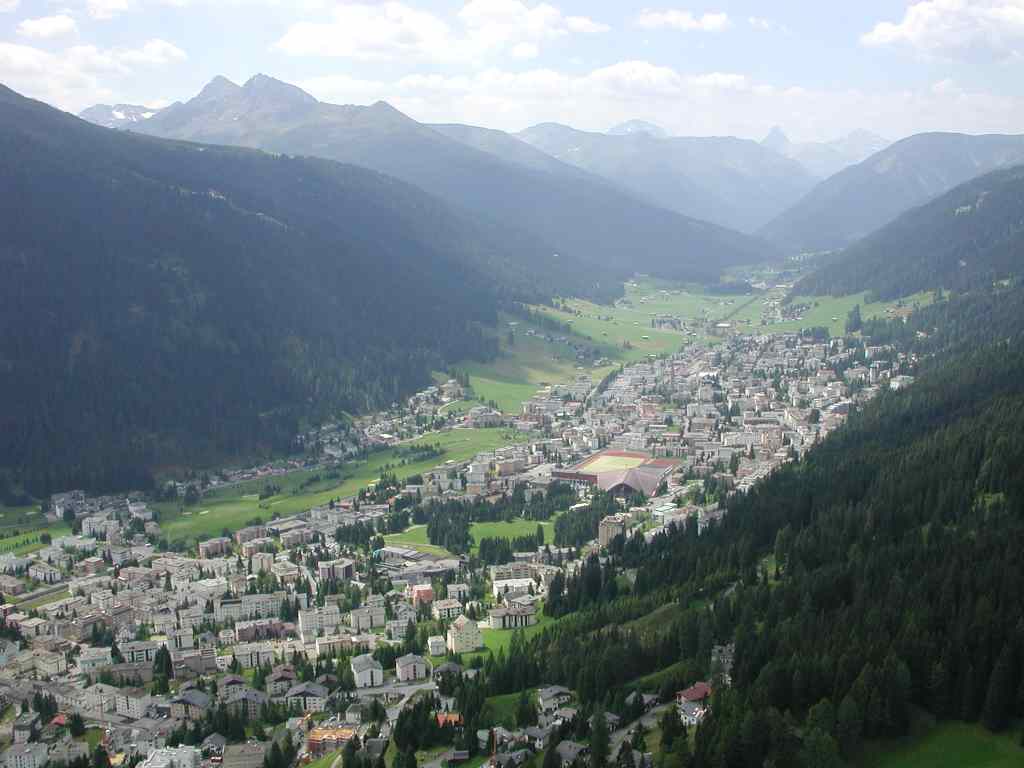
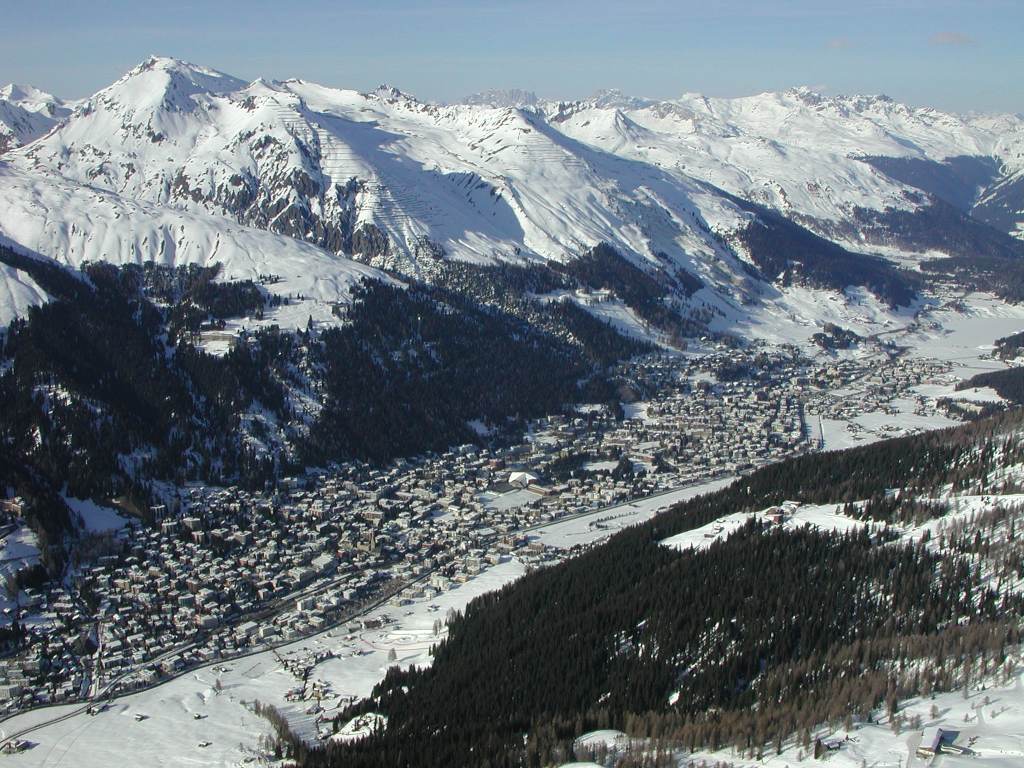
The main village of Davos lies at the top of the narrow valley of the Landwasser at an altitude of 1560 m, just below the Wolfgang Pass. Lake Davos is northeast of the village, formerly the source of the Landwasser.
The municipality of Davos () has an area (as of the 2004/09 survey) of , including most of the Landwasser valley and its side valleys.
Of that area, about 35.0% is used for agricultural purposes, and 22.2% is forested. Of the rest of the land, 2.3% is settled (buildings or roads) and 40.5% is unproductive land. In the 2004/09 survey a total of 337 ha or about 1.2% of the total area was covered with buildings, an increase of 61 ha over the 1985 amount. Over the same time period, the amount of recreational space in the municipality increased by 10 ha and is now about 0.22% of the total area. Of the agricultural land, 1296 ha is fields and grasslands and 9056 ha consists of alpine grazing areas. Since 1985 the amount of agricultural land has decreased by 736 ha. Over the same time period the amount of forested land has increased by 481 ha. Rivers and lakes cover 285 ha in the municipality.
The Wolfgang Pass divides the waters flowing into the Landquart from the valley of the Landwasser, and has a year-round road and Rhaetian Railway connection. Crossing the pass leads to the village of Klosters and the Prättigau. Three long side valleys reach out to the south from the main valley of the Landwasser, one of which leads to the Flüela Pass and the Engadin beyond.
Political divisions
The whole municipality of Davos is divided into six Fraktionsgemeinden: Davos Dorf, Davos Platz, Davos Frauenkirch, Davos Glaris, Davos Monstein and Davos Wiesen. The names of the Fraktionsgemeinden correspond to their largest village within.
Smaller populated places in the municipality are the village of Davos Clavadel, the hamlets of Laret, Wolfgang, Obem See, Meierhof, Stilli, Bünda, and Spina (in the main Landwasser valley), and Tschuggen, Dörfji, In den Büelen, Hof, Teufi, Gadmen, Am Rin, Dürrboden, Sertig Dörfli, Oberalp, Inneralp (in the side valleys).
Until 2017, the municipality was located in the Davos subdistrict of the Prättigau/Davos district. Since 2017, it is part of the Prättigau/Davos Region. In terms of area, it was the largest municipality in Switzerland in 2009 after a municipal merger with Wiesen. Davos lost that distinction after the formation of Glarus Süd in 2010 and today is the fourth-largest municipality in the canton of the Grisons.
Climate
Davos has a subalpine climate (Köppen Dfc) with an average of 125.3 days of precipitation per year and on average receives 1046 mm of precipitation.
The wettest month is August during which time Davos receives an average of 150 mm of precipitation. During this month there is precipitation for an average of 13.6 days. The month with the most days of precipitation is July, with an average of 13.8, but with only 133 mm of precipitation. The driest month of the year is February with an average of 52 mm of precipitation over 7.9 days, of which 74 cm in 11.1 days are snowfall.{{cite web
| Jan record high C = 14.3 | Feb record high C = 14.1 | Mar record high C = 20.6 | Apr record high C = 20.4 | May record high C = 28.0 | Jun record high C = 29.8 | Jul record high C = 30.0 | Aug record high C = 29.0 | Sep record high C = 26.1 | Oct record high C = 23.3 | Nov record high C = 19.5 | Dec record high C = 12.0 | Jan record low C = -32.0 | Feb record low C = -30.2 | Mar record low C = -25.7 | Apr record low C = -20.0 | May record low C = -15.8 | Jun record low C = -3.5 | Jul record low C = -1.1 | Aug record low C = -9.9 | Sep record low C = -6.5 | Oct record low C = -15.5 | Nov record low C = -23.7 | Dec record low C = -26.2 | archive-url=https://web.archive.org/web/20241211071027/https://www.ncei.noaa.gov/data/oceans/archive/arc0216/0253808/5.5/data/0-data/Region-6-WMO-Normals-9120/Switzerland/CSV/Davos_06784.csv | archive-date=11 December 2024 | access-date=11 December 2024}} | access-date = 14 September 2025}}
Politics
Government
The Small Country Council (Kleiner Landrat) constitutes the executive government of the municipality of Davos and operates as a collegiate authority. It is composed of five councilors (), each presiding over a department (Departement) comprising several bureaus. The president of the executive department acts as president of the municipality (Landammann or Gemeindepräsident). In the mandate period 2025–2028 (Legislatur), the Small Country Council is presided by Landammann Philipp Wilhelm. Departmental tasks, coordination measures and implementation of laws decreed by the Grand Country Council are carried by the Small Country Council. The regular election of the municipal councils by any inhabitant valid to vote is held every four years. Any resident of the municipality of Davos allowed to vote and being registered can be elected as a member of the Small Country Council for a maximal period of twelve years. The delegates are selected by means of a system of Majorz. The President is elected as such as well by a public election while the heads of the other departments are assigned by the collegiate. They usually meet once a week.
Davos's Small Country Council is made up of two members of SP (Social Democratic Party), of whom one is the president), and one each of FDP (FDP.The Liberals), SVP (Swiss People's Party), and GLP (Green Liberal Party). The last regular election (Landschaftswahlen) was held on 22 September 2024.
| Country Councilor | |||
|---|---|---|---|
| (Landrat/-rätin) | Party | Head of Department (Vorsteher(in), since) of | Elected since |
| Philipp WilhelmPresident (Landammann or Gemeindepräsident) | SP | President's Office (Präsidialdepartement, 2021) | 2020 |
| Claudia Bieler | SP | Civil Engineering and Public Facilities (Departement Tiefbau + öffentliche Betriebe, 2025) | 2024 |
| Valérie Favre AccolaVice President (Statthalter or Gemeindevizepräsident) | SVP | Structural Engineering and Environmental Protection and Energy (Departement Hochbau + Umweltschutz + Energie, 2025) | 2024 |
| Walter von Ballmoos | GLP | Education and Social Services (Departement Bildung + Soziales, 15 November 2023) | 2023 |
| Jürg Zürcher | FDP | Health and Security (Departement Gesundheit + Sicherheit, 2021) | 2020 |
Parliament
The Grand Country Council (Grosser Landrat) holds legislative power. It is made up of 17 members, with elections held every four years. The Grand Country Council decrees regulations and by-laws that are executed by the Small Country Council and the administration. The delegates are selected by means of a system of Majorz.
The sessions of the Grand Country Council are public. They usually meet ten times a year. Members of the Grand Country Council are not politicians by profession, and they are paid a fee based on their attendance. Any resident of Davos allowed to vote can be elected as a member of the Grand Country Council for a maximal period of twelve years.
The last regular election of the Grand Country Council was held on 22 September 2024 for the mandate period () from January 2025 to December 2028. Currently the Grand Country Council consist of 5 (-1) Liberals (FDP/PLR), 5 (+2) Swiss People's Party (SVP/UDC), 4 (+1) members of Social Democratic Party (SP/PS), 2 (+1) Center Party, and 1 (-1) members of the Green Liberal Party (glp/pvl).
Federal elections
In the 2023 federal election the most popular party was the SVP with 29.1%, (+9.1) of the votes. The next four parties were the SP (17.4%, -3.9), Central Party (16.4%, +10.6), FDP (15.6%, +5.5), and the glp (12.0%, +5.2). In the federal election, a total of 2'874 votes were cast, and the voter turnout was 42.9%.
In the 2019 federal election the most popular party was the SP with 21.3% (+7.6) of the votes. The next four parties were the SVP (20.0%, -10.0), FDP (10.1%, -10.3), CVP (6.8%, +1.6), and the glp (6.8%, -5.3). In the federal election, a total of 2'885 votes were cast, and the voter turnout was 41.8%.
In the 2015 federal election the most popular party was the SVP with 30.0% of the votes. The next five parties were the FDP (20.4%), the BDP (15.8%), the SP (14.7%), the glp (12.1%), and CVP (5.2%). In the federal election, a total of 3,231 votes were cast, and the voter turnout was 46.7%.
Sister cities
Davos has sister city agreements with:
- United States Aspen, Colorado
- France Chamonix-Mont-Blanc
- Japan Ueda, Nagano
Demographics
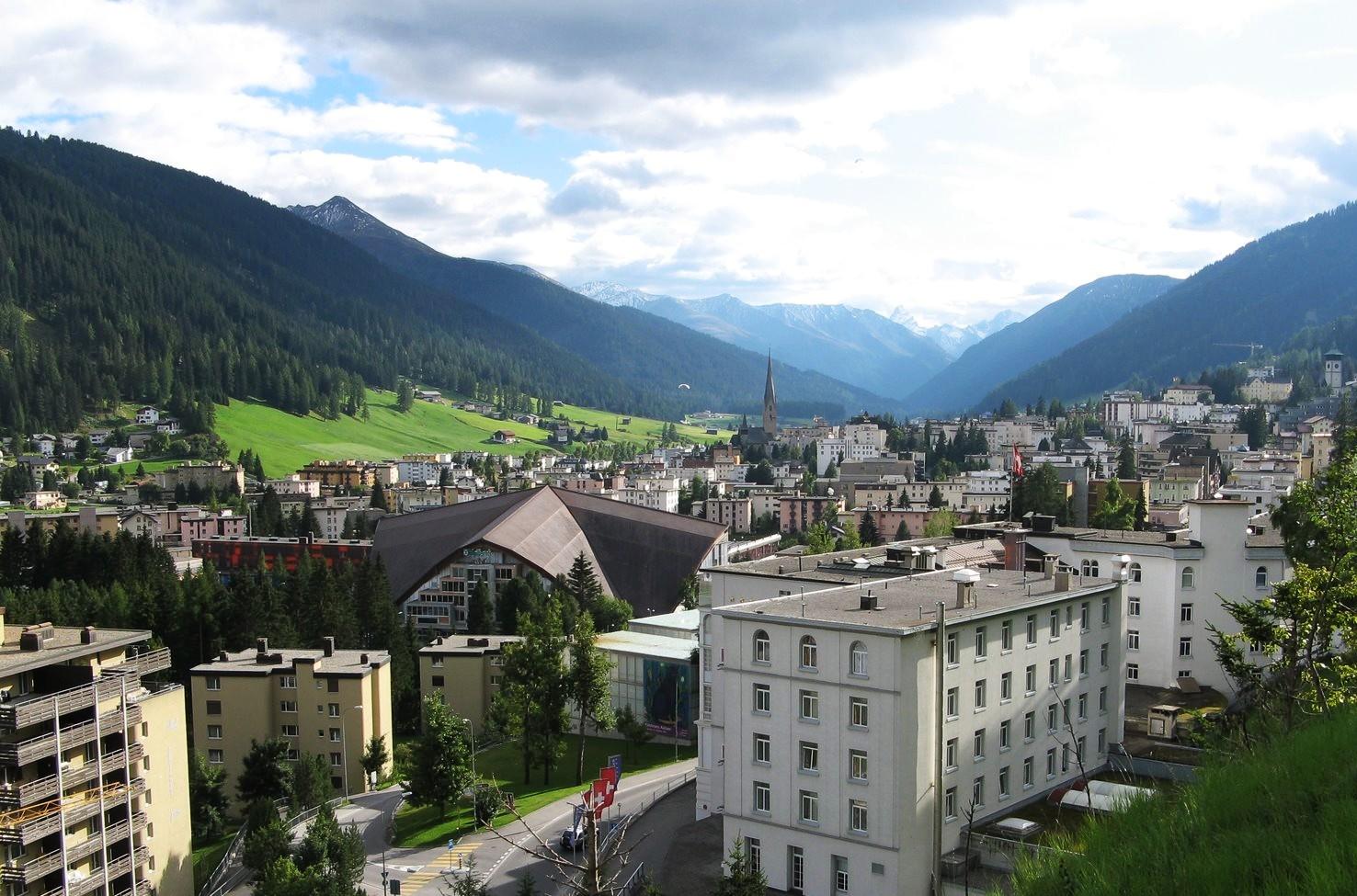
Population
Davos has a population () of . 27.0% of the population are resident foreign nationals. In 2015 7.3% of the population was born in Germany and 6.9% of the population was born in Portugal. Over the last four years (2010–2014) the population has changed at a rate of -0.27%. The birth rate in the municipality, in 2014, was 9.1, while the death rate was 8.2 per thousand residents.
Most of the population () speaks German (86.3%), with Serbo-Croatian being second most common (2.8%) and Italian being third (2.7%).
, children and teenagers (0–19 years old) make up 17.3% of the population, while adults (20–64 years old) are 64.5% and seniors (over 64 years old) make up 18.2%. In 2015 there were 5,099 single residents, 4,666 people who were married or in a civil partnership, 550 widows or widowers and 794 divorced residents.
In 2014 there were 5,441 private households in Davos with an average household size of 2.03 persons. Of the 2,133 inhabited buildings in the municipality, in 2000, about 30.7% were single family homes and 39.1% were multiple family buildings. Additionally, about 25.9% of the buildings were built before 1919, while 8.3% were built between 1991 and 2000. In 2013 the rate of construction of new housing units per 1000 residents was 23.46. The vacancy rate for the municipality, was 0.71%.
Historic population
The historic population is given in the following chart: Colors= id:lightgrey value:gray(0.9) id:darkgrey value:gray(0.8) ImageSize = width: auto height:200 barincrement:45 PlotArea = top:20 left:40 bottom:20 right:35 AlignBars = justify DateFormat = x.y Period = from:0 till:14000 TimeAxis = orientation:vertical AlignBars = justify ScaleMajor = gridcolor:darkgrey increment:2400 start:0 ScaleMinor = gridcolor:lightgrey increment:600 start:0 PlotData= color:yellowgreen width: 35 mark:(line,white) align:center bar:1850 from:start till:1680 text:"1,680" bar:1860 from:start till:1705 text:"1,705" bar:1870 from:start till:2002 text:"2,002" bar:1880 from:start till:2865 text:"2,865" bar:1888 from:start till:3891 text:"3,891" bar:1900 from:start till:8089 text:"8,089" bar:1910 from:start till:9905 text:"9,905" bar:1920 from:start till:9727 text:"9,727" bar:1930 from:start till:11164 text:"11,164" bar:1941 from:start till:9259 text:"9,259" bar:1950 from:start till:10433 text:"10,433" bar:1960 from:start till:9588 text:"9,588" bar:1970 from:start till:10238 text:"10,238" bar:1980 from:start till:10468 text:"10,468" bar:1990 from:start till:10957 text:"10,957" bar:2000 from:start till:11417 text:"11,417" bar:2010 from:start till:11237 text:"11,237" bar:2014 from:start till:11136 text:"11,136" bar:2015 from:start till:12624 text:"12,624"
Education
In Davos about 74% of the population (ages 25–64) have completed either non-mandatory upper secondary education or additional higher education (either a university or a Fachhochschule).
Economy
Davos is a tourist community and a regional center.
, there were a total of 8,853 people employed in the municipality. Of these, a total of 203 people worked in 80 businesses in the primary economic sector. The secondary sector employed 996 workers in 145 separate businesses. Finally, the tertiary sector provided 7,654 jobs in 926 businesses. In 2014 a total of 5,211 employees worked in 908 small companies (less than 50 employees). There were 17 mid sized businesses with 2,074 employees and 1 large business which employed 369 people. In 2014 a total of 23.5% of the population received social assistance.
In 2015 local hotels had a total of 797,348 overnight stays, of which 46.9% were international visitors.
Religion
From the 5,321 residents (46.6% of the population) belonged to the Swiss Reformed Church while 3,950 residents (34.6%) are Roman Catholic. Of the rest of the population, there were 10 individuals (or about 0.09% of the population) who belong to the Christian Catholic faith, 439 individuals (3.85% of the population) who belonged to the Orthodox Church, 274 (2.40%) who belonged to another Christian church, 79 (0.69%) who were Muslim, 56 (0.49%) who belonged to another faith (not listed), and eight residents (0.07%) were Jewish. In addition, 832 residents (7.29%) belonged to no faith, were agnostic or atheist, and 448 individuals (3.92%) did not answer the question.
Sports


Davos's ice hockey team, HC Davos, plays in the National League (NL). Their home arena is the Vaillant Arena. In December of each year, the team and arena host the Spengler Cup, an international tournament first held in 1923.
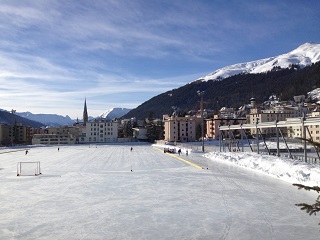
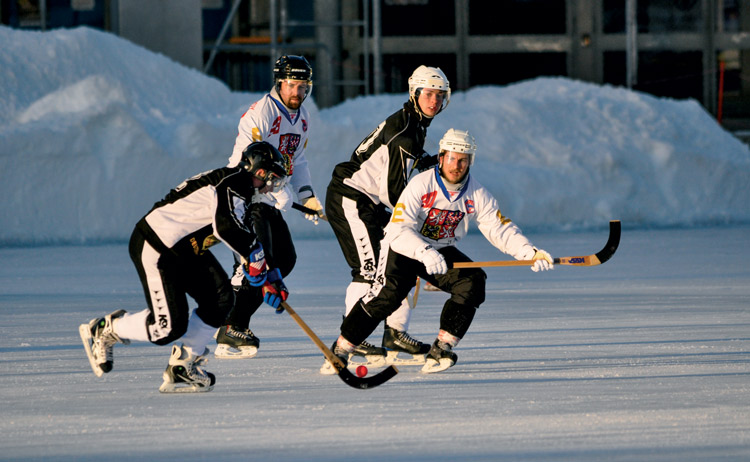
Besides cross-country skiing, offering some 97 km of pistes, Davos has the largest natural ice skating field in Europe. Bandy is occasionally played there. An international tournament, starting in 2014, has been organised. The 1913 European Bandy Championships in Davos is so far the only one of its kind.
Davos has long been a place for the devotees of ice skating, as well as the sport of figure skating. The Dutch, Germans, and Russians have skated there as early as the 1860s. In 1877, the Hotel Belvédère opened a rink used mostly by British skaters; according to figure skating historian James R. Hines, a second rink was opened shortly afterwards to accommodate skaters from Germany and Russia. The Davos Skating Club, which eventually had over 200 members from all over the world, was formed in 1880. Davos hosted eleven World Championships in the years before World War II.
There are six main ski areas in winter, with a total of 320 km of slopes:
- Parsenn / Gotschna which connects to the partner town of Klosters from Davos Dorf
- Jakobshorn which can be reached from Davos Platz directly
- Pischahorn which can be reached by frequently running buses into Flüela valley
- Rinerhorn to start from Davos Glaris
- Madrisahorn located in neighbouring Klosters
- Schatzalp is privately owned by the Schatzalp Hotel and a specialty as a "decelerated" skiing area
All areas offer summer transport as well on to the main peaks from mid May until end of October. The remote side valleys heading towards the Engadine area are worth long hikes towards the passes of Sertig or Scaletta Pass to reach, for example, Piz Kesch, an Ultra prominent peak. To the north there are no valleys but rather a direct one-day ascent to continue across a pass into the "Schanfigg" valley towards the rival resort of Arosa or even to continue to Lenzerheide in a two-day hike.
Culture

Davos is home to seven sites that are listed as Swiss heritage sites of national significance.
These heritage sites include the Town Archives, the Kirchner Museum, the Grosses Jenatschhaus (a type of charity house known as a Pfrundhaus) and the Forest Cemetery (Waldfriedhof). Several hotels and spas are also included on the list. The three hotels or former hotels are: Berghotel Schatzalp, the former Grand Hotel Belvédère, and the Zürcher Höhenklinik von R. Gaberel.
Davos hosts annual meetings of the World Economic Forum. The city was featured in an episode of Viva La Bam, when cities around Europe were visited. On 14 March 2003, a festival called Winterjam was held in the city and bands such as Sum 41, Crazy Town, and Guano Apes performed during this event.
Transport
Davos is part of the rail network of the Rhaetian Railway (RhB). The RhB has two main stations in Davos: (northeast) and (southwest). Other stations in the municipality include and towards Klosters, and , , , and towards Filisur.
The valley station Davos Dorf (Parsennbahn) of the funicular Parsennbahn to Weissfluhjoch (Parsenn) is in Davos Dorf, the station Davos Platz Schatzalpbahn of Schatzalp-Bahn in Davos Platz. Also in Davos Platz are the bottom stations of the cable car to the Jakobshorn, the station Davos Platz DKB (right next to the corresponding railway station), and also that of the chair lift to Usser Isch, namely the Davos Platz (Talstation Carjöl).
The bottom station of the lift to Rinerhorn is right next to RhB station Davos Glaris. The one (Dörfji) of the Pischa area in the side valley of the Flüela, reachable by bus.
Local buses are operated by Verkehrsbetrieb der Landschaft Davos Gemeinde (vbd).
Research
Davos has several research institutes: the AO Foundation focusing on trauma and disorders of the musculoskeletal system, the Swiss Institute of Allergy and Asthma Research (SIAF), the World Radiation Center (PMOD/WRC) and the Institute for Snow and Avalanche Research (SLF) of the Swiss Federal Institute for Forest, Snow and Landscape Research (WSL).
Notable people

.jpg)
_(c._1885).jpg)


The arts
- Sophie Taeuber-Arp (1889 in Davos – 1943), painter, sculptor, architect and dancer
- Dorothea Wieck (1908 in Davos – 1986), a German theatre and film actress
- Ernst Haefliger (1919 in Davos – 2007), tenor
- Eberhard W. Kornfeld (1923–2023), art collector; made Honorary citizen of Davos in 2004
- Jürg Federspiel (1931–2007), writer, grew up in Davos
- Thomas Hirschhorn (born 1957), artist, grew up in Davos
- Marc Forster (born 1969), German and Swiss director and filmmaker, grew up in Davos made freeman of Davos in 2007
Politics, public service and business
- Wilhelm Vischer (1895 in Davos – 1988), a pastor, theologian, Hebraist, Old Testament scholar and amateur Lied lyricist
- Ursula Wyss (born 1973 in Davos), economist, Swiss National Councillor 1999–2013 and former Municipal Councilor of Bern
Science, medicine & TB patients
- Alexander Spengler (1827–1901), a German and Swiss physician, specialised in TB in Davos
- John Addington Symonds (1840–1893), an English poet and literary critic, TB patient in Davos from 1877.
- Friedrich Miescher (1844–1895), biologist who discovered DNA, died in Davos
- Carl Rüedi (1848 in Davos – 1901), a pulmonologist, treated Robert Louis Stevenson
- Robert Louis Stevenson (1850–1894), Scottish novelist and travel writer, TB patient in Davos in the 1880s.
- Oscar Levertin (1862–1906), a Swedish poet and literary historian; lived in Davos 1888–1890.
- Ernst Ludwig Kirchner (1880–1938 in Davos), German artist, TB patient, lived in Davos from 1917; namesake of the local art museum
- Philipp Bauknecht (1884–1933 in Davos), German expressionist painter, TB patient from 1910
- Harry Clarke (1889–1931), an Irish stained-glass artist and book illustrator, TB patient from 1929, buried in Chur
- Klabund (1890–1928 in Davos), aka Alfred Henschke, German writer and painter, TB patient
- Micha Brumlik (1947 in Davos – 2025), a Swiss-German educational theorist and publicist
Sport
- Fritz Kraatz (1906–1992), ice hockey player, competed in the 1928 Winter Olympics
- Paul Söllner (1911 in Davos – 1991), German rower, competed in the 1936 Summer Olympics
- Albert Künzler (1911 in Davos – 1982), ice hockey player, competed in the 1936 Winter Olympics
- Andreas Däscher (1927 in Davos – 2023), ski jumper, competed at the 1956 Winter Olympics and developed the Daescher technique
- Franz Berry (1938 in Davos – 2009), ice hockey player, competed in the 1956 and 1964 Summer Olympics
- Peter Frei (born 1946 in Davos), alpine skier, competed in the 1968 Winter Olympics
- Nicolas Gilliard (born 1947 in Davos), swimmer, competed at the 1968 Summer Olympics
- Paul Accola (born 1967 in Davos), alpine skiing World Cup, overall champion
- Martina Accola (born 1969, Davos), alpine skier, competed in the 1994 and 1998 Winter Olympics
- Andrea Senteler (born 1977), cross-country skier, competed in the 1998 Winter Olympics
- Carmen Schäfer (born 1981 in Davos), a curler
- Andres Ambühl (born 1983 in Davos), ice hockey forward
- Iouri Podladtchikov (born 1988), a Russian-born Swiss snowboarder, brought up in Davos, gold medallist at the 2014 Winter Olympics
- Dino Wieser (born 1989 in Davos), ice hockey forward
- Stefanie Müller (born 1992 in Davos), Alpine snowboarder, competed at the 2014 Winter Olympics
- Claude-Curdin Paschoud (born 1994 in Davos), ice hockey defenceman
References
References
- "Davos". [[HarperCollins]].
- "Davos". [[Oxford University Press]].
- {{Cite American Heritage Dictionary. Davos
- (1957). "Die Aussprache des Hochdeutschen in der Schweiz. Eine Wegleitung". Schweizer Spiegel Verlag.
- "Davos". ortsnamen.ch.
- {{HDS. 1571. Davos
- Pfister, Max. (1989). "Jahrhundertealter Davoser Kampf um Freiheit". Verlag Buchdruckerei Davos.
- Max Pfister (1989) p.14
- Pfister, Max (1989).p.15
- Pfister, Max (1989).p.16
- Pfister, Max (1989).p.17
- "Alexander Spengler Davos Klosters".
- (5 May 2020). "Davos im Zweiten Weltkrieg - Der weltberühmte Kurort war einst ein Nazi-Nest".
- Venetz, Matthias. (13 April 2024). "Davos arbeitet seine Nazi-Vergangenheit auf". Neue Zürcher Zeitung.
- "Davos und der Nationalsozialismus – Veranstaltung zum Stand der Forschung".
- (28 October 2009). "Switzerland".
- (26 August 2012). "Opening Ceremony: IDRC". Idrc.info.
- "Van Leer Family Europe".
- (24 November 2016). "Arealstatistik Land Use - Gemeinden nach 10 Klassen". Swiss Federal Statistical Office.
- [https://www.bfs.admin.ch/bfs/de/home/statistiken/regionalstatistik/regionale-portraets-kennzahlen/gemeinden/daten-erlaeuterungen.assetdetail.328115.html Swiss Federal Statistical Office - Regional portraits] accessed 27 October 2016
- "Fraktionsgemeinden". Gemeinde Davos.
- [https://www.bfs.admin.ch/bfs/de/home/grundlagen/agvch.assetdetail.1666963.html Swiss Federal Statistical Office - Amtliches Gemeindeverzeichnis der Schweiz - Mutationsmeldungen 2016] accessed 16 February 2017.
- "Kleiner Landrat". Gemeinde Davos.
- (27 September 2020). "Erneuerungswahlen der Gemeinde Davos und Volksabstimmung". Gemeinde Davos.
- "Grosser Landrat". Gemeinde Davos.
- (22 October 2023). "Nationalratswahlen 2023: Davos". Kanton Graubünden.
- (22 October 2023). "Nationalratswahlen chronologisch / Nationalratswahlen 2023 / Ergebnisse 2023 /". Bundesamt für Statistik, Swiss Confederation.
- (20 October 2019). "Nationalratswahlen 2019: Davos". Kanton Graubünden.
- (9 March 2016). "Nationalratswahlen 2015: Stärke der Parteien und Wahlbeteiligung nach Gemeinden". Swiss Federal Statistical Office FSO.
- (6 March 2020). "Davos – Switzerland".
- "Ueda ― Davos (1976)".
- [https://www.bfs.admin.ch/bfs/de/home/statistiken/kataloge-datenbanken/daten.assetdetail.325718.html Federal Statistical Office - Ständige und nichtständige Wohnbevölkerung nach institutionellen Gliederungen, Geburtsort und Staatsangehörigkeit (Land)] accessed 31 October 2016
- [http://www.bfs.admin.ch/bfs/portal/en/index/regionen/02/key.html Swiss Federal Statistical Office] {{webarchive. link. (5 January 2016 accessed 28 October 2009)
- de accessed 8 September 2016
- "Swiss Federal Statistical Office STAT-TAB - Thema 09 - Bau- und Wohnungswesen".
- de accessed 27 April 2016
- "Gemeinde Davos: Davos in Zahlen".
- (17 February 2016). "Die Raumgliederungen der Schweiz 2016". Swiss Federal Statistical Office.
- [https://www.bfs.admin.ch/bfs/de/home/statistiken/kataloge-datenbanken/daten.assetdetail.331681.html Federal Statistical Office -Arbeitsstätten und Beschäftigte nach Gemeinde, Wirtschaftssektor und Grössenklasse] accessed 31 October 2016
- [https://www.bfs.admin.ch/bfs/de/home/statistiken/kataloge-datenbanken/daten.assetdetail.252702.html Federal Statistical Office - Hotellerie: Ankünfte und Logiernächte der geöffneten Betriebe] accessed 31 October 2016
- [http://www.gr.ch/DE/institutionen/verwaltung/dvs/awt/dienstleistungen/volkswirtschaftlichegrundlagen/Seiten/Bevoelkerung.aspx Graubunden Population Statistics] {{webarchive. link. (27 August 2009 {{in lang). de accessed 21 September 2009
- "Bandy field at the ice stadium".
- Česká Asociace Bandy. (24 February 2014). "Bandy Davos 2014 (Czech republic vs. Netherlands)".
- "Czech Republic and Germany playing in the international bandy tournament 2014".
- Hines, James R.. (2011). "Historical Dictionary of Figure Skating". Scarecrow Press.
- "Hiking Alps in Switzerland, Davos, Graubünden".
- [http://www.kirchnermuseum.ch/ Kirchner Museum], official website
- [http://www.bevoelkerungsschutz.admin.ch/internet/bs/de/home/themen/kgs/kgs_inventar.html Swiss inventory of cultural property of national and regional significance] {{webarchive. link. (1 May 2009 21 November 2008 version, {{in lang). de accessed 28 October 2009
- "SkisnowboardEurope.com".
- {{Cite EB1911. Waugh. Arthur
- {{Cite EB1911. Gosse. Edmund William
- {{Cite EB1911
This article was imported from Wikipedia and is available under the Creative Commons Attribution-ShareAlike 4.0 License. Content has been adapted to SurfDoc format. Original contributors can be found on the article history page.
Ask Mako anything about Davos — get instant answers, deeper analysis, and related topics.
Research with MakoFree with your Surf account
Create a free account to save articles, ask Mako questions, and organize your research.
Sign up freeThis content may have been generated or modified by AI. CloudSurf Software LLC is not responsible for the accuracy, completeness, or reliability of AI-generated content. Always verify important information from primary sources.
Report