From Surf Wiki (app.surf) — the open knowledge base
David Nutt
English neuropsychopharmacologist
English neuropsychopharmacologist
| Field | Value |
|---|---|
| name | David Nutt |
| image | File:Prof. David Nutt Presenting 2020.jpg |
| image_size | 300 |
| alt | Nutt in 2020 |
| caption | Professor David Nutt, February 2020 |
| birth_date | |
| birth_place | Bristol, England, United Kingdom |
| death_date | |
| resting_place_coordinates | |
| citizenship | British |
| workplaces | Drug Science |
| Imperial College London | |
| University of Cambridge | |
| University of Oxford | |
| University of Bristol | |
| Guy's Hospital | |
| Advisory Council on the Misuse of Drugs (ACMD) | |
| Independent Scientific Committee on Drugs (ISCD) | |
| The European Brain Council | |
| alma_mater | Downing College, Cambridge |
| thesis_title | The effect of convulsions and drugs on seizure susceptibility in rats |
| thesis_url | http://ethos.bl.uk/OrderDetails.do?uin=uk.bl.ethos.345395 |
| thesis_year | 1982 |
| known_for | Founding Drug Science |
| Controversial removal from the Advisory Council on the Misuse of Drugs | |
| Performing the first MRI of a human brain under the influence of LSD | |
| Ecstasy controversy | |
| signature | |
| website | |
| module | |
| education | Bristol Grammar School |
Imperial College London University of Cambridge University of Oxford University of Bristol Guy's Hospital Advisory Council on the Misuse of Drugs (ACMD) Independent Scientific Committee on Drugs (ISCD) The European Brain Council Controversial removal from the Advisory Council on the Misuse of Drugs Performing the first MRI of a human brain under the influence of LSD Ecstasy controversy
David John Nutt (born 16 April 1951) is an English neuropsychopharmacologist specialising in the research of drugs that affect the brain and conditions such as addiction, anxiety, and sleep. He is the chairman of Drug Science, a non-profit which he founded in 2010 to provide independent, evidence-based information on drugs. In 2019 he co-founded the company GABAlabs and its subsidiary SENTIA Spirits which research and market alternatives to alcohol. Until 2009, he was a professor at the University of Bristol heading their Psychopharmacology Unit. Since then he has been the Edmond J Safra chair in Neuropsychopharmacology at Imperial College London and director of the Neuropsychopharmacology Unit in the Division of Brain Sciences there. Nutt was a member of the Committee on Safety of Medicines, and was President of the European College of Neuropsychopharmacology.
Career summary and research
Nutt completed his secondary education at Bristol Grammar School and then studied medicine at Downing College, Cambridge, graduating in 1972. In 1975, he completed his clinical training at Guy's Hospital.
He worked as a clinical scientist at the Radcliffe Infirmary from 1978 to 1982 where he carried out basic research into the function of the benzodiazepine receptor/GABA ionophore complex, the long-term effects of BZ agonist treatment and kindling with BZ partial inverse agonists. This work culminated in a ground-breaking paper in Nature in 1982{{cite journal
In 2007 Nutt published a study on the harms of drug use in The Lancet. Eventually, this led to his dismissal from his position in the Advisory Council on the Misuse of Drugs (ACMD; see government positions below). Subsequently, Nutt and a number of his colleagues who had resigned from the ACMD founded the Independent Scientific Committee on Drugs, later renamed as Drug Science.
Nutt has since produced numerous prominent reports on drug policy through Drug Science, while launching campaigns of support for evidence-based drug policy; including Project Twenty21, Medical Cannabis Working Group, and the Medical Psychedelics Working Group. In 2013, Drug Science launched a peer-reviewed journal - Journal of Drug Science, Policy and Law - for which Nutt was appointed Editor. Nutt also hosts the Drug Science Podcast, in which he engages drug policy experts, policy-makers, and scientists on the topics of drugs and drug policy.
Nutt is the deputy head of the Centre for Psychedelic Research at Imperial College London. He and his team have published research into psilocybin for treatment-resistant depression, as well as neuroimaging studies investigating psilocybin, MDMA, LSD, and DMT.
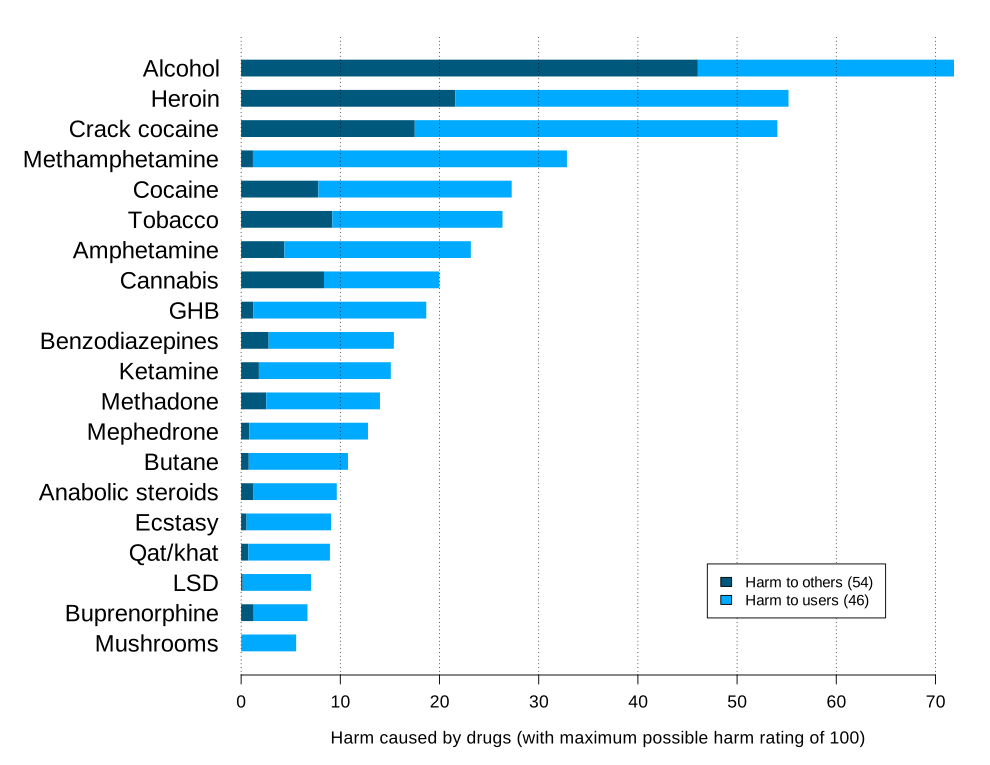
In November 2010, Nutt published a study in The Lancet - co-authored with Les King and Lawrence Phillips, on behalf of the Independent Committee on Drug Science - which ranked the harm done to individual users and broader society by a range of licit and illicit drugs. Owing in part to criticism of the 2007 study for arbitrary weighting of factors, the 2010 study employed a multiple-criteria decision analysis in its procedure to support their conclusion that alcohol is more harmful to society than heroin and crack (cocaine), whereas heroin, crack, and methamphetamine are most harmful to individuals. Nutt has also published popular-level articles on these findings in newspapers and print media for the general public, which have been met with to public disagreement from other researchers.
Nutt continues to campaign for changing UK drug laws to facilitate greater research opportunities.
Alcarelle and GABA Labs
Building on his extensive research on the role of GABA in the brain, and the psychopharmacology of alcohol, since 2014 Nutt has spoken publicly about his desire to bringing-to-market a compound which could act as a "safer" replacement to alcohol and mimic some of its effects – namely, "conviviality" – by affecting the GABA receptor without the negative health impacts of alcohol. Nutt has named the compound "Alcarelle", but has not yet disclosed the exact chemical composition; preliminary tests employed a benzodiazepine derivative, with later adaptations aimed at improving efficacy and reducing abuse potential.
In 2018 Nutt's company GABALabs (previously called "Alcarelle") lodged patents branded as "Alcarelle," for several new compounds proposing to more closely mimic the desired "conviviality" of alcohol. As of October 2019, no research has been published regarding the efficacy, safety, or long-term health impacts of these compounds, nor have they been made publicly available to consumers.
In January 2021, the science team at GABA Labs released-to-market a plant-based functional alcohol alternative, under the brand "Sentia," and advertised as a "botanical spirit" reported to reproduce the relaxed and social effects typically associated with the consumption of alcoholic beverages.
Psychedelics

In collaboration with Amanda Feilding and the Beckley Foundation, Nutt is investigating the effects of psychedelics on cerebral blood flow.
Government positions
Nutt previously worked as an advisor to the Ministry of Defence, Department of Health, and the Home Office.
He served on the Committee on Safety of Medicines where he participated in an inquiry into the use of SSRI anti-depressants in 2003. The inquiry drew criticism for Nutt's participation, based on potential conflict-of-interest over his financial involvement in GlaxoSmithKline, which led to his withdrawal from discussions of the drug paroxetine. In January 2008 he was appointed as chairman of the Advisory Council on the Misuse of Drugs (ACMD), having previously served as Chair of the Technical Committee of the ACMD for seven years.
"Equasy"
.svg)
| author-link4= Colin Blakemore | author-link1= David Nutt As ACMD chairman, government ministers have repeatedly clashed with Nutt over conflicting opinions regarding drug harm and drug classification. In January 2009, Nutt published an editorial in the Journal of Psychopharmacology ("Equasy – An overlooked addiction with implications for the current debate on drug harms") in which the risks associated with horse riding (1 serious adverse event every ~350 exposures) were compared to those of taking ecstasy (1 serious adverse event every ~10,000 exposures).
The word equasy is a portmanteau of ecstasy and equestrianism (based on Latin equus, 'horse'). Nutt told The Daily Telegraph that his intention was "to get people to understand that drug harm can be equal to harms in other parts of life". In 2012, he explained to the UK Home Affairs Committee that he chose riding as the "pseudo-drug" in his comparison after being consulted by a patient with irreversible brain damage caused by a fall from a horse. He discovered that riding was "considerably more dangerous than [he] had thought ... popular but dangerous" and "something ... that young people do".
Equasy has been frequently referred to in later discussions of drug harmfulness and drug policies.
The issue of the mismatch between lawmakers' classification of recreational drugs, in particular that of cannabis, and scientific measures of their harmfulness surfaced again in October 2009, after the publication of a pamphlet containing a lecture Nutt had given to the Centre for Crime and Justice Studies at King's College London in July 2009. In this, Nutt repeated his view that illicit drugs should be classified according to the actual evidence of the harm they cause, and presented an analysis in which nine 'parameters of harm' (grouped as 'physical harm', 'dependence', and 'social harms') revealed that alcohol or tobacco were more harmful than LSD, ecstasy or cannabis. In this ranking, alcohol came fifth behind heroin, cocaine, barbiturates and methadone, and tobacco ranked ninth, ahead of cannabis, LSD and ecstasy, he said. In this classification, alcohol and tobacco appeared as Class B drugs, and cannabis was placed at the top of Class C. Nutt also argued that taking cannabis created only a "relatively small risk" of psychotic illness, and that "the obscenity of hunting down low-level cannabis users to protect them is beyond absurd". Nutt objected to the recent re-upgrading (after 5 years) of cannabis from a Class C drug back to a Class B drug (and thus again on a par with amphetamines), considering it politically motivated rather than scientifically justified. In October 2009 Nutt had a public disagreement with psychiatrist Robin Murray in the pages of The Guardian about the dangers of cannabis in triggering psychosis.
Dismissal
Following the release of this pamphlet, Nutt was dismissed from his ACMD position by the Home Secretary, Alan Johnson. Explaining his dismissal of Nutt, Johnson wrote in a letter to The Guardian that "[Nutt] was asked to go because he cannot be both a government adviser and a campaigner against government policy. [...] As for his comments about horse riding being more dangerous than ecstasy, which you quote with such reverence, it is of course a political rather than a scientific point." Responding in The Times, Professor Nutt said: "I gave a lecture on the assessment of drug harms and how these relate to the legislation controlling drugs. According to Alan Johnson, the Home Secretary, some contents of this lecture meant I had crossed the line from science to policy and so he sacked me. I do not know which comments were beyond the line or, indeed, where the line was [...]". He maintains that "the ACMD was supposed to give advice on policy".
In the wake of Nutt's dismissal, Dr Les King, a part-time advisor to the Department of Health, and the senior chemist on the ACMD, resigned from the body. His resignation was soon followed by that of Marion Walker, Clinical Director of Berkshire Healthcare NHS Foundation Trust's substance misuse service, and the Royal Pharmaceutical Society's representative on the ACMD.
The Guardian revealed that Alan Johnson ordered what was described as a 'snap review' of the 40-strong ACMD in October 2009. This, it was said, would assess whether the body is "discharging the functions" that it was set up to deliver and decide if it still represented value for money for the public. The review was to be conducted by David Omand. Within hours of that announcement, an article was published online by The Times arguing that Nutt's controversial lecture actually conformed to government guidelines throughout. This issue was further publicised a week later when Liberal Democrat science spokesman Dr Evan Harris, MP, attacked the Home Secretary for apparently having misled Parliament and the country in his original statement about Nutt's dismissal.
John Beddington, the Chief Scientific Adviser to the UK Government stated that he agreed with the views of Professor Nutt on cannabis. When asked if he agreed whether cannabis was less harmful than cigarettes and alcohol, he replied: "I think the scientific evidence is absolutely clear cut. I would agree with it." A few days later, it was revealed that a leaked email from the government's Science Minister Lord Drayson was quoted as saying Mr Johnson's decision to dismiss Nutt without consulting him was a "big mistake" that left him "pretty appalled".
On 4 November, the BBC reported that Nutt had financial backing to create a new independent drug research body if the ACMD was disbanded or proved incapable of functioning. This new body, the Independent Scientific Committee on Drugs (later renamed DrugScience), was launched in January 2010 (later on to establish, in 2013, the journal Drug Science, Policy and Law). On 10 November 2009, after a meeting between ACMD and Alan Johnson, three other scientists tendered their resignations, Dr Simon Campbell, a chemist, psychologist Dr John Marsden and scientific consultant Ian Ragan.
In an 11 November 2009 editorial in The Lancet, Nutt explicitly attributed his dismissal to a conflict between government and science, and reiterated that "I have repeatedly stated [cannabis] is not safe, but that the idea that you can reduce use through raising the classification in the Misuse of Drugs Act from class C to class B—where it had previously been placed, but thus now increasing the maximum penalty for possession for personal use to 5 years in prison—is implausible." In a rejoinder, William Cullerne Bown of Research Fortnight pointed out that the framing of science vs. government was misleading because the weighting of the factors in Nutt's 2007 Lancet paper was arbitrary, and consequently that there was no scientific answer to ranking drugs. In reply, Nutt admitted the limitations of the original study, and wrote that ACMD was in the process of devising a multicriteria decision-making approach when he was dismissed. Nutt reiterated that "The repeated claims by Gordon Brown's government that it had scientific evidence that trumped that of the ACMD and the acknowledgment that it was only interested in scientific evidence that supported its political aims was a cynical misuse of scientific evidence that breached the principles of the 1971 Act and was insulting to Council." Nutt announced that he and number of colleagues that had resigned from the ACMD had set up an Independent Scientific Committee on Drugs.
A subsequent review of policy drafted by Lord Drayson essentially reaffirmed that the scientific advisers to the government can be dismissed under similar circumstances: "Government and its scientific advisers should not act to undermine mutual trust." This clause was kept despite protest from Sense about Science, Campaign for Science and Engineering, and Liberal Democrat MP Evan Harris; according to Lord Drayson, the clause was requested by John Beddington, the Chief Scientific Adviser to the UK Government. Leslie Iversen was announced as the successor of Nutt as the chair of the ACMD in January 2010.
Honours
David Nutt is a Fellow of the Royal College of Physicians, Royal College of Psychiatrists and the Academy of Medical Sciences. He holds visiting professorships in Australia, New Zealand and the Netherlands. He is a past president of the British Association of Psychopharmacology and of the European College of Neuropsychopharmacology. He is past president of the British Neuroscience Association and past president of the European Brain Council.
His book Drugs Without the Hot Air (UIT press) won the Salon London Transmission Prize in 2014.
The University of Bath awarded Nutt with an honorary doctorate of laws in December 2019.
Personal life
David Nutt lives in Bristol, with his wife Diana. He has four children.
Nutt is a Patron of My Death My Decision, an organisation which seeks a more compassionate approach to dying in the UK, including the legal right to a medically assisted death, if that is a person's persistent wish.
Publications
Articles
- {{cite journal |author=((Nutt DJ, King LA, Phillips LD; Independent Scientific Committee on Drugs)) |title=Drug harms in the UK: a multicriteria decision analysis |journal=Lancet |volume=376 |issue=9752 |pages=1558–65 |date=November 2010 |pmid=21036393 |doi=10.1016/S0140-6736(10)61462-6 |url= http://www.ias.org.uk/uploads/pdf/News%20stories/dnutt-lancet-011110.pdf
Books
- David J. Nutt (2021). Nutt Uncut. Waterside Press.
- David J. Nutt (2021). Brain and Mind Made Simple. Waterside Press.
- David J. Nutt (2022). Cannabis (seeing through the smoke): The New Science of Cannabis and Your Health. Yellow Kite.
Medical and science
Pharmacotherapy
- 1st ed(2001):.
- 1st ed(1999):.
Brain science
Addiction and associated disorder
Anxiety disorders
- 1st ed(1998):
Other disorders
- 1st ed(2004):.
- 1st(2000):.
Sleep and connected disorder
- (PMC link is a 2-page book review)
References
References
- "Drug Science founded".
- (8 November 2009). "Johnson 'misled MPs over adviser'".
- (11 April 2016). "LSD's impact on the brain revealed in groundbreaking images".
- (18 September 2012). "David Nutt".
- Science and Technology Select Committee. (18 July 2006). "Drug classification: making a hash of it?". [[House of Commons of the United Kingdom.
- "The Truth About Drugs".
- "Professor David Nutt". University of Bristol.
- "Home - Professor David Nutt DM, FRCP, FRCPsych, FSB, FMedSci".
- "David J Nutt". The Royal Institution.
- {{AcademicSearch. 23408530
- [https://web.archive.org/web/20131016060306/http://downloads.bbc.co.uk/podcasts/radio4/tls/tls_20120918-0930a.mp3 bbc.co.uk] David Nutt on The Life Scientific with Jim Al-Khalili, September 2012, BBC Radio 4
- Lucy Goodchild. (8 January 2009). "Addiction, anxiety and Alzheimer's disease tackled by new Chair at Imperial College". Imperial College, London.
- "SAGE Journals: Your gateway to world-class research journals".
- (22 January 2014). "David Nutt elected president of the European Brain Council | Imperial News | Imperial College London".
- "SAGE Journals: Your gateway to world-class research journals".
- "The Drug Science Podcast".
- "People".
- "Research".
- (2010). "Drug harms in the UK: a multicriteria decision analysis". The Lancet.
- Tim Locke (1 November 2010) [http://www.webmd.boots.com/mental-health/alcohol-abuse/news/20101101/alcohol-more-harmful-than-crack-or-heroin-study Alcohol more harmful than crack or heroin: Study. Former government drugs advisor Professor David Nutt produces new measures on the way drugs and alcohol cause harm] {{Webarchive. link. (10 November 2010 , [[WebMD]] Health News)
- (15 January 2010). "The best scientific advice on drugs (written by David Nutt)". The Guardian.
- "Medicinal cannabis: time for a comeback?".
- Nutt, David. (1 March 2014). "Mind-altering drugs and research: from presumptive prejudice to a Neuroscientific Enlightenment?: Science & Society series on "Drugs and Science"". EMBO Reports.
- (2013). "Effects of Schedule I drug laws on neuroscience research and treatment innovation". Nat. Rev. Neurosci..
- (2013). "New victims of current drug laws". Nat Rev Neurosci.
- (26 March 2019). "Could 'alcosynth' provide all the joy of booze – without the dangers?".
- Amy Fleming. (26 March 2019). "Could 'alcosynth' provide all the joy of booze – without the dangers?". The Guardian.
- Journal 6751, GB1813962.6, Applicant: Alcarelle Holdings Limited Title: Mood enhancing compounds. Date Lodged: 28 August 2018
- Journal 6751, GB1813962.9, Applicant: Alcarelle Holdings Limited Title: Mood enhancing compounds. Date Lodged: 28 August 2018
- "Sentia".
- Schuster-Bruce, Catherine. "I tried an alcohol-free, no-hangover drink made by a top professor that claims to make you as relaxed as alcohol does. It hits the spot — but make sure you read the label.".
- (2014-12-06). "Homological scaffolds of brain functional networks". Journal of the Royal Society Interface.
- Carhart-Harris R, Kaelen M, Nutt DJ [2014] How do hallucinogens work on the brain? http://thepsychologist.bps.org.uk/volume-27/edition-9/how-do-hallucinogens-work-brain {{Webarchive. link. (5 October 2018)
- Nutt DJ [2014] A brave new world for psychology? The Psychologist Special issue: http://thepsychologist.bps.org.uk/volume-27/edition-9/special-issue-brave-new-world-psychology
- (2014). "Homological scaffolds of brain functional networks". J. R. Soc. Interface.
- Muthukumaraswamy S, Carhart-Harris R, Moran R, Brookes M, Williams M, Erritzoe D, Sessa B, Papadopoulos A, Bolstridge M, Singh K, Fielding A, Friston K, Nutt DJ (2013) [http://www.psychedelicscience.org.uk/wp-content/uploads/2015/09/JNEURO_MEG.pdf Broadband cortical desynchronisation underlies the human psychedelic state] The Journal of Neuroscience, 18 September 2013 • 33(38):15171–15183
- Hobden P, Evans J, Feilding A, Wise RG, Nutt DJ (2012) Neural correlates of the psychedelic state as determined by fMRI studies with psilocybin PNAS 1-6 10.1073/pnas.1119598109
- Sarah Boseley. (17 March 2003). "Drugs inquiry thrown into doubt over members' links with manufacturers". The Guardian.
- (2009-01-21). "Equasy -- an overlooked addiction with implications for the current debate on drug harms". Journal of Psychopharmacology.
- (9 February 2009). "Home Office's drugs adviser apologises for saying ecstasy is no more dangerous than riding a horse". [[The Daily Telegraph]].
- "House of Commons: Oral Evidence Taken Before the Home Affairs Committee - Drugs: Breaking the Cycle - Minutes of Evidence (HC 184-II)". Parliament of the United Kingdom.
- (8 November 2015). "Why does someone dying from alcohol poisoning get no media coverage, while an ecstasy-related death does?". [[The Independent]].
- (2014). "Book Review: 'The Norm Chronicles' by Michael Blastland and David Spiegelhalter". [[The Wall Street Journal]].
- (2014). "Die großen Fragen Ethik".
- (January 2024). "Sanación psicodélica para el siglo XXI". Michael Watts.
- (2015). "Deadly Psychiatry and Organised Denial". Art People.
- "David Nutt's pamphlet 'Estimating drug harms: a risky business?'".
- Jones, Sam. (1 November 2009). "David Nutt's sacking provokes mass revolt against Alan Johnson". The Guardian.
- Vuillamy, Ed. (24 July 2011). "Richard Nixon's 'war on drugs' began 40 years ago, and the battle is still raging". The Guardian.
- Dominic Casciani. (30 October 2009). "Profile: Professor David Nutt". BBC.
- [[Robin Murray]], [https://www.theguardian.com/commentisfree/2009/oct/29/cannabis-schizophrenia-classification A clear danger from cannabis], ''[[The Guardian]]'', 29 October 2009 replying to David Nutt [https://www.theguardian.com/commentisfree/2009/oct/29/cannabis-david-nutt-drug-classification The cannabis conundrum], ''The Guardian'', 29 October 2009
- Johnson, Alan. (2 November 2009). "Why Professor David Nutt was shown the door". The Guardian.
- Nutt, David. (2 November 2009). "Penalties for drug use must reflect harm". The Times.
- Nutt, David: Drugs - without the hot air. UIT Cambridge, 2012. page 4
- (1 November 2009). "Government drugs adviser resigns". BBC News.
- (1 November 2009). "Second drugs adviser quits post". BBC News.
- Travis, Alan. (2 November 2009). "Alan Johnson orders swift review of drugs advice body". The Guardian.
- Henderson, Mark. (2 November 2009). "David Nutt's controversial lecture conformed to government guidelines". The Times.
- (8 November 2009). "Johnson 'misled MPs over adviser'". BBC News.
- Ghosh, Pallab. (3 November 2009). "Science chief backs cannabis view". BBC News.
- (6 November 2009). "Minister 'backs adviser autonomy'". BBC News.
- (4 November 2009). "Nutt vows to set up new drug body". BBC News.
- (10 November 2009). "Three more drugs advisers resign". BBC News.
- (2009). "Government vs science over drug and alcohol policy". The Lancet.
- (2010). "Nutt damage". The Lancet.
- (2010). "Nutt damage – Author's reply". The Lancet.
- "Scientific advice to government: principles".
- Nick Dusic (24 March 2010) [http://blog.sciencecampaign.org.uk/?p=874 Principles of Scientific Advice], [[Campaign for Science and Engineering]]
- (29 April 2018). "Focus on cannabis 'past history'". BBC News.
- He was the recipient of the 2013 [[John Maddox Prize]] for promoting sound science and evidence on a matter of public interest, whilst facing difficulty or hostility in doing so.{{YouTube. tDFvaQq_YBs. David Nutt: John Maddox Prize winner 2013
- "List of Officers". European Brain Council.
- "List of Transmission Prize winners". [[Foyles]].
- "Professor David Nutt: oration".
- Nutt, David. (2021). "Nutt Uncut". Waterside Press.
- "About Us".
- Kupferschmidt, Kai. (31 January 2014). "The Dangerous Professor". Science.
This article was imported from Wikipedia and is available under the Creative Commons Attribution-ShareAlike 4.0 License. Content has been adapted to SurfDoc format. Original contributors can be found on the article history page.
Ask Mako anything about David Nutt — get instant answers, deeper analysis, and related topics.
Research with MakoFree with your Surf account
Create a free account to save articles, ask Mako questions, and organize your research.
Sign up freeThis content may have been generated or modified by AI. CloudSurf Software LLC is not responsible for the accuracy, completeness, or reliability of AI-generated content. Always verify important information from primary sources.
Report