From Surf Wiki (app.surf) — the open knowledge base
David Carradine
American actor (1936–2009)

American actor (1936–2009)
| Field | Value | |
|---|---|---|
| name | David Carradine | |
| image | David Carradine 1987 (cropped).jpg | |
| caption | Carradine in 1987 | |
| birth_name | John Arthur Carradine Jr. | |
| birth_date | ||
| birth_place | Los Angeles, California, U.S. | |
| death_date | ||
| death_place | Bangkok, Thailand | |
| resting_place | Forest Lawn Memorial Park, Hollywood Hills | |
| alma_mater | ||
| occupation | ||
| works | Filmography | |
| years_active | 1963–2009 | |
| father | John Carradine | |
| relatives | ||
| spouse | ||
| <!--Partner section only for long-term/unmarried, life partners, not girlfriends or fiancées.--> | partner | Barbara Hershey (1968–1975) |
| children | 3 | |
| family | Carradine | |
| website |
David Carradine ( ; born John Arthur Carradine Jr.; December 8, 1936 – June 3, 2009) was an American actor, director, and producer, whose career included over 200 major and minor roles in film, television and on stage. He was widely known to television audiences as the star of the series Kung Fu (1972–1975), playing Kwai Chang Caine, a peace-loving Shaolin monk traveling through the American Old West.
A member of the Carradine family of actors, he got his break playing Atahuallpa in the 1965 Broadway production of The Royal Hunt of the Sun. He became known for his B movie and martial arts roles, particularly as Big Bill Shelly in Martin Scorsese's Boxcar Bertha (1972), Frankenstein in Death Race 2000 (1975), the titular character in Cannonball (1976), Kaz Oshay in Deathsport (1978), Detective Shepherd in Q – The Winged Serpent (1982), and Rawley Wilkes in Lone Wolf McQuade (1983). He portrayed Woody Guthrie in the biopic Bound for Glory (1976), which earned him a Golden Globe nomination for Best Actor – Motion Picture Drama. He also received Golden Globe nominations for Kung Fu and for the television miniseries North and South (1985), as well as an Emmy Award nomination, also for Kung Fu.
Carradine experienced a resurgence after playing the title character in Quentin Tarantino's Kill Bill duology (2003–2004). The role of Bill earned him his fourth Golden Globe nomination and he won the Saturn Award for Best Supporting Actor. On April 1, 1997, Carradine received a star on the Hollywood Walk of Fame.
Throughout his life, Carradine was arrested and prosecuted for a variety of offenses, which often involved substance abuse. Films that featured Carradine continued to be released after his death. In addition to his acting career, Carradine was a director and musician. Influenced by his Kung Fu role, he studied martial arts, particularly Shaolin quan. In 2014, Carradine was posthumously inducted into the Martial Arts History Museum Hall of Fame.
On June 4, 2009, he was found dead in a hotel room in Bangkok, Thailand hanging from a rope tied around his neck and genitals. The cause of death was determined to be accidental death by auto-erotic asphyxiation.
Early life
Main article: Carradine family
Carradine was born John Arthur Carradine Jr., on December 8, 1936, in Hollywood, California, the eldest child of actor John Carradine and his wife Ardanelle Abigail (née McCool) Carradine. He was a half-brother of Bruce, Keith, Christopher, and Robert Carradine, and an uncle of Ever Carradine and Martha Plimpton, most of whom are also actors. Primarily of Irish descent, he was a great-grandson of Methodist evangelical author Beverly Carradine and a grandnephew of artist Will Foster. Called "Jack" by his family, Carradine had a turbulent childhood. His parents divorced and repeatedly remarried; he was born during his mother's second marriage of three, and his father's first of four. At the time of Carradine's parents' marriage, his mother already had a son by her first husband, whom John Carradine adopted. John Carradine had planned to have a large family, but later he discovered his wife had gotten two abortions without his knowledge, and afterward a miscarriage rendered her unable to carry a baby to term.
Against this backdrop of marital discord, Carradine almost died by suicide by hanging at the age of five. He said the incident followed his discovery that he and his elder half-brother, Bruce, had different biological fathers. Carradine added, "My father saved me, and then confiscated my comic book collection and burned it—which was scarcely the point." After three years of marriage, Ardenelle filed for divorce from John, but they remained married for five more years. They divorced in 1944, when Carradine was seven. His father left California to avoid court action in the alimony settlement. After the couple had a series of court battles over child custody and alimony, which at one point landed John in jail, Carradine joined his father in New York City; by this time, his father had remarried. On December 25, 1947, Carradine appeared in a live telecast adaptation of A Christmas Carol, with his father in the role of Ebenezer Scrooge. For the next few years, Carradine spent time in boarding schools, foster homes, and reform school. He also often accompanied his father to summer theater throughout the Northeast. Carradine spent time in Massachusetts, and a winter milking cows on a farm in Vermont.
Oakland
Eventually, Carradine returned to California, where he graduated from Oakland High School. He attended Oakland Junior College (now Laney College) for a year before transferring to San Francisco State College, where he studied drama and music theory, and wrote music for the drama department's annual revues while juggling menial jobs, a fledgling stage acting career, and his studies. After he dropped out of college, Carradine spent some time with the "beatniks" of San Francisco's North Beach and southern California's Venice. During this time he collected unemployment insurance and sold baby pictures. He was also prosecuted for disturbing the peace.
Army service
Despite an attempt to dodge the draft, in 1960, Carradine was inducted into the United States Army, where he drew pictures for training aids. That Christmas he married his high school sweetheart, Donna Lee Becht. While stationed at Fort Eustis, Virginia, he helped establish a theater company that became known as the "entertainment unit". He met fellow inductee Larry Cohen, who later cast him in Q, The Winged Serpent. He also faced court-martial for shoplifting. In 1962, Donna gave birth to their daughter, Calista. Carradine was honorably discharged after two years of active duty.
Film and television career
Early television and film appearances
Upon leaving the Army, Carradine became serious about acting. He was advised to change his name to avoid confusion with his famous father. In an interview from 2005 Carradine says his father encouraged him going into acting: "The first thing I ever did outside of school, which was a production of Romeo & Juliet, he came up from Hollywood to San Francisco to see it. And right after he just sort of opened up to me with all this advice. He became very proud of me."
In 1963, he made his television debut on an episode of Armstrong Circle Theatre, "Secret Document X256" followed by several other television roles*.* In 1964 Carradine got a contract with Universal. The studio gave him his feature film debut in Taggart (1964), a Western based on a Louis L'Amour novel.
In May 1964, Carradine joined the cast of the Broadway play The Deputy by Rolf Hochhuth, replacing Jeremy Brett. When the play ended he was still under contract to Universal, and resumed TV work. He spent a lot of time playing, in his words, "greenhorns in Westerns and villains in thrillers". Carradine guest-starred in The Trials of O'Brien in episodes that were cut together and released theatrically as Too Many Thieves (1967), and Coronet Blue.
''The Royal Hunt of the Sun''
Carradine's first big break came with his second Broadway part in The Royal Hunt of the Sun, a play by Peter Shaffer about the destruction of the Inca civilization by conquistador Francisco Pizarro. Carradine played Atahuallpa opposite Christopher Plummer as Pizarro. The play premiered in October 1965 and was a solid hit, running for 261 performances. Carradine said of this performance, "Many of the important roles that I got later on were because the guy who was going to hire me was in that audience and had his mind blown." For that part, Carradine won a Theatre World Award for Best Debut Performance in 1965. He was also named as one of Theatre World's Promising Personalities from Broadway and Off Broadway. (The play was filmed in 1968 with Plummer taking Carradine's part.)
''Shane'' and supporting actor roles
Carradine left the production of Royal Hunt of the Sun in May 1966 to take up an offer to star in the TV series Shane, a 1966 Western based upon a 1949 novel of the same name. Carradine played the title role opposite Jill Ireland. "I know I have some kind of vision that most actors and directors don't have", he said, "so it becomes a duty to exercise that vision. It's a responsibility, a mission." The show only lasted 17 episodes, despite good reviews. Carradine said his career was "rescued" when he was cast in Johnny Belinda (1967). He was in demand as a supporting actor, mostly in Westerns: The Violent Ones (1967), Heaven with a Gun (1969), Young Billy Young (1969) for Burt Kennedy, The Good Guys and the Bad Guys (1969) with Kennedy, The McMasters (1970), and Macho Callahan (1970). He was unhappy playing villains and told his agent he wanted to stop, which led to his not working in Hollywood for a year. He was cast in a musical, The Ballad of Johnny Pot, but fired two days before opening night on Broadway. In 1972, he co-starred as "Big" Bill Shelly in one of Martin Scorsese's earliest films, Boxcar Bertha, which starred Barbara Hershey, his partner at the time. This was one of several Roger Corman productions in which he appeared. It was also one of a handful of acting collaborations he did with his father. He made his feature directorial debut with the film You and Me, starring alongside Hershey and his brothers Keith and Robert. It was shot in 1972, between making the Kung Fu pilot and the series, but released in 1975.
''Kung Fu''


For three seasons, Carradine starred as the half-Chinese/half-white American Shaolin monk Kwai Chang Caine in the ABC hit TV series Kung Fu (1972–1975). The role was nominated for an Emmy and a Golden Globe Award. Along with Bruce Lee films, Kung Fu helped popularize the martial arts and Eastern philosophy in the west. Carradine's character also brought the term "grasshopper" (referring to an apprentice) into popular culture.
Racial controversy Although the choice of a non-Asian to play the role of Kwai Chang Caine stirred controversy, the show provided steady employment for a number of Asian-American actors. In addition to Keye Luke and Philip Ahn, who held leading roles in the cast as Caine's Shaolin masters, Robert Ito, James Hong, Benson Fong, Richard Loo, and Victor Sen Yung frequently appeared in the series. A second controversy was over whose idea the series had been. Bruce Lee's widow claimed he had come up with the idea of a wandering monk in the Old West, but Ed Spielman, the series' creator, insisted that the concept was his own idea from years before Lee became a star. In an interview from 2005 Carradine disputed Bruce Lee's claim: "That's mythology. I think the way that story started was that they got it mixed up with The Silent Flute. Not sure how that happened." In his authoritative biography Bruce Lee: A Life, Matthew Polly clarifies the issue of Bruce Lee's involvement, concluding that the claim was the result of his not being cast for the leading role, and that he had no participation in the creation of the series.
Kung Fu ended due to several factors. It has been said that Carradine left the show after sustaining injuries that made it impossible for him to continue. While Carradine mentioned it when talking about his work in film, other causes involved were Carradine's burnout, changes in the writing and shooting that altered the show's quality, and changes in the time slot, which led to audience decline. Finally, the main reason was Carradine's decision to quit to pursue a career as a film actor and filmmaker. Also, the bad publicity from a 1974 peyote-related incident involving Carradine affected the ratings; Radames Pera described it as sabotage, which Carradine himself acknowledged had been detrimental to the series. Carradine's annual salary on the show was reportedly $100,000.
Film stardom
Immediately after Kung Fu, Carradine accepted the role of the racecar driver Frankenstein in Death Race 2000 (1975), he said, to "kill the image of Caine and launch a movie career." The role had originally been offered to Peter Fonda, who was not available. The film, directed by Paul Bartel and produced by Roger Corman, became a cult classic for New World Pictures. Carradine got 10% of the profits and made significant money from it. Carradine was tapped to play Duke Leto Atreides in Alejandro Jodorowsky's aborted Dune adaptation in the late 1970s. In 1976, he earned critical praise for his portrayal of folksinger Woody Guthrie in Hal Ashby's Bound for Glory, for which he won a National Board of Review Award for Best Actor and was nominated for a Golden Globe Award and New York Film Critics Circle Award. Carradine worked very closely with his friend, singer-songwriter-guitarist Guthrie Thomas, on the film. Thomas assisted Carradine in the guitar style of the period and the songs that had been chosen to be in the film.
In 1978, Carradine starred Deathsport, an unofficial sequel to Death Race 2000. When Bruce Lee died in 1973, he left an unreleased script he developed with James Coburn and Stirling Silliphant, The Silent Flute. The script became Circle of Iron (1978), and in the film, Carradine played the four roles originally intended for Lee. Carradine considered this among his best work.
Directing work and 1980s-90s career
Carradine returned to the director's chair with Americana (1981), which he also starred in, produced and edited. The film took ten years to complete due to difficulty in financing. It featured several of his friends and family members in supporting roles. It won the People's Choice Award at the Director's Fortnight at Cannes, but failed to achieve critical support or adequate distribution. He also directed the unreleased *Mata Hari'', an epic that starred his daughter, Calista.
Carradine attracted notice in 1985 when he appeared in a major supporting role in North and South, a miniseries about the American Civil War, as the evil and abusive Justin LaMotte. He was nominated for a Golden Globe for Best Supporting Actor for his performance.
Carradine reprised his role as Caine in Kung Fu: The Movie (1986) for TV, which he also produced. It was the acting debut of Bruce Lee's son, Brandon Lee.
He remained in demand as the star for cheaper action films, including straight-to-video, throughout the 80s and 90s.
In a 2005 interview, Carradine talks about a period in his career in which he worked as much as he could. Psychotronic Magazine gave him an award for the "Most Working Actor in the Universe". Carradine commented that he received it "because I did nineteen movies in eighteen months. And they actually missed a couple!" He further stated, "That whole era of independent movies died. They clotted the market. I didn't know how to get out of that, so I did [the second series of Kung Fu]".
''Kung Fu: The Legend Continues''
Carradine played the part of the grandson and namesake of the original Kwai Chang Caine in Kung Fu: The Legend Continues, a new TV series that ran from 1993 to 1997, and consisted of 88 episodes. Carradine also worked as a producer and directed one episode. In 1997, Carradine was awarded a star on the Hollywood Walk of Fame. The presenters played an April Fool's Day prank on him by first unveiling a star bearing the name of his brother, Robert.
In the early 2000s Carradine was increasingly becoming a support actor in films.
''Kill Bill''
Carradine enjoyed a revival of his fame when he was cast in Quentin Tarantino's Kill Bill films, Kill Bill: Volume 1 (2003) and Kill Bill: Volume 2 (2004). Scott Mantz of The Mediadrome said of his performance, "Carradine practically steals every scene he's in with confident gusto, and he gives a soulful performance that should all but ensure a spot on next year's Oscar ballot." Roger Ebert and Richard Roeper both had Kill Bill Vol. 2 on their top ten list for Academy Awards predictions. Although the films received no notice from the Academy, Carradine did receive a Golden Globe nomination and a Saturn Award for Best Supporting Actor for his portrayal of Bill. [[File:Carradine.jpg|Carradine in 2005|thumb|upright]]
Posthumous releases
Carradine still had approximately a dozen films in post-production at the time of his death in 2009. Most of these roles were cameos or small parts in independent, direct-to-DVD productions.
Carradine appeared in a minor role in Yuen Woo-ping's Chinese kung fu epic True Legend; they had first met while filming Kill Bill. Yuen eulogized Carradine on the True Legend website, describing him as a "good friend". Yuen said of Carradine:
His final released film was the cult independent film Night of the Templar (2013), directed by his friend Paul Sampson.
Carradine co-produced a full-length documentary about luthier Stuart Mossman, which has been identified as the actor's last film appearance. The Legend of Stuart Mossman: A Modern Stradivari, directed by Barry Brown, premiered at the Santa Barbara International Film Festival, in February 2010.
Martial artist
Carradine knew nothing of the practice of kung fu at the time he was cast in the role of Kwai Chang Caine; instead, he relied on his experience as a dancer for the part. He also had experience in sword fighting, boxing, and street fighting on which to draw.
Music career
In addition to his acting career, Carradine was a musician. He sang and played the piano, the guitar, and the flute, among other instruments. In 1970, Carradine played one half of a flower power beatnik duo in the season 4 Ironside episode, "The Quincunx", performing the songs "I Stepped on a Flower", "Lonesome Stranger", and "Sorrow of the Singing Tree". He recorded an album titled Grasshopper, which was released in 1975. His musical talents were often integrated into his screen performances. He performed several of Woody Guthrie's songs for the film Bound for Glory. For the Kung Fu series, he made flutes out of bamboo that he had planted on the Warner Brothers lot. He later made several flutes for the film Circle of Iron, one of which he later played in Kill Bill. Carradine wrote and performed the theme songs for at least two films that he starred in, Americana and Sonny Boy. The first line from the Sonny Boy theme, "Paint", which he wrote while filming Americana in 1973, is engraved on his headstone. He wrote and performed several songs for American Reel (2003) and wrote the score for You and Me. He and his brother, Robert, also performed with a band, the Cosmic Rescue Team (also known as Soul Dogs). The band performed primarily in small venues and at charity benefits.
Personal life
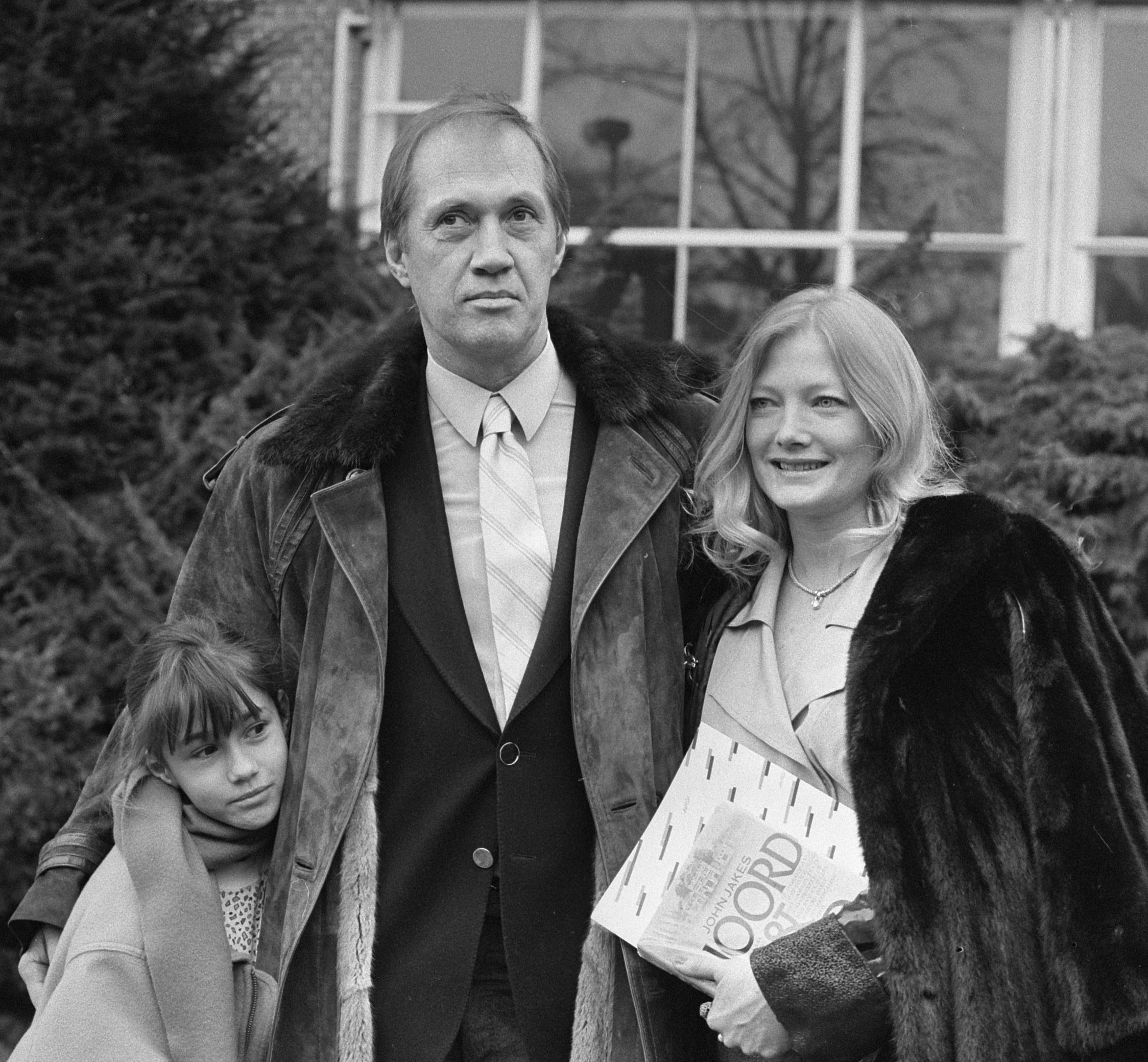
Shortly after being drafted into the U.S. Army in 1960, Carradine proposed to Donna Lee Becht (born September 26, 1937), whom he had met when they were students at Oakland High School; they married on Christmas Day that year. She lived with him off-base when he was stationed at Fort Eustis in Virginia. In April 1962, she gave birth to their daughter Calista. After Carradine's discharge, the family lived in New York while Carradine established his acting career, appearing on Broadway in The Deputy and Royal Hunt of the Sun. The marriage dissolved in 1968, whereupon Carradine left New York and headed back to California to continue his television and film careers.
In 1968, Carradine met actress Barbara Hershey while the two of them were working on Heaven with a Gun. The pair lived together until 1975. They appeared in other films together, including Martin Scorsese's Boxcar Bertha. In 1972, they appeared together in a nude Playboy spread, recreating some sex scenes from Boxcar Bertha. That year, Hershey gave birth to their son, Free (who, when aged nine, changed his name to Tom, much to his father's chagrin). The couple's relationship fell apart around the time of Carradine's 1974 burglary arrest, when Carradine began an affair with Season Hubley, who had guest-starred on Kung Fu. Carradine was engaged to Hubley for a time, but they never married.
In February 1977, Carradine married his second wife Linda (née Linda Anne Gilbert) in a civil ceremony in Munich, Germany, after filming The Serpent's Egg. Gilbert was previously married to Roger McGuinn of The Byrds. Their daughter, Kansas, was born in 1978. Carradine's second marriage ended in divorce, as did the two that followed: he was married to Gail Jensen from 1986 to 1997, and to Marina Anderson from 1998 to 2001.
On December 26, 2004, Carradine married his fifth wife, widow Annie Bierman
Arrests and prosecutions
In the late 1950s, while living in San Francisco, Carradine was arrested for assaulting a police officer. He pleaded guilty to a lesser charge of disturbing the peace. While in the Army, he faced court-martial on more than one occasion for shoplifting. After he became an established actor and had changed his name to David, he was arrested in 1967 for possession of marijuana.
In 1974, at the height of his popularity in Kung Fu, Carradine was arrested again, this time for attempted burglary and malicious mischief. While under the influence of peyote, Carradine began wandering nude around his Laurel Canyon neighborhood. He broke into a neighbor's home, smashing a window and cutting his arm, and accosted two young women, allegedly assaulting one while asking her if she was a witch. Carradine pleaded no contest to the mischief charge and was given probation. He was never charged with assault, but the young woman sued him for $1.1 million and was awarded $20,000.
In 1980, while in South Africa filming Safari 3000 (also known as Rally), which co-starred Stockard Channing, Carradine was arrested for possession of marijuana. He was convicted and given a suspended sentence. He claimed that he had been framed by the apartheid government, as he had been seen dancing with Tina Turner.
During the 1980s, Carradine was arrested at least twice for driving under the influence of alcohol, once in 1984 and again in 1989. In the second case, Carradine pleaded no contest. Of this incident, the Los Angeles Times reported: "Legal experts say Carradine was handed a harsher-than-average sentence, even for a second-time offender: three years' summary probation, 48 hours in jail, 100 hours of community service, 30 days' work picking up trash for the California Department of Transportation, attendance at a drunk driving awareness meeting and completion of an alcohol rehabilitation program."
In 1994, in Toronto, filming Kung Fu: The Legend Continues, Carradine was arrested for kicking in a door at the SkyDome while attending a Rolling Stones concert. He later claimed that he was trying to avoid being swarmed by fans.
Death

Carradine arrived in Bangkok, Thailand, on May 31, 2009, to shoot the film Stretch. He was last seen alive on June 3, but he could not be contacted after he failed to appear for a meal with the film crew.
On June 4, Carradine was found dead in his room at the Swissôtel Nai Lert Park Hotel. He was 72 years old. Lieutenant Teerapop Luanseng and Lieutenant Colonel Pirom Jantrapirom said that Carradine was found naked and had hanged himself in the room's closet with a curtain cord. Police said he had been dead for at least 12 hours and found no sign of struggle. Thai police suggested the death might have been from accidental suffocation, since there was no suicide note and he was found with a rope tied to both his neck and his genitals. His funeral was held on June 13. On July 1, 2009, Michael Baden, the medical examiner hired by Carradine's family to conduct his autopsy, stated that the actor died from asphyxiation, and that the way Carradine's body was bound allowed him to rule out suicide.
Filmography
Main article: David Carradine filmography
Awards and honors
- 1966: Winner – Theatre World Award, for The Royal Hunt of the Sun
- 1973: Nominee – Primetime Emmy Award. Outstanding Continued Performance by an Actor in a Leading Role (Drama Series - Continuing), for Kung Fu
- 1974: Nominee – Golden Globe Awards. Best Television Actor - Drama Series, for Kung Fu
- 1974: Winner – TP de Oro, Spain. Mejor actor extranjero (Best Foreign Actor), for Kung Fu
- 1974: Nominee – TP de Oro, Spain. Personaje más popular (Most Popular Character), for Kung Fu
- 1976: Winner – National Board of Review Award. Best Actor, for Bound for Glory
- 1976: Nominee – New York Film Critics Circle Award. Best Actor, for Bound for Glory
- 1977: Nominee – Golden Globe Awards. Best Actor - Motion Picture Drama, for Bound for Glory
- 1986: Nominee – Golden Globe Awards. Best Supporting Actor - Television, for North and South
- 1997: Honoree – Gold Star on the Hollywood Walk of Fame, Television
- 1998: Honoree – Golden Boot Award (along with brothers Keith and Robert)
- 2004: Winner – The Golden Schmoes award. Best Supporting Actor, for Kill Bill (V2)
- 2004: Honoree – Capri, Hollywood International Film Festival, Capri Legend Award.
- 2005: Winner – Saturn Award. Best Supporting Actor, for Kill Bill: Volume 2
- 2005: Nominee – Golden Globe Awards. Best Supporting Actor - Motion Picture, for Kill Bill (Vol.2)
- 2005: Winner – EW.com Award – Annual prize bestowed on deserving Golden Globe nominees, for Kill Bill - Vol.2
- 2005: Nominee – 31º People's Choice Awards. Favorite Villain Movie Star, for Bill in Kill Bill - Vol. 2.
- 2005: Nominee – Gold Derby award. Supporting Actor, for Bill in Kill Bill, Volume 2
- 2005: Nominee – Satellite Award, Best Supporting Actor - Drama, for Kill Bill: Volume 2
- 2005: Nominee – Online Film & Television Association, OFTA Awards. Best Supporting Actor, for Kill Bill, Vol. 2
- 2005: Nominee – Online Film Critics Society Awards 2004. Best Supporting Actor, for Kill Bill: Volume 2
- 2005: Winner – Action on Film International Film Festival, Lifetime Achievement Award - First annual recipient
- 2005: Nominee – Albo d'oro, Italian Online Movie Awards (IOMA). Miglior attore non protagonista (Best Supporting Actor), per Kill Bill volume 2
- 2008: Honoree – Bronze plaque on the Walk of Western Stars
- 2010: Mención especial del jurado (Special Mention by the Jury) – Fancine - Festival de Cine Fantástico de la Universidad de Málaga (Málaga International Week of Fantastic Cinema), for Kandisha
- 2013: Honoree – Hollywood Museum, Exhibition "The Barefoot Legend: David Carradine - a Contemporary Renaissance Man"
- 2014: Inductee – Martial Arts History Museum, Hall of Fame
Bibliography
- (See Shaolin Kung Fu)
- Co-authored with David Nakahara.
- (Autobiography)
- Co-authored with David Nakahara.
- Co-authored with David Nakahara. (Alternate transliteration is Qigong)
- Compilation of 19 articles published as a regular section in the magazine Inside Kung Fu, from November 2003 onwards.
Discography
- {{cite AV media |people=Jim Helms, David Carradine, Keye Luke, Philip Ahn, Radames Pera |title=Kung Fu - Music & Dialogue From The Warner Bros. T.V. Series
References
References
- (June 4, 2009). "Kung Fu Star Carradine Found Dead". BBC News.
- (June 4, 2009). "David Carradine". [[The Daily Telegraph]].
- "David Carradine family seeks FBI forensic experts help".
- "HFPA Awards Search, Nominations & Wins". [[Hollywood Foreign Press Association]].
- "Getting It Together". Windeler, Robert; ''[[People (magazine). People]]'', March 21, 1977, Vol. 7 No. 11
- Arnold, Laurence. (June 4, 2009). "David Carradine, Star of T.V.'s Kung Fu, dies at 72". Bloomberg.com.
- Carradine, David. (1997). "Spirit of the Shaolin". Charles E. Tuttle.
- "Hall of Fame".
- (June 5, 2009). "Forensic Scientist Says Carradine Death May Be Linked to Auto-Erotic Asphyxiation". FoxNews.
- (June 4, 2010). "Carradine's Widow Files Wrongful Death Suit". ABC News.
- Carradine, David. (1995). "Endless Highway". Journey.
- "William Frederick Foster". askART.
- [https://www.foxnews.com/story/fast-facts-david-carradine-biography David Carradine Biography]. FOX. Updated February 12, 2020
- "Sued for Divorce". ''Desert News'', February 4, 1945, p. 8
- "Mrs. Carradine Pushes Action Against Actor". ''[[Los Angeles Times]]'', September 4, 1945, p. A12
- "Actor Goes Free Pending Hearing on Old Charge". ''The Modesto Bee'' (September 5, 1953) p. 4
- "Carradine Flies East After Court Victory". ''Los Angeles Times'', August 17, 1946, p. A1
- Fred Guida. (2000). "A Christmas Carol and Its Adaptations: A Critical Examination of Dickens's Story and Its Productions on Screen and Television". McFarland & Company.
- . (2016-10-23). ["Variety (December 1947) Television Reviews. A Christmas Carol. pages 18 & 28: Internet Archive"](https://archive.org/details/variety168-1947-12/page/n275/mode/2up).
- Sheridan, Patricia (March 31, 2008) [http://www.post-gazette.com/pg/08091/869248-129.stm Patricia Sheridan's Breakfast with David Carradine], ''Pittsburgh Post-Gazette''
- [https://archive.today/20130129101142/http://www.mtv.com/movies/person/74249/personmain.jhtml David Carradine Biography]. Accessed December 26, 2009
- Rabin, Nathin (2004) [https://www.avclub.com/david-carradine-1798208345 Interview: David Carradine]. ''The Onion''
- Axemaker, Sean. [http://parallax-view.org/2009/06/04/interview-david-carradine/ Interview-David Carradine]. (2009)Parallax View
- Holley, Joe [https://www.washingtonpost.com/wp-dyn/content/article/2009/06/04/AR2009060402049.html "Kung Fu" Star Later Became Tarantino's Villainous "Bill"] (2009) Washington Post
- [http://www.biography.com/articles/David-Carradine-456272 David Carradine Biography] {{webarchive. link. (December 25, 2009 (2009) Biography Channel Website)
- "David Carradine interview".
- "He Tells It Like It Is As an Actor's Son". Carradine, David; ''Los Angeles Times'', September 22, 1968: c16.
- "The Deputy – Broadway Play – Original | IBDB".
- (May 18, 1964). "David Carradine in 'Deputy'". [[The New York Times]].
- (August 28, 1966). "Inca God to Gunfighter". [[The New York Times]].
- Caldwell Titcomb. "The Royal Hunt of the Sun". The Harvard Crimson.
- "On the Aisle: New York Imports 'The Royal Hunt of the Sun,' One of Those Ambitious Failures You Really Ought to See". Cassidy, Claudia; ''[[Chicago Tribune]]'', November 7, 1965: g9.
- "Theatre World Awards, 1965–66".
- (June 10, 1966). "'Promising Personalities' Named by Theater Annual". [[The New York Times]].
- (October 21, 1966). "2 TV Programs Dropped by A.B.C.: 'Shane' and 'Hawk' Going off at End of December". [[The New York Times]].
- "Young Actor Finds an Idol--It's Himself". Crawford, Linda; ''Chicago Tribune'', June 5, 1966: i17.
- (1998). "International Television & Video Almanac". Quigley Publishing Company.
- Paul, Louis. (November 29, 2014). "Tales from the Cult Film Trenches: Interviews with 36 Actors from Horror, Science Fiction and Exploitation Cinema". McFarland.
- Aaker, Everett. (May 16, 2017). "Television Western Players, 1960-1975: A Biographical Dictionary". McFarland.
- (December 4, 1976). "Carradine Plays Woody 'Like Me'". [[The New York Times]].
- (April 27, 1971). "The Theater: 'The Ballad of Johnny Pot' Arrives". [[The New York Times]].
- Burke, Tom. (April 29, 1973). "David Carradine, King of 'Kung Fu'". [[The New York Times]].
- Pilato, Herbie J. (1993). "The Kung Fu Book of Caine: The Complete Guide to TV's First Mystical Eastern Western". [[Tuttle Publishing.
- Kung Fu season 2 DVD documentary "From Grasshopper to Caine"
- Richard Bejtlich. (May 20, 2019). "The Truth about the Creation of the Kung Fu TV Series". Martial Journal.
- Polly, Matthew E.. (2018). "Bruce Lee: A Life". Simon & Schuster.
- "10 hard-hitting facts about 'Kung Fu'". MeTV.
- "THE REAL REASON 'KUNG FU' WAS CANCELLED". Wing Chun News.
- Dave Davies, Host. "Remembering David Carradine (1991 Interview)". NPR.
- (2003). "The Tao of Caine: Production and Beyond. 20:28 min.". mod3productions.
- Stephanie Nolasco. (June 10, 2020). "'Kung Fu' star Radames Pera explains why the series ended, what 'Little House on the Prairie' was like". Fox News.
- "David Carradine: The Antihero's Antihero". Haber, Joyce; ''Los Angeles Times'', February 3, 1974: m17
- "Carradine Fined, Given Probation: Kung Fu Star Pleads No Contest to Mischief Charge". Farr, William; ''Los Angeles Times'', November 13, 1974: 3.
- Carradine, David (1997). ''Spirit of the Shaolin'', Charles Tuttle, p. 49, {{ISBN. 0804817510.
- Kalat, David (2009). ''Death Race 2000''. TCM Underground, Accessed January 14, 2009
- Christopher T Koetting, ''Mind Warp!: The Fantastic True Story of Roger Corman's New World Pictures'', Hemlock Books. 2009 p 80-83
- link. (May 16, 2006. Nbrmp.org. Retrieved on July 24, 2013.)
- Harmetz, Aljean. (December 5, 1976). "Gambling on a Film About the Great Depression".
- [https://trailersfromhell.com/deathsport/ Allan Arkush on ''Deathsport''] at [[Trailers From Hell]]
- "Joe Levine's Path to 'Bridge'". Lee, Grant; ''Los Angeles Times'', January 24, 1977: f6a.
- Searle, Robert (July 14, 2009) [http://www.thehdroom.com/news/Circle_of_Iron_Blu-ray_Review/5250 Circle of Iron Blu-ray Review], thehdroom.com
- Carradine, David and Moore, Richard "Circle of Iron DVD Extra Feature Commentary"
- Honeycutt, Kurt (June 5, 2009) [https://www.reuters.com/article/idUSTRE5541C320090605 Carradine's "Americana" was one from the heart], ''Reuters''
- [https://news.google.com/newspapers?id=8OkyAAAAIBAJ&sjid=1QcGAAAAIBAJ&pg=4380,139684&dq=carradine+david&hl=en Being a Carradine can be confusing]. Freelance Star (April 2, 1997), Fredericksburg, Virginia. p. 3A
- Mantz, Scott. (2008). "Kill Bill Vol. 2".
- Szymanski, Mike (December 29, 2004) [http://www.accessmylibrary.com/coms2/summary_0286-7755448_ITM Roeper agree on five for their Top Ten List], ''Knight Rider Tribune''
- "[http://www.asiaone.com/print/News/Latest%2BNews/Showbiz/Story/A1Story20100208-197290.html Legend in Martial Arts Tale]". ''New Straits Times'' (February 8, 2010).
- Indy Staff. (2010-01-26). "(Santa Barbara International) Film Festival Program Announced".
- Brooks, Brian (January 22, 2010) [http://www.indiewire.com/article/premieres_lessons_men_celebritage_heading_to_25th_santa_barbara_film_festiv/ Premieres, "Lessons," "Men" & Celebritage Heading to 25th Santa Barbara Film Festival], ''IndieWire''.
- (June 4, 2009). "Remembering David Carradine".
- For the first half of the original series, David Chow provided technical assistance with kung fu, followed by [[Kam Yuen]], who became Carradine's martial arts instructor. He never considered himself a master of the art, but rather an "[[Evangelism. Shi Yǒngxìn]], said that he recognized Carradine's important contribution to the promotion of the Shaolin Monastery and kung fu culture, to which Carradine replied, "I am happy to serve."{{YouTube. QBi6e8YOJv4. "David Carradine's Shaolin Diaries: Back to the Beginning", Season 3 DVD. Warner Video (2005)
- Hyatt, Jeff (June 4, 2009) [http://beatcrave.com/2009-06-04/david-carradine/David Carradine Leaves Behind a Musical Legacy] {{webarchive. link. (March 3, 2012, ''Beat Crave'')
- Carradine, David (2006) ''The Kill Bill Diary''. Harper
- [http://www.radaronline.com/exclusives/2009/12/exclusive-photos-david-carradines-grave-marker David Carradine Grave Marker] December 7, 2009, Radar online
- (2008). "Who's Who in America – 2009".
- Weber, Bruce. (June 4, 2009). "David Carradine, Actor, Is Dead at 72". The New York Times.
- Thal, Ron. (August 1972). "Boxcar Bertha". [[Playboy]].
- Lewis, Barbara. (November 20, 1975). "David Carradine feels typecast as Guthrie". Lakeland Ledger.
- (February 5, 1977). "Notes on People". [[The New York Times]].
- "David Carradine Marries in Munich," ''St. Petersburg Times'' (February 5, 1977) p. 9
- (August 17, 2008). "Carradine Finds Eternal Youth With Younger Women".
- Bennetts, Leslie (September 4, 1975) "Children of the Stars: They do the Strangest Things," ''Miami News'', p. 6
- Sease, Glean (August 29, 1967). "People". ''The Pittsburgh Press''
- (September 19, 1974). "David Carradine Arrested". [[The New York Times]].
- "David Carradine Charged With Attempted Burglary in Rampage". West, Richard; ''Los Angeles Times'', September 19, 1974.
- "Carradine Fined, Given Probation", ''L.A. Times'' (November 13, 1974) p. 3.
- "Woman Sues, Says T.V. Actor Attacked Her," ''L.A. Times'' (October 23, 1974) p. 1
- "David Carradine Ordered to Pay in Assault Suit". Mtnra, Oliver; ''L.A. Times'', July 11, 1975, p. 3
- (November 12, 1980). "A South African court Wednesday handed U.S. film star". UPI.
- "South Africans Arrest Carradine," ''Tuscaloosa News'' (September 21, 1980) p. 19
- "Carradine Guilty in Pot Case," ''Sarasota Times'' (November 13, 1980) p. 12
- "David Carradine Arrested in L.A.," ''St. Petersburg Times'' ((May 19, 1984))
- (October 3, 1989). "David Carradine Gets Jail, Probation for Drunk Driving". Los Angeles Times.
- (October 5, 1989). "Celebrity Justice: When Laws Are Broken, Fame Isn't the Shield It Used to Be". Los Angeles Times.
- "Living - Seen, Heard, Said - Seattle Times Newspaper".
- Jevon Phillips. (June 4, 2009). "David Carradine, star of 'Kung Fu' and 'Kill Bill,' dies at 72". Los Angeles Times.
- (June 4, 2009). "U.S. Embassy Speaks About Carradine's Death". [[Associated Press]].
- Darren Schuettler, Bob Tourtellotte. (June 4, 2009). "'Kung Fu' actor David Carradine found hanged in Thai hotel". Reuters.
- (June 4, 2009). "'Kung Fu' Star David Carradine Found Dead". CBS.
- (June 4, 2009). "David Carradine's death. Police rule out foul play by now.". [[The Nation (Thailand).
- (June 5, 2009). "David Carradine's death might be accidental".
- (June 15, 2009). "Carradine Mourned".
- Dobuzinkskis, Alex. (July 1, 2009). "David Carradine died of asphyxiation: pathologist". [[Reuters]].
- "David Carradine". Television Academy Emmys.
- "David Carradine". Golden Globe Awards.
- "1976 Award Winners". National Board of Review.
- (October 25, 2019). "David Carradine". The Hollywood Walk of Fame.
- "GOLDEN BOOT AWARDS 1998 The 16th Annual Golden Boot Awards". Golden Boot Awards.
- "Golden Schmoes Winners and Nominees (2004)". The Golden Schmoes.
- "About Us -> Hall of Fame Gallery". Capri, Hollywood.
- (December 28, 2004). "Gallery -> Capri Hollywood 2004". Capri, Hollywood.
- "Why David Carradine won a 2005 EW.com Award". Entertainment Weekly.
- ""Shrek 2" tops People's Choice nominees". Entertainment Weekly.
- (March 7, 2016). "2004 Goldderby Film Awards". Gold Derby.
- "9th Annual Film Awards (2004)". Online Film & Television Association.
- "AOF People". Action On Film International Film Festival.
- "Albo d'oro 2005". IOMA.
- "Walk of Western Stars". Old Town Newhall Santa Clarita, CA.
- "Premiados Fancine". Fancine.
- (June 13, 2013). "Hollywood Museum honors 'Kung Fu' star David Carradine". Los Angeles Times.
- "David Carradine inducted into Hall of Fame and Jacket unveiled at Museum". Martial Arts History Museum.
This article was imported from Wikipedia and is available under the Creative Commons Attribution-ShareAlike 4.0 License. Content has been adapted to SurfDoc format. Original contributors can be found on the article history page.
Ask Mako anything about David Carradine — get instant answers, deeper analysis, and related topics.
Research with MakoFree with your Surf account
Create a free account to save articles, ask Mako questions, and organize your research.
Sign up freeThis content may have been generated or modified by AI. CloudSurf Software LLC is not responsible for the accuracy, completeness, or reliability of AI-generated content. Always verify important information from primary sources.
Report