From Surf Wiki (app.surf) — the open knowledge base
Daugava
River in Europe

River in Europe
| Field | Value |
|---|---|
| name | Daugava |
| name_other | Western Dvina |
| native_name | |
| image | Fluss-lv-Düna.png |
| image_caption | The drainage basin of the Daugava |
| mapframe | yes |
| mapframe-zoom | 4 |
| source1 | Valdai Hills |
| source1_location | Penovsky District, Tver Oblast, Russia |
| source1_coordinates | |
| source1_elevation | 221 m |
| mouth | Gulf of Riga |
| mouth_location | Riga, Latvia |
| mouth_coordinates | |
| mouth_elevation | 0 m |
| subdivision_type1 | Country |
| subdivision_name1 | Belarus, Latvia, Russia |
| subdivision_type2 | Cities |
| subdivision_name2 | |
| length_km | 1020 |
| length_ref | |
| discharge1_avg | 678 m3/s |
| basin_size_km2 | 87900 |
| basin_size_ref |
| mapframe-zoom = 4
The Daugava ( ), also known as the Western Dvina or the Väina River, is a large river rising in the Valdai Hills of Russia that flows through Belarus and Latvia into the Gulf of Riga of the Baltic Sea. The Daugava rises close to the source of the Volga. It is 1020 km in length, and 325 km in Russia. It is a westward-flowing river, tracing out a great south-bending curve as it passes through northern Belarus. The city of Ķekava is located 6 miles south of the west bank of the river.
Latvia's capital, Riga, bridges the river's estuary four times. Built on both riverbanks, the city centre is 15 km from the river's mouth and is a significant port.
Etymology
According to Max Vasmer's Etymological Dictionary, the toponym Dvina cannot stem from a Uralic language; instead, it possibly comes from an Indo-European word which used to mean 'river' or 'stream'. The name Dvina strongly resembles Danuvius which is itself derived from the Proto-Indo-European *dānu, meaning 'large river'.
The Finno-Ugric names Vēna (Livonian), Väinajõgi (Estonian), and Väinäjoki (Finnish) all stem from Proto-Finnic *väin, which roughly translates to 'a large, peacefully rolling river'.
Geography
The total catchment area of the river is 87900 km2, of which 33150 km2 are in Belarus.
Tributaries
The following rivers are tributaries to the river Daugava (from source to mouth):
- Left: Mezha, Kasplya, Dysna, Laucesa, Berezauka, Eglona, Pikstere, Ņega
- Right: Usvyacha, Palata, Drysa, Dubna, Aiviekste, Pērse, Dīvaja, Ogre
History

Humans have settled at the mouth of the Daugava and along the shores of the Gulf of Riga for millennia, initially participating in a hunter-gatherer economy and utilizing the waters of the Daugava estuary for fishing and gathering. Beginning around the sixth century CE, Viking explorers crossed the Baltic Sea and entered the Daugava River, navigating upriver into the Baltic interior. Compare: |access-date= 2017-07-06
In medieval times, the Daugava was part of the trade route from the Varangians to the Greeks, an important route for the transport of furs from the north and of Byzantine silver from the south. The Riga area, inhabited by the Finnic-speaking Livs, became a key location of settlement and defence of the mouth of the Daugava at least as early as the Middle Ages, as evidenced by the now destroyed fort at Torņakalns on the west bank of the Daugava in present-day Riga.
From the end of the Livonian War great part of the Daugava formed the northeastern border of Duchy of Courland and Semigallia separating it initially from the Kingdom of Livonia, later Swedish Livonia and Riga Governorate. After the incorporation later in the Russian Empire the river formed a border between governorates of Courland on the western bank and Livonia and Vitebsk on the eastern bank.
From 1936 to 1939 Ķegums Hydroelectric Power Station was built on the Daugava river in Latvia. Pļaviņas Hydroelectric Power Station was put into operation in 1968 and Riga Hydroelectric Power Plant in 1974.
Settlements
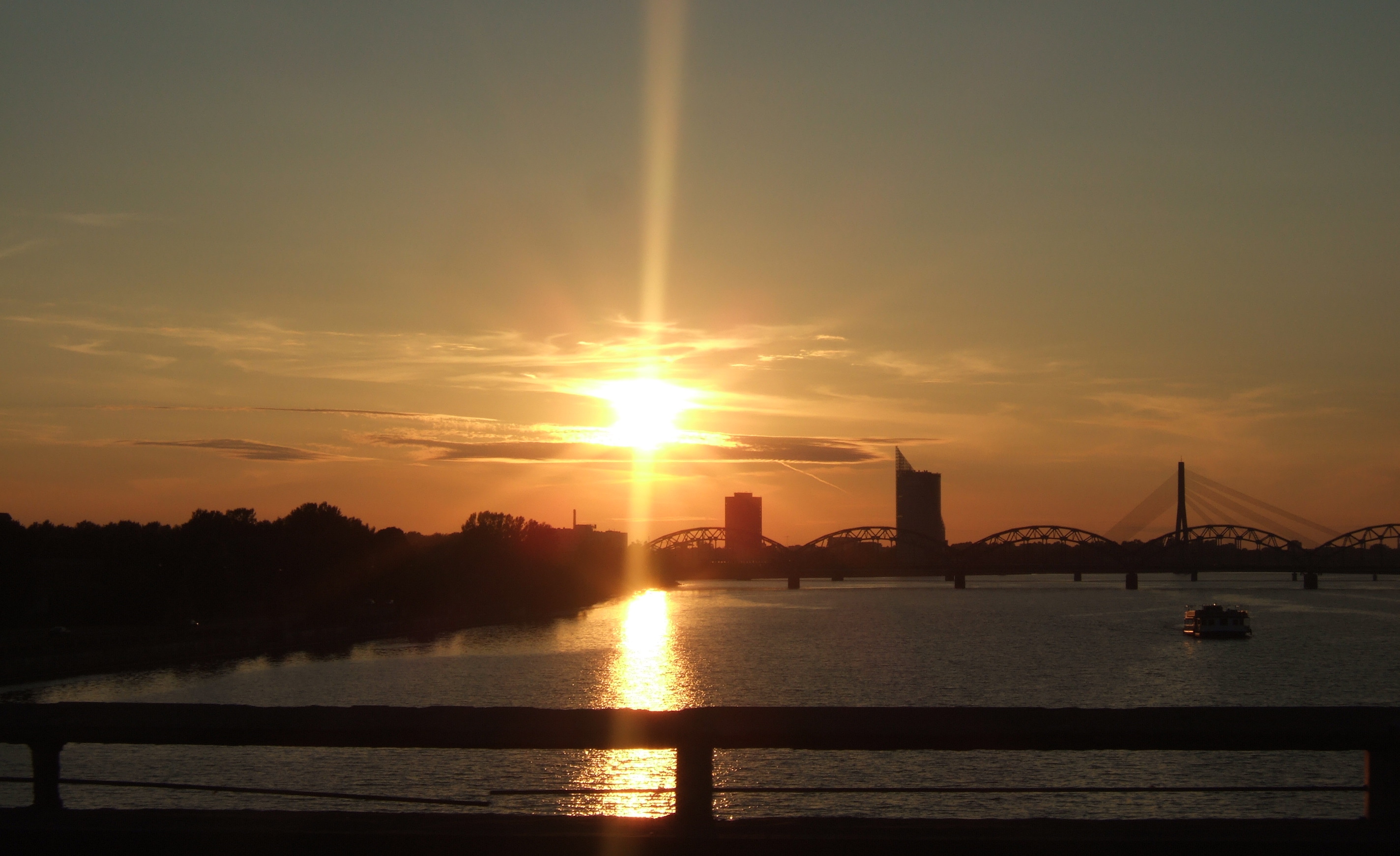
The following are some of the cities and towns built along the Daugava:
Russia
- Andreapol
- Zapadnaya Dvina
- Velizh
Belarus
- Ruba
- Vitebsk
- Beshankovichy
- Polotsk (home to the Boris stones)
- Navapolatsk
- Dzisna
- Verkhnedvinsk
- Druya
Latvia
- Krāslava
- Daugavpils
- Līvāni
- Jēkabpils
- Pļaviņas
- Aizkraukle
- Jaunjelgava
- Lielvārde
- Kegums
- Ogre
- Ikšķile
- Salaspils
- Riga
Environment

Water quality
Upstream of the Latvian town of Jekabpils, the river's pH has a characteristic value of about 7.8 (slight alkaline). In this area, the concentration of ionic calcium is around 43 milligrams per liter, nitrate is about 0.82 milligrams per liter, ionic phosphate is 0.038 milligrams per liter, and oxygen saturation is 80%. The high nitrate and phosphate load of the Daugava has contributed to the extensive buildup of phytoplankton biomass in the Baltic Sea; the Oder and Vistula rivers also contribute to the high nutrient loading of the Baltic.
In Belarus, water pollution of the Daugava is considered moderately severe, with the chief sources being treated wastewater, fish-farming, and agricultural chemical runoff (such as herbicides, pesticides, nitrates, and phosphates).
Notes
References
References
- (2011). "Main Geographic Characteristics of the Republic of Belarus. Main characteristics of the largest rivers of Belarus". Data of the Ministry of Natural Resources and Environmental Protection of the Republic of Belarus..
- [[Johann Georg Theodor Grässe]], ''[[Orbis Latinus]]'', [[Braunschweig]], 1972, [https://daten.digitale-sammlungen.de/~db/0005/bsb00050912/images/index.html?id=00050912&nativeno=674 vol. I, p. 674].
- "Gruberts D. "Daugava". Nacionālā enciklopēdija.". Nacionālā enciklopēdija.
- (September 20, 1944). "Reds in Six Miles of Latvia Capital". [[Valley Morning Star]].
- Фасмер. Макс. link
- C.Michael Hogan. (2012). "Daugava River". National Council for Science and the Environment.
- (2020). "Towards water security in Belarus: a synthesis report".
- "Water Report 15". Food and Agriculture Organization of the United Nations.
This article was imported from Wikipedia and is available under the Creative Commons Attribution-ShareAlike 4.0 License. Content has been adapted to SurfDoc format. Original contributors can be found on the article history page.
Ask Mako anything about Daugava — get instant answers, deeper analysis, and related topics.
Research with MakoFree with your Surf account
Create a free account to save articles, ask Mako questions, and organize your research.
Sign up freeThis content may have been generated or modified by AI. CloudSurf Software LLC is not responsible for the accuracy, completeness, or reliability of AI-generated content. Always verify important information from primary sources.
Report