From Surf Wiki (app.surf) — the open knowledge base
Datong

| Field | Value | |
|---|---|---|
| name | Datong | |
| other_name | Tatung | |
| native_name | 大同市 | |
| native_name_lang | zh | |
| settlement_type | Prefecture-level city | |
| total_type | ||
| image_skyline | {{Photomontage | position=center |
| photo1a | The skyline of Datong(Southgate)2019.jpg | |
| photo2a | Datong Shanhua Si 2013.08.29 13-19-10.jpg | |
| photo2b | Datong Huayan Si 2013.08.29 09-58-58.jpg | |
| photo3a | Datong 14 grotta.jpg | |
| photo3b | Tower in Lingyan Temple, Yungang Grottoes.jpg | |
| photo3c | Datong Wenmiao 2013.08.29 11-59-31.jpg | |
| photo4a | Datong Guandi Miao 2013.08.29 10-44-56.jpg | |
| photo4b | Wikiwyprawa 2015 IGP5026.jpg | |
| size | 260 | |
| spacing | 2 | |
| color | #FFFFFF | |
| border | 0 | |
| foot_montage | From top down, left to right: Datong panorama; Shanhua Temple; Huayan Temple; Yungang Grottoes; Tower at Lingyan Temple; Temple of Confucius (Wenmiao); Guandi Temple; Yinghui Gate of the City Wall | |
| image_map | Location of Datong Prefecture within Shanxi (China).png | |
| map_caption | Location of Datong City jurisdiction in Shanxi | |
| dot_x | dot_y = | |
| pushpin_map | Shanxi#China | |
| pushpin_map_caption | Location of the city center in Shanxi | |
| pushpin_label_position | right | |
| pushpin_mapsize | 240 | |
| subdivision_type | Country | |
| subdivision_name | People's Republic of China | |
| subdivision_type1 | Province | |
| subdivision_name1 | Shanxi | |
| seat_type | Municipal seat | |
| seat | Pingcheng District | |
| parts_style | ||
| parts | ||
| p2 | ||
| government_type | Prefecture-level city | |
| leader_title | CPC Secretary | |
| leader_title1 | Party Secretary | |
| leader_name1 | Zhang Jifu | |
| established_title | ||
| established_title1 | ||
| established_title2 | ||
| area_magnitude | ||
| unit_pref | ||
| area_total_km2 | 14068 | |
| area_blank1_title | Districts | |
| area_metro_km2 | 976 | |
| area_urban_km2 | 3563 | |
| area_urban_footnotes | ||
| elevation_footnotes | ||
| elevation_m | 1042 | |
| population_as_of | 2020 census | |
| population_footnotes | ||
| population_total | 3105591 | |
| population_density_km2 | auto | |
| population_density_metro_km2 | auto | |
| population_blank1_title | Districts | |
| population_metro | 1790452 | |
| population_urban | 2030203 | |
| population_density_urban_km2 | auto | |
| demographics_type2 | GDP | |
| demographics2_title1 | Prefecture-level city | |
| demographics2_info1 | CN¥ 137 billion | |
| US$ 21.5 billion | ||
| demographics2_title2 | Per capita | |
| demographics2_info2 | CN¥ 44,110 | |
| US$ 7,058 | ||
| timezone | China Standard | |
| utc_offset | +8 | |
| coor_pinpoint | Datong municipal government | |
| coordinates | ||
| postal_code_type | Postal code | |
| postal_code | 037000 | |
| area_code | 0352 | |
| blank2_name | License Plates | |
| blank2_info | 晋B | |
| blank4_name | ||
| blank5_name | Administrative division code | |
| blank5_info | 140200 | |
| iso_code | CN-SX-02 | |
| website |
Default is list if up to 5 items, coll if more than 5-- US$ 21.5 billion US$ 7,058 GreatTogetherness PacifiedCityCounty |t2=平城 |s2=平城 |p2=Píngchéngxiàn |w2=P‘ing-ch‘êng Hsien Datong is a prefecture-level city in northern Shanxi Province in the People's Republic of China. It is located in the Datong Basin at an elevation of 1040 m and borders Inner Mongolia to the north and west and Hebei to the east. As of the 2020 census, it had a population of 3,105,591 of whom 1,790,452 lived in the built-up (or metro) area made of the 2 out 4 urban districts of Pingcheng and Yungang as Yunzhou and Xinrong are not conurbated yet.
History

The area of present-day Datong was close to the state of Dai, which was conquered by the Zhao clan of Jin in 457 BC. It was a frontier land between the agricultural Chinese and the nomads of the Great Steppe. The area was well known for its trade in horses.
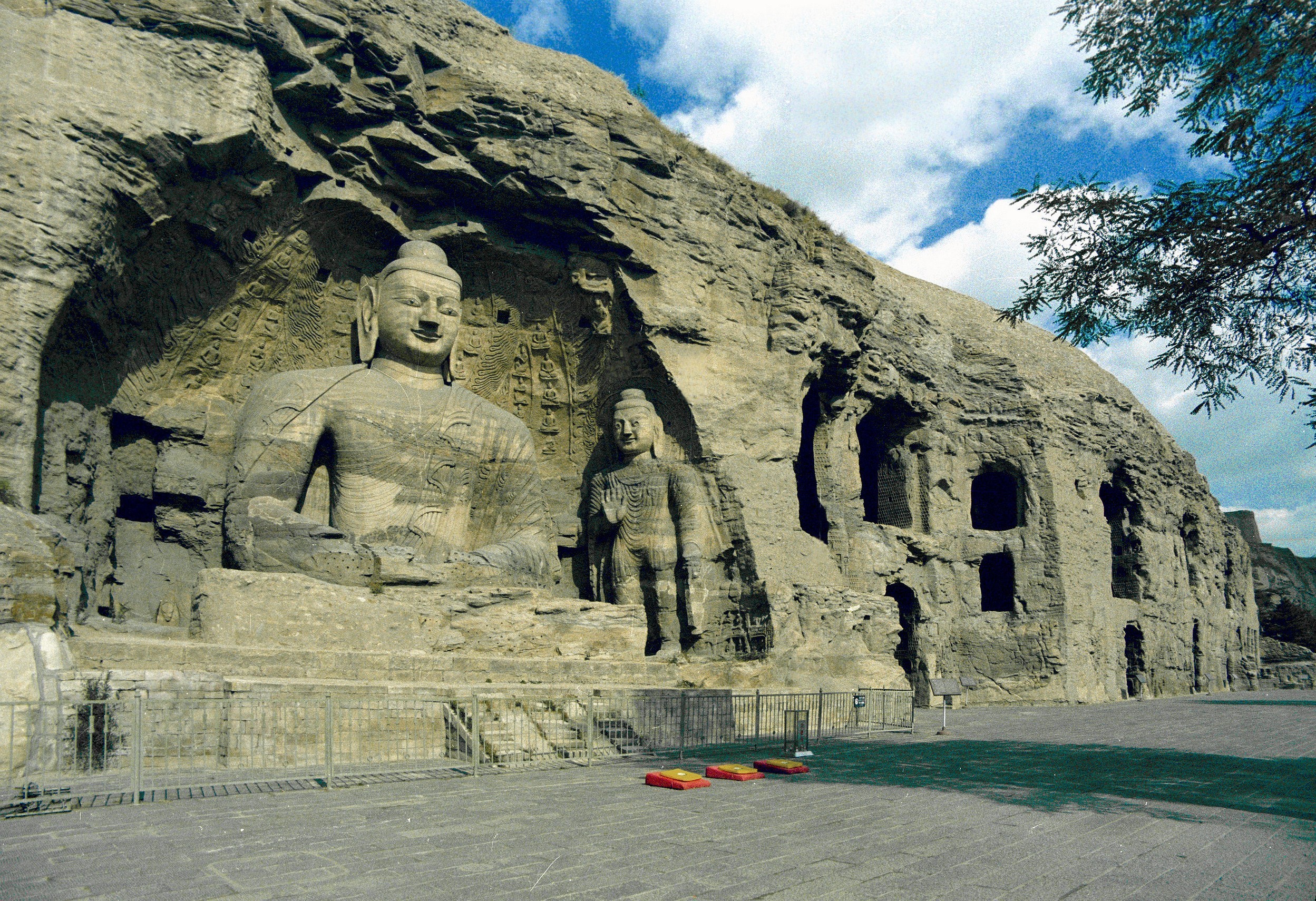
The area of present-day Datong eventually came under the control of the Qin dynasty, during which it was known as Pingcheng County (平城县) and formed part of the Qin commandery of Yanmen. Pingcheng County continued under the Han dynasty, which founded a site within present-day Datong in 200BC following its victory against the Xiongnu nomads at the Battle of Baideng. Located near a pass to Inner Mongolia along the Great Wall, Pingcheng blossomed under Han rule and became a stop-off point for camel caravans moving from China into Mongolia and beyond. It was sacked at the end of the Eastern Han. Pingcheng became the capital of the Xianbei-founded Northern Wei dynasty from AD398–494. The Yungang Grottoes were constructed during the later part of this period (460–494). During the mid to late 520s, Pingcheng was the seat of Northern Wei's Dai Commandery. During the Tang dynasty, Datong became the seat of the Tang prefecture of Yunzhou, and the original Guandi temple was built.
The city was renamed Datong in 1048. It was the Xijing ("Western Capital") of the Jurchen Jin dynasty prior to being sacked by the Mongols. Datong later came under the control of the Ming dynasty, serving as an important Ming military stronghold against the Mongols to the north. During the Ming period, many of Datong's notable historical structures such as the Drum Tower and the Nine-Dragon Wall were built. Datong was sacked again at the end of the Ming in 1649, but promptly rebuilt in 1652.
During the Second Sino-Japanese War, the Japanese included the Datong region of north Shanxi in the puppet state of Mengjiang, Inner Mongolia, as shown on the administrative map of the United Mongol Autonomous Government in the Mengjiang entry. The region reverted to Shanxi Province after the war.
By 1982 a portion of its city walls remained so it became one of the National Famous Historical and Cultural Cities that year. Prior to 2008, about 100,000 people lived in the old city. In 2008 mayor Geng Yanbo decided to redevelop much of the inner city, with over 3 sqkm being redeveloped, and with Geng becoming known as the "Demolition Mayor". Geng and his group anticipated that 30,000 to 50,000 people would remain in the old city.
In 2013 Geng left his position. Su Jiede of Sixth Tone wrote that much of the city was still under construction at the time and that Geng's efforts resulted in "a half-finished city center and a complicated legacy" and that "To critics, the city had spent enormous sums of money without much to show for it." By 2020 the population of the old city was below 30,000 and there were fewer governmental facilities available for the residents. That year Su stated that the old city "still presents a headache for the local government."
Demographics
Su Jiede wrote that since Pingcheng District, which had most of its urbanized area, had 1,105,699 people as of 2020, "Datong is a small city by Chinese standards".
Geography
Datong is the northernmost city of Shanxi, and is located in the Datong Basin, with an administrative area spanning latitude 39° 03'–40° 44' N and longitude 112° 34'–114° 33' E. The urban area is surrounded on three sides by mountains, with passes only to the east and southwest. Within the prefecture-level city elevations generally increase from southeast to northwest. Datong borders Ulanqab (Inner Mongolia) to the northwest and Zhangjiakou (Hebei) to the east, Shuozhou (Shanxi) to the southwest, and Xinzhou (Shanxi) to the south.
The well-known Datong Volcanic Arc lies nearby in the Datong Basin.
It is 250 km west of Beijing.
Climate
Datong has a continental, monsoon-influenced steppe climate (Köppen BSk), influenced by the 1000 m+ elevation, with rather long, cold, very dry winters, and very warm summers. Monthly mean temperatures range from −10.5 °C in January to 22.6 °C in July; the annual mean temperature is 7.33 °C. Due to the aridity and elevation, diurnal temperature variation is often large, averaging 13.2 C-change annually. There barely is any precipitation during winter, and more than of the annual precipitation occurs from June to September. With monthly percent possible sunshine ranging from 54% in July to 66% in October, sunshine is abundant year-round, and the city receives 2,671 hours (about 60% of the possible total) of bright sunshine per year. Extremes since 1951 have ranged from -31.9 °C on 16 December 2023 to 39.2 °C on 29 July 2010.
| Jan record high C = 11.2 | Feb record high C = 19.2 | Mar record high C = 25.3 | Apr record high C = 35.4 | May record high C = 36.1 | Jun record high C = 39.0 | Jul record high C = 39.2 | Aug record high C = 35.9 | Sep record high C = 34.7 | Oct record high C = 29.7 | Nov record high C = 21.9 | Dec record high C = 15.8 | Jan record low C = −31.1 | Feb record low C = −29.9 | Mar record low C = −20.9 | Apr record low C = −16.1 | May record low C = −5.8 | Jun record low C = 2.9 | Jul record low C = 7.8 | Aug record low C = 2.8 | Sep record low C = −3.7 | Oct record low C = −11.5 | Nov record low C = -24.2 | Dec record low C = −31.9 |access-date= 2024-09-16 |access-date= 9 August 2025
Administrative divisions

| Map | Name | Simplified Chinese | Pinyin | Population | ||
|---|---|---|---|---|---|---|
| (2003 est.) | Area (km2) | Density | ||||
| (/km2) | ||||||
| Pingcheng District | 平城区 | Píngchéng Qū | 580,000 | 246 | 2,358 | |
| Yungang District | 云冈区 | Yúngāng Qū | 280,000 | 684 | 409 | |
| Xinrong District | 新荣区 | Xīnróng Qū | 110,000 | 1,102 | 109 | |
| Yunzhou District | 云州区 | Yúnzhōu Qū | 170,000 | 1,501 | 113 | |
| Yanggao County | 阳高县 | Yánggāo Xiàn | 290,000 | 1,678 | 173 | |
| Tianzhen County | 天镇县 | Tiānzhèn Xiàn | 210,000 | 1,635 | 128 | |
| Guangling County | 广灵县 | Guǎnglíng Xiàn | 180,000 | 1,283 | 140 | |
| Lingqiu County | 灵丘县 | Língqiū Xiàn | 230,000 | 2,720 | 85 | |
| Hunyuan County | 浑源县 | Húnyuán Xiàn | 350,000 | 1,965 | 178 | |
| Zuoyun County | 左云县 | Zuǒyún Xiàn | 140,000 | 1,314 | 107 |
- Defunct – Kuang District () is largely made up of separate mines throughout the metropolitan area.
Tourism
The Yungang Grottoes are a collection of shallow caves located 16 km west of Datong. There are over 50,000 carved images and statues of Buddhas and bodhisattvas within these grottoes, ranging from 4 to. Most of these icons are around 1500 years old.It is a UNESCO World Heritage Site and one of the most important attractions in Datong.
Within the city itself, there are a few surviving sites of historical interest such as the Nine-Dragon Wall, the Huayan Monastery, and the Shanhua Temple. Further afield is the Hanging Temple built into a cliff face near Mount Heng. Most of the historical sites in this region date to the Liao, Jin and Ming dynasties, but the Hanging Temple dates to the Northern Wei dynasty (386–534).
The railway locomotive works (see below) began to attract increasing numbers of railway enthusiasts from the 1970s. When the construction of steam locomotives was phased out, the authorities did not want to lose this valuable tourism market, and pondered the possibility of developing a steam railway operating center as an attraction. A number of study visits were undertaken to the East Lancashire Railway at Bury, and a twinning arrangement was concluded with that town.
In 2010, work began on reconstructing the city's 14th century Ming dynasty defensive wall. The controversial reconstruction project was in its final phase at the end of 2014. The documentary The Chinese Mayor documents two years of vigorous and highly controversial (due to summary demolition of about 200,000 homes) effort by Mayor Geng Yanbo to push the reconstruction project forward. File:Xuankongsi.jpg|The Hanging Temple File:Loess landscape china.jpg|Loess landscape near Hunyuan File:Datong 06.JPG|A tower on the City Wall File:Pagoda Huayanmonastery Datong Shanxi.jpg|Pagoda at Huayan Temple File:Datong Huayan Si 2013.08.29 09-37-05.jpg|Huayan Temple File:Datong Yungang Shiku 2013.08.29 14-24-22.jpg|Lingyan Temple at Yungang Grottoes File:Steps leading up to guard tower of Datong City Wall.jpg|Guard house on Datong City Wall
Culture
Datong is known for its knife-cut noodles and Shanxi mature vinegar.
Economy
The GDP per capita was ¥17,852 (US$2,570) per annum in 2008, ranked no. 242 among 659 Chinese cities. Coal mining is the dominant industry of Datong. Its history and development are very much linked to this commodity.
Development zones Datong Economic and Technological Development Zone
Due to its strategic position, it is also an important distribution and warehousing center for Shanxi, Hebei and Inner Mongolia.
Datong is an old fashioned coal mining city, and still sits on significant reserves of this commodity. Consequently, it has developed a reputation as one of China's most polluted cities. The Datong Coal Mining Group is based here and is China's third largest such enterprise. Datong is indeed however an emerging economy, as the city seeks to loosen its dependence on coal, introduce more environmentally friendly and efficient methods of extraction and move into other areas of business services. The local government has continued to upgrade its pillar coal sector (and related industries like coal chemicals, power and metallurgy), while also developing "substitute industries" such as machinery manufacturing, tourism and distribution, warehousing and logistics services. This has had some impact. Datong's GDP grew by 5.1 percent in 2008 to RMB56.6 billion.
While coal will continue to dominate, Datong has been identified as one of the key cities requiring redevelopment, with part of this being in environmental cleanup, rehabilitation and industrial refocusing. Datong is a pilot city for rehabilitation studies following years of pollution. To this end it has already struck up strong relationships with other cities worldwide with similar backgrounds, and has begun plans, for example, to develop a tourism base focused on steam engine technology with antique locomotives to be used along designated tracks.
Datong has a large railway locomotive works, the 'Datong locomotive factory', opened in 1954. The works are notable as the main producer (~4,689 of 4,717) of the QJ or 'Advance Forward' () class of steam locomotive, built as late as 1988. Steam locomotive production ended in the late 1980s and the plant's main products (as of 2010) is mainline electric locomotives. The factory is currently owned by the China Railway Rolling Stock Corporation Ltd.
Main enterprises
- Datong Coal Mine Group (The third biggest coal-mining enterprise in China)
- Datong Electric Locomotive Co., Ltd, (DELC) (The second biggest Elec-Locomotive enterprise in China)
- Shanxi Diesel Engine Industries Corporation, Ltd, CNGC
- Shanxi Synthetic Rubber Group Co., Ltd, CNCC
- GD Power Datong No.2 Power Plant
- GD Power Datong Power Generation Co., Ltd
- Shanxi Datang International Yungang Co-generation Co., Ltd.
- China National Heavy Duty Truck Group Datong Gear CO., LTD
Transportation
- China National Highway 109
- China National Highway 208
- G55 Erenhot–Guangzhou Expressway
- G5501 Datong Ring Expressway
- Datong railway station and Datong South railway station
- Datong Yungang Airport
Education
Colleges and universities
- Datong University (大同大学)
- Datong Normal College(大同师范高等专科学校)
Major schools
- Datong No.1 Middle School (大同市第一中学)
- Datong No.2 Middle School (大同市第二中学)
- Datong Railway No. 1 Middle School (大同市铁路第一中学)
- Datong Locomotive Middle School (大同机车中学)
- Datong No.3 Middle School (大同市第三中学)
- BeiYue Middle School (北岳中学)
- Datong Experimental Secondary School (大同市实验中学)
- The No.1 Middle School of DCMG (Datong Coal Mine Group) (同煤一中)
- Datong No.14 Elementary School (大同市第十四小学)
- Datong No.18 Elementary School (大同市第十八小学)
- Datong Experimental Elementary School (大同市实验小学)
References
Citations
Bibliography
- .
References
- (2019). "China Urban Construction Statistical Yearbook 2017". China Statistics Press.
- "China: Shānxī (Prefectures, Cities, Districts and Counties) - Population Statistics, Charts and Map".
- 山西省统计局、国家统计局山西调查总队. (December 2021). "《山西统计年鉴-2021》". [[China Statistics Press]].
- {{citation. Hou. Xiaorong. (2009). Social Science Academic Press. zh
- {{harvp. Xiong. 2009
- "Guandi Temple, Datong".
- "Datong {{!}} China {{!}} Britannica".
- "Drum Tower, Datong".
- "Nine-Dragon Wall, Datong".
- Su, Jiede. (2020-10-10). "In Datong, a Crumbling Legacy of China's Most Extreme Urban Makeover".
- link. [[China Meteorological Administration]]
- link. [[National Bureau of Statistics of the People's Republic of China]]
- "历史沿革".
- link. XZQH.org
- link
- "Fake it to make it". [[South China Morning Post]] Magazine.
- "The Chinese Mayor". [[IMDb]].
- "In addition to the sliced noodles in Datong, Shanxi, have you eaten these kinds of delicacies? What else do you know?".
- Zhu, Xingxin. (2024-07-28). "'Knife-cut noodle' chef slices way to success".
- "The best of Datong in 96 hours - Destinations".
- [http://www.china-briefing.com/article/central-china:-datong-551.html China Briefing Business Guide] {{Webarchive. link. (3 March 2016 . China-briefing.com. Retrieved on 25 February 2014.)
- (July 2022). "2008 Datong Economy Report}} {{Dead link".
- [http://www.china-briefing.com/article/central-china:-datong-551.html China Briefing Business Guide: Datong Economy] {{Webarchive. link. (3 March 2016 . China-briefing.com. Retrieved on 25 February 2014.)
- link. Datong Coal Mine Group
- [http://www.dtloco.com/english/home.htm Datong Electric Locomotive Co., Ltd Of Cnr] {{webarchive. link. (30 July 2012 . Dtloco.com. Retrieved on 25 February 2014.)
- http://www.shanxi-engine.com.cn {{webarchive. link. (10 February 2005)
- "ChinaBlueStar".
- "English-guodan".
- [http://www.china-cdt.com/en/index.html Www.China-Cdt.Com] {{webarchive. link. (12 March 2008 . Www.China-Cdt.Com (29 December 2002). Retrieved on 25 February 2014.)
- [http://www.dcgroup.com.cn/en/index.jsp china national heavy duty truck group datong gear co ltd] {{Webarchive. link. (15 January 2010 . Dcgroup.com.cn. Retrieved on 25 February 2014.)
This article was imported from Wikipedia and is available under the Creative Commons Attribution-ShareAlike 4.0 License. Content has been adapted to SurfDoc format. Original contributors can be found on the article history page.
Ask Mako anything about Datong — get instant answers, deeper analysis, and related topics.
Research with MakoFree with your Surf account
Create a free account to save articles, ask Mako questions, and organize your research.
Sign up freeThis content may have been generated or modified by AI. CloudSurf Software LLC is not responsible for the accuracy, completeness, or reliability of AI-generated content. Always verify important information from primary sources.
Report