From Surf Wiki (app.surf) — the open knowledge base
Darkroom manipulation
Photography method

Photography method
Darkroom manipulation is a traditional method of manipulating photographs without the use of computers. Some of the common techniques for darkroom manipulation are dodging, burning, and masking, which though similar conceptually to digital manipulations, involve physical rather than virtual techniques. Darkroom manipulations are those processes used, for example, to remove unwanted areas and change image background, among others. Varying techniques can be used to accomplish the same tasks.
History
Jerry Uelsmann
Jerry Uelsmann was best known for manipulating images in the darkroom long before Photoshop was available. He started off with photography in high school as a hobby and then decided to go to an institution to learn photography. Uelsmann's photographs are different from those of most photographers because he uses multiple negatives to produce one picture. He started with one enlarger but after waiting for some prints to dry one day, he decided to use more enlargers to get more images quickly, then began using seven enlargers at one time. His darkroom style allowed him to create images that had realism and the motion of what would be seen in dreams.
Techniques
Before Photoshop, dodging and burning were used to lighten or darken a part of the photograph to get better details in highlights and shadows. Toning changes the color of the photograph. Black and white photographs can be changed to sepia, red, orange and even blue. Toning can be used to help make the photograph last long. Cropping is used to decide what is left out in the final print.
Dodging
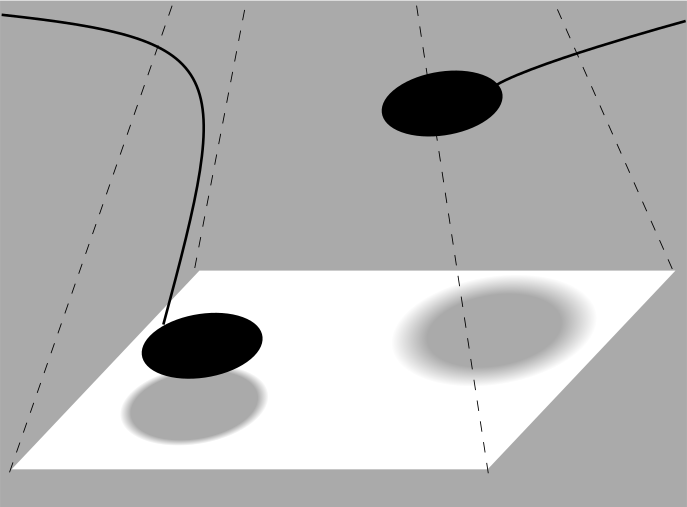
Burning

Masking
Image Masking is a very faint positive image that comes from the original negative image. Masking in darkroom photography can be used with more than one mask for the image by putting the original image and the mask together to come out with the single print. The advantages of masking is that this process sharpens the image and if done correctly, the contrast of the image could change when the image prints out. The mask is a copy of the original, so the edges should line up correctly and density can be shown in the original negative. Masking can give slight texture so that true blacks and shadows look properly dark.
Manipulation used today
Photo manipulation is used today in place of darkroom manipulation. Today, photo manipulation can be started on a photographer's camera by formatting the image into either a JPEG or RAW format. An example of manipulation with the camera itself is automatic red-eye removal in the image. After the image is on the computer many other photo editing programs such as Photoshop are used for photo manipulation.
References
References
- [[Elaine Hedges]] and [[Ingrid Wendt]] (1980). ''[https://books.google.com/books?id=N2YJqJF2YboC&dq=The+Sketch+by+Gertrude+K%C3%A4sebier&pg=PA106 In Her Own Image: Women Working in the Arts]'', Feminist Press at CUNY, p. 107.
- Baines, Evan. (24 January 2009). "AN ABBREVIATED HISTORY OF PHOTO-MANIPULATION". Evan Baines Photography.
- Lai, Lawrence. "Digital Darkroom: An Exploration of Altered Realities". ABC News Network.
- Maher, Berman, Chris,Larry. "Master Interview; Jerry Uelsmann".
- (17 April 2017). "Darkroom Photo Manipulation before Photoshop".
- "darkroom and digital techniques". Nitsa.
- Birnbaum,C.,Boas,Bright V.,Engdahl A.,Sribnick,Wignall,Zakia D., Hubert,Keith,Michael,David,Larry,Jeff,Richard. (1984). "Darkroom Expression". KODAK Publication KW-21.
- Birnbaum,C.,Boas,Bright V.,Engdahl A.,Sribnick,Wignall,Zakia D., Hubert,Keith,Michael,David,Larry,Jeff,Richard. (1984). "Darkroom Expression". KODAK Publication KW-21.
- Hicks,Schultz, Roger,Frances. (2000). "Darkroom Basics...and beyond". Collins & Brown Limited.
- Phillips, James. "Unsharp Masking - A beginners primer".
- Phillips, James. "Unsharp Masking - A beginners primer".
- Chevalier, Ally. (9 June 2009). "What is Darkroom Manipulation, Really?". Bright Hub Inc.
This article was imported from Wikipedia and is available under the Creative Commons Attribution-ShareAlike 4.0 License. Content has been adapted to SurfDoc format. Original contributors can be found on the article history page.
Ask Mako anything about Darkroom manipulation — get instant answers, deeper analysis, and related topics.
Research with MakoFree with your Surf account
Create a free account to save articles, ask Mako questions, and organize your research.
Sign up freeThis content may have been generated or modified by AI. CloudSurf Software LLC is not responsible for the accuracy, completeness, or reliability of AI-generated content. Always verify important information from primary sources.
Report