From Surf Wiki (app.surf) — the open knowledge base
Danube Banovina
Banovina or province of the Kingdom of Yugoslavia
Banovina or province of the Kingdom of Yugoslavia
| Field | Value |
|---|---|
| native_name | Dunavska banovina |
| Дунавска бановина | |
| conventional_long_name | Danube Banovina |
| common_name | Danube Banovina |
| subdivision | Banovina |
| nation | the Kingdom of Yugoslavia |
| p1 | Banat, Bačka and Baranja |
| flag_p1 | Flag of the Kingdom of Yugoslavia.svg |
| s1 | Territory of the Military Commander in Serbia |
| flag_s1 | Flag of German Reich (1935–1945).svg |
| s2 | Autonomous Province of Vojvodina (1945–1963) |
| flag_s2 | Flag of SR Serbia.svg |
| s3 | People's Republic of Serbia |
| flag_s3 | Flag of SR Serbia.svg |
| s4 | People's Republic of Croatia |
| flag_s4 | Flag of SR Croatia.svg |
| event_start | Established |
| year_start | 1929 |
| date_start | 3 October |
| event_end | Invasion of Yugoslavia |
| year_end | 1941 |
| date_end | 17 April |
| event1 | 1931 Yugoslav Constitution |
| date_event1 | 3 September 1931 |
| image_coat | Coat of arms of the Kingdom of Yugoslavia (small).svg |
| image_flag | Flag of the Kingdom of Yugoslavia (state).svg |
| image_map | Locator map Danube Banovina in Yugoslavia 1929-1939.svg |
| image_map_caption | The Danube Banovina in 1941. |
| capital | Novi Sad |
| (1929–1941) | |
| Smederevo | |
| (1941) | |
| government_type | Devolved autonomous banate |
| title_leader | Monarch |
| leader1 | Alexander I |
| year_leader1 | 1929–1934 |
| leader2 | Peter II |
| year_leader2 | 1934–1941 |
| title_deputy | Ban |
| deputy1 | Daka Popović |
| year_deputy1 | 1929–1930 |
| deputy2 | Milorad Vlaškalin |
| year_deputy2 | 1941 |
| today | Croatia |
| Serbia |
Дунавска бановина (1929–1941) Smederevo (1941) Serbia
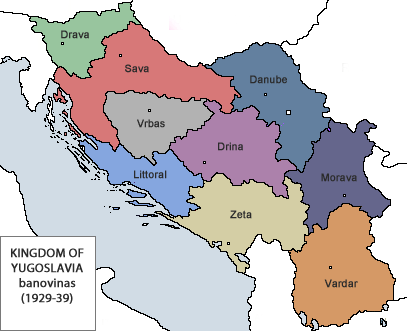
Danube Banovina or Danube Banate (), was a banovina (or province) of the Kingdom of Yugoslavia between 1929 and 1941. This province consisted of the geographical regions of Syrmia, Bačka, Banat, Baranya, Šumadija, and Braničevo. The capital city of the Danube Banovina was Novi Sad. The province was named after the Danube River.

Population
According to the 1931 census, the Danube Banovina had 2,387,495 inhabitants. The population of this region was composed of:
- Serbs and Croats (56.9%)
- Hungarians (18.2%)
- Germans (16.3%)
Borders
According to the 1931 Constitution of the Kingdom of Yugoslavia,
- "The Danube Banovina is bounded on the south-west by the boundaries ... of the Sava and Drina Banovinas, on the north and north-east by the State frontiers with Hungary and Romania, up to the point where the latter frontier meets the Danube. The boundary then follows the course of the Danube up to the eastern boundary of the district of Ram and then turns along the south-eastern boundary of the Požarevac district. It then follows the eastern boundaries of the districts of Morava, Lepenica, Kragujevac, and Gruža, as far as the Dulenski Crni Vrh (hill 919), turning towards the Gledic Mountains and thence over the Krečane (hill 760) and Brzak (hill 822) up to the boundary of the Drina Banovina on Mount Kotlenik, near Crni Vrh (hill 768)."
History


In 1931, Mitrovica and Šid districts were transferred from Drina Banovina to Danube Banovina.
In 1939, when the new Banovina of Croatia was formed, Šid and Ilok districts were transferred from the Danube Banovina to that of Croatia.
In 1941, the World War II Axis powers occupied the Danube Banovina. Bačka and Baranja regions were attached to Hungary, while Syrmia was attached to the Independent State of Croatia. The remainder of the former Danube Banovina (including Banat, Šumadija, and Braničevo) were part of the Territory of the Military Commander in Serbia. However, Banat had autonomy as a region ruled by its ethnic German minority.
In 1945 the region was restored as a province of Serbia within a federal Socialist Yugoslavia. The province was officially renamed as Vojvodina, its historical name, with the capital at the city of Novi Sad. The new province consisted of Syrmia, Banat and Bačka regions. Baranja was included in the People's Republic of Croatia, while Šumadija and Braničevo were included in Serbia Proper.
Cities
Some large cities of the Danube Banovina were:
- Novi Sad
- Subotica
- Petrovgrad (now Zrenjanin)
- Sombor
- Velika Kikinda (now Kikinda)
- Mitrovica (now Sremska Mitrovica)
- Kragujevac
- Smederevo
- Požarevac
Bans of Danube Banovina (1929–1941)
- Daka Popović (1929–1930)
- Radoslav Dunjić (1930)
- Svetomir Matić (1930–1931)
- Milan Nikolić (1931–1933)
- Dobrica Matković (1933–1935)
- Milojko Vasović (1935)
- Svetislav Paunović (1935–1936)
- Svetislav Rajić (1936–1939)
- Jovan Radivojević (1939–1940)
- Branko Kijurina (1940–1941)
- Milorad Vlaškalin (1941)
References
- (9 August 2018). "MONOGRAFIJA MODOŠKE PAROHIJE - NMR Info".
This article was imported from Wikipedia and is available under the Creative Commons Attribution-ShareAlike 4.0 License. Content has been adapted to SurfDoc format. Original contributors can be found on the article history page.
Ask Mako anything about Danube Banovina — get instant answers, deeper analysis, and related topics.
Research with MakoFree with your Surf account
Create a free account to save articles, ask Mako questions, and organize your research.
Sign up freeThis content may have been generated or modified by AI. CloudSurf Software LLC is not responsible for the accuracy, completeness, or reliability of AI-generated content. Always verify important information from primary sources.
Report