From Surf Wiki (app.surf) — the open knowledge base
Danny Kaye
American actor, singer, dancer, and comedian (1911–1987)

American actor, singer, dancer, and comedian (1911–1987)
| Field | Value |
|---|---|
| name | Danny Kaye |
| image | Kaye, Danny.jpg |
| birth_name | David Daniel Kaminsky |
| birth_date | |
| birth_place | New York City, U.S. |
| death_date | |
| death_place | Los Angeles, California, U.S. |
| occupation | |
| years_active | 1933–1987 |
| party | Democratic |
| spouse | |
| children | 1 |
Danny Kaye (born David Daniel Kaminsky; ; January 18, 1911 – March 3, 1987) was an American actor, comedian, singer, and dancer. His performances featured physical comedy, idiosyncratic pantomimes, and rapid-fire novelty songs.
Kaye starred in 23 films, notably Wonder Man (1945), The Kid from Brooklyn (1946), The Secret Life of Walter Mitty (1947), The Inspector General (1949), Hans Christian Andersen (1952), White Christmas (1954), and The Court Jester (1955). His films were popular, especially for his performances of patter songs and favorites such as "Inchworm" and "The Ugly Duckling".
He was the first ambassador-at-large of UNICEF in 1954 and received the French Legion of Honor in 1986 for his years of work with the organization.
Early life and education
David Daniel Kaminsky was born in Brooklyn, New York, on January 18, 1911 (though he would later say 1913), to Russian Jewish immigrants Jacob and Clara (née Nemerovsky) Kaminsky. He was the youngest of three sons. His parents and older brothers Larry and Mac left Yekaterinoslav (now Dnipro in Central Ukraine) two years before Danny's birth; he was their only son born in the United States.
He attended Public School 149 in East New York, Brooklyn (eventually renamed to honor him)—where he began entertaining his classmates with songs and jokes. He attended Thomas Jefferson High School in Brooklyn, but he did not graduate.
His mother died when he was in his early teens. Not long after, Kaye and his friend Louis ran away to Florida. Kaye sang while Louis played the guitar, and the pair eked out a living for a while. When Kaye returned to New York, his father did not pressure him to return to school or work, giving his son the chance to mature and discover his abilities.
After leaving school, he held a succession of jobs as a soda jerk, auto insurance investigator, and office clerk. Most ended with him being fired. He lost the insurance job when he made an error that cost the insurance company $40,000 ($600,000 in 2019 adjusted for inflation). A dentist who hired him to look after his office over lunch and run errands fired him when he found Kaye using his dental drill on the office woodwork. In 1939, Kaye met the same dentist's daughter, Sylvia Fine, at an audition, and in 1940, they eloped. He learned his trade in his teenaged years in the Catskills as a tummler (master of ceremonies) in the Borscht Belt.
Kaye's first break came in 1933 when he joined the Three Terpsichoreans, a vaudeville dance act. They opened in Utica, New York, where he used the stage name Danny Kaye for the first time. The act toured the United States and in Asia with the show La Vie Paree. The troupe left for a six-month tour of Asia on February 8, 1934. During its stay in Osaka, Japan, a typhoon hit the city. The troupe's hotel suffered heavy damage. The strong wind hurled a piece of the hotel's cornice into Kaye's room. By evening's performance time, the city was in the grip of the storm. With no power, the audience became restless and nervous. To calm them, Kaye went on stage holding a flashlight to illuminate his face and sang every song he could recall as loudly as he was able.
The experience of trying to entertain audiences who did not speak English inspired him to do the pantomime gestures, songs, and facial expressions that eventually made his reputation.
Jobs were in short supply when Kaye returned to the United States, and he struggled for bookings. One job was working in a burlesque revue with fan dancer Sally Rand. After the dancer dropped a fan while trying to chase away a fly, Kaye was hired to watch the fans, so they were always held in front of her.
Career
In 1937, Kaye's film début came from a contract with New York-based Educational Pictures for a series of two-reel comedies. He usually played a manic, dark-haired, fast-talking Russian in these low-budget shorts, opposite young hopefuls June Allyson and Imogene Coca. The Kaye series ended abruptly when the studio shut down in 1938. He was working in the Catskills in 1937 under the name Danny Kolbin.
His next venture was a short-lived Broadway show with Sylvia Fine as the pianist, lyricist, and composer. The Straw Hat Revue opened on September 29, 1939, and closed after 10 weeks, but critics noticed Kaye's work. The reviews brought an offer for both Kaye and his bride Sylvia to work at La Martinique, a New York City nightclub. Kaye performed with Sylvia as his accompanist. At La Martinique, playwright Moss Hart saw Danny perform, and that led to Hart's casting him in his hit Broadway comedy Lady in the Dark.
In 1941, aged 30, Kaye scored a triumph playing Russell Paxton in Lady in the Dark, starring Gertrude Lawrence. His show-stopping number was "Tschaikowsky (and Other Russians)" by Kurt Weill and Ira Gershwin in which he sang the names of a string of Russian composers at breakneck speed, seemingly without taking a breath. In the next Broadway season, he was the star of a show about a young man who is drafted called Let's Face It!.
His feature-film début was in producer Samuel Goldwyn's Technicolor 1944 comedy Up in Arms, a remake of Goldwyn's Eddie Cantor comedy Whoopee! (1930). Rival producer Robert M. Savini cashed in by compiling three of Kaye's Educational Pictures shorts into a patchwork feature entitled The Birth of a Star (1945). Studio mogul Goldwyn wanted Kaye's prominent nose fixed to look less Jewish; Kaye refused, but he did allow his red hair to be bleached blond, apparently because it looked better in Technicolor.
Kaye starred in a radio program, The Danny Kaye Show, on CBS from 1945 to 1946. The program's popularity rose quickly. Within a year, he tied with Jimmy Durante for fifth place in the Radio Daily popularity poll. Kaye was the first American actor to visit postwar Tokyo. He had toured there some ten years before with the vaudeville troupe. When Kaye asked to be released from his radio contract in mid-1946, he agreed not to accept a regular radio show for one year and only limited guest appearances on other radio programs. Many of the show's episodes survive today, notable for Kaye's opening signature patter ("Git gat gittle, giddle-di-ap, giddle-de-tommy, riddle de biddle de roop, da-reep, fa-san, skeedle de woo-da, fiddle de wada, reep!").
Kaye starred in several movies with actress Virginia Mayo in the 1940s, and is known for films such as The Secret Life of Walter Mitty (1947), The Inspector General (1949), On the Riviera (1951) co-starring Gene Tierney, Knock on Wood (1954), White Christmas (1954), The Court Jester (1956), Me and the Colonel (1958), and Merry Andrew (1958). Kaye starred in two pictures based on biographies, Hans Christian Andersen (1952) about the Danish storyteller and The Five Pennies (1959) about jazz pioneer Red Nichols. His wife, writer/lyricist Sylvia Fine, wrote many of the tongue-twisting songs for which Kaye became famous. Some of Kaye's films included the theme of doubles, two people who look identical (both played by him) being mistaken for each other to comic effect.[Image:Danny Kaye ww2 45.jpg|thumb|right|Danny Kaye on USO tour at Sasebo, Japan, October 25, 1945. Kaye and his friend, Dodgers manager Leo Durocher, made the trip.
When he appeared at the [London Palladium in 1948, he "roused the Royal family to laughter and was the first of many performers who have turned British variety into an American preserve." Life described his reception as "worshipful hysteria" and noted that the royal family, for the first time, left the royal box to watch from the front row of the orchestra. He related that he had no idea of the familial connections when the Marquess of Milford Haven introduced himself after a show and said he would like his cousins to see Kaye perform. Kaye had an invitation to return to London for a Royal Variety Performance in November of the same year. When the invitation arrived, Kaye was busy with The Inspector General (which had a working title of Happy Times). Warner Bros. stopped the film to allow their star to attend. When his Decca labelmates The Andrews Sisters began their engagement at the London Palladium on the heels of Kaye's successful 1948 appearance there, the trio was well received and David Lewin of the Daily Express declared: "The audience gave the Andrews Sisters the Danny Kaye roar!"
He hosted the 24th Academy Awards in 1952. The program was broadcast on radio; telecasts of the Oscar ceremony started the very following year, in 1953. During the 1950s, Kaye visited Australia, where he played Buttons in a production of Cinderella in Sydney. In 1953, Kaye started a production company, Dena Pictures, named for his daughter. Knock on Wood was the first film produced by his firm. The firm expanded into television in 1960 under the name Belmont Television.
Kaye entered television in 1956, on the CBS show See It Now with Edward R. Murrow. The Secret Life of Danny Kaye combined his 50,000-mile, ten-country tour as UNICEF ambassador with music and humor. His first solo effort was in 1960 with a one-hour special produced by Sylvia and sponsored by General Motors, with similar specials in 1961 and 1962.
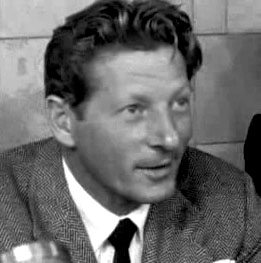
He hosted The Danny Kaye Show from 1963 to 1967; it won four Emmy awards and a Peabody award. His last cinematic starring role came in 1963's The Man from the Diners' Club.
Beginning in 1964, he acted as television host to the CBS telecasts of MGM's The Wizard of Oz. Kaye did a stint as a What's My Line? mystery guest on the Sunday-night CBS-TV quiz program. Kaye was later a guest panelist on that show. He also appeared on the interview program Here's Hollywood. In the 1970s, Kaye tore a ligament in his leg during the run of the Richard Rodgers musical Two by Two, but went on with the show, appearing with his leg in a cast and cavorting on stage in a wheelchair. He had done much the same on his television show in 1964, when his right leg and foot were burned from a cooking accident. Camera shots were planned so television viewers did not see Kaye in his wheelchair.
In 1976, he played Geppetto in a television musical adaptation of Pinocchio with Sandy Duncan in the title role. Kaye portrayed Captain Hook opposite Mia Farrow in a musical version of Peter Pan featuring songs by Anthony Newley and Leslie Bricusse. He later guest-starred in episodes of The Muppet Show and The Cosby Show, and in the 1980s revival The Twilight Zone.
In many films, as well as on stage, Kaye proved to be an able actor, singer, dancer, and comedian. He showed his serious side as ambassador for UNICEF and in his dramatic role in the memorable TV film Skokie, when he played a Holocaust survivor. Before his death in 1987, Kaye conducted an orchestra during a comical series of concerts organized for UNICEF fundraising. Kaye received two Academy Awards – an Academy Honorary Award in 1955 and the Jean Hersholt Humanitarian Award in 1982. That year, he received the Screen Actors Guild annual award.
In 1980, Kaye hosted and sang in the 25th anniversary of Disneyland celebration and hosted the opening celebration for Epcot in 1982 (EPCOT Center at the time). Both were aired on primetime television in the U.S.
Career in music
.jpg)
While Kaye claimed he could not read music, he was said to have perfect pitch. A flamboyant performer with his own distinctive style, "easily adapting from outrageous novelty songs to tender ballads" (according to critic Jason Ankeny), in 1945, Kaye began hosting his own CBS radio program, in which he performed a number of hit songs, including "Dinah" and "Minnie the Moocher".
In 1947, Kaye teamed up with The Andrews Sisters (Patty, Maxene, and LaVerne) on Decca Records, producing the number-three Billboard hit "Civilization (Bongo, Bongo, Bongo)". The success of the pairing prompted both acts to record through 1950, producing such rhythmically comical fare as "The Woody Woodpecker Song" (based on the bird from the Walter Lantz cartoons and a Billboard hit for the quartet), "Put 'em in a Box, Tie 'em with a Ribbon (And Throw 'em in the Deep Blue Sea)", "The Big Brass Band from Brazil", "It's a Quiet Town (In Crossbone County)", "Amelia Cordelia McHugh (Mc Who?)", "Ching-a-ra-sa-sa", and a duet by Danny and Patty Andrews of "Orange Colored Sky". The acts teamed for two yuletide favorites – a frantic, harmonic rendition of "A Merry Christmas at Grandmother's House (Over the River and Through the Woods)" and a duet by Danny and Patty, "All I Want for Christmas Is My Two Front Teeth".
Kaye's début album, Columbia Presents Danny Kaye, had been released in 1942 by Columbia Records with songs performed to the accompaniment of Maurice Abravanel and Johnny Green. The album was reissued as a Columbia LP in 1949 and is described by the critic Bruce Eder as "a bit tamer than some of the stuff that Kaye hit with later in the '40s and in the '50s, and for reasons best understood by the public, doesn't attract nearly the interest of his kids' records and overt comedy routines".
In 1950, a Decca single, "I've Got a Lovely Bunch of Coconuts", was released, and became another chart hit for him. His second Columbia LP album Danny Kaye Entertains (1953, Columbia) included five songs recorded in 1941 from his Broadway musical Lady in the Dark, most notably "Tschaikowsky (and Other Russians)".
Following the success of the film Hans Christian Andersen (1952), two of its songs written by Frank Loesser and sung by Kaye, "Thumbelina" and "Wonderful Copenhagen", reached the charts; the former title became a minor US hit, and the latter reached number five on the UK Singles Chart. In 1953, Decca released Danny at the Palace, a live recording made at the New York Palace Theater, followed by Knock On Wood (Decca, 1954) a set of songs from the movie of the same name sung by Kaye, accompanied by Victor Young and His Singing Strings.

In 1956, Kaye signed a three-year recording contract with Capitol Records, which released his single "Love Me Do" in December of that year. The B-side, "Ciu Ciu Bella", with lyrics written by Sylvia Fine, was inspired by an episode in Rome when Kaye, on a mission for UNICEF, befriended a 7-year-old child with polio in a children's hospital, who sang this song for him in Italian.
In 1958, Saul Chaplin and Johnny Mercer wrote songs for Merry Andrew, a film starring Kaye as a British teacher attracted to the circus. The score added up to six numbers, all sung by Kaye; conductor Billy May's 1950 composition "Bozo's Circus Band" (renamed "Music of the Big Top Circus Band") was deposited on the second side of the Merry Andrew soundtrack, released in 1958. A year later, another soundtrack came out, for The Five Pennies (in which Kaye starred as 1920s cornet player Red Nichols), featuring Louis Armstrong.
In the 1960s and 1970s, Kaye regularly conducted world-famous orchestras, although he had to learn the scores by ear. Kaye's style, even if accompanied by unpredictable antics (he once traded the baton for a flyswatter to conduct "The Flight of the Bumblebee") was praised by the likes of Zubin Mehta, who once stated that Kaye "has a very efficient conducting style". His ability with an orchestra was mentioned by Dimitri Mitropoulos, then conductor of the New York Philharmonic Orchestra. After Kaye's appearance, Mitropoulos remarked, "Here is a man who is not musically trained, who cannot even read music and he gets more out of my orchestra than I have." Kaye was invited to conduct symphonies as charity fundraisers
Imitations
Kaye was sufficiently popular to inspire imitations:
- The 1946 Warner Bros. cartoon Book Revue had a sequence with Daffy Duck wearing a blond wig and impersonating Kaye.
- Satirical songwriter Tom Lehrer's 1953 song "Lobachevsky" was based on a number that Kaye had done, about the Russian director Constantin Stanislavski, with the affected Russian accent. Lehrer mentioned Kaye in an opening monologue, citing him as an "idol since childbirth".
- Superman creators Jerry Siegel and Joe Shuster fashioned a short-lived superhero title, Funnyman, taking inspiration from Kaye's persona.
Other endeavors
Cooking
In his later years, Kaye entertained at home as chef. He specialized in Chinese and Italian cooking. He had a custom-made Chinese restaurant installed at the rear of his house by its alley, then had a kitchen and dining area built around it. He learned "at Johnny Kan's restaurant in San Francisco and with Cecilia Chang at her Mandarin restaurants in San Francisco and Los Angeles". The theatre and demonstration kitchen under the library at the Hyde Park, New York, campus of the Culinary Institute of America is named for him.
Kaye referred to his kitchen as "Ying's Thing". While filming The Madwoman of Chaillot in France, he phoned home to ask his family if they would like to eat at Ying's Thing that evening; Kaye flew home for dinner. Rather, he had cooked for several famous French chefs at his house (all of them MOFs), and they signed an "honorary" Meilleur Ouvrier de France diploma for him.
Flying
Kaye became an aviation enthusiast and pilot. His interest was sparked by his longtime friend, choreographer Michael Kidd, who at the time had recently earned his private pilot's license. Kaye was an enthusiastic and accomplished golfer, but reduced golf activities in favor of flying and started training for his license in 1959. The first plane Kaye owned was a Piper Aztec. After this, he became qualified for many types of aircraft, from single-engined light aircraft to multiengine jets.
Kaye received a type rating in a Learjet, and he was named vice president of the Learjet Company by Bill Lear as an honorary title (he had no line responsibility at the company). He supported many flying projects. In 1968, he was honorary chairman of the Las Vegas International Exposition of Flight, a show that used many facets of the city's entertainment industry while presenting an air show. The operational show chairman was well-known aviation figure Lynn Garrison. Kaye flew a Learjet to 65 cities in five days on a mission to help UNICEF.
Business ventures
In 1958, Kaye and partner Lester Smith formed Kaye–Smith Enterprises. The company owned a chain of radio stations, mostly in the Pacific Northwest. Other Kaye–Smith divisions included a concert-promotion company, a video-production company, and a recording studio.
Baseball
A lifelong Dodgers fan, Kaye recorded a song called "D-O-D-G-E-R-S (Oh, Really? No, O'Malley!)", describing a fictitious encounter with the San Francisco Giants, a hit during the real-life pennant chase of 1962. That song is included on Baseball's Greatest Hits compact discs. A good friend of Leo Durocher's, he often traveled with the team.
Kaye and his business partner Lester Smith also led an investment group, which was awarded the American League's 13th franchise, which became the Seattle Mariners for US$6.2 million on February 7, 1976. The ownership percentages of Kaye, Smith, and two other remaining original investors were reduced to 5% each when George Argyros purchased 80% of the Mariners for $10.4 million on January 30, 1981. Kaye sold all of his business interests to Smith's family in 1985. The Mariners never had a winning record while Kaye owned a stake in the club.
Medicine
Kaye was an honorary member of the American College of Surgeons and the American Academy of Pediatrics.
Charity
Working alongside UNICEF's Halloween fundraiser founder, Ward Simon Kimball Jr., Kaye educated the public on impoverished children in deplorable living conditions overseas, and assisted in the distribution of donated goods and funds. His involvement with UNICEF came about in an unusual way. Kaye was flying home from London in 1949 when one of the plane's four engines lost its propeller and caught fire. The problem was initially thought serious enough that it might make an ocean landing; life jackets and life rafts were made ready. The plane was able to head back over 500 miles (804.67 km) to land at Shannon Airport, Ireland. On the way back to Shannon, the head of the Children's Fund, Maurice Pate, had the seat next to Danny Kaye and spoke at length about the need for recognition for the fund. Their discussion continued on the flight from Shannon to New York; it was the beginning of the actor's long association with UNICEF.
"For all of his success as a performer (...) his greatest legacy remains his tireless humanitarian work—so close were his ties to the United Nations International Children's Emergency Fund (UNICEF) that when the organization received the Nobel Peace Prize, Kaye was tapped to accept it", according to music critic Jason Ankeny.
Proud of his Jewish heritage, he frequently visited Israel as part of tribute and solidarity missions. During the Yom Kippur War in 1973, he visited many wounded Israeli soldiers in hospitals. He also conducted the Israeli Philharmonic Orchestra several times in charity concerts.
Personal life

Kaye and Sylvia Fine grew up in Brooklyn, living a few blocks apart, but they did not meet until they were working on an off-Broadway show in 1939. Sylvia was an audition pianist.
Sylvia discovered that Danny had worked for her father Samuel Fine, a dentist. on January 3, 1940. They were married for life, except for a separation in 1947 and 1948, when Kaye was involved with Eve Arden.
The couple's only child, daughter Dena, was born on December 17, 1946. When she was very young, Dena did not like seeing her father perform because she did not understand that people were supposed to laugh at what he did. Kaye said in a 1954 interview, "Whatever she wants to be she will be without interference from her mother nor from me." Dena grew up to become a journalist.
Donald Spoto, the author of Laurence Olivier (HarperCollins), made an unsubstantiated claim that Kaye had a 10-year secret affair with Laurence Olivier. Despite rumors and speculation on social media since that book's publication, no evidence has been published. English journalist Terry Coleman, who spent four years studying Olivier's archive of letters and memorabilia, could not find evidence of such an affair between Kaye and Olivier. Coleman observed, "I did check it and talked to a number of people. In this mountain of material in the archives, I could not find a hint of an affair with Danny Kaye."
On January 18, 2013, during a 24-hour salute to Kaye on Turner Classic Movies in celebration of what TCM thought was his 100th birthday, Kaye's daughter Dena revealed to TCM host Ben Mankiewicz that Kaye's stated birth year of 1913 was incorrect, and that he was actually born in 1911.

A lifelong Democrat, he supported Adlai Stevenson's campaign during the 1952 presidential election. Kaye was the godfather of actress Mary Louise Weller.
Health and death
In 1983, Kaye had quadruple bypass heart surgery and contracted hepatitis C from a blood transfusion. He died at Cedars-Sinai Medical Center in the early morning hours of March 3, 1987, aged 76, from complications of heart failure, internal bleeding, and hepatitis C.
Legacy
Kaye's body was cremated and his ashes were interred in the foundation of a bench in Kensico Cemetery in Valhalla, New York. His grave is adorned with a bench that contains friezes of a baseball and bat, an aircraft, a piano, a flowerpot, musical notes, and a chef's toque. His name and birth and death dates are inscribed on the toque. The United Nations held a memorial tribute to him at its New York headquarters on the evening of October 21, 1987.
The Sylvia and Danny Kaye Playhouse at Hunter College in New York was opened in 1988, with a $1 million gift from Sylvia Kaye.
David Koenig reflects, "His legacy has dimmed with the passage of time. His greatest works (...) endure today only as memories in the minds of aging members of his audiences (...) much of his TV work has not aged particularly well. Whimsy was of another time." However, Koenig sees Kaye's film work in a different light, "History has smiled on individual pictures — in particular the holiday staple of White Christmas and The Court Jester... the medieval romp has steadily gained a reputation as one of the greatest comedies of all time."
Comedian George Carlin idolized Kaye and wanted to be just like him, and although he eventually realized he wasn't as good an actor as Kaye was, he constantly referred to his sad realization of not being able to attain his boyhood dream of being like Kaye. But near the end of his life, he took more acting roles as he never really gave up on the dream.
Honors
Honors, awards, tributes


.svg)
- Kaye was knighted by Queen Margrethe II of Denmark on November 10, 1983. He was awarded the cross of the Knight of the Dannebrog, 1st Class, for his work with UNICEF and longstanding ties with Denmark. Kaye portrayed Hans Christian Andersen in the 1952 film of the same name.
- Chevalier of the French Legion of Honor on February 24, 1986, for his work for UNICEF.
- On June 23, 1987, Kaye was posthumously presented with the Presidential Medal of Freedom by President Ronald Reagan. The award was received by his daughter Dena.
- In 1988, Kaye was posthumously inducted into the American Theater Hall of Fame.
- UNICEF created the Danny Kaye International Children's Award in his honor, a children's European singing competition shown every year between 1988 and 1992 hosted by Audrey Hepburn and Roger Moore.
Awards and other recognition

- Golden Globe Award for Best Actor – Motion Picture Musical or Comedy in 1951, for On the Riviera
- Received an honorary Academy Award Oscar in 1955 "for his unique talents, his service to the Academy, the motion picture industry, and the American people".
- Golden Globe Award for Best Actor – Motion Picture Musical or Comedy in 1958, for Me and the Colonel
- Lions Clubs International The first recipient of the Lions Clubs International Foundation's Humanitarian Award. (1973–74)
- Jean Hersholt Humanitarian Award (1981)
- Asteroid 6546 Kaye
- Three stars on the Hollywood Walk of Fame; for his work in music, radio, and films
- Kennedy Center Honor (1984)
- Grand Marshal of the Tournament of Roses Parade (1984)
- The song "I Wish I Was Danny Kaye" on Miracle Legion's 1996 album Portrait of a Damaged Family
- UNICEF's New York Visitor's Centre is named to honor Danny Kaye.
- In December 1996, the PBS series American Masters aired a special on Kaye's life.
- In San Antonio, Texas named a street in the neighborhood Oak Hills Terrace (located in the city's northwest) is named for Danny Kaye near streets bearing other familiar names from TV and movies. The neighborhood was established in the late 1960s.
- The careers of Kaye and Fine are immortalized in The Danny Kaye and Sylvia Fine Collection at the Library of Congress. The materials preserved in the collection include manuscripts, scores, scripts, photographs, sound recordings, and video clips.
- On June 9, 1986, Kaye was crowned King of Brooklyn at the Back to Brooklyn Day Festival. Kaye was there to accept his crown.
Filmography
Film
| Title | Year | Role | Director | Co-stars | Filmed in |
|---|---|---|---|---|---|
| Dime a Dance | 1937 | Eddie | Al Christie | Imogene Coca, June Allyson | Black and white short subjects for Educational Pictures |
| Getting an Eyeful | 1938 | Russian | Charles Kemper, Sally Starr | ||
| Cupid Takes a Holiday | Nikolai Nikolaevich | William Watson | Douglas Leavitt, Estelle Jayne | ||
| Money on Your Life | Nikolai Nikolaevich | Charles Kemper, Sally Starr | |||
| Up in Arms | 1944 | Danny Weems | Elliott Nugent | Dinah Shore, Dana Andrews | Technicolor, for Samuel Goldwyn |
| I Am an American | Himself | Crane Wilbur | Humphrey Bogart, Gary Gray, Dick Haymes, Joan Leslie, Dennis Morgan, Knute Rockne, Jay Silverheels | Black and white short subject for Warner Bros. | |
| Wonder Man | 1945 | Edwin Dingle/Buzzy Bellew | H. Bruce Humberstone | Virginia Mayo, Vera-Ellen, Steve Cochran | Technicolor, for Samuel Goldwyn |
| The Kid from Brooklyn | 1946 | Burleigh Hubert Sullivan | Norman Z. McLeod | Virginia Mayo, Vera-Ellen, Steve Cochran, Eve Arden | |
| The Secret Life of Walter Mitty | 1947 | Walter Mitty | Norman Z. McLeod | Virginia Mayo, Boris Karloff, Fay Bainter, Ann Rutherford | |
| A Song Is Born | 1948 | Professor Hobart Frisbee | Howard Hawks | Virginia Mayo, Benny Goodman, Hugh Herbert, Steve Cochran | |
| It's a Great Feeling | 1949 | Himself | David Butler | Dennis Morgan, Doris Day, Jack Carson | Technicolor, for Warner Bros. |
| The Inspector General | Georgi | Henry Koster | Walter Slezak, Barbara Bates, Elsa Lanchester, Gene Lockhart | ||
| On the Riviera | 1951 | Jack Martin/Henri Duran | Walter Lang | Gene Tierney, Corinne Calvet | Technicolor, for 20th Century-Fox |
| Hans Christian Andersen | 1952 | Hans Christian Andersen | Charles Vidor | Farley Granger, Zizi Jeanmaire | Technicolor, for Goldwyn |
| Knock on Wood | 1954 | Jerry Morgan/Papa Morgan | Norman Panama | ||
| Melvin Frank | Mai Zetterling, Torin Thatcher | Technicolor, for Paramount Pictures | |||
| White Christmas | Phil Davis | Michael Curtiz | Bing Crosby, Rosemary Clooney, Vera-Ellen, Dean Jagger | VistaVision and | |
| Technicolor, for Paramount | |||||
| The Court Jester | 1956 | Hubert Hawkins | Norman Panama | ||
| Melvin Frank | Glynis Johns, Basil Rathbone, Angela Lansbury | ||||
| Merry Andrew | 1958 | Andrew Larabee | Michael Kidd | Salvatore Baccaloni, Pier Angeli | CinemaScope |
| and Metrocolor, for Metro-Goldwyn-Mayer | |||||
| Me and the Colonel | Samuel L. Jacobowsky | Peter Glenville | Curt Jürgens, Nicole Maurey, Françoise Rosay, Akim Tamiroff | Black and white, for Columbia Pictures | |
| The Five Pennies | 1959 | Red Nichols | Melville Shavelson | Barbara Bel Geddes, Louis Armstrong, Tuesday Weld | VistaVision and |
| Technicolor, for Paramount | |||||
| On the Double | 1961 | Private First Class Ernie Williams/General Sir Lawrence MacKenzie-Smith | Melville Shavelson | Dana Wynter, Margaret Rutherford, Diana Dors | Panavision and |
| Technicolor, for Paramount | |||||
| The Man from the Diners' Club | 1963 | Ernest Klenk | Frank Tashlin | Cara Williams, Martha Hyer | Black and white, for Columbia |
| The Madwoman of Chaillot | 1969 | The Ragpicker | Bryan Forbes | Katharine Hepburn, Charles Boyer | Technicolor, for Warner Bros. |
Television
- Autumn Laughter (1938) (experimental telecast)
- The Secret Life of Danny Kaye (1956) (See It Now special)
- What's My Line? (1960) (celebrity mystery guest)
- An Hour With Danny Kaye (1960 and 1961) (specials)
- The Danny Kaye Show with Lucille Ball (1962) (special)
- The Danny Kaye Show (1963–1967) (series)
- The Lucy Show: "Lucy Meets Danny Kaye" (1964) (guest appearance)
- Rowan & Martin's Laugh-In (1970)
- Here Comes Peter Cottontail (1971) (voice)
- The Dick Cavett Show (1971) (interview guest)
- The Enchanted World of Danny Kaye: The Emperor's New Clothes (1972) (special)
- An Evening with John Denver (1975) (special)
- Pinocchio (1976) (CBS special); live action television musical adaptation starring Kaye as Gepetto and Sandy Duncan in the title role
- Peter Pan (1976) (NBC special); live action television musical adaptation starring Mia Farrow in the title role, and Kaye as Captain Hook
- The Muppet Show (1978) (guest appearance)
- Disneyland's 25th Anniversary (1980) (special guest appearance)
- An Evening with Danny Kaye (1981) (special)
- Skokie (1981) (television movie)
- "Epcot Center: The Opening Celebration" television special (1982) (host and conductor)
- The Twilight Zone: "Paladin of the Lost Hour" (1985) (guest appearance)
- The Cosby Show: "The Dentist" (1986) (guest appearance) (final role)
Stage work
- The Straw Hat Revue (1939)
- Lady in the Dark (1941)
- Let's Face It! (1941)
- Two by Two (1970)
Selected discography
Studio albums
- Danny Kaye (Decca, 1949)
- Gilbert And Sullivan And Danny Kaye (Decca, 1949)
- Danny Kaye Entertains (Columbia, 1950)
- Mommy, Gimme a Drinka Water (Orchestration by Gordon Jenkins) (Capitol, 1958)
- The Five Pennies (with Louis Armstrong, London, 1959)
Soundtracks
- Hans Christian Andersen (1952)
- Knock on Wood (Decca, 1954)
- Court Jester (Brunswick, 1956)
- Merry Andrew (1958)
Spoken word
- Danny Kaye for Children (Coral, 1959)
- Danny Kaye Tells 6 Stories from Faraway Places (Golden, 1960)
Compilations
- Selections from Irving Berlin's White Christmas (1954)
- The Best of Danny Kaye (Decca, 1965)
- Two by Two (Columbia, 1970)
- The Very Best of Danny Kaye (20 Golden Greats) (MCA, 1987)
Charting singles
- "Bloop Bleep" (With Orchestra Directed by Billy May, Decca) US No. 21, 1947
- "Civilization (Bongo, Bongo, Bongo)" from the Broadway musical Angel in the Wings (Danny Kaye – Andrews Sisters, with Vic Schoen and His Orchestra, Decca) US No. 3, 1947
- "The Woody Woodpecker" (Danny Kaye – Andrews Sisters, With The Harmonica Gentlemen, Decca) US No. 18, 1948
- "I've Got a Lovely Bunch of Coconuts" (With The Harmonaires And Orchestra Directed By Vic Schoen, Decca) US No. 26, 1950
- "C'est Si Bon (It's So Good)" (With Lee Gordon Singers And Vic Schoen And His Orchestra, Decca) US No. 21, 1950
- "Black Strap Molasses" (Danny Kaye – Jimmy Durante – Jane Wyman – Groucho Marx with 4 Hits and A Miss and Orchestra Directed by Sonny Burke, Decca) US No. 29, 1951
- "Thumbelina" (Danny Kaye and Gordon Jenkins and his Chorus and Orchestra, Decca) US No. 28, 1952
- "Wonderful Copenhagen" (Danny Kaye and Gordon Jenkins and his Chorus and Orchestra, Decca) UK No. 5, 1953
- "Little Child (Daddy Dear)" with Dena Kaye (Decca, 1956) US Cash Box No. 25
- "Ciu Ciu Bella" (Capitol, 1956) US Music Vendor No. 76
- "Lullaby in Ragtime" with Eileen Wilson (Dot, 1959) US Music Vendor No. 116
- "D-O-D-G-E-R-S Song (Oh, Really? No, O'Malley)" (Reprise, 1962) US Cash Box No. 113
References
Sources
- Remarks at the Presentation Ceremony for the Presidential Medal of Freedom , June 23, 1987. Retrieved March 9, 2015.
References
- (February 26, 1986). "French Honor Danny Kaye". [[The Modesto Bee]].
- Kaye, Dena. (January 18, 2013). "Interview".
- [[FBI]] records and [[SSDI]] show 1911.
- "1980–1989 Obituaries [SSDI search]".
- (2001). "The Great Clowns of American Television". McFarland & Company.
- "Welcome P.S. 149 Danny Kaye".
- (March 4, 1987). "World-renowned comedian dies". [[Eugene Register-Guard]].
- Battelle, Phyllis. (May 8, 1959). "Mrs. Danny Kaye Proves a Genius". [[The Milwaukee Sentinel]].
- (February 6, 1949). "Transcript: Jinx Falkenburg Interviews Danny Kaye".
- "Danny Kaye: Entertainer, Humanitarian, Renaissance Man".
- (March 11, 1946). "Git Gat Gittle".
- Kaye, Dena. (January 19, 1969). "Life With My Zany Father – Danny Kaye". [[Rapid City Journal]].
- (February 27, 2013). "Danny Kaye's "First Film" a Fraud".
- (July 4, 1937). ""Highlights and Shadows"-front of program".
- (July 4, 1937). ""Highlights and Shadows" – inside of program".
- (October 30, 1960). "Who Is Sylvia?". [[Pittsburgh Post-Gazette]].
- Remington, Fred. (January 12, 1964). "Danny Kaye: King of Comedy". [[The Pittsburgh Press]].
- Edel, Leon. (November 8, 1941). "Danny Kaye as Musical Draftee Brightens the Broadway Scene". [[Montreal Gazette]].
- Whittaker, Herbert. (May 20, 1944). "Danny Kaye Makes Successful Debut in 'Up in Arms'". Montreal Gazette.
- Kanfer, Stefan. (1989). "A Summer World: The Attempt to Build a Jewish Eden in the Catskills From the Days of the Ghetto to the Rise and Decline of the Borscht Belt". Farrar, Straus & Giroux.
- Nolan, J. Leigh. "Danny! Danny Kaye F.A.Q.s".
- Foley, Roy L.. (February 2, 1946). "Helen and Danny: O-Kaye! Crowd Howls". [[The Milwaukee Sentinel]].
- BCL. (November 12, 1945). "Riding the Airwaves". [[The Milwaukee Journal]].
- (November 23, 1945). "Lily Pons the Guest Star Tonight of Danny Kaye, Back from Tour". Montreal Gazette.
- Manners, Dorothy. (May 3, 1946). "Danny Kaye released from his radio contract". [[The Milwaukee Sentinel]].
- Brady, Thomas F.. (November 13, 1947). "Danny Kaye Film Set At Warner's". Montreal Gazette.
- (February 14, 2013). "Danny Kaye in Film – Danny Kaye and Sylvia Fine: Two Kids from Brooklyn".
- Wilson, Earl. (July 4, 1959). "It Happened Last Night". [[Sarasota Herald-Tribune]].
- Young, Andrew. (March 4, 1987). "Kaye: everyone's favourite". [[The Glasgow Herald]].
- Januzzi, Gene. (October 23, 1949). "Danny Kaye Won't Talk of Royalty". [[Pittsburgh Post-Gazette]].
- Handsaker, Gene. (October 11, 1948). "Danny Kaye Is a Real Showoff". [[Kentucky New Era]].
- Bianculli, David. (December 10, 1996). "The Many Lives of Danny Kaye". [[Daily News (New York).
- (1948). "Royal Variety Performance".
- (October 20, 1948). "Royal Invitation for Danny Kaye". Montreal Gazette.
- Goldie, Tom. (July 10, 1953). "Friday Film Notes-Danny--Producer". [[Evening Times]].
- (December 6, 1960). "Danny Kaye Founds Film Firm". [[The Pittsburgh Press]].
- McManus, Margaret. (September 23, 1956). "Found at Last: A Happy Comedian". [[The Milwaukee Journal]].
- Mercer, Charles. (December 5, 1956). "Danny Kaye Gives TV Its Finest 90 Minutes". [[The Miami News]].
- Pearson, Howard. (December 3, 1956). "Color Shows, Danny Kaye, Draw Attention". [[The Deseret News]].
- Drew, Mike. (March 4, 1987). "Danny Kaye always excelled as an entertainer and in life". [[The Milwaukee Journal]].
- "The Danny Kaye Episode Guide".
- Raidy, William A.. (February 17, 1971). "Real people go to matinees and Danny Kaye loves 'em". Montreal Gazette.
- Lowry, Cynthia. (April 17, 1964). "Accident Confines Danny Kaye to Chair". [[Eugene Register-Guard]].
- "Disney Avenue: Disney Documentary Hour: Disneyland's 25th Anniversary".
- "EPCOT Grand Opening".
- Falconer-Barfield, Zacchary. (October 15, 2014). "Danny Kaye – Gentleman Icon".
- Ankeny, Jason. "Danny Kaye biography at".
- Sforza, John. (2000). "Swing It! The Andrews Sisters Story". University of Kentucky Press.
- Eder, Bruce. "Danny Kaye 1949 album review".
- Eder, Bruce. "Danny Kaye Entertains record review".
- Whitburn, Joel. (1986). "Joel Whitburn's Pop memories, 1890-1954: the history of American popular music: compiled from America's popular music charts 1890-1954". Record Research.
- "Danny at the Palace". Discogs.
- "Knock on Wood OST".
- [http://www.45cat.com/record/cl14672 Love Me Do/Ciu Ciu Bella]. Record details @ 45cat
- (December 15, 1956). "Kaye Signs 3-Year Pact With Capitol".
- Ruhlmann, William. "Merry Andrew soundtrack".
- "The Five Pennies".
- "Danny Kaye official biography".
- Goodman, Mark. (December 23, 1979). "A Conversation With Danny Kaye". [[Lakeland Ledger]].
- Barrier, Michael. (2003). "Hollywood Cartoons: American Animation in Its Golden Age". [[Oxford University Press]].
- Lehrer, Tom. "Lobachevsky Lyrics".
- Rice, William. (March 12, 1987). "Kaye Got Rave Reviews For A Starring Role As An Artist In The Kitchen". [[Chicago Tribune]].
- (October 6, 2008). "Marcella Hazan: Memoir of a classic Italian chef". [[Today (U.S. TV program).
- (January 22, 1974). "Danny Kaye Teaches Chinese Cooking". [[Tri-City Herald]].
- (1995). "Cooking secrets of the CIA". Chronicle Books.
- "Annuaire des Meilleurs Ouvriers de France".
- Collart, Yanou. (2019). "Les étoiles de ma vie". L'Archipel.
- Scott, Vernon. (July 14, 1962). "Kaye Likes Air". [[Windsor Star]].
- Kaye, Danny. (January 1967). "If I Can Fly, You Can Fly". [[Popular Science]].
- Thomas, Bob. (September 21, 1965). "Danny Kaye Likes Flying, TV, Dodgers". [[Gettysburg Times]].
- Smith, Red. (June 12, 1976). "American League's a new act for Danny Kaye". [[The Miami News]].
- Pope, Stephen. (July 6, 2016). "The Last True Learjet". [[Flying (magazine).
- "History of Kaye-Smith".
- [https://www.baseball-almanac.com/poetry/dodgers.shtml "D-O-D-G-E-R-S (Oh, Really? No, O'Malley)"] at [[Baseball Almanac]]
- (February 9, 1976). "Major League Baseball Returns To Seattle". [[The Leader-Post]].
- (March 27, 2003). "You Could Look It Up: The first time...". [[Seattle Post-Intelligencer]].
- (January 30, 1981). "A.L. Owners Approve 2 Sales". [[The New York Times]].
- (July 28, 2023). "History and Overview".
- Friedman, Steve. (October 23, 2018). "Seattle Mariners team ownership history".
- "Danny Kaye Biography".
- (July 8, 1949). "Crippled Transport Limps to Safety". [[The Lewiston Daily Sun]].
- "Danny Kaye".
- כאן 11 - תאגיד השידור הישראלי. (March 21, 2023). "הבלתי חשובים עונה 3 {{!}} פרק 2 - דני קיי".
- (April 25, 1975). "A team grew in Brooklyn". [[The Dispatch (Lexington).
- (April 25, 1975). "Kaye at the Met". The Evening News.
- (October 29, 1991). "Film producer, songwriter Sylvia Fine Kaye dies at 78". [[The Daily News (Kentucky).
- Wilson, Earl. (July 2, 1959). "It Happened Last Night". [[The Herald-Standard.
- "A Song Is Born".
- Parsons, Louella. (July 28, 1946). "Danny Kaye Awaits Christmas Bulletin On Maternity Front". [[The News and Courier]].
- Hughes, Alice. (January 28, 1953). "A Woman's New York". [[Reading Eagle]].
- Perry, Lawrence. (May 9, 1954). "Danny Kaye Looks at Life". [[The Milwaukee Journal]].
- Boyd, Joseph G.. (May 23, 1980). "Travel writer attends party saluting hotel". [[The Milwaukee Sentinel]].
- Moody, Nekesa Mumbi. (March 29, 2013). "On 100th anniversary of Danny Kaye's birth, daughter Dena seeks to spread his legacy". [[Times Colonist]].
- Christiansen, Richard. (February 25, 1992). "The Other Olivier". Chicago Tribune.
- Thomas, Bob. (December 31, 2005). "Laurence Olivier detailed, to the letter". Los Angeles Times.
- King, Susan. (December 2, 2012). "Getting reacquainted with Danny Kaye". Los Angeles Times.
- ''Motion Picture and Television Magazine''. November 1952, page 33.
- (August 29, 1982). "Playright's Advice Credited in Success". [[The Victoria Advocate]].
- (March 3, 1987). "Actor-comedian Danny Kaye dies". [[Pittsburgh Post-Gazette]].
- Gottfried, Martin. (1994). "Nobody's Fool: The Lives of Danny Kaye". Simon & Schuster.
- Pace, Eric. (March 4, 1987). "Danny Kaye, Limber-Limbed Comedian, Dies". [[The New York Times]].
- Wilson, Scott. (August 19, 2016). "Resting Places: The Burial Sites of More Than 14,000 Famous Persons". McFarland.
- Taylor, Clarke. (October 23, 1987). "UN and Friends Pay Tribute to Kaye". [[Los Angeles Times]].
- Lewis, Paul. (October 22, 1987). "U.N. Praises Danny Kaye at Tribute". [[The New York Times]].
- (November 22, 1987). "Danny Kaye's Widow Backs Theater". [[The New York Times]].
- Koenig, David. (2012). "Danny Kaye King of Jesters". Bonaventure Press.
- (February 10, 2009). "Tributes ~ George Carlin on Danny Kaye {{!}} Make 'Em Laugh".
- (October 4, 2007). "George Carlin still furious 50 years on".
- "George Carlin with Tony Hendra".
- (November 10, 1983). "Kaye knighted". [[Times-News (Hendersonville, North Carolina).
- (April 22, 1987). "Kaye, Willson to Get Medal of Freedom". Los Angeles Times.
- (June 23, 1987). "Remarks at the Presentation Ceremony for the Presidential Medal of Freedom".
- (November 22, 1988). "Theater Hall of Fame Adds Nine New Names". The New York Times.
- "Danny Kaye International Children's Awards".
- "Humanitarian Award Winners".
- "Danny Kaye-Hollywood Star Walk". [[Los Angeles Times]].
- "Danny Kaye Visitor's Centre Virtual Tour".
- (September 16, 2005). "Danny Kaye – About the Actor".
- (January 16, 1971). "'Adventure' Homes Shown In Oak Hills". [[San Antonio Express]].
- (August 3, 1969). "Oak Hills Terrace – A 'Back to School' Sale". San Antonio Express.
- "The Danny Kaye and Sylvia Fine Collection: About the Collection".
- "Quirks in the News".
- "I Am An American".
- "DANNY KAYE – full Official Chart History – Official Charts Company".
- Whitburn, Joel. (2015). "The Comparison Book Billboard/Cash Box/Record World 1954-1982". Sheridan Books.


This article was imported from Wikipedia and is available under the Creative Commons Attribution-ShareAlike 4.0 License. Content has been adapted to SurfDoc format. Original contributors can be found on the article history page.
Ask Mako anything about Danny Kaye — get instant answers, deeper analysis, and related topics.
Research with MakoFree with your Surf account
Create a free account to save articles, ask Mako questions, and organize your research.
Sign up freeThis content may have been generated or modified by AI. CloudSurf Software LLC is not responsible for the accuracy, completeness, or reliability of AI-generated content. Always verify important information from primary sources.
Report